A History of the County of Lancaster: Volume 6. Originally published by Victoria County History, London, 1911.
This free content was digitised by double rekeying. All rights reserved.
'The parish of Whalley', in A History of the County of Lancaster: Volume 6, ed. William Farrer, J Brownbill (London, 1911), British History Online https://www.british-history.ac.uk/vch/lancs/vol6/pp349-360 [accessed 30 April 2025].
'The parish of Whalley', in A History of the County of Lancaster: Volume 6. Edited by William Farrer, J Brownbill (London, 1911), British History Online, accessed April 30, 2025, https://www.british-history.ac.uk/vch/lancs/vol6/pp349-360.
"The parish of Whalley". A History of the County of Lancaster: Volume 6. Ed. William Farrer, J Brownbill (London, 1911), British History Online. Web. 30 April 2025. https://www.british-history.ac.uk/vch/lancs/vol6/pp349-360.
In this section
WHALLEY
Clitheroe; Chatburn; Worston; Mearley; Bowland With Leagram; Whalley; Mitton, Henthorn And Coldcoats; Pendleton With Pendleton Hall, Standen And Standen Hey; Wiswell; Church; Oswaldtwistle; Huncoat; Altham; Clayton-Le-Moors; Old Accrington; New Accrington; Haslingden; Higher Booths; Lower Booths; Henheads; Newchurch; Burnley; Habergham Eaves; Briercliffe With Extwistle; Worsthorne With Hurstwood; Cliviger; Ightenhill Park; Reedley Hallows, Filly Close And New Laund Booth; Padiham; Simonstone; Read; Hapton; Higham With West Close Booth; Heyhouses; Dunnockshaw; Goldshaw Booth; Barley With WheatleyBooth; Rough Lee Booth; Wheatley Carr Booth; Old Laund Booth; Colne; Marsden; Barrowford Booth; Foulridge; Trawden; Downham; Twiston
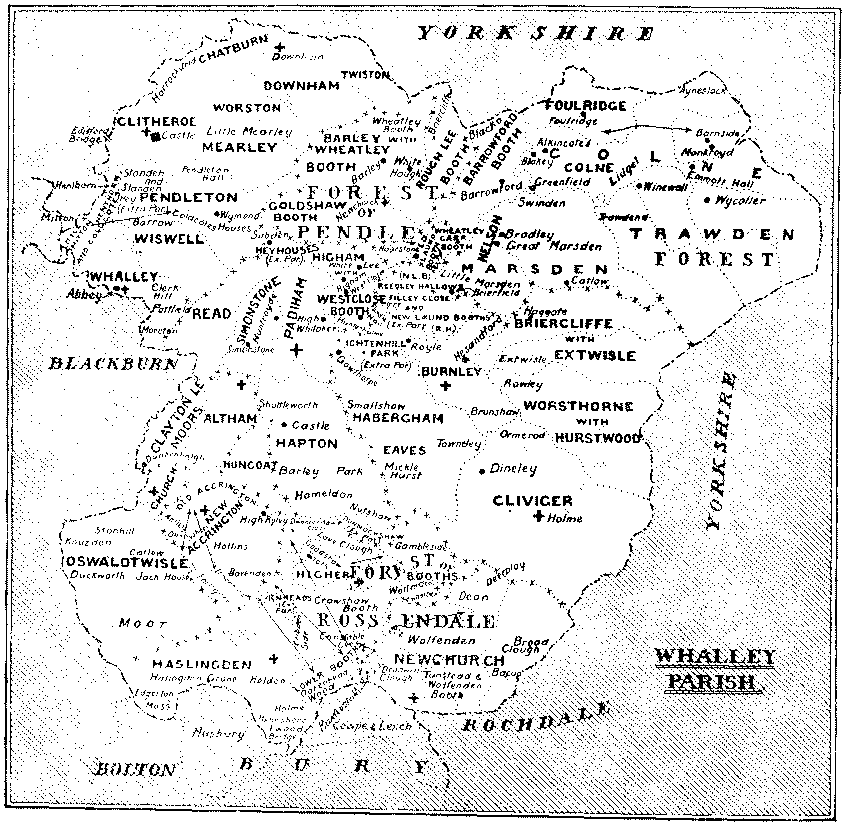
Index Map of Whalley Parish.
The ancient parish of Whalley had an area of 106, 395 acres, of which a small part lay in Yorkshire, as Bowland Forest. In Lancashire there were three considerable forest districts, Pendle, Trawden and Rossendale, all belonging to the honor of Clitheroe. Of the ancient history there is little to be said beyond what is connected with Clitheroe and the abbey of Whalley. There are a few prehistoric remains and traces of Roman roads from Ribchester through Clitheroe north-east and through Burnley southeast.
The sculptured crosses at Whalley and Burnley may point to English conquest during the 7th century, soon followed by conversion to Christianity and the erection of churches at those places. The first occurrence of the district in written history is in 798, when during Lent on 2 April a great battle was fought at Whalley in Northumbria, Alric son of Heardbert being slain and many more with him. (fn. 1)
Before the Conquest Whalley was the ecclesiastical head of the district, its church having a liberal endowment, and this superiority may have dated from the labours of the first missionaries. The 14thcentury tradition that the original parish extended across the Ribble is probably erroneous, for the later ecclesiastical boundaries of that district agree with Domesday Book in attaching it to Amounderness and York; and the connexion of Bowland and Leagram with Whalley parish, or rather with Clitheroe Chapel, is obviously artificial, being due to the secular lordship of the Lacys and their successors.
The chief centres of population in the earlier period are probably marked by the most ancient of the chapelries, Whalley, Clitheroe, Burnley and Colne; by 1296 Altham, Downham, Church and Haslingden had been added. A record of the boundaries in the time of Edward III has been preserved. (fn. 2) The numerous booths or vaccaries within the so-called forests ceased to be put to farm in 1507, when they were demised to the occupiers to hold by copy of court roll. As a result new villages sprang up at Goodshaw and elsewhere.
The district round Clitheroe was very disaffected to the religious changes made by Henry VIII, and the opposition called the Pilgrimage of Grace obtained considerable support. The Earl of Derby, in command of the county force, was at Whalley in November 1536 and wrote that he did not trust the people of the shire on the borders of Lancashire and Yorkshire, near Whalley and Sawley. (fn. 3) One of the proclamations of the Pilgrimage forbade aid to be given to the earl or to anyone not sworn for the Commonwealth and ordered all of sixteen years of age to be on Clitheroe Moor on the Monday after SS. Simon and Jude's Day (30 October). (fn. 4) A Chorley witness deposed that he had been told by adherents that 'the Commons were between that place and Whalley.' (fn. 5) The fate of the Abbot of Whalley for alleged assistance to the movement has been told elsewhere. (fn. 6)
The changes brought about by the destruction of Whalley Abbey and the Reformation are illustrated in the detailed accounts of the townships given below. Owing largely to the absence of feudal influences, the district appears to have become Puritan and in the Civil War sided against the king, the Nowells of Read forming the noteworthy exception. The Presbyterian Classis in 1646 was formed for the whole hundred, but half of the ministers and most of the lay members belonged to Whalley parish. After the Restoration Nonconformity appears, Independents, Baptists and Quakers being known, and in parts influential. The Revolution and the Jacobite insurrections do not seem to have caused any stir in the parish, but a great change has been wrought by the introduction of the cotton manufacture in the middle of the 18th century. One of the chief agents in its success was the inventor James Hargreaves, a native of Oswaldtwistle. A great part of the district is now occupied with the trade; Burnley and Accrington have become large towns, while entirely new towns have been created in Rawtenstall and Nelson.
Church
The church of ST. MARY (fn. 7) stands on the west side of the town, a short distance to the north-east of the abbey ruins, and consists of a chancel with north vestry, nave with north and south aisles, south porch, and west tower.
Although a church probably stood on the present site in Saxon times and was followed by a later 12thcentury building, evidences of which are found in various fragments still preserved and in the doorway of the south aisle, the history of the present building begins in the 13th century, to which period the greater part of it still belongs. The south doorway, belonging to the older building, is not in its original position, the jambs and arch may possibly not belong to each other; but it conclusively shows that the 12th-century church was a stone building of some importance. This is in accordance with the tradition that the old name of the place was 'White Church under Lea,' a 'white church' being one of stone. The whole, however, was rebuilt during the 13th century. The 12th-century church most likely consisted of a chancel and aisleless nave, and the new chancel would be built round the old one in the usual manner, after which the rebuilding of the nave would be proceeded with, an aisle being added first on one side and then on the other. There is enough difference of detail between the two arcades to show that one was done before the other, and probably that on the north side, which has circular piers, was built first, but of this there is no definite evidence. The building then assumed more or less of its present aspect with chancel and small north vestry, nave and aisles, and probably a clearstory. The bells would in all likelihood be hung in a turret over the west gable and there would probably be a large west window. The church as then completed seems to have stood without alteration till the latter half of the 15th century, when the triple lancet east window of the chancel was done away with and a new traceried window better suited to the display of painted glass was substituted. The aisles were at the same time transformed by the insertion of new windows all round, the roofs probably renewed and perhaps the walls raised, but there is no evidence in the masonry that the walls were entirely rebuilt, the character of the rubble walling rendering a positive pronouncement difficult. In any rebuilding, however, the old stones would doubtless be used again. The ground plan of the church therefore remained unchanged except at the west end, where a tower was added and the building assumed externally its present aspect. When the tower was built a new roof appears to have been put over the nave and the clearstory altered as the aisles had been. That the clearstory is not altogether an addition of the 15th century there seems to be proof in the mark of an earlier roof above the present one on the east face of the tower. The existing clearstory windows and the nave roof were evidently part of one work, and the roof has ruled the spacing of the windows, not the windows the setting out of the roof, and both of them are so nearly of the same date as the tower that it is impossible to suppose any earlier roof can have been put there after the tower was built unless it had chanced to be destroyed by fire as soon as it was built, of which there must have been some evidence. (fn. 8) The probability is that when the tower was built the 13th-century clearstory and roof still stood over the nave and the junction between them was made good in the usual way. After that it was determined to have a new roof and to alter the clearstory, the reason being that the early windows would be small—perhaps only round holes —and larger ones would be required for the sake of light after the building of the tower had taken away the direct light which formerly came from the west window. It is possible however that the clearstory may have been wholly rebuilt, though an examination of the walls would probably bring to light evidence of work older than the 15th century.
The church is therefore still in substance and plan that which was built in the 13th century with some alterations and the addition of a west tower made in early Tudor times. Since then the vestry has been enlarged, probably about the end of the 18th or beginning of the last century, and a south porch added in 1844, when a general internal refitting of the building took place. The chancel was restored in 1866, and in 1868 the old timber roof was laid open and repaired. (fn. 9) A great deal of alteration had taken place, however, in the interior during the 17th or 18th centuries, when galleries were erected and new seating introduced. A further restoration took place in 1909, when the north and south galleries were removed, the west gallery reconstructed, a north porch erected, the seating partly rearranged, and the tower arch opened out.
The chancel, the architectural detail of which is very good, is faced with rough rubble masonry both inside and out, the interior plaster having been stripped from the walls during one of the restorations. Its internal dimensions are 51 ft. 6 in. long by 24 ft. 6 in. wide and 33 ft. in height to the ridge of the roof. It is divided into three unequal bays externally on the south side by wide but slightly projecting buttresses with gabled heads, and has a stone slated roof with overhanging eaves. There are five lancet windows and a doorway on the south side and three similar windows in the western half of the north wall, the eastern end being occupied by the vestry. A string course runs round the chancel both inside and out at the level of the sills of the windows, being carried externally round the buttresses. The window openings are 18 in. wide, splaying out internally to 4 ft. 9 in., with a depth of 2 ft. 9 in. and with inner arches springing from corbels. The external label mould is carried along the wall as a string course at the line of the springing. The east window is of five lights with tracery under a pointed head and external hood mould, the mullions and tracery being apparently the original 15th-century work. The glass on which are painted the shields of arms of families and persons connected with the church was inserted in 1816. The sedilia are original under the second window from the east and now outside the sacrarium. They are triple, with pointed chamfered arches springing from circular shafts with moulded caps and bases, the whole under a square head. A stone slab ornamented with an incised cross and probably belonging to the earlier church forms part of the seats. The piscina and credence table are under the first window from the east, the bowl of the former being set at one side of a square opening 21 in. wide, the top of which is formed by the moulded string below the sill of the window. The credence has a trefoiled head with chamfered arrises and jambs. The south doorway is situated between the fourth and fifth windows from the east end and has a pointed chamfered arch springing from impost mouldings and with label over. The door is the original one of oak with very good iron scroll hinges and has what appears to have been a knocker. The knocker itself is wanting, but the head, probably a representation of the head of our Lord, remains.
The first 12 ft. of the north wall from the east is now occupied by a recess containing the monument to Dr. T. D. Whitaker, and immediately to the west of this is the doorway to the vestry with shoulder arched head. There has been a good deal of reconstruction of the wall and doorway where the Whitaker monument was erected and the vestry, which is of course modern, has no points of antiquarian interest, though its walls may incorporate some of the masonry of an older and smaller vestry on the same site.
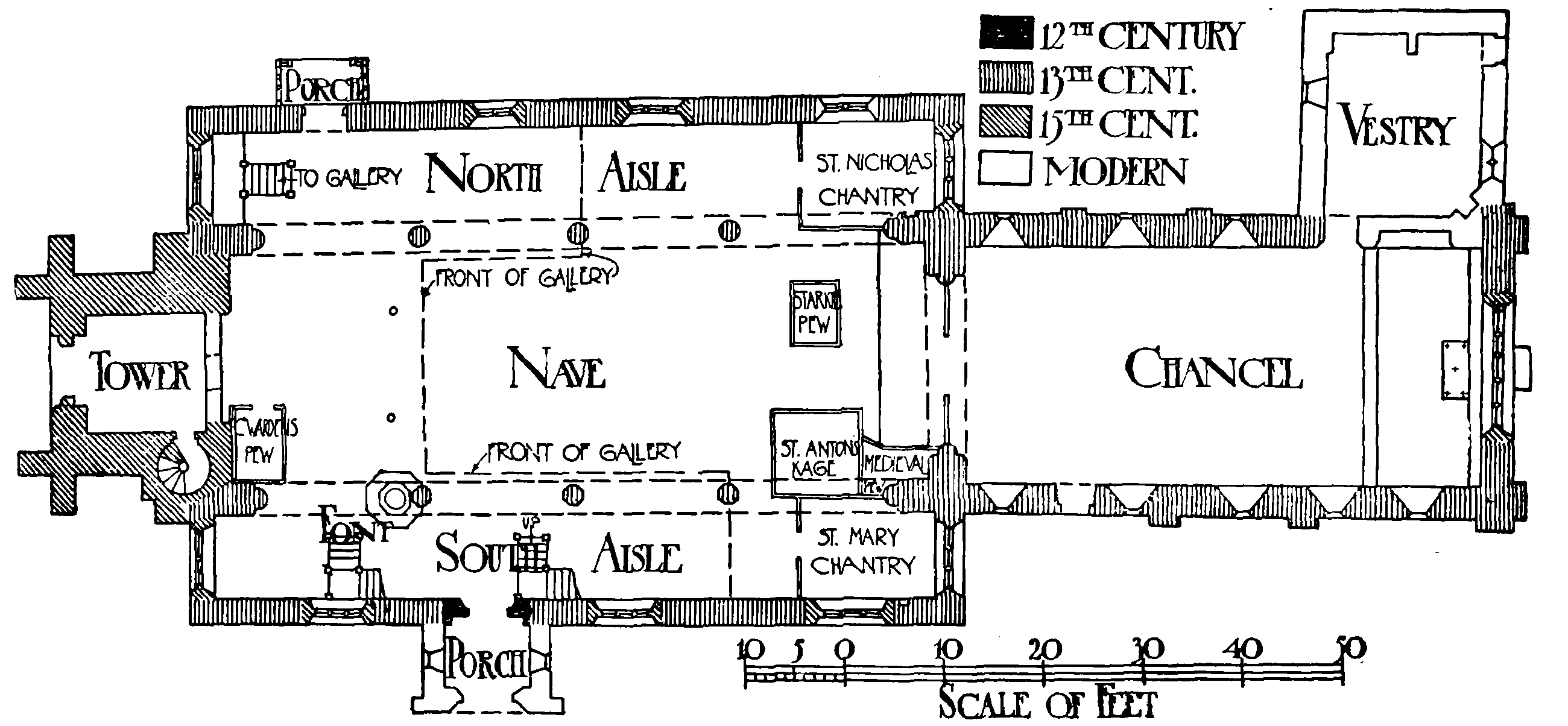
Plan of Whalley Church
The chancel roof is divided into five bays by six curved principals, one against each wall, and is probably substantially the old one, though restored and decorated and boarded between the spars. The original 13th-century appearance of the chancel, however, has been almost entirely lost, owing not only to the complete restoration of 1866, from which time the present arrangement of the sanctuary and stalls dates, but to the introduction of the stalls themselves, whose high canopies effectively hide any interior view of the lancet windows. The stalls are said to have come from Whalley Abbey Church and very probably did so, but there seems to be no record remaining of their being placed here. (fn. 10) They are now twenty-two in number, but were unfortunately taken to pieces and very much altered and mixed up with modern work in 1866. When Sir Stephen Glynne visited the church in 1859 he found the stalls 'not placed quite at the extreme west of the chancel' and returned at that end. (fn. 11) In the restoration, however, this arrangement, which was probably of the 17th rather than the 16th century, (fn. 12) was altered to that at present existing, with twelve stalls on the north side and ten on the south, the difference being occasioned by the interruption of the passageway to the south door. In the restoration a very lavish renewal of the old work was made, greatly to the prejudice of the value of the stalls as historical works of art. They remain, however, a very interesting and beautiful piece of work with elegant canopies carried on slender shafts and a series of misericorde carvings of more than ordinary interest. From the initials W.W. on the 'abbot's stall' it may be assumed that the work dates from the time of William Whalley, who was abbot from 1418 to 1434. The subjects of the misericorde carvings, reading from east to west, are as follows on the north side: (1, 2 and 3) flowers, modern; (4) man and two dogs pursuing animal with bird in mouth; (5) St. George and the Dragon; (6) two eagles tearing intestines of lamb; (7) prior's stall: satyr and woman, with inscription 'Penses molt et p(ar)les pou'; (8 and 9) foliage; (10) the Holy Trinity (three faces to one head); (11) oak, with sprays of flowers, and mouse; (12) warrior, with sword and buckler thrown down, kneeling before his wife, who is beating him with a frying-pan. On the south side: (1) angel, modern; (2) flying dragon carrying in its claws a swaddled infant; (3) shoeing the goose, with the inscription 'Who so melles hĠ of yt al mē dos let hĠ cū heir & shoe ye ghos'; (4) abbot's stall, vine and grapes with initials W.W. at either side and inscription 'Semp. gaudentes sint ista sede sedentes'; (5) face with plant growing out of mouth; (6) angel; (7) king's head, with scroll held by griffins; (8) pelican feeding young with its blood; (9) pomegranates between two sharp-beaked birds; (10) lion and winged dragon. The seats and book desks in front of the stalls are modern, as is the reredos, which extends the length of the east wall, but the altar piece, a picture of Christ in the garden, painted by James Northcote, was placed here in 1816. It was formerly in a gilt frame. Suspended from the chancel roof is a good brass 18th-century chandelier. The bishop's throne was erected in 1909.
The chancel arch is of two rounded orders, the inner one with fillet on the face springing from moulded imposts. The arch is set back from the face of the responds beneath, the wall diminishing in thickness above the imposts; the responds consist of a half-round attached shaft with fillet on the face.
The nave is 72 ft. long by 24 ft. wide and consists of four bays with north and south arcades of pointed arches of two chamfered orders and hood moulds over. The north arcade has circular columns 2 ft. 2 in. in diameter and half-round responds with fillet on the face, all with moulded caps and bases, 9 ft. 6 in. high to the springing of the arches. The south arcade has similar responds, but the piers are octagonal with moulded caps and bases. The walls above the arcade are plastered and the clearstory has four square-headed windows of two cinquefoiled lights on each side.
The north aisle, which is 9 ft. 6 in. wide, has three square-headed windows, the easternmost of which is modern, with a three-light pointed window at the east and one of two lights at the west end, and two dormer windows have been inserted in the roof in modern times. The east end of the aisle is occupied by the former chantry chapel of St. Nicholas inclosed by a 15th-century screen and retaining on its south side what appear to be the remains of a piscina, a shallow recess in the wall 8 in. wide and only 4 in. deep under a pointed head, but without bowl or drain. In the wall above are traces of the door giving access to the rood loft. (fn. 13) On the east wall placed in an upright position is the ancient altar stone, the five crosses on which are perfect, which was discovered buried beneath the floor when the chantry was repaired. (fn. 14) The chapel is now furnished with chairs, but was previously filled with square pews. The north doorway, to which a wooden porch was added in 1909, is small and plain with continuous moulded jambs and pointed head, the principal entrance to the church being by the south doorway, which, as already stated, is a late 12th-century fragment from the former building. It has a pointed arch of three orders, the two outer ones chamfered and the middle one moulded, springing from imposts and late Norman caps. The shafts and bases, however, are gone, though it is possible the latter may be covered up. The porch was added about 1844, (fn. 15) and is of stone with pointed arch and gable. The south aisle is 8 ft. 6 in. wide and lit by three square-headed three-light windows, a modern three-light pointed window at the east end, and a window of two lights with four-centred head at the west, the mullions and tracery of which are new. The east end of the aisle is occupied by the former chantry of St. Mary inclosed by a 15thcentury screen and now filled with square pews, but preserving its piscina, which has an ogee-shaped head, in the south wall. Externally the nave is architecturally uninteresting. The roof and those of the aisles have overhanging eaves and are covered with stone slates, and the walling as in the rest of the building is of rough rubble with angle quoins.
The tower, which is 12 ft. square inside and 70 ft. high, is very plain in detail, the stages being externally unmarked. On the north and south sides the walls are blank to the height of the belfry windows except for a small square-headed opening to the bell-ringing stage. There is a projecting vice in the south-east corner and square buttresses of eight stages finishing at a little more than half the total height. The belfry windows are of two trefoiled lights with tracery and hood moulds, splayed jambs and stone louvres. On the east side facing the town is a clock, the dial of which is partly in front of the belfry window. The tower terminates in an embattled parapet above a string course, and there is a good weathervane over the vice. The west door has a pointed arch and jambs of two hollowchamfered orders, with hood mould and a three-light pointed traceried window above with trefoiled heads to the lights, chamfered jambs and head and hood mould over. The tower arch is 10 ft. wide and of two chamfered orders, but is almost entirely hidden towards the nave by the organ. On the east wall of the tower, as already mentioned, is the line of a former roof of slightly higher pitch above the present one.
Apart from the 13th-century detail of the chancel and other parts of the building, the chief interest of the church lies in its woodwork and ancient furniture of many dates and styles. The quire stalls have already been described, but in addition to these, which are not really part of the original furniture of the church, there is other 15th-century woodwork in the chancel screen, the screens to the chantry chapels, and in the so-called 'mediaeval pew.' The chancel screen is a 15th-century rood screen of great value, and though there have been large renewals impairing to some extent the authenticity of the original work, enough remains to make it still of great interest. It appears to have been shortened at the bottom at the time of its restoration in 1864. (fn. 16) The screen has seven openings, each with cusped arches in the head, two to the middle wider opening, which is without doors. It once carried a loft which must have been of considerable size, as there was an altar in it. (fn. 17) The screens to the chantry chapels are of less interest, but, though much patched, retain a good deal of original work.
Although there are many scattered fragments there does not appear to be any pew work in place so old as the award of places by Sir John Towneley, of which Whitaker preserves the story, assigning it to the year 1534, but the four places allotted by him are still occupied by four very noteworthy pews. (fn. 18) The easternmost on the south side of the nave adjoining the reading desk, known as the 'mediaeval pew,' is a small low, irregularly shaped inclosure with oak door, the greater part of the work of which is mediaeval, but probably made up and added to in the 17th century. Whether it is in its original position or was only placed where it now stands at the time it was altered is uncertain. The date 1610, which occurs on the next pew to the west, probably gives the date of both, and the more ancient work which each contains probably once formed part of the former St. Anton's 'cage,' for which this is the most likely site. (fn. 19) The pew to the west of this, called 'St. Anton's cage,' is an extremely interesting piece of work measuring 9 ft. square. It is of many dates, several being recorded in the inscriptions, and its curious and highly ornamented Renaissance inclosing screen which is dated 1697 is a singularly late example of a 'cage.' (fn. 20) The pew formerly belonged to the manor of Read, and the first inscription, in Gothic characters, is 'Factum est per Rogerum Nowell, armigerum anno dm MoCCCCCoXXXoIIII.' This inscription is on the eastern side and taken in conjunction with Sir John Towneley's decision seems to imply that the original pew was made in accordance with it. (fn. 21) On the western side is another similar inscription, probably indicating an enlargement, 'Factum per Rogerum Nowell arm. MoCCCCCCoX.' On a carved panel on the north side is the date 1697 with the initials R.N.R. (Roger Nowell, Read), which is no doubt the year when the elaborate upper portion with its carved Renaissance top panels and cornice was added. The 'cage' has been a fruitful source of contention, originating in the dispute about sittings in 1534 which Sir John Towneley was called upon to decide, (fn. 22) and as late as 1800 the owners of Read and Moreton Halls quarrelling as to the ownership, recourse was had to law, when it was decided that the pew be divided into two portions. The division still remains and the two doors by which the cage is entered on the north side bear the initials I.F.R. (John Fort, Read) and I.T.M. (John Taylor, Moreton) and the date 1830.
Opposite 'St. Anton's cage' on the north side of the nave is the low 'Starkie pew' measuring 6 ft. 4 in. by 5 ft., a very fine example of Renaissance carving dated 1702, and with the initials W.R.S. Till 1909 it was closed in on the north and west sides by other pews, and much of its elaborate detail was thus lost. It now stands free, and a smaller pew, which stood immediately to the west and had a handsomely carved front dated 1644, has been removed. (fn. 23) It bore a small brass plate with the arms of Whitaker and the inscription 'Vicar's pew 1842,' but the real vicar's pew is at the west end of the south aisle.
There were also till 1909 four other square pews of later date and less interest on the north side of the nave, the first of which had a small portion of the upper part carved, the second was known as the churching pew, and the third had a brass plate recording that it belonged to the Whalleys of Clerk Hill. Some original old oak benches remain on the south side of the nave, the foremost of which, the seat appropriated to the use of the inmates of the almshouses, has at one end the arms of Adam Cottam and the words 'Alms Houses.' There were formerly a variety of small brass plates attached to the pews throughout the church with the names and dates of the proprietors, most of them belonging to the first half of the 19th but a few to the end of the 18th century. The nave and aisles were uniformly seated in 1909.
The churchwardens' pew formerly stood near the south door, but was removed to its present position under the gallery in the south-west corner of the nave about 1898. It measures 7 ft. 3 in. by 5 ft. and contains eight sittings assigned to the churchwardens who represented the eight townships chargeable with the repairs of the fabric. The pew is dated 1690 and on the panel behind each seat inside are the name of the township and the initials of the churchwardens at the time the pew was constructed. (fn. 24) The initials are repeated on two shields on the exterior. The churchwardens' staves of office are still attached to the seats.
At the west end of the north aisle, but at one time close to the churchwardens' pew, is the constable's seat, a pew measuring 5 ft. by 4 ft. 3 in., dated 1714. It was removed to its present position in 1909 from the west side of the south doorway, where it had stood since a previous removal.
The font stands on two raised steps in its original position, to the west of the third pier of the south arcade, near the south entrance. It is of yellow gritstone, octagonal in form, and probably of late 15th or early 16th-century date. The sides are plain, but have an embattled moulding at the bottom. There is a flat hinged wooden cover probably of 17thcentury date, but it seems to be of the old form, as shown by the marks on the west side of the bowl, indicating a lock by which the cover was fastened down. (fn. 25)
At the west end of the north aisle, near the gallery staircase, is a small stone font, which was formerly at Wiswell Hall and was brought here for preservation when the hall was pulled down in 1895.
The pulpit is modern.
The north and south galleries, removed in 1909, and the old west gallery were all works of the first half of the 19th century, but apparently a make-up from old materials, the best work in them being a panelled oak front and two staircases, which appeared to be of considerably older workmanship. (fn. 26) 'These parts may have belonged to an 18th-century western gallery in use before the organ was introduced, or they may have been brought with the organ from Lancaster.' (fn. 27) The west gallery, which was erected in 1812 to receive the organ, is 20 ft. in width, the front being in line with the third piers of the nave from the east. Since 1909 it has stood free at the ends within the line of the nave. The side galleries were carried in front of the piers, that on the north side, however, only occupying one bay of the nave beyond the west gallery, while that on the south occupied two, being in reality two separate galleries erected by the owners of Read and Moreton Halls, with separate staircases from the south aisle. The west gallery front is quite plain, and has the royal arms of George III on a painted board. The side galleries had good panelled fronts with classic entablature and cornice.
The organ was designed and built for Lancaster Church in 1729, where it remained till 1813, when it was presented to Whalley Church by Adam Cottam. It was improved in 1829 and again in 1865. The case is the original 18th-century one, and is a design of much merit.
The ancient monuments in the church are not numerous. The oldest is a grave slab, now used as a hearth in the vestry. It has a border of foliage and a mutilated inscription which has been deciphered as 'Qui me plasmasti tu . . . op sit ut exclusate.' (fn. 28) In the north aisle, close to St. Nicholas chantry, is the reputed gravestone of John Paslew, last Abbot of Whalley. It is a flat stone slab with an incised cross, the arms and head of which terminate in fleurs de lis, the intersection marked by a pointed quatrefoil. At the foot the initial I remains, but another letter has been obliterated. On either side the cross is the inscription 'I.H.S. fili Dei miserere mei,' and an incised chalice. The slab is now set up against the wall. At the west end of the south aisle is a stone marking the grave of Christopher Smith, last Prior of Whalley, who died in 1539. It bears his initials, X.S., with a cross fleury, chalice and paten.
Attached to the eastern respond of the north arcade in the St. Nicholas chantry is a small brass to the memory of Ralph Catterall, who died in 1515. It bears the figures of Catterall and his wife, the man in armour of the early Tudor period, kneeling at a prayer desk with nine sons behind him, and facing his wife, who kneels at another desk with eleven daughters. The inscription reads: 'Of yr charitie pray for the sowllys of Ralfe Catterall esquire, and Elizabeth, hys wyfe, whyche bodies lyeth Before this Pellor and for all ther Chylder sowlys whyche Rafe decesyd the xxvi day of deceber ye yere of our Lord God MoCCCCCoXVo, on whose sowlys Jhu. have mercy Amen.' (fn. 29) On the south wall of the south aisle is a brass to John Stonhewer of Barleyford, co. Chester, who died in 1653, and his wife Jane, with rhyming inscription; and in the north aisle, attached to the third pillar, is a brass to Richard Waddington of Bashall Eaves, who died in 1671, with a long Latin inscription. At the east end of the north aisle, in St. Nicholas chantry, is a stone monument to Thomas son of Thomas Braddyll, who died in 1672, aged ten, and further west a marble monument to various members of the family of Bradhull (or Braddyll) of Brockhall (1672–1748). Over the altar, but now hidden, is a brass with a Latin inscription to Stephen Gey (vicar 1663–93); and in addition to the monument to Dr. T. D. Whitaker, already mentioned, which consists of a recumbent figure, the chancel contains mural monuments to the Rev. Robert Nowell Whitaker (vicar 1840–81), Eliza wife of James Whalley of Clerk Hill (d. 1785), Sir James Whalley Smythe Gardiner, bart. (d. 1805), Alice Cottam (d. 1819), Thomas Brookes (d. 1831), and William Whalley Smythe Gardiner of Clerk Hill (d. 1860) and Eliza first wife of James Whalley. In the nave, high up on the south wall, is an 18thcentury classic stone monument to members of the Walsham family (1783–93), and on a pier to the south side a small stone tablet to Robert Hayhurst of Parkhead, who died in 1767. In St. Nicholas chantry is a brass to the Rev. Richard Noble, vicar 1822–40.
There is no ancient glass, but notes of four early 16th-century windows with the arms of Towneley, Nowell, Paslew and Catterall have been preserved. (fn. 30)
In a glazed oak case at the west end of the north aisle are three chained books: Jewell's Apology, printed in 1611 by John Norton, Foxe's Actes and Monuments (ed. 9, 1684), and the Book of Homilies, 1593.
There is a ring of six bells, by C. & G. Mears, 1855. These, however, were a recasting of six bells cast in 1741 by Edward Seller of York, out of four previously existing. From the inscriptions on the 18th-century peal, which have been preserved, it appears that one of the bells had been recast in 1823 by Thomas Mears, but all were injured by a fire in the tower in 1855 and recast the same year. (fn. 31) There is also in the belfry, though not included in the peal, an old Flemish bell, which was brought from Church Kirk about 1866, (fn. 32) with ornament and inscription, 'MARIA BEN IC VAN PETER VANDEN OHEIN GHEGOTEN INT IAER MCCCCCXXXVII.' (fn. 33)
The plate is all modern, and consists of an embossed flagon of 1828–9, 'The gift of Adam Cottam 1829,' and a set of two chalices, two patens, a credence paten and a flagon, presented in 1883 by Mr. Richard Thompson. Two chalices, 'The gift of James Whalley, esq., to the Parish Church of Whalley 1787,' and a paten of 1810 are now at St. Luke's Mission Church, Barrow. Five 17th-century pieces, of which a record remains, have unfortunately disappeared. (fn. 34)
The registers begin in 1538, and have the appearance of having been uniformly copied at one time either from an older register or from slips of parchment till about the middle of February 1600–1, after which date entries were made as they occurred. The first volume (1538–1601) has been printed by the Lancashire Parish Register Society. (fn. 35)
The churchyard is inclosed by a stone wall and iron railings, and has entrances on the north, east and west sides, the stone gateways of which were erected by Adam Cottam, (fn. 36) who died in 1838. Previous to this inclosure, the first steps towards which were made in 1818, it appears to have been open or surrounded at certain points by cottages. To the southwest of the tower was a building called The Hermitage, no vestige of which now exists, and the churchyard was traversed by three pathways, which were stopped as rights of way when the inclosure was made. There was an enlargement on the south side in 1871.
In the churchyard are some objects of great antiquarian interest, the chief being the three pre-Norman sculptured crosses standing on the south side of the church. They have been already described. (fn. 37) To the north of the tower is a sepulchral slab 6 ft. 6 in. long with an incised floreated cross of eight arms within a circle, on the south side a stone 7 ft. long with an incised four-armed cross. There are also a number of fragments of similar ancient stonework. In the angle between the south aisle and the tower is a stone coffin. The sundial, which stands on three square stone steps, is dated 1757. The oldest dated gravestone is of 1600. An early 19th-century stone records the death of a woman on 31 April, and an inscription to the memory of 'the principal innkeeper of the town,' who died in 1813, records that 'notwithstanding the temptations of that dangerous calling, he maintained good order in his house, kept the Sabbath Day holy, frequented the public worship with his family, induced his guests to do the same, and regularly partook of the Holy Communion.'
Advowson
In 1066 the church of Whalley had two plough-lands as an endowment, corresponding to the later township and manor of Whalley. (fn. 38) As at Blackburn the rectors, though presented by the lord of Blackburnshire, are related to have held by hereditary right. They were called deans; it is not said that they had any sort of ordination, but they could not have been in holy orders, for they sent priests to the bishop to be licensed to serve the cure. (fn. 39) The succession Robert, Henry (d. 1183), William, Geoffrey, Geoffrey, and Roger seems to be proved, though the kinship is not in each case known. (fn. 40) How long this system had continued is unknown, but it was stopped by the action of Innocent III in directing due observance of a canon of the Lateran Council of 1139. (fn. 41) Roger, the last of these deans, lived in continence and was ordained priest; wishing to please his kinsman, John de Lacy, lord of Clitheroe, he resigned his whole right in rectory and advowson to him, retaining the pastoral charge and a share of the revenue under the name of a vicarage. (fn. 42) John de Lacy then in 1235 presented his clerk, Peter de Chester, to the rectory. (fn. 43) This was no doubt done to record the title. In 1249, after Roger's death, Peter, who was provost of Beverley and had other benefices, reunited the vicarage with the rectory, thus enjoying the whole revenue. (fn. 44)
Henry de Lacy in 1284 gave the advowson of the church to the monks of Stanlaw, (fn. 45) and after Peter de Chester's death in 1294 the rectory was appropriated to them, (fn. 46) and they removed from their old house to Whalley, founding the great abbey which came to an abrupt end through the Pilgrimage of Grace in 1536. (fn. 47) The monks of Pontefract about 1300 put forward a claim to the church of Whalley on the ground of a donation to them by Hugh de la Val about 1121, a donation which was not confirmed by the Lacys when they regained possession. (fn. 48) In 1291 the value of the rectory was £66 13s. 4d., (fn. 49) and in 1341 the value of the ninth of sheaves, &c., was £68 7s. 10d. (fn. 50) In 1535 the rectory was valued at £91 6s. 8d. a year. (fn. 51) It remained in the hands of the Crown after the Suppression, (fn. 52) until in 1547 it was granted by exchange to the Archbishop of Canterbury. (fn. 53) From that time it was held by the archbishops until 1799, when it was sold to the farmers of the rectory, the advowson of the vicarage being reserved. (fn. 54) In 1846 the advowson also was sold, the Hulme Trustees purchasing it, (fn. 55) so that the recent vicars have been presented by them.
The first 'vicarage' was, as already stated, reunited to the rectory in 1249. The second was ordained in 1298 by the Bishop of Lichfield (fn. 56); the vicar was to have a dwelling house and 30 acres of land with various easements; also altarage. (fn. 57) This was changed in 1331 by a new ordination, whereby the vicar was to have 66 marks a year and certain allowances, being made responsible for the maintenance of divine worship in the parish church and the various chapels. (fn. 58) From about 1348 to the Suppression one of the monks was usually vicar. That was the year when the Black Death appeared, but the appointment of monks as vicars was due to quite another reason. (fn. 59) In 1535 he received £12 a year from the abbey, but various charges reduced his net income to £6 3s. 8d. (fn. 60) At some time after the rectory came into the possession of the Archbishops of Canterbury, (fn. 61) the farmer contracted to pay £38 a year to the vicar, who had also a house, and other sums to certain of the chapelries. (fn. 62) Archbishop Juxon in 1660 gave the Easter roll to the vicar and curates, but the latter were to pay £42 a year to the vicar, whose income was thus made £80 a year. (fn. 63) This was still the income in 1717 when eight townships contributed to the repairs of the parish church, viz.—Whalley, Wiswell, Read, Mitton, Pendleton, Simonstone, Padiham, and Hapton. (fn. 64) The value of the benefice was £137 a year in 1834, and is now given as £356 net. (fn. 65)
The following have been vicars:—
| Instituted | Name | Patron | Cause of Vacancy |
|---|---|---|---|
| 4 Oct. 1298 | John de Whalley (fn. 66) | Whalley Abbey | — |
| 3 May 1309 | Richard de Chadesden (fn. 67) | The Bishop | — |
| 27 Mar. 1311 | Richard de Swinesley (fn. 68) | Geoff. de Blaston | res. R. de Chadesden |
| oc. 1326 | ? John (fn. 69) | — | — |
| 7 Oct. 1330 | John de Topcliffe (fn. 70) | Whalley Abbey | — |
| — 1336 | William Wolf (fn. 71) | " | — |
| 19 Apr. 1342 | John de Topcliffe (fn. 72) | Whalley Abbey | d. W. Wolf |
| 20 Nov. 1348 | Bro. John de Walton (fn. 73) | " | — |
| 11 Oct. 1349 | Bro. Robert de Newton (fn. 74) | " | d. J. de Walton |
| 8 Dec. 1351 | Bro. William de Selby (fn. 75) | " | res. R. de Newton |
| 12 July 1379 | Bro. Robert de Normanville (fn. 76) | " | res. W. de Selby |
| 7 June 1381 | Bro. John de Tollerton (fn. 77) | " | res. R. de Normanville |
| 7 Nov. 1411 | Bro. John Sawley (fn. 78) | " | res. J. de Tollerton |
| 30 Oct. 1425 | Bro. Ralph Clitheroe (fn. 79) | " | d. J. Sawley |
| 29 Sept. 1453 | William Dinckley (fn. 80) | — | res. R. Clitheroe |
| 24 Nov. 1488 | Bro. John Seller (fn. 81) | Whalley Abbey | d. W. Dinckley |
| 15 Feb. 1534–5 | Bro. Robert Parish (fn. 82) | " | d. J. Seller |
| 2 Feb. 1536–7 | Edward Manchester, B.D., alias Pedley (fn. 83) | " | res. R. Parish |
| 8 Apr. 1559 | George Dobson (fn. 84) | The Queen | d. last vicar |
| 3 Oct. 1581 | Robert Osbaldeston, M.A. (fn. 85) | Archbp. of Canterbury | res. G. Dobson |
| 11 Aug. 1605 | Peter Ormerod, B.A. (fn. 86) | " | d. R. Osbaldeston |
| 24 Feb. 1631–2 | William Bourn, M.A. (fn. 87) | The King | d. P. Ormerod |
| Archbp. of Canterbury | |||
| oc. 1646 | William Walker, M.A. (fn. 88) | — | — |
| 19 May 1650 | William Moore (fn. 89) | Lord Protector | — |
| 11 Feb. 1663–4 | Stephen Gey, B.A. (fn. 90) | Archbp. of Canterbury | — |
| 13 Jan. 1693–4 | Richard White, M.A. (fn. 91) | " | d. S. Gey |
| 8 Dec. 1703 | James Matthews, B.A. (fn. 92) | " | d. R. White |
| 25 Sept. 1738 | William Johnson, M.A. (fn. 93) | " | d. J. Matthews |
| 2 July 1776 | Thomas Baldwin, LL.B. (fn. 94) | " | res. W. Johnson |
| 24 Jan. 1809 | Thomas Dunham Whitaker, LL.D. (fn. 95) | Archbp. of Canterbury | d. T. Baldwin |
| 11 Mar. 1822 | Richard Noble (fn. 96) | " | d. T. D. Whitaker |
| 1 Jan. 1840 | Robert Nowell Whitaker, M.A. (fn. 97) | " | d. R. Noble |
| 23 Nov. 1881 | Charles Collwyn Prichard, M.A. (fn. 98) | Hulme Trustees | d. R. N. Whitaker |
| — 1895 | Thomas Henry Gregory, M.A. (fn. 99) | " | res. C. C. Prichard |
| 6 Dec. 1904 | Richard Newman, M.A. (fn. 100) | " | d. T. H. Gregory |
After the church came into the hands of the monks they appointed secular priests as vicars, but soon found it advisable to have monks instead. It was necessary that the monk-vicar should have one or more of his brethren for company. This arrangement continued till the suppression of the abbey. From later depositions it appears that in addition to the (daily) masses at the high altar and the two side chapels a Jesus mass was said on Fridays in the rood loft. (fn. 101) Four priests would thus be required. At the visitation of 1548 the vicar (an ex-monk) and four other priests are named on the list as attached to the parish church, but these had been reduced to two by 1554 and in later times there was only one. (fn. 102) The destruction of the great abbey church and the dispersal of the monks must have caused a great difference in the arrangements for divine worship; the confiscation of the chantries and the further changes of the time completed the revolution.
George Dobson, appointed vicar in 1559, was one of the old clergy who conformed to the various changes of doctrine and worship. He took the oath of the queen's supremacy in religion in 1563. (fn. 103) Yet about the same time he was reported to be 'as ill a vicar as the worst,' (fn. 104) the censure referring partly to his morals, but chiefly to his disposition towards the reformed religion; light on both points is afforded by a complaint of 1575. The document is among the Consistory Court records at Chester. It states:
The vicar of Whalley is a common drunkard and such an ale-knight as the like is not in our parish; and in the night when most men be in bed at their rest then is he in the alehouse with a company like to himself, but not one of them can match him in ale-house tricks, for he will, when he cannot discern black from blue, dance with a full cup on his head, far passing all the rest—a comely sight for his profession.
Item, he doth teach in the church the seven sacraments, and persuadeth his parishioners that they shall come and receive, but in any case but to take it but as common bread and wine as they may take it at home or elsewhere, for that it is so, far differing from the word of God; and that this Church of England is a defiled and spotted church, and that no man may come to it lawfully in time of divine service except he at his coming in heart exempt himself from this service and all that is partaker of it, and make his prayer by himself according to the doctrine of the Pope of Rome.
Item, he hath been accustomed at every Easter to give, to certain of his parishioners, as he termeth them consecrated hosts, saying in them was salvation, but in the other was nothing worthy acceptance.
How much truth there was in the accusation cannot be determined. Dobson denied all the charges absolutely. To the first he said he had for thirty or forty years behaved 'as behoveth a man of his calling'; to the second he said that for ten years he had conformed exactly to the Book of Common Prayer according to the laws of the realm; and to the third, that he used no other consecration than that in the same book. (fn. 105) A few years later he was induced or compelled to resign, and his successor, as a nominee of Grindal, would no doubt be a sincere and thorough-going Calvinist. (fn. 106) In 1590 he was reported to be 'a preacher, but insufficient,' (fn. 107) and in 1601 it was presented that no surplice was provided for the minister, (fn. 108) so that the tendency of the place was manifest. On the other hand complaint was made about a rushbearing, with piping, in 1604. (fn. 109) Of the next incumbents practically nothing is known, but in the Commonwealth time it was judged best to appoint a preacher to visit the different churches and chapels for a few years, till suitable ministers could be provided. (fn. 110) After the Restoration Nonconformists and Quakers appear to have been numerous, and conventicles were reported to the Bishop of Chester. (fn. 111) The district immediately attached to the parish church has remained comparatively untouched by the manufactures which have caused great changes elsewhere, but one or two new churches have been built within it in recent times.
In December 1360 Henry Duke of Lancaster gave the monks Ramsgreave and other lands at Standen, &c., for the maintenance of a recluse or anchoress to live in a hermitage in the churchyard of Whalley. The recluse was to have two servants to wait on her, and a monk attended by a server was to sing mass daily in the chapel of her inclosure, the abbey providing all necessaries. The duke and his successors were to nominate the recluses. (fn. 112) The monks probably objected to the intrusion of women, particularly of the servants who waited on the recluse, and the recluses appear to have found their situation irksome, for several are said to have run away; and this course having been taken by Isold Heaton, widow, nominated by the king in 1437, the abbot and convent petitioned for relief. (fn. 113) It was therefore ordered that the endowment should be employed to maintain two chantry priests to say mass daily for the soul of Duke Henry and for the king. (fn. 114) The chapels on the south and north side of the church, called St. Mary's and St. Nicholas', respectively, were so used down to the Reformation. (fn. 115) St. Mary's chapel, as the abbey pew, was acquired by Ralph Assheton in 1593, but there were long disputes over it. (fn. 116)
In 1909 Whalley was chosen to give the title to an additional suffragan or assistant bishop for the diocese of Manchester, and the Rev. A. G. Rawstorne, rector of Croston, was appointed.
The grammar school probably originated with the monks. In 1548 a stipend of 20 marks a year was assigned to it by Edward VI out of the late abbey of Croxton's rectory of Tunstall. (fn. 117)
The charities of this large parish will be noticed in sections, according to the recent reports, under the several chapelries. (fn. 118)