A History of the County of Lancaster: Volume 6. Originally published by Victoria County History, London, 1911.
This free content was digitised by double rekeying. All rights reserved.
'Townships: Colne', in A History of the County of Lancaster: Volume 6, ed. William Farrer, J Brownbill (London, 1911), British History Online https://www.british-history.ac.uk/vch/lancs/vol6/pp522-536 [accessed 30 April 2025].
'Townships: Colne', in A History of the County of Lancaster: Volume 6. Edited by William Farrer, J Brownbill (London, 1911), British History Online, accessed April 30, 2025, https://www.british-history.ac.uk/vch/lancs/vol6/pp522-536.
"Townships: Colne". A History of the County of Lancaster: Volume 6. Ed. William Farrer, J Brownbill (London, 1911), British History Online. Web. 30 April 2025. https://www.british-history.ac.uk/vch/lancs/vol6/pp522-536.
In this section
COLNE
Calna, 1230; Kaun, 1241; Caune, 1251; Colne, 1311.
The chapelry of Colne embraces the townships of Colne, Marsden and Foulridge, Barrowford Booth in Pendle, and Trawden.
The main portion of Colne township lies on the north side of the stream here called Colne Water, (fn. 1) flowing west to join Pendle Water, a tributary of the Calder. The older part of the town of Colne occupies a central position on a ridge of ground 600 ft. above the sea, about a quarter of a mile north of the river, on the banks of which is the part called Waterside, with a bridge—no doubt the bridge mentioned in the Court Roll of 1323. The township has two large moorland projections; one, north-east between the two portions of Foulridge, extends to the county border and includes the elevation called Piked Edge, 1,165 ft.; the other, a hillside tract eastward between Barnside and Trawden, also extends to the county border as Emmott Moor, having the Laneshaw, the principal affluent of Colne Water, on the north, and rising to 1,430 ft. at the Wolf Stones in the south-eastern corner. North of the town the surface descends, the brook across which is Vivary Bridge (fn. 2) flowing down the hollow, and then rises again, a long ridge, which may be described as an extension of Piked Edge, reaching to the western boundary, where the ground falls away steeply to form the clough down which flows Wanless Water south to join Colne Water. This ridge at one point attains 728 ft. above sea level. North of it, in the lower ground, are the large Foulridge reservoirs for the service of the Leeds and Liverpool Canal. The area of the township is 4,635 acres, and its population in 1901 numbered 19,055. The present extended township contains 5,063 acres, (fn. 3) and has a population of 23,000.
At the western end of the township are Greenfield, in the corner between Colne and Wanless Waters; Alkincotes, on the end of the central ridge, with Holt House to the east and Heir's House and Blakey Hall on lower ground to the west. North, near the reservoir, is Hob Stones. North of the town of Colne is Langroyd; to the east of it are Lidgett, Standroyd and Heyroyd, Flass and Salter Syke; to the south-east, beyond Colne Water, is Carry Heys. Further to the east is the hamlet of Laneshaw Bridge, beyond which is Emmott Hall. To the north-east of Piked Edge are Black Lane End and Ayneslack, in the extreme corner.
The principal road is that from Burnley through Nelson; it enters the township at Primet Bridge, to the east of Greenfield and below rising ground now called Bunker's Hill; thence it goes eastward past the house known as Colne Hall (fn. 4) and through the town, where it is called Market Street, and is crossed by roads leading north to Foulridge and south by Waterside to Marsden. The eastward road is continued into Yorkshire by Laneshaw Bridge through Wycoller and through Barnside; it has branches also north-east by Lidgett and south-east to Trawden. On the east side of the town the Skipton road leads north. There are numerous minor roads and several bridges in addition to those mentioned. (fn. 5) The Accrington and Colne branch of the Lancashire and Yorkshire Railway Company (fn. 6) has a station at the west end of the town near Primet Bridge, and the line continues north, as part of the Midland Railway, to Skipton. (fn. 7) The Leeds and Liverpool Canal also crosses the west end of the township beyond Wanless Water. The Colne Light Railway connects with the Nelson and Burnley electric tramway system.
There are a number of cotton manufactories, fancy goods being made here; there are also some iron foundries and works for the manufacture of looms and mill furnishings, a brewery and brick works. Coal was formerly mined. (fn. 8) The agricultural land is almost entirely in pasture, there being 3,676 acres in permanent grass, 36 acres of woods and plantations, and 24½ acres of arable.
The annual wake was formerly held on 24 August. The present market days are Wednesday and Saturday, special cattle markets being held on the last Wednesday of each month. The fair days are the second Wednesdays of March, May and October. (fn. 9) These are of recent institution, as will be seen by the account of the town and neighbourhood given in 1795:
It is a small market-town, the market on Wednesdays. The trade formerly consisted in woollen and worsted goods, particularly shalloons, calamancoes, and tammies; but the cotton trade is of late introduced, the articles consisting chiefly of calicoes and dimities. There is an elegant Cloth Hall—or Piece Hall, as it is here called—where goods are sold during the ringing of a bell, fines being levied on sales after the stated time. Much money is turned in this town, in proportion to its size, it being situated on the edge of the district of Craven, where cattle for slaughter are procured for a large surrounding country. Colne stands only a mile from the course of the Leeds Canal, at a part where a subterraneous tunnel [Foulridge] is to be carried at vast expense through a quick sand. The country about Colne is hilly, and the town is seated upon coal, with stone beneath, and slate for building. Lime is plentiful four miles on the Skipton road. Roman coins have been found at Colne, but there are no other marks of its being a Roman station. (fn. 10)
The Cloth Hall mentioned was erected by subscription in 1775. It is now used for public meetings and dramatic performances.
There are around Colne numerous remains of the ancient inhabitants of the district, (fn. 11) and the name of the place has led local antiquaries to suppose that it was a Roman colony or to identify it with the Colunio recorded by the Ravenna geographer. (fn. 12) The history of the place is quite obscure, but it may have been an independent parish in 1120, as mentioned below. It had a church and school; market and fair were instituted (fn. 13); and one of the halmote courts of the honor of Clitheroe was held there. During the Civil War there is some slight notice of the district; the Parliament's forces were in 1643 stationed at Emmott Lane Head to check the Yorkshire Cavaliers, (fn. 14) and in 1644 there were skirmishes at Haggate and Colne. That at the latter place on 25 June went in favour of the Royalists, who under Sir Charles Lucas defeated the Parliamentarians under Col. Shuttleworth. (fn. 15) Somewhat later the Society of Friends gained many members here. The woollen manufacture was long the chief industry of the town, and afterwards the cotton trade; the introduction of machinery here as in other towns led to opposition and disturbance, as in 1819 and 1826. (fn. 16) In 1840 there was a conflict between local Chartists and the police. (fn. 17)
Two newspapers are published weekly, the Times and the Observer.
The market cross was removed in 1823 to allow room for coach traffic. (fn. 18) This cross has been restored and re-erected on another site in the Free Library grounds. The Tom Crosses were on the boundary. By the wayside near Emmott Hall there was in 1806 'a perfect cross with the ciphers IHS and M, half obliterated, upon the capital. . . . A very copious spring, in an adjoining field, now an excellent cold bath, is called the Hullown, i.e. the Hallown or Saints' Well.' (fn. 19) The cross is still standing.
The chapelry in 1626 was by the County Lay expected to contribute £8 0s. 1¾d. towards a levy of £100 upon the whole hundred; the different parts contributed thus: Colne, £2 3s. 10¾d.; Marsden, £2 6s. 2d.; Foulridge, £1 18s. 2¾d.; and Trawden Forest, £1 11s. 10¼d. (fn. 20)
Manors
The manor of COLNE was one of the members of the honor of Clitheroe. Several Lacy charters are dated at Colne, pointing to the occasional residence there of the lords of Clitheroe and Pontefract. In 1241 it was worth £14 5s. 9d. a year, while Alkincotes was worth 19s. 4d. to the chief lord. (fn. 21) The place was included in the grant of free warren made to Edmund de Lacy in 1251. (fn. 22) In 1296 the farm of Colne and its members amounted to £22 11s. 8d.; the mills of Colne and Walverden produced £12 16s., and the fulling mill at Colne 33s. 4½d.; fines, perquisites of the halmote and the merchets of two women added 74s. 10d.; there were other profits from Trawden. (fn. 23) The inquest of 1311 shows that Henry de Lacy had a chief messuage in Colne; 551 acres of land demised to tenants at will at 4d. an acre; 10½ oxgangs of land held in bondage and rendering 31s. 6d. a year, each oxgang paying 4d. in addition for works remitted; also 14 tofts worth 7s. a year. The mills at Colne and Walverden were worth £5 clear, and the fulling mill, 6s. 8d.; the halmote of Colne and Walverden with its members 20s. a year. There were seven free tenants. (fn. 24) The accounts for 1323–4 show a net receipt of £41 15s. 9½d. from Colne and its members. (fn. 25) The extent of the manor of the same year shows various changes. The mines of coal were worth 3s. for a smith, and the ore smithies when set to farm were worth £8 13s. 4d. The Thistletake had ceased to be of value. (fn. 26) Some later details may be given. In 1446–7 a lease of two mills in Colne for thirty years was granted to James Banastre and Robert his son at a rent of 61s. 6d. a year (fn. 27); and in 1495 John Towneley of Towneley received a lease of them on being compelled to stop his new mill at Walverden. (fn. 28) The rental of 1527 gives a list of tenants with their rents (fn. 29); the corn mill and the walk mill, paying £2 13s. 4d. and 13s. 4d. respectively, were held by Henry Townley in succession to Lawrence Towneley. (fn. 30)
In 1592 the queen ordered Sir Richard Shireburne and others to survey the boundaries between the moors and wastes of her manor of Colne and adjoining manors, and to inquire about inclosures and proposed inclosures; evidence was taken accordingly and bounds defined. (fn. 31) Another survey was made in 1605, and bounds were set between the manors of Colne and Ickornshaw. (fn. 32)
A demise of the manors of Colne, &c., was made to Edward Allen and another by Charles I in 1625. (fn. 33) It seems to have come into the possession of Henry Doughty of Thornley in Chipping, for in 1641 the manor and various copyhold lands in Colne were assigned to secure the dowry of Elizabeth Callis, who married Henry's son John. (fn. 34) The Doughtys were Royalists and their estates were sequestered and forfeited. (fn. 35) Hence, apparently, the sale of the manor to William Sykes, a Leeds merchant. This sale is said to have been nullified at the Restoration. (fn. 36) The manor was then and afterwards included in the Clitheroe honor conferred on General Monk and held by his descendants, but Colne Hall remained with the Doughtys, and so descended through the Patten heiress to the Earls of Derby, (fn. 37) who continued to own it till recently. The house with some land was sold to the late Mr. Thomas Shaw, who sold the house and grounds to the Colne Co-operative Society. The Earl of Derby still remains one of the principal landowners.
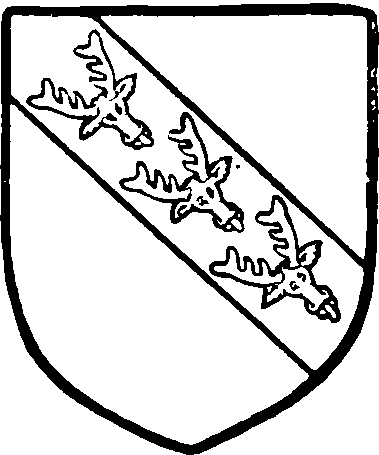
Stanley, Earl of Derby. Argent on a bend azure three stags' heads caboshed or.
A rental of 1662 is preserved in one of Christopher Towneley's MSS. (fn. 38) The land remains largely copyhold, the courts being held regularly by the lords of the honor of Clitheroe. The manor now includes Trawden, with Emmott and Carr or Carry Heys, formerly in the Forest of Trawden. The Court Rolls are complete from 1507, and there are a few earlier ones. (fn. 39) The pinfold is mentioned in 1425 (fn. 40); the stocks were wanting in 1509. (fn. 41) A large number of field-names and minor place-names occur in the rolls. (fn. 42)
ALKINCOTES (fn. 43) was sometimes regarded as a separate vill. There were several freehold estates in it. John de Lacy gave 22 acres in the vill to the Hospitallers, (fn. 44) and this land was in 1540 held by the heir of John Parker at a rent of 12d. (fn. 45) In 1311 there were four other estates there held by charter, viz. 32 acres held by Richard son of Adam de Alkincotes by 10s. 8d. rent; 7 acres by William son of Adam de Alkincotes by 3s. 6d.; 23 acres by Adam son of Peter de Alkincotes by 7s. 8d.; and 20 acres by Richard son of Adam Ayre by 20d. rent. (fn. 46) The first of these was in 1342 held by John the Parker in virtue of a grant by Henry de Lacy to Adam son of Richard de Alkincotes. (fn. 47) The second was a grant by Adam de Alkincotes to his son William. (fn. 48) The third was held by James de Walton in 1323, and may have been in Marsden. (fn. 49) The fourth appears to be the tenement known as Heir's House.
The Parkers were the chief family at Alkincotes, and had several branches. (fn. 50) Bernard Parker died in 1608 holding a messuage in Alkincotes of the king as duke in socage. (fn. 51) His son and heir, also named Bernard, then thirty years of age, in 1611 sold to Daniel Barnard, (fn. 52) who in 1631 paid £10 as composition for declining knighthood. (fn. 53) It was afterwards acquired by the Parkers of Browsholme, and occupied by Robert Parker (d. 1714), a younger son of Thomas Parker, and his descendant J. Parker was there in 1801. (fn. 54) It is now the property of Colonel John William Robinson Parker.
ALKINCOTES, standing on high ground in a park-like inclosure to the west of Colne, is an interesting house of three stories, built of dressed gritstone apparently in the latter half of the 16th century, but considerably altered in the 18th, and added to in later times. The principal front, which faces south, is about 64 ft. in length, and is distinguished by a central projecting porch carried up the full height of the building and by five picturesque and equally spaced stone gables surmounted by finials. The upper part of the building retains all its Elizabethan characteristics, the original four-light mullioned windows with the two centre lights raised, the stepped hood moulds and the boldly projecting gargoyles being still in position in the gables, but the front of the house appears to have been wholly refaced below in the 18th century, when all the mullioned windows were apparently removed, the present plain tall sash windows inserted and the porch remodelled in the classic fashion of the time. The windows retain their thick wood bars, and the effect of the whole, though exceedingly plain and unrelieved by string course or moulding except in the top story and the porch, is nevertheless one of dignity and some picturesqueness. The end walls, which are of rough stone, show the old built-up windows, but later sash windows have been inserted also. The roofs are covered with stone slates. The north-east wing is also of three stories and of the same date and character as the main building, to which it is connected by a lower two-story structure, the upper part of which appears to have been rebuilt at the same time the changes took place in the front. On the ground floor the old mullioned and transomed windows remain, and a stone in the upper part of the wall has the initials TPA (Parker) and the date 1720, which probably gives the year when the house was remodelled. A west wing was added in the early part of the 19th century and has many of the characteristics of the revived Gothic of the period, though that portion which is seen from the south carries out the design of the front in all its details. The interior has been wholly modernized and is without interest except for a good collection of Elizabethan oak furniture removed hither from Browsholme. (fn. 55) On the lawn is a quaint 17th-century octagonal sundial which bears the names of 'Christopher Trueman, generosus,' and John Dixon on the shaft, and a date which is difficult to decipher. (fn. 56)

Parker of Alkincotes. Vert a cheveron between three stags' heads caboshed or.
HOLT HOUSE was also a Parker estate, and in 1548 Lawrence Parker made a settlement of various messuages in Colne, with remainders to his son Henry and grandson Lawrence. (fn. 57) Henry Parker in 1551 sold the same to Ralph Greenacre. (fn. 58) There followed considerable disputing, (fn. 59) but the Parkers appear to have regained Holt House, Henry Parker, who died in 1617, holding it of the king as duke in socage; his heir was his grandson Alexander (son of Henry) Parker, aged sixteen. (fn. 60) Hob Stones was in 1513 held by the family of Hargreaves, John Hargreaves in that year succeeding his father Richard. (fn. 61) Soon afterwards it was acquired by the Parkers of Alkincotes. (fn. 62)
HEIR'S HOUSE was no doubt the land, meadow, buildings, &c., in Alkincotes which were granted to Richard de Marsden, clerk, by Richard son of Adam le Hayr in 1312, together with the reversion of the dower of his mother Agnes. (fn. 63) The new possessor in 1314 gave them to Robert his son, (fn. 64) and in 1318 Robert son of Richard de Marsden summoned Richard de Marsden to warrant a messuage in Colne to him. (fn. 65) The estate descended in this family till the 17th century, (fn. 66) when Edward Marsden (fn. 67) of Heir's House gave it to his natural son Richard Marsden alias Robinson, who gave the same with his natural daughter Jane in marriage with Richard Burton of Preston, stationer, in possession in 1658. (fn. 68) About 1875 Heir's House was the property of Mr. T. T. England, who also owned the following estate. It is now the property of Mr. Rennie Knight. (fn. 69)
BLAKEY HALL may have derived its name from one of the families who owned it, for Blakey, or the Blake Hey, appears to have been within Pendle Forest, where the family had lands. (fn. 70) Simon de Blakey was tenant of part of Barrowford in 1323, (fn. 71) and in 1331 he obtained from the king a grant of Blakey in fee; he had paid 11s. 5d. rent for it as tenant at will, and was to pay 5s. more as freeholder. (fn. 72) He died in 1349, and his lands, described as in Colne, were still in the king's hands in 1361, (fn. 73) probably through the minority of his son and heir Geoffrey, who held in Colne by 16s. 5d. rent, and obtained a pardon in 1362. (fn. 74) The line can be traced down to 1634, (fn. 75) when Simon Blakey and Nicholas his brother confirmed to the above-named Edward Marsden the capital messuage of Blakey, &c. (fn. 76) The Blakeys were recusants, and the fines for religion are said to have been the chief cause of their fall. (fn. 77) There are numerous references to the Blakeys of Colne in the Court Rolls. (fn. 78)
GREENFIELD was reputed to be a manor. (fn. 79) It was at one time held by a Banastre family. In 1457 Agnes Banastre of York, as widow of John Banastre, claimed dower from John's son John in her husband's estate in Colne, Great Marsden and elsewhere. The son objected, because she had deliberately procured a divorce from bed and board by acting as sponsor at confirmation to one of her children by the said John Banastre. (fn. 80) The estate seems to have descended to another John Banastre in 1507. (fn. 81) In or before 1518 an award was made concerning all the lands, &c., which had belonged to John Banastre of the Greenfield and the reversion of those held for life by Lawrence Towneley; and William Banastre of Aldcliffe became bound for the observance of the same to Sir John Towneley and George Hoghton. (fn. 82) This George Hoghton, no doubt in right of his wife, appears to have entered on possession of Greenfield. (fn. 83) Nicholas son and heir of Richard Townley acquired the estate in 1541, (fn. 84) and thus it descended to the Townleys of Royle. (fn. 85) Edmund Townley, the son of Nicholas, died in 1598 holding the manor of Greenfield, with various lands in Colne, Marsden and Trawden, of the queen by knight's service and a rent of 40s. 10d. (fn. 86) The estate continued in the same ownership as Royle down to 1816, when R. Townley Parker sold it to Jonathan Dickinson. It was afterwards owned by Mr. Catlow. The farm called Stanroyd or Standroyd formed part of the estate, (fn. 87) but in 1538 Standroyd Hall was owned by the Rushworths. (fn. 88)
Heyroyd and Moss House were owned by Thomas son and heir of John Driver in 1524. (fn. 89) The former has long been in the possession of the ancestors of the present owner, Mr. Richard Sager. Lands called Burwens (fn. 90) were the inheritance of Christopher Lister, who was in 1509 succeeded by his son William. (fn. 91) The estate was afterwards sold in part at least to the Townleys of Barnside, (fn. 92) and so descended to the Claytons of Carr Hall. (fn. 93) Mrs. Anderton is the present owner. The Mitchell family occurs frequently in the records. (fn. 94)
John Hartley of LANGROYD was a plaintiff in 1540. (fn. 95) The estate is now the property of Mr. Edward Carr. Langroyd House is a picturesque two-story stone building about three-quarters of a mile to the north of Colne, of simple design, the chief feature being a boldly projecting two-story gabled porch in the middle of the south or principal front. In the spandrels of the doorway, which has a four-centred arched head, is the date 1605—probably the year of erection. The house, however, has been a good deal restored and modernized, especially internally, the windows having probably all been enlarged in the 18th century. The original front measures only about 42 ft. in length, but at a later date a new wing, with gable 20 ft. wide, facing south, has been added at the east end, slightly projecting in front of the main wall. On each side of the gabled porch the roofs, which are covered with modern green slates, have overhanging eaves with gables facing east and west. Additions were made again at the east end in 1900, and at the back in 1909, during the progress of which latter work two old chimney openings were discovered and opened out. In a panel over the porch are the arms of Carr, a modern insertion taking the place of an older panel, the original moulded border of which remains.
The Vivers or Vivary was shared by the Walker and other families. (fn. 96) Mr. Harold Smith is the owner of Nether Heys. The names of owners of land appear also in the Subsidy Rolls. (fn. 97)
EMMOTT (fn. 98) probably represents the 10 acres in Colne held by Robert de Emmott in 1311 by a rent of 3s. 4d. (fn. 99) An estate of 10 acres in Emmott was in 1440 granted by John Wollo of Kildwick to Maud widow of Thomas Radcliffe; all the grantor's lands in the parish of Colne and chase of Trawden were included. (fn. 100) The descent of the estate cannot be traced for lack of evidence, but the surname was not uncommon in the district. (fn. 101) The estate called Emmott Hall descended to two brothers, William and John Emmott, the former of whom died in 1725 and the latter in 1746, (fn. 102) but a younger brother, Christopher, a London merchant, had been obliged to repurchase it. It went to a nephew, Richard Wainhouse, who took the name of Emmott, and his granddaughter Harriet Susanna Ross having married George Green, (fn. 103) their son, after succeeding to this estate, took the additional name of Emmott in 1851. The hall is now the property of his son, Mr. Walter Egerton John GreenEmmott. (fn. 104)
EMMOTT HALL stands on high ground 2½ miles east of Colne near the junction of the River Laneshaw with the Hullown Beck, the front facing south towards the Wycoller Valley. The house, which is built of stone and has stone slated roofs, is apparently of 17thcentury date (fn. 105) and of the usual type with central hall and projecting gabled end wings, but in the first half of the 18th century the whole of the middle part was refronted and other alterations carried out entirely changing its appearance. The building is of two stories and the end wings retain their original balled gables, though the windows have been modernized and sashes and later casements substituted for the old mullioned openings. Between the end wings the 18th-century work remains unaltered and is a fine and dignified classic composition, the middle part emphasized by four Ionic pilasters rising from the ground the full height of the two stories and carrying an entablature with cushioned frieze, surmounted by a parapet with large urn ornaments, the middle one of which bears the Emmott arms. The windows, which retain their original wood bars, have moulded architraves, those to the first floor having in addition pedimented heads. The junction of the classic front with the lower side gables is effected by a boldly stepped and curved parapet, the whole forming a very good specimen of late Renaissance work of a type not frequently met with in this part of the county. Over the two outer windows and below the cornice are the initials C. I. E. and the date 1737, probably the year when the new front was erected, but some work appears to have been done ten years earlier, as on an ornamental spout head on the return of the east wing is the date 1727 together with the Emmott crest. The doorway is centrally placed and has an open stone porch supported by small Ionic pillars and pilasters. The older 17th-century work in the wings is built with small roughly-coursed stones, but the later work is faced with large squared blocks of gritstone. The interior of the house preserves some of the 17thcentury panelling and a good staircase on the north side with twisted balusters. There is a modern wing at the east end.

Emmot. Per pale azure and sable a fesse engrailed ermine between three bulls' heads caboshed or.
The fine 18th-century stone gate-piers and iron gates now at the south-east side of the house were originally erected to the left of the carriage drive in front of the hall, but were removed to their present position in 1841, when the road was altered and the grounds in front of the house were rearranged by the banking up with soil of the rocky surface and by the erection of a retaining wall to the road.
Emmott Moor and Carry Heys were parts of Trawden Forest. In 1507 the former, which had paid nothing, (fn. 106) was demised to Lawrence Townley and Ralph Askew for £1 rent. They sold twothirds to Thomas Emmott in 1508 (fn. 107) and the other third to Alice Hanson and John Hanson in 1509 (fn. 108); but, though Thomas Emmott paid the whole rent in 1527, John Emmott paid two-thirds and John Hanson one-third in 1609, and William Emmott and William Hanson the same shares in 1662. John Hanson of Emmott died in 1612 holding a messuage there of the king as duke by the twohundredth part of a knight's fee. His son and heir William was twenty years of age. (fn. 109)
Carry Heys was held by John Rushworth in 1527 by a rent of 20s. 6d.; in 1662 James Folds, James Hargreaves and the heirs of Robert Hargreaves paid 20s. net, while the fee farm of Nicholas Townley of Royle for old rent there was 13s. 2d., and for new improvement 15s. 11d. (fn. 110)
The abbey of Whalley had a barn and a few acres of land at Colne, occupied by John Mitchell in 1538. (fn. 111)
The following in 1524 contributed to the subsidy for lands:—Thomas Emmott, Leonard Blakey, Richard Blakey, John Rishworth. (fn. 112) In 1543 John Rishworth, 'squyer,' Lawrence Parker, John Hartley, Robert Blakey and Thomas Driver. (fn. 113) In 1564 Robert Blakey, Thomas Emmott, Bernard Parker and Edward Marsden. (fn. 114) In 1597 Thomas Emmott, Thomas Rishworth, Bernard Parker, Henry Parker, Edward Marsden, Henry Shaw, John Hargreaves, James Paley and Nicholas Mitchell. (fn. 115) In 1626 John Emmott, Daniel Barnard, Henry Shaw, Alexander Parker, Edward Marsden, Robert Hargreaves, Nicholas Mitchell, Geoffrey Shakleton and Simon Bulcock. A number of convicted recusants are entered on this list. (fn. 116)
The hearth tax return for 1666 shows that there were in Colne town 170 hearths liable to the tax and 134 in the rest of the township. In the town the principal houses were those of Robert Trueman with eleven hearths, Margaret Emmott and Joseph Shakleton eight each, Francis Robinson seven, Mrs. Cunliffe six, James Hargreaves, Greenfield, William Greene the younger and John Huitt five each. Outside Robert Hammond had fifteen hearths to be taxed, Christopher Smith and Christopher Trueman seven each, John Hargreaves and Henry Shaw six each, John Bankes, William Emmott and Miles Tilltes five each. (fn. 117) The hearth tax return of 1673 also shows a considerable number of houses in Colne with four hearths and more; the only occupiers entitled 'Mr.' were Robert Hamond, John Hargreaves and (Robert ?) Trewman. (fn. 118)
Borough
A local board was formed for COLNE in 1875, the district including the northern part of Marsden. (fn. 119) In 1894 this district was constituted the township of Colne, (fn. 120) and the board became an urban district council. In the following year a charter of incorporation was granted, (fn. 121) the council consisting of a mayor, six aldermen and eighteen councillors. The borough is divided into six wards: Central, Horsfield, Vivary Bridge, Primet Bridge, Carry Bridge and Laneshaw Bridge. The town hall was opened in 1894. Waterworks were established in 1806, (fn. 122) the source of supply being at Flass; the undertaking was acquired by the local board in 1881. (fn. 123) Gas-works, erected in 1838 by a company, were also taken over by the local board in 1877. (fn. 124) A commission of the peace was granted to the borough in 1898. There is a voluntary fire brigade. The cemetery, opened in 1860, is controlled by the corporation. An isolation hospital has been established. The Jubilee Cottage Hospital, erected in 1900 by Sir W. P. Hartley, is supported by voluntary contributions. There is a public library, given by Mr. Carnegie. The old Free Trade Hall has become the Theatre Royal.
Church
The church of ST. BARTHOLOMEW (fn. 125) stands in a commanding position (fn. 126) near to the summit of the hill on which the town is situated, on the north side of the main street, and consists of chancel with north and south aisles or chapels, together with vestries, and organ chamber forming a kind of transept beyond the north aisle, nave with double north and single south aisle, south porch and west tower.
The earliest part of the building is the north arcade of the nave, which dates from the end of the 12th or beginning of the 13th century, and forms the only remaining part of a transitional church consisting of chancel and nave with north aisle, the dimensions of which would be, approximately, chancel 25 ft. by 18 ft. and nave as at present. No evidence of its western termination or whether there was a south aisle can be deduced from the plan, but it probably ended in a western gable and was aisleless on the south side. No doubt the building passed through the usual processes of enlargement and alteration during the next two centuries, but there is little positive evidence of this in the structure itself till the beginning of the 16th century, when the church having probably become dilapidated the people determined upon its repair and restoration. The greater part of the building belongs to this date, but a fragment of 14th-century work remains at the east end of the north side of the chancel in a narrow doorway opening into the north aisle, which shows that in the 14th century the chancel was of the same extent as at present, and had an aisle its full length on the north side, the door, as may be seen by the reveals, never having been an external one. In the last restoration, when the east wall of the north chancel aisle was pulled down, the masonry was found to be very largely of 14th-century date and contained fragments of a window of the same period, (fn. 127) so that it may be assumed that the chancel (fn. 128) at least of the early church had been rebuilt in the 14th century, at which date probably the plan would assume more or less of its present form. The lower part of the tower may belong to this period, though it bears little external evidence of a date earlier than the 16th-century building.
There was apparently an almost complete reconstruction of the church (fn. 129) early in the 16th century, for to that period the greater part of the present building belongs, including the chancel, nave, with the south aisles of each, south porch and west tower. Some work was probably carried out in the 17th century, the porch, if not rebuilt, having been most likely then repaired, and in the 18th century the interior appears to have been filled with square pews and to have assumed more or less the appearance which it held till about fifty years ago. In 1733 a gallery was erected at the west end, and the easternmost window of the south nave aisle was rebuilt, (fn. 130) and in 1765 a flat plaster ceiling was erected. In 1815 the middle pier of the north arcade of the nave gave way and had to be taken down and rebuilt. (fn. 131) This occasioned so considerable a declension of the other piers that they had to be underpinned and a new base of strong masonry built up from the rock below. (fn. 132) The church was at that time pronounced to be insecure and unsightly, and its demolition and the erection of a new building were demanded by a strong party among the parishioners, who actually attacked the fabric while the restoration was in progress. (fn. 133) In the following year, 1816, the Banastre chapel on the north side of the chancel was repaired, but otherwise nothing seems to have been done to the building till 1856–7, when a further and more extensive restoration took place. The west gallery, which contained the organ, was then taken down, the flat ceiling removed, exposing the original 16thcentury roof, the tower arch opened out and various repairs done to the tower, including the forming of the ringing chamber and clock room. The nave was reseated with modern seats, but the square pews were allowed to remain in the chancel and chancel aisles. The chief work, however, consisted in the pulling down and rebuilding of the north aisle of the nave, which was increased in width from 13 ft. to 25 ft. and covered with a high gabled roof. This new aisle, which was in a very plain Gothic style with four tall two-light pointed windows in the north wall, was in its turn pulled down in 1889, together with that on the north side of the chancel, and the present double nave aisle, with organ chamber and vestries eastward, was erected. (fn. 134)
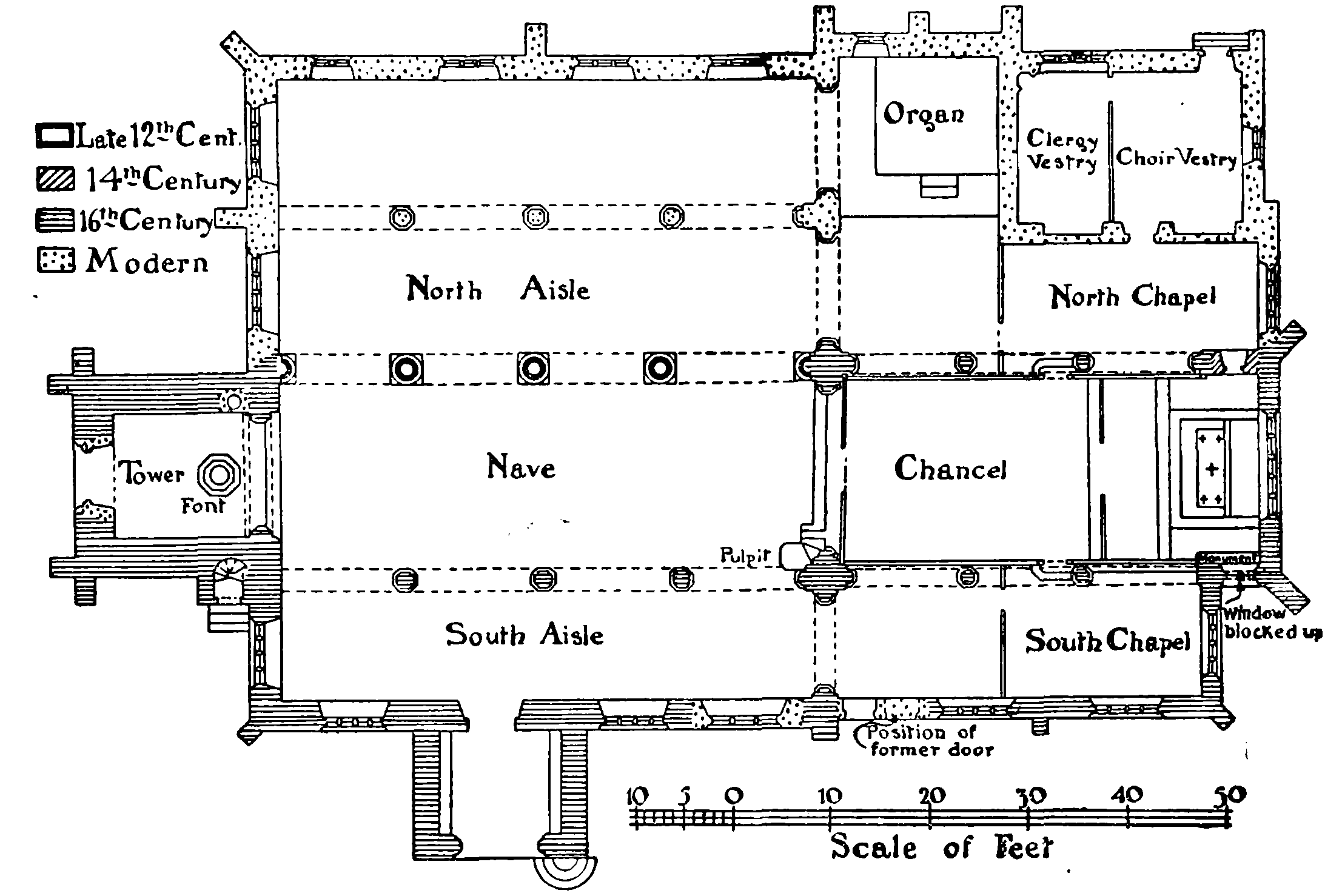
Plan of Colne Church
The church is built of wrought stone, which has been renewed in places; but the lower part of the east wall of the chancel is of very rough masonry, being constructed with round and unshaped stones and without plinth. The roofs are covered with stone slates and have overhanging eaves, except to the porch and the south nave aisle, and the work is generally of a very plain description.
The chancel is 42 ft. 9 in. long by 20 ft. 9 in. in width, and is lit at the east end by a modern fivelight pointed window in 15th-century style, with cinquefoiled heads to the lights and tracery over. The roof, which is slightly lower than that of the nave, is also modern and divided into five bays by moulded oak principals plastered between. On each side is an arcade of three pointed arches of two chamfered orders springing from octagonal piers and responds, (fn. 135) 18 in. in diameter, with moulded caps and bases. The chancel floor has been raised above that of the aisles and is now level with the tops of the bases, the mouldings of which on the south side are plainer in detail than those on the north. Above the arcade on each side are three square-headed, widely-spaced clearstory windows, each of three round-headed lights, the westernmost of which on the north side is now below the modern high gabled roof of the new organ chamber transept. The chancel arch, which is of two continuous chamfered orders with moulded base, showed signs of giving way in 1815 and was then restored. Eastward of the arcades is a length of straight wall 6 ft. long, that on the north side containing the 14th-century doorway already mentioned, with splayed jambs, now used as a seat, the difference of level resulting from the raising of the chancel floor rendering its use as a door no longer possible. On the south side is a two-light window, now built up and hidden on the inside by a monument, but visible from the exterior. The chancel is inclosed on all three sides by modern oak screens. The north aisle, the eastern end of which is the Banastre chapel, is modern and structurally without antiquarian interest, the walls having been entirely rebuilt and vestries added on the north side. The area, however, remains the same, the east wall having been originally, as now, in line with that of the chancel, the diagonal buttress at this point being probably built only to balance that on the south side. (fn. 136) Originally the aisle, which is 11 ft. wide, had two windows of three and four lights respectively on the north side, and prior to 1889 there was a small vestry at the east end approached by the 14th-century doorway, with a window on the north side and a fireplace on the east. There is now a modern four-light traceried window at the east end. The south aisle is also 11 ft. wide, but the east wall sets back from that of the chancel 6 ft., and the east end is occupied by the Barnside chapel, formerly belonging to the Townleys of Barnside. The chapel, as well as that on the north side, is divided from the rest of the aisle at the west end by an oak screen, and is 20 ft. in length. (fn. 137) The screens are the original 16th-century ones restored, with Gothic tracery in the heads of the openings, and the sills and top rails carved with vine pattern or traceried ornament. The south aisle is lit by an original square-headed four-light window at the east end, and on the south has two windows of similar design, the mullions of which have been renewed, and a modern door at the west end. (fn. 138) The walls of the chancel and aisles, as also those of the nave and rest of the church, are plastered, and the chancel aisles are separated from those of the nave by stone arches of two continuous chamfered orders.
The nave, which is flagged, is 55 ft. by 19 ft., and has an arcade of four bays on each side with pointed arches of two plain chamfered orders. The north arcade is supported by circular piers 2 ft. 5 in. in diameter, with moulded bases and capitals, 7 ft. 2 in. high to the springing of the arches, and at the ends by responds of similar character. The piers on the south side are 8 ft. high, and have octagonal shafts 20 in. in diameter, with moulded bases and capitals, the arch springing at the east end from a similar respond and at the west dying into the wall. The clearstory consists of four three-light square-headed windows on each side, unequally spaced, and with pointed heads to the lights; and the roof, which is modern or the 16th-century one almost wholly restored, is divided into six bays by two main principals and three intermediate ones plastered between, with half-principals against the end walls.
The new north inner aisle is the same width (13 ft.) as the original 16th-century one, and is lit at the west end by a four-light pointed window; and the outer aisle, which is separated from it by an arcade of four pointed arches on octagonal piers, is of the same width, the outer wall being 3 ft. in front of the former wall of the wide north aisle built in 1856. It is lit by four traceried windows with segmental heads on the north side, and a pointed window of four lights at the west end similar to that of the inner aisle. The east end is open to the organ chamber under a pointed arch, and the two aisles have separate gabled roofs.
The south aisle, which has a lean-to roof, preserves most of its 16th-century features, and is lit at the west end by a four-light square-headed window, with two other windows at the eastern end of the south wall. That furthest east is the window which in 1862 replaced the one erected in 1733, but which in its turn has given place to a new window of three lights, with transom and plain tracery, in the last restoration. The wall at the east end of the aisle was raised at an early period, and is roofed with a gable which gives it externally the effect of a small transept. West of this is an original four-light square-headed window, and beyond this again, but 18 ft. from the west wall, the south doorway, which has a pointed head, with moulded jambs and external hood mould ending in carved heads. The door is modern. The porch is 12 ft. 6 in. by 10 ft. 6 in., and has a stone seat on each side, but is without side windows. The outer opening has a pointed arch with two plain chamfered orders, imposts and chamfered jambs. In the gable is a plain niche, and, in the place of a finial, there is a square stone sundial, with a gnomon on three sides, raised on a short pedestal. In the apex of the gable are a number of initials, probably those of the churchwardens at the time when the porch was erected or rebuilt, together with the name 'John Dison, August.' (fn. 139) The outer archway is now open to the churchyard, but had formerly wooden gates about 6 ft. high. Against the front wall on the east side are three semicircular stone steps.
The tower is 12 ft. 9 in. square inside and 62 ft. high. It has a projecting vice with external door in the south-east corner, and square buttresses of four stages at the western angles stopping below the belfry windows. There is a moulded plinth, but otherwise the exterior is very plain. The belfry windows are pointed and of three lights, with transoms and tracery in the heads, the openings and hood moulds alone being ancient. The original mullions and tracery were removed at the beginning of the 19th century, when new bells were hung and wood louvres were substituted, the present mullions dating only from the last restoration. The walls terminate in an embattled parapet, with gargoyles below the string on the north and south sides. The west door has a pointed head with hood mould and continuous double hollow-chamfered head and jambs stopped at the base, the inner order being new; and above is a pointed three-light window with traceried head and external hood mould. The lights are cinquefoiled, and the head has a sunk chamfer dying into plain splayed jambs. On either side of the window are two shields, all four of which are indecipherable or blank, and above is a small window to the ringing chamber. On the vice are two other shields, one above the other, the lower one defaced, and the other supposed to be the arms of Lee, or Legh. (fn. 140) The clock was placed in the tower in 1811, and faces east and west high up on the south side of the belfry windows, and there is a good 18th-century weather vane. The arch is lofty and open to the church, and consists of two continuous chamfered orders running to the ground.
The font, which now stands under the tower, (fn. 141) has an octagonal basin on a clustered shaft with hollowed sides, each containing a shield. It is of early 16th-century date, and was given to the church by Lawrence Townley of Barnside, whose initials and arms occur on three of the shields. The remaining sides have the sacred monogram and the implements of the Passion.
In the Banastre chapel, or north chancel aisle, now attached to the wall, are preserved three pieces of oak which originally formed part of one of the beams which supported the roof, on which is an inscription in raised letters:—
Quesumus in celo precibus succurrere mundo.
Hac recitare via debes Letare Maria Laruas interitu diluit ilia manu.
Hyrd genitrix Xristi Wilelmum deprecor audi Ne superet mors me virgo parens retine. (fn. 142)
In the south chancel aisle is a sepulchral slab 5 in. thick, 6 ft. long and 2 ft. wide, at the top slightly tapering, with bevelled edge and floreated cross and sword. (fn. 143)
The organ is first mentioned in 1815, and stood till 1829 in a gallery at the east end, supported by the chancel screen. In that year it was removed to the west gallery, the eastern one being pulled down. A new organ was opened in 1857 at the west end of the new north aisle, which position it occupied till the erection of the present organ chamber in 1889.
The pulpit, which dates from 1891, is of oak on a stone base, and all the seating is modern.
There is no ancient stained glass.
When the west gallery was removed in 1856 fragments of a wall painting were found beneath the whitewash above the western arch of the north arcade, half the head and part of the body of a man in red colouring being visible. (fn. 144)
There are mural monuments to William Emmott (d. 1660), with a rhyming epitaph made by himself; to the Rev. John Horrocks, incumbent (d. 1669), with a long Latin inscription; and to Edward Parker of Alkincotes (d. 1805), who is buried at Waddington. A brass to George Hartley (d. 1670) has a quaint rhyming inscription, and another brass marks the place of burial of Christopher Jackson (d. 1695), 'Actor homo, Coelum Spectator, grande Theatrum Mundus, Vita frequens Fabula, Scena Dies.'
There is a ring of eight bells. Six were cast by Thomas Mears of London in 1814, and two trebles, the gift of Thomas Hyde of Colne, were added in 1900, in which year all the bells were restored and rehung. (fn. 145)
The plate (fn. 146) consists of two chalices of 1790, with maker's mark I. L.; a flagon of 1774–5, originally given to Mr. John Turner of Hob Stones, on the completion of the Cloth Hall by the shareholders, in recognition of his superintendence of the erection of the building, and afterwards given by him to the church. The flagon, which is 14 in. high, is inscribed, 'I cloath the naked,' with a sheep feeding below, and the words, 'The free gift of the Proprietors of the Piece Hall in Coln to Mr. John Turner of that Town, Surgeon, in gratitude to Him for his unwearied attendance and daily instructions to the workmen who where engaged in carrying on that Work, and which was begun and finished under his care and sole direction in the year 1776. Further given by the sd John Turner for perpetual Use of the Communion Service of the Church in Coln 1790.' There is also a paten of Sheffield make 1853, inscribed 'Presented by the principal members of the Congregation of the Church of Colne 1854. John Henderson, incumbent,' and an electro-plated credence paten.
The registers (fn. 147) begin in 1599, and are continuous to the present time except that the marriage register is wanting from February 1644 to June 1654. The churchwardens' accounts (fn. 148) begin in 1703. The seating arrangements were settled in 1576 by John Towneley of Towneley, head steward of Blackburnshire, with the consent of the wardens and inhabitants. (fn. 149) Another order was made in 1635 by commissioners appointed by the Bishop of Chester. In 'the rank between mid alley and south alley' occur allotments of 'the third form adjoining to the pulpit and great pillar,' next 'the double form on the west side of the great pillar and adjoining to the pulpit,' and then 'the fifth through next beneath the pulpit.' (fn. 150)
The churchyard lies principally on the south side of the building and is partly planted and covered with flat gravestones. Previous to 1820 it had neither gates nor railings, and was used as the playground of the town, but it is now inclosed by a stone wall with gates at the south and south-east. The oldest dated stone is 1606. The cross in the churchyard remained undefaced in 1622, and was finally removed in 1728. (fn. 151)
Advowson
The 'church' of Colne is named in the gift of Whalley to Pontefract Priory about 1121 by Hugh de Laval. (fn. 152) By the time the monks of Stanlaw received possession of Whalley Rectory Colne had become a chapel only, and in 1296 the tithes of its chapelry were worth £20 13s. 4d. a year, the altarage £10 and the land 7s. Out of this there was a customary payment of 4 marks to the chaplain. (fn. 153) This stipend seems to have been increased, as in other cases, to £4. (fn. 154) This was paid after the Reformation, when the rectory had been transferred to the Archbishop of Canterbury, but was increased to £11 10s. In 1650 the minister of Colne received this stipend from the farmer of the rectory and £28 10s. from the Royalist sequestrations. (fn. 155) At the end of that year the allowance was increased to £50. (fn. 156) This would cease at the Restoration, but private benefactions and a share of the fees had raised the stipend to £30 by 1717. (fn. 157) Large additions have been made, and the net value of the benefice, which is styled a rectory, (fn. 158) is now £425 a year. (fn. 159)
The vicars of Whalley used to nominate to this as to the other curacies, but the advowson was in 1847 acquired by the Hulme Trustees. The following have been incumbents (fn. 160) :—
| c. 1525 | John Hitchen (fn. 161) |
| c. 1545 | John Fielden (fn. 162) |
| 1563 | Roger Blakey (fn. 163) |
| oc. 1596 | Lawrence Ambler (fn. 164) |
| 1599 | Richard Brierley (fn. 165) |
| 1636 | Thomas Warriner (fn. 166) |
| 1645 | John Horrocks, M.A. (fn. 167) |
| 1669 | James Hargreaves, B.A. (fn. 168) |
| 1694 | Thomas Tatham (fn. 169) |
| 1706 | John Barlow, B.A. (fn. 170) |
| 1727 | Henry Smalley, B.A. |
| 1732 | William Norcross (fn. 171) |
| 1741 | George White (fn. 172) |
| 1751 | Roger Wilson, LL.B. (fn. 173) |
| 1789 | John Hartley, B.A. (fn. 174) |
| 1811 | Thomas Thoresby Whitaker, M.A. (fn. 175) (University Coll., Oxf.) |
| 1817 | Philip Abbott (fn. 176) |
| 1821 | John Henderson (fn. 177) |
| 1876 | William Clifford, M.A. (Brasenose Coll.,Oxf.) |
| 1908 | Stephen Peachey Duval, M.A. (fn. 178) (Brasenose Coll., Oxf.) |
Though there were two side chapels to the quire— that on the north belonging to the Banastres of Park Hill and that of St. Sithe (fn. 179) on the south to the Townleys of Barnside (fn. 180) —there was no endowed chantry, but the Edwardine commissioners seized bells and 'ornaments' worth 27s. 6d. (fn. 181) The visitation list of 1548 shows five priests resident at Colne; there were four in 1554, and two, Fielden and Blakey, in 1562 and 1563. (fn. 182) The latter then remained sole curate, and one minister was thenceforward considered sufficient for the chapelry till recent times. The careers of some of the incumbents have details of interest, such as those of Warriner and Horrocks in the Civil War period. The visitation returns also give some particulars, (fn. 183) particularly as to the recusants and Nonconformists in the chapelry. At the beginning of the 18th century service was performed every Sunday twice a day, except one afternoon in the month, when the curate officiated at Marsden. (fn. 184) The most exciting episodes in the religious history of the town relate to the opposition to Methodism about 1748. (fn. 185) Wesley wrote in 1752: 'There have been no tumults since Mr. White was removed. He was for some years a Popish priest. Then he called himself a Protestant and had the living of Colne. It was his manner first to hire, then to head the mob, when he and they were tolerably drunk. But he drank himself, first into gaol and then into his grave.' (fn. 186) A great contrast to this man was the first rector, the Rev. J. Henderson, who held the benefice for fifty-five years, and retired amid the respect of all classes, the Nonconformists included. An additional church was built in his time in the eastern part of the township in 1836; it is called Christ Church, (fn. 187) and the Hulme Trustees have the patronage. The school at Laneshaw Bridge is also used for service.
As above stated Methodism early made its appearance in Colne. The first chapel was built in Colne Lane in 1777, and Wesley preached there soon after it was opened. (fn. 188) A famous preacher of later times was William Dawson, a Yorkshire man, who died at Colne in 1841. (fn. 189) Chapels were afterwards built at Laneshaw Bridge, 1822–58; Burnley Road (Albert Road), 1825; Collingwood Street, 1882, and Black Lane End; and there is a mission room at Stone Bridge. The Primitive Methodists have two chapels; one of them, named Ebenezer, was built by the New Connexion in 1811. The Methodist Free Church also has a chapel, called Mount Zion.
The Inghamites or Old Independents appeared about 1743; they have now two chapels in the town. (fn. 190)
The Congregationalists began services in 1807, and used the Cloth Hall till a chapel was built in 1811. (fn. 191) This chapel was used till 1879; it has since been pulled down. The present church was built 1877–9 and renovated in 1901.
The Baptists had been known in the town from the beginning of the 18th century. (fn. 192) The history of Zion Chapel begins in 1769; the founder, John Stuttard, ministered there for nearly fifty years. (fn. 193) The church, now known as Trinity, was rebuilt in 1883. A second chapel has been opened.
The Unitarians have a chapel (1876). There are also two Free Gospel Halls, a Free Christian Church and Bethel Chapel. The members of the Society of Friends were formerly numerous in the chapelry, but their meeting-place is in Marsden. (fn. 194)
The names of a number of convicted recusants appear in the time of Charles I, but there is little other evidence to prove the permanence of the Roman Catholic religion. (fn. 195) Mass was publicly said in 1850 for the first time after the Reformation in an upper room of the Angel Inn; the priest had usually to be guarded by a policeman, and after a time the service ceased. In 1872 a resident priest began to minister, a room over a shop being used; the school-chapel of the Sacred Heart was opened in 1888, and the present church in 1897.
A grammar school existed in 1558, when it had 4 marks rent as endowment. (fn. 196) Archbishop Tillotson is said to have been a scholar there about 1640. In 1687 the school received a gift of £40 to provide £2 a year for the education of four poor children. Further endowments were obtained, but the school languished, and in 1887 came to an end. (fn. 197) The income, over £30 a year, is employed in giving exhibitions at the municipal day school, under a scheme made in 1898. The free school at Laneshaw Bridge was founded by John Emmott and others in 1783.
Charities
Inquiries were made into the charities of the chapelry in 1826 and 1899, and the following details are taken from the report issued in 1900. The endowments for education amount to £149 a year; there are none for ecclesiastical purposes or almshouses; but about £28 is available for the poor. A number of charities have been lost. (fn. 198)
For Colne chapelry Alice Hartley in 1600 gave £60 for the poor, and a rent-charge of £3 10s., known as the Spead Dole, now represents it. (fn. 199) It is distributed in money doles. Lord's Ing Dole, represented by a rent of £5 a year on land covered by the Foulridge reservoir of the canal, was in existence in 1671, a meadow called Lord's Ing having been given to the poor. It is managed like Hartley's charity. Other ancient benefactions by Ambrose Walton, £40, and William Rycroft, £50, were augmented and applied in 1724 to the purchase of land at Dowshay Clough which now produces £16 a year. It is given in small sums to poor persons in the townships within the chapelry. Mary Anderton, widow, in 1876 left £100 for a distribution of bread every Sabbath day by the rector and churchwardens. The rector (Mr. Clifford) refused to accept a trust which required a Sunday distribution, and thus the interest, £4 3s. a year, has been left to accumulate in the bank. The rector stated that the charity would be more useful if a distribution of flour were allowed, because most of the inhabitants baked their own bread.