A History of the County of Lancaster: Volume 7. Originally published by Victoria County History, London, 1912.
This free content was digitised by double rekeying. All rights reserved.
'The parish of Ribchester', in A History of the County of Lancaster: Volume 7, ed. William Farrer, J Brownbill (London, 1912), British History Online https://www.british-history.ac.uk/vch/lancs/vol7/pp36-44 [accessed 30 April 2025].
'The parish of Ribchester', in A History of the County of Lancaster: Volume 7. Edited by William Farrer, J Brownbill (London, 1912), British History Online, accessed April 30, 2025, https://www.british-history.ac.uk/vch/lancs/vol7/pp36-44.
"The parish of Ribchester". A History of the County of Lancaster: Volume 7. Ed. William Farrer, J Brownbill (London, 1912), British History Online. Web. 30 April 2025. https://www.british-history.ac.uk/vch/lancs/vol7/pp36-44.
In this section
RIBCHESTER
Ribchester; Dilworth; Dutton; Alston with Hothersall
Ribchester proper, together with Dutton and Dilworth, is in the hundred of Blackburn, but the remaining township is in Amounderness. The area of the whole, including Stidd, is 8,437 acres, and the population in 1901 was 5,912.
The history of the town goes back to Roman times, numerous vestiges of its former occupation still remaining. (fn. 1) Camden says that the inhabitants used the following proverb in his time (fn. 2) :—
It is written upon a wall in Rome,
'Ribchester was as rich as any town in Christendom.
Before the Conquest the whole formed part of Earl Tottig's Preston fee, and was within the hundred of Amounderness. During the 12th century one part seems to have been included in the honor of Clitheroe, and thus Ribchester, Dilworth and Dutton became transferred to Blackburn Hundred, the other townships, Alston and Hothersall, remaining in Amounderness. (fn. 3) Ecclesiastically there was no change; the parish was in the diocese of York, archdeaconry of Richmond and deanery of Amounderness.
The mediaeval history is obscure (fn. 4); the resident lords and landowners are scarcely known. Leland about 1540 made the following notes: 'Ribchester is a seven miles above Preston on the further ripe of Ribble as Preston is. Ribchester is now a poor thing; it hath been an ancient town. Great squared stones, vaults, and antique coins be found there: and there is a place where that the people fable that the Jews had a temple.' (fn. 5) The Reformation left traces in the prosecution of recusants, some of the gentry and a large portion of the yeomanry remaining faithful to the Roman Catholic religion. (fn. 6) Thomas Cottam, a native of the parish, was executed for his priesthood in 1582. Though the Civil War passed over with few sequestrations, the Jacobite rising of 1715 received much support. Thomas Hothersall of Hothersall was outlawed for his part in it, as were Robert Daniell and another; while Jonathan Winckley and Thomas Shuttleworth, both of Alston, were executed.
In more recent times the parish has remained comparatively isolated. The manufactures are small; wood-turning, cotton-weaving and quarrying employ the people. The agricultural land is employed almost entirely for pasture, as the following return (fn. 7) shows:—
| Arable land ac. | Permanent grass ac. | Woods and plantations ac. | |
| Ribchester, Dutton, Hothersall | 3 | 4,309½ | 340½ |
| Longridge, Alston, Dilworth | 36 | 2,750 | 82 |
| 39 | 7,059½ | 422½ | |
The last perambulation of the parish took place in 1829. (fn. 8)
To the county lay of 1624, founded on the old fifteenth, when Blackburn Hundred paid £100, Ribchester and Dilworth paid £3 14s.4d. and Dutton £1 11s. 10¼d., while Alston and Hothersall in Amounderness paid £1 3s 11½d.—a total of £6 10s. 1¾d. from the whole parish. (fn. 9)
The government was formerly in the hands of 'the gentlemen and Twenty-four,' the records going back to 1638. (fn. 10) At present Ribchester and Dutton have each a parish council; Alston and Dilworth form the urban district of Longridge.
The hearth tax returns of 1666 show that Ribchester and Dilworth together had 124 hearths liable; the largest house was Ellis Cottam's with five hearths, one house had four and three had three. Mr. Richard Townley's house at Dutton had five hearths, another had four, and there was a total of sixty-one in that township. (fn. 11)
Thomas Pennant in his journey to Alston Moor in 1773 visited this place to see the antiquities. He says: ' We crossed the New Bridge, an elegant structure of three elliptical arches. A quarter of a mile beyond stands Ribchester, a poor village, formerly a famous Roman station: on its north-east side it is bounded by a little brook, on the south-east by the River Ribble, both which annually make great encroachments on the place; the last especially, which has crossed from the other side of the vale and threatens ruin by undermining the banks on which the village stands: a row of houses and some gardens have already been swept away.' After describing the Roman remains, and speculating on the possibility of the tide having once ascended as high as Ribchester, Brockholes being at that time its limit, he names some of the old halls of the neighbourhood, remarking that 'they all stand on the edge of the bank, embosomed once by thick woods of oak, which flourished greatly on the steep slope.' (fn. 12)
Church
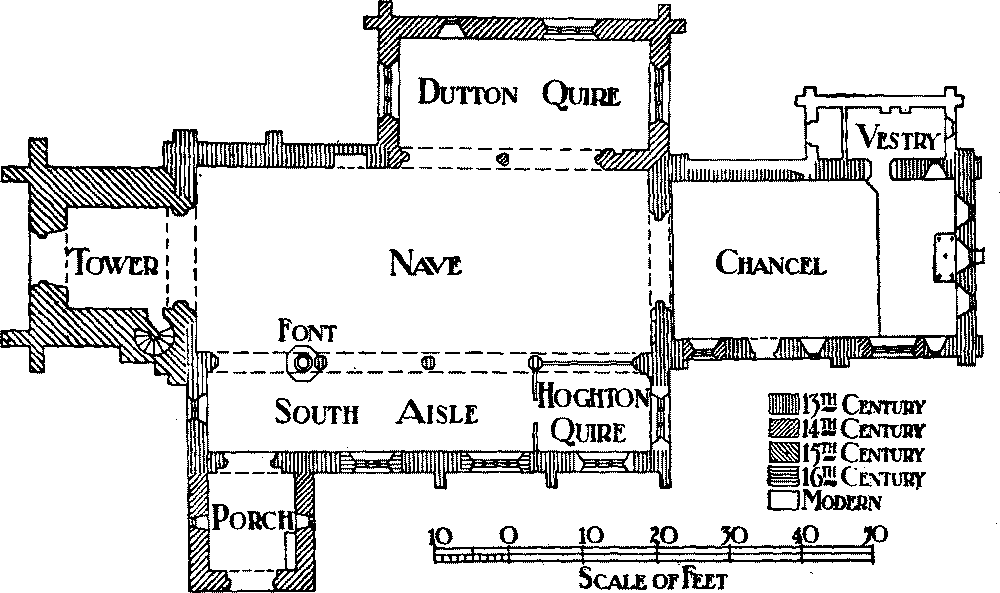
The church of ST. WILFRID stands on the south side of the town, about 100 yds. from the right bank of the Ribble, which here, taking a big bend, flows south for about half a mile below Ribchester Bridge. The building consists of chancel with small north vestry, nave with south aisle and north chapel, south porch and west tower, and occupies part of the site of the Roman station, the line of the north wall of which passes through the churchyard on the north side.
The building belongs substantially to the 13th century, and has many points of resemblance to the church of Whalley, which was erected about the same time, though the dimensions are smaller and there is no north aisle to the nave. The work would probably be in progress during the middle of the first half of the century, when the building would assume its present shape, with the exception of the north chapel, porch and tower. It probably then terminated with a gable at the west end surmounted by a bell-turret, and so remained till some time in the 14th century, when the chapel and porch were added. Nothing then seems to have been done till the end of the 15 th century, when the west tower was built and the plan assumed its present shape. Considerable changes, however, took place in the appearance of the building during the next century, when the old steep roofs of both chancel and nave were taken down, the chancel walls raised and the present roofs erected. The appearance of the aisle was entirely altered by the insertion of new square-headed windows and the walls probably raised, and it is even possible that the aisle walls were entirely rebuilt at this time, though the rough character of the masonry makes it difficult to be sure of this. The line of the former steep roof to the nave is still clearly distinguishable on the east face of the tower, and its pitch suggests that the original aisle wall must have been considerably lower than at present or that the nave and aisle were under one roof. There seems never to have been a clearstory, the nave originally having enough light in all probability from the west end as well as from the north. There are records of repairs done to the fabric in the 17th and 18th centuries, the two ugly dormer windows on the south side of the nave roof probably belonging to the former period. The chief work of repair was done in 1685–6 and in 1711, when the fabric was twice beautified, (fn. 13) and in 1736 the west gallery was erected. After this little seems to have been done to the building till 1830, when it was repaired and new seats put in. Two windows in the south aisle were renewed some thirty years later, but no real restoration took place till 1881, when the chancel was taken in hand. The rest of the building remains in a more or less neglected condition, the walls being covered with yellow wash, obscuring much of the mediaeval detail, which in other parts is spoilt by paint and varnish.
The chancel, in common with the rest of the church, is faced with rubble masonry, and the north wall was partly rebuilt in the restoration of 1881. Its internal dimensions are 40 ft. in length by 21 ft. in width, and the floor is 6½ in. below that of the nave, the east end of the church thus losing something in dignity when viewed from the west, the sanctuary being raised by only one step, thus bringing it to the general level of the floor of the church. The roof is new with three wood principals, the tie-beam at the east end cutting awkwardly across the top of the window. The east wall is faced on the interior with rough stone, but the other walls are plastered above the string which goes round the chancel at the height of the window sills. The east window is the original 13th-century one of three lancet lights 1 ft. 10 in. in width, splaying out on the inside to 5 ft. There are two original lancet lights also in the south wall 15 in. wide, splaying to 4 ft. on the inside and with a depth of 2 ft. 3 in., and remains of a third may still be seen from the inside. There have been two similar windows at the east end of the north wall, one of which still remains, opening into the vestry, the door to which is cut in the wall through the lower part of the second, the head of which may be seen above. West of these windows the north chancel wall appears to have been always blank as at present, except for a small opening about midway in its length 10 in. wide by l5 in. high with a pointed head, and 3 ft. 6 in from the floor. The outside of the wall having been rebuilt no trace of an opening now appears on the exterior, but the wide splay on the interior seems to show that it answered the purpose of a low side window directed on to the altar. In the 14th century a good deal of alteration appears to have taken place on the south side of the chancel, the sedilia and piscina being of that date, together with two windows; one a wide three-light opening near the east end replaces the second lancet and the other of two-lights at the west end with low transom forming a lychnoscope or low side window. The first of these 14th-century windows, the lights of which were low with cinquefoiled heads under a wide pointed arch with foliated circular tracery, has been entirely renewed, but the original jambs and traceried head of the western two-light window remain, though the mullion and transom are modern. The south doorway is the original 13th-century one with a simple pointed arch with external hood mould springing from moulded imposts slightly above the level of an external string course which goes round the chancel. The sedilia and piscina appear to have been inserted subsequent to the three-light window, if the present stonework of the latter exactly represents that which it displaced, as they break awkwardly in front of the opening. They are, however, of 14th-century date, the sedilia being triple with semicircular heads and a half-semicircular arch at each end dying into a scroll moulding string course which forms a square head to the sedilia and piscina. The piscina has a segmental head and two bowls with floreated sinkings. The 13th-century string which runs the length of the north and east sides is cut away under the first lancet on the south side against the returned 14th-century scroll moulding. In the east wall the string and the sills of the windows have been renewed. To the north of the east window is a semicircular moulded stone corbel 5 ft. above the floor, probably for an image, but now unoccupied and broken at the top, and in the south-west corner is preserved a sepulchral slab 4 ft. 3 in. long, though imperfect at the top, with incised ornament and sword. The chancel arch is pointed and of two chamfered orders, springing from circular moulded imposts and semicircular shafts below with fillet on the face and bases with the water moulding. The bases, however, have been a good deal restored, and rest on a plain chamfered plinth running along the west side of the chancel back to the north and south walls. The small vestry on the north side of the chancel and all the fittings are modern.
Plan of St. Wilfrid's Church, Ribchester
Externally the chancel has a plain chamfered plinth now below the level of the surrounding ground, and flat buttresses of two stages. The heads of the east window are quite plain without hood moulds, and the gable has been repaired at the top and a modern apex cross erected. The roof is covered with stone slates and has overhanging eaves. The raising of the walls has greatly injured the appearance of the chancel on the south side, spoiling the proportions of the windows by reason of the long stretch of blank walling above. The line of the former high-pitched chancel roof, the eaves of which were level with the top of the windows, can still be seen on the east wall of the nave.
The nave is 61 ft. by 24 ft. and consists of four bays, with south arcade of four pointed arches of two chamfered orders, carried on octagonal piers with moulded caps and bases, and similar responds at each end. The floor is flagged and the roof is divided into eight bays by nine oak principals, the two end ones against the walls and the middle one having a tie-beam and short pieces down the walls carried on corbels. The others are merely collars with shaped pieces under, and the roof does not seem to have been at all altered since its erection in the 16th century except by the insertion of the two great dormer windows on the south side which break into it awkwardly, the principals being still in front of each window with a space above the rafters where the line of the roof is raised. A moulded wall plate now whitewashed runs round the building, on a portion of which at the north-west corner is the date 1527 in Gothic characters.
The south aisle is 10 ft. 6 in. wide and has three square-headed windows on the south side, the easternmost of which is modern, a three-light modern pointed window at the east end, (fn. 14) and a small twolight window at the west. The south doorway is in the west bay and is a good piece of 13th-century work, now unfortunately painted and varnished, with pointed arch of two moulded orders, square chamfered inner jamb and outer shafts with moulded capitals and bases. The door is modern, probably of 18thcentury date. The aisle retains its original 16thcentury oak lean-to roof with shaped wind braces, and its east end is occupied by what is known as the 'Hoghton choir' or chapel, inclosed by an oak screen probably of early 16th-century date but much restored. It has eleven openings with traceried heads on the north side and eight on the west, with an embattled cornice. The chapel is now filled with square pews.
The porch has a pointed 14th-century arch of two orders with wave moulding springing from moulded imposts, and with external hood mould and moulded jambs. The gable, however, is quite plain above, and the roof in common with all the roofs of the church has overhanging eaves and is covered with stone slates. The walling is of rough stone with large angle quoins. There is a small window on each side and a wood bench on the west side. In the south-east corner is an altar tomb cut from a solid block of stone with three shields, one of which bears the arms of Hoghton. (fn. 15)
On the north side the nave is open, for something like half its length at the east end, to the north chapel, but west of this is a built-up doorway 3 ft. 6 in. wide. The rest of the wall is blank, except for a square-headed three-light window under the roof inserted in the 16th century when the wall was raised. Externally the north nave wall retains its two original angle buttresses with gabled heads and a portion of the former west wall of the building above the straight joint in the masonry showing where the north wall was raised when the old steeppitched roof was removed.
The north chapel, or 'Dutton choir,' is 34 ft. by 14 ft. and is open to the nave on the south side by an arcade of two pointed arches of two plain chamfered orders with hood moulds on each side, springing from a central pier of three clustered shafts with large circular moulded cap, and from half-round responds at each end with moulded caps and bases. The terminations of the outer chamfer over the pier on both sides are ornamented with roughly carved heads, but the arches and shafts, as well as all the other stonework in the chapel, are much spoiled by repeated coats of whitewash and paint. The chapel has a separate gabled roof, and on the western gable are the remains of a bell-turret. The wall plate on the south side is carried over the tops of the arches by four stone brackets, and there is one rough principal to the roof which is plastered under the spars. At the east and west ends the chapel is lit by two good 14th-century windows with moulded jambs and mullions, traceried heads and external hood moulds. The north wall has a square-headed window of three trefoiled lights and a 13th-century lancet with inner arch on corbels, probably re-erected here from the north wall of the nave when the chapel was built. The piscina which remains at the end of the south wall has a moulded segmental head and jambs.
The west tower is 13 ft. 6 in. square inside and has a projecting vice in the south-east corner. The western buttresses are of seven stages, set square and finishing just above the sill of the belfry windows. The tower is faced with rubble masonry with quoins at the angles and is very plain in character, its stages being externally unmarked. On the north and south sides the walls are blank below the belfry except for a small square-headed window to the bell-ringing stage. The belfry windows are pointed and of three lights with tracery in the head, external hood mould and stone louvres. The walls finish with an embattled parapet and string course, and there is a clock on the east side facing the village. The west door has a pointed arch with continuous moulded jambs and head, and above is a three-light window similar to those in the belfry. The tower arch is of two chamfered orders, the outer one dying into the wall at the springing, but the lower part is now filled by a wooden screen with turned balusters at the top and a modern door. The upper part of the opening is hidden by the organ, which occupies the west gallery. This gallery, which is described in the faculty of 1736 as 'for the use of the Singers of Psalms,' has a plain 18th-century wood front grained and varnished, and is approached by a staircase on the north side within the tower.
The font is of 14th-century date, and stands in its original position near the south door. It is octagonal in plan with straight sides and chamfered angle shafts dying into a splayed plinth, and has a flat wood top. Like the south door it has unfortunately suffered from successive coats of paint.
The pulpit is of oak and octagonal in plan, with pilasters at the angles, richly carved panels and projecting cornice carried by shaped brackets. On the door are the date 1636 and the initials of Christopher Hindle, vicar, and attached to it is an oak readingdesk, probably of equal date, forming a two-decker.
The seating is composed principally of modern straight-backed benches, but some of the 18th-century square pews still remain, two in the nave having the name or initials of Jas. Dewhurst and the date 1761. Another in the north chapel has the initials RCA and the date 1729.
There is a little old stained glass in the head of the east window of the north chapel, but it has been spoiled with paint on the inside. (fn. 16)
There are mural monuments to the Rev. B. T. Haslewood, rector (d. 1876), Jonathan Openshaw of Hothersall (d. 1882) and the Rev. F. E. Perrin, rector (d. 1885).
In the south-east corner of the north chapel is the base of an old cross. In the north chapel also is an ancient tombstone now bearing an inscription dated 1689.
There is a ring of six bells by Mears of Whitechapel, all dated 1821, but hung in the following year. In 1650 the 'curfew' was rung at 4 a.m. and 8 p.m. It is still rung in the evening. (fn. 17)
The plate consists of a chalice of 1777, another of 1815, and a plated flagon and paten made by Richards of Birmingham, 1826.
The registers begin in 1598. The first volume (1598–1694) has been printed by the Lancashire Parish Register Society. (fn. 18) The churchwardens' accounts begin in 1650. (fn. 19) There was formerly a parish library, dating from 1684, but it was dispersed more than fifty years ago. (fn. 20)
The churchyard lies principally on the north, south and west sides of the church, and is entered through gates, near the south-east corner, from the village. It was enlarged in 1870 when the old burial-ground was closed. To the south of the chancel is a stone sundial raised on six square steps, the plate of which is missing, but the shaft, which is probably of 17thcentury date, forms a very picturesque feature in the exterior view of the building. The oldest dated gravestone is 1696.
Advowson
A church has existed here at least from the end of the 12th century. (fn. 21) Like the manor, the advowson belonged to the Lacys, lords of Clitheroe, (fn. 22) and descended to the Earls and Dukes of Lancaster, and so to the Crown. In 1546 the rectory was granted to the newly-created bishopric of Chester, in part exchange for other lands, (fn. 23) and a vicarage was ordained to which the bishop collated. (fn. 24) The rectory is now in the hands of the Ecclesiastical Commissioners, and the Bishop of Manchester collates to the vicarage. (fn. 25)
In 1292 the value of the rectory was taxed as £22 a year, (fn. 26) but owing mainly to an incursion of the Scots it decreased within the next thirty years to £12, (fn. 27) at which it remained in 1341. (fn. 28) In 1535 the income was estimated at £39 15s. 6d., including the value of the rectory-house and glebe. (fn. 29) The Parliamentary Commissioners in 1650 found that the Bishop of Chester had leased the tithes to the inhabitants for the nominal value of the rectory, out of which he had paid 20 marks to the vicar. (fn. 30) This stipend was greatly increased soon afterwards, out of the sequestered revenues of the bishopric of Chester, (fn. 31) but after the Restoration the vicar's income would return to its former level. However, about 1718 Bishop Gastrell found that the vicar had nearly £39 a year (fn. 32) and that there was also £5 6s. 8d. reserved 'for a priest serving within the church of Ribchester.' (fn. 33) The vicars have for forty years been styled rectors. (fn. 34) The income is now returned as £242. (fn. 35)
The following have been rectors and vicars:—
| Rectors | |||
|---|---|---|---|
| Instituted | Name | Patron | Cause of Vacancy |
| c. 1200 | Richard (fn. 36) | — | — |
| c. 1240 | Drogo (fn. 37) | — | — |
| 25 Feb. 1243–4 | Guy de Russelon (fn. 38) | The King | — |
| 1 Aug. 1246 | Humbert de Ascitiis (fn. 39) | The King | res. G. de Russelon |
| c. 1290 | Robert de Pocklington (fn. 40) | — | — |
| 23 Nov. 1325 | Robert de Brustwick (fn. 41) | " | res. R. de Pocklington |
| oc. 1333 | Thomas Trayley (fn. 42) | — | — |
| 10 Nov. 1337 | Matthew Palmer (fn. 43) | Queen Isabella | exch. T. Trayley |
| Mr. Walter de Woodhouse (fn. 44) | — | — | |
| 7 Oct. 1343 | William de Wakefield (fn. 45) | Queen Isabella | exch. W. de Woodhouse |
| 5 Feb. 1349–50 | William de Hornby (fn. 46) | — | exch. W. de Wakeneld |
| 1 Mar. 1364–5 | John de Lincoln (fn. 47) | — | — |
| 18 Dec. 1374 | John de Yerdeburgh | Duke of Lancaster | exch. Jo. de Lincoln |
| 21 Jan. 1374–5 | Lambert de Thirkingham (fn. 48) | " | res. Jo. de Yerdeburgh |
| ? | William de Bolton (fn. 49) | " | — |
| 8 Nov. 1395 | John Farmer (fn. 50) | " | res. W. de Bolton |
| oc. 1408 | John Moor (fn. 51) | — | — |
| 5 Apr. 1419 | Richard Coventry (fn. 52) | The King | d. John Moor |
| 3 Dec. 1419 | John Elswick (fn. 53) | " | res. R. Coventry |
| 14 Dec. 1468 | William Talbot, D.Decr. (fn. 54) | E. and R. Talbot | res. J. Elswick |
| 16 Mar. 1496–7 | Robert Crombleholme (fn. 55) | The King | — |
| 31 July 1527 | William Clayton, D.Can.L. (fn. 56) | — | res. R. Crombleholme |
| 21 Dec. 1532 | Thomas Thirlby, LL.D. (fn. 57) | The King | d. W. Clayton |
| 9 June 1542 | George Wolset, LL.D. (fn. 58) | " | res. T. Thirlby |
| Vicars | |||
| Instituted | Name | Patron | Cause of Vacancy |
| oc. 1562 | James Lingard (fn. 59) | — | — |
| 22 Mar. 1571–2 | Christopher Alsop (fn. 60) | — | — |
| 9 Mar. 1573–4 | Henry Norcross (fn. 61) | John Whitaker | res. last incumbent |
| 17 Dec. 1616 | Richard Learoyd (fn. 62) | Bp. of Chester | depr. of H. Norcross |
| 5 Feb. 1617–18 | Christopher Hindley (fn. 63) | " | res. R. Learoyd |
| 1656 | William Ingham (fn. 64) | — | — |
| 6 Oct. 1681 | George Ogden, B.D. (fn. 65) | Bp. of Chester | d. W. Ingham |
| 3 Aug. 1706 | Thomas Johnson, B.A. (fn. 66) | " | d. G. Ogden |
| 26 Feb. 1738–9 | John Heber (fn. 67) | " | d. T. Johnson |
| 29 Aug. 1775 | John Griffiths, B.A. | Bp. of Chester | d. J. Heber |
| 27 July 1776 | John Atkinson (fn. 68) | " | — |
| 11 July 1798 | Isaac Relph (fn. 69) | " | d. J. Atkinson |
| 23 Apr. 1800 | James Quartley, M.A. (fn. 70) | " | d. I. Relph |
| 14 Apr. 1829 | Boulby Thomas Haslewood, B.A. (fn. 71) | " | d. J. Quartley |
| Rectors | |||
| Instituted | Name | Patron | Cause of Vacancy |
| 1876 | Frederick Eugene Perrin, M.A. (fn. 72) | Bp. of Manchester | d. B. T. Haslewood |
| 18 Aug. 1885 | Francis John Dickson, M.A. (fn. 73) | " | d. F. E. Perrin |
| 11 May 1892 | Evan Harries (fn. 74) | " | — |
| 7 Jan. 1908 | John William Brooker | " | res. E. Harries |
The early rectors were often officials of the Earls of Lancaster or the kings, holding Ribchester as one of numerous preferments and resigning it after a brief tenure for some more lucrative benefice. It is unlikely that many of them were resident, and probably for this reason they seldom occur in local deeds. After the rectory came into the possession of the Bishops of Chester the vicars appointed were usually resident, but the stipend was small, and the position of the incumbents was probably no better than that of the former curates of the absentee rectors. Some of the vicars held other preferments. Before the Reformation there were probably three or four resident priests, (fn. 75) the parish church with its chantry and the chapels at Longridge and Stidd having to be served. The visitation list of 1548 gives four names, including the rector's, but Stidd had no doubt ceased to be used. (fn. 76) The church goods taken away by the commissioners of Edward VI in 1552–3 were a pix of silver gilt, a cross, a cope and five vestments. (fn. 77) In 1554, when the Bishop of Chester was rector, only one name appears, (fn. 78) and the same is the case in 1562. (fn. 79) A single minister appears thenceforward to have sufficed for the parish until about 1700, (fn. 80) though during the Commonwealth period there was a second one at Longridge. (fn. 81) Mr. Ogden, vicar at the end of the 17th century, had a resident curate. (fn. 82) In 1731 the churchwardens notified to the Bishop of Chester the existence of Quakers, Popish and Presbyterian Dissenters and Anabaptists. (fn. 83)
The priest of St. Mary in Ribchester Church appears to have been an established institution before 1349, when a rent-charge of 2s. on lands in Dutton was made in his favour by Henry de Clayton. (fn. 84) Ten years later a small sum was left to the priest singing at St. Mary's altar. (fn. 85) This was no doubt the altar on the south side of the church. In 1407 Sir Richard Hoghton obtained the royal licence to refound or at least to endow a chantry at her altar on the north side of the church. (fn. 86) The endowment, derived from lands in Ribchester, Dutton, Chipping and Goosnargh, was unusually liberal, the net income of the chantry priest in 1547 being £10 17s. 4½d. (fn. 87) Robert Whittingham was the first priest, 1409 (fn. 88); Ellis Crombleholme was appointed in 1467 (fn. 89) and was still there in 1496 (fn. 90); James Schlacter, chaplain, held it in 1504 (fn. 91); James Tarleton appears in 1525 (fn. 92) and was still celebrating according to his foundation in 1547, (fn. 93) when the chantry was suppressed. The confiscated estates were in 1550 granted by the Crown to Thomas Reeve and others. (fn. 94)
Land had also been given for the maintenance of a light in the church. (fn. 95)
Cecily the Recluse is mentioned in 1292. (fn. 96).
A school was founded in 1793–7 (fn. 97)
Charities
Apart from the school and religious endowments there are several benefactions for the benefit of the poor. An official inquiry was held in 1898, and the report, printed the following year, contains a reprint of that of 1826. (fn. 98) For the township of Ribchester about £54 is distributed annually in money doles, of which over £42 is derived from a bequest by Mrs. Elizabeth Dewhurst in 1842. (fn. 99) In addition for Ribchester and Stidd is a sum of over £10 yearly, with 'preference for poor Catholics' (fn. 100) and almshouses with an income of £53 11s. 2d. (fn. 101) In Dilworth £12 is given in money doles (fn. 102) and another endowment has been lost. (fn. 103) In Dutton calico is distributed to the value of £7. (fn. 104) For Alston over £16 is available, distributed in gifts of money (fn. 105); and some benefactions for this township (fn. 106) and Hothersall have been lost. (fn. 107)