A History of the County of Lancaster: Volume 8. Originally published by Victoria County History, London, 1914.
This free content was digitised by double rekeying. All rights reserved.
'The parish of Aldingham', in A History of the County of Lancaster: Volume 8, ed. William Farrer, J Brownbill (London, 1914), British History Online https://www.british-history.ac.uk/vch/lancs/vol8/pp320-328 [accessed 9 May 2025].
'The parish of Aldingham', in A History of the County of Lancaster: Volume 8. Edited by William Farrer, J Brownbill (London, 1914), British History Online, accessed May 9, 2025, https://www.british-history.ac.uk/vch/lancs/vol8/pp320-328.
"The parish of Aldingham". A History of the County of Lancaster: Volume 8. Ed. William Farrer, J Brownbill (London, 1914), British History Online. Web. 9 May 2025. https://www.british-history.ac.uk/vch/lancs/vol8/pp320-328.
In this section
ALDINGHAM
Aldingham, Dom. Bk. Belleclive, 1212; Beleclyve, 1277; Belclyf or Beelclyff, 1418. Dene, Dom. Bk. Glassertun, Dom. Bk.; Gleston, 1363. Hert, Dom. Bk. Lies, Dom. Bk. Scales, 1277.
This parish, composed of a single township of the same name, occupies a pleasant position on the southeast side of Low Furness overlooking Morecambe Bay. The surface is undulating, being highest in the north, where 400 ft. above sea level is attained on the border of Birkrigg; in the northern half also at the coast it rises steeply from the sea, 200 ft. being attained a quarter to half a mile from the shore. The southern end is flat and low near the shore, but to the north-west, on the border of Dalton, rises to 214 ft. above sea level at Scarbarrow. The two portions are known as Upper and Lower Aldingham.

ALDINGHAM URSWICK PENNINGTON
Formerly a number of the hamlets appear to have been considered townships, (fn. 1) and in 1717 Bishop Gastrell enumerated eleven, arranged in four quarters, viz. (1) Aldingham, BayclifF, Sunbrick and half of Scales; (2) Roosebeck, Newbiggin, Colt Park and Mote; (3) Leece and Dendron; (4) Gleaston and half of Scales. (fn. 2) Three main subdivisions are still recognized: Aldingham proper, Gleaston and Leece with Dendron. The first of these occupies the whole coast line from Sunbrick and Sea Wood (fn. 3) at the northern end to Roosebeck (fn. 4) at the south. The hamlet of Aldingham, with the parish church, is near the centre, on the shore, Baycliff, formerly Belcliff, is about a mile to the north, Scales a mile and a half inland to the north-west, and Newbiggin about two miles south-west. Halfway between Aldingham Church and Newbiggin lies the ancient mound called the Mote Hill, with Colt Park on its western side. The area of this part is 2,463 acres. There are a number of wooded places, for trees grow well on the sheltered coast. Fine views are obtained over the bay. Gleaston occupies a central position to the west, having an area of 1,055 acres; the ruins of the castle stand alone, a mile and a half from the parish church, (fn. 5) and the village or hamlet is a little way off to the south. Leece occupies the southern end of the parish, with Dendron, 245½ acres, rising and projecting north to separate Gleaston from Dalton. The village of Leece stands near the centre of Leece proper, around a little tarn, and has Old Holebeck in the western corner; the area, including Dendron, is 1,156½ acres. Thus the whole parish measures 4,674½ acres. (fn. 6) Birkrigg, at the northern end, between Sunbrick, Bardsea and Great Urswick, is common to the parishes of Aldingham and Urswick. It rises to a height of over 400 ft. above the sea, and measures 276 acres. From the top there is a fine view over Furness and the country to the east.
There is little to be said of the history of the place. The local tradition tells of an extension of the land eastward washed away by some ancient encroachment of Morecambe Bay, the church thus becoming stationed on the edge of the sea, instead of being near the centre of the land. (fn. 7) On Birkrigg there are a small circle and two camps called Foula and Appleby Slack; there are also traces of ancient defensive works near the church. (fn. 8) The lords of Gleaston were formerly among the great men of the district, and, being summoned to Parliament as barons, had a direct voice in the affairs of England in the middle ages; they also fought abroad in the wars with France and at home on the Yorkist side. With their removal and eventual forfeiture the parish was left with none but yeoman inhabitants, whose quiet and useful lives call for no special notice.
To the county lay of 1624 Aldingham had to contribute £3 0s. 7d. and Leece £3 3s. 9½d., when the hundred of Lonsdale raised £100. (fn. 9)
A fulling mill is named in one of the Harrington inquisitions. (fn. 10) There is some stone quarrying, but the chief industry is agriculture. Wheat, oats and turnips are grown. The soil is gravelly, overlying limestone, and the land is at present occupied thus:— arable, 1,479 acres; permanent grass, 2,828 acres; and 61 acres of woods and plantations. (fn. 11) At Birkrigg there were copper mines. Cockles are found on the sands, and Baycliff is a fishing village. The population was 1,072 in 1901. There is a parish council of seven members.
Aldingham Hall is a modern residence near the church; it does not represent the old hall of the lords of the manor.
There is no railway. The principal road is one from Barrow to Ulverston, through the centre of the township. It passes through Leece, Gleaston and Scales, and has branches south-east to the shore at Roosebeck, Mote Hill, Aldingham and Baycliff, and north to Dendron.
Manor
There were several manors in the parish in 1066. ALDINGHAM proper was held by one Ernulf, and was assessed at six plough-lands; Turulf of Ulverston held DENDRON as one plough-land; and the rest formed part of Earl Tostig's Hougun fee—HART, two plough-lands, LEECE and another Leece, six and two respectively, and GLEASTON two. (fn. 12) Afterwards the whole became part of the Aldingham or Muchland manor of Michael le Fleming, of which an account has already been given. (fn. 13) At first he and his successors held it directly of the lord of the honour of Lancaster, but from 1227 onwards the Abbot of Furness was the immediate lord. John de Harrington the elder had the king's licence in 1341 to inclose 300 acres of land, wood, moor and marsh within his manor of Aldingham, and make a park thereof. (fn. 14) In course of time, owing, it is believed, to inroads of the sea, Gleaston was fixed upon as the seat of the manor, and before 1389 a castle was built there. (fn. 15)
In the assignment of dower to Elizabeth widow of Sir John Harrington in 1418 a number of placenames occur, among them 'a little close called the Mote-garth within the site of the manor of Aldingham.' Over and Nether Aldingham are mentioned, also High Park, Colt Park, Seawood Park, pasture called Birkrigg in the town of Sunbrick near the road leading from Scales to Ulverston, the towns of Leece, Gleaston and Dendron, the pasture of Hartcarr in Newbiggin, Baycliff, Windhill, &c. (fn. 16)
The 'manor and castle of Gleaston' was, after the lordship of Muchland escheated to the Crown, regarded as in some way a separate estate. (fn. 17) Leases of portions were granted from time to time, (fn. 18) and in 1628 the castle and various lands were sold, (fn. 19) for in virtue of this the 'manor of Gleaston' was in 1652 stated to have been sold to the city of London. (fn. 20) It was acquired by the Prestons of Furness Abbey, (fn. 21) and has since descended like their other estates to the present owner, Lord Richard Cavendish of Holker.
GLEASTON CASTLE (fn. 22) stands about half a mile to the north-east of Gleaston village on a rather weak site at the south end of an oblong-shaped hill which rises above it on the north side, and overlooked on the east by the still higher Beacon Hill, which lies between it and the sea. (fn. 23) The castle is quadrangular in plan and of 14th-century date, and consists of four corner towers connected by curtain walls inclosing a ward, now overgrown with turf, 240 ft. in length from north to south and in width measuring 150 ft. at the north and 120 ft. at the south end. The walls, which are 9 ft. thick, are constructed of limestone rubble in roughly dressed blocks of various sizes, without plinth or string course, but with some dressings of red sandstone in the towers. The masonry seems to be generally of one date, but there is some reason for believing that the south end was erected first, beginning with the south-west tower and including the south curtain wall and part of that on the east side. (fn. 24) However this may be, the whole of the existing building was probably completed before 1350, though it is doubtful if more than the foundations of the north wall were got out. If the north wall were ever constructed it was probably razed about the end of the 14th century, when what seems to have been a pleasure garden was added to the north side of the ward. In 1458 the castle, ceasing to be a manorial residence, was dismantled and speedily fell to decay, for Leland, about 1540, calls it only 'the ruin and walls of a castle.' (fn. 25) Buck's drawing shows the ruins to have been in much the same condition in 1727 as now.
The keep was at the north-west corner at the highest point of the site, the ground being there about 30 ft. higher than the south end of the castle yard. The principal parts of the tower now remaining are a large piece of the north and west walls, a fragment of the east wall and a portion of the south wall where it was joined by the west curtain. The tower is 92 ft. in length from west to east by 53 ft. 3 in. in width at the west and 42 ft. 7 in. at the east end. The entrance is on the south side, and opened into a hall 30 ft. by 22 ft., lit from the south and flanked by dungeons. Above were two floors, each containing four rooms, access to which was gained by a stone staircase at the north-east corner of the hall. The north-west portion still standing is between 30 ft. and 40 ft. in height, with two narrow window openings on the first floor level facing west and remains of another window and fireplace above. In the fragment of the north wall is a passage in the thickness of the wall at the first floor level leading to a garderobe above in which is a narrow trefoiled window, and there is also a garderobe in the second floor.
Close to the north-west tower in the west curtain is a gateway 6 ft. 6 in. wide, with a segmental arch 13 ft. high leading to the castle yard, but whether or not this was the only and original entrance is uncertain. The external jambs of the gateway have been removed, and the opening shows no trace of a portcullis or any special means of defence, but its proximity to the keep may have been considered sufficient protection. (fn. 26)
The west curtain wall runs south in a ruined condition for about 95 ft. from the keep, when it is interrupted by a mass of masonry apparently originally a tower, 30 ft. in length, with a projection on the south side of about 12 ft. Below this the curtain is continued for another 95 ft. to the south-west tower, but not in the same straight line with the wall north of the ruined middle tower. That part of the curtain next to the south-west tower is the best preserved in the castle, and is about 30 ft. high and apparently complete except for its battlements.
The south-west tower is 42 ft. 6 in. in height to the battlements, and measures at the base 33 ft. 2 in. by 31 ft. 2 in. It is not quite rectangular in plan (fn. 27) at the ground level, but twists into an approximately square form as it rises, and consists of four stages each of a single room. The basement room, which measures 14 ft. 7 in. by 13 ft. and is entered from the ward by a door in the east wall, was evidently a dungeon, being only 7 ft. in height and without windows. A staircase in the thickness of the east wall leads to the first floor, at which height the wall is reduced in width, but all the floors, which were of wood, are gone. The first floor room is 16 ft. 3 in. by 13 ft. 10 in. and was about 10 ft. in height, with a fireplace and two small windows. The second floor room, which measures 17 ft. 6 in. by 14 ft. 10 in., has no connexion internally with the first floor, but is reached by a separate flight of steps on the north side with a pointed red sandstone doorway. The top room is similar to that below, but is 2 ft. wider, the walls being still further reduced in thickness. The battlements are reached by a vice in the north-west corner surmounted by a turret 49 ft. to the top. The three upper rooms have each a garderobe in the thickness of the south wall with parallel shafts. The outside of the tower is now overgrown with ivy, but the windows appear to have been narrow pointed openings about 12 in. wide with a plain external chamfer, and splayed inside to about 3 ft. to 5 ft., with pointed rear arches.
The south curtain wall runs at rather more than a right angle from the west curtain, and is now externally about 3 ft. in height but flush with the ground towards the ward. The south-east tower, which stands at the lowest part of the site and consists of two stories, is 29 ft. in height to the top of the battlements and measures externally 43 ft. by 31 ft. The entrance to the basement is from the courtyard on the west side by a pointed doorway with external label. The hole in the wall for the bar still remains. The lower room is 25 ft. 6 in. by 12 ft. 9 in., and was about 12 ft. high, but the floor has now gone. It has a fireplace on the east side and a window north and south, access to the room above being by a staircase in the thickness of the west wall. This upper room is 26 ft. 6 in. by 15 ft. 6 in., with four windows and a fireplace, and a vice in the north-west corner leading to the battlements surmounted by a turret 41 ft. to the top. There is a garderobe to each floor in the south-west corner, from the upper one of which a floor leads to the south curtain wall. The windows seem to have been, as before, narrow pointed lights (fn. 28) splayed inside and about 4 ft. above the floor.
From the south-east tower the curtain runs northeast in a straight line with the west wall of the tower, and not parallel with the west curtain. Except a portion at the south end, which is about 10 ft. above the level of the ward and about 20 ft. above the ground outside, the wall is so ruined as to appear from the inside merely a mound, but is externally 9 ft. to 10 ft. high. It is 160 ft. in length, but at a distance of about 40 ft. from the south-east tower there is a gap of about 25 ft., which, however, may be modern. The north-east tower projects about 20 ft. from the curtain, and seems to have been about 56 ft. in length, but as only its south wall and some fragments of its east wall remain its plan is impossible to determine. From here to the north-west tower is over 100 ft., but the north curtain wall has entirely disappeared, though its line is traceable in the turf.
The interior of the ward is raised at the south end from 3 ft. to 6 ft. above the ground level outside the walls, and the centre seems to have been artificially levelled, though no mounds of débris are anywhere visible, nor are there any traces of a moat or ditch.
There was no doubt a chapel in the castle, for in 1415 John Harrington, lord of Aldingham, obtained a papal indult for a private chapel and portable altar for mass, &c. (fn. 29)
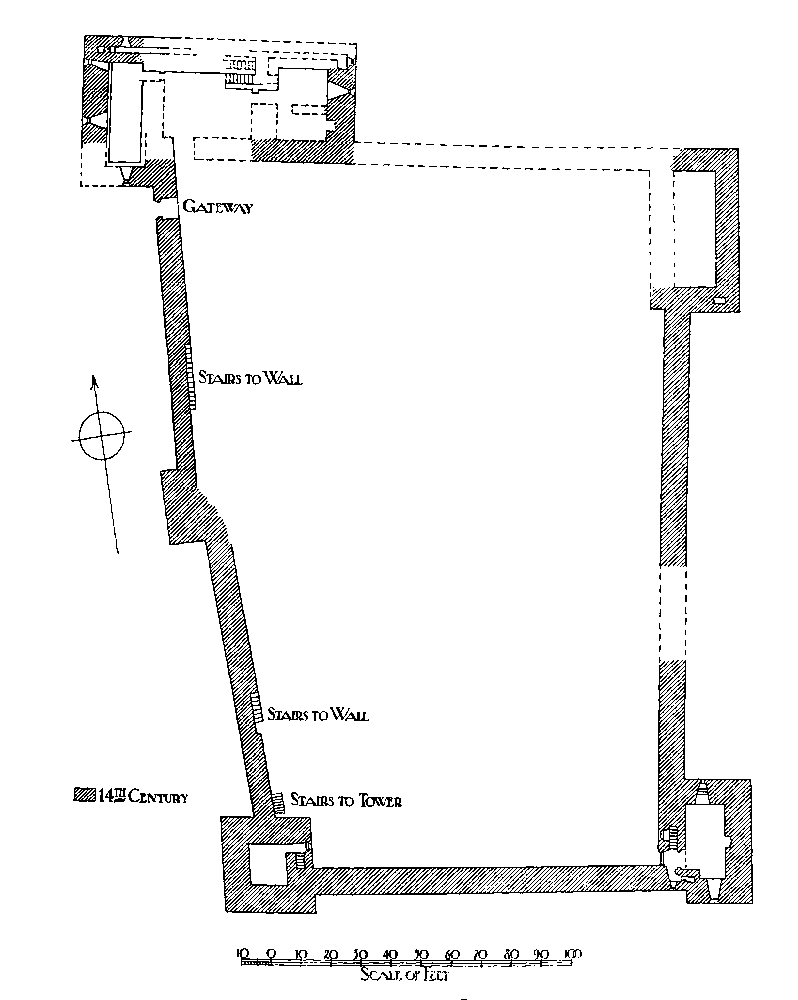
Plan of Gleaston Castle
Though some alienations are on record as having been made by the first Michael le Fleming and his son William, (fn. 30) the Harringtons appear to have been practically the only holders of the land, so that there is little to record of the mediaeval history. (fn. 31) After the Muchland lordship came into the hands of the Crown some alienations were made. (fn. 32) Thomas Singleton of Dendron in 1653 compounded for his estate, which had been declared forfeit and ordered for sale by the Parliament. (fn. 33) An agreement as to equal hunting rights in Leece, Dendron and Stainton was made about 1260 between the Abbot of Furness and William le Fleming. (fn. 34) The family of Ashburner, occurring in Furness and Cartmel and elsewhere in the county, is traced to Gleaston. (fn. 35)
Church
The church of ST. CUTHBERT (fn. 36) stands on sloping ground about 20 yds. from the shore, to which the churchyard falls on the south side, being retained by a sea wall about 9 ft. high erected in 1816. The building, which is constructed of local limestone with quoins and dressings of red sandstone and gritstone and externally covered with rough-cast, consists of a chancel 36 ft. 6 in. by 18 ft. with north vestry, nave 51 ft. 6 in. by 18 ft. with north and south aisles, and west tower 12 ft. square, all the measurements being internal. The earliest part of the building is the south nave arcade, which is of late 12th or early 13th-century date, but no other part of the church of that period remains with the possible exception of the priest's doorway, which is 13th-century work but apparently later than the arcade. This early church seems to have consisted of a chancel about 24 ft. long and a nave with south aisle as at present, but little can be said with regard to the development of the plan till the 14th century, when the chancel and south aisle were rebuilt, the former being then lengthened to its present size. Probably the whole of the nave, with the exception of the arcade, was rebuilt at the same time, but subsequent alterations have removed traces of other 14th-century work than the chancel and south aisle. The west tower was added in the latter half of the 15 th century, but little was afterwards done to the structure till modern times. The interior went through the changes usual in the 17th and 18th centuries, a flat ceiling being erected, and was fitted up with square pews and a 'three-decker' pulpit against the north wall. In 1845–6 the north aisle was built, the floor flagged, the west entrance, which had for long been walled up, opened out, and a south porch, which is said to have been like the one at Urswick, (fn. 37) was pulled down and its place taken by a window. New windows were at the same time inserted in the south aisle, and in the following year the old oak pews were removed and replaced by new ones, the church then assuming more or less of its present appearance.
The chancel roof, which is of steep pitch with overhanging eaves, is covered with blue slates and retains the original gable coping with the base of an apex cross. The east window is of three trefoiled lights under a pointed head without hood mould, and is flanked externally by two boldly projecting buttresses with a single set off at the height of the eaves. Internally the walls are plastered and a low flat ceiling obscures the top part of the window. In the south wall are a square-headed piscina with slightly projecting bowl and a square-headed window of a rather nondescript character in red sandstone which appears to be made up of some 13th-century stonework taken perhaps from former sedilia, or is perhaps a later copy of some early work. The window is of three lights 4 ft. 9 in. in height and 3 ft. 11 in. wide with chamfered jambs and a modern square lintel, the mullions, however, being circular shafts 5 in. in diameter with moulded capitals and bases. The priest's doorway, which is 7 ft. high by 2 ft. 6 in. wide, has a trefoiled head below a semicircular hood mould, on the underside of which are six nail-headed ornaments, and is of yellow stone. The jambs and head have a plain chamfer and the cuspings of the head have a small floral ornament within the line of the chamfer. At the west end of the south wall is a good 14th-century window of two trefoiled lights and quatrefoil in the head without a hood mould, but with a low transom forming a lychnoscope or low side window, and on the north side near to the east wall is a square-headed window of three cinquefoiled lights and perpendicular tracery with hollow chamfered mullions and moulded jambs. To the west of this the north wall is blank except for the door to the modern vestry. The 17th-century altar rails remain and the sanctuary floor is raised three steps, but the rest of the chancel is on the same level as the nave, the floor being flagged. The chancel arch is 11 ft. in height to the crown and is of two chamfered orders, the inner one springing from corbels with carved heads on the underside and the outer one going down to the ground.
The south arcade of the nave consists of four semicircular arches of two orders, the outer square and the inner chamfered, springing from alternate octagonal and circular piers and responds, (fn. 38) with moulded capitals and bases. The east respond is a good deal cut away to allow for a squint from the south aisle to the chancel, now closed with a shutter. The piers are 2 ft. in diameter and 7 ft. in height to the top of the capitals, above which the arches rise 5 ft. The circular piers have square capitals, the first from the east being simply moulded, but the third is carved below the abacus. The westernmost arch now dies into the wall against the diagonal buttress of the tower, which projects into the nave, the respond having apparently been destroyed when the tower was built. The south aisle, which is the same length as the nave and 12 ft. 10 in. wide, has a red sandstone 14th-century square-headed window of two trefoiled lights and tracery in the head but without hood mould at the east end, and four modern windows similar in style in the south wall. The modern north arcade consists of four tall pointed arches of a single chamfered order springing from octagonal piers with moulded capitals and chamfered bases 9 ft. 8 in. in height and responds at either end. The north aisle is 13 ft. 10 in. wide and of equal length with the nave and has four windows on the north side similar to those in the south aisle and one at the east end placed high up in the wall above the roof of the vestry. The nave and aisles are under one widespanned roof with overhanging eaves and covered with modern blue slates, the nave retaining its 18thcentury flat plaster ceiling 17 ft. 9 in. high, and all the walls are plastered. The royal arms of Queen Victoria are over the chancel arch.
The west tower has an embattled parapet and diagonal buttresses of three stages at each of the four corners going up the full height and terminating in pinnacles. The belfry windows are square-headed of two trefoiled lights except on the north side, where the window is a pointed one of two trefoiled lights with quatrefoil in the head and hood mould over, perhaps a window from the 14th-century building used up at the time of the erection of the tower. The east belfry window is new and on the west the mullion has been renewed. The west door is pointed, with chamfered jambs and head, and a hood mould terminating in a carved head on the north side but broken on the south, and the west window is a modern one of three trefoiled lights and perpendicular tracery. There is no vice, the upper floors being reached by a wooden staircase and ladder. The walls like those of the rest of the building are covered with rough-cast and quite plain on the north and south sides below the belfry, and the tower arch is of two chamfered orders continued down to the ground, but it is now hidden from the nave by the organ which was erected in a west gallery within the tower in 1908. It previously stood at the east end of the south aisle. The lower part of the openings below the gallery is filled with a solid oak screen.
The font is of red sandstone 2 ft. 6 in. in diameter, circular in plan and scalloped all round. The bowl only, which is 14 in. deep, is ancient, probably of 12thcentury date, and stands on a modern shafted stem.
At the west end of the south aisle is a 13th-century sepulchral slab with floreated cross, inscribed 'hic iacet goditha de scales.' There are also two red sandstone grave slabs with crosses carved on them, all of which were found in 1845–6 as lintels of windows in the old north wall. (fn. 39)
There are brasses in the chancel floor to the Rev. Thomas Shaw, rector, who died in 1667, and to the Rev. John Ashton (d. 1759), and there are mural monuments to three other rectors, the Revs. Roger Baldwin (d. 1801), James Barton (d. 1814), and John Stonard (d. 1849).
There are three bells, two of which are of preReformation date, probably of the last decade of the 15 th century. One of these is inscribed in black letter characters 'Celorum x˜pe placeat tibi rex sonus iste,' with the maker's stamp within a shield (fn. 40) supposed to be that of Richard Mellor of Nottingham. (fn. 41) The second bell has a similar founder's mark, the inscription consisting of the letter S and a cross patonce each repeated three times. The third bell is by Abraham Rudhall, 1711, and is inscribed 'God Save Queen Ann.'
The plate now in use is all modern, having been acquired in exchange for plate of some antiquity. No record, however, has been preserved of the old plate beyond the fact that it consisted of a small chalice and cover paten probably of 16th or 17thcentury date. There was also a piece of silver, which was, however, not used or known to have been used for sacramental purposes, described as a 'shapeless silver stoup,' the gift of the Rev. Roger Baldwin, rector. (fn. 42)
The register of marriages begins in 1542, that of burials in 1553, and that of baptisms in 1561. The first four volumes (1542–1695) have been printed. (fn. 43)
On the south side of the churchyard is a mounting block and sundial, the plate of which bears the name and date 'John Williamson, 1753,' and is inscribed 'Use the present time, Redeem the past, for thus certainly tho' imperceptibly the night of life approaches.'
Advowson
The history of the church can be traced back to the latter part of the 12th century. (fn. 44) The right of presentation has always been vested in the lord of the manor, and is therefore now held by the king. (fn. 45) At the taxation in 1291 the rectory was valued at £53 6s. 8d., a higher sum than any in the neighbourhood, Cartmel included, but after the devastating raids of the Scots in 1316 and 1322 the estimate was reduced to £10. (fn. 46) The value of the ninth of sheaves, &c., in 1341 was also £10. (fn. 47) The clear value in 1535 was £39 18s. 11d., derived almost entirely from tithes. (fn. 48) In 1650 the estimate had risen to £140 a year; there was a parsonage-house with about 2½ acres of land. (fn. 49) There was a further increase to £200 by 1717. (fn. 50) At present the net value is stated to be £530 per annum. (fn. 51)
The following have been rectors:—
| Instituted | Name | Patron | Cause of Vacancy |
| c. 1180 | Daniel (fn. 52) | — | — |
| c. 1200 | H. (fn. 53) | — | — |
| c. 1250 | Thomas (fn. 54) | — | — |
| c. 1270 | William de Furness (fn. 55) | — | — |
| oc. 1288–93 | John de Curwen (fn. 56) | — | — |
| oc. 1314 | John son of Adam de Twisleton (fn. 57) | — | — |
| oc. 1323–34 | John de Harrington (fn. 58) | — | — |
| — | John Scaiffe (fn. 59) | — | — |
| 1367 | William de Ripon (fn. 60) | — | exch. J. Scaiffe |
| — | John Multon | — | — |
| 12 June 1444 | Thomas Nicholl (fn. 61) | Sir W. Harrington | res. J. Multon |
| 8 Dec. 1458 | John Harrington (fn. 62) | — | exch. T. Nicholl |
| oc. 1535 | Thomas Greynhaldy (fn. 63) | — | — |
| 20 Dec. 1546 | Mr. Robert Brook (fn. 64) | William Harper | d. last rector |
| Robert Good | |||
| 13 Feb. 1562–3 | John Robinson (fn. 65) | — | res. R. Brook |
| —Jan. 1577–8 | Richard Gilpin, M.A. (fn. 66) | The Crown | [d. J. Robinson] |
| 27 Mar. 1614 | John Rowth (fn. 67) | Francis Wharton | d. R. Gilpin |
| 22 Apr. 1617 | Sir Timothy Hutton | ||
| —1623 | Thomas Valentine, M.A. (fn. 68) | The Crown | — |
| 13 Sept. 1625 | Thomas Shaw, M.A. (fn. 69) | " | res. T. Valentine |
| 18 Mar. 1667–8 | Theophilus Amyas (fn. 70) | " | d. T. Shaw |
| 1 Jan. 1672–3 | Michael Stanford, M.A. (fn. 71) | " | [d. T. Amyas] |
| 14 May 1683 | William Thompson (fn. 72) | The Crown | d. M. Stanford |
| 2 May 1694 | Thomas Tullie, LL D. (fn. 73) | " | — |
| 20 Apr. 1727 | Thomas Tullie, LL.B. (fn. 74) | " | d. T. Tullie |
| 12 July 1742 | Thomas Ashton, D.D. (fn. 75) | " | d. T. Tullie |
| 27 Mar. 1749 | John Ashton, M.A. (fn. 76) | " | res. T. Ashton |
| 6 Sept. 1759 | Edward Smalley, M.A. (fn. 77) | " | d. J. Ashton |
| 20 Oct. 1760 | Roger Baldwin, D.D. (fn. 78) | " | res. E. Smalley |
| 14. Sept. 1801 | James Barton, M.A. (fn. 79) | " | d. R. Baldwin |
| 19 Aug. 1814 | John Stonard, D.D. (fn. 80) | " | d. J. Barton |
| — 1849 | John Macaulay, M.A. (fn. 81) | " | d. J. Stonard |
| — 1874 | Henry Hayman, D.D. (fn. 82) | " | d. J. Macaulay |
| Oct. 1904 | Francis Hewson Wall, LL.D. (fn. 83) | " | d. H. Hayman |
Of the earlier rectors practically nothing is known but their names. Of the later ones, as might be expected when the patronage was in the hands of the king, several have been men of distinction. The rector at the time of the Reformation is perhaps the most noteworthy of the series, for unlike most of the beneficed clergy of his time he appears to have resigned his rectory rather than conform to the changes made by Elizabeth. (fn. 84) Though there was no endowed chantry, the parish before the Reformation appears to have been well supplied with priests, there occurring five names in the visitation list of 1548 and three in that of 1554. In 1562 the rector did not appear, but the other survivor of the old clergy, Robert Garner, appeared and subscribed. From that time there seems to have been usually only one resident minister in the parish, (fn. 85) though the 17th-century chapel at Dendron led to some change.
This chapel was built in 1642 by Robert Dickinson,
who left £200 to be invested in land for 'a sufficient
scholar, to read divine service there every Sunday
and to teach school on weekdays. (fn. 86) The following
inscription may be read on a brass over the door:
THIS CHAPPELL WAS BVILT & FINISHED IN YE
YEARE OF OVR LORD GOD 1642 AT THE
PROPER COST AND CHARGE OF ROBERT
DICKINSON, A CITIZEN OF LONDON, & BORNE IN
THE TOWN OF LESS WITHIN YE PARISH OF
ALDINGHAM, WHOE IN HIS LYFE TYME HATH
GIVEN SVFFICIENT MAYNTENANCE FOR EVER
TO A MINESTER TO HAVE DIVINE SERVICE
READ IN THE SAID CHAPPELL ACCORDING TO
THE CHVRCH OF ENGLAND & IN THE WEEKE DAY
TO HAVE CHILDREN BROUGHT VPP IN LEARNING &
TAVGHT THEREIN TO WCH GOD GIVE HIS BLESSING
ÆTATIS SVÆ 74.
The outbreak of the Civil War just after its erection and the abolition of the Prayer-book by the Parliament probably interfered with the Sunday service and with the endowment of the school, for nothing seems to have been done in 1650, (fn. 87) and in 1652 George Fox 'went to a chapel beyond Gleaston, which was built but never a priest had preached in it. Thither the country people came and a quiet, peaceable meeting it was.' (fn. 88) In 1717 the chapel was used only for a school. A new church was built there and consecrated in 1776 and has since had a curate or vicar appointed by the rector of Aldingham. It has been rebuilt (1795), enlarged and restored and is called St. Matthew's. (fn. 89) An ecclesiastical parish was constituted in 1892.
Reports by the churchwardens to the Bishop of Chester early in the 18th century show that the rector was usually absent, but his curate was diligent and careful in his duties. The church was in good repair, except the roof, and was decently fitted. In 1703 it was stated that 'in our little parish, where there are many Quakers, (fn. 90) we have a good many communicants.' In 1723 the curate, whose salary was thought 'little enough,' administered 'the holy sacrament of the Lord's Supper four times a year, namely at Easter, Whitsuntide, Michaelmas, and Christmas.'
There are a Wesleyan Methodist chapel at Roosebeck (1879), a Free Methodist one at Leece (1881), and a Congregational one at Gleaston (1887). (fn. 91)
Though George Fox one Sunday went to Aldingham Church and spoke to 'the priest,' who evaded him, and then addressed the people, and though at Baycliff he gained an adherent in Leonard Fell, who became a minister, and at Dendron found attentive hearers, (fn. 92) the Society of Friends does not seem to have had any meeting-place here. A piece of land was acquired at Sunbrick in 1703 to be used as a burialground, but there have been no burials there since 1767. (fn. 93)
Dickinson's school was at one time a grammar school, Latin and Greek being taught. It has been rebuilt on a new site at North Hill, and is now a public elementary school. The endowments produce £8 13s. 8d., of which one-third is paid to the vicar of Dendron. (fn. 94)
Charities
Bishop Gastrell in 1717 recorded that Sir John Preston had given three pensions of 5 marks each and there were poor's stocks of £20 at Aldingham and £20 at Dendron. (fn. 95) Official inquiries were made in 1820 and 1898; the report of the latter, issued in 1899 and containing a reprint of the older one, gives the following particulars:
The Preston charity, of which an account is given under Urswick, became void about 1810. (fn. 96) The Aldingham poor's stock named above seems to have been the Poulton charity, in respect of which small sums used to be paid out of the rates to various poor persons on St. Thomas's Day, the total varying from £3 to £5. The payments were discontinued before 1870. Thus, except the school, there are no endowed charities in the parish.