A History of the County of Lancaster: Volume 8. Originally published by Victoria County History, London, 1914.
This free content was digitised by double rekeying. All rights reserved.
'Townships: Church Coniston', in A History of the County of Lancaster: Volume 8, ed. William Farrer, J Brownbill (London, 1914), British History Online https://www.british-history.ac.uk/vch/lancs/vol8/pp365-369 [accessed 1 May 2025].
'Townships: Church Coniston', in A History of the County of Lancaster: Volume 8. Edited by William Farrer, J Brownbill (London, 1914), British History Online, accessed May 1, 2025, https://www.british-history.ac.uk/vch/lancs/vol8/pp365-369.
"Townships: Church Coniston". A History of the County of Lancaster: Volume 8. Ed. William Farrer, J Brownbill (London, 1914), British History Online. Web. 1 May 2025. https://www.british-history.ac.uk/vch/lancs/vol8/pp365-369.
In this section
CHURCH CONISTON
Coningeston, 1160.
Tillesburc, 1160; Tildesburgthwait, 1196.
In area Church Coniston, formerly Coniston Fleming, is the largest township in the parish, containing 7,423 acres; its population in 1901 was 917. (fn. 1) It occupies the northern end of the parish, being bounded on the east by Coniston Water and Yewdale Beck, and on the north by the Brathay. Except for a tract of comparatively level ground beside the lake, the whole surface is occupied by the great Fells, culminating in Coniston Old Man, 2,633 ft. above the sea, which is the highest point in the county. This was formerly a beacon station. The view from the summit commands the great Cumberland mountains to the north, Ingleborough to the east, Snowdon to the south, and the Isle of Man to the south-west. About a mile north in a depression in the hills is Levers Water; the hills again rise till at Wetherlam 2,502 ft. is attained, and then descend to the Brathay valley. This northern part is called Tilberthwaite. From Levers Water and Reddell two streams descend south-east, uniting to form the Church Beck, which discharges into the north end of the lake.
The scattered village of Coniston is placed on the banks of this beck, at the north-west corner of the lower ground referred to, so that it looks over the upper end of the lake towards Monk Coniston Moor (922 ft.) on the east, and is dominated by the gloomy mass of the Old Man about 2 miles to the west. To the north are the steep sides of Yewdale Crag, 1,345 ft. To the south are Cat Bank and Haws Bank; near the latter by the lake-side stands the old hall. The hamlet of Tilberthwaite is situated nearly 3 miles north of Coniston below a rocky gill extending from Yewdale up the Fells towards Wetherlam. The scenery of this part is very picturesque; there is a road over the hills to the Brathay valley and Little Langdale Tarn on the north.
The principal road is that leading north from Ulverston through Torver to Coniston, and then by Yewdale to Skelwith, or round the head of the lake to Hawkshead on the east. The single-line railway of the Furness Company from Broughton to Coniston runs beside the road; its terminus stands just above the village. The line was opened in 1860.
There are some ancient inclosures and a Bronzeage fenced interment place (fn. 2) on the hill-sides.
A cattle fair is held in September.
There was a smelting forge at work at Coniston for about a century, 1675 to 1750. (fn. 3) The slate quarries are extensively worked, the green slate being a special product. The copper mines, which have long been known, (fn. 4) have not been worked for the last few years. The land is chiefly in pasture; the soil is gravel, overlying slate and stone.
At the north side of the town is the institute built in 1878 and rebuilt in 1897, to which the Ruskin Museum (1901) has been added; this contains relics of the great writer, also local antiquities, &c.
In 1894 the township was augmented by the addition of Monk Coniston from Hawkshead, and the whole is now known as Coniston simply (fn. 5); it is governed by a parish council of seven members.
Manor
On the partition of Furness Fells about 1160 Coniston was included in the Lancaster moiety, (fn. 6) and so became a member of the barony of Ulverston; but on the later division of this barony it appears to have been included in the Lindsay or Coucy share, afterwards held by Furness Abbey. The manor of CONISTON was granted by Gilbert Fitz Reinfred about 1200 to Gilbert son of Bernulf. (fn. 7) It descended to Adam de Urswick, whose daughter married Richard le Fleming, (fn. 8) apparently of the Wath family, the senior branch of which obtained a moiety of Croston in Leyland. As they were concerned chiefly with Cumberland and Westmorland (fn. 9) there is but little to record of them in Lancashire. (fn. 10) John Fleming died in 1352 holding the manor of Coniston by the fortieth part of a knight's fee; his son Richard was thirty years of age. (fn. 11) Richard Fleming of Furness in 1373 gave the manor of Beckermet to his son Thomas and Margaret his wife. (fn. 12) In 1409 it was stated that Sir Thomas Fleming then held Coniston of the Abbot of Furness by knight's service and a rent of 2½d. (fn. 13) John son of John Fleming was in 1522 found to hold the manor of Coniston with messuages, water mill, land and wood, but the tenure was not recorded. (fn. 14) Hugh Fleming died in 1557 holding the manor of the queen in socage as of the late abbey of Furness; William his grandson and heir was twenty-six years old in 1561. (fn. 15)
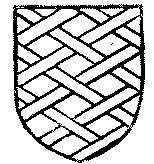
Fleming of Coniston, baronet. Gules a fret argent.
The family conformed to the established religion in the time of Elizabeth and James I, for William Fleming was a justice of the peace in 1600, (fn. 16) in which year he died, (fn. 17) and his sod John was high sheriff in 1610–11 (fn. 18); John, however, was afterwards reconciled to the Roman Church and paid large sums as a recusant. (fn. 19) He made a settlement of his estate about 1640 for the benefit of his son William, a minor, (fn. 20) and appears to have died at the beginning of the Civil War, his estate being sequestered as that of 'a Papist and delinquent.' Though William Fleming was a minor and died before attaining his majority his manors and lands were sequestered in 1643 for his 'popery and delinquency.' The heir was a cousin William Fleming of Skirwith, who in 1647 compounded for his delinquency in being in arms against the Parliament. He and his descendants were Protestants, and his grandson Sir George Fleming, second baronet, was Bishop of Carlisle 1735–47. The manor descended in the male line (fn. 21) to the bishop's grand-nephew Sir Michael le Fleming, who died in 1806, leaving an only daughter Anne Frederica Elizabeth, who married her cousin Sir Daniel Fleming, the heir male. He died without issue in 1821, but his widow lived till 1861, and by her dispositions the estates went to cousins. Of these Andrew Fleming Hudleston died soon after her, unmarried, and then Major-General George Cumberland Hughes succeeded. He assumed the surname Le Fleming in 1862 and at his death in 1877 was succeeded by his son, Mr. Stanley Hughes Le Fleming of Rydal, the present lord of the manor. (fn. 22) The baronetcy has descended to the heir male, Sir Andrew Fleming Hudleston Le Fleming, eighth baronet.

Coniston Hall: The North Front
Courts are held every year, usually in June, at Coniston Hall, by the steward, who has in his custody court rolls going back to 1806. There are two parts of the manor, Above Beck and Below Beck. A fine of £2 called 'income' is paid by each tenant on his first entry. The usual fines are twenty times the rent on change of tenant, and on the death of the lord seventeen times the rent is paid in Below Beck and fifteen times in Above Beck. Officers called Common-lookers and Pinfold-lookers are appointed. (fn. 23)
In the registers (at 1645) is an account of the tenements from which the constable was chosen in a seventeen-years' cycle: Uppermorewdale (High Yewdale), Smartfield, Dixonground, Huthwaite or Howthwaite, Nether Udall, Bowmanstead, Silverbank, Howhousebank (Hawsbank), Far-end, Outrack, Cragamidden (unknown), Overmore Little Aray (Arrow), Brow, Nethermore Little Aray, Holywath, Cotebank or Catbank, Parkyeat.
CONISTON HALL (fn. 24) stands near the edge of the lake about three-quarters of a mile south-east of the village, and is an interesting building, the plan of which is an adaptation suited to the site of the central hailed house with east and west wings. The building, however, was never H-shaped, the east wing being very short, and on the north side only attached to the main building at its north-east corner, while the hall, owing no doubt to the low and damp nature of the site, was on the first floor. The house is probably that built by William Fleming in the reign of Elizabeth, no satisfactory evidence of earlier work being forthcoming. The walls are constructed of the hard Silurian stone of the district with a thin covering of rough-cast, and no wrought stone remains except in the fireplaces, the old windows being all of oak. The house seems to have been deserted about the second decade of the 18th century, (fn. 25) and fifty years later it is described as an ivy-covered ruin. About 1815 it was patched up into a farm-house, and has since been so used. The ruined north-east wing was left untouched, and an inclined way 13 ft. wide was built on the north side to the level of the hall floor, the main part of the house, including the hall, being turned into a barn. At a later date the old oak was carried off, and more recently the west wing and chimneys have been newly cemented. The roofs are covered with modern slates, and many of the windows are modern insertions, but the large cylindrical chimneys, the ivy-covered walls and its position adjoining the lake give it a picturesqueness not shared by many buildings of far greater architectural pretensions. (fn. 26)
The house faces north and south with the lake on its east side, the entrance having been on the north through a lean-to building, which may have been an addition, in the angle between the main and the west wings. The hall was probably entered only from the screens at the west end, to which access must have been obtained by a staircase from the ground floor now destroyed, the only stairs now remaining being those to the kitchen, which was on the ground floor at the south end of the west wing. The hall probably occupied only the western half of the present barn, which would originally include at its east end the parlour or withdrawing room, with another room above within the roof. The present entrance from the causeway is a modern squareheaded opening, 9 ft. wide by 11 ft. high, broken through the wall, its east jamb probably about marking the extent of the hall proper, which would be divided from the chamber beyond by a wooden partition now destroyed. The hall would be about 26 ft. by 23 ft., with the dais at the east and the screens at the west end. Portions of the screen in panelled oak still remain, between two later blocked-up doors, and the west wall beyond, which retains its original timber framing, is open to the roof like the rest of the main block, the height of the walls of which to the wall-plate is 12 ft. The fireplace, which is on the south side and of red sandstone, is 10 ft. wide by 8 ft. high, but is now blocked up, and opposite to it is a large window, also blocked up, the opening measuring 7 ft. by 6 ft. 6 in., and there was also a window at each end of the dais, north and south. At the south end of the screens is a narrow window splaying outwards in a rather curious manner in the thickness of the hall chimney and the outer wall of the west wing, and above the screen a window overlooking the hall from one of the upper rooms. The room at the east end of the main block was 23 ft. by 21 ft. 6 in., with a large fireplace in the east wall, which still remains, and a window on each side, both of which are now blocked. The room above in the roof was lighted by one small east window, and together with the withdrawing room was approached from the ground floor by a circular oak staircase in the thickness of the wall in the north-east corner of the main block. The groundfloor rooms below the hall and withdrawing room are low, but contain fireplaces, and were therefore evidently living rooms. The west wing is divided from the main block by a thick wall to the height of the ground floor, upon which the screens and passage rest, the main wall above being of timber. The rooms on the first floor of the west wing were probably bedrooms, and are separated by the old pugged partitions, but those on the north side have been divided up again with modern walls.
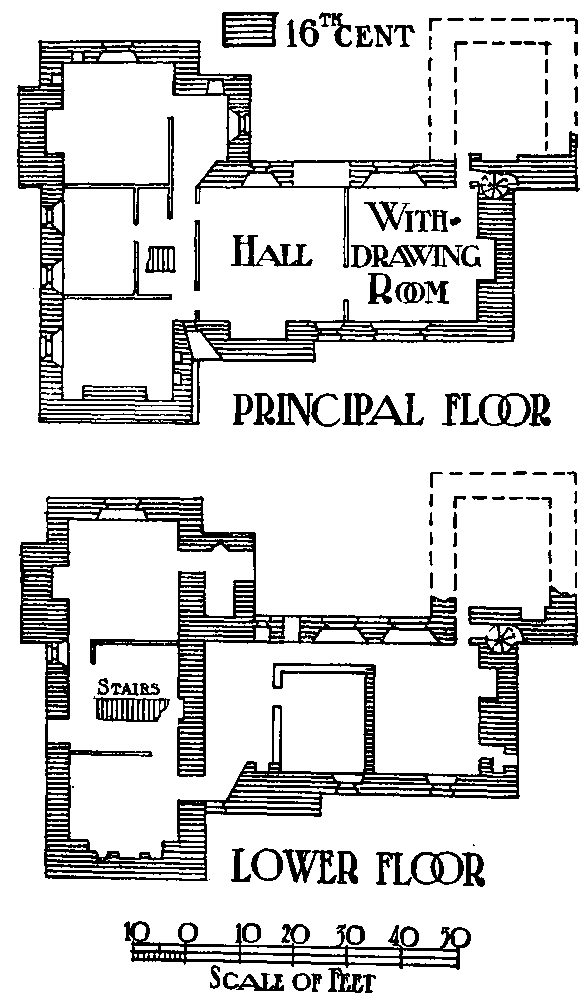
Plan of Coniston Hall
The north-east wing measured externally about 28 ft. by 24 ft., and consisted probably of one room on each floor, but only the east wall, which is 4 ft. thick, and the short south wall which connects it with the main building remain. At its south end, where it still stands its full height, is a garderobe, but beyond for a distance of about 15 ft. it is only 7 ft. 6 in. high. The fireplace at the south end of the principal room still remains on the outside, facing north, with the chimney above, but this end of the building, as well as nearly the whole of the south front, is now thickly overgrown with ivy.
The hall is said formerly to have contained wood carvings with the initials of William Fleming, and foundations of buildings have been found in a field immediately to the north of the west wing.
Another manor in Coniston was TILBERTHWAITE, anciently belonging to the Pennington family, (fn. 27) but in 1730 in the possession of Abraham Rawlinson and others. (fn. 28)
Church
There may have been a chapel of ease in this remote corner of the parish before the Reformation, but nothing definite is known till 1586, when it is said to have been 'consecrated' (fn. 29) or licensed for service. How it was then served is unknown. In 1650 it had 'no maintenance but what the inhabitants raised of themselves for the salary of Sir Richard Roule their reader.' (fn. 30) In 1717 the contributions of the people amounted to £1 19s. 10d., and £2 or a little more came from a capital stock, in the hands of six sidesmen. The chapel was then' served by a careful and diligent minister,' who taught children in the chapel. (fn. 31) The net value is now £220. (fn. 32) In 1707 the chapel was decently furnished, having a communion cup of silver. (fn. 33) The present church, now called St. Andrew's, was built in 1819 and has been enlarged; it consists of a chancel, nave and west tower. The interior was improved in 1867, and there was a restoration in 1891. The churchyard is first mentioned as a burying ground in 1594. Until 1841 it was very small; it was then enlarged, and again in 1845, 1865 and 1878. It is notable as the burial-place of John Ruskin, 1900. There is a brass from the old building to Alice Fleming of Coniston Hall (d. 1680), with a long inscription. An old oak chest is also preserved. The patronage was formerly in the hands of the Braddylls of Conishead, but about 1860 was acquired by the Rev. A. Peache, and is now exercised by his trustees.
The registers begin in 1599. They have been published down to 1700 by the Lancashire Parish Register Society. (fn. 34)
The following have been curates and vicars (fn. 35) :—
| oc. 1606 | Robert Dowson (fn. 36) |
| 1645–83 | Richard Rawling (fn. 37) |
| 1683 | John Birkett (fn. 38) |
| 1719 | John Stoup (fn. 39) |
| 1761–96 | John Strickland |
| oc. 1805 | William Tyson |
| oc. 1809 | John Hodgson |
| c. 1809 | Jonas Lindow |
| 1826 | William Travis Sandys, M.A. (fn. 40) (Pemb. Coll., Camb.) |
| 1835 | H. Siree |
| 1837 | John William Harden, M.A. (fn. 41) (St. John's Coll., Camb.) |
| 1839 | Thomas Tolming, M.A. (fn. 42) (Brasenose Coll., Oxf.) |
| 1870 | Charles Chapman, M.A. (Corpus Christi Coll., Camb.) |
| 1906 | Frederick T. Wilcox, M.A. (Dur.) |
Quakers and Anabaptists are mentioned in the chapelwarden's presentments at the visitations in the first part of the 18th century, but it does not appear that they had any meeting-places within the township.
The Primitive Methodists had a chapel from 1859 till recently, when it was made into a Masonic Hall. The Wesleyan Methodists have had a church since 1875.
The Particular or Calvinistic Baptists built a chapel at Bowmanstead in 1837. The congregation was dissolved about 1894, and the building was then used by the Plymouth Brethren. (fn. 43) These in 1903 opened a chapel of their own, and Baptists have since reoccupied their old place of worship.
The Roman Catholic Church of the Sacred Heart was opened in 1872, the mission having been begun in 1866. (fn. 44)