A History of the County of Lancaster: Volume 8. Originally published by Victoria County History, London, 1914.
This free content was digitised by double rekeying. All rights reserved.
'Townships: Kirkby Ireleth', in A History of the County of Lancaster: Volume 8, ed. William Farrer, J Brownbill (London, 1914), British History Online https://www.british-history.ac.uk/vch/lancs/vol8/pp392-400 [accessed 4 May 2025].
'Townships: Kirkby Ireleth', in A History of the County of Lancaster: Volume 8. Edited by William Farrer, J Brownbill (London, 1914), British History Online, accessed May 4, 2025, https://www.british-history.ac.uk/vch/lancs/vol8/pp392-400.
"Townships: Kirkby Ireleth". A History of the County of Lancaster: Volume 8. Ed. William Farrer, J Brownbill (London, 1914), British History Online. Web. 4 May 2025. https://www.british-history.ac.uk/vch/lancs/vol8/pp392-400.
In this section
KIRKBY IRELETH
Gerleworde, Dom. Bk.
Kyrkeby, c. 1160.
Kirkeby Irelith, c. 1200; Kyerkelith, 1201; Kyrkeby Yrlith, 1227. The local pronunciation is Kirby Irleth.
As there is an Ireleth adjacent to this township at the north end of Dalton, the name may anciently have been applied to the district, the northern half being distinguished as Kirkby Ireleth on a division. The modern postal name is Kirkby-in-Furness. The whole township has an area of 9,702½ acres (fn. 1) and has five customary divisions: Low Quarter, beside the Duddon estuary, 2,571½ acres; Middle Quarter, to the north, 1,047 acres; Heathwaite, 1,393 acres; Woodland, which has a detached part at the extreme north end, 1,315 acres; and Kirkby Moor, a narrow strip along the hills which bound the township on the east, 3,376 acres. The parish church stands at Beckside in Low Quarter, close to the boundary of Middle Quarter. The population of the whole was 1,477 in 1901.
Beckside hamlet is nearly a mile from the shore, being hidden from it by a slight hill, at the western foot of which is Sandside. Further south are the hamlets of Soutergate, Bank House and Gargreave. The surface on the east rises towards the hills. Middle Quarter is more hilly, but has level ground near Kirkby Pool, which bounds it on the west; about the centre is the hamlet called Chapels; Hallsteads is further north; and Grizebeck and Beanthwaite on the border of Heathwaite. This is a district of hills, divided by valleys opening from south-west to northeast; in its north-west corner is an open tract of moss-land. There are several extensive woods in this quarter. Woodland also is hilly, with some scattered woods, and has level and open land along Steers Pool, the boundary on the west. The chapel is about the centre, with Th;;rnthwaite to the south, Raisthwaite and Green Moor to the east and northeast; the detached part to the north is a wood called Haverigg Holme. Kirkby Moor, as stated, is the fell country at the back of the township; the peaks and spurs, rising in places to over 1,000 ft., are divided by many valleys, and contain circles, cairns and other signs of the primitive inhabitants.
The principal road is that north from Dalton through Soutergate and Grizebeck to Broughton. It has a branch to the shore at Sandside and to Beckside eastward, ascending the hills to cross to Ulverston. From this road grand views are obtained over the Duddon valley in ascending, and over the Ulverston plain and Morecambe Kay in descending to the east. At Grizebeck it is continued north through Woodland, and has a branch east to Lowick and Spark Bridge. The Furness railway line runs north along the shore, and has a station at Sandside called Kirkby.
The principal industry is that of slate quarrying, the hard blue slate of the hills on the east side having long been in great demand. The soil is gravel with subsoil of stone and slate, and the agricultural land is chiefly in pasture.
The township is governed by a parish council of ten members.
The cross which gave its name to Crosshouse, the old residence of the lords of the manor, is said to have been destroyed by Archbishop Sandys; there were traces of it till recently. (fn. 2)
Manor
In 1066 KIRKBY IRELETH seems to have been part of Earl Tostig's Hougun lordship. (fn. 3) It was in the king's hands in 1086, and in 1127 was included in Stephen's grant of a moiety of Furness to found the abbey, so that the immediate lords were afterwards stated to hold of the abbots. The pedigree of the Kirkby family can be traced to Orm son of Ailward or Eiward, to whom, as formerly stated, Albert Grelley, lord of Manchester, granted a knight's fee in Wrightington, &c, in marriage with his daughter Emma. (fn. 4) Roger son of Orm had a confirmation of Ashton and of Heaton, near Lancaster, from a later Albert Grelley, about 1160. (fn. 5) As Roger de Kirkby he attested a somewhat earlier grant of land in Copeland to Furness Abbey. (fn. 6) William de Lancaster granted Dunnerdale and Seathwaite to Roger, and the gift was confirmed by William's son William to William son of Roger probably about 1175. (fn. 7) The same William son of Roger released to the Abbot of Furness all claim to the advowson of the church at Kirkby. (fn. 8) From this time the descent of the manor is clear. (fn. 9)
Roger de Kirkby, who was the son of William, was about 1200 accused of being concerned in the death of Matthew son of Simon, and offered the king 50 marks and two chasours to be allowed his liberty on giving pledges to stand his trial if summoned. (fn. 10) He occurs again in 1212 (fn. 11) and probably died about ten years later, his son Alexander being defendant in 1225. (fn. 12) In 1227 Alexander de Kirkby released to the Abbot of Furness his claim to the advowson of the church (fn. 13) and also to 4 oxgangs of land in Kirkby. (fn. 14) In 1252 he granted the monks a part of Stephengarths adjoining their grange of Dunnerholme. (fn. 15) His younger son John was in possession in 1257 (fn. 16) and died about 1284, (fn. 17) leaving a son Alexander, (fn. 18) whose son and heir John de Kirkby was a minor in 1291, (fn. 19) his wardship being claimed by the Abbot of Furness. The abbot alleged that the manor was held of him by homage and fealty, the service of 30s. a year, ploughing, reaping, entertaining the abbot's grith-serjeant, doing suit at the court of his barony of Furness at Dalton from three weeks to three weeks and rendering a relief, if of full age, of 100s. (fn. 20) The jury refused to acknowledge the right of wardship, it being asserted that Kirkby, Pennington and Aldingham were exceptions in this respect, and John de Kirkby was placed in possession. (fn. 21)
In 1300 John son of Alexander de Kirkby gave his manors of Kirkby Ireleth and Dunnerdale to Robert de Lathom, probably as trustee (fn. 22); and later in the year they were restored to the same John and Margery his wife, with remainders to their issue and to the heirs of John. (fn. 23) Sir John de Kirkby acquired lands (fn. 24) and died about 1336, (fn. 25) his widow Margery appearing as defendant in that year. (fn. 26) His son, another Sir John, lived on till about 1382 and many of his deeds are on record. (fn. 27) One of the first, in 1337, was the procuring of a royal charter for free warren in his demesne lands of Kirkby and Dunnerdale and for the inclosure of 500 acres of land, wood and moor there in order to make parks. (fn. 28) In 1349 he did homage to the abbot, under protest that his act was not to prejudice the verdict his father had obtained in 1292. (fn. 29) He made a settlement of his manors of Kirkby and Dunnerdale in 1363, with remainders to Richard son of John, Robert son of Richard and Thomas brother of Sir John. (fn. 30) He added to the family possessions. (fn. 31) A drawing of his seal has been preserved. (fn. 32)
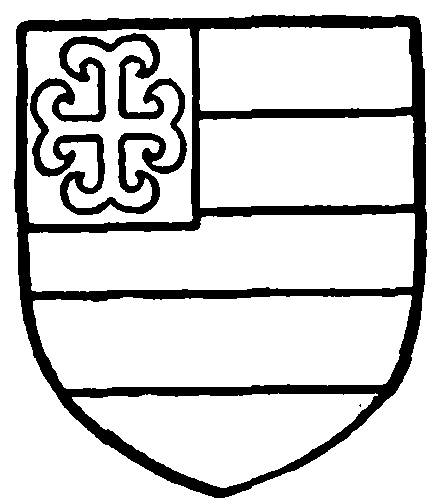
Kirkby of Kirkby. Argent two bars gules on a canton of the last a cross moline or.
Sir Richard, his son and heir, is named as early as 1356 (fn. 33) and held the manors till about 1425. (fn. 34) His eldest son Alexander, who married Isabel daughter of Sir Thomas Tunstall, died about 1402, leaving an infant daughter Isabel. (fn. 35) This led to a number of settlements for the benefit of Sir Richard's sons. (fn. 36) Isabel married Robert son and heir of Sir Robert Ogle, (fn. 37) a Yorkisr, who was summoned to Parliament as Lord Ogle in 1461 (fn. 38) and retained the manors till her death about 1474, (fn. 39) though she is said to have sold her right of inheritance in 1434–5 to Roger Kirkby, Sir Richard's second son. (fn. 40) Roger was succeeded by a son and heir Richard, (fn. 41) who left sons Henry and Richard. (fn. 42) The father as a Lancastrian was convicted of treason in 1461, (fn. 43) but the attainder was afterwards (1485) reversed and his estates allowed to his son Henry. (fn. 44)
Henry Kirkby fought at 'the Scottish Field,' i.e. Flodden, and was wounded. (fn. 45) He died in 1524 holding the manor of Kirkby in Furness with messuages called Crosshouse, &c, of Furness Abbey by knight's service; his heir was his brother Richard, aged forty. (fn. 46) This brother seems to have been a violent man and his attempt to gain possession of the estates led to a brawl in Kirkby Church, which was stayed by the intervention of the parish priest with the Sacrament and of various honest persons; but the priest took off his vestments and refused to say mass. (fn. 47) Richard Kirkby did homage to the Abbot of Furness for the manor in 1533. (fn. 48) He died in 1547 holding the manor of Kirkby with messuages, lands, woods, mills, &c, there of the king as of the late monastery of Furness by the service of one knight's fee; he had lands also in Broughton, Dunnerdale and Wrightington. His son and heir John was only three years old. (fn. 49) John Kirkby died in 1551 and the heir was found to be his kinsman Henry Kirkby, fifty years of age. (fn. 50) He had married Anne daughter of the last Richard Kirkby, (fn. 51) and at his death in 1566 left a son Roger, aged thirty-six. The manor of Kirkby, with lands there and in Torver and Dunnerdale, was said to be held of the queen as of her manor of Furness by the tenth part of a knight's fee. (fn. 52) A survey of the bounds was made about that time. (fn. 53)
Roger made a settlement of his manors in 1582, (fn. 54) and was still living in 1613, when a pedigree was recorded. (fn. 55) His eldest son Richard having died in 1587, leaving a son Roger, aged five, (fn. 56) this Roger succeeded his grandfather, and was about 1627 followed by his son, another Roger, (fn. 57) who died in 1643. This last Roger Kirkby was returned for Lancaster in the Short Parliament of 1640 (fn. 58) and for the county in the Long Parliament later in the same year. As a Royalist he was disabled from sitting in August 1642 (fn. 59) and soon afterwards removed from the list of justices. (fn. 60) In December he was acting as one of Lord Derby's council in Lancashire, being appointed one of the collectors of the subsidy in Lonsdale Hundred (fn. 61) and having charge of Lancaster Castle. (fn. 62) In the summer of 1643 he organized the Royalists of Cartmel and Furness, intending to relieve Thurland Castle, (fn. 63) but seems to have died before any fighting took place. His son Richard, about sixteen years of age, succeeded, and, taking arms against the Parliament, had his estates sequestered. He soon surrendered, taking the Negative Oath in November 1645 and the National Covenant the following August, when he made his petition. He was allowed to compound for a fine of £750 but had also to settle £75 a year on the minister of Hawkshead, he being the lay rector. (fn. 64) He survived the Restoration and it is said he was named as one of the proposed knights of the Royal Oak (fn. 65); he served as member for the borough of Lancaster from 1660 till 1681, (fn. 66) and recorded a pedigree in 1664. (fn. 67)
Colonel Richard Kirkby died 9 September 1681, (fn. 68) and was succeeded by his son Roger, born about 1650. Roger Kirkby also succeeded his father in the representation of Lancaster, 1685 to 1702, being regarded as a Tory. (fn. 69) He made a feoffment of his manors in 1689, (fn. 70) and mortgaged Kirkby to a London banker, agent to Catherine Duchess of Buckingham, who acquired it on her agent's insolvency. She left it to her grandson Constantine Phipps, (fn. 71) created Lord Mulgrave in 1767, and he in 1771 sold it to Lord John Cavendish, son of the third Duke of Devonshire. The heir male of Roger Kirkby, who owned Ashlack, was the nominal lord of the manor, but found it so encumbered that he could not clear it, and therefore passed away all right in it. (fn. 72) After Lord John's death (fn. 73) in 1796 the manor became united with the Furness Abbey and Holker estates of the Cavendish family and has since descended in the same way. A chief rent is paid to the Earl of Dalkeith as lord of Furness.
A court baron is held for the manor. The customs of the manor (fn. 74) were thus described in 1774: Each tenant on admittance paid the lord twenty years' rent as a fine; a widow during widowhood was entitled to half her husband's tenement; the tenant forfeited all to the lord for treason or felony, while for wilful perjury he paid twenty years' rent and for petty larceny ten years' rent. No one could let his land for more than seven years without the lord's permission. Every entire tenement had formerly been obliged to keep a horse furnished for the king's service, and to give as a boon a day's ploughing and harrowing. (fn. 75)
KIRKBY HALL, (fn. 76) originally known as the Crosshouse, stands about a mile to the north of Beckside village on an eminence gently sloping to the south, from which side it is approached through a modern avenue of beeches and sycamores leading to an open space in front of the house. The building, now a farm-house, is of two stories, with rough-cast walls, cylindrical chimneys and slated roofs, and externally is of little architectural interest, the windows being all low mullioned openings without transoms, and the roof at the south, or principal, front having an unbroken ridge with overhanging eaves and a hip at the west end, which gives the house a rather undistinguished appearance. The plan, however, is interesting. The hall occupies the middle of the house with a parlour or withdrawing room at the west end, to the north of which is a smaller room, forming a north-west wing under a lower gabled roof. The east wing, which is set at an irregular angle to the front and goes back about 60 ft., contains the kitchen and other rooms on the ground floor and may be the oldest part of the house, (fn. 77) and attached to it at the north end is a small wing running eastward of two stories, which was at one time accessible both from the kitchen and from the room above. To the south-west of the front is a detached building measuring externally 32 ft. by 24 ft., now cut up for farm purposes and a good deal modernized, standing at a different angle, the original use of which can now scarcely be determined. The south front is 76 ft. in length, with low mullioned windows to both stories and a doorway with depressed fourcentred red sandstone arch and splayed and moulded jambs. The door opens to the east end of the hall by a passage, at the north end of which is a circular oak staircase. The partition is modern, but apparently takes the place of an older screen. The hall measures about 25 ft. by 24 ft. up to the partition and is lit on the south side by two windows, one of three lights and the other a bay 8 ft. wide by 5 ft. 6 in. deep, of four lights and one on each return, in the south-west corner. There is also a single-light window, now blocked up, in the north-east corner, and on the north side a fireplace opening 9 ft. wide with segmental arch. From the hall a door opens in the south-west corner to the parlour or withdrawing room, now divided into two by a partition, but originally 24 ft. by 12 ft. 6 in., lit at the south end by a window of four lights and by a widely splayed opening in the west wall to the north of the fireplace. From the north-west corner of the hall an oblique passage with hollow-chamfered doorway leads to a small room now used as a dairy, 13 ft. 6 in. by 9 ft. 9 in., which has been lighted by at least two windows, one only of which, in the north-west corner, a narrow single light, now blocked up, retains its dressings. The east wing contains three rooms on the ground floor, the largest of which, on the north side, measuring 22 ft. by 16 ft. 6 in., is the kitchen. The fireplace opening at the north end is 11 ft. wide, but is now built up and a modern range inserted. In the west face of the chimney recess a small door opens into a closet 5 ft. by 3 ft. in the thickness of the wall, lit by a small window now blocked up, and there is a closet about 9 ft. long on the first floor immediately above. The kitchen is lit by a window on the east side, but there are also a narrow window at the north-west corner and a doorway immediately opposite, leading to the later north-east wing, both of which are built up. The south end of the east wing is occupied by an irregularly shaped room 18 ft. 6 in. by 13ft. 6 in. lighted by a three-light window to the front, and between this and the kitchen is a small room, now used as a coal cellar, originally lit by two narrow windows on the east side, one high up in the wall and oblique. (fn. 78) The staircase is 8 ft. in diameter with solid treads round a plain wood newel and is lighted from the outside and by a narrow opening to the kitchen at the first half-turn.

Plan of Kirkby Hall
The upper floors are at different levels, the hall being higher than the other ground floor rooms in the end wings. The front room of the east wing contains a fireplace with depressed four-centred arch, over which is a plaster panel with floral ornamentation and originally a shield with the arms of Kirkby, the mantling and cap of maintenance of which alone remain. Behind this room and over the 'coal cellar' is a small chamber known as the Skull Room, in which some niches are pointed out in the wall in which human skulls, the legend of which is now forgotten, are said to have stood. Over the hall are two bedrooms and a passage, the bedrooms divided by a partition said to have been formerly covered by oak panelling. (fn. 79)
The west wing had originally a gable to the front, facing down the avenue, the present hipped roof, the west slope of which is continued straight up till it joins the main roof above the hall, being quite modern. The upper floor was occupied by the chapel, a room 26 ft. by 14 ft., the flooring of which has been removed and to which access can now only be obtained by a trap-door in the ceiling of the passage or from the roof above the bedrooms. There was formerly a door to the west wing on the first floor in the corner of the room above the passage from the hall to the dairy, but this is now built up. The 'chapel' is divided into two bays by a king-post roof truss, and there is a three-light mullioned window at the south end and another at the north. It has two oak-framed doors, one of which on the east side led to the rooms above the hall and the other on the north to a room over the present dairy. The chapel, however, is chiefly remarkable for its mural decoration, (fn. 80) which consists of panels with birds, animals, texts and other inscriptions, all painted on plaster. The walls, which are 7 ft. high to the wall-plate, were probably at one time painted all over, but only fragments of the painting now remain, the east wall being the best preserved. It contains the Lord's Prayer and the Ten Commandments, with a decorated border dividing and inclosing two panels, the border apparently at one time having been continuous round the chapel. On the south side was the Creed, and there are remains of a text at the north end taken from Cranmer's Great Bible of 1541. On the west side the painting has been obliterated.

Kirkby Hall: South Front
In front of the house there is a small garden inclosed by a fence wall, upon which is a loose detached stone, two sides of which are carved with the arms of Kirkby and Lowther, the shields joined together at the angle by clasped hands, while on the third side are the initials of Roger and Agnes Kirkby with the date 1639, and on the fourth the initials of eleven of their children, five sons and six daughter, The stone, which may have formed part of a sundial, was found in the farmyard.
There were some minor families taking their name from Kirkby. (fn. 81) while others were surnamed from Ashlack, (fn. 82) Heathwaite, (fn. 83) Thornthwaite (fn. 84) and other estates (fn. 85) of which no continuous records exist.
ASHLACK HALL (fn. 86) stands about half a mile to the north-east of Grizebeck village on high ground in a sheltered hollow between the fells; which rise almost immediately behind the house on the north and west, the south side being open. The building, now a farm-house, is of two stories with rough-cast walls and slated roofs and is of late 16th or early 17th-century date, much modernized in the interior. It is cruciform in plan, but the east wing consists of stables and outbuildings, and the north limb, which is short and broad, is the result of alterations about the time of Charles II. The original building was [capital L]-shaped, the longer or south wing measuring 50 ft. 6 in. in length to the interior angle and the west wing 44 ft. All the windows in this portion facing west and south, as well as those at the end of the south wing, are the original low mullioned openings with external hood moulds, all of three lights, with the exception of a two-light window over the entrance, which is in the middle of the south wing, facing west. The door is square-headed with hood mould, and on a plaster panel above is the date 1667 with the initials of William Kirkby, but the date is probably later than this part of the building and was most likely put up at the time when the alterations and additions were made on the north. These consist of a large kitchen 20 ft. 6 in. by 18 ft. 3 in., which, with an adjacent staircase on the north-west, forms the north limb of the cross, and an east wing about 46 ft. in length, now used for farm purposes. The north limb projects only about 11 ft. m face of the main building, but has a frontage of 46 ft. The gables are all quite plain and covered with roughcast and without barge-boards, and the chimneys are of the cylindrical type common in the district. The house is architecturally without much interest. Originally the hall appears to have been at the north end of the south wing, measuring about 25 ft. by 20 ft., lighted by a single window on the west and with stairs leading from it on the east side between two walls. In the south-east corner of the hall are doors leading to two smaller rooms, one probably the withdrawing room, 18 ft. square, divided from it by a wall 6 ft. thick, and the other nearer the stairs, a parlour 13 ft. square, below which are cellars lit by original two-light windows. In the west wing are two rooms divided by a wall 8 ft. thick, one of which was probably the kitchen. The outer one, which is 21 ft. by 17 ft., is known as the Stone Parlour and is now a dairy. The hall is now cut up with modern walls and is reduced in size by the new additions, which encroach on it at the north end, the new kitchen chimney forming a mass of masonry 13 ft. thick in the centre of the house. The additions are loftier than the older parts of the building and the walls are of less thickness. The north wing is lit by tall wooden mullioned and transomed windows and there are remains of blocked windows on the north side of the west wing. The old entrance retains its oak nail-studded door and there is some 18th-century panelling in a large room over the kitchen, now divided by partitions.
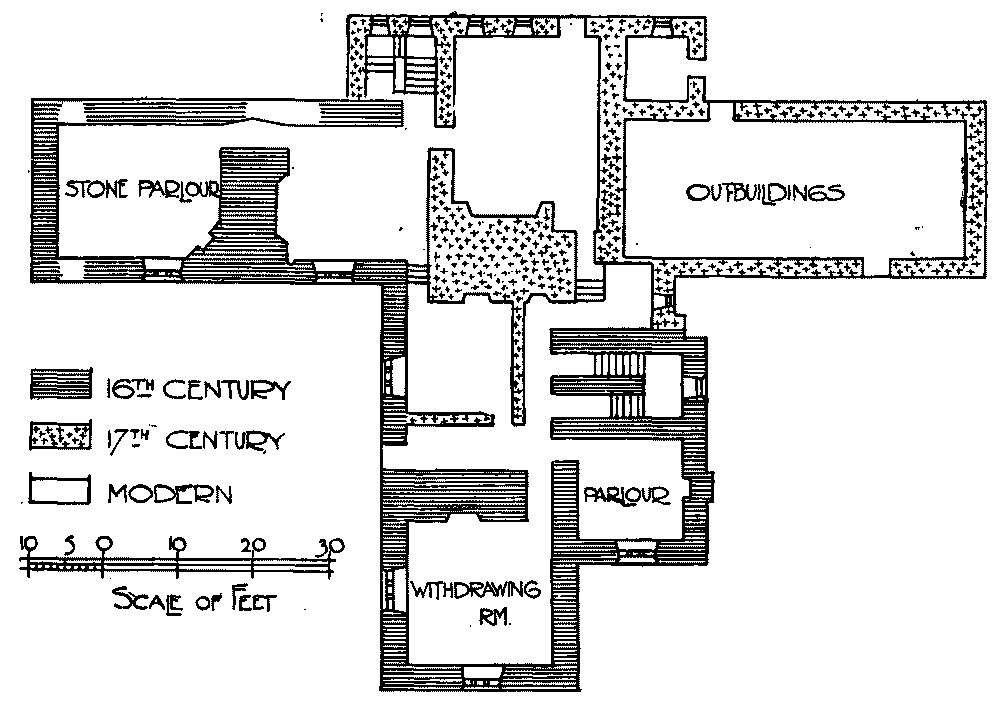
Plan of Ashlack Hall
Richard Dodgson and John Whinfield of Kirkby and George Ashburner of Woodland were freeholders in 1600. (fn. 87)
As above shown, Furness Abbey had land in Kirkby. In 1300 the abbot complained of the cutting down of his trees. (fn. 88) In 1535 a rent of 5s. 6d. was drawn from Soutergate. (fn. 89)
The parish church at Beckside has been described above. The chapel at WOODLAND is of preReformation date, but its origin is unknown. (fn. 90) It was served by a 'reader' in 1650; as it had no endowment, the inhabitants contributed a small sum yearly. (fn. 91) It had about £7 a year in 1717. (fn. 92) The minister of Broughton in 1734 obtained the Bishop of Chester's licence for the chapel of Woodland, and going to it on the Sunday was opposed by Mr. Holme, vicar of Kirkby Ireleth, by virtue of the Dean of York's licence. Mr. Holme would not allow the doors to be opened and took the key away with him. At noon, however, the doors were opened—how is not stated—and the minister of Broughton went in, read the prayers and preached a sermon. (fn. 93) It may perhaps be inferred that there was no regular service at Woodland just then. The old chapel, rebuilt in 1689 and 1822, was replaced by the present church of St. John the Evangelist in 1864. (fn. 94) The benefice is styled a rectory (fn. 95) and the patronage is vested in five trustees, of whom the Bishop of Carlisle is one. The net annual value is stated to be £185. (fn. 96) At Grizebeck is the church of the Good Shepherd, opened in 1898, which serves as a chapel of ease. The following have been incumbents:—
| — | John Kendall |
| 1821 | William Sandwith |
| 1851 | Edwin Gilpin |
| 1860 | Richard Palgrave Manclarke, M.A. (fn. 97) (Wadham Coll., Oxf.) |
| 1868 | Edwin Charles Shawfield (fn. 98) |
| 1893 | Henry Arthur Ditchett (fn. 99) |
| 1894 | James Park, B.A. (fn. 100) (Christ's Coll., Camb.) |
There is a Wesleyan Methodist chapel at Marshside. A Baptist chapel near St. Mary's Well in Middle Quarter was opened about 1826. A new chapel was built at Wall-end in 1876, but this is now occupied by 'Christian Brethren,' who purchased the old chapel and then moved to the new one. (fn. 101)