A History of the County of Lancaster: Volume 8. Originally published by Victoria County History, London, 1914.
This free content was digitised by double rekeying. All rights reserved.
'Townships: Broughton ', in A History of the County of Lancaster: Volume 8, ed. William Farrer, J Brownbill (London, 1914), British History Online https://www.british-history.ac.uk/vch/lancs/vol8/pp400-406 [accessed 2 May 2025].
'Townships: Broughton ', in A History of the County of Lancaster: Volume 8. Edited by William Farrer, J Brownbill (London, 1914), British History Online, accessed May 2, 2025, https://www.british-history.ac.uk/vch/lancs/vol8/pp400-406.
"Townships: Broughton ". A History of the County of Lancaster: Volume 8. Ed. William Farrer, J Brownbill (London, 1914), British History Online. Web. 2 May 2025. https://www.british-history.ac.uk/vch/lancs/vol8/pp400-406.
In this section
BROUGHTON
Borch, Dom. Bk.; Broctun, c. 1140; Barton, c. 1160; Brocton, 1196.
To distinguish this township from others of the like name it is usually called Broughton-in-Furness, or sometimes West Broughton. It has an area of 7,297½ acres, (fn. 1) extending north-east along a hilly ridge between the level open valleys of Steers Pool and the Lickle, streams flowing into the Duddon. The height of the ridge gradually increases, till at Lag Bank over 1,250 ft. above the sea is attained, and a little further north, on the border of Seathwaite and Torver, about 1,800 ft. There are numerous bits of woodland, but of no great area on the whole. The population numbered 1,117 in 1901.
The chief place is the little town of Broughton, situated on the southern slope of the ridge named, from 50 to 100 ft. above the sea and looking southwest over Duddon Sands. To the north of the main road through it is the square, with an obelisk in the centre (fn. 2); from the upper side ascends the drive to Broughton Tower, the ancient seat of the lords of the manor. About a mile south of the town is Eccle Riggs, the seat of Viscount Cross. There are a few small outlying hamlets, as Duddon Bridge (fn. 3) to the west, Greenslack and Greedy Gate by the sands to the south, Aulthurstside, Rosthwaite and Borderriggs to the east. Bleansley and Broughton Mills are on the Lickle; Hawthwaite, Wallenrigg and Appletreeworth are to the north-east of the town. In the vale to the south-east is White Moss.
The principal road is that from Dalton and Barrow into Cumberland, crossing the township from southeast to north-west, passing through the town and going over High Cross Brow to descend into the Duddon Valley, crossing the bridges over the Lickle and Duddon and then turning south to Millom. This road is crossed by two which begin at the Duddon shore and ascend the valleys at each side of the ridge, the more southerly going by Torver to Coniston and the more northerly by Broughton Mills into the hills of Dunnerdale and Seathwaite. The main line of the Furness railway enters the township at the southern corner and runs towards the shore for a mile and a half to Foxfield; here it turns west to cross the Duddon estuary. From the same point a single-line branch goes northeast to Coniston. There are three stations: Foxfield Junction, Broughton, and Woodland. The line was opened as far as Broughton in 1848.
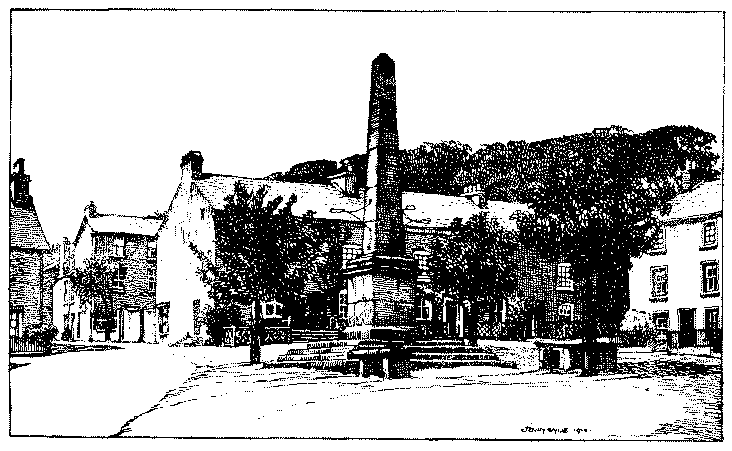
The Square, Broughton-in-Furness
Fr. West's description of the town in 1774 is of interest:—
This place is so much improved by the late lord and the inhabitants that it has the appearance of a new town. It has a weekly market on Friday and a fair for all sorts of merchandise on the 1st day of August. The principal commodities are woollen yarn spun by the country people and brought to the market, always open to receive any quantity. The annual return on this article is upwards of £4,000 per annum. Blue slate is another important article, of which 2,000 ton is exported per annum. Sheep, short wool, and black cattle of the longhorned kind are the produce of this district. The country is mountainous and contains in its bowels minerals, slate, copper, &c. The quantity of arable land is but small in proportion to the wastes and commons in this manor; yet the examples of improvements given in the environs of Broughton are more attended to than in Low Furness, where the materials of cultivation are much easier come at. The town is situated on ground sloping to the south; the plan of it is a regular square; the houses are all built of stone, neat, commodious, and covered with slate, which makes a good appearance. Broughton Tower stands on the summit of the hill, above the town, and has a commanding view of the estuary of Duddon. (fn. 4)
Broughton at one time consisted of a series of hamlets, viz. Kepplewray, Church Town, Sykehouse, &c. Church Town comprised the street now known as Old Street or Church Street, together with the Kirkhouse, now known as the "Old King's Head." These were all situate in the Rectory lands, a portion of the original endowment of the church.' (fn. 5)
The little town was of some importance in the coaching days, and still has its weekly market on Wednesday and three fairs. There was also a shipping place on the Duddon for the mineral products of the district.
The August fair mentioned is of some standing, but its origin is unknown. Probably it arose after the fall of the abbey and before the Civil War, i.e. 1540–1640. The proclamation is annually made by the steward of the lord of the manor, ordering all to keep the peace, to bear no 'bill, battleaxe or other prohibited weapons,' to buy and sell in the open market and not in 'corners, back sides, or hidden places,' and to use lawful measures. (fn. 6)
Making brush stocks and wooden hoops has long been the chief trade. There are also slate and stone quarries. The soil is gravel with subsoil of slate, and the land is mostly in pasture.
There is a parish council of seven members. Water is supplied by a local company.
In addition to Lord Cross the town has had a resident of distinction in another way, the artist D. A. Williamson having spent the latter part of his life there, from 1864 to 1903. A politician and temperance reformer connected with it was the late William Sproston Caine, M.P. for Barrow 1886–90, who died in 1903.
Manor
In 1066 Earl Tostig held 'Borch' as part of his lordship of Hougun; it was assessed as six plough-lands. (fn. 7) It is possible that BROUGHTON preserves the name, but the later manor of Broughton seems to have been in the Fells, for it was held of the Lancaster family as a member of their barony of Ulverston. Probably it became attached to this lordship after the partition of Furness Fells about 1160, William de Lancaster choosing the western moiety, which would include Broughton and Dunnerdale. (fn. 8) It must therefore have been this William de Lancaster who gave or confirmed Broughton to one Ailward de Broughton to hold of him by knight's service. (fn. 9) From his surname it may be assumed that Ailward was already in possession of some estate there. (fn. 10)
The story of the Broughton family is very imperfectly known. Their evidences appear to have been lost, and their names occur but seldom in the records. Ailward's son may have been the Ulf son of ' Afward ' who about 1180 granted 4 oxgangs of land in Urswick to Roger son of Augustine de Heaton, (fn. 11) but the next certain lord of Broughton to occur is Simon de Broughton towards the end of the 12th century. (fn. 12) Then comes Simon son of Matthew, who in 1235 agreed with Alan de Kirkby about his land in Angerton Moss. (fn. 13) He is called Sir Simon about 1250, (fn. 14) and had a son Richard, (fn. 15) likewise styled a knight about 1280. (fn. 16) Sir Richard was followed by a son John, soon succeeded by a brother Richard. (fn. 17) Richard son of Richard de Broughton in 1292 appeared to warrant Thomas Skilhare in the possession of land in Angerton Moss, and had in consequence of a claim by Adam de Kirkby to find him equivalent land elsewhere. (fn. 18) Being of full age that year, he claimed the third part of the manor of Broughton against Philippa widow of Roger de Lancaster, for she had no entry except through Roger, who had had custody during Richard's minority. He was non-suited. (fn. 19)
Nicholas de Broughton was in possession by 1299, (fn. 20) but his relationship to Richard does not appear. About 1326, for the souls of himself, Christiana his wife, his parents and others, he confirmed a further gift in Angerton Moss to Furness Abbey. (fn. 21) He was still living in 1340, (fn. 22) but by 1346 had been succeeded by Christopher de Broughton, summoned to show why he had not received knighthood, his lands being returned as worth over £40 a year. He replied that his lands were not so valuable; he held two plough-lands at Broughton, a hamlet of the vill of Ulverston, also 20 acres of meadow and 20 marks of rent; from Subberthwaite, another hamlet of Ulverston, he had 6 marks rent. An inquiry held in 1349 showed that he had lands and rents in Broughton, Subberthwaite and Urswick, the total value being £37 1s. a year. This being under the £40, he was allowed to go free, (fn. 23) but in the same year he is found described as a knight. (fn. 24) Thomas de Shelton and Joan his wife in 1358 complained that Sir Christopher de Broughton and others had abducted Christopher the son and heir of Joan and a minor. Sir Christopher said that John, the father of the heir, had held an oxgang of land of him by knight's service, so that when John died at Broughton he became seised of the wardship of the heir. (fn. 25) Another Christopher, not a knight, succeeded by 1378, when he recovered the manor of Broughton and lands and rents there and in Ulverston and Little Urswick. (fn. 26) He occurs in 1404–5.
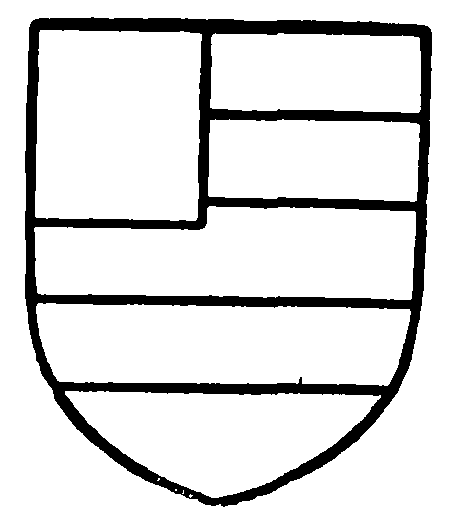
Broughton of Broughton. Argent two bars and a canton gules.
John Broughton and Margaret his wife in 1432 made a feoffment of the manor of Bolton Adgarley. (fn. 27) Ten years later he had some quarrel with Sir John Pennington, (fn. 28) but it appears to have been amicably settled, for in 1452 his daughter Isabel was contracted to marry John son of John Pennington. (fn. 29) Then follows the Sir Thomas Broughton with whom the line ends. (fn. 30) He was a staunch Yorkist, and on the landing of Lambert Simnel's force at Piel in 1487 he and his brother John joined them, taking part in the battle of Stoke and enduring the consequent attainder and forfeiture. (fn. 31) A local tradition averred that Sir Thomas escaped alive from the field of battle and lived in obscurity at Witherslack, which had been one of his manors. (fn. 32)
His forfeited estates were granted to the Earl of Derby, (fn. 33) and descended like Knowsley (fn. 34) until the losses of the family in the Civil War compelled the eighth earl to sell the castle and manor of Broughton, together with the bailiwick of Lonsdale Hundred, to Edward Lee (or Leigh) in 1653–4. (fn. 35) His son the ninth earl afterwards endeavoured to recover it, but the sale was confirmed or held to be valid. (fn. 36) In 1658 Edward Lee and Mary his wife sold the estate to Roger Sawrey, (fn. 37) a Parliamentarian in politics and a zealous Anabaptist in religion. (fn. 38)
Roger Sawrey (fn. 39) was succeeded by a son Jeremiah, who by his wife Anne daughter of Richard Gilpin (fn. 40) left a son and heir Richard Gilpin Sawrey. (fn. 41) He died without issue in 1755, having bequeathed his estate to a cousin, John Gilpin, who took the name of Sawrey and was the author of the improvements in the town recorded in 1774. He died in 1773, (fn. 42) leaving a son and five daughters. The son, John Cookson Gilpin Sawrey, died without issue in 1799, and the manor passed to his sister Sarah, who in 1787 married John Bertrand Baubec de Brouguens (fn. 43); their second son John assumed the name of Sawrey on succeeding. He died in 1881, and by bequest his estate went to a kinsman James Cookson of Neasham Hall, Durham, who assumed the additional name of Sawrey. (fn. 44) He died in 1888, and his widow Mrs. Georgina Margaret Sawrey-Cooksor. is now lady of the manor. (fn. 45)
BROUGHTON TOWER stands on high ground at the north side of the town, and is approached by a fine avenue of trees. (fn. 46) It consists of what appears to be a 14th-century keep, or tower-house, incorporated into a modern mansion, but except for the external walls very little of the original structure remains, nearly all its distinguishing architectural features having been lost in successive alterations and rebuildings. The tower is rectangular in plan, measuring internally 42 ft. 6 in. by 32 ft., the greater length being from north to south, with walls varying in thickness from 5 ft. to 7 ft., constructed of rubble masonry with red sandstone quoins, and terminating in an embattled parapet. The keep consists of a basement and three upper stories, but externally it is only visible its full height of about 60 ft. on the north side, where it remains, with the exception of the windows, substantially unaltered. On the south side the top of the tower only, with a new parapet, is seen behind the modern buildings which have been erected in front of it and which now form the greater part of the house. There were additions to the tower before the present modern buildings were erected, but when the first of these was made it is impossible to say. When Roger Sawrey came into possession he found ' barns and other necessary outhouses attached to it.' These he repaired, and he is said to have erected a 'parlour and chamber over it.' It does not appear, however, that the additions made by him were very extensive, and they seem to have been superseded by later work, the effect of which has been to convert the building into a modern residence. These were chiefly made at two periods, the first by the Gilpin Sawreys in the 18th century, and the second by Mr. Sawrey-Cookson shortly after 1881.
The basement of the tower has a barrel vault, but all the windows have been built up and it has been otherwise altered. The hall was on the ground floor, the chamber above, and the second floor was probably occupied by sleeping apartments, all approached by a vice in the thickness of the wall at the south-east corner. The vice yet remains, but all its openings, both doors and loophole windows, have been built up, and it now gives access to the roof only from the basement, from which level it is approached by a passage in the east wall, in which there remains a pointed outer doorway with hollow chamfered jambs and head, now opening into the later 18th-century building. An inner pointed doorway gives direct access to the basement room, which commonly goes by the name of the 'dungeon.' The whole of the interior of the ancient part of the house has been modernized, and the windows are all 18th-century insertions with pointed heads. The original leaded roof has been replaced by a gabled one of slate. On the middle merlon of the old embattled parapet on the north side is carved a shield with the arms of Broughton, and above the first-floor window on the same side are the remains of a square hood mould. The 18th-century additions, which include the middle part of the south or principal front, and the east and west wings adjoining the tower on the north side, appear to have been erected about the middle of the century, the date 1744 being on a spout-head at the back. (fn. 47) The south front, which is two stories in height above a lofty basement, has ogee-headed sash windows and an embattled parapet—a rather early example of the characteristic ' Gothic' architecture of the period. Over the west wing at the back is a bell-turret containing a bell dated 1747; and two spout-heads, one on each wing, at the back, have the date 1777 and the initials E. S. On either side of the 18th-century south front are the projecting wings in the form of towers, and in a similar style of architecture, added by Mr. Sawrey-Cookson, that on the east being wider than the other and having a small round tower on the east side.
The services of the tenants were in 1774 described as 'few and reasonable.' On admission a fine of 20d. was paid to the lord; there was an ancient annual rent with suit and service of court. The tenant could alienate or mortgage any part of his estate, as he desired, upon paying 10s. to the lord. The woods were free. (fn. 48) These customs are still maintained. The manor courts are regularly held about 23 April each year. The court rolls go back to the 16th century. (fn. 49)
TROUGHTON HALL, at the north end of the township, probably commemorates a family once seated in Broughton. (fn. 50) Richard Fleming purchased a messuage from John Troughton in 1573, (fn. 51) and sold it to Ralph Latus in 1597. (fn. 52) Edward Rigby of Burgh in Duxbury died in 1627 holding a messuage called Troughton Hall in Broughton, a garden, &c, and common of pasture for all cattle in the wastes of Broughton. (fn. 53) The Rigbys appear later in Furness, (fn. 54) fighting on the king's side in the Civil War. Their estate here may explain how it came about that Troughton Hall was in 1625 subject to a rent-charge of £18 for the benefit of Standish Grammar School, the trustees of which afterwards obtained possession and still own the estate. (fn. 55)
From its position to the west of the Lickle BLEANSLEY should have been included in the grant of Dunnerdale to the Kirkby family, but it is probable that the lords of Broughton had an earlier title to it, and so it was retained in this township. In 1292 Richard son of Richard de Broughton was non-suited in a claim against Robert son of John de Kirkby for a tenement in Bleansley by right of inheritance. (fn. 56) In the 16th century a family called Ellison or Elletson lived at Bleansley, (fn. 57) and may have been the ancestors of Robert Elletson of Broughton who in 1631 compounded for refusing knighthood by a fine of £10. (fn. 58) He was, perhaps, the same Robert whose estate stood sequestered by the Commonwealth authorities in 1650. (fn. 59) James Towers had been treated similarly. (fn. 60)
There are but few references to Broughton in the records. (fn. 61) In 1552 the Earl of Derby complained that various persons had been hunting in Broughton Park near Hangman's Oak and killed three 'tegges.' (fn. 62)
An inclosure award was made in 1847.
Church
The church of ST. MARY MAGDALENE (fn. 63) stands on an elevated site on the south-west side of the town, and consists of a chancel 29 ft. 9 in. by 24 ft. 6 in., nave 67 ft. by 24 ft. 6 in., south aisle 78 ft. 3 in. by 18 ft. 6 in., south porch and west tower at the end of the aisle 17 ft. 6 in. by 16 ft. 3 in., all these measurements being internal. The east and west walls and portions of the south wall at each end of the aisle are old, but all the rest of the building is modern, the chancel and nave having been erected in 1873 and the tower in 1900. The evolution of the present plan, however, is interesting. Previous to 1873 the church consisted of a chancel and nave under one roof, 78 ft. 3 in. by 18 ft. 6 in., with north and south aisles separated from the nave by arcades of four arches, the north aisle being 45 ft. by 12ft. and that on the south 39 ft. by 13 ft. 6 in., and a west tower 10 ft. 6 in. square. Of this church, however, only the nave and chancel were of any antiquity, the former being part of the original 12th-century church, and the chancel, then filled with seats, a 16th-century extension. To this original rectangular plan a north aisle was added in 1738 and a south aisle in 1758, (fn. 64) necessitating the almost total destruction of the north and south walls. (fn. 65) The tower was erected in 1782, and at various times during the century the seats were raised and backed and made into pews, the floor flagged, a west gallery erected and a ceiling inserted. (fn. 66) In the rebuilding of 1873 both the 18th-century aisles were pulled down and a new chancel and nave were built on the north side of the old one, which then became an aisle, its south wall being rebuilt and a porch added. The old tower was left standing till 1900.
The new building is plain and massive in character, the windows being all round-headed of a modernized Norman type. The walls are of rubble with red sandstone dressings, and the roofs, which have overhanging eaves, are covered with slates. The chancel and nave are under one continuous roof without structural distinction inside, but externally the chancel is differentiated by half-round buttresses between the windows on the north side. The arcade is a modern one of six pointed arches on circular piers with moulded capitals and bases. At the west end of the aisle the original 12th-century masonry has been preserved, though the window between the tower and the south doorway is a modern restoration. The walling, which is 3 ft. 6 in. thick, is built of large boulders, (fn. 67) widely jointed, with sandstone quoins at the angle, the top stone of which is carved with a small grotesque head.
The 12th-century doorway, which is 4 ft. 2 in. in width, is of red sandstone with a semicircular arch of two moulded orders and label, springing from moulded imposts. The inner jambs are moulded, but the outer ones are square inclosing shafts with moulded bases and scalloped capitals. The shafts, however, are gone, the capitals and bases alone remaining, all in a good state of preservation, with the exception of the base on the east side, which has been defaced; the impost on the south side has also been partly cut away. East of the doorway the wall is new for a distance of 42 ft., the total length of the building prior to the 16th century, when it was extended 18 ft. to the east, having been about 60 ft. The east window of the aisle, formerly the chancel window, has a pointed head and three trefoiled lights with perpendicular tracery and external label, and on the south side are a restored three-light square-headed window and a square-headed priest's door with chamfered jambs and head. A floreated piscina bowl, which was found doing duty as a window lintel, was placed below the south window within a modern round-headed recess at the time of the rebuilding. The font is octagonal on plan, similar in shape to those at Dalton and Urswick, the sides curving in, each having a blank shield, and may be of late 15th, but more probably of early 16th-century date. (fn. 68) The porch is of wood on dwarf stone walls.
The tower is 50 ft. high to the top of the square parapet and has a saddle-back slated roof with stone gables facing east and west, with a vice in the northwest corner. The ground floor is used as a vestry. Before the erection of the former tower in 1782 there appears to have been a bell-turret on the west gable, the stones of which were built into the old tower and are now in the wall above the vestry door.
There is a ring of eight bells, seven by Taylor of Loughborough, 1900, and one by John Warner & Sons, 1869. The 15th-century bell, which formerly hung in the tower, inscribed 'johannes est nomen mevm ' is now at Eccle Riggs. (fn. 69)
The communion plate now in use consists of a set of plated vessels, comprising two cups, two patens and a flagon presented in 1850. Two silver cups and a flagon mentioned in a terrier of 1778 were then (1850) given to the donors in exchange. (fn. 70) One of the 'cups' was returned in 1898, (fn. 71) but the others are still missing. The 'cup,' which is really a bowl 4 in. in diameter and 3¼ in. high, with two handles, has the maker's mark of Joyce Issod, (fn. 72) but the date letter is indecipherable. There are also two pewter flagons and two pewter plates, the smaller of which is stamped with the name of George Simson, Dublin.
The registers begin in 1662, but the year 1681 is missing. (fn. 73)
On the south side of the churchyard is an undated pedestal sundial with octagonal stone shaft.
Advowson
Though it is clear that a church has existed here from an early time, no written record of it has been preserved earlier than 1547, when by a commission from the Bishop of Chester the chapel and yard were consecrated for a burial-place for the people of Broughton, Seathwaite, Dunnerdale and Woodland. (fn. 74) Broughton, unlike Kirkby, was subject to the Bishop of Chester. The curate appears to have been entitled to the small tithes and Easter dues, (fn. 75) and service was probably maintained here after the Reformation with some regularity, for the chapel is mentioned in the list of 1610. (fn. 76) In 1650 the curate had the small tithes, with £10 a year, and an augmentation of £40 out of the Earl of Derby's sequestered estates (fn. 77); but in 1717 the certified income was only £7 10s. 11d. (fn. 78) At that time three chapelwardens were chosen, being one each for Broughton North, Broughton South and Dunnerdale. The net value is now stated as £243. (fn. 79) The advowson, formerly appurtenant to the manor, is at present in the hands of five trustees, Mrs. Sawrey-Cookson being one. It was proposed in 1658 to make Broughton a separate parish, (fn. 80) but no change has ever been made.
The following have been perpetual curates and vicars:—
| oc. 1623 | James Skellding (fn. 81) |
| oc. 1650 | Thomas Rigby, M.A. (fn. 82) (St. John's Coll., Camb.) |
| oc. 1663 | Thomas Inman (fn. 83) |
| oc. 1664 | Anthony Turner |
| oc. 1668 | George Wainhouse (fn. 84) |
| 1684 | George Sedgwick, B.A. (fn. 85) (St. John's Coll., Camb.) |
| oc. 1696 | Joseph Taylor |
| 1698 | John Wright |
| 1739 | Isaac Walker |
| 1749 | Timothy Cooperson (fn. 86) |
| 1777 | Jeremiah Gilpin, M.A. (fn. 87) (St. John's Coll., Camb.) |
| 1793 | William Pearson |
| 1844 | John Robinson, M.A. (St. Catherine's Coll., Camb.) |
| 1870 | Frederick Amadeus Malleson, M.A. (fn. 88) (T.C.D.) |
| 1897 | James Cropper, B.A. (fn. 89) (Trinity Coll., Camb.) |
| 1905 | Thomas Pateshall Monnington, M.A. (fn. 90) (Corpus Christi Coll., Oxf.) |
There is a chapel of ease in Dunnerdale.
Information as to the condition of the church and parish in the early part of the 18th century is afforded by the chapelwardens' replies to the visitation inquiries. In 1712 the chapel was in good repair and properly furnished, the plate including two chalices or communion cups and two flagons; a decent surplice was provided by the parish. William Woods was curate. The congregation was reported to Bishop Gastrell as very numerous, though there were many Dissenters; Presbyterians, Baptists and Independents are named in 1722. The minister in 1729 was accustomed to read 'the prayers of our Church' on Sundays, holy days and fast days, administering the holy sacrament of the Lord's Supper in September, at Christmas, on Good Friday and twice on Easter Day; he preached 'to encourage an auditory.'
A funeral custom, said to have been general at one time in Cumberland and Westmorland, was still observed at Broughton in 1880; the principal mourners kept their hats on at the church and graveside, and on attending the next Sunday service remained seated and covered all through the service. (fn. 91)
The Wesleyan Methodists built a chapel at Broughton in 1837 (fn. 92); the present one was built in 1875.
The Baptists had a chapel at Scroggs, built by Roger Sawrey of the Tower, but little is known of it, and it became an outbuilding. (fn. 93) Scroggs is near Hawthwaite, about a mile north of the town.
There are two endowed schools, at Broughton and at Aulthurstside. Both existed in 1724, but the date of foundation is unknown. (fn. 94)