A History of the County of Stafford: Volume 8. Originally published by Victoria County History, London, 1963.
This free content was digitised by double rekeying. All rights reserved.
'The county borough since 1910', in A History of the County of Stafford: Volume 8, ed. J G Jenkins (London, 1963), British History Online https://www.british-history.ac.uk/vch/staffs/vol8/pp259-271 [accessed 30 April 2025].
'The county borough since 1910', in A History of the County of Stafford: Volume 8. Edited by J G Jenkins (London, 1963), British History Online, accessed April 30, 2025, https://www.british-history.ac.uk/vch/staffs/vol8/pp259-271.
"The county borough since 1910". A History of the County of Stafford: Volume 8. Ed. J G Jenkins (London, 1963), British History Online. Web. 30 April 2025. https://www.british-history.ac.uk/vch/staffs/vol8/pp259-271.
In this section
THE COUNTY BOROUGH SINCE 1910
THE county borough as constituted in 1910 comprised an area of 11,142 acres. (fn. 1) In 1922 an extension of the boundary took place in an easterly and southerly direction by the absorption of the civil parishes of Chell and Smallthorne and part of Milton (2,464 acres), and part of the parishes of Newchapel (155 acres), Caverswall (1,235 acres), Norton-in-theMoors (1,012 acres), Stoke Rural (1,934 acres), and Stone Rural and Trentham (2,835 acres). (fn. 2) Thus an area of 9,635 acres was added, much of it agricultural land, (fn. 3) and the total acreage of the borough rose to 20,777 acres. In 1930 a further 430 acres in Trentham and Barlaston parishes, comprising the area between Strongford Farm and Oldroad Farm, was added for the purpose of constructing the Strongford Sewage Works. (fn. 4) In 1930 an attempt to extend the borough boundary westwards to include the borough of Newcastle-under-Lyme proved abortive. (fn. 5) In 1946 another attempt to include Newcastle, as well as Kidsgrove and parts of the rural districts of Leek, Cheadle, and Stone, was made, in proposals advanced to the Local Government Boundary Commission. (fn. 6) Two years later the report of the commission (fn. 7) proposed the union of Stoke, Newcastle, and Kidsgrove with some neighbouring areas into a new one-tier county administered by a single all-purpose authority. The proposal, however, fell through when the Government decided in 1949 to wind up the Boundary Commission. (fn. 8)
On 5 July 1925 King George V, when visiting Stoke to lay the foundation stone of the extensions to the North Staffordshire Royal Infirmary, announced the conferment of the title and status of a city upon the borough. (fn. 9) On 5 July 1928 the title of mayor was replaced by that of lord mayor. (fn. 10)
By the Act of 1908 the county borough was divided into 26 wards for purposes of municipal franchise. (fn. 11) Consequent upon the 1922 extension the number of wards was increased to 28. (fn. 12) Of the original 26 wards, nos. 1 to 20 and 22 and 25 remained unchanged. Those designated 21, 23, 24, and 26, together with the added areas, were formed into six new wards numbered 21, 23, 24, 26, 27, and 28. In 1954 the wards were reorganized and their number reduced to 24. (fn. 13)
Under its original constitution the borough council consisted of 26 aldermen (one for each ward) and 78 councillors (three for each ward). (fn. 14) As a result of the 1922 extension the number of aldermen was increased to 28 and of councillors to 84. (fn. 15) With the reduction of the number of wards in 1954, the number of aldermen was reduced to 24 and of councillors to 72. (fn. 16)
The meeting-place of the new council was, in 1910, a matter of some delicacy. Each of the six towns had its own town hall and the choice of one rather than another as the headquarters of the new council was complicated by feelings of local pride and sentiment. The first meeting of the council on 31 March 1910 was held at the North Stafford Hotel, Stoke, when it was decided that the council should meet at each town in turn. (fn. 17) Consequently the April, May, June, July, and September meetings took place at Fenton, Tunstall, Burslem, Longton, and Hanley town halls respectively. (fn. 18) But this single experience of peripatetic government was sufficient to emphasize its disadvantages, and, at its meeting in Stoke Town Hall on 27 October, the council agreed that all future meetings of the council and its committees, except Education and Watch, should be located at Stoke, which was also to be the council's administrative headquarters. It was also decided that the Education and Police departments should be housed in Hanley, together with their relevant committees. (fn. 19)
In 1910 the committees of the council consisted of Baths, Markets and Fairs, Distress, Education, Electricity Supply, Estates, Public Works and Tramways, Finance, Gas, General Purposes, Health, Housing and Destructor, Highways and Plans, Local Pension, Parks and Cemeteries, Libraries, Museums and Gymnasiums, Sewage Farms and Sewage Works, Stores and Purchase, Water (for two years only), and Watch. (fn. 20) By 1958 (fn. 21) inevitable changes in the committee structure had taken place. Electricity Supply and Gas committees had ceased to exist following the nationalization of these industries. Distress and Local Pensions were no longer the direct concern of the local authority. By 1929 (fn. 22) Baths and Markets and Fairs had been combined with the Estates Committee which by that year had been curtailed by the disappearance of tramways and the constitution of Public Works as a separate committee, still operating in 1958. By 1958 there were separate committees for Health and Housing and a new committee known as Sanitary and Cleansing. Otherwise the original committees remained unchanged but new ones had been added; these were Architectural, Children's, Reconstruction, Welfare Services, and Smallholdings. (fn. 23) By 1939 an Aerodrome Committee had been constituted to administer the municipal airport at Meir (fn. 24) and by 1949 an Establishment Committee to supervise the large administrative staff required for the conduct of the city's affairs. (fn. 25)
In 1911 (fn. 26) it was ruled that no committee, except the Watch and Education Committees, should con sist of more than 26 members, but in the following year (fn. 27) the limit was reduced to 18, which still (1959) applies to all committees except General Purposes, Watch, and Education. (fn. 28)
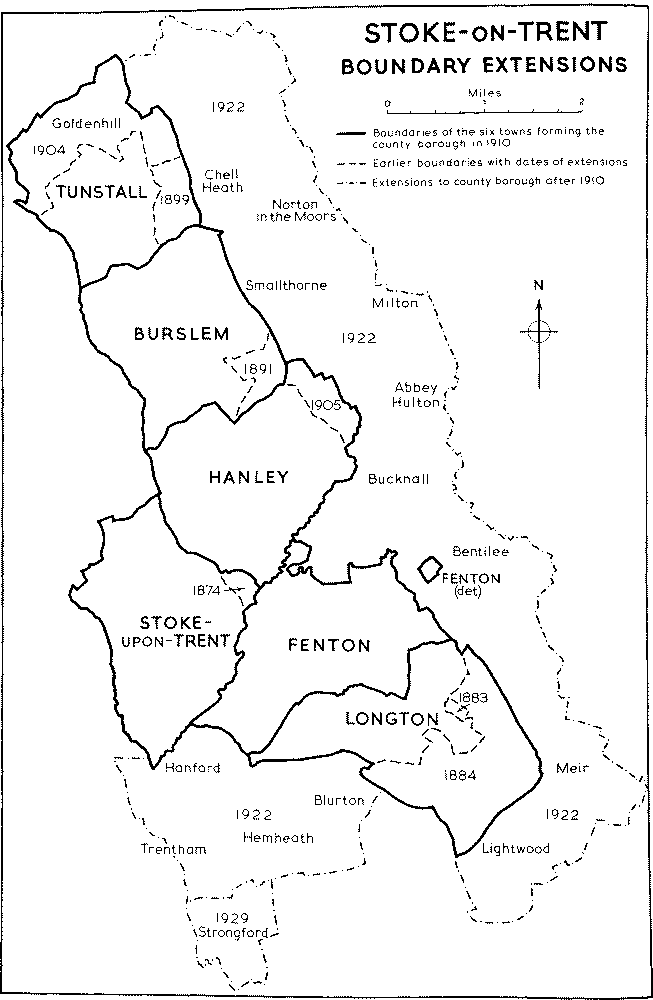
STOKE-on-TRENT BOUNDARY EXTENSIONS
In the early years of the new county borough membership of the council does not seem to have had a political complexion but in the 1920's seats were increasingly contested by Labour party candidates. (fn. 29) In 1928–9 the council was made up of 66 Independent and 46 Labour members, (fn. 30) while in the November 1930 election Labour for the first time secured a small majority over the Independent members (59:53). (fn. 31) Labour remained in control of the council until 1937, (fn. 32) but in November of that year 60 Independent and non-party members were returned as against 52 Labour members. (fn. 33) Elections were suspended during the war but with their resumption the predominance of Labour party members has remained unbroken. (fn. 34)
Tables III to VI (fn. 35) show the rateable value of the county borough for each year since the amalgamation of the six towns (Table III) and the poundage of the rate for the same period (Tables IV, V, and VI).
Table III - Rateable value of county borough since 1910
| £ | |
| 1910–11 | 789,461 |
| 1911–12 | 818,532 |
| 1912–13 | 820,003 |
| 1913–14 | 858,958 (fn. 36) |
| 1914–15 | |
| 1915–16 | 858,279 |
| 1916–17 | 852,249 |
| 1917–18 | 850,604 |
| 1918–19 | 848,014 |
| 1919–20 | 850,221 |
| 1920–1 | 891,554 |
| 1921–2 | 912,734 |
| 1922–3 | 999,274 (fn. 37) |
| 1923–4 | 1,033,385 |
| 1924–5 | 1,018,343 |
| 1925–6 | 1,207,561 (fn. 36) |
| 1926–7 | 1,158,371 |
| 1927–8 | 1,135,592 |
| 1928–9 | 1,182,193 |
| 1929–30 | 1,214,371 (fn. 36) |
| 1030–1 | 974,618 (fn. 38) |
| 1931–2 | 989,236 |
| 1932–3 | 1,005,589 |
| 1933–4 | 1,021,632 |
| 1934–5 | 1,100,816 (fn. 36) |
| 1935–6 | 1,121,097 |
| 1936–7 | 1,144,135 |
| 1937–8 | 1,177,522 |
| 1938–9 | 1,209,447 |
| 1939–40 | 1,245,309 |
| 1940–1 | 1,268,221 |
| 1941–2 | 1,273,826 |
| 1942–3 | 1,280,142 |
| 1943–4 | 1,296,246 |
| 1944–5 | 1,297,912 |
| 1945–6 | 1,306,182 |
| 1946–7 | 1,305,466 |
| 1947–8 | 1,312,178 |
| 1948–9 | 1,303,089 |
| 1949–50 | 1,330,334 |
| 1950–1 | 1,352,905 |
| 1951–2 | 1,368,159 |
| 1952–3 | 1,395,243 |
| 1953–4 | 1,425,843 |
| 1954–5 | 1,469,538 |
| 1955–6 | 1,512,194 |
| 1956–7 | 2,477,054 (fn. 36) |
| 1957–8 | 2,420,449 |
Table IV - Poundage of the borough rate for the period 1911 to 1921
The total rate includes the poor rate, which is shown in italic figures
Table V - Poundage of the borough rate for the period 1922 to 1929
The total rate includes the poor rate, which is shown in italic figures, and which is the same for all rating districts during the whole period
Table VI - Poundage of the borough rate for the period 1930 to 1957
From 1930–1 to 1944–5, the Abstracts of Accounts of Stoke-on-Trent Corporation, from which these tables have been compiled, give the average rate only
The amalgamation of the towns in 1910 brought no change in the parliamentary representation, and in the general elections of January and December in that year, Stoke-upon-Trent and Hanley each returned a Labour member. (fn. 39) In 1918, (fn. 40) however, Hanley lost its separate representation, while Stokeupon-Trent was allotted three members, one for each of its three divisions, Burslem, Hanley, and Stoke. In December 1918, two Coalition candidates and one Labour candidate were returned, (fn. 41) but since 1922 Labour has, apart from a break in 1931–5, (fn. 42) remained dominant in the Stoke constituency. Since 1948 the nomenclature of the latter has been Central, North, and South divisions. (fn. 43)
The creation of Stoke-on-Trent as a county borough involved no immediate changes in the administration of justice in Burslem, Hanley, Stoke, and Longton, the former boroughs. The 1908 Act provided for the continuance in the new borough of the Hanley Court of Quarter Sessions, (fn. 44) and petty sessions continued to be held in the above-mentioned four towns. New borough courts were, however, established in May 1910 at Tunstall and Fenton (fn. 45) and each of the six courts had its own justices' clerk. At the same time the stipendiary magistrate held his weekly court at Hanley, Burslem, Tunstall, and Stoke and every alternate week in Longton and Fenton. (fn. 46) An exact delimitation of the functions of these two systems of petty sessional jurisdiction had not been attempted, but in 1945 Lord Goddard in his Report on the Longton Court Inquiry (fn. 47) brought to light certain unsatisfactory features of the existing arrangements. In particular, there was no agreement about the class of case that ought to be taken before the stipendiary magistrate. In other large towns the difficulty did not exist because there was only one clerk to the justices, including the stipendiary magistrate, and he arranged the list of court cases. The force of tradition, the recollection of the time when there were separate commissions of the peace, and some feeling of local prestige were, in Lord Goddard's view, probably the reasons why similar arrangements had not been made in Stoke. (fn. 48)
As a result of the Inquiry changes were made. It was decided to appoint a full-time magistrate's clerk for the city (but excluding the stipendiary court) and that arrangements should be made with the stipendiary magistrate about the allocation of business between the stipendiary court and the lay magistrates' courts. As a first step towards centralization, the number of magistrates' courts was reduced to four, Tunstall and Fenton being omitted. (fn. 49) In the same year the Stipendiary Commissioners were empowered to vary the salaries paid by them to the stipendiary magistrate and his clerk. (fn. 50)
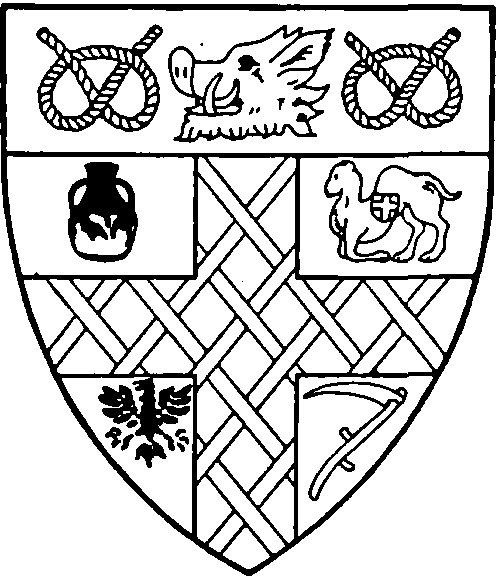
The City and County Borough of Stoke-on-Trent Silver, a cross gules fretted with gold; in the first quarter a representation of the Portland Vase; in the second, a kneeling camel proper charged on the body with a silver shield bearing a red cross; in the third, an eagle displayed sable; and in the fourth, a scythe proper; on a chief gules a boar's head torn off, between two Stafford Knots all gold. [Granted 1912]
The population of the county borough in 1911 was 234,553 (fn. 51) and in 1921 240,428. (fn. 52) As a result of the extension of the borough in 1922 and 1930, (fn. 53) the population in the intercensal period increased by 27,219, this being the total population of the transferred areas at the 1921 Census. (fn. 54) By 1931 the population had increased to 276,639 (fn. 55) and it is noteworthy that whereas in 1921 the population density per acre was 21.6 persons, (fn. 56) that figure had been reduced by 1931 to 13, (fn. 57) a result of the development of new housing in the added areas. Between 1921 and 1931 the natural increase of births over deaths was 9.2 per cent. and the loss of population by migration was 5.8 per cent., leaving a net increase of 3.4 per cent. over the 1921 figure (as amended by the intercensal increase). (fn. 58) In 1951 the population numbered 275,115. The natural increase of births over deaths amounted to 11.5 per cent. and the loss by migration to 12.1 per cent., leaving a net decrease over the 1931 figure of 0.6 per cent. The density per acre was still 13 as in 1931. (fn. 59)
Arms were granted to the new county borough in 1912. (fn. 60) They were made up of devices previously used by the constituent towns, though of these Burslem alone had received a grant. (fn. 61) In its coat the Portland Vase appeared. So did a scythe, the emblem of the Sneyds. The fretty cross is supposed to have been derived from a device used by Fenton, (fn. 62) and the boar's head from Stoke-upon-Trent. (fn. 63) The camel was taken from the crest used by Hanley (fn. 64) and the eagle from the Longton crest. (fn. 65) Tunstall supplied the Stafford Knots and its unauthorized arms also showed the scythe. (fn. 66)
PUBLIC HEALTH. After 1910 the main developments in sewage disposal were located in the Strongford area in the extreme south of the city, and to a lesser extent at Meir on the eastern boundary. The initiation of the Strongford sewage scheme was the result, first, of the deterioration of the Stoke and Fenton sewage works which had been damaged by mining subsidence, (fn. 67) and, secondly, of the development of housing estates in the southern part of the city. (fn. 68) The need for better sewage disposal facilities had been felt before the First World War and as early as 1912 the Strongford site had been selected, (fn. 69) but actual operations had to be postponed until the end of the war.
In 1922 the corporation was required by statute to submit to the Minister of Health a sewage scheme for the borough and, when sanction was given, to carry it out within seven years. (fn. 70) After an inquiry in 1927 (fn. 71) the construction of the first section of the Strongford scheme to serve the Stoke, Fenton, and Trentham districts was begun in 1928. (fn. 72) Representatives of Stoke-on-Trent, Newcastle-under-Lyme, Wolstanton United Urban District Council, and the Staffordshire County Council then met in conference, at the suggestion of the Ministry of Health, to discuss the possibility of dealing with the sewage of Newcastle and Wolstanton at the Strongford works. (fn. 73) After protracted negotiations it was agreed in 1932 (fn. 74) that the Newcastle sewage—the borough by that date included Wolstanton (fn. 75) —should be received and treated at Strongford. The necessary additions to the works, the construction of the main outfall sewer from Newcastle to the Trent Vale Pumping Station, and the mains thence to Strongford were completed in 1936. (fn. 76) In 1938 the city agreed with Stone Rural District Council to receive sewage at Strongford from parts of that area, including the parishes of Barlaston and Swynnerton. (fn. 77)
In 1946 sanction was obtained for an extension of the works to deal with the sewage of Longton, the plants at Blurton and Newstead being inadequate. (fn. 78) As a result the centralization of the sewage disposal of the district was carried a stage further, and sewage effluent was made available to the Meaford Electricity Power Station, two miles south of Strongford. (fn. 79) By 1951 the extension had been completed and the sewage works now occupy an area of 179 acres with ample space for future development. (fn. 80) In 1944 the city council agreed to make available the final effluent of the Strongford works to the Meaford Power Station, which came into operation in 1947. (fn. 81) Sewage effluent from other sewage works in the city was used for other industrial purposes to the extent, in 1951, of 7 million gallons daily. (fn. 82) Protection against mining subsidence was safeguarded by an agreement with the Coal Board in 1946. (fn. 83) As a result of the centralization at Strongford of much of the city's sewage, land was released for other uses, 165 acres for 1,200 houses at Blurton and Newstead and 35 acres for the Newstead light industry estate. (fn. 84)
The extension of the borough boundary in 1922 (fn. 85) brought under the control of the corporation the Meir Sewage Works (in Caverswall parish) which previously had been the responsibility of the Cheadle Rural District Council. The works was situated at Calverhay Farm which, together with the adjoining Ivy House Farm, the corporation bought in the same year, providing an area of 19½ acres for sewage development. Extensive house building in the neighbourhood of Meir (fn. 86) necessitated an enlargement of the sewage works, which was carried into effect in 1934. (fn. 87) Twenty years later the Meir sewage system was incorporated into the larger Blithe Valley Main Drainage scheme, controlled by a Joint Management Committee of 21 members, 10 of whom are appointed by Stoke. (fn. 88)
At the time of the amalgamation of the towns the arrangements for indoor sanitation and for the disposal of household refuse could only be described as primitive. In 1911 out of some 48,000 houses in the county borough only about 18,000 were supplied with water closets. (fn. 89) In 1914 a fresh attempt to bring about the conversion of privies into water-closets was made, but an application by the council to the Local Government Board for a loan towards the cost of conversion in Longton and Fenton was refused in 1915 on the ground of the war-time financial condition of the country, 'a distinctly retrograde step from the public health point of view'. (fn. 90) After the war the work was resumed, but progress was slow. By 1930, however, out of nearly 60,000 houses, over 35,000 of them had been provided with water closets. (fn. 91) In the 1930's the erection of new houses and the demolition of slum dwellings accelerated the final solution of the problem, but, in 1951, there were still 1,501 households without water closets. (fn. 92) As late as 1957 the conversion of privies in the outlying areas around Packmoor still awaited the completion of a resewering scheme. (fn. 93)
In 1911 about one-half of the 48,000 houses in the borough were served by ashpits. (fn. 94) By 1930, as part of a scheme for finding work for unemployed workers, covered ashpits, which numbered 19,000 in 1922, (fn. 95) had been eliminated, and the whole of the city was served by ashbins. (fn. 96)
OTHER PUBLIC SERVICES. In 1910 the water-supply of the county borough was in the hands of the Staffordshire Potteries Water Works Company. (fn. 97) To meet increased domestic and trade requirements, the company was empowered in 1912 (fn. 98) to construct two pumping stations, one at Mill Meece near Stone and the other at Cresswell in the Blithe valley. At the former, in 1914, a pumping engine was erected and in the following year a main was laid from there to Hanchurch reservoir. (fn. 99) Expansion of this pumping station took place in 1927–8. (fn. 100) The powers acquired under the 1912 Act over the Cresswell works were not at that time assumed. (fn. 101) Under the same Act the company was authorized to construct an additional reservoir at Hanchurch which was completed in 1927. (fn. 102)
For some years the local authorities in the area served by the Water Company had wished to municipalize the undertaking. The first attempt had been made in 1899 (fn. 103) and another was made in 1911, (fn. 104) but it was not until 1924 that their aim was achieved. In that year the borough councils of Stoke and Newcastle, together with Wolstanton United Urban District Council, promoted a private Bill for the compulsory purchase of the undertaking. (fn. 105) The House of Commons Select Committee passed the Bill (fn. 106) on the ground that, although the Water Company had fulfilled all its engagements, the community had a right, if it so desired, to own and control its own waterworks, provided that the company was properly compensated. (fn. 107) This view would not, at that time, have commended itself to a Conservative House of Lords and it seemed unlikely that the Bill would pass the Upper House. (fn. 108) Local efforts were, therefore, initiated to secure agreement between the parties, and these were successful, (fn. 109) so that the Bill went through the necessary stages as an unopposed measure. (fn. 110)
Under the Staffordshire Potteries Water Board Act (1924) (fn. 111) the undertaking on 1 January 1925 passed under the control of the Water Board consisting of 23 members representative of the local authorities concerned, of whom fifteen were nominated by the borough of Stoke. The area of supply, set out in the Act, comprised, in addition to Stoke and Newcastle, the greater part of North Staffordshire. (fn. 112)
In 1928 the board promoted a Bill (fn. 113) to revive the powers under the 1912 Act to construct a pumping station at Cresswell, to lay a main from Cresswell to the existing reservoir at Meir, and to obtain powers to lay a gravitation main from Meir Reservoir to Blurton to deliver additional water to the district. At the same time power was sought to protect the Cresswell Pumping Station from the abstraction of underground water in a surrounding protective area and to protect the underground supplies at the board's various pumping stations from possible pollution. Opposition to the former proposal was manifested by the coal-mining interests, with the result that the relevant clause in the Bill was excluded by the House of Lords Committee, which also amended the clauses regarding pollution. (fn. 114) Under the 1928 Act (fn. 115) the Cresswell works was completed in 1932. (fn. 116)
In the 1930's an extensive programme of reconstruction at all the main pumping stations, namely Wall Grange, Meir, Stockton Brook, Hatton, and Mill Meece, was embarked upon, but was interrupted by the outbreak of the Second World War. (fn. 117) The increase in house building and the increased use of water for industrial and domestic purposes, including in the latter the installation of baths and water closets, obliged the board to seek new sources of supply. For geological reasons these had to be found outside the board's area and even outside the county. In 1937 (fn. 118) sanction was obtained for the erection of pumping stations at Peckforton and Tower Wood in Cheshire, for a reservoir on Bulkeley Hill in the same county whence the water would gravitate to a large storage reservoir at Cooper's Green near Audley, for a repumping station near Cooper's Green to enable the water to be repumped from that reservoir to a service reservoir at Bignall Hill, and for trunk mains to connect with the existing trunk mains at Tunstall. The Act also empowered the board to construct wells and boreholes at Greatgate, a reservoir at Heath House in Checkley parish, and trunk mains to connect with the existing trunk main at Draycott-in-the-Moors, through which water is pumped to Meir Reservoir from the Cresswell and Meir works. Most of these enterprises were held up by the Second World War, except for the first stage of the Greatgate scheme which was undertaken in 1942. (fn. 119)
Nevertheless during the war the increased demands of munition factories and other activities connected with the war made it imperative that further supplies of water should be obtained quickly. In 1944, in co-operation with the Ministry of Works, tests were made in an old mine-shaft at Draycott Cross. (fn. 120) These proved satisfactory so that the Ministry of Health granted the board limited powers under the Defence Regulations to install temporary plant and to lay a pumping main to connect with the existing trunk main. (fn. 121) In 1947 Draycott Cross became a permanent part of the board's system, (fn. 122) and at the same time sanction was given for the construction of another pumping station also in Draycott-inthe-Moors. (fn. 123)
In the immediate post-war period, as supply from the Peckforton works was still not available, the urgency of the water situation called for yet another ad hoc effort. The possibility of obtaining water from two abandoned mine shafts, which had been sunk in 1906 at Shaffalong near Cheddleton, was successfully investigated, and in 1949 a pumping plant, water tower, filtration and chemical plant to remove iron and manganese found in the water, and a main connecting with Wall Grange were installed. (fn. 124)
In 1948 the protection against the abstraction of underground water, refused in 1928, was granted to the board. (fn. 125) In 1949 the area of the board's supply was extended to include the Urban District of Stone and such parts of Kidsgrove Urban District, Newcastle Rural District, and Stone Rural District (except part of Sandon parish) as had not been previously included in the area, together with the parishes of Bagnall and Norton-in-the-Moors. Consequently the constitution of the board was amended to include six additional members representing the four districts. (fn. 126)
The board was also empowered to obtain further supplies by the enlargement of surface reservoirs at Deep Hayes and Tittesworth in the Churnet Valley in the neighbourhood of Leek. (fn. 127) These had originally been built as compensation reservoirs, Deep Hayes c. 1847 and Tittesworth in 1876, (fn. 128) to replace water abstracted by the company from the springs and streams which flowed into the River Churnet, for the benefit of owners of mills in the Churnet Valley. By 1949 the number of these mills had diminished so that the obligation of the board to discharge compensation water was correspondingly reduced (fn. 129) and the reservoirs were made available for supply purposes. This decision to collect surface waters represented a departure from the original policy of obtaining naturally purified water from the underground rocks. (fn. 130)
Despite the impressive record of development in the provision of an adequate water-supply there were in 1951 more than 900 households in the city without a piped supply. (fn. 131) By 1953, however, it could be stated that 'practically all the houses within the city have a piped supply for domestic purposes [and] only a few persons draw water from standpipes'. (fn. 132)
The arrangements for the supply of gas to the Pottery towns have already been outlined. (fn. 133) By the Act of 1908 (fn. 134) the gas undertakings of Burslem Corporation, Longton Corporation, Stoke Corporation, and Fenton Urban District Council passed under the control of the new county borough. Under the Act the revenue of the undertakings was to be applied (a) to meet establishment charges, (b) to pay loan interest, (c) to discharge loans, (d) to form a reserve fund to provide for any extraordinary expenditure, subject to certain limitations. Any residue was to be carried forward to the revenue account for the following year and applied to reducing the price of gas within the borough. Any deficiency on any of the undertakings in any year was to be made good out of the reserve fund, or, if there was no reserve fund or if the fund was insufficient, then out of the district fund of the borough. In the event of the last-named eventuality the deficiency was to be a debt to be repaid to the district fund out of future revenue. (fn. 135)
The British Gaslight Company, which supplied Hanley, Tunstall, Newchapel, Smallthorne, and Norton-in-the-Moors, remained outside the scope of the 1908 Act, but the economics of centralized management made it only a question of time before the company was absorbed by the county borough. At the end of the First World War the Gas Committee, faced with the need to spend a large sum of money to bring its gas undertakings up to date, decided to buy out the company and to concentrate the local gas supply at the company's works at Etruria. (fn. 136) In March 1922 (fn. 137) the company agreed to sell its assets as they were at 31 December 1920 to the corporation for £345,000. The corporation was to pay the company the difference between the value of its assets at 31 December 1920 and at the date of transfer, or more if that amount was insufficient to pay the shareholders' maximum dividends for the whole of the period between the two dates. The date of transfer was the next quarter-day following the passing of the Bill (i.e. 24 June 1922). The sale did not include the Directors' Minute Books or any other books and papers 'relating exclusively to shareholders'. The Act provided for the payment of compensation to any company officials discharged by the corporation within a period of five years. (fn. 138) The limits of the county borough's undertaking were enlarged to embrace those of the company, (fn. 139) and an earlier provision enabling a gas company at Stone to impinge in a minor way upon the corporation's territory was annulled. (fn. 140)
The corporation was empowered to make gas and its by-products, and it might amalgamate and reorganize any of its undertakings as it thought fit. It could also purchase and process residual products of other undertakings up to a maximum of one-third of its own in any one year. It might also acquire by purchase up to 20 acres of land in addition to the existing lands (fully specified in the Third Schedule to the Act), but any land so acquired was not to be used for the manufacture of gas or the processing of its by-products. Full provisions were made for the quality, testing, pressure, and price of the corporation's gas, and the terms in which these were laid down reflect the advance of applied chemistry and physics since the 19th century. (fn. 141) After all normal working expenses and loan interest had been allowed for, any surplus profit was to be employed to reduce the price of gas. (fn. 142) The price could only be raised if the Minister of Health was satisfied of its necessity for reasons outside the corporation's control. (fn. 143)
By September 1924 the corporation had ceased to manufacture gas at Stoke and Fenton, and these undertakings had been connected up with the Etruria works. (fn. 144) In 1927 the Longton undertaking was also amalgamated with Etruria. (fn. 145) The Burslem gasworks at Longport still remained, and, before it could be connected up with Etruria, statutory authority had to be obtained to lay the pipes between the two places through the Wolstanton United Urban District. (fn. 146)
In 1932 the first gas-fired tunnel kilns were laid down by a local pottery manufacturer; by 1936 there were ten such kilns in operation and by 1939 sixtysix. (fn. 147) By 1950 the number of gas-fired kilns had increased to 300. (fn. 148) These industrial demands necessitated large extensions to the Etruria Works, (fn. 149) and in addition an entirely new works was erected on a site adjacent to the main works formerly occupied by the Wagon Repair Company. (fn. 150)
In May 1949, following the nationalization of the gas industry, (fn. 151) the undertaking passed into the control of the West Midlands Gas Board. (fn. 152)
The four electricity undertakings (fn. 153) came under the management of the county borough on 1 September 1910 (fn. 154) as provided by the 1908 Act. (fn. 155) A threefold problem faced the Electricity Supply Committee: the provision of additional electrical power to meet the needs of the district; the linking-up of the four existing works; and the demand for economical generation and distribution. The problem was partly met by the construction of a Central Power House in Hanley together with the adoption of a system of generation at extra high tension, and three-phase alternating current with a frequency of 50 cycles a second, transmitted by trunk mains to the four existing works and there converted to low tension for local distribution. (fn. 156)
After a Local Government Board Inquiry in the summer of 1911, (fn. 157) the Central Power House was built and the plant put into operation on 10 April 1913. (fn. 158) In the same year the area of supply was extended to cover Wolstanton Ward in Wolstanton United Urban District. (fn. 159) Extensions to the Power House were made in 1919, 1922, 1925, 1927, and 1929. (fn. 160)
From 1 April 1914 (fn. 161) the four existing undertakings were combined, but the different systems operated by each proved an obstacle. The original supply system in Hanley was single phase, 100 cycles, alternating current, while the supplies in Burslem, Longton, and Stoke were direct current, although at different voltages. It was not until 1923 that a supply was available in Fenton. (fn. 162) In that year also the area of supply was defined as the borough and Wolstanton Ward in Wolstanton United Urban District. (fn. 163) The 1923 Act gave the corporation power to supply electricity in bulk to the borough of Newcastle. (fn. 164) The work of conversion to the 50 cycles alternating current was not finally completed until 1938. (fn. 165)
In 1927 two important developments took place. Eight new houses in Avenue Road, Hanley Park, were electrically equipped for lighting, heating, and other domestic purposes. (fn. 166) That year also marked the beginning of the application of electricity to the manufacture of pottery, when two electrical furnaces for the firing of decorated were were set up. (fn. 167) Since the end of the Second World War development in this field has advanced greatly, and in 1957 there were more than 110 electric kilns and ovens in use in the city. (fn. 168) Moreover, the making of pottery has been largely mechanized by the use of automatic or semi-automatic electrically driven machines. (fn. 169)
The electrical industry was nationalized in 1948 (fn. 170) and the electricity undertaking came under the control of the Midlands Electricity Board, Stoke being the headquarters of the North Staffordshire SubArea of the Board. (fn. 171)
In 1910 each of the six towns had its own fire brigade, but as a result of their amalgamation a measure of co-ordination of the fire services of the whole area was introduced. In November of that year all the brigades of the borough, except that of Hanley, were placed under the control of F. Bettany, (fn. 172) a former borough surveyor of Burslem, who had captained the Burslem Fire Brigade since 1894. (fn. 173) He was made chief officer at a yearly salary of £100. (fn. 174) In Hanley the fire brigade was a police responsibility, but in 1913 this brigade, with a station in Stafford Street and manned thereafter by volunteers, (fn. 175) passed under the control of the chief officer, and in the same year the erection of a new fire station at the corner of Percy Street and Old Hall Street, Hanley, was approved; (fn. 176) this, however, was not opened until 1921. (fn. 177) In Stoke, which had never had a permanent home for its fire appliances, (fn. 178) a new station in Welch Street was built and opened in 1914. (fn. 179)
In 1916 a fire at the Empire Pottery Works, Hanley, brought to light deficiencies in the organization and equipment of the brigade, (fn. 180) and one result of the public criticism then aroused was the acquisition of the first motor appliance, which was stationed at Hanley. (fn. 181) The other fire stations in the borough continued to use horse-drawn steamer appliances.
In 1926, a major reorganization took place, whereby Hanley became the headquarters of the City Fire Brigade, with sub-stations at Burslem and Longton. (fn. 182) The fire stations at Tunstall, Stoke, and Fenton thus ceased to function, and at the same time the horsedrawn appliances were taken out of service. (fn. 183) In 1941 the City Fire Brigade became part of the nationalized fire service, (fn. 184) but in 1948 the city council resumed control of the brigade, (fn. 185) then comprising three fire stations and 89 personnel. (fn. 186) The revival of Civil Defence in 1949 placed upon the city council the responsibility for the recruitment and maintenance of an efficient Auxiliary Fire Service. (fn. 187) In 1956 a new fire station was built in Hamil Road, Burslem, the old station in Baddeley Street having become inadequate. (fn. 188)
When in 1910 the county borough came into existence, the population was about 234,000 contained within an area of a little over 11,000 acres which indicated a population density of 21 to the acre. (fn. 189) Overcrowding was consequently rife. Indeed it was even more serious than the density figure suggests because much of the borough area consisted of potworks, tileries, and coal mines and much of the available open land could not be built on owing to the risk of subsidence. The new borough council was naturally reluctant to embark on any major scheme of rehousing which would have meant an increase in the rates, and it was not until the central government offered financial inducements to local authorities to initiate housing schemes that any progress was made. During the period 1910–18 just under 1,000 new houses were built in the borough, (fn. 190) all provided by private enterprise, but in 1919 the generous subsidy provided by the Housing Act of that year (fn. 191) spurred the council to set up a Housing Committee (fn. 192) to tackle the twin problems of slum clearance and rehousing. Progress was inevitably slow owing to the shortage of building labour and materials, and altogether only 545 houses were built under the so-called Addison Act. (fn. 193) The Housing Act of 1923 (fn. 194) encouraged private builders to build houses for the owner-occupier, while the Housing (Financial Provisions) Act of the following year, (fn. 195) by means of a generous subsidy, made it possible for a local authority to erect houses for letting at low rents.
The Housing Act of 1930 (fn. 196) was the first comprehensive attempt to deal with slum clearance and Stoke was the first local authority in the country to submit a five-year clearance programme to the Ministry of Health. (fn. 197) The council was, however, faced with difficulties peculiar to the locality. In the previous year the medical officer of health had pointed out that it was useless to undertake large schemes until more suitable sites could be found; many of the small sites available were quite unsuitable owing to the atmospheric pollution and the congestion of surrounding areas. In his view the incidence of smallpox and infant mortality in the congested areas was proof that the inhabitants must be removed from overcrowded areas and housed away from the smoke; in the event of slum clearance it was impossible to rehouse on the old sites. A peculiarity of the smoke problem in Stoke was that the smoke from the ovens came right down on to the houses and was not carried away by high chimneys. (fn. 198) It was no doubt this difficulty of finding suitable housing sites that had prompted the eastward expansion of the borough in 1922. (fn. 199)
The Housing Act of 1935 (fn. 200) imposed on the local authority new duties in relation to the abatement of overcrowding and the redevelopment of congested areas, and in December of that year the number of overcrowded families in Stoke was estimated to be 3,740. (fn. 201) In the 1930's much was accomplished by the borough council to meet the challenge of slum conditions, and by the outbreak of the Second World War clearance orders and compulsory purchase orders had been applied to 3,877 houses. (fn. 202)
Table VII shows the progress that had been achieved in the period between the world wars in the field of housing and also the substantial contribution made by private enterprise.
Table VII - Housing in Stoke-on-Trent, 1921–39 (fn. 203)
The chief housing estates within the original borough boundary were Blurton Road (294) and Cowper Street (44), both in Fenton, Etruria Vale (154), Fletcher Road, Stoke (96), Gom's Mill Road, Longton (117), High St. East, Fenton (57), Hollywall Lane, Goldenhill (368), Kingsfield, Basford (56), Leek Road, Hanley (172), Little Chell, Tunstall (74), Lightwood Chase, Longton (266), Newcastle Lane, Penkhull (74), Newhouse Farm, Bucknall (508), Shelton New Road, Stoke (121), Stanfield, Burslem (558), Stoke Lodge, Trent Vale (170), St. Michael's Road, Pitts Hill (90), Swan Lane, Trent Vale (284), Vivian Road, Fenton (257), and Woodlands, Trent Vale (90). (fn. 204) The land acquired in the 1922 expansion (fn. 205) made possible the erection of the following estates: Abbey Hulton (604), Carmountside (456), Cornhill (358), Back Lane (170) and Wilson Road (158), both in Hanford, Meir (1,388), Sandon Road, Meir (370), and Townsend, Bucknall (262). (fn. 206)
In the field of private enterprise mention should be made of the operations of the Sutton Dwellings Trust. (fn. 207) In 1926 the trustees acquired by purchase surplus land on the Stoke Lodge site in Trent Vale and 7 acres of adjoining land for the erection of houses. (fn. 208) The estate was opened in 1929 and the number of houses built was 310. (fn. 209) Collin Road, Forber Road, Freemantle Road, Levita Road, Sutton Drive, and Waterfield Road commemorate the names of trustees. An institute was also built on the estate. (fn. 210) In Abbey Hulton, too, from 1933, 403 houses were built, the names of the roads, Kyffin Road, Shelley Road, and Taylor Road, again commemorating the names of trustees. (fn. 211)
The outbreak of the Second World War slowed down and ultimately put a stop to housing development; during the period 1940–4 the number of new houses erected was: 1940 590; 1941 148; 1942 125; 1943 2; 1944 nil. (fn. 212) In 1944 and 1945 the acute housing shortage led to the erection of temporary bungalows by the Ministry of Works (fn. 213) and these were made available to the local authority, which was also empowered to acquire the necessary building sites. Temporary bungalows to the number of 662 were erected in the city, mostly on central sites which had been cleared of unfit houses before the war under the slum clearance programme. (fn. 214)
At the same time the importance attached by the central government to the provision of permanent houses was manifested by a series of enactments (fn. 215) to induce local authorities by the grant of subsidies to resume or initiate building schemes. A noticeable feature of the post-war development in Stoke was the smaller part played by private enterprise as compared with the pre-war period, as shown in Table VIII.
Table VIII - Housing in Stoke-on-Trent, 1945–58 (fn. 216)
| Year | By corporation | By private enterprise | Total |
| 1945 | 22 | 6 | 28 |
| 1946 | 421 | 283 | 704 |
| 1947 | 599 | 226 | 825 |
| 1948 | 1,203 | 99 | 1,302 |
| 1949 | 783 | 16 | 799 |
| 1950 | 386 | 87 | 473 |
| 1951 | 1,201 | 81 | 1,282 |
| 1952 | 1,407 | 100 | 1,507 |
| 1953 | 2,412 | 96 | 2,508 |
| 1954 | 2,502 | 157 | 2,659 |
| 1955 | 1,998 | 153 | 2,151 |
| 1956 | 2,054 | 179 | 2,233 |
| 1957 | 1,419 | 169 | 1,588 (fn. 217) |
| 1958 | 706 | 189 | 895 |
| 17,113 | 1,841 | 18,954 | |
The principal housing estates erected in the above period within the original borough boundary were Furlong Road (304) and Mill Hill (534), Tunstall; Stonor Street (250) and Windermere Street (50), Cobridge; Hilton Road (248) Harpfields; Riverside Road (122), Springfields (262), and Stone Road (95), Trent Vale; Carron Street (58) and Hollybush (552), Fenton; Anchor Road (256), Heathcote Street (158), Longley Road (544), and Longton Hall Road (120), Longton. On the land to the east and south of the borough acquired in 1922 and 1930 the following represent the main housing developments: Chell Heath (813), Fegg Hayes; Chorley Avenue (460), Tunstall; Oxford estate (122), Chell; Norton Lane (161), Norton; Wilding Road (64), Ball Green; Woodhead Road (52), Carmountside; Weston Coyney (64); Abbey Lane (94), Longton Road (102), Ruxley Road (94), and Townsmead (266), Bucknall; Bentilee Farm (1,950); Ubberley Farm (636); Whitfield site (220); Lyme Road (340), Meir; Drubbery Lane (62), Blurton; Blurton Farm (1,536); and Newstead Farm (822). (fn. 218)
Since the end of the Second World War slum clearance has proceeded, (fn. 219) but in 1956 it was estimated that there were still 10,800 houses in the city deemed unfit by modern standards. (fn. 220) Redevelopment of the cleared areas was slow and it was not until 1955–6 that the first post-war redevelopment scheme, embracing 57½ acres at Heathcote Road, Longton, on which 421 houses were to be built, was sanctioned. (fn. 221) It has been suggested that the extension of the borough to the east had made open agricultural land available for housing expansion and consequently there has been less incentive to redevelop the derelict areas within the older built-up limits. (fn. 222)
Another aspect of redevelopment within the limits of the original six towns has been the reconditioning and modernization of houses otherwise structurally sound. The Housing Act (1949), (fn. 223) as amended by the Housing Repairs and Rents Act (1954), (fn. 224) empowered local authorities to make grants to landlords and owner-occupiers for modernizing their properties. In Stoke, where it was estimated that there were 20,000 houses in this category, (fn. 225) the city council, in order to show what could be done, modernized seven houses belonging to the corporation in Gilman Street, Hanley. (fn. 226) Up to 31 July 1957 735 grants had been made for the improvement of old houses. (fn. 227)
The special housing needs of old people were partially met through the generosity of a local pottery manufacturer, W. G. Barratt, who in 1954 gave £20,000 for the provision of 20 bungalows, together with a social hall, which were built at Carmountside. A further gift of £20,000 by the same donor made it possible for similar provision to be made for old people at Blurton, both sites being provided by the corporation. (fn. 228) The city council also helped to solve the problem, e.g. at Hilton Road, Harpfield Estate, and at Mill Hill, Tunstall, where special accommodation has been provided for those who are too old or infirm to care for themselves. (fn. 229)
In the post-war period the trend in housing policy has been towards the development of the neighbourhood unit, representing an aggregate of about 10,000 people and consisting of a residential area complete with additional buildings, viz. community centre, health centre, churches, schools, shops, public houses, playing fields, and open spaces. Practical effect has been given to this conception in the Ubberley-Bentilee estate on the eastern boundary of the city. (fn. 230)
In 1910 there were six full-time libraries (fn. 231) in the county borough: Tunstall (Victoria Institute), Burslem (Wedgwood Institute), Hanley (Pall Mall), Stoke (London Road), Fenton (Baker Street), and Longton (Sutherland Institute). (fn. 232) They were under the general control of the Libraries Committee of the borough council, but for finance and administration each library was separately administered by its own subcommittee.
These arrangements continued until the beginning of the First World War, but in 1915 a chief librarian was appointed to take charge of all the libraries, though he was required to report to each district sub-committee as well as to the main Libraries Committee. Further steps towards the centralization of the borough's library system were taken in 1920 when it was agreed to pool the different library rates and funds and in 1921 when the district sub-committees were abolished.
In 1929 the Libraries Committee decided to adopt the principle of open access, and in the same year the Longton Library was converted to that system. Tunstall, Fenton, and Stoke Libraries followed in 1931, and Burslem in 1932 on its removal, first proposed in 1914, (fn. 233) from the Wedgwood Institute to the first floor of the Old Town Hall. It was not until 1949 that the open-access system was introduced in the Hanley Library.
In 1950 the reference library facilities, hitherto dispersed among the constituent libraries, were centralized in the Hanley Library, and in 1958 a separate reference library, known as the Horace Barks Reference Library, was opened in the former Russell Art Gallery adjacent to the main lending library. The latter, in 1954, had been declared unsafe and was accommodated in Piccadilly Chambers while the Pall Mall building was being repaired. In 1956 the move back to its former building took place.
Provision for young readers, initiated at Hanley, (fn. 234) was extended in 1913 with the establishment of junior libraries at Tunstall and Fenton. In 1925–6 a schools library service was instituted. In 1935 the junior library in the Wedgwood Institute at Burslem was reorganized on the open-access system.
The expansion of the county borough in 1922 and the development of housing estates led to the provision of library facilities in the outlying areas. As the need arose, part-time libraries were established; the first, in 1924, was at the Hardman Institute, Milton, converted to the open-access system in 1932. In subsequent years other branch libraries were set up: Brindley Ford (1937), Abbey Hulton (1938), Ball Green (1946), Goldenhill (1946), Packmoor (1946), Chell Heath (1950), Hanford (1955), Bucknall (1955), Blurton (1955), Bentilee (1958), Newstead (1959), Sandford Hill (1959). At Meir a part-time library service was begun in 1947 at the T.A. Drill Hall, but removal therefrom took place in 1950 when a full-time library was established at the Church Institute, Box Lane.
In 1910 museums (fn. 235) existed at Tunstall (Victoria Institute), Burslem (Wedgwood Institute), Hanley (Pall Mall), and Stoke (London Road). Centralization of the art collections of the various towns and of the museums service generally was the chief aim of the newly constituted Libraries, Museums, and Gymnasiums Committee of the council. (fn. 236) As a first step a curator was appointed for the county borough. A rearrangement of the collections was undertaken, and in 1912 the museums were reopened by the mayor. (fn. 237)
The outbreak of the First World War halted further developments. In 1926 the bequest to the city by Dr. John Russell of an important collection of paintings emphasized the need for adequate accommodation. Part of the Hanley School of Art was acquired for the housing of the collection, but this was no more than a temporary expedient. In the same year a proposal to convert the Old Town Hall, Burslem, into a central art gallery was rejected in favour of the Pall Mall site at Hanley, where the City Art Gallery remained until 1956 (see below).
The museum problem still awaited a solution. As early as 1919 plans for a modern museum and art gallery on the site of the present Essoldo Cinema had been drawn up, but were not proceeded with. Later, similar building plans on the sites of Hope Chapel, Hanley, and Chatterley House, Hanley, proved nugatory. The industrial depression of 1931 put an end to building schemes for the time being. Later in the 1930's the project of a new building was revived, but again the outbreak of war led to its postponement. In September 1939 the contents of all the museums were evacuated to places of safety, and at the end of the war the whole of the evacuated material was returned to Hanley. In 1949 Hanley Art School was acquired from the Education Committee in exchange for three rooms at the Wedgwood Institute, Burslem, and the whole of the Tunstall Museum.
In October 1956 the Museum and Art Gallery, a building of modern design in Broad Street on the site of the former Bell Pottery, (fn. 238) was opened, the first new museum to be opened in England since the end of the Second World War. The architect was J. R. Piggott, the City Architect. It contains a notable collection of pottery of all ages and countries, including Staffordshire wares.
In May 1952 Ford Green Hall, a timber-framed building at Smallthorne on the eastern boundary of the city, was opened as a museum devoted primarily to the display of 17th-century furniture and household utensils. The architectural description of the building is reserved for a subsequent volume.
INDUSTRY. The pattern of industrial development in Stoke during the half-century that has elapsed since the amalgamation of the towns has changed considerably. While the pottery industry has remained predominant, other industries have arisen in the area in the last 50 years. One of the most important has been the manufacture of motor tyres, principally by the Michelin Tyre Company which in 1927 acquired an 80-acre site at Oak Hill between London Road and Campbell Road. (fn. 239) In 1921 the Normeir Tyre Company Ltd., a pioneer firm in the repair and remoulding of motor tyres, was established at Meir Bank, then outside the borough boundary, and also at Hanley, and in 1923 at Longton. Additional premises in Liverpool Road, Newcastle, were opened in 1934 and since the end of the Second World War at Tunstall and at Longton (The Strand and Clayton Street). (fn. 240)
Light industry, such as the manufacture of electric motors, non-ferrous castings, sewage disposal equipment, sheet metal, and pattern making, (fn. 241) has gained a firm foothold in recent years. An oil-blending plant was installed in North Street, Stoke, in 1937 (rebuilt in 1948), (fn. 242) while the manufacture of steel tanks began in Fenton in 1949. (fn. 243) Glass used in building construction is manufactured at Etruria Road, Hanley, and in the chemical industry at Duke Street, Fenton, (fn. 244) while electric lamps, including those for Belisha beacons and totalisator signs, have been manufactured at Newcastle Road, Trent Vale, since 1951. (fn. 245)
The extension of the boundaries in 1922 brought within the limits of the county borough additional industrial plants. Such were the Chatterley Whitfield Colliery at Ball Green, Norton Colliery at Ford Green, Berry Hill Collieries in Botteslow, Mossfields Colliery, and Adderley Green Colliery, both at Adderley Green, Park Hall Colliery near Weston Coyney, and Hem Heath Colliery near Trentham; and also the Berry Hill Brickworks, the largest of its kind in North Staffordshire.
Figures compiled in 1952 reveal the pattern of employment in the city. Out of an approximate total of 152,000 employed persons, 62,000 were engaged in pottery and 15,000 in coal mining, a little more than half the total. Of the remainder nearly 6,000 were employed in metal manufacture, including iron and steel milling and rolling and tinplate and steel sheet manufacture; 1,500 in the production of light metal goods; and nearly 5,000 in the engineering and electrical industries, including machine tools, and the manufacture of agricultural, textile, and electrical equipment. One of the larger industries is that of building which employs more than 8,000 persons. With a few exceptions, the factories are small. In 1952 the number of factories was stated to be 428 and one-half of these employed fewer than 100 workers. (fn. 246)