A History of the County of Stafford: Volume 5, East Cuttlestone Hundred. Originally published by Victoria County History, London, 1959.
This free content was digitised by double rekeying. All rights reserved.
'Brewood: Introduction, manors and agriculture', in A History of the County of Stafford: Volume 5, East Cuttlestone Hundred, ed. L Margaret Midgley (London, 1959), British History Online https://www.british-history.ac.uk/vch/staffs/vol5/pp18-40 [accessed 30 April 2025].
'Brewood: Introduction, manors and agriculture', in A History of the County of Stafford: Volume 5, East Cuttlestone Hundred. Edited by L Margaret Midgley (London, 1959), British History Online, accessed April 30, 2025, https://www.british-history.ac.uk/vch/staffs/vol5/pp18-40.
"Brewood: Introduction, manors and agriculture". A History of the County of Stafford: Volume 5, East Cuttlestone Hundred. Ed. L Margaret Midgley (London, 1959), British History Online. Web. 30 April 2025. https://www.british-history.ac.uk/vch/staffs/vol5/pp18-40.
In this section
BREWOOD
The ancient parish of Brewood lies in the south-west corner of the hundred on the Shropshire border. Its northern boundary is formed by nearly four miles of Watling Street while the Stafford-Wolverhampton road runs through the eastern part of the parish. The River Penk, joined by a number of tributaries, flows north through the parish, also on the eastern side, and with the Moat Brook, a tributary, also forms part of the southern boundary. The ground rises from below 300 ft. in the north-east to over 500 ft. on the western boundary to the north of Chillington Park. The soil is fertile but varied, being mainly stiff in the north and west and lighter in the south and east. (fn. 1) The parish to the west of the Penk lay within the royal forest of Brewood until its disafforestation by King John in 1204, while the part to the east of the river was within the royal forest of Cannock between at least 1167 and 1301. (fn. 2) In 1940 there were eleven farms of over 150 acres. (fn. 3) The geological formation is Keuper Sandstone, (fn. 4) which lies near the surface in and around the town itself so that the earth tremors noticed along the west of England in 1678, 1852, and 1863 were strongly felt in Brewood. (fn. 5)
By 1834 the ancient parish was divided into the eight liberties or constablewicks of Brewood town, Chillington, Coven, Engleton, Gunstone and the Hattons, Horsebrook, Kiddemore, and Somerford, which maintained their poor jointly and their roads separately. (fn. 6) There were 305 households in the parish in 1666, (fn. 7) and the population was 2,960 in 1931 and 3,576 in 1951. (fn. 8) The area was increased from 12,152 acres to 12,517 acres under the Staffordshire Review Order of 1934 when Coven Heath and Brinsford were transferred from Bushbury (Seisdon hundred) to Brewood. (fn. 9)
The nucleus of the town of Brewood is the marketplace and the four streets radiating from it, Bargate, Newport and Stafford Streets, and Sandy Lane, with a fifth, Dean Street, leading south-east from the parish church. The township had some 60 houses c. 1680 (fn. 10) and by 1811 210 inhabited houses with a population of 919. (fn. 11) It was described in 1834 as 'a small but well-built market town, with several good streets and a spacious market-place'. (fn. 12) Chillington, to the south-west of Brewood, contained 30 houses c. 1680, (fn. 13) but in 1834 and 1851 it had only five farms, in addition to the Hall. (fn. 14) Coven, two miles to the south-east of Brewood town, had 40 houses c. 1680, (fn. 15) and by 1851 covered 1,750 acres with 650 inhabitants, being 'a large liberty, with a considerable village'. (fn. 16) Engleton, about 1½ mile to the northeast of Brewood, had 5 or 6 houses c. 1680 (fn. 17) but was only 'a small estate' in 1834. (fn. 18) Gunstone, some two miles to the south-west of Brewood, had 10 houses c. 1680, the Hattons being two farms there. (fn. 19) In 1834 Hatton and Gunstone were described as adjoining hamlets with four farms and a few cottages. (fn. 20) Horsebrook, a mile to the north of Brewood, with 30 houses c. 1680, (fn. 21) was described as 'a small hamlet' in 1834. (fn. 22) Kiddemore Green, some 2 miles west of Brewood, had 30 houses c. 1680, with 'a good farm' called Hawkshead House belonging to Edward Moreton of Engleton, (fn. 23) and in 1834 was described as 'a hamlet of scattered houses'. (fn. 24) Bishop's Wood, c. 1680 'a little vill a little beyond Kiddemore Green', (fn. 25) was, in 1834, an open common with a few cottages built on encroachments upon the waste (fn. 26) but had been inclosed by 1851. (fn. 27) Somerford, a mile east of Brewood, with 30 houses c. 1680, (fn. 28) had a population of 578 in 1811. (fn. 29) Standeford, described as a vill in Somerford c. 1680, (fn. 30) seems to have been attached to Coven by 1834. (fn. 31) The hamlet of Four Ashes, which existed by 1775 (fn. 32) and was part of Somerford in 1834, (fn. 33) is said to have taken its name from a former cluster of trees in front of the inn of the same name on the Stafford-Wolverhampton road. (fn. 34)
This main road to Wolverhampton was turnpiked under an Act of 1760. (fn. 35) The present dual carriageway was constructed between 1936 and 1939. (fn. 36) The road from Brewood formerly joined this main road at Standeford, passing close to Somerford Hall, but the Hon. Edward Monckton c. 1781 closed the section by the Hall and built the present road which, running farther to the north, goes direct to Four Ashes. (fn. 37) Between at least 1730 and 1750 Brewood town had two separate overseers of the highways, one for the 'High Town' and one for the 'Deanery'. (fn. 38)
The first mail coach between Birmingham and Liverpool, which began running in 1785, passed through Four Ashes at night, while the mail coach between Bristol and Manchester, started in 1810, passed through by day. (fn. 39) With the opening of the railway in 1837, out of several coaches calling at Four Ashes only the Potteries coach, the Red Rover, was retained, running between Manchester and Birmingham until 1846. (fn. 40) The London-Liverpool coach, known as the Emerald, passed through Brewood town daily in each direction by 1834, calling at the Lion Inn, and for many years required an additional pair of horses to take it over the bad road through Bishop's Wood to Ivetsey Bank on Watling Street. (fn. 41) A rival coach, the Albion, preferred to go via Gailey with only four horses. (fn. 42) Also by 1834 there was a coach from Brewood to Wolverhampton and back each Wednesday and a 'car' there and back from the Fleur de Lis Inn on Wednesdays and Saturdays. (fn. 43) The Emerald was replaced in 1837 by a two-horse coach which eventually ran only between Wolverhampton and Kiddemore Green, and for some years after 1855 there was an 'omnibus' from Brewood to Wolverhampton and back twice a week. (fn. 44) The post office was at 'The Giffard's Arms' by 1818, (fn. 45) and by 1860 there was also a post office at Coven. (fn. 46)
The railway between Birmingham and Stafford runs through the eastern part of the parish and has a station at Four Ashes, which was opened in 1837, with two trains a day in each direction by 1838. (fn. 47) A further line from Bushbury Junction to the end of Stafford Street in Brewood town was being planned by 1874 (fn. 48) but was never constructed.
The Staffordshire and Worcestershire Canal, completed in 1772, (fn. 49) crosses the south-eastern part of the parish. The Birmingham and Liverpool Junction Canal (now the Shropshire Union), running northward through the middle of the parish, was begun in 1830. (fn. 50) It was opened in 1843 (fn. 51) and in 1851 had 'commodious wharves and warehouses' in Brewood town and Chillington. (fn. 52) The wharves were still in existence in 1956 but neither had been in commercial use for the past 30 years. (fn. 53) The Belvide reservoir built in connexion with the canal about a mile north-west of the town covers some 208 acres, (fn. 54) and by 1860 was noted for its pike, (fn. 55) the Giffards of Chillington having the fishing and shooting rights by at least 1876. (fn. 56)
Somerford Bridge (formerly Stone Bridge), carrying the road from Brewood to Four Ashes over the Penk, was repaired at the expense of the parish in 1605 (fn. 57) and at the expense of the county in 1711. (fn. 58) Rebuilt in 1796, (fn. 59) it was described in 1830 as 'old but in good repair'. (fn. 60) An attempt by the Hon. Edward Monckton to divert the road from Brewood to cross the Penk at Somerford Mill farther south was defeated at a vestry meeting in 1781; the footbridge at the mill, apparently the responsibility of the lord of Somerford, would have had to be replaced by a carriage bridge, the cost of maintaining which would have fallen upon the parish. (fn. 61) Somerford Bridge is a stone bridge of four segmental arches, splayed piers, and refuges at parapet level. The core is probably of the 17th century, but there has been much rebuilding, and the bridge has been widened on its north side. Standeford Bridge, carrying the Stafford-Wolverhampton road over the Saredon Brook before it enters the Penk, is mentioned in 1630 (fn. 62) and was rebuilt as a cart bridge c. 1757. (fn. 63) It was widened by the county in 1823 (fn. 64) and stated to be in good repair in 1830. (fn. 65) A bridge at Gunstone was repaired by the parish in 1663 at a cost of £1 5s. 4d. It then seems to have been of timber, (fn. 66) but was rebuilt as a stone bridge in 1682 at a cost to the parish of £2 10s. (fn. 67) Lows Bridge over the Penk near Brewood Lower Forge (see below) occurs in 1724. (fn. 68) King's Bridge, now Jackson's Bridge, carrying the road from Brewood to Coven over the Penk, and possibly to be identified with 'the bridge of Coven, near the Park of Brewood' mentioned in 1286, (fn. 69) was rebuilt by the county in 1824. (fn. 70) Two bridges over Dean's Hall Brook and Brewood Hall Brook were repaired by the parish in 1663. (fn. 71) There are also thirteen bridges in the parish over the Shropshire Union Canal and five over the Staffordshire and Worcestershire Canal. Avenue Bridge, carrying Chillington Lower Avenue over the Shropshire Union Canal about 500 yds. north of Chillington Wharf, dates from c. 1830 and is of rustic-faced stone ashlar with long curved balustraded parapets.
The workhouse, formerly in the lane leading to Kiddemore between the Churchfields and Hockerill, was moved at some time between 1795 and 1801 to premises in Bargate which in 1837 became the workhouse for the Penkridge Union. (fn. 72) Extensions made between 1838 and 1842 gave it a capacity of 200, (fn. 73) but in 1872 the poor of the Union were moved to the new workhouse in Cannock. (fn. 74) The house and garden in Brewood were sold in 1878 to Major J. E. Monckton and the proceeds added to the Workhouse Charity. (fn. 75) Since 1920 the building has been a Dominican convent. (fn. 76) It is a long two-story brick range with projecting side wings and a five-sided porch. Large extensions were made at the rear in 1956.
There were gas-works, owned by a private company, in the town between at least 1872 and 1912, (fn. 77) but by 1916 gas was provided by the Stafford Corporation. (fn. 78) Two pumping stations, one at Slade Heath, east of Coven, and the other north-east of Somerford Bridge, were built by the South Staffordshire Waterworks Company in 1922. (fn. 79) Electricity was available in the town by 1928 (fn. 80) and throughout the parish by 1940. (fn. 81)
A reading-room, built in 1857 by 'Mr. Swann of this town' at the expense of T. W. Giffard, was mentioned in 1860 and 1868 as possessing 'a small but select library as well as newspapers and periodicals' (fn. 82) and was apparently still in existence in 1896. (fn. 83) A library of 600 volumes was formed under the auspices of the clergy c. 1842 and was held in 1874 by the Working Men's Institute. (fn. 84) This may have been the 'parochial library' of 1860 and 1868, open to subscribers of 4s. a year, (fn. 85) and the 'church library of divinity', with some 70 volumes, of 1884, 1892, and 1896. (fn. 86)
At the wake held on the Sunday following the September fair horse-racing was substituted for bull-baiting after 1835, and although by 1864 the wake consisted merely of 'two cake-stalls and two public-house balls', 'shows and sports' had been revived by 1874. (fn. 87) Before the First World War many visitors came to Brewood from the Black Country during the third week of September travelling by horse-drawn brake, but the wake seems to have lapsed, like the fair, after 1918. (fn. 88) The custom of adorning wells, and, at the Gospel places, trees and houses also, with boughs and flowers on Maundy Thursday was noted in 1686 (fn. 89) and was still practised in 1794. (fn. 90)
From time immemorial until the end of 1872 an 8 o'clock curfew was rung each evening from All Hallowtide to Candlemas for about fifteen minutes. (fn. 91) The ringing of the 'Pudding Bell' at the end of midday service on Sunday and of the 'Pancake Bell' for a quarter of an hour before 11 a.m. on Shrove Tuesday had both been discontinued by 1874. (fn. 92)
There are remains of two sulphur wells in the parish, one in Chillington Park and the other in Gunstone in a field near the Water Splash. (fn. 93) Sulphurous waters were used as a remedy for leprosy, and a house for lepers seems to have been built near Gunstone, presumably on or near the site of the present Leper House Farm. (fn. 94) In the later 17th century men and animals suffering from scabs or itch were treated with these local waters which were also used by the inhabitants in brewing and cooking. (fn. 95)
There was considerable trade in timber here in the 18th century, carried on by the Emery family, one of whom was tenant of Brewood Hall for a few years after its sale to the Hon. Edward Monckton, (fn. 96) while the Sansom family had a large tannery in Brewood at some time during the 18th century. (fn. 97) By 1817 the chief manufacture was agricultural machinery. (fn. 98) There were lockmakers in the parish by at least 1818, (fn. 99) and by 1834 there were three in Brewood town and three in Coven. (fn. 100) The craft was in decline by 1874, (fn. 101) but there was still a locksmith in Brewood town in 1940. (fn. 102) Malting was a major occupation between at least 1834 and 1874. (fn. 103) Stradsfield Quarry to the west of Somerford Hall and near the Birmingham and Liverpool Junction Canal was being worked by 1834. (fn. 104) It was some 4 acres in extent and owned by the Giffards of Chillington. (fn. 105) It was disused by 1956. The stone used in the building of the churches at Bishop's Wood and Coven and of the Roman Catholic church in Brewood, as well as for local farm buildings and the restoration of Lapley church, came from this and a neighbouring quarry. (fn. 106) By 1924 the Four Ashes Manufacturing Company had opened their carbon works here. (fn. 107) The buildings were taken over by the General Electric Company c. 1940 and were occupied in 1956 by Battery Carbons Ltd., a subsidiary of G.E.C., and by G.E.C. Switchgear Works (Four Ashes Iron-clad Factory). (fn. 108) Since about 1950 the Midland Tar Distillers also have had a works at Four Ashes on a neighbouring site. (fn. 109)
By 1485 there was a forge in Brewood leased by the lord of the manor to Thomas Smith for a rent of 4d., (fn. 110) and there was reference in 1603 to 'hammermen' of Brewood Park. (fn. 111) Thomas Chetwynd of Rugeley and Walter Coleman of Cannock built a forge on the Penk, less than a quarter of a mile south of Somerford Hall, c. 1620, and in 1623 Francis Somerford was complaining not only that the working of his water-mill was being impeded and his meadowland flooded but also that the iron-works were disturbing him and his family 'by the usual knocking thereof at several times of the night', by 'the unwholesome smoke, sparks and air . . . and by the ill neighbourhood of disordered and ill-disposed persons usually employed in and repairing unto such iron-works'. (fn. 112) There was a furnace in Brewood in 1642, (fn. 113) which in 1647 was stated to lie a quarter of a mile from the iron forge adjoining Brewood Park. (fn. 114) There was then ironstone also within two miles of the park. (fn. 115) The forge and iron-works known as Brewood Park Forge or Brewood Upper Forge was leased by Walter Giffard of Chillington to Philip Foley of Stourbridge (Worcs.) in 1669, evidently in succession to Thomas Foley, and the lease was renewed for seventeen years at a rent of £20 in 1673 when there was also reference to another forge in the parish known as the Lower Forge, then apparently no longer in use. (fn. 116) Brewood Park Forge was still in operation in 1682. (fn. 117) The New Forge near Shurgreave Field within the manor of Brewood occurs in 1696. (fn. 118) There were two forges in the parish in 1717, the Lower Forge, erected on land inclosed out of Shurgreave Field, and the Upper Forge, and the total output was 100 tons. (fn. 119) In 1735 one of these forges, presumably the Lower, was described as in Brewood and the other as in Coven, (fn. 120) and both were still in operation in 1750. (fn. 121) The Lower Forge was disused by 1753, (fn. 122) while that at Coven was worked at some time during the 18th century by Mr. Barker, an iron-master of Congreve (fn. 123) (in Penkridge parish). The Upper Forge is probably to be identified with a forge on the site of the 1682 iron-works that was in operation between at least 1747 and 1832, (fn. 124) but this was disused by c. 1841 when the pool was owned and held by T. W. Giffard. (fn. 125) The building seems to have been used subsequently as a corn mill and was burnt down c. 1869. (fn. 126) Low brick footings remain near the pool, which, now silted up, is owned by Mr. T. A. W. Giffard of Chillington Hall. (fn. 127) Forge House, on the opposite side of the road, incorporates a large late16th-century brick chimney with four nibbed shafts and a moulded base. The house itself dates from the early 18th and late 19th centuries.
There was a Roman villa near Engleton on a slight eminence overlooking the Penk some 500 yds. south of Watling Street, inhabited probably between the late 2nd and the 4th centuries. (fn. 128)
Henry II visited Brewood probably in September 1165. (fn. 129) King John was here in April 1200, (fn. 130) January 1206, (fn. 131) and August 1207, (fn. 132) and Edward I in October 1278. (fn. 133) Queen Elizabeth I stayed one night at Chillington Hall on her way south from Stafford in 1575. (fn. 134) A proposal in 1585 to lodge Mary Queen of Scots at Chillington Hall was abandoned since the neighbourhood was considered too 'backward in religion' and the house not secure enough. (fn. 135)
The greatest concentration of old buildings is in the region of Dean Street and the Market Place which appear to have been built up at an early date. At the lower end of Dean Street, opposite its junction with The Pavement, is a timber-framed building, now four cottages known as Old Smithy Cottages, which retains evidence of a single-story hall of c. 1350. The hall, which is represented by the two middle cottages, consisted of two bays and covered an area of 28 ft. by 18 ft. The framing of the side walls, which have heavy posts and deep curved braces, is still visible although altered by the insertion of later doors and windows. The wall plates have stopped double chamfers and the cambered tie-beam of the open truss which divided the bays forms part of a later partition between the cottages. The original steeply pitched roof is of the trussed rafter type, having a king-post with four-way struts above the tie-beam of the central truss. All the timbers are smoke-blackened. The partition at the north-west end of the hall roof has evidence on its farther side that there was originally another bay beyond it. The structure now in this position is a timber-framed replacement of the early 17th century. Adjoining the south-east wall of the former hall is a brick addition of c. 1700. A spliced purlin near this end of the roof suggests that there may originally have been an additional bay here also. On the other hand, the timbers in the gable end are heavily weathered, showing that for some considerable period this wall was external and exposed to the elements. About 50 yds. south of this house there was formerly a cottage which stood partly demolished for many years and has now disappeared. Exposed in one gable end was the open truss of a medieval hall, having cruck principals below collar-beam level. (fn. 136) This type of truss has been found elsewhere associated with two-bay halls of the 14th century. (fn. 137)
Facing The Pavement at its junction with Dean Street is a long timber-framed range. The two cottages at its north-east end have been formed out of a three-bay house probably of the early 16th century. The cottage at the extreme end contains the cross-passage with its original doorhead, the mortices of the buttery partition being visible in a main cross-beam. The second cottage represents the single-bay hall and the solar, the end walls of the former being heavily smoke-blackened. A large fireplace and stack of c. 1600 have been inserted. The south-west end of the range consists of a twobay cottage added in the early 17th century but incorporating earlier material. The external framing can be distinguished from that of the older structure by its small square panels. The whole range was heightened c. 1700, the roof trusses of both this and the earlier dates being visible internally. Farther along The Pavement a roof truss consisting of cambered tie, collar-beam, and principals remains embedded in the gable end of a later cottage.
On the south-west side of Dean Street are at least five timber-framed houses of the late 16th or early 17th century. In most cases they retain exposed framing on their rear and end elevations and have centrally placed chimneys of the original date. They include Dean Cottage at the higher end of the street, Wood End, with a late-18th-century 'Gothic' bay window facing the road, and Old Smithy House, refronted in the 18th century. West Gate on the same side of the street is dated 1723 and has a good brick frontage of the period. The doorcase is original, and the central first-floor window has side scrolls and a grotesque mask below the keystone. The Chantry and The Deanery are slightly later 18thcentury houses of similar type, the latter having an imposing facade with angle pilasters and pedimented windows, altered in the 19th century. These houses contain good staircases and other contemporary internal details. The enriched door-hood of Dean Street House is dated 1791. The first-floor windows, which have segmental heads to the lights, are of the type that appears to have been fashionable in Brewood at this period. A girls' school is said to have been held here in the 19th century. (fn. 138) Dean House on the opposite side of the street has a good symmetrical front of c. 1800. Other houses and cottages date from the late 18th and early 19th centuries.
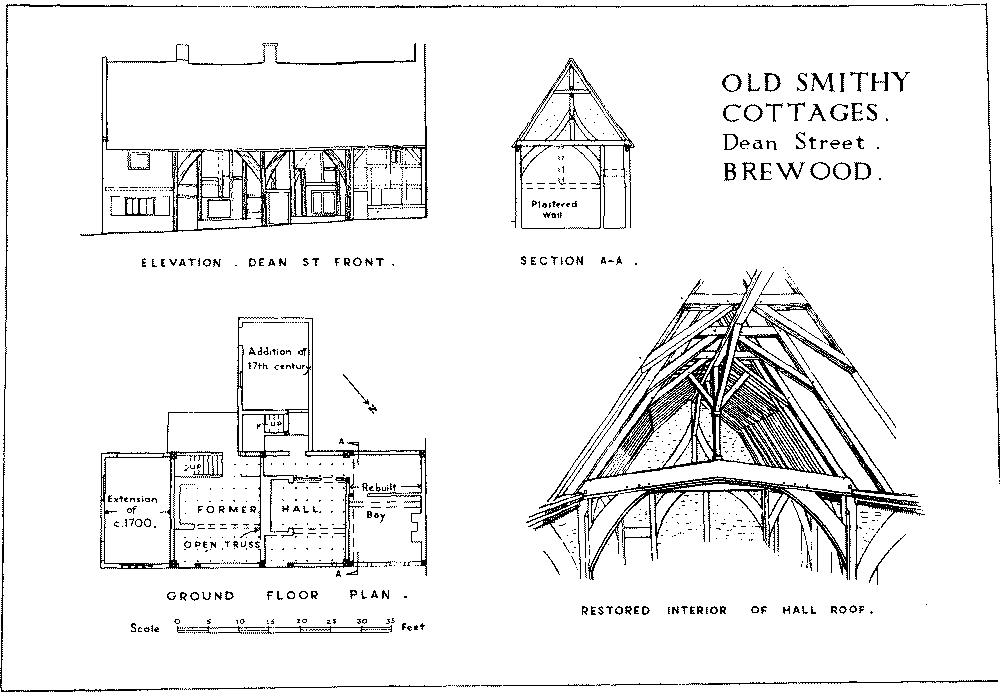
OLD SMITHY COTTAGES. Dean Street. BREWOOD.
The street connecting Dean Street with the Market Place dates from 1864 when a new road was cut. (fn. 139) The east side of the Market Place, lying north of the parish church, was traditionally the site of the 14th-century capital messuage of the bishop's manor. (fn. 140) An ancient timber building on the site of the house known as The Dreadnought was demolished here in 1896 (fn. 141) but there is no evidence to connect this with the bishop's messuage. South of this a house with a three-story 18th-century frontage is structurally of c. 1680 and has a good staircase of this period. Farther south the so-called 'Manor House', also refronted, has a late-16th-century rear wing and one of c. 1700. The houses forming the opposite side of the Market Place are timber-framed structures of c. 1600 refronted early in the 18th century with later shop-fronts inserted. The house at the north end has two upper-cruck roof trusses, probably late-17th-century work. The post office, on the north side of the Market Place, formerly had a good pedimented brick frontage of c. 1800. (fn. 142) The two-story stucco building at the corner of Sandy Lane, which retains its fluted doorcase and railings, is of similar date. In general the Market Place is Georgian in appearance in spite of alterations and the insertion of later shops.
A timber-framed building at the east end of Newport Street was faced with brickwork in the early 18th century and retains a small open shop of this period under a pentice roof. An adjoining outbuilding with stabling, now demolished, was at one time the fire station. (fn. 143) A group of timber-framed buildings, formerly known as The Mansion House (fn. 144) and standing at the junction of Newport Street with School Road, date from c. 1600. They consist of a low cottage range and a small house with two stories, attics, and a centrally placed entrance and chimney.
Most of the houses in Bargate were built after the beginning of the 19th century, but a few partially timber-framed cottages remain, and Bargate House dates from the mid-18th century. The former pinfold stood on the south side of the street east of the canal bridge. (fn. 145) The site is now occupied by a singlestory shop. Facing the end of Stafford Street is a tall brick house, now known as Castle Flats, with a very striking and ornate Gothic frontage. (fn. 146) It is said to have been built by William Rock, an apothecary (d. 1753), (fn. 147) who acquired a large sum at some date before 1740 by backing the racehorse Speedwell. (fn. 148) The house was formerly called Speedwell Castle. The building certainly represents an extravagant outlay on a confined site, but the architectural evidence suggests that its date is unlikely to be earlier than 1760. The front has two five-sided bays of three stories flanking a central entrance. The ogeeheaded and crocketted porch is supported on shafted columns. The windows of the bays are either roundheaded with keystones or ogee-headed with acorn finials. A few of the original Gothic glazing-bars have survived. Internally the staircase has a fretted balustrade of the 'Chinese Chippendale' type and one ground-floor room has an elaborate plaster ceiling and doorhead.
Stafford Street dates in the main from the 18th century. A house near the north end, dated 1715, contains a roof truss in which a medieval tie-beam has been reused. At the south end is a uniform terrace of six mid-18th-century houses. Opposite Stafford House, a brick building of c. 1800, are two early19th-century stucco fronts applied to a large L-shaped timber-framed house of the early 17th century. Adjoining it to the south and parallel with the street is an outbuilding containing a large medieval cruck truss. The south end of this building was evidently reconstructed in the early 17th century when a second cruck truss was replaced by one having an upper cruck tenoned into a cross beam.
The former smithy in Sandy Lane is a brick house incorporating a chimney and timbers from an earlier structure. The smithy itself has been converted into a living room. In other parts of the town are isolated examples of timber-framed structures of early-17th-century date.
The old grammar school, a building probably of the 17th century, disappeared in a reconstruction of 1856. It stood on the south-west side of School Road with the head master's house adjoining it. An 18thcentury drawing (fn. 149) shows the latter as a building of the late 17th century with mullioned and transomed windows and a curvilinear central gable. The school itself was a long single-story structure in which both the master's and the usher's classes were taught. In 1799 the master's house was enlarged and refronted. (fn. 150) At the same time two attached houses on the opposite side of the road were acquired and converted into an usher's house and a junior school. (fn. 151) These buildings, considerably altered, now represent the oldest part of the school. They are said to bear a bricklayer's date of 1778. (fn. 152) In 1799 School Road was diverted behind these houses, and the original road, by the erection of a wall and gate, became part of the school grounds. (fn. 153) In 1830 a portion of the croft or playground was sold to the Birmingham and Liverpool Junction Canal Company. (fn. 154) A hall and classrooms replaced the original school building in 1856, and the head master's house was rebuilt in 1863. (fn. 155) Further extensions date from 1898, 1926, 1935, and 1952. (fn. 156)
Little expansion of the town took place in the late 19th and early 20th centuries, the small residential development being mostly confined to the roads to Kiddemore Green and Coven. By far the largest area of new building is to the north-east, between Deansfield and the Stafford road. Here council and private housing estates have been developed since the Second World War and are still expanding. The police station and three police houses in the Pavement date from 1950.
The outlying parts of the parish also contain buildings of considerable interest. In Chillington Street, a lane that formed the main approach to Chillington Hall before the early 18th century, are several small timber-framed cottages with thatched roofs. They date from c. 1600 and have exposed framing in small square panels.
White House Farm, which internally appears to date from the early 18th century, has a long north elevation evidently designed to screen the farm buildings and present an imposing facade to Chillington Park on the north. The frontage is of brick, now painted white, with stone dressings. The tall central block, masking the farmhouse, is connected by short colonnades to side pavilions. Both the main block and the pavilions have pediments, formerly with ball finials, and a treatment of tall round-headed recessed panels. (fn. 157)
Leper House Farm (fn. 158) to the east is a timber-framed building of the central chimney type dating from the early 17th century. A later dormer window is dated 1716. One of the barns is partly timber-framed.
Park Lodge, perpetuating in its name the former park of Brewood, (fn. 159) is an isolated cottage 150 yds. east of Chillington Wharf. Its older portion is timberframed and dates from the late 16th or early 17th century.
Grange House Farm at the north end of Coven village retains a two-storied timber-framed crosswing dating from the later 16th century. The upper floor is jettied on three sides, supported on bullnosed joists and with a heavy dragon beam at the south-west angle. The framed partition between the two ground-floor rooms contains a Tudor doorhead and both rooms have chamfered and broachstopped beams and joists. The original stair newel is in position, and a first-floor room contains panelling of the late 16th or early 17th century. Coven Farm is a timber-framed two-story house built on a T-shaped plan and probably of the late 16th century. The roof has queen-post trusses, and the upper story was originally open to the ridge. At the corner of Lawn Lane and attached to the building and engineering works of John McLean & Sons Ltd. is a house originally of the 16th century which has been largely rebuilt in brick. The gable-end facing the road has stone walling and a projecting chimney-stack, probably a partial rebuilding dating from the 17th century. The engineering works occupy a mid-19thcentury brick building, formerly a brewery. (fn. 160) A colour-washed brick house in the centre of Coven, known as The Homage, has a date stone of 1679. It consists of two stories, attics, and cellars, and has a rectangular plan with a projecting porch wing near the north end of the front. The large central stack contains a cellar fireplace. The eaves cornice, gable parapets, and cellar windows are of stone. The Beeches, a tall brick house in its own grounds, dates from the late 18th century, and there are several other 18th-century houses in the village. Estate cottages built in the mid-and late 19th century by the Moncktons of Stretton occur in Coven village, at Four Ashes, and at Hill Top.
Owing to their position near the main StaffordWolverhampton road and the industrial development at Four Ashes, both Coven and Four Ashes have expanded considerably since c. 1930. There are council houses both north and east of the school, near Jackson's Bridge, and at Cross Green. Chambley Green is a three-sided court of fourteen terrace houses built by Cannock R.D.C. in 1955. There are caravan sites in Lawn Lane, at Lower Green, and near Coven Farm.
At Clay Gates, Engleton, are two single-story square brick cottages known locally as the 'pepperpots'. They were built by Mrs. Monckton of Stretton in the mid-19th century and their design is said to have been suggested by workers' dwellings in Scotland. (fn. 161)
Yew Tree Cottage in the hamlet of Horsebrook is a well-preserved example of a small brick house of the late 17th century. It has an L-shaped plan and retains its brick strings, stone eaves cornice, and wood-framed windows with leaded lights. Horsebrook Manor Farm has a 17th-century timberframed barn. Lea Fields Farm at Shutt Green to the south-west incorporates a late-16th-century timberframed house with a central chimney. One of the farm buildings contains two upper-cruck trusses, probably work of the late 17th or early 18th century.
At Kiddemore Green and Bishop's Wood are scattered timber-framed cottages of the late 16th and early 17th centuries.
Somerford Grange, a farmhouse in Somerford hamlet, is said to have been built by George Barbor (fn. 162) who took possession of the estate in 1761. (fn. 163) The three-storied south elevation was designed to present a picturesque front to Somerford park and is of interest as an example of 18th-century Gothic taste. It has a castellated parapet and stone bands, the central windows being circular and the windows of the two projecting bays having trefoil heads. Somer ford Farm has a 17th-century timber-framed barn and there is a small timber-framed cottage in the hamlet.
The architecture of the manor-houses and houses attached to lesser estates is treated under the relevant sections.
Markets and Fairs
In 1221 the Bishop of Coventry and Lichfield was granted a market in Brewood each Friday until the full age of the king. (fn. 164) In 1259 the Crown granted the bishop a market to be held in his manor each Monday. (fn. 165) The bishop successfully upheld this right in 1293. (fn. 166) In 1382 the burgesses of Stafford complained that Brewood market had been held for twenty years past without royal licence and to their prejudice, (fn. 167) but at some time between 1387 and 1390 the king confirmed the bishop's right. (fn. 168) By 1680 the Monday market had been discontinued, (fn. 169) but by 1747 a Tuesday market was being held. (fn. 170) The market-cross collapsed in 1810, (fn. 171) while by 1817 the decayed market-house had been pulled down and markets were no longer held. (fn. 172) The Friday market was revived in November 1833 (fn. 173) but had been discontinued by 1851, owing to the growing importance of Wolverhampton. (fn. 174) The market pump was destroyed in a bonfire on 5 November 1837. (fn. 175)
In 1259 the king granted the bishop an annual fair at the manor of Brewood on the vigil, feast and morrow of the Nativity of the Virgin (7, 8, 9 September). (fn. 176) The bishop upheld this right in 1293, (fn. 177) and at some time between 1387 and 1390 Richard II confirmed it. (fn. 178) By 1662, when the fair was held on 8 and 9 September, the main traffic was in horses. (fn. 179) After the change of style in the calendar the date was altered to 19 September. (fn. 180) An additional fair, free of tolls, held on the second Tuesday in May by at least 1834, (fn. 181) had lapsed by 1860, (fn. 182) and that on 19 September was gradually discontinued after the First World War. (fn. 183)
Manors
BREWOOD was among the possessions of the church of Lichfield before the Conquest and in 1086 was held by the bishop as 5 hides. (fn. 184) It was confirmed to the bishop with other temporalities in 1152 by Pope Eugenius III, (fn. 185) and Henry II, probably in 1155, granted the bishop 80 acres of assarted land at Brewood taken from the royal forest after 1135. (fn. 186) Brewood remained with the bishops of Lichfield (fn. 187) until 1852 when it passed to the Ecclesiastical Commissioners. (fn. 188)
For some years before 1643 the manor had been leased to the Giffards of Chillington, and Peter Giffard, who was lessee c. 1647 at the time of his sequestration as a papist and for taking arms against Parliament, paid a rent of £58 3s. (fn. 189) Although the park was surveyed in 1647, the bounds of the manor could not then be defined since, 'by reason of the unity of possession many ages in Mr. Giffard and his ancestors' of the manor of Chillington and of lands in Brewood, Broom Hall, Hatton, and Chillington, 'the late bishop's lands and his are annexed and for the present not distinguished'. (fn. 190) Sir Roland King, who had acquired the manor, was complaining in 1651 that although he had paid for it he was deprived of the rent due from tenants to whom the State had given leases. (fn. 191) By 1670 Peter Giffard's son Walter was holding the manor. (fn. 192) The Giffards thereafter retained a leasehold which seems to have afforded them a status and rights equivalent to lordship, (fn. 193) but in 1758 Thomas, great-nephew of Walter Giffard, made over his lease for lives to Thomas Prowse (fn. 194) in order to avoid prosecution as a papist. (fn. 195) Courts were held in the name of Thomas Prowse until 1 December 1766, in the name of John Prowse from 20 July 1767 to 16 May 1768 and in the name of Thomas Giffard again from 8 August 1768. (fn. 196) Thomas's grandson T. W. Giffard was granted the lease in 1825 (fn. 197) and is said to have bought the reversionary interest from the Ecclesiastical Commissioners in 1852. (fn. 198) In 1956 Mr. T. A. W. Giffard of Chillington owned such manorial rights as still existed. (fn. 199)
Bishop Roger de Weseham, who was at Brewood in 1253 (fn. 200) and 1254, (fn. 201) retired there in 1256 and died the next year. (fn. 202) The bishops continued to visit Brewood until at least 1305, (fn. 203) but by 1321 the capital messuage, with a garden and a close, had been leased out for a rent of 18d. which, it was then estimated, might be increased to 40d. (fn. 204) The manor-house had been leased to the Vicar of Brewood by 1473, (fn. 205) but there seems to have been no house in existence by 1538, when a pasture described as the site of the manor was leased to Roger Fowke of Brewood. (fn. 206)
In 1321 there was a fishpond within the manor of Brewood valued at 10s., although no rent was received for it as no fish were found there, (fn. 207) and by 1473 a fishery within the manor had been leased to Thomas Knightley for 20d. (fn. 208)
By c. 1280 the bishop had created burgage tenure in Brewood, the tenement being situated at Woodhouse-end. (fn. 209) One of the common fields in the manor was called Burgage Field. (fn. 210)
In 1086 the bishop held woodland at Brewood 1½ league long and a league broad. (fn. 211) In 1139 and 1144 the Pope confirmed the bishop in his possession of the 'hay and forest' of Brewood. (fn. 212) A plot of woodland here called 'Stryfwode' was sold by Sir Fulk Pembrugge, lord of Tong (Salop.), to the bishop in 1314. (fn. 213) In 1321 the underwood from a wood in the manor was valued at 51 marks, although only 12s. had been realized by the sale of underwood that year. (fn. 214) In 1538 the bishop gave Roger Fowke of Brewood the right to take timber from 'the common wood of Brewood called Bishop's Wood or Kerrimore' for 40 years, the dean and chapter confirming the grant. (fn. 215) In 1661 Peter Giffard of Chillington, presumably as lessee of the bishop's manor, had a 'warren of connies' in Bishop's Wood which he then leased to one of his younger sons, John Giffard of Blackladies. (fn. 216) By 1724 Bishop's Wood was all waste ground except for the rabbit warren, leased by the Giffards to a John Blakemore. (fn. 217)
In 1200 King John, after visiting Brewood, gave the bishop licence to inclose a park 2 leagues in circumference within the woodland of the manor, (fn. 218) and, having disafforested the royal forest of Brewood in 1204, (fn. 219) allowed the bishop to erect a deer-leap in this park, over against 'the forest' in 1206. (fn. 220) This park seems to have lain on the western side of the Penk opposite Coven. (fn. 221) The king gave 30 stags from this park to the Archbishop of Dublin in 1213, during a vacancy in the See of Coventry and Lichfield. (fn. 222) The deer-leap within the park was said in 1286 to be to the injury of the forest of Cannock. (fn. 223) In 1321 the park with a pasture was valued at 100s. though no rent was received because of the tenant's right of turbary. (fn. 224) In 1485 a sum of 23s. 4d. was spent on repairing the park palings. (fn. 225) Although in 1534 Bishop Rowland Lee, at the request of Thomas Cromwell, appointed a Ralph Sadleyer as keeper of the park and bailiff of the manor, (fn. 226) in 1535 Thomas Giffard was receiving a salary of £5 0s. 8d. as bailiff and custodian of the park. (fn. 227)
The park was in the tenure of John Giffard in 1609. (fn. 228) By 1647 Peter Giffard held it on lease for £8 a year and a brace of bucks and a brace of does in season, but the sequestrators then valued it at a rack rent of £134 13s. 1½d., namely 300 acres at 5s., 300 acres at 3s., and 293 acres at 12d. an acre, while a tenement and land leased by Peter Giffard to a Widow Bumfield for £17 12s. they considered should be worth £23. (fn. 229) In assessing the value of the woodland the sequestrators calculated that ironworking in the vicinity would 'advance the sale of the wood'; and they suggested that 'a great part of Brewood Park will bear good corn and may be much improved by ploughing.' (fn. 230) In 1649 Peter Giffard, lessee under the former bishop, was farmer of the park from the Committee of the County of Stafford or their lessee and had cut down 110 timber trees, worth £300, of which some were used by him to repair the park-pales, 'in these distracted times . . . so pulled down and stolen', and the rest, worth £102 17s. 8d. or more were disposed of to friends and neighbours; he had sold bark, 'from timber fallen in season for barking', to Francis Spooner of Brewood, tanner, for £5 10s. (fn. 231) Only two brace of deer were then left in the park; part of it was already sown with corn, and a further 100 acres was being made ready for ploughing. (fn. 232)
Walter Giffard was lessee c. 1680. (fn. 233) When the bishop leased the park in 1777 to Frances, widow of Thomas Giffard, the rent was still £8. (fn. 234) By 1788 the lessee was Thomas's son, Thomas Giffard. (fn. 235)
By 1255 the bishop held a view of frankpledge in the manor of Brewood and its 'members', which were together assessed at 5 hides, geldable, (fn. 236) and were described in 1285 as the liberty of Brewood, held in chief by the bishop as of his barony of Lichfield. (fn. 237) The temporalities of Brewood, assessed at £38 4s., then included 30s. from perquisites of courts and 15s. from view of frankpledge. (fn. 238) In 1293 the bishop defended his right to view of frankpledge, infangthief, and waif in his manor, (fn. 239) and in 1316 he was found to have return of writs in his vill of Brewood. (fn. 240) A fixed payment of 10s. 4d. for view of frankpledge called frithsilver was made in 1473 by the members of the manor, namely Brewood, Horsebrook, Engleton, Somerford, Gunstone, Hyde, Broom Hall, and Chillington. (fn. 241) The bishop's demesne lands of Kiddemore ('Kyrrymore') were then held on lease by five tenants, and no frithsilver was due from the remaining member, Hatton, because there was no building there. (fn. 242) Each brewer in Brewood and Horsebrook was paying 1d. for toll of ale. (fn. 243) The townships within the view in 1724 were Brewood, Horsebrook, Kiddemore, Engleton, Somerford, Chillington, the Hattons, and Gunstone. (fn. 244)
ASPLEY, within the fee of Coven by 1310, (fn. 245) was described as a manor in 1507 when the overlordship was held by Simon Harcourt, mesne lord of Coven. (fn. 246)
This manor was held in 1507 by Thomas Ellyngbrigg who was then succeeded by his infant daughter Anne. (fn. 247) There was a hall here by the 16th century, (fn. 248) and in 1704 the manor and capital messuage were held by Thomas Fowke and Mary his wife who in that year sold them to Thomas Bracegirdle. (fn. 249) The manor subsequently passed to Thomas Watson Perks of Shareshill by marriage with one of the daughters of a Henry Bracegirdle (fn. 250) and in 1774 seems to have been held by John and Ann Perks and William and Mary Bromley. (fn. 251) It was sold soon afterwards to the Hon. Edward Monckton (fn. 252) and as Aspley Farm was owned c. 1841 by his son Edward, the tenant then being Michael Lovatt. (fn. 253) The farm seems then to have descended with Somerford, being owned by Major R. F. P. Monckton of Stretton Hall in 1956. (fn. 254) By 1940 Aspley farm was over 150 acres in size. (fn. 255)
The farmhouse has a roughly H-shaped plan with a central block between north and south cross-wings. It incorporates a timber building of the open-hall type, probably dating from the early 16th century. The hall was presumably of two bays and a through passage formerly existed at its north end. The shaped and chamfered head of a post belonging to the open truss dividing the bays is visible in the bedroom above the passage. The insertion of heavy ceiling beams in the hall to form two stories probably took place in the late 16th century when a large chimney was built against the passage. A late 17th-century staircase blocks the passage at the north-west angle. The framed walls were replaced by brick in the 18th and 19th centuries.
BROOM HALL was probably a member of the bishop's manor of Brewood until the grant of the overlordship at some time between 1155 and 1159 by the bishop to the Dean and Chapter of Lichfield. (fn. 256) The overlordship was still held by the dean and chapter in 1317, (fn. 257) but by 1473 it had returned to the bishop. (fn. 258) Broom Hall descended as part of the liberty of Brewood until at least 1605. (fn. 259)
Land in Broom Hall, formerly held by Burtheimer and his sons Edwin, Achi, and Gamel and from about 1149 by William 'Awnoilus' (or 'the uncle') and by the widow of Ailric, was granted, with the services of the last two, by the bishop to his steward Ralph, lord of Harborne (Offlow hundred; now in Birmingham), and his heirs at some time between 1155 and 1159. (fn. 260) Ralph was to hold this with other land in Brewood of the dean and chapter at a rent of 4s. for the light of the high altar in the cathedral. (fn. 261) The subsequent descent of this intermediate lordship is obscure.
Land in Broom Hall was granted to Thomas de la Hyde and Margaret his wife in 1299 by John son of Ralph of Broom Hall, (fn. 262) while in 1303 Adam, son of John, and Adam's wife Lettice conveyed to Thomas a messuage, ½ virgate, 3 acres of meadow, and 4 acres of pasture here. (fn. 263) Thomas died in 1314, (fn. 264) and in 1315 the dean and chapter granted Broom Hall to his son, also Thomas. (fn. 265) Iseult, widow of the elder Thomas, seems to have been holding what was described as the manor of Broom Hall as her dower in 1316 and 1317, paying the 4s. due for the light at the high altar. (fn. 266) Thomas de la Hyde leased the manor in 1332 to William de Donyngton of Leicester for nine years, at a rent of 28s. to Thomas and 4s. to the light at Lichfield. (fn. 267) In 1342 Thomas settled all his lands in Broom Hall on Nicholas his eldest son, with reversion to Thomas's younger son Giles for life and the right heirs of Thomas. (fn. 268) Giles conveyed these lands in 1353 to Ralph his brother, (fn. 269) who in 1354 settled them on his own wife Joan and his son Thomas. (fn. 270) In 1396 or 1397 Joan acquired from Agnes Somerford, widow of Robert Fowleshurst, all her right in lands of 'the manor of Broom Hall' formerly held by Thomas, (fn. 271) but was sued in 1414 for a toft, land, and rent in Broom Hall by Elizabeth, described as daughter and heir of Ralph, and her husband Richard Lane, (fn. 272) to whom Joan resigned the manor in 1418 or 1419. (fn. 273) Lands here were held by Richard's grandson Ralph in 1477 (fn. 274) and, described between at least 1577 and 1605 as the manor of Broom Hall, descended in the Lane family with The Hyde (fn. 275) until at least 1715. (fn. 276) Sir John Giffard, however, at his death in 1556 was holding lands in Broom Hall of the bishop, (fn. 277) and what was described as a manor of Broom Hall was held of the bishop by Sir John's son and heir Thomas at his death in 1560 when the manor was stated to have been settled on him at the time of his marriage in 1531. (fn. 278) Lands in Broom Hall belonging to John, son of Thomas, were confiscated in 1588 because of his recusancy and were still forfeit in 1595, (fn. 279) but by 1611 John held a messuage and lands here. (fn. 280) His estate passed at his death in 1613 to his son Walter, (fn. 281) who died seised of it in 1632 (fn. 282) and whose grandson Walter was holding part of Broom Hall c. 1680, the other part being 'Captain Lane's'. (fn. 283)
In 1715, since the Giffard and Lane shares of what was called Broom Hall farm were so intermixed that neither party could sell or improve, Thomas Giffard of Chillington and John Lane of Bentley agreed to an exchange of various parcels. (fn. 284) The house remained with Thomas Giffard, (fn. 285) and c. 1841 Broom Hall farm was owned and held by T. W. Giffard, (fn. 286) whose nephew W. T. C. Giffard sold it in 1919. (fn. 287) In 1956 it was owned by Mr. C. Moreton. (fn. 288)
Thomas Careless was tenant of Sir John Giffard's lands in Broom Hall in 1556. (fn. 289) In 1599 a John Careless, husbandman, his wife Ellen and his son Edward were granted a lease by John Lane of all his lands in Broom Hall, (fn. 290) while in 1611 John, Ellen, and Edward were granted the lease of John Giffard's messuage and lands. (fn. 291) John Careless, whose brother William was with Charles II at Boscobel in 1651, (fn. 292) was tenant of the Giffards at Broom Hall in 1656, and from 1662 to 1670 he shared the tenancy with his step-father Edward Dearn, who had been tenant in 1653 and 1656. (fn. 293) After Edward's death John became sole tenant. (fn. 294) In 1704 the Careless estate consisted of 132 acres and included what was described as the hall. (fn. 295) John's grandson Edward was tenant at some time after 1707, but by 1715 he had been succeeded by his son Charles, who was then ejected from the share of the estate owned by John Lane and replaced by a Thomas Dearn. (fn. 296) In 1724 Charles was ejected from the Giffard share also, on grounds of having impoverished the estate, and Peter Giffard granted the lease to an Adrian Goodluck. (fn. 297) Charles died in 1726, (fn. 298) and his son Edward, a Wolverhampton baker, was claiming the land in 1739 after coming of age. (fn. 299)
The present farmhouse is a much-altered brick building of late-17th-century origin, and there is a 17th-century timber-framed barn. Pools which have recently been filled in and built over may have formed part of a moat.
In 1086 CHILLINGTON (Cillentone) was held of the king as 3 hides by William son of Corbucion, but it was being claimed by the Bishop of Coventry and Lichfield, (fn. 300) who held the overlordship by 1182. (fn. 301) Chillington descended as part of the liberty of Brewood between at least 1285 (fn. 302) and 1724. (fn. 303)
Peter Corbesun, apparently William's son, (fn. 304) held the manor at some time during the 12th century, and his daughter Margaret had it as her marriage portion. (fn. 305) Peter's son, however, Peter (II), after granting the manor to Peter Giffard at some time between 1175 and 1182, (fn. 306) retained a mesne lordship which may have passed in 1263 to Sir John Fitz John. (fn. 307) John's brother Richard, having succeeded him in 1275, was holding this lordship by 1287, (fn. 308) and it passed at his death in 1297 to his sister Maud Countess of Warwick, (fn. 309) whose son Guy Earl of Warwick was holding it in 1304. (fn. 310) Guy's son Thomas succeeded in 1315, (fn. 311) and Thomas's son Thomas was holding the mesne lordship at his death in 1401. (fn. 312) William and Roger, sons of a Peter Corbesun, were successively claiming some right in the manor as heirs of their kinswoman Margaret, daughter of Peter Corbesun (I), between 1293 and 1329. (fn. 313)
At some date between 1175 and 1182 Peter Corbesun (II) conveyed the manor to his wife's nephew Peter Giffard to hold as ½ knight's fee, and his son William confirmed the grant. (fn. 314) The manor then descended in the Giffard family (fn. 315) and in 1956 was held by Mr. T. A. W. Giffard. (fn. 316)
By 1297 Sir John Giffard's lands in the vills of Chillington and La Hyde included a capital messuage, presumably in Chillington, with a garden and curtilage attached, a carucate of land containing 80 acres under wheat and 40 acres under rye, 12 acres of woodland and pasture and rents from free and villein tenants. (fn. 317) Sir John's son John was granted free warren in his demesne lands at Chillington for himself and his heirs in 1319. (fn. 318) In 1511 a later John Giffard inclosed 5 acres of arable at Chillington to make a park, and the pastures at Chillington in 1650 included the New Park, the Old Park, and the Common Park. (fn. 319) By 1851 Chillington Park was open to the public during the summer. (fn. 320)
Chillington Hall is largely the work of Sir John Soane c. 1786, but it incorporates an early-18thcentury wing, and there are traces of the Tudor house which preceded it. The same site appears to have been in use since medieval times. A curved stretch of water south-east of the house, which survived until at least 1756, (fn. 321) was probably part of the moat. A complete rebuilding was undertaken by Sir John Giffard (d. 1556), probably after his mother's death in 1537. (fn. 322) The Tudor house appears to have been roughly quadrangular in plan with a gatehouse on the east side. (fn. 323) The present saloon, of which the walls are unusually thick, is thought to occupy the site of the Great Hall. A stone chimneypiece dated 1547, now in the saloon, may incorporate in a restored form original carved panels which were formerly above the doorway of the Great Hall. It bears shields of arms and a representation of the panther-shooting legend (see below). Some fragments of panelling are the only other survivals from the Tudor house. The building is said to have been 'remarkable for the various forms of its windows and chimneys'. (fn. 324)
Peter Giffard, who succeeded his cousin in 1718, demolished some of the Tudor buildings and erected the present three-story brick range on the south side of the quadrangle. Between this and the Hall he inserted a staircase block. The service courtyard behind the house and the stable ranges with their octagonal dovecot are also of his time. The south wing, of which the rainwater heads are dated 1724 with initials P.G.B. (Peter and Barbara Giffard), is of red brick with stone dressings. It is typical good provincial work of its day, thought to have been designed and built by Francis Smith of Warwick (1672–1738). (fn. 325) The windows, eight to each story, are uniformly spaced and have segmented heads, keystones, and aprons. Internally several of the rooms are oak-pannelled. The fine staircase has turned balusters, carved strings, and moulded undersides to the treads and risers. The walls of the staircase hall are ornamented with contemporary plasterwork. The kitchen rises to the full height of the service wing and originally had open fireplaces on two opposite walls. In the garden west of the house, laid out by Peter Giffard, is a stone screen which formerly led to a bowling alley. The fine wrought-iron gates have his initials on the overthrow. The Upper Avenue, over a mile long, leading from the house to Giffard's Cross was described in 1727 as 'lately made by Peter Giffard'. (fn. 326) The earlier approach was by the lane still known as Chillington Street.
Between 1756 and his early death in 1776 Thomas Giffard carried out important alterations to the park. He employed 'Capability' Brown and James Paine (fn. 327) who had recently collaborated on similar work at Weston under Lizard. (fn. 328) A string of three pools, about three-quarters of a mile south-west of the house, was formed into a roughly triangular expanse of water, with a dam at its lower end. The shores were planted with woodland. By 1851 the lake was admired for its 'beautiful fleet of vessels . . . from large yachts to the smallest of skiffs'. (fn. 329) A canal or 'private navigation', used for the transport of fuel and building material, leads from the south-east corner of the lake towards the house. Near its west end is a bridge of local stone designed by Paine. It is composed of a single segmented arch and has niches to the piers, roundels in the spandrels, and an iron balustrade. (fn. 330) There is said to have been a bridge by Brown at the farther end of the 'navigation'. (fn. 331) Across the northern arm of the lake is a sham bridge or causeway, similar in detail to Paine's bridge and having five blind arches. Other features designed to be seen to advantage across the water and probably dating from c. 1772 are a Classical and a 'Gothic' temple. (fn. 332) The former is a small summerhouse on the east bank with a Roman Doric portico of local stone. The Gothic temple, now partly ruinous, is of brick and stucco. An octagonal room in one of its flanking turrets is decorated with contemporary plasterwork. The so-called Ionic Temple, which masks the back of a gamekeeper's cottage, is possibly the work of Soane some fifteen years later.
Two designs by Adam for rebuilding the house survive from Thomas Giffard's time. One, dated 1772, was for an entirely new mansion probably on a site near the lake. The other was intended to incorporate the wing of 1724. (fn. 333) Thomas Giffard the younger, (fn. 334) who came of age in 1785, employed Sir John Soane from 1786 onwards. Soane's first design was also for a completely new house, but this was modified to include Peter Giffard's buildings of 1724. (fn. 335) Nearly all the remaining Tudor work was demolished. The house now consists of a long rectangle with the 1724 range forming its south end. The intended stucco finish was never applied, possibly to avoid too great a contrast with the older brickwork. The principal two-story front faces east and has a central Ionic portico of Tunstall stone. In order to mask the east end of the earlier and higher range the two end pavilions are carried up an extra story, a feature which did not appear in Soane's original design and which tends to dwarf the central portico. The fine domed saloon is entered through the portico and a vestibule with Ionic columns. It was originally intended for a chapel (fn. 336) and is thought to occupy the site of the Tudor hall. Its only lighting is from a clerestory in the shallow elliptical dome. Once again the design has been modified, the room as executed being asymmetrical and only three-quarters of its intended size. The handling of the dome and coved ceiling foreshadows some of Soane's important later interiors. The first-floor corridor with a small top-lighted dome at each end is also characteristic of this architect's later work. Soane's drawings include an unexecuted design for a bridge with an Ionic pavilion in the centre. (fn. 337)
Thomas William Giffard, who succeeded in 1823, completed some interior work, and the staircase window contains armorial glass said to have been designed by his brother Francis. (fn. 338) In 1911 a billiard room was added to the house, and the garden screen leading to the bowling alley was restored. (fn. 339) In 1957 restoration was in progress under the supervision of the Ministry of Works. (fn. 340)
Giffard's Cross, reputedly marking the spot where a panther was shot by Sir John Giffard (d. 1556), (fn. 341) is an ancient wooden cross about 6 ft. high. The arms, formerly terminating in trefoils, are much decayed. It now stands in the garden of a small 18th-century brick lodge near the gates at the east end of Upper Avenue.
COVEN was held by Ailric before the Conquest and by Robert de Stafford in 1086 when it was assessed at a hide. (fn. 342) The overlordship descended in the Stafford barony until at least 1605. (fn. 343)
In 1086 Coven was held of Robert de Stafford by Buered. (fn. 344) An intermediate lordship seems to have been held in 1166 by Geoffrey de Coppenhall (fn. 345) and to have descended with the mesne lordship of Coppenhall until about 1255 when Robert de Coppenhall surrendered it to Robert de Stafford. (fn. 346)
A lordship in Coven, held by the Burnell family, passed to Ralph Purcell with Shareshill on his marriage to Sibyl, sister of Robert Burnell, possibly during Stephen's reign. (fn. 347) Otwell Purcell held the vill of Coven c. 1255 of Robert de Coppenhall, and then replaced him as immediate tenant of the Staffords. (fn. 348) Otwell's son, Otwell (II), had succeeded to what was called the manor of Coven by 1283, (fn. 349) and Thomas, son of Otwell (II), was holding it in 1334 when his homage and services were included in a grant by Ralph de Stafford of 1½ knight's fee here and in Shareshill to Sir William de Shareshill. (fn. 350) In 1339 Thomas surrendered to Sir William all the homages and services of his tenants in Coven (fn. 351) and in 1340 all his rights and those of his wife Joan in a knight's fee there. (fn. 352) This intermediate lordship, covering by 1390 only two-thirds of Coven, (fn. 353) descended with Shareshill (fn. 354) until at least 1638 when Thomas Leveson conveyed it to Sir Edward Littleton, (fn. 355) who made a settlement of it in 1642. (fn. 356) Its subsequent descent is obscure.
In 1166 Alan de Coven was holding 2/3 knight's fee, presumably in Coven, of Geoffrey de Coppenhall, (fn. 357) and a Ralph de Coven held a fee there in 1242 (fn. 358) and 1255. (fn. 359) Ralph was still living in 1262 but by 1272 had been succeeded by his three daughters, Alice the eldest, Margery, and Philippa. (fn. 360) Ralph (II), the son of Alice and Robert de Pendeford, was granted a messuage and ½ carucate there in 1278 by his mother and her second husband Thomas Sany (or Pany), (fn. 361) and in 1285 he was said to be holding Coven of Otwell Purcell. (fn. 362) A Ralph de Coven was lord until at least 1329. (fn. 363) John, son of Ralph, and Juliana, wife of John, granted what was called the manor to Ralph de Coven, probably John's son or perhaps a brother, at some time after 1331, reserving to themselves a chamber in the great hall. (fn. 364) The manor was settled on a John de Coven in 1356 by a Richard le Taylor, (fn. 365) and in 1366 a Sir Thomas Coven conveyed all his lands and services here to Robert Jones, skinner, of London, who then settled them on a John de Coven. (fn. 366) In 1391 or 1392 John held a messuage and lands here (fn. 367) and settled the manor in 1394 or 1395 (fn. 368) on trustees, one of whom conveyed it to John's son, also John, in 1422. (fn. 369)
A grant of land in Coven to Richard Lane in 1433 or 1434 by a Thomas Boddesley and his wife Catherine (fn. 370) seems to have been confirmed by John Coven, (fn. 371) and an estate here, called a manor from 1576, then descended in the Lane family with The Hyde (fn. 372) until 1705 when John Lane conveyed the manor to Sir Walter Wrottesley. (fn. 373) It seems to have passed to Sir Walter's widow Anne at his death in 1712 and after her death in 1732 to Thomas, their grandson. (fn. 374) Thomas still held it in 1735 (fn. 375) but being childless he devised it to Magdalen Craig, presumably a relative on his mother's side. (fn. 376) In 1744 she conveyed it to Robert Barbor of the Inner Temple, (fn. 377) and the manor then descended with Somerford. (fn. 378) Such manorial rights as still existed in 1956 were then held by Major R. F. P. Monckton. (fn. 379)
What was described as one-third of the manor was held of Otwell Purcell by Robert Burnell, Bishop of Bath and Wells, at his death in 1292 and passed to his nephew Philip, (fn. 380) whose son Edward was holding rent only in Coven at his death in 1315. (fn. 381)
The Coven family were occupying a hall at Coven at some time shortly after 1331, (fn. 382) while in 1666 the 'hall house' here, whose owner was not named, was taxable for five hearths. (fn. 383) In 1738 the hall was held by William Jellicoe, apparently as tenant of Robert Lillyman, to whom it seems to have been sold by Thomas Wrottesley. (fn. 384) No house known as Coven Hall now exists.
A court leet and a court baron were included in the sale by John Lane to Sir Walter Wrottesley in 1705. (fn. 385) Records of the manorial court survive from 1520 to 1630. (fn. 386)
There was a fishpond in the vill in 1307, and the 'old fishpond' here was mentioned in 1322. (fn. 387)
By 1242 ENGLETON was held of the Bishop of Coventry and Lichfield as ¼ knight's fee (fn. 388) and continued to be held of the manor of Brewood until at least 1724. (fn. 389)
A Ralph de Engleton occurs at some time between 1149 and 1160, (fn. 390) and by 1226 William de Engleton was holding a free tenement here. (fn. 391) William's son John (fn. 392) held the ¼ fee here in 1242, (fn. 393) but probably by 1272 and certainly by 1293 he had been succeeded by his son Thomas, (fn. 394) who was lord of Engleton until at least 1326. (fn. 395) Thomas's eldest son Hugh, (fn. 396) who may have succeeded by 1327 (fn. 397) and was described as lord of Engleton in 1330 or 1331, (fn. 398) was alive in 1332 (fn. 399) but by 1355 had been succeeded as lord of Engleton by Thomas de Levereshoved (or Levershed). (fn. 400) Apparently by 1368 an Adam de Wisbrid and his wife Joan, possibly a daughter of Thomas, had settled what was called the manor on their daughter Joan with successive remainders to the son of Thomas and to Eleanor daughter of Thomas. (fn. 401) Eleanor, as a widow, made a settlement of half the manor of Engleton in 1376 or 1377. (fn. 402) Edmund Botiler and his wife Iseult likewise made a settlement of half the manor in 1391, (fn. 403) while in 1428 Agnes de Bradley and co-parcenors were holding ½ fee in Engleton. (fn. 404)
Alan de Withyfield, described as lord of Engleton, and his wife Joan conveyed what was called the manor to Roger Fowke and his wife Elizabeth for their lives in 1446 at a rent of 25s. (fn. 405) Roger Fowke, descendant of Roger and Elizabeth, (fn. 406) was described as lord of the manor between at least 1582 and 1610, (fn. 407) while his son Thomas and Thomas's son Ferrers together made a settlement of the manor in 1641. (fn. 408) Thomas died in 1652, (fn. 409) and in 1682 Ferrers, with his younger son Thomas, made a further settlement. (fn. 410) By 1691 the manor had passed to Phineas Fowke, second cousin of Ferrers, (fn. 411) and Phineas was succeeded in 1711 by his nephew Fowke Hussey, (fn. 412) who was holding the manor in 1724. (fn. 413) Phineas, son of Fowke, held the manor in 1734, (fn. 414) and in 1767 he conveyed it to Thomas Plimley, (fn. 415) who made a settlement of it in 1778. (fn. 416) Plimley conveyed it in 1785 to the Hon. Edward Monckton, (fn. 417) who was living at Engleton Hall in 1817 (fn. 418) and whose son Edward c. 1841 owned the land there, most of which, including the Hall, was in the hands of tenants. (fn. 419) The estate seems then to have descended with Somerford, and Major R. F. P. Monckton owned land here in 1956. In 1929 he had sold the Hall to the tenant, R. M. Walley, whose son, Mr. W. Walley, succeeded c. 1953 and still lived there in 1957. (fn. 420)
The other half of the manor had been held by William Buckingham, apparently of Wolverley (Worcs.), before 1473, when his daughter and heir Elizabeth, still under age, was in the custody of the Duchess of Buckingham while the bishop, as overlord, was receiving 26s. 8d. rent from a John Hore as lessee. (fn. 421) By 1544 this land was held by Thomas Moreton and his wife Margery, (fn. 422) and their son Matthew was holding a messuage called 'Buckingham's Land' of the bishop at a rent of 2d. at his death in 1582, when his son Edward succeeded. (fn. 423) The estate passed in 1630 to Edward's son and heir Matthew, (fn. 424) who made a settlement of what was called half of the manor in 1639. (fn. 425) He died in 1669, (fn. 426) and his son and heir Edward (fn. 427) was living at Engleton Hall c. 1680. (fn. 428) Edward's son Matthew, who became Lord Ducie of Moreton (in Gnosall) in 1720, (fn. 429) succeeded in 1687 (fn. 430) and in 1724 held the Hall and ancestral lands at a rent of £1 0s. 5d. (fn. 431) His son Matthew, who succeeded in 1735 and was created Baron Ducie of Tortworth (Glos.) in 1763, (fn. 432) made a settlement of what was called the manor with a dovehouse and a fishery in the Penk in 1767. (fn. 433) By his will dated 1768 he devised the manor to his nephew Thomas Reynolds, (fn. 434) who succeeded in 1770, and whose brother Francis, having succeeded in 1785, (fn. 435) held it in 1797. (fn. 436) Francis's son Thomas sold this half of the manor to Edward Monckton in 1811. (fn. 437)
The present Engleton Hall, now a farmhouse, was probably built in 1810, a date which appears on the brickwork. Ponds and depressions south-east of the house may indicate the position of a moat surrounding an earlier hall.
A Thomas de Lovers held a fishery in Engleton in 1346, (fn. 438) and a fishery in the mill-pond was included in the lease of the mill by the bishop to Robert Knightley in 1467. (fn. 439) In 1724 Fowke Hussey and Matthew Ducie each had a fishery appurtenant to their lands in Engleton, Matthew paying a rent of 10d. to the lord of Brewood. (fn. 440)
The overlordship of GUNSTONE as a member of Brewood was held by the Bishop of Coventry and Lichfield between at least 1477 (fn. 441) and 1576. (fn. 442)
In 1227 Geoffrey de Thickbroom was found to have been unjustly disseised of 2 virgates in Gunstone by Robert Fulco and his son Walter. (fn. 443) A Richard de Thickbroom leased 2 virgates in Gunstone formerly held by Walter de Thickbroom to a Henry de Lilleburn and his wife Isabel at a rent of 12d. in 1240, retaining 1½ virgate. (fn. 444) In 1251 what was called the manor of Gunstone was in dispute, except for 2 virgates, between Richard, described as son of Roger de Thickbroom, and his younger brother Hugh. (fn. 445) Richard de Thickbroom was still living in 1283 (fn. 446) but had been succeeded by his son Simon's son Ralph by 1293. (fn. 447) By 1341 Ralph de Thickbroom had granted to Hugh de Gunstone 1/6 knight's fee in Gunstone, 12s. rent and the services of four tenants, including Thomas de la Hyde and Hugh atte Pyrye. (fn. 448)
What was called the manor had passed by 1419 or 1420 to Joan, widow of Ralph son of Thomas de la Hyde, who then conveyed all her estate in it to Elizabeth, Ralph's daughter, and her husband Richard Lane. (fn. 449) Lands here were held by Richard Lane and his son John in 1434 (fn. 450) and then descended with Hyde in the Lane family, (fn. 451) being described in 1576 and 1589 as a manor. (fn. 452) In 1597 John Lane conveyed land there to John Fowke, described as of Gunstone, (fn. 453) who made a settlement of an estate there, including the capital messuage, in 1618. (fn. 454) John was succeeded in 1641 by his son Roger, who on his death in 1649 was followed by his son John. (fn. 455) John was succeeded in 1670 by his son Roger, who was living here c. 1680. (fn. 456) The subsequent history of this tenancy is not known.
By c. 1841 T. W. Giffard owned the land at Gunstone, most of which was in the hands of three tenant farmers. (fn. 457) The owner in 1956 was Mr. T. A. W. Giffard. (fn. 458)
At some time before 1279 one-third of the capital messuage of Gunstone was held by Alice, wife of Henry de la Pyrye of Gunstone, who after Henry's death exchanged it with his son Hugh for a messuage and land in Chillington. (fn. 459) Gunstone Hall was held by John Fowke in 1618 (fn. 460) and was the seat of 'Squire Fowke' in 1666 (fn. 461) and of his son Roger c. 1680. (fn. 462) There is now no trace of the early capital messuage. The present Gunstone Hall is a gabled stucco farmhouse dating from c. 1840. (fn. 463)
The overlordship of the manor of HATTON, a member of Brewood, was held by the Bishop of Coventry and Lichfield between at least 1428 and 1477. (fn. 464)
A messuage and land in Hatton were held by a Roger de Sparham of Hatton in 1302. (fn. 465) Richard Lane of Bentley (in Wolverhampton) and Hyde held a close in Hatton in 1423 and 1425, (fn. 466) and in 1428 the bishop granted him and his heirs what was described as the manor of Hatton for a rent of 7 marks and two appearances at the great court of Brewood. (fn. 467) Lands here descended in the Lane family with Hyde (see below) until at least 1477, (fn. 468) but in 1495 the bishop leased all his messuages and lands here to Sir John Giffard and Roger Fowke for 99 years. (fn. 469) Sir John's grandson John Giffard made a settlement in 1579 of what was called the manor of Hatton with lands and a fishery (fn. 470) and bought a further messuage and lands in Hatton and Brewood from John Lane in 1592. (fn. 471) John Giffard was holding lands in Hatton at his death in 1613, (fn. 472) and his grandson Peter held the 'manor or lordship of Hatton' in 1633. (fn. 473) John, Peter's son, held the manor in 1689, (fn. 474) but the subsequent descent is obscure.
In 1540 Bishop Roland Lee seems to have granted to Roger Fowke's son John a messuage and lands in Hatton which John Lane was claiming c. 1547, (fn. 475) and in 1571 Roger son of John Fowke made a settlement of lands and a free fishery in Hatton. (fn. 476) An estate here then descended in the Fowke family with Gunstone (fn. 477) (see above) until at least c. 1680, when Joyce, widow of John Fowke, owned the two farms called The Hattons, devised to her by her husband, (fn. 478) and seems to have been living at Hatton House, presumably the present Old Hattons (see below). (fn. 479) Part of the estate was subsequently sold to one of the Giffards of Chillington, while the remainder, continuing to be called The Hattons, was sold c. 1698 to a Mr. Nichols, who in turn sold it to a Mr. Stannier c. 1713. (fn. 480) By 1728 it was occupied and probably owned by Thomas Plimley, while the Giffard portion was by then divided between two tenants. (fn. 481)
Farms on the site of the present Upper Hattons, Hattons, and Old Hattons were owned c. 1841 by T. W. Giffard and occupied by Edward Wilson. (fn. 482) The Upper Hattons was sold by W. T. C. Giffard in 1919 to E. J. Morris and subsequently transferred to his sister Mrs. E. M. Cartwright, whose son, Mr. P. H. Cartwright, owned it in 1956. (fn. 483) The Hattons was sold, also in 1919, to the late Mr. Williams, who sold it in 1943 to P. H. Cartwright, the owner in 1956. (fn. 484) The Old Hattons was sold in 1919 to Major Carr and subsequently to Mr. Crewe of Kiddemore Green, who later sold it to Mr. F. Watson, the owner and occupier in 1956. (fn. 485)
The oldest of the three farmhouses at The Hattons is the most northerly. This continued to be known as The Hattons until at least c. 1841 (fn. 486) but has now been renamed The Old Hattons. The smaller house about 200 yds. to the south was built by 1775, (fn. 487) and is now known as The Hattons. The third and most southerly of the farms, described c. 1841 as Lower Hattons, (fn. 488) is now called Upper Hattons. It is an 18th-century brick house with later additions at its east end.
The Old Hattons dates in the main from the late 17th century but some of its features may be of earlier origin and there are indications that it was formerly of greater extent. It has a roughly Lshaped plan with wings extending to the east and south. Below the east wing a rock-cut cellar is lighted by windows in the stone plinth. There is a projecting chimney-stack on the north wall. On the west side of the south wing there is a central doorway with brick pilasters. Against the east wall are later additions concealing the features of a large chimneystack which may have formed part of an older house. Heavy chamfered and moulded ceiling beams are also of earlier character than the rest of the building.
The overlordship of HYDE, a member of Brewood, was held by the Bishop of Coventry and Lichfield from before 1292 (fn. 489) until at least 1605. (fn. 490)
What seems to have been a mesne lordship of part at least of Hyde, was held with Chillington as ½ knight's fee by Richard Fitz John at his death in 1297 when the reversion passed to his sister Maud Countess of Warwick. (fn. 491) Her son Guy Beauchamp, Earl of Warwick, held the lordship at his death in 1315. (fn. 492)
Sir John Giffard held the ½ fee of Richard Fitz John in 1297, (fn. 493) and this further intermediate lordship was held by Sir John's son John in 1316. (fn. 494)
A Walter de la Hyde, possibly the Walter son of Roger de la Hyde who occurs in 1294 or 1295, (fn. 495) conveyed the vill of La Hyde with lands in Chillington and Brewood to John de Sparham (or Sempringham), Canon of Lichfield, who conveyed them to the bishop. (fn. 496) Before 1292 the bishop granted them to Margaret, later the wife of Urian lord of Saint Pierre, knight, as the manor of La Hyde consisting of a messuage worth ½ mark, 60 acres of land worth 4d. an acre, and 4 acres of meadow worth 12d. an acre, and subsequently settled the manor on Urian and Margaret jointly. (fn. 497) Urian was dead by 1295, (fn. 498) with a grandson, Urian son of John, a minor, as his heir, (fn. 499) and in this year Margaret, then wife of Ralph Basset, recovered seisin of the manor. (fn. 500) She was holding La Hyde in 1323 or 1324 as ½ knight's fee (fn. 501) but seems to have been succeeded by John de Saint Pierre, son of her son Robert, by 1347. (fn. 502) John was still living in 1354, (fn. 503) but in 1425 his sister's son Robert de Brinton, described as of Chillington, conveyed lands called 'Seymperesthing' (St. Pierre's Thing) to Joyce wife of William Greville and widow of Thomas Giffard. (fn. 504) The land had passed by 1452 to Margaret, daughter of William Greville and Joyce, and Margaret's husband Thomas Corbyn, described as of Chillington, (fn. 505) and in 1455, after Margaret's death, Thomas conveyed it to John Lane of Bentley and his wife Margery. (fn. 506)
Lands and tenements in La Hyde were conveyed by a Roger son of William de la Hyde to his daughter Parnel, widow of Thomas de Gypwich (or Gypevico), whose settlement of them on her eldest son Thomas was confirmed in 1294 or 1295 by Walter son of Roger. (fn. 507) At about the same time Thomas de la Hyde was granted by John de Sparham a further 10 acres here, held of John Giffard, (fn. 508) and after Thomas's death c. 1314 (fn. 509) his widow Iseult sued for dower in La Hyde from his son and heir Thomas, (fn. 510) who in 1316 or 1317 was holding what was called the manor of Hyde. (fn. 511) It seems to have passed with Broom Hall to his son Ralph whose widow Joan in 1419 or 1420 conveyed all her estate in the manor of Hyde to Elizabeth, daughter and heir of Ralph, and Elizabeth's husband Richard Lane of Bentley, (fn. 512) and in 1434 Richard settled it on his son John, (fn. 513) who had succeeded by 1439. (fn. 514)
The two manors seem to have been united in the hands of John Lane, who was succeeded in 1470 by his son Ralph. (fn. 515) He held a messuage and a mill in Hyde called 'le maner' of Hyde with lands here at his death in 1477 when his son Richard succeeded. (fn. 516) The manor passed to Richard's son John in 1517 (fn. 517) and in 1576 to John's son Thomas, (fn. 518) who was succeeded in 1589 by his son John. (fn. 519) The 'capital messuage called Le Hyde' with lands appurtenant passed in 1605 to John's son Thomas, (fn. 520) an active supporter of Charles I and father of Jane who assisted Charles II in part of his flight after the battle of Worcester in 1651. (fn. 521) John, son of Thomas, succeeded in 1660 (fn. 522) and was followed in 1667 by his son Thomas, (fn. 523) whose son John succeeded in 1715. (fn. 524) The manor, or reputed manor, of The Hyde with the farmhouse called The Hyde, having been settled in 1732 on John's son Thomas, was conveyed by him in 1747 to Thomas Plimley (fn. 525) who in 1757 settled the farm on his son Thomas on his marriage with Catherine Stubbs. (fn. 526) This younger Thomas mortgaged the manor and house in 1767 (fn. 527) and in 1778 leased the house for ten years to Walter Richards of The Hyde. (fn. 528)
By 1781 the manor seems to have been in the hands of Frances, widow of Thomas Giffard, (fn. 529) and it passed to Thomas's son and heir Thomas when he came of age in 1785. (fn. 530) Hyde Farm, with 48 acres of land, was owned c. 1841 by T. W. Giffard, the tenant being George Howell. (fn. 531) The owner in 1956 was Mr. T. A. W. Giffard.
The present brick farmhouse was built early in the 18th century. The symmetrical north front was later covered with stucco, the windows altered and a porch added. A ground-floor room contains reset panelling which incorporates carved medallion heads of the mid-16th century and shields bearing the arms of Lane and of Lane impaling Bagot. (fn. 532) The former moat has been filled in on the north and east sides. The western arm still contains water and a ditch remains on the south.
SOMERFORD was within the manor of Brewood probably before 1120 and certainly by 1126 (fn. 533) and remained a member of the Bishop of Coventry and Lichfield's liberty of Brewood between at least 1285 and 1761. (fn. 534)
Probably at some date between 1120 and 1126 the bishop gave a Richard de Somerford lordship over Haenilda and the lands which she had inherited from her father Franus, to hold as ½ knight's fee, (fn. 535) and this is probably the ½ fee held of the bishop by a Robert fitz Richard in 1166. (fn. 536) A Robert son of William de Somerford, who in 1281 was holding a messuage here of the bishop by suit of court and a rent of 4s., (fn. 537) was named as lord of Somerford in 1285 (fn. 538) and was holding Somerford in 1313 or 1314 by the service of finding a man with a horse worth ½ mark and with a sack of hemp, to follow the lord for 40 days when there was war in Wales; by attendance at the lord's three-weekly courts; by presentation of a tithing man at the twice-yearly great courts of Brewood; and by a rent of 4s. a year. (fn. 539) By 1324 Robert had been succeeded by John de Somerford, (fn. 540) and he or another John was holding land here in 1346 (fn. 541) and 1347. (fn. 542) A John Somerford of Somerford occurs in 1422 (fn. 543) and he or another of the same name in 1473. (fn. 544) By 1547 a William son of John Somerford of Somerford (fn. 545) had been succeeded by his son Humphrey (fn. 546) whose eldest son Robert seems to have predeceased him without issue and whose second son Thomas may have been in possession in 1548. (fn. 547) Thomas too died without issue, and the third son Geoffrey was holding what was described as the manor of Somerford in 1589 (fn. 548) and 1594. (fn. 549) Geoffrey's eldest son Francis was living at Somerford Hall between at least 1620 and 1623, (fn. 550) but Francis's son John was dealing by fine with the manor in 1625, the year of his coming of age, (fn. 551) and in 1655. (fn. 552) Francis died in 1657, (fn. 553) but John was not admitted to his lands until 1661. (fn. 554) John's eldest son Francis, who was admitted to his father's lands in 1673, (fn. 555) was still living in 1689, (fn. 556) but by 1693 he had been succeeded by a John Somerford. (fn. 557)
The capital messuage and lands had been conveyed by 1705 to Sir Walter Wrottesley of Wrottesley (in Tettenhall, Seisdon hundred), who was living at Somerford Hall at least in 1707 and, dying there in 1712, was buried in Brewood church. (fn. 558) His widow Anne, on whom he had settled the estate (fn. 559) and who subsequently married Paul Boyer, was holding part of Somerford in her own right by 1724, (fn. 560) and after her death in 1732 the manor with the capital messuage and lands passed to her daughter and others in trust for sale. (fn. 561) The estate was bought in 1734 for £5,400 by Robert Barbor, of the Inner Temple, (fn. 562) who was living there in 1737. (fn. 563) Robert was still alive in January 1761, (fn. 564) but his son and heir George was admitted to the Somerford lands in July. (fn. 565) A James Barbor suffered recoveries of the manor in 1766 and 1774, (fn. 566) and it passed, probably in 1779, to the Hon. Edward Monckton, (fn. 567) who was a younger son of Viscount Galway (d. 1751) and had made a large fortune in India. (fn. 568) He much improved the estate and made extensive plantations of trees to replace the timber cut by previous owners. (fn. 569) He was succeeded in 1828 by his son Edward, who was followed by his brother George in 1848. (fn. 570) Francis, nephew of George's younger brother Henry, succeeded in 1858 and was followed in 1926 by his son Major R. F. P. Monckton, (fn. 571) the owner in 1956 of the estate and of such manorial rights as still existed. (fn. 572)
After the death of George Monckton in 1858 the Hall was held by tenants until at least 1928, but it was unoccupied in 1932 and 1940. (fn. 573) It was converted into flats c. 1945. (fn. 574)
Somerford Hall stands in a park and consists of a tall three-storied block of seven bays, flanked by single-story pavilions. (fn. 575) On the entrance front the pavilions have Venetian windows with blind side lights set in round-headed recessed panels. Above these are pedimented gables with ball finials. The house was built by Robert Barbor (fn. 576) in the second quarter of the 18th century. The central hall of this date has contemporary plasterwork and an oak staircase. The building was much altered in the late 18th century by the Hon. Edward Monckton whose additions include the porch, the Adam-type fireplaces, and probably the external stucco. Since 1945, when the building was adapted for use as separate dwellings, alterations to doorways and windows have taken place. In the mid-19th century the domestic offices were considered 'all very excellent and commodious for the purpose of saving manual labour, being supplied by a large reservoir at the top of the house . . . filled by a waterwork invented and erected at great expense by Mr. Monckton on the river at some distance'. (fn. 577) The gardens and strawberry beds were served by an irrigation system using surplus water from the house. (fn. 578) Extensive stables and outbuildings adjoin the house on the west, incorporating a square dovecot which probably dates from Robert Barbor's time. Farther west the farm buildings are also large and numerous and include a fine Dutch barn of brick with arcaded sides.
An estate in Brewood belonging to the deans of Lichfield included the prebend of Brewood (to which the church of Brewood had already been approximated) in Lichfield Cathedral by episcopal grant c. 1176; (fn. 579) half a 'wara' of land and a dwellinghouse in Brewood given by the bishop between 1175 and 1182; (fn. 580) and a parcel of moor in Brewood granted by Roger de Hyde after 1222. (fn. 581) What was called the DEANERY MANOR by 1628 remained with the deans of Lichfield (fn. 582) until 1868 when, on the death of Dean Howard, the ownership became vested in the Ecclesiastical Commissioners. (fn. 583) In 1904 the commissioners conveyed some 24 acres to Francis Monckton and in 1911 some 8 acres to the grammar school for sports fields. (fn. 584) The manor and its court were still held by the commissioners in 1925, (fn. 585) but in 1927 they sold all remaining deanery land in Brewood, some 117 acres, to Mr. T. A. W. Giffard. (fn. 586) The Dean of Lichfield still retains the prebend of Brewood. (fn. 587)
In 1628 the manor was leased to Isaac Tomkys of Bilston (in Wolverhampton) and his eldest son John, and Isaac was still in possession in 1650. (fn. 588) By c. 1680 the rectorial estate at least was held of the dean by a Samuel Whitwick, 'brother of Francis'. (fn. 589) A John Whitwick, probably son of Francis, appears as Samuel's executor in 1684, (fn. 590) and this John's son John (fn. 591) was lessee of the manor in 1724. (fn. 592) Mary daughter of this younger John (fn. 593) and her husband Peter Calmel conveyed manor, prebend, and tithes in 1780 to Edward Monckton of Somerford. (fn. 594) He was holding the manor courts by 1781, (fn. 595) and his family retained the lease of the manor (fn. 596) until 1903 when it expired and reverted to the Ecclesiastical Commissioners. (fn. 597)
A house called Dean's Hall was included in the lease of the manor in 1628 and was valued 'upon improvement' at £6 a year in 1650. (fn. 598) It is presumably the 'Dean's Hill in Dean's End' noted by Gregory King c. 1680. (fn. 599) As the capital messuage it was included in the leases of the manor to the Moncktons from 1783 (fn. 600) and it was still held by the family in 1874. (fn. 601) As Dean's Hall Farm it was bought in 1927 by Mr. T. A. W. Giffard (fn. 602) who sold it in 1950 to Mr. S. Robinson, still the owner in 1956. (fn. 603)
In its present form the house dates largely from c. 1700 and is roughly L-shaped on plan. It is built on two levels, the block of c. 1700 facing north-east and having an earlier but much altered service wing at its rear. A large pilastered chimney is common to both wings. Two rooms contain 17th-century panelling, in one case obviously reset. A tall garden wall and a dovecot, the latter much overgrown, date from c. 1700. In the farmyard a barn of five bays retains three cruck trusses of medieval date. These have tie-beams, collar-beams with curved braces, and upper collars. Short spur ties, formerly connecting the principals with the side framing, are still in existence although the side walls have been rebuilt in brick. There is evidence that several other cruck trusses are missing. At the north-west corner of the barn is a 17th-century timber-framed extension of two stories.
Lesser Estates
A virgate of land at Ackbury ('Herkebarowe'), with ½ virgate in Hyde, was conveyed c. 1200 by Galopin and his wife Edith, whose mother's marriage portion the land had been, to Hugh son of Peter Giffard for homage, service, and 2 marks. (fn. 604) By 1230 Hugh had granted it to his brother Peter to hold of Galopin and his heirs. (fn. 605) In 1724 waste land called 'Ackburyes' belonged to Peter Giffard as parcel of the manor of Chillington and was held by four tenants. (fn. 606)
Bishop Roger Meuland c. 1280 granted 9 acres in Ackbury ('Eskborrow'), with a burgage in Brewood, to Richard le Mason who in 1315 or 1316 conveyed the estate to Richard of Wolverhampton, and he in return granted these 9 acres, described as 'Eskborrow Heath' near the bishop's park, with the burgage in Brewood in Woodhouse-end, to Thomas de la Hyde. (fn. 607)
A formerly moated site at the junction of Port Lane and Chillington Street probably indicates the position of an early messuage. Two cottages on the site, known as Barn Houses, form together a rectangular timber-framed structure of the 17th century, very probably a converted barn. (fn. 608) In 1889 the moat was more extensive and the building was described as 'Hackbury Heath'. (fn. 609) The house 300 yds. to the north, now known as Ackbury Heath, is not ancient.
The site and lands in Brewood belonging to the Benedictine nunnery of St. Mary, or Blackladies, founded c. 1150 probably on land granted by the bishop out of the manor of Brewood and dissolved in 1538, (fn. 610) were sold by the Crown in 1539 to Thomas Giffard of Stretton, (fn. 611) who succeeded his father Sir John Giffard as lord of Chillington in 1556. (fn. 612) Thomas leased the site to his son Humphrey in 1559 for life with reversion to his eldest son John, (fn. 613) and after Humphrey's death, at some time between 1614 and 1632, it passed to Walter Giffard of Chillington, son of John, from whom it descended in 1632 to his son and heir Peter. (fn. 614) By 1655 Blackladies had been sequestrated and sold by the Treason Trustees to a Thomas Gookin, (fn. 615) and in 1656 it passed to Thomas Harper of London, who conveyed it in 1657 to Francis Page of London. (fn. 616) Peter Giffard's fourth son John, on whom it seems to have been settled at his marriage, (fn. 617) redeemed it (fn. 618) and was living there in 1661. (fn. 619) In a dispute lasting from 1680 to 1698 he tried unsuccessfully to maintain the exemption of Blackladies, as an ancient peculiar within the parish, from payment of tithe. (fn. 620) His grandson Peter succeeded to Blackladies in 1710 and to Chillington in 1718. (fn. 621) Blackladies then descended with Chillington (fn. 622) but was sold by W. T. C. Giffard in 1919 to Miss Louise Vaughan, passing a few years later to her brother, Major Ernest Vaughan. (fn. 623) His widow occupied it in 1956. (fn. 624)
In c. 1841 this farm comprised 206 acres with house and chapel and was tenanted by John Green. (fn. 625)
There was a fishpond attached to the nunnery in 1286. (fn. 626) The estate in 1710 included a fishpool 'lately made' and a dovecot. (fn. 627)
No part of the monastic buildings has survived, the present house having been built late in the 16th or early in the 17th century. It is T-shaped in plan, having two stories and attics, and is a large brick structure with stone dressings. The principal range faces east, and a long rear wing extends to the west. The entrance front has a central porch and two large projecting five-sided bays, each of three stories. The range has crow-stepped gable ends. Both here and in the rear wing some of the original windows have survived. The rear wing retains moulded brick round-headed doorways and at least one original chimney with diagonal shafts. A panelled groundfloor room at the north end of the east range has a stone fireplace with a four-centred head and an arcaded overmantel of carved oak.
A small timber-framed chapel, probably built in the 17th century, was in existence until c. 1846. It stood north of the rear wing and was connected to it by passages both at ground-floor and gallery level. The site is now marked by a cross set in a low brick wall. The chapel had close studding to its upper story and the timbering of the connecting passage was diagonal. (fn. 628) A wooden bell turret was taken down in 1789. (fn. 629) A description published in 1846 (fn. 630) records south and west galleries internally, the latter supported on twisted pillars, and a tesselated floor. Axedressed and moulded stones at the base of the low yard wall near the chapel site may be of medieval origin. A long two-story stable range of brick with stone dressings lies north of the house. It dates from the early 17th century and has been little altered. The brick walls to the forecourt are thought to be the work of Peter Giffard early in the 18th century. (fn. 631) After the sale of the property in 1919 the house was altered and very thoroughly restored. (fn. 632) Many of the doors, windows, dormers, and chimneys are of this date.
In March 1710, when the greater part of the house was leased to William Webb of Hamstall Ridware (Offlow hundred), certain rooms were retained by Catherine, widow of John Giffard, for her own use, and these included 'the chapel and all rooms, paths, and passages thereto belonging, the necessary house at the end of the gallery, the writing house, the use of one of the fireplaces in the kitchen, the water there and free passage through the same'. (fn. 633) She was also to have the use of various domestic offices and outbuildings, the 'fishpool or pond lately made . . . the canals and stews at the bottom of the garden, the pond between the court and barns, half the pigeons in the dovecot . . . also the best court and best garden'. (fn. 634)
Brewood Hall is said to have been the seat of William son of Roger Fowke temp. Edward IV. (fn. 635) It then descended with the Fowke share of the manor of Engleton (fn. 636) until 1930 when Major R. F. P. Monckton sold it to Mr. C. O. Langley, (fn. 637) steward of Brewood manor and deputy-steward of the deanery manor. (fn. 638) Mr. Langley was living at the Hall in 1956. (fn. 639) It was occupied in 1666 by Mary widow of Thomas Fowke. (fn. 640) Thomas Plimley was living there as tenant in 1743. (fn. 641) The Hon. Edward Monckton intended the Hall to be used as a jointure house by his widow who, however, remained at Somerford until her death in 1834. (fn. 642) The Hall then seems to have been occupied variously by tenants and members of the Monckton family until at least 1924. (fn. 643)
The present house, which lies on the eastern outskirts of the town, was built late in the 17th century. It appears to follow the layout of an earlier, probably medieval, plan consisting of a central hall block with gabled cross-wings projecting to the east. It is built of brick and has two stories and attics. The projecting wings on the symmetrical east front carry stone tablets below the first-floor windows, that on the north wing bearing a HusseyFowke achievement of arms. The other tablet is blank. Blocked lunette windows are visible on the much-altered back elevation. Internally the central hall has a stone bolection-moulded fireplace of the late 17th century, and the main staircase has twisted balusters and square newels. A ground-floor room in the north wing contains 17th-century panelling. While in the occupation of the Misses Monckton in the later 19th century, the house was considerably altered; plate-glass windows with cement quoins were inserted and a conservatory built between the front wings. (fn. 644) Topiary work in the garden, admired in 1686, (fn. 645) also disappeared at this time. Service quarters have been added at the north-west corner of the house, and the front porch is modern. Garden walls and gate piers date from the late 17th century. Several of the outbuildings, including a timberframed barn with long straight braces to the lower panels, are also of 17th-century date.
A messuage called 'Coldhome' in Kiddemore Green within the manor of Brewood was conveyed in 1660 by Thomas Harris to his son Thomas and Thomas's wife Elizabeth. (fn. 646) Father and son were alive in 1666, (fn. 647) but the widow of Thomas the younger and Thomas Harris, presumably the father, was living there in 1672. (fn. 648) By 1729 Coldhome was held of the manor of Brewood by a John James, as it had been earlier by his father. (fn. 649) The name Coldham is now attached to some cottages at the junction of the roads from Chillington and Boscobel (Salop.).
Land called 'Longbryche' adjoined the land in Hatton granted by the bishop in 1540 to John Fowke. (fn. 650) The land and a house recently built on it, called The Long Birch, were held by Roger Fowke (d. c. 1649), who shortly before his death assigned part of the estate to the use of his three unmarried daughters. (fn. 651) What was described as 'the capital messuage called Long Birch' was occupied in 1664 by James Greene and his mother, (fn. 652) and c. 1677 was sold by one Fowler of Salt (St. Mary's parish, Stafford, Pirehill hundred) to Walter Giffard. (fn. 653) Described c. 1680 as 'a good house', (fn. 654) it was used as a dower house by Mary Giffard of Chillington after the death of her husband Thomas in 1718. (fn. 655) She died in 1753, and the house was leased to the Vicars Apostolic of the Midland District from c. 1756 until 1804. (fn. 656) After 1804 the house seems to have been leased from the Giffards as a farm. (fn. 657) As most of the house collapsed when restoration was attempted in 1874, the foundations were blown up, (fn. 658) and in 1878 the present farmhouse was built. (fn. 659) It was sold in 1919 by W. T. C. Giffard to a Mr. Southern of Lower Penn (Seisdon hundred), who had sold it by 1939 to Mr. W. N. Meanley, the owner in 1956. (fn. 660)
The old house at Long Birch appears to have been of three distinct dates. (fn. 661) The entrance range was a tall block of mid-17th-century character containing two stories and attics. The symmetrical front had three curvilinear gables to the parapet, mullioned and transomed windows and a pilaster treatment. The central two-story porch had a round-headed entrance and a hipped roof. Behind this range was an even taller block with stone mullioned windows and massive chimneys, probably of late-16th-century date. At the extreme rear were timber-framed gabled wings with overhanging upper stories which may have been of medieval origin.
Pearce Hay, an estate of 51 acres c. 1841, was then owned by Thomas Vaughton (fn. 662) having formerly belonged to a family called Pitt. (fn. 663) Vaughton sold it in 1843 to T. W. Giffard, (fn. 664) and the farm called Pearce Hay was owned in 1956 by Mr. T. A. W. Giffard. (fn. 665) By 1940 it was over 150 acres in size. (fn. 666) The farmhouse is a building of the early 17th century and retains exposed timber-framing on its south side. There is a three-story addition of c. 1835.
Land at Woolley ('Wulveley') near Hyde was granted in 1273 by Peter de Wulveley to his son, also Peter. (fn. 667) In 1661 Peter Giffard of Chillington leased 'his capital messuage or tenement called Woolley' to his son John Giffard of Blackladies for 21 years. (fn. 668) In c. 1841 Woolley farm was owned by T. W. Giffard and in the tenure of William Icke. (fn. 669) It was owned in 1956 by Mr. T. A. W. Giffard. (fn. 670) The north block dates from the late 17th century and has a large central stack. The south block carries the date 1824 and the initials T.L.
Agriculture
The bishop's manor of Brewood was being farmed on the three-field system by 1367. (fn. 671) Open fields named Shurgreave Hill Field, Hargreave Field, Eachells (or Nechells) Field and Burgage Field in the manor of Brewood, Quarry Field and Church Field which seem to have been shared by the bishop's manor and the deanery manor, and Cross Field, Mill Field, Street Field, and Butts Field in the vill of Horsebrook within the bishop's manor were being inclosed piecemeal from at least 1696. (fn. 672) By 1800 there seems to have been no open-field arable remaining in the manor. (fn. 673)
By 1724 'waste ground called Bishop's Wood' within the bishop's manor of Brewood was common pasture for the tenants of the manor (fn. 674) and in 1834 was still an open common attached to the manor covering 44 acres and with several cottages built on encroachments. (fn. 675) It was inclosed under an agreement of 1844 between the Bishop of Lichfield as lord of the manor and T. W. Giffard as lessee. (fn. 676)
There were three open fields in the manor of Coven in 1596, Broadmeadow Field, Fulmore Field, and 'Rycrofte'. (fn. 677) Broadmeadow Field seems still to have been an open field in 1657. (fn. 678) In 1855 55 acres on Slade Heath to the east of Coven village and on Coven Heath in Bushbury (Seisdon hundred) were inclosed under an Act of 1850. (fn. 679)
Mills
The grant of Blackladies to Thomas Giffard in 1539 included a water-mill 'within the site' (fn. 680) which was held by Humphrey Giffard in 1613 (fn. 681) and by Walter Giffard in 1632. (fn. 682)
Sir John Giffard's estate in Chillington and La Hyde in 1297 included a water-mill. (fn. 683) A later Sir John had a water-mill at Chillington in 1556, (fn. 684) and there was still a mill here in 1723. (fn. 685)
In 1318 Ralph de Coven granted to John de Aldenham the homage and services of Walron the miller and his son John and a share in the old watermill in Coven near Brewood Park with the site of the mill, fishponds, and appurtenances at a quit-rent for fourteen years and thereafter at a rent of 20s. (fn. 686) In 1322 Ralph confirmed the grant of what was then described as a third part of the mill. (fn. 687) John de Aldenham and his son were accused by the bishop in 1337 of having diverted the Saredon Brook and the Coven Brook to the use of this mill, thereby impeding the flow of water to the bishop's mill, (fn. 688) probably that at Somerford. This mill in Coven may have occupied the site of the water-mill which was attached to Aspley by 1704, (fn. 689) was described in 1757 as situated on a 'brook running . . . to Somerford mill', (fn. 690) and is probably to be identified with Standeford mill on the Saredon Brook mentioned in 1760. (fn. 691) In 1834 Standeford mill was occupied by William Shenstone, (fn. 692) and his executors owned it c. 1841 when the tenant was John Austin. (fn. 693) The ownership subsequently passed to the Yeomans family, who sold it in 1930 to Evelyn, widow of Francis Monckton of Stretton Hall, and in 1956 the building was owned by Major R. F. P. Monckton. (fn. 694) The mill was used as a grist mill until c. 1912 and continued to grind horse fodder until 1939. (fn. 695) It is an 18th-century brick building with additions to the mill-house of c. 1840. (fn. 696) In 1933 the house was damaged by fire and was partly rebuilt. (fn. 697) In 1956 the house and buildings were unoccupied.
An estate in Bushbury (Seisdon hundred) and Coven which included a water-mill was conveyed in 1614 by Sir Walter Leveson, mesne lord of Coven manor, to Francis Toncke and his wife, (fn. 698) and a mill within the manor of Coven and Brinsford (in Bushbury) was occupied by Walter Clarke in 1657. (fn. 699) By at least 1775 the Brewood parish boundary ran just to the north of Coven mill (fn. 700) which was thus situated in Bushbury, and the remains of the mill are at Old Mill Farm, Bushbury. The centre part of the mill-house, built partly of stone, may date from the 17th century. The mill is a small derelict brick building dating from the early 18th century. The pool has been filled.
One of the two mills in Brewood held by the bishop in 1086 (fn. 701) and 1291 (fn. 702) was probably situated at Engleton. In 1467 the bishop leased a water-mill here for ten years at a rent of 53s. 4d. to Robert Knightley. (fn. 703) In 1538 the bishop granted the lease to Roger Fowke for 40 years at a rent of 4 marks. (fn. 704) Engleton mill was owned in 1643 by Peter Giffard and occupied by Francis Lun at a rent of £2 10s. (fn. 705) The ownership descended in the Giffard family until 1864 when the mill was sold to the Moncktons, (fn. 706) and the tenancy was held by the Mellow family between at least 1754 and 1876. (fn. 707) The mill went out of use c. 1896 (fn. 708) and the derelict building was owned in 1956 by Major R. F. P. Monckton. (fn. 709) It is a brick building of the late 17th century in which earlier timbers have been reused. The east wall against the former wheel site has lower courses of dressed sandstone. The adjacent 18th-century brick dwelling is also derelict. Building stone on the site in 1956 was brought from the former Teddesley Hall for a proposed restoration. (fn. 710)
A mill descended with Hyde manor from at least 1477 (fn. 711) and was owned c. 1841 by T. W. Giffard, being then in the tenure of Joseph Bill. (fn. 712) It continued in use until the Second World War, (fn. 713) and the pool, owned by Mr. T. A. W. Giffard, was well stocked with trout in 1956. (fn. 714) The three-storied brick mill and dwelling-house, forming an L-shaped block, were built early in the 19th century. In 1956 the machinery was still intact, there being two millstones, supplied from Kidderminster (Worcs.), (fn. 715) and a large metal wheel of the overshot type.
There was a windmill between Hyde mill and the road from Brewood to Kiddemore Green by 1775, (fn. 716) and in 1778 Thomas Plimley leased it with the watermill at Hyde to Edward Kent for ten years. (fn. 717)
The second of the two mills in Brewood held by the bishop in 1086 (fn. 718) was probably situated at Somerford. The grant to Richard de Somerford between c. 1120 and 1126 included the right to build a mill. (fn. 719) A mill rebuilt by the bishop before 1288 and in use in 1291 seems to have been at Somerford. (fn. 720) In 1337 the bishop complained that John de Aldenham had diverted the Saredon Brook by a trench to Coven mill, thus reducing the output of the mill in Brewood (probably Somerford mill), which working day and night could as a result produce only 6 qr. of 'each kind of corn' instead of thirty. (fn. 721) Somerford mill was leased by the bishop as a fulling-mill before 1473, probably to John Somerford who by then had rebuilt it. (fn. 722) It was in use as a corn-mill by 1620, and in 1623 Francis Somerford was complaining that its working was hampered, presumably by diversion of the water, by the new forge a short distance up the Penk. (fn. 723) The mill continued to descend with the manor as a grain-mill (fn. 724) and was owned by Edward Monckton c. 1841 when the tenant was Joseph Brewster. (fn. 725) It was in use until at least 1884. (fn. 726) Somerford Mill Farm at Catchem's End incorporates the former mill building in its northern half. The working floor was carried on a brick arcade, and the present low kitchen block housed the wheel. There are 18th-century leaded lights in the side walls, and the roof contains reused tie-beams. The living quarters adjacent to the mill date from the earlier 18th century and contain a stair of this period. Heavy main beams suggest an earlier structure rebuilt. The mill pool to the south is overgrown.
A mill situated on the Penk by Somerford Hall and driven by a turbine was used in 1956 for grinding cattle food and sawing timber.