
A History of the County of Stafford: Volume 5, East Cuttlestone Hundred. Originally published by Victoria County History, London, 1959.
This free content was digitised by double rekeying. All rights reserved.
'Cannock: Churches, schools and charities', in A History of the County of Stafford: Volume 5, East Cuttlestone Hundred, (London, 1959) pp. 63-75. British History Online https://www.british-history.ac.uk/vch/staffs/vol5/pp63-75 [accessed 25 April 2024]
In this section
Churches
There was a chapel at Cannock by the 12th century. (fn. 1) It was probably founded as a dependency of Penkridge collegiate church, (fn. 2) and by the later 12th century it was attached to a prebend in that church. (fn. 3) The right of appointing a chaplain was disputed like the rectory between the Dean and Chapter of Penkridge and the Dean and Chapter of Lichfield and was finally secured by Lichfield in 1345. (fn. 4) No vicarage was ever ordained, the benefice remaining a perpetual curacy until 1868 when it became a titular vicarage. (fn. 5) The advowson was still held by the Dean and Chapter of Lichfield in 1956. (fn. 6)
It is not known when the chapel acquired the status of a parish church. In 1293 the Bishop of Coventry and Lichfield insisted that it was a church and not a chapel, (fn. 7) and from 1330 it had its own burial ground. (fn. 8) The church was exempted from archidiaconal jurisdiction in 1255 and remained a peculiar of the dean and chapter. (fn. 9)
In 1604 the curate of Cannock was receiving a salary of £8. (fn. 10) The Committee for Plundered Ministers in 1646 granted the curate, probably Richard Bourne, an augmentation of £50 a year out of the impropriate tithe, and in 1654 Richard Bourne, described as 'former curate', was established in Cannock by the commissioners to preach the gospel at a salary of £100, which by c. 1659 had been increased by £80. (fn. 11) The incumbent in 1885 still received £1 from a rent-charge given by Henry Stone in 1686. (fn. 12) By will proved 1891 James Holford left £100, the proceeds to be divided equally between the vicar and curate of the parish church. The legacy became payable in 1905. In 1929 the income was £8. (fn. 13)
The 'service of St. Mary' at Cannock was in existence by 1421 when it was granted the contingent remainder of a messuage in Hednesford called 'Mokyntonplace', with land adjoining. (fn. 14) The Chantry of Our Lady in Cannock church was endowed by 1548 with lands, tithes, ten cows, and £1 6s. 8d. for the support of a priest who sang mass daily at the Lady Altar. (fn. 15) The chantry priest, Laurence Peryn, who had been keeping a grammar school for 30 years, was allowed to continue as schoolmaster after the dissolution of the chantry at a salary of £4 14s. 5½d. a year. (fn. 16) In 1549 the chantry lands, lying in Cannock, Huntington, and Leacroft, with rents of 4s. 2d. a year in Cannock, Huntington, and Great Wyrley, were sold to John Cupper and Richard Trevour, (fn. 17) but by 1552 the lands and tithes, valued at £5, had passed to Lord Paget (fn. 18) and seem to have descended with the manor of Cannock until at least 1788. (fn. 19)
By 1548 there was a chapel dedicated to St. Margaret in the parish, possibly at Huntington. (fn. 20) It was endowed with 4d. rent, and only one mass was said there each year. (fn. 21) It possessed one little bell. (fn. 22) By 1563 the chapel was no longer in existence. (fn. 23)
Missions were established at Hednesford c. 1864, (fn. 24) Wimblebury by 1871, (fn. 25) Bridgtown and Green Heath by 1872, (fn. 26) Chadsmoor in 1874, (fn. 27) Five Ways (Heath Hayes) by 1874 (St. Chad's, closed c. 1892) (fn. 28) with a second mission here by 1885, (fn. 29) West Hill, Hednesford, by 1880 (until c. 1896), (fn. 30) Hazel Slade by 1880, (fn. 31) Brindley Heath by 1889 (until c. 1954), (fn. 32) Rawnsley Cottage by 1889, (fn. 33) Pye Green by 1894, (fn. 34) West Chadsmoor by 1947, (fn. 35) Moss Wood by 1950, (fn. 36) and in Fosters Avenue, Broadway (between Chadsmoor and Pye Green) by 1950. (fn. 37) The schoolroom at the workhouse was used for public services between c. 1880 and c. 1946. (fn. 38) The new ecclesiastical parish of St. Peter's, Hednesford, was established in 1870, the vicarage being in the gift of the Bishop of Lichfield, (fn. 39) and in 1956 included Wimblebury, Green Heath, Rawnsley, and Hazel Slade. (fn. 40)
On condition of attending an annual service in Cannock church on St. Barnabas' Day (11 June) and there preaching a sermon in rotation, the incumbents of the eight Staffordshire parishes of Abbots Bromley, Bednall, Brewood, Colwich, Lapley, Penkridge, Shareshill, and Weston upon Trent, provided they are resident for at least ten months in the year in their cures, share equally the income from the charity founded by the Revd. William Alport, of Buckinghamshire, by will dated 1720. (fn. 41) The original endowment consisted of lands in Cannock and Hednesford. (fn. 42) This land has long since been sold, and the proceeds, invested in stock, yielded £624 9s. 4d. in 1956. (fn. 43) Four of these incumbents, of Abbots Bromley, Penkridge, Shareshill, and Weston upon Trent, with those of Bloxwich, Bradley, Castle Church, and Coppenhall, likewise on condition of their being resident in their parishes for at least ten months of the year and attending a service in Cannock church on this same day, share equally in the income of the charity founded by Miss Eleanor Alport, sister of William, by will dated 1727. (fn. 44) This charity estate consisted of a messuage and lands in Hammerwich (St. Michael's, Lichfield), (fn. 45) over 72 acres by 1847 (fn. 46) and over 110 acres by 1921, when most of it was sold. (fn. 47) The income in 1956 consisted of £15 rent from two fields in Hammerwich, some 13 acres in all, and £174 16s. 6d. interest from stock. (fn. 48) These two charities were jointly administered in 1956, the Vicar of Cannock receiving 10s. 6d. for conducting the service. (fn. 49)
A sermon was preached in Cannock as late as 1823 under the terms of the Troming Charity. (fn. 50)
The church of ST. LUKE consists of an aisled and clerestoried nave of six bays, chancel, north vestry, south chapel, and west tower. The nave dates largely from the 14th and the tower from the 16th century. The south nave wall was rebuilt in 1752–3. Between 1878 and 1882 the nave was extended eastwards, and the present chancel and vestry were built. The south chapel was added in 1949.
The earliest masonry in the building, which occurs near the west end of the north aisle, dates from the late 12th or early 13th century. This suggests that the 13th-century church was aisled and of its present width. An almost complete rebuilding took place in the 14th century: much of the internal walling in the western part of the nave is of this date, together with the four western arches of the two arcades. The octagonal piers with scroll-moulded capitals have been rebuilt or recut, but the western responds are original. The widening of what was then the most easterly bay of the north aisle to form a chapel is also of the 14th century. There was formerly a five-light Geometrical window in the north wall of this bay (fn. 51) and the basement course externally (now restored) is also of the 14th century. The north doorway and the external buttresses to the north wall of the aisle appear to be of the same date. The tower has a 14thcentury basement course and an ogee-headed doorway to the vice staircase. It is possible to reconstruct a fairly complete picture of the 14th-century church from these remaining features. An aisled nave of four bays had a tower at the west end and a chapel occupying the easternmost bay of the north aisle. There was no clerestory, the nave being covered by a steeply pitched roof, the line of which is still visible externally on the east face of the tower. Drawings made before the 19th-century alterations (fn. 52) show a small rectangular chancel, occupying much the same position as the two easternmost bays of the present nave and having a two-light Geometrical east window. It is known that in 1330 the Dean and Chapter of Lichfield were planning to start work on the chancel, (fn. 53) and it is very probable that this date marks the beginning of rebuilding operations which extended to the whole church.
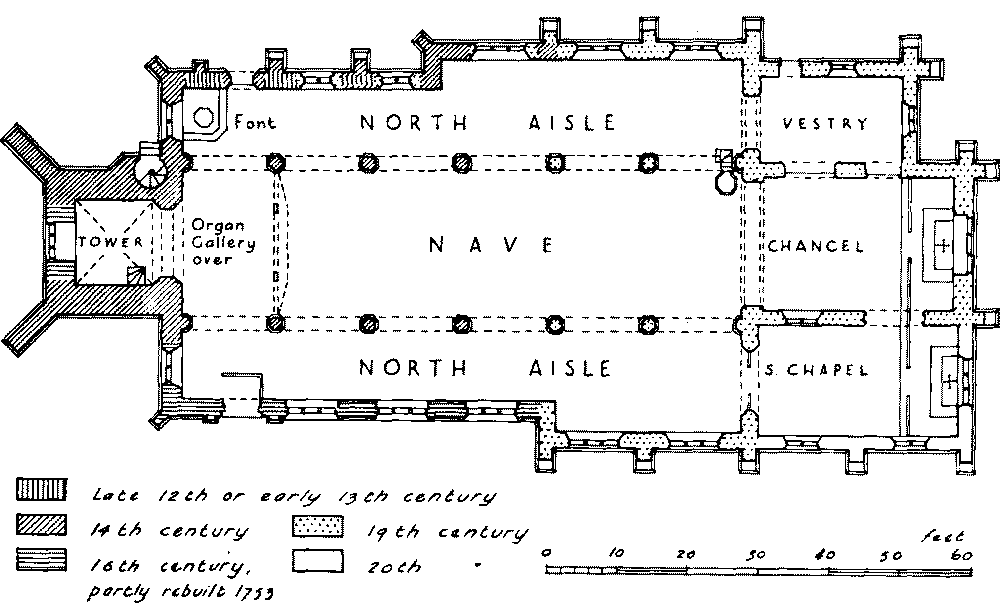
Plan of St. Luke's Church
The tower is mainly of 16th-century masonry, refaced externally, (fn. 54) and the belfry stage with its two-light windows, Perpendicular string, and embattled parapet is of this period. It is probable that other alterations were made to the church in the 16th and 17th centuries. At one time there were large windows of very late medieval type in the north wall of the nave (fn. 55) and three existing windows on the south side may have had their origin at the same time. (fn. 56) A drawing of 1841 (fn. 57) shows a vestry with a stepped gable and pinnacle on the north side of the former chancel; this was probably a 17th-century addition.
The south side of the church is said to have been rebuilt in 1753. (fn. 58) The south doorway, demolished in 1957, had a sundial above it, Tuscan pilasters, and a pediment. (fn. 59) It carried the date 1752, probably that of its insertion, but there is a tradition that it came originally from Leacroft Old Hall. (fn. 60) The hipped roofs which formerly covered both nave and chancel were probably new in the 18th century and the clerestory was built or rebuilt at the same period. Writing in 1836 Edward Thomas complains that 'the original beauty of this church has been sadly disfigured by the introduction of large kitchen-like windows of the present day into the clerestory, which being also (rebuilt I suppose) of brick gives the whole a very mean appearance'. (fn. 61)
Interior drawings of 1841 (fn. 62) show a flat plaster ceiling to the nave, a four-centred chancel arch, and galleries at the west end and over the aisles. One of these latter was approached by a stair with flat early17th-century balusters. The nave was filled with tall box pews and there was a three-decker pulpit.
In 1849 the church was repewed and the north side restored. (fn. 63) The three most westerly windows in the north aisle and the small window above the north door were filled with heavy Geometrical tracery at this date. (fn. 64) More extensive alterations took place between 1878 and 1882 (fn. 65) under the direction of N. Joyce of Stafford. (fn. 66) The nave and aisles were extended eastwards by two bays, the line of the widened chapel being continued on the north side and a similar widening introduced on the south. A new chancel was built with a combined vestry and organ chamber to the north of it. The style followed that of the 14th-century church, the piers and arches of the arcades being exactly copied and the new windows being filled with Geometrical tracery. Pointed windows replaced the 'kitchen-like' windows in the clerestory.
In 1925 the north and south galleries, then considered unsafe, were cleared away, (fn. 67) and the internal plaster was removed from the walls. The south chapel, built in 1949 as a memorial to the fallen of both world wars, (fn. 68) is the full width of the south aisle and the same length as the chancel. It was designed by James Swan of Birmingham and is in a modern version of the late Decorated style. The organ was moved to a gallery at the west end of the nave in 1950 (fn. 69) and the arches between the former organ chamber and the chancel were partly walled up.
Tables of charities, formerly on the west gallery, are now stored in the tower. (fn. 70)
In May 1956 a faculty was granted for the addition of a stone south porch to the church. (fn. 71)
The church formerly contained an octagonal font, probably of the 15th century, with a moulded bowl having flat shields on four of its faces. (fn. 72) The present bowl, restored and mounted on a new pedestal in memory of Jack Ball (d. 1944), (fn. 73) is similar but the shields are missing. The font's position has been moved at least twice. Near the north door is a fine ancient chest with iron bands and three locks. The altar, chancel panelling, and readingdesk date from 1932, 1936, and 1940 respectively. (fn. 74) Memorial glass was inserted in most of the windows in the late 19th and 20th centuries.
The oldest memorial in the church, commemorating Mary Warynge (d. 1613), is a wall tablet with flanking columns from which the figure, probably kneeling, was already missing in 1836. (fn. 75) A tablet to Elizabeth Bagot (d. 1638) was engraved in the early 19th century to replace an earlier one which had been plastered over in the former chancel. (fn. 76) A floor-slab now in the north aisle may be the original stone. Other wall tablets commemorate William and Eleanor Alport (d. 1721 and 1730), founders of the Alport Trust; William Finney (d. 1743) and members of his family (1746–85); Moreton Walhouse of Hatherton (d. 1796); Moreton Walhouse, his son (d. 1821); John Walhouse (d. 1835); Catharine and Ann Walhouse (d. 1836 and 1837). A tablet to Bernard Gilpin (d. 1902) was erected by his workpeople of Churchbridge and Wedges Mills; one to Napier H. Walker (d. 1916) was erected by old pupils of Walhouse National School of which he was master for 38 years. An alabaster slab engraved with a male and two female figures of the early 16th century, recorded in 1836, appears to be missing. (fn. 77)
In 1553 the church plate consisted of a silver chalice, parcel gilt with paten. (fn. 78) In 1957 it included an Elizabethan chalice; a flagon and lid, 1733, the gift of Dorothy Byrch; a dish, 1680; two dishes, 1741, the gift of Robert and Ann Fisher; a paten, 1806, the gift of William Cary; a modern chalice; a silver chalice and paten, 1956, in memory of Leonard Rowley; all of silver; a pewter flagon with lid and a pewter plate; and a ciborium. (fn. 79)
In 1553 there were three bells and one sanctus bell. (fn. 80) By 1889 there were six bells: (i) 1849; (ii–vi) 1747. (fn. 81) There are now eight bells: (i, v, vii, viii) 1923, J. Taylor and Co.; (ii) 1849, Mears; (iii, iv, vi) 1747, Bagley. (fn. 82)
The surviving registers date from 1744. The earlier registers were destroyed by fire about 1858. (fn. 83)
In the churchyard, south of the church, are the remains of a stone cross probably dating from the 13th or 14th century. It consists of a broken square shaft and a square base raised on three tall steps. The churchyard was closed for burials in 1878 (fn. 84) and has been largely cleared of gravestones. An area of about 157 sq. yds. at its southernmost corner was appropriated by the Ministry of Transport in 1941 for road widening. (fn. 85)
The vicarage house, built on a site north of the churchyard in 1839 at a cost of £800, (fn. 86) is a gabled brick house with 'Tudor' details.
The church of ST. PETER, Hednesford, dates from 1868. (fn. 87) The site was given by the Marquess of Anglesey, and the cost of the church was about £3,000. (fn. 88) The walls are of stone, left exposed internally, and in the first instance only the nave, apsidal chancel and south transept were built. Provision was made for a tower, the tower arch being incorporated in the west nave wall. In 1904 and 1905 a north aisle in Penkridge stone and a south porch were added, the architect being T. W. Sandy of Stafford. (fn. 89) The original building has lancet windows to apse and transepts and is generally of 13th-century style. The nave and additional aisle have Perpendicular windows. The foundations were underpinned in 1937, and the walls, evidently much damaged by subsidence, were repaired. The levels in the sanctuary were altered at the same time. (fn. 90) The first organ, installed by public subscription in 1872, (fn. 91) was replaced by a new one in 1910. (fn. 92) Stained glass to the memory of Thomas Eskett was inserted in the east window in 1879. (fn. 93) The choir stalls and clergy desks date from 1924. (fn. 94) In 1957 the plate included a silver chalice given in memory of M. E. Slaney in 1924; a silver paten given in 1924; a gold chalice, 15th-century Flemish, bearing the inscription 'Maria Jesus' in knop, given by Prebendary Grier; and two patens, one gelfmetal, one electro-plated. (fn. 95) There is one small modern bell. (fn. 96) The vicarage-house to the west of the church was built in 1872. (fn. 97)
The church of ST. PAUL at Wimblebury dates from 1889 and 1890 (fn. 98) and is of red brick with blue bands and dressings. It was originally built so that the chancel could be shut off with revolving shutters and the nave used as a day-school. (fn. 99) In 1957 the plate included an electro-plated chalice and paten and another paten. (fn. 100) There is one bell.
A school-church was opened at Bridgtown in 1874 (fn. 101) and an iron church in 1876. (fn. 102) The present church of ST. PAUL replaced the iron church, which was becoming dilapidated, in 1899. (fn. 103) It is built of red brick with stone dressings and consists of nave, chancel, north porch, organ chamber, and vestry. There are traceried windows at the east and west ends; the other windows have mullions and round-headed lights. In 1957 the plate included a silver chalice and paten, presented in memory of Sarah Jane Barnes by her husband in 1924; an electro-plated chalice and paten; a silver private communion set (miniature); and a silver ciborium given by Mrs. A. Whitehouse in memory of her husband George A. Whitehouse (d. 1938). (fn. 104)
The church of ST. SAVIOUR at Green Heath was dedicated in 1888. (fn. 105) It is a plain red-brick building to which a chancel with lancet windows was added in 1901. (fn. 106) In 1957 the plate included a silver chalice and paten; a silver paten presented by the Sunday school in 1929; an electro-plated wafer cup; and a silver private communion set, given in memory of Mrs. Marland. (fn. 107) There is one bell.
A school-church was opened at Chadsmoor in 1874, and transepts and a small chancel were added in 1876. (fn. 108) The foundation stone of the present church of ST. CHAD was laid at Easter 1891 'in the presence of a large company of miners and their families', (fn. 109) and the church was consecrated in 1892. (fn. 110) It is built of machine-made red brick and consists of nave, chancel, south porch, vestry, and organ chamber. The windows are tall lancets, those at the east and west ends being graduated. The interior is unplastered, and one course of brickwork at sill level carries the names of subscribers to the building. The oak reredos and the lectern date from 1906. (fn. 111) Stained glass was inserted in the east window in 1908 in memory of Tabitha Benton. (fn. 112) In 1957 the plate included an electro-plated flagon, chalice, and paten, and an electro-plated ciborium. (fn. 113) There is one bell in a turret at the north-west corner of the church. The incumbent's house is east of the church.
The surviving chapel at Five Ways (Heath Hayes) was enlarged in 1891 (fn. 114) and replaced by the church of ST. JOHN THE EVANGELIST, which was built in 1902–3 (fn. 115) and consists of a nave, chancel, vestry, and porch. St. John's is of red brick with stone dressings and is similar in style to the church of St. Paul, Bridgtown (see above). The ground round the building was levelled by miners who also raised £400 in small subscriptions towards the cost. (fn. 116) In 1957 the plate included a silver flagon, 1918–19, presented as a war-memorial; a silver chalice presented in memory of Edwin Thomas Gwyther by Agnes Gwyther in 1919; a silver paten presented in 1919 by Annie Timmins in memory of her husband; and an electro-plated chalice, two patens, small chalice, and jug. (fn. 117) There is one bell.
The church of ALL SAINTS at Hazel Slade, built in 1884, (fn. 118) consists of nave, chancel, and north transept with a bell-cote and one bell at the west gable-end. It has pointed windows and is built of red brick with blue-brick bands. In 1957 the plate included a silver chalice and paten presented in memory of John Hall, 1910, and an electro-plated chalice and paten. (fn. 119)
The church of ST. MARY at Brindley Heath was dismantled in 1954. (fn. 120) The plate included one electroplated chalice given by E. Appleyard in 1926. (fn. 121)
The church of ST. MICHAEL AND ALL ANGELS at Rawnsley was built in 1889 (fn. 122) and is a structure of wood and corrugated iron. In 1957 the plate included a silver chalice, and two silver patens. (fn. 123) There is one bell in a bell-cote.
The church of ST. MARK at Pye Green is a small roughcast building with a bell in a bell-cote, and there is a hall adjoining. In 1957 the plate consisted of a chalice and paten. (fn. 124)
The small wooden church of ST. AIDAN in Pye Green Road, West Chadsmoor, was in use from 1947 to 1956 when it was converted into a church hall. (fn. 125) It had one bell. The present church, begun in 1955 (fn. 126) on a nearby site on the opposite side of the road, was opened in 1956, the architects being Wood, Goldstraw, and Yorath of Stoke on Trent. Built of light-brown brick, the church consists of a wide nave, a shallow chancel, a south vestry, and a north porch, and has one bell.
The mission of ST. GEORGE in Fosters Avenue, Broadway, had been started by 1950 (fn. 127) in a hut which by 1956 was used solely as a church hall, a new mission hut with one bell having been built by then. In 1957 the plate consisted of a chalice and paten. (fn. 128)
Roman Catholicism
It was stated in 1604 that the 400 people of Cannock parish were 'almost all papists, as is commonly seen in the jurisdiction of the Dean and Chapter of Lichfield'. (fn. 129) Walter Coleman of Cannock, who occurs as a recusant in 1607, (fn. 130) had a Benedictine chaplain, and a Benedictine monk named Nicholas Becket died here in 1618. (fn. 131) Twenty-nine recusants in Cannock, including John Coleman, son of Walter, John's wife Margaret, and Anne and Mary Coleman, were named in 1641, along with three in Great Wyrley. (fn. 132) There were four convicted recusants, including a Charles Coleman, in Cannock c. 1667 when there were also eight in Great Wyrley and two in Huntington. (fn. 133) Only five papists in Cannock were mentioned in 1780. (fn. 134)
The immediate origin of the present mission in Cannock was the mass centre opened at Hatherton Hall, Hatherton (in St. Peter's, Wolverhampton), in 1873 and served first from the Cathedral at Birmingham, from 1874 or 1875 to 1876 by its own resident priest, and from 1876 to 1878 by a priest living at Rugeley. (fn. 135) A school-chapel dedicated to St. Mary was opened in John Street, Cannock, in 1878 with a resident priest (fn. 136) and was replaced in 1899 by the chapel of the Sacred Heart and Our Lady, Walsall Road, (fn. 137) which was in turn replaced in 1924 by the present church of St. Mary on an adjoining site. (fn. 138) The average attendance at Sunday mass there in 1956 was 615. (fn. 139)
By 1898 there was a school-chapel at Hill Top, Hednesford, dedicated to St. Joseph and St. Philomena (fn. 140) and served by the parish priest of Cannock until the appointment of a resident priest in 1907. (fn. 141) By about 1915 a site for a church and presbytery had been acquired nearby in Uxbridge Street, (fn. 142) and services were held in a hut from Christmas 1920 pending the erection of the new church. (fn. 143) Work was started in 1927, funds being raised by a worldwide appeal, (fn. 144) and mass was first said in the present church of Our Lady of Lourdes on 1 November 1933. (fn. 145) The average attendance at Sunday mass there in 1956 was 300. (fn. 146)
Between about 1902 and 1948 there was a chapel at the Union Workhouse dedicated to the Good Shepherd and served by the parish priest of Cannock. (fn. 147) There was also a mass centre, served by a visiting Polish priest, at the Polish ex-soldiers' camp at Wimblebury, open from 1947 to 1952, and mass is still said at the Polish camp at Bridgtown, opened in 1947. (fn. 148)
The Sisters of the Christian Retreat opened the present convent of the Holy Rosary at Cannock in 1898 (fn. 149) and the convent of Our Lady of Lourdes at West View, Rugeley Road, Hednesford, in 1920. (fn. 150) The Hednesford community moved to Mount Pleasant, Uxbridge Street, in 1926 and, owing to mining subsidence, to York House, Anglesey Street, in 1950. (fn. 151) This latter house too was closed in 1954, and the nuns went to live in the convent at Cannock. (fn. 152) The Little Company of Mary, a nursing order, had a house in Hednesford Street between about 1913 and 1922. (fn. 153)
The church of OUR LADY OF LOURDES at Hednesford, the architect of which was G. B. Cox of Birmingham, (fn. 154) is a large cruciform building of stone with an entrance portico on the north side and a bell tower incorporated in the west transept. Internally the nave has narrow aisles with a series of side chapels beyond them. The pulpit, altar, and baldachino are by Bridgman of Lichfield. (fn. 155) The sculptor of the crucifix and the panels representing the Stations of the Cross was P. Lindsey Clark. (fn. 156) North of the church is a reproduction of the grotto at Lourdes. It contains an altar and is approached by a wide paved forecourt in which open-air services can be held.
Protestant Nonconformity
In 1648 Richard Bourne of Cannock was among the Presbyterians who signed the Testimony of the Ministers in the county of Stafford. (fn. 157) An application was made to license the house of Edward Wilson in Cannock as a Presbyterian meeting-place under the Act of Indulgence of 1672. (fn. 158) Further evidence of nonconformity occurs in 1700 when the house of John Bladen and Mary Corbett was certified as a place of worship under the Toleration Act. (fn. 159) In the summer of 1814 John Fernie the Congregational minister at Brewood started to preach at Cannock using two rooms in a dwelling house, and in October 1814 a converted building was opened as a Congregational chapel. (fn. 160) It was replaced by another built in 1824 by public subscription (fn. 161) and opened in 1825. (fn. 162) The chapel, a red-brick building, seated 170 in 1956 (fn. 163) and lies in Stafford Road.
The first Congregational chapel at Hednesford was erected in 1873 on land given by Alfred Stanley, the church originally being a branch of Wednesbury Road Church, Walsall. (fn. 164) The new chapel in Mount Street was opened in 1898 with seating accommodation for 330. (fn. 165) It is of red brick, and the former chapel which stands behind it is a smaller roughcast building.
Other Protestant meeting-houses were registered in Cannock in 1814, (fn. 166), 1816, (fn. 167) 1819, (fn. 168) and 1824, (fn. 169) probably signs of the growth of Methodism in the area. In 1842 a Wesleyan Methodist chapel was opened there. (fn. 170) In 1866 (fn. 171) this chapel was replaced by Trinity Methodist chapel, a large red-brick building in Walsall Road, built by public subscription (fn. 172) and in 1940 seating 220. (fn. 173) Trinity Methodist Sunday school stands opposite the chapel.
A small Wesleyan Methodist chapel was built at Cannock Wood in 1834. (fn. 174) In 1940 the chapel seated 80 persons. (fn. 175) Situated in Chapel Lane, it is a stone building with rounded windows and a tiled roof.
A Wesleyan Methodist chapel was built in stone at Bridgtown in 1863, seating 300. (fn. 176) It was superseded by Bethel, Union Street, in 1909 (fn. 177) and in 1956 was used as a day-school by the Bridgtown (Cannock) Boys' School. The red-brick Union Street chapel, built in front of this former chapel, was said in 1940 to seat 200. (fn. 178)
A Wesleyan Methodist chapel was built at Hazel Slade, in Rugeley Road, in 1876, (fn. 179) and in 1940 seated 200. (fn. 180) It is cement-faced, probably over brick.
A Wesleyan Methodist chapel was built at Wimblebury in 1870. (fn. 181) In 1940 it seated 150 (fn. 182) and is of red brick with rounded windows and bluebrick dressings.
In March 1738 John Wesley preached at Hednesford on his outward and return journeys from London to Manchester; in February 1747 he again passed through the town., (fn. 183) Three Wesleyan Methodist chapels have been built in Hednesford. St. John's chapel, a roughcast building in Station Road, dates from 1873 (fn. 184) and in 1940 had a seating capacity of 236. (fn. 185) The Sunday school and church hall, of red brick, situated behind the church, were added in 1883. (fn. 186) Bradbury Lane chapel, built in 1892, (fn. 187) had a seating capacity in 1940 of 100. (fn. 188) Hill Street chapel, Old Hednesford, was built in 1890 (fn. 189) and in 1940 seated 150. (fn. 190) It is a cement-rendered and roughcast building.
A Wesleyan Methodist chapel, the Williamson Memorial Mission, given by J. T. Williamson of Cannock, was built c. 1903 (fn. 191) at Blackfords in Cannock Road. In 1940 it had a seating capacity of 150. (fn. 192) In March 1955 the congregation amalgamated with that at Broomhill Methodist chapel, and the old building, of corrugated iron, is now only used for women's meetings and a Sunday school. (fn. 193)
Primitive Methodism quickly gained followers in Cannock after the first visit by Hugh Bourne to the area in 1810 at the invitation of David Buxton of Cheslyn Hay. The movement had two main centres in this area, Cannock and Cannock Wood. As early as 1808 the house of Geoffrey Townsend at Cannock had been registered as a meeting-house, David Buxton being one of the witnesses of the certificate. (fn. 194) In 1810 (fn. 195) the house of Samuel Craddock at Cannock Wood was also registered as a meeting-house for Primitive Methodists. (fn. 196) This was superseded by the house of John Linney at Cannock Wood in 1811. (fn. 197) Although there was serious dissension among the Primitive Methodists at Cannock Wood in 1813, John Linney's house continued as a centre of the movement for some years. (fn. 198) This meeting continued till at least 1868. (fn. 199) At Cannock the Primitive Methodists met for some time in a house in Cannock Lane (fn. 200) and also in that of William Turner, registered as a meeting-house in 1832. (fn. 201) Both these meetings had apparently lapsed by 1851. (fn. 202) Primitive Methodism in Cannock revived, however, before 1865 when a chapel was built. (fn. 203) Of red brick with rounded windows and blue-brick dressings, this stands in Mill Street. A new red-brick chapel was subsequently built by the side of it and seated 220 in 1940. (fn. 204) A Sunday school, a cement-dressed building, was added in 1924. (fn. 205)
A Primitive Methodist chapel was built at Littleworth in 1842, although it was not used exclusively as a chapel. (fn. 206) A Primitive Methodist chapel there, built in 1852 on a site given by the Marquess of Anglesey, (fn. 207) was still in use in 1940. (fn. 208) It has since been closed and sold. (fn. 209)
In 1870 a group of Primitive Methodists started to hold services in the house of Charles Woolley of Hednesford, and in the following year a site for a chapel, in Station Road, Hednesford, was purchased for £12 17s. The chapel, named Bethesda, was opened in July 1872. By 1877 the congregation had greatly increased in numbers and a new chapel was then built, in front of the former building, at a cost of £900. An organ was added in 1879. By 1901 there was need for further accommodation, and a site for a new chapel was bought for £122. This site was never used, and since 1914 the numbers attending. the chapel have decreased. (fn. 210) Bethesda chapel seated 300 in 1940. (fn. 211) It was almost closed down in 1950, but the necessary money (£600) to repair it was raised. The attendance has since improved, but the position was still critical in 1956 when money was being raised to replace the organ. The former chapel has been used as a Sunday school since 1877, a room being built over it in 1905 to meet the need for additional accommodation. (fn. 212) Both Sunday school and chapel are of brick.
A Primitive Methodist chapel was built in Bradbury Lane, Hednesford, in 1876 (fn. 213) and in 1928 was replaced by a new chapel in Florence Street, Hednesford, (fn. 214) seating 200 in 1940. (fn. 215) Both buildings are of brick, and the former chapel has been used as a club for about 30 years. (fn. 216)
A Primitive Methodist chapel was built at Chadsmoor in 1876 (fn. 217) and was replaced in 1911 (fn. 218) by a new chapel built in front of it. The former chapel is a rough-cast building with round-headed windows and in 1956 was being used as a Sunday school and also as a day school. (fn. 219) The present chapel, of red brick with stone Gothic windows and doorways, was designed by Jeffries and Shipley. (fn. 220) In 1940 it seated 350. (fn. 221)
A Primitive Methodist chapel named Ebenezer was built at Hazel Slade in 1882. (fn. 222) A red-brick building with blue-brick dressings, it lies in Albert Road and in 1940 seated 100. (fn. 223)
A Primitive Methodist chapel was built in East Street, Bridgtown, in 1897. (fn. 224) This chapel, called Carmel, although still in use in 1940, (fn. 225) was subsequently sold and in 1956 was used as a warehouse. It is of red brick. A smaller building at the side of it, erected in 1928, was formerly used as a Sunday school and for the Ladies' Guild. (fn. 226)
Bourne Primitive Methodist chapel, situated at Heath Hayes, was built in 1900. (fn. 227) In 1940 it seated 400. (fn. 228) It is a red-brick building and stands at the corner of Hednesford Road and Chapel Street.
A Methodist New Connexion chapel was erected at Bridgtown in 1901. (fn. 229) Becoming United Methodist after the Methodist Union of 1907 this chapel, built of red brick, stands in Park Street and in 1940 seated 494. (fn. 230) It replaced a smaller chapel, a stonedressed building, erected in 1863 (fn. 231) beside it and is now used as a Sunday school. (fn. 232) This earlier chapel replaced a former one, a red-brick building with round-headed windows and blue-brick dressings, built c. 1850 and standing behind the present chapel.
There are two former Methodist New Connexion, and subsequently United Methodist, chapels at High Town, one lying in Cannock Road and one at Broomhill. The first chapel in Cannock Road was built c. 1850 (fn. 233) but was replaced by a larger chapel built in front of it in 1879. (fn. 234) The chancel of this chapel was extended in 1903 to house the organ. (fn. 235) In 1940 the chapel seated 322. (fn. 236) It is a tall roughcast building with paired lancet windows and stone and cement dressings. It formerly had a bell which has been given to Broomhill chapel. The former chapel was used as a Sunday school after 1879 and also as a day school. In 1886 it was extended. (fn. 237) It is a small red-brick building with blue-brick dressings and is now partly plastered. The chapel at Broomhill was built in 1898. (fn. 238) It is of red brick and stands in Victoria Street. In 1940 it seated 176. (fn. 239)
A Methodist New Connexion, later United Methodist, chapel was built at Heath Hayes in 1876. (fn. 240) It stands in Wimblebury Road and in 1940 seated 200. (fn. 241) It is a cement-faced building with round-headed windows.
All the Methodist chapels in Cannock belonged to denominations which were included in the Methodist Union of 1932 and now all belong to the Methodist Church.
There is one Baptist chapel in Cannock, built at Chadsmoor, in Arthur Street, in 1905 at a cost of £1,000. (fn. 242) It replaced an earlier Baptist chapel, which stands behind it and was built in 1879. (fn. 243) This former chapel, a roughcast building with pointed windows, is used as a Sunday school and as an overflow for Chadsmoor Central Boys' School. The present chapel is of red brick with stone dressings and leaded windows. It has seating accommodation for 250. (fn. 244)
The Plymouth Brethren held a meeting as early as 1840 in Cannock; attendance on 30 March 1851 was said to number between 15 and 20 in the morning and between 30 and 50 in the evening. (fn. 245) The meeting survived until at least 1940. (fn. 246)
The Christadelphians have held meetings in Cannock since at least 1912. (fn. 247) By 1940 they had a hall in Price Street. (fn. 248) This is a cement-faced building.
The Salvation Army started to hold meetings in the Market Hall, Hednesford, c. 1881. The Salvation Army Barracks, a wooden building, was opened at West Hill, Hednesford, c. 1883. The Army also had a hall in Walhouse Street, Cannock, opened c. 1885. This hall, also a wooden building, was burnt down in 1951. In 1953 a large brick building, with two halls, was erected at the cost of £19,000. (fn. 249)
In 1885 a mission hall was erected for the Seamen and Boatmen's Friends' Society at Canal Basin, Hednesford, and was still used in 1940. (fn. 250) The mission has since been dissolved. (fn. 251)
A Progressive Spiritualist church in Cannock Road, Hednesford, was opened before 1932 (fn. 252) and although still in use in 1940 (fn. 253) has since been closed. (fn. 254)
A Pentecostal church, a concrete building standing in Hednesford Road, Heath Hayes, was built by 1942 and in 1956 was still in use. (fn. 255)
Primary Schools
The chantry priest of Cannock had kept a grammar school and had taught parishioners' children for the most part freely for some 30 years before the dissolution of the chantry in 1548, when Lawrence Peryn, then priest, was ordered to continue this school at a salary of £4 14s. 5½d., corresponding to the endowment of the former Lady's Service. (fn. 256) The later history of the school is obscure.
In 1680 John Wood of Paternoster Row, London, gave a house at Cannock 'to be used by a schoolmaster for teaching children to read'. (fn. 257) For some time between 1725 and 1818 the master of this school seems to have received 24s. a year for teaching two poor boys and two poor girls under the bequest of Mary Chapman, and from 1747 to c. 1806 28s. a year for the education of three boys under the will of Dorothy Birch. (fn. 258) In 1752 John Biddulph gave in trust a meadow in Cannock called Pool Yard or Pool Yort, bought for £100, and in 1761 a piece of freehold land or garden lying at the back of the school house, for the use of the schoolmaster. (fn. 259) In 1818 the house was found to be not very suitable for its purpose. (fn. 260) The Chapman Charity was then being applied to general charitable purposes and some 40 to 60 children 'of pauper and the lowest classes' of Cannock and Cannock Wood were being educated each year by a rate, about £30 in 1817. (fn. 261) By 1823 the master received £8 a year from Pool Yard and still occupied the garden and house; attendance had dropped from some 60 under a previous master to 30. (fn. 262) The Chapman bequest was then declared sufficient for only two boys. (fn. 263) In 1864 the master of Wood's school moved to another building where he conducted a private boarding and day school for boys, with no free pupils. (fn. 264)
The vacated school-house was in the same year leased to a newly founded parochial school for infants. (fn. 265) The average attendance in 1865 was 60 and the school was then in receipt of a government grant. (fn. 266) In 1874 the endowment and house were transferred by the Charity Commissioners to the school. (fn. 267) The building was then altered and enlarged to accommodate 40 more children, making a total of 100. (fn. 268) In 1893 the average attendance was 109. (fn. 269) The school was again enlarged in 1895, the average attendance being 130 c. 1900. (fn. 270) In 1930 the Education Authority decided that the premises must be vacated immediately (fn. 271) and the school was subsequently housed in weather-board buildings off the Wolverhampton Road. (fn. 272) In 1949 it became an aided school (fn. 273) and is now known as Cannock Church of England Voluntary Primary School (Infants).
At some time between 1874 and 1888 Joseph Poynor of Cannock gave £100 to be invested for the benefit of the Infants' school, and the income in 1894 was £5. (fn. 274) The total income from endowments in 1893 was £16 14s. (fn. 275) In 1906 the amount of income of Mary Chapman's Charity to be assigned for education was fixed at three-fifths. Much of the landed endowment was sold between 1917 and 1942, and the total income in 1940 was £8 rent and £3 13s. 6d. interest on stock. (fn. 276)
The former school building on the south side of High Green is a long two-story brick range, much altered. It retains part of its original roof and chimney. A plaque on the front wall is carved with a broken pediment enclosing a mask and a scroll device. Below is the inscription 'Mr. John Wood of London, born at Cannock, founded this school 1680.' (fn. 277)
In 1828 Mrs. Walhouse of Hatherton Hall built a school, with a teacher's house, in New Penkridge Road, where she educated about 200 children at her own expense. (fn. 278) She bequeathed £800 to the school by her will proved in 1843, her daughter Clara left £1,000 by will proved in 1859, and Caroline Walhouse gave another £1,000 by will proved in 1876. (fn. 279) A National school by 1851, (fn. 280) by 1854 the school was receiving an annual parliamentary grant, had certificated teachers, and included an industrial department mainly for the part-time education of boys employed in the brick-yards. (fn. 281) This department continued until at least 1860. (fn. 282) Attendances averaged 86 in 1866 (fn. 283) and 171 in 1893. (fn. 284) The school was enlarged in 1898, the average attendances c. 1900 being 130 boys and 80 girls, under a master and mistress. (fn. 285) Additional classrooms were built on the opposite side of the road in 1950. (fn. 286) The old school house is now occupied by the caretaker, with Cannock Walhouse Church of England Voluntary Primary School for Boys to the south of it, and Cannock Walhouse Church of England Voluntary Primary School for Girls to the north, both schools sharing the 1950 buildings. (fn. 287)
The symmetrical stucco front has a two-story teacher's house as its central feature, dating from 1828. The classrooms, also built in 1828, lie in single-story flanking wings with gable-ends facing the road. Each gable has a pointed Gothic window and a circular window above. (fn. 288) The name of the school and the date are inscribed in contemporary lettering.
A school-church and a teacher's house were built in Bridgtown in 1874, on land given to the vicar and churchwardens of Cannock by Miss Crockett, for the poorer children of the parish. (fn. 289) The attendance in 1874 was about 90 children. (fn. 290) This National school was said in 1880 to be self-supporting, apart from a yearly grant of coal from the West Cannock Colliery Company. (fn. 291) By 1891 the school was in receipt of a parliamentary grant, the average attendance in 1892 to 1893 being 131 girls and infants. (fn. 292) It became a controlled school in 1951 (fn. 293) and is known as Cannock, Bridgtown Church of England Voluntary Primary Controlled School for Girls and Infants. The school stands in Church Street, Bridgtown, to the south-east of St. Paul's Church.
A Church of England day-school was started at Chadsmoor, Cannock, in 1874 in the nave of the church. (fn. 294) Attendance in that year averaged 110 girls and boys. (fn. 295) By 1880 it had become a National school and was said to be self-supporting, except for a yearly grant of coal from the West Cannock Colliery Company, (fn. 296) but by 1891 the boys' department was in receipt of a parliamentary grant, (fn. 297) the boys' average attendance then being 234. (fn. 298) The girls were transferred to Chadsmoor Board school opened in 1887 and the infants to Chadsmoor Infants' school opened in 1886. (fn. 299) The original building, in which the boys were accommodated, was replaced in 1934 by the present wooden building. (fn. 300) In 1951 this school became controlled, (fn. 301) and it is now Cannock Chadsmoor Church of England Voluntary Primary Controlled School for Junior Boys. It lies at the corner of Cannock Road and Church Street.
There was a church school in Hednesford by 1864. (fn. 302) A large classroom was added in 1883. (fn. 303) In 1888 it was a mixed National school under a master, and was then enlarged and again in 1892, when an infants' department was opened. (fn. 304) The average attendance was 350 children in 1900 (fn. 305) and in 1912 345. (fn. 306) The school became controlled in 1954 (fn. 307) and is now Cannock, Hednesford Church of England Voluntary Primary Controlled School, Junior Mixed and Infants. It stands beside St. Peter's Church, Church Hill.
The school-church at Hazel Slade was built in 1884 on a site given by the Marquess of Anglesey, for use as a day school as well as a church. (fn. 308) By 1892 it was receiving a parliamentary grant as an Infants' school, and the average attendance was 132. (fn. 309) It was still an Infants' school in 1900, (fn. 310) but by 1912 it was Mixed and Infants', with an average attendance of 110. (fn. 311) The older children were transferred c. 1920 to Rawnsley School. (fn. 312) In 1922 there were 99 on the roll, (fn. 313) and in 1924 the school was taken over by the Local Education Authority. (fn. 314) A new school was built at Hazel Slade in 1936 (fn. 315) and was enlarged in 1948 by the addition of a wooden building formerly part of the Rawnsley school which was by then closed, its pupils being transferred to Hazel Slade. (fn. 316) This school is now Cannock, Hazel Slade County Primary School, Junior Mixed and Infants. It stands at the junction of the Brereton and Cannock Wood roads.
An Infants' school, with about 68 children on the books, was opened in 1890 in the school-church in Glover Street, Wimblebury, built in 1889. (fn. 317) It had become a mixed school by 1900, under a mistress, with average attendances then of 90 (fn. 318) and in 1912 of 100. (fn. 319) The school was closed in 1940. (fn. 320)
A Roman Catholic school-chapel dedicated to St. Mary, built in Cannock in 1878, (fn. 321) had about 80 pupils in 1884. (fn. 322) It was in receipt of a parliamentary grant by 1891, and the average attendance in 1891 was 122 girls and boys. (fn. 323) The school was enlarged in 1897, (fn. 324) and after the establishment of the Convent of the Holy Rosary in 1898 the teachers were sometimes nuns, (fn. 325) Sister Mary Berchman being headmistress in 1900. (fn. 326) In 1949 it became aided and is now Cannock St. Mary's Roman Catholic Voluntary Primary School, Mixed and Infants, although in 1956 it still took children of all ages. It lies next to the Convent of the Holy Rosary, off St. John's Road, Cannock. (fn. 327)
The Roman Catholic school built at Hill Top, Hednesford, in 1898 and enlarged in 1899 had a lay mistress, assisted by the Sisters of the Convent of the Holy Rosary, Cannock, who subsequently took over the management. (fn. 328) In 1900 the average attendance was 183. (fn. 329) From 1920 to 1954 the school was run by the Sisters of the Convent of Our Lady of Lourdes, Hednesford, and since their return to Cannock, by Sisters of the Convent of the Holy Rosary. (fn. 330) In 1954 this became an aided school (fn. 331) and is now Cannock, St. Joseph's Voluntary Primary School, Mixed and Infants, although in 1956 it still took children of all ages, (fn. 332) the average attendance then being 214. (fn. 333)
A Methodist New Connexion school existed in Bridgtown, Cannock, by 1868, under a master, (fn. 334) and remained until at least 1872 when it was under a mistress. (fn. 335)
There was a Primitive Methodist school at Hednesford under a mistress, between at least 1868 (fn. 336) and 1876. (fn. 337)
In 1866 a school named Cannock Chase Colliery School was in receipt of a government grant and was attended by 140 children (fn. 338) and in 1884 by 355 children. (fn. 339)
Cannock School Board was formed in 1874. (fn. 340) In 1878 a Board school was built in Walsall Road, Cannock, for boys and girls and infants, and was enlarged in 1887 and 1899, the average attendance in 1900 being 261 boys, 175 girls, and 170 infants, each department having its own head teacher. (fn. 341) This was still a Mixed and Infants' school in 1924 (fn. 342) but by 1951 had been divided as Cannock, Walsall Road County Primary School for Boys and Cannock, Walsall Road County Primary School for Girls and Infants. (fn. 343)
Chadsmoor Board school for infants, to which infants from Chadsmoor Church of England school were transferred, (fn. 344) was built in 1886, the average attendance in 1900 being 363, (fn. 345) and in 1912 340. (fn. 346) This is now Cannock, Chadsmoor County Primary School for Infants, under a mistress. It stands at the corner of Cannock Road and Cecil Street.
Chadsmoor Board school for girls, to which the girls from Chadsmoor Church of England school were transferred, was built c. 1887, (fn. 347) the average attendance being 230 in 1900 (fn. 348) and 340 in 1912. (fn. 349) It is now Cannock, Chadsmoor County Primary School for Junior Girls. It is housed, with the Infants' school, in buildings at the corner of Cannock Road and Cecil Street.
A Board school was built at Five Ways, Hednesford (in what is now Heath Hayes Road), in 1875 to hold 140 boys, 120 girls, and 120 infants, (fn. 350) and was in receipt of a parliamentary grant by 1882. (fn. 351) It was enlarged in 1884 for 220 boys, 200 girls, and 120 infants, the average attendances in 1892 being 219, 180, and 85 respectively. (fn. 352) It was again enlarged in 1895 for 280 boys, 240 girls, and 200 infants, the average attendances in 1900 being 250 boys, 200 girls, and 164 infants. (fn. 353) By 1912 the school was named Heath Hayes, and the average attendances were 259, 280, and 250 respectively, each department under its own head teacher. (fn. 354) In 1953 the Boys' and Girls' schools were closed because of mining subsidence (fn. 355) and in 1956 were being demolished. The Infants' school, known as Cannock, Heath Hayes County Primary School for Infants, and the caretaker's house were still in use. The boys' and girls' departments which were housed from 1953 in St. John's Church Hall, Hednesford Road, were transferred in 1956 to a new single-story prefabricated aluminium building, also in Hednesford Road. (fn. 356) They form the Cannock, Heath Hayes County Primary School for Junior Girls and Boys.
Board schools were built at West Hill, Hednesford, in 1876 for 350 boys, 226 girls, and 150 infants, each department with its own head teacher. (fn. 357) They were in receipt of a parliamentary grant by 1882. (fn. 358) The average attendances were 320, 220, and 150 respectively in 1884 (fn. 359) and 336, 289, and 173 in 1912. (fn. 360) What is now the Cannock, West Hill County Primary School for Junior Boys is housed in a building enlarged in 1881. (fn. 361) The building housing Cannock, West Hill County Primary School for Junior Girls is dated 1883. (fn. 362) In 1956 Cannock, West Hill County Primary School for Infants was housed in a wooden building.
A mixed Board school opened at Rawnsley, in Cannock Wood Road, in 1877 for 200 children (fn. 363) and enlarged in 1895 for 251 children, had an average attendance in 1912 of 238. (fn. 364) The building was again enlarged in 1903. (fn. 365) In 1924 it was said to be overcrowded, (fn. 366) and the children were transferred to Hazel Slade County Primary School, Junior Mixed and Infants (see above). The Local Education Authority acquired the freehold of this old Rawnsley Council School building (fn. 367) which in 1956 was being demolished, (fn. 368) although the schoolmaster's house was still occupied.
A public elementary school for 300 children was built at Bridgtown, Cannock, in 1927. (fn. 369) This later formed two schools, Cannock Bridgtown County Primary School for Girls and Infants and Cannock Bridgtown County Primary School for Boys. (fn. 370)
Cannock, West Chadsmoor County Primary School, Junior Mixed and Infants was opened in 1932. (fn. 371) There were 554 names on the roll in January 1956. (fn. 372) The infants were transferred to a new school in 1956. (fn. 373) This building, designed by Wood, Kendrick & Williams of Birmingham, (fn. 374) is faced with aluminium and is a good example of contemporary school architecture.
Cannock, Station Road County Primary School for Infants was built in 1903 for 212 children, average attendance in 1912 being 164. (fn. 375)
Nurseries, originally built as day nurseries during the Second World War, at Cannock (Hall Court Crescent), Chadsmoor, and Hednesford were taken over as education nurseries in 1955–6. (fn. 376)
Charities for the Poor
William Alport of Great Wyrley, by deed of 1567, gave a rent of 10s. charged on Coal Pit (or Coldpit) Field there to be distributed equally among fifteen poor and infirm of Cannock and fifteen of Great Wyrley on Good Friday. (fn. 377) By 1823 the 5s. due to Cannock was distributed with the following six charities on 1 January in doles varying between 2s. and 10s., (fn. 378) and by 1956 the charity formed part of the general distribution to the poor on St. Luke's Day (18 October). (fn. 379)
Henry Smythe, by deed dated 1614, gave an annuity of £5 from lands in Cannock to provide 2s. worth of bread each Sunday for 24 poor of the parish, but by 1823 the money was used to give twelve poor, mainly widows regularly attending church, two penny loaves each. (fn. 380) The £5 was still paid in 1956 when it formed part of the general distribution. (fn. 381)
William Goldsmith, by will dated 1703, gave a rent of 40s. charged on land in Great Wyrley to be distributed among 20 poor of Cannock and 20 of Great Wyrley on St. Thomas's Day (21 December). (fn. 382) By 1823 the 20s. due to Cannock had been added to the general distribution on 1 January, (fn. 383) and in 1956 the money formed part of the general distribution. (fn. 384)
At some time before 1720 John Troming (or Trumwyn) left land in Cannock out of the profits of which 6s. 8d. was to be paid to the incumbent for a sermon on 1 January and the rest distributed after the sermon to such poor of Cannock, Hednesford, and Leacroft as attended divine service regularly. (fn. 385) The rent seems to have been £1 11s. 8d. by 1786, (fn. 386) but c. 1822 the land was let for £10 10s. (fn. 387) By 1823 the income was added to the distribution on 1 January, except for the 6s. 8d. still paid to the incumbent. (fn. 388) The rent from part of the land ceased to be paid from 1856, and in 1876 permission was given for the sale of this part for £153 15s. (fn. 389) In 1955 or early 1956 further land was sold for £387 17s. 1d., (fn. 390) and the total income from the charity in 1956 was £29 2s. 4d. which formed part of the distribution on 18 October. (fn. 391) By 1720 three pews in the new gallery in the church had been bought with the proceeds from a sale of timber off the land with a view to letting them and adding the rents to the distribution, but by 1823 they were occupied by poor from the workhouse. (fn. 392)
Elizabeth Pinson at some date before 1786 gave £10, the income to be distributed in bread to the poor of the parish each Good Friday. (fn. 393) The interest was 10s. in 1786, (fn. 394) but before 1823 the charity had been lost through the bankruptcy of the trustee. (fn. 395) It was subsequently recovered, and by 1929 was yielding 11s. (fn. 396) which in 1956 formed part of the distribution on 18 October. (fn. 397)
John Perrot of Cannock (d. c. 1807) left £20 for the poor which with the proceeds of a sale of timber c. 1812 from Troming's land was placed in the funds. (fn. 398) The income from Perrot's Charity was 9s. in 1956 when it formed part of the general distribution. (fn. 399)
Sarah Knight of Cannock, by will proved in 1834, left a sum to be invested to produce £5 a year for distribution to the poor of the parish. (fn. 400) By 1873 the capital had been invested in £166 3s. 4d. stock and was producing £5 in 1886. (fn. 401) The interest, £4 3s. 4d. from at least 1929, formed part of the general distribution by 1956. (fn. 402)
John Wilson and his son William in 1623 gave a rent of 10s. charged on land in Great Wyrley for distribution on Christmas Day among ten of the poorest from Cannock and ten from Great Wyrley. (fn. 403) By 1823 the charity was added to the distribution on 1 January, (fn. 404) but it was decided c. 1887 not to enforce payment of the 5s. due to Cannock, collection of which had ceased some years before. (fn. 405)
Mary Chapman (d. by 1725) in her will directed the sale of some of her lands in Cannock and the distribution of the proceeds among the most needy poor of Cannock on Christmas Day. (fn. 406) Her executors seem to have applied the proceeds to securing a rent-charge of 40s. on the land, 16s. of which was then used for distribution among the poor of the town on Christmas Day and 24s. for sending two poor boys and two poor girls to school to learn English and the Catechism. (fn. 407) By 1823 the master of the free school was refusing to educate more than two boys for 24s., and all or part of the sum was being added to the 16s. and the whole distributed with the other charities on 1 January. (fn. 408) The charity was still paid in 1886 (fn. 409) but seems to have lapsed by 1956. (fn. 410)
Dorothy Birch, by will dated 1747, gave £40, the interest to be spent on twelve penny loaves on the first Sunday of the month for twelve of the poorest most regularly present at the sacrament and the remainder in a distribution on 10 August to such poor of Cannock who could not work or in sending poor children to school or in apprenticing them. (fn. 411) Until 1806 12s. a year was spent on bread, and £1 8s. was paid to the schoolmaster of Cannock for the education of three boys, but after that date payment of the interest stopped. (fn. 412)
Elizabeth Ball of Castle Bromwich (Warws.), by will proved in 1770, gave the interest on £100 to be shared among the poor of Cannock Wood and seven neighbouring townships a week before Christmas, and in 1821 14s. was divided between Cannock Wood and Gentleshaw (Offlow hundred) for the purchase of bread. (fn. 413) This charity has since lapsed. (fn. 414)
Ann Davis, widow, at some time before 1786, left a rent of 5s. charged on lands in Norton (presumably Norton Canes, Offlow hundred), for distribution to the poor of Leacroft on Christmas Day, (fn. 415) and this was still paid in 1886. (fn. 416) It had lapsed by 1956. (fn. 417)