A History of the County of Stafford: Volume 5, East Cuttlestone Hundred. Originally published by Victoria County History, London, 1959.
This free content was digitised by double rekeying. All rights reserved.
'Rugeley: Churches, schools and charities', in A History of the County of Stafford: Volume 5, East Cuttlestone Hundred, ed. L Margaret Midgley (London, 1959), British History Online https://www.british-history.ac.uk/vch/staffs/vol5/pp162-173 [accessed 30 April 2025].
'Rugeley: Churches, schools and charities', in A History of the County of Stafford: Volume 5, East Cuttlestone Hundred. Edited by L Margaret Midgley (London, 1959), British History Online, accessed April 30, 2025, https://www.british-history.ac.uk/vch/staffs/vol5/pp162-173.
"Rugeley: Churches, schools and charities". A History of the County of Stafford: Volume 5, East Cuttlestone Hundred. Ed. L Margaret Midgley (London, 1959), British History Online. Web. 30 April 2025. https://www.british-history.ac.uk/vch/staffs/vol5/pp162-173.
In this section
Churches
There was a church in Rugeley by 1189 when Richard I granted it with the manor to the Bishop of Coventry and Lichfield. (fn. 1) By 1192 the bishop had given the church to the Dean and Chapter of Lichfield, though he then reserved episcopal rights. (fn. 2) In 1255 the bishop exempted the church from archidiaconal jurisdiction, and the dean and chapter thus acquired a peculiar jurisdiction. (fn. 3) In 1338, however, they delegated their right of probate and their disciplinary powers over the parishioners to the Vicar of Rugeley. (fn. 4)
A vicarage was instituted in 1276, (fn. 5) and the advowson has remained with the dean and chapter. (fn. 6)
The rectory which by the 14th century was regularly leased out, (fn. 7) was being farmed by the vicar in 1329 (fn. 8) and 1356. (fn. 9)
In 1535 the dean and chapter's annual revenue from the appropriated church was £4 2s. 8d. (fn. 10) They granted a lease of the tithes along with the advowson for £3 6s. 8d. in 1548 (fn. 11) and 1554. (fn. 12) In 1637 the great tithe, the tithe barn of three bays, and the adjoining cottage were leased to Walter Littleton of Lichfield for twenty years at a rent of £3 6s. 8d. (fn. 13) The history of that part of the rectorial estate called Puysland is treated above. (fn. 14)
The vicarage was endowed in 1276 with a house, the small tithe, oblations and offerings, the tithes of pannage, mills and fisheries, mortuaries, a rent of ½ mark from land in Rugeley, and a paddock. (fn. 15) Richard de Rugeley subsequently granted the vicar an adjoining messuage at a rent of 12d. a year (fn. 16) and another messuage, next to this, and land were given by Pain, sometime servant of the Precentor of Lichfield. (fn. 17) The vicar's annual income in tithes and offerings was £5 2s. in 1535. (fn. 18) The value of the vicarage was given as £24 in 1604 and as £40 in 1646 when the Committee for Plundered Ministers granted an augmentation of £50 a year out of the sequestered rectory. (fn. 19) The value was given as £38 a year in 1650, and the endowments then consisted of the small tithe, Easter offerings, a house lately repaired by the vicar at his own expense, a backside and croft of 3 roods, and glebe land consisting of 5 acres of arable and meadow. (fn. 20) By will proved 1844 Sarah Hopkins of Stone House left £1,000 to be invested, the profits to be applied to enlarge or rebuild Rugeley church, (fn. 21) but it was decided in 1940 to use the current income to augment the stipend of the incumbent. (fn. 22) In 1949 the income was £431 1s. 5d. from stock and rents. (fn. 23) By will proved 1939 the Revd. W. J. Stanton of Eaton Lodge left £1,000 to be invested and the income applied for the benefit of the Rugeley Assistant Clergy Fund. (fn. 24)
William de Thomenhorn's right to a private oratory with a chaplain celebrating mass there daily was confirmed to him in 1329, for two years, by the Dean and Chapter of Lichfield on condition that he surrendered the licence previously granted him by the bishop. (fn. 25) In 1356 the Vicar of Rugeley complained that he was losing offerings through the ministrations of Thomas de Thomenhorn's chaplain who, it was alleged, had taken vestments, chalices, books, bread, wine, and candles from Rugeley church to the chapel. (fn. 26) In 1360 the bishop gave a licence for an oratory for two years to Henry Puys, (fn. 27) and in 1364 a similar licence to the vicar for an oratory within the vicarage house. (fn. 28)
The Chantry of Our Lady in the parish church was endowed by 1553 with eight cottages and lands worth in all 45s. 7d. a year. (fn. 29) These were leased by the Crown in 1567 for 21 years to a Robert Hurleston at a rent of 70s. 4d., the principal tenant then being Thomas Ryve, schoolmaster. (fn. 30) It was stated in 1590 that the property had been immemorially vested in trustees with the profits used for the maintenance of a grammar school. (fn. 31)
There was a keeper of a Light of the Blessed Mary by 1448. (fn. 32)
By 1548 Agnes Weston, widow, had given 4 acres of arable and ½ acre of meadow worth 2s. 4d. a year to endow an obit in memory of Richard Weston, a lamp before the rood, and 8d. to be used for the poor; Margery Moore, Richard Fletcher, and William Truebody had each given, for a perpetual yearly obit, rents of 1s. 11d. or 1s. 9d. of which 4d. was for the poor; and Thomas Starkey, priest, had given a cow worth 12s. (fn. 33) In 1549 the lands given by Agnes Weston, then held by the vicar, were sold by the Crown to John Cupper and Richard Trevour of London. (fn. 34) In 1571 the queen granted the burgesses of Stafford an annual rent of 1s. 9d. from a messuage in Rugeley called 'The Swanne' hitherto given to an obit there. (fn. 35)
An assistant priest was appointed in 1325 because Henry de Barton alias de Passelewe, the first vicar, was helpless and blind. (fn. 36) In 1356 and 1357 the dean and chapter rebuked the vicar for being nonresident despite the stipulation that he must fulfil his duties personally. (fn. 37) From 1639 to 1646 the vicar, Richard Chapman, was non-resident and the church was served by a curate. (fn. 38)
Sermons were still preached in 1956 under the terms of the Chetwynd Charity. (fn. 39) The Revd. James Deakin, schoolmaster of Rugeley (d. 1727), bequeathed £10, the interest to be paid to the vicar for a sermon on Ascension Day. (fn. 40) By 1821 the £10 had been used to redeem land tax for Bamford's Charity School, and 10s. a year was then paid from this for the sermon. (fn. 41) This charity had been lost by 1890. (fn. 42) In 1826 Sarah Hopkins gave land to endow a sermon on any Sunday afternoon in the parish church. (fn. 43) The income was £15 in 1951, and in 1956 arrangements were being made to sell the land to the National Coal Board. (fn. 44) By 1838 the rent from property in Rugeley, apparently three cottages, was used to pay the salary of the organist in the parish church. (fn. 45) In 1952 the cottages, by then disused, were sold to the Urban District Council for £187. (fn. 46) In 1941 A. W. Whitworth gave a piece of land in Etching Hill for a church or mission room or some other parochial object, and the plot is still (1957) held by the parish. (fn. 47) Elizabeth Poynton of Rugeley, by will proved 1949, left a house and shop for use by the parish. (fn. 48) The property was sold in 1951 for £700 which was then invested. (fn. 49)
The former parish church of ST. AUGUSTINE consisted of nave, chancel, north aisle, north chapel, west tower, and south porch. After the completion of the present church in 1823 the old building was partly demolished. The chancel and the adjacent north chapel, under separate gabled roofs, were left standing and walled up on the west side. In 1957 they were still in use for a Sunday school and occasional services. The west tower was left in position, but the nave and aisle were demolished except for the arches of the arcade.
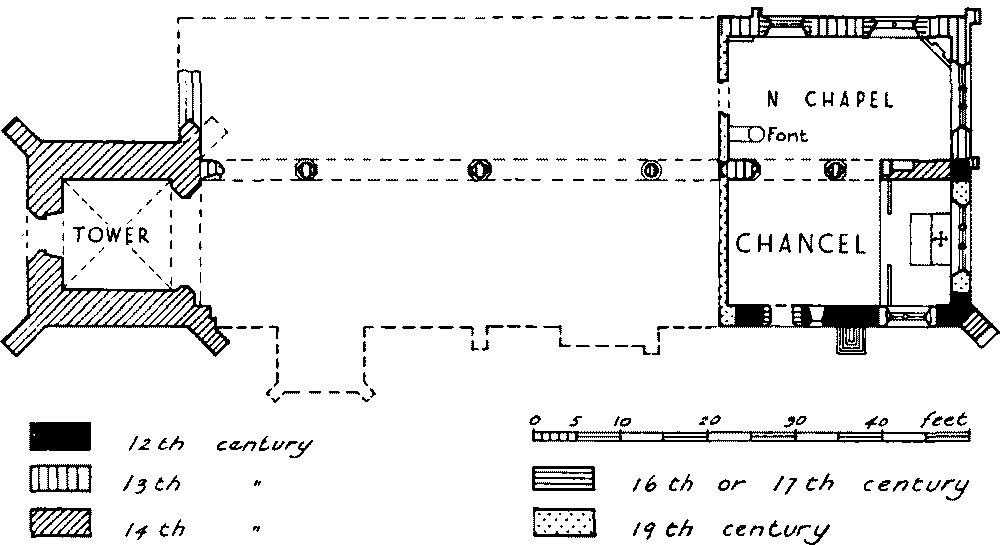
Plan of St. Augustine's (old) Church
The oldest part of the remaining structure is the chancel which dates from the late 12th century. The south wall, which has a contemporary string course and a single-light window, is of this date. The window's pointed head may be a later replacement. The 12th-century nave was probably without aisles; the eastern respond and the most easterly pier of the arcade are circular on plan and represent an early13th-century reconstruction of the nave. The north chapel, of the same length as the chancel but slightly narrower, is an addition of the later 13th century. The east window consists of three graded lancets under a single head, and there is a flat contemporary buttress at the north-east angle. The chapel is divided from the chancel by an arcade which originally consisted of two bays. The remains of a single-light window, part of the earlier north wall of the chancel, are visible in the spandrel between the arches. The west respond and single pier of the arcade have engaged semicircular shafts with wide fillets. The bell capitals, undercut abaci, and doubleroll bases are typical of the period 1250–1300. Alterations to the chancel itself of about this time include a trefoil-headed piscina and a two-light window with original geometrical tracery. West of the piscina is a large niche with a trefoil head, presumably a single sedile. The walling which partially blocks the eastern arch of the arcade appears to date from the 14th century and was probably inserted to form a screen between the two altars, On the chapel side is a double piscina and an ogeeheaded recess. It seems probable that the floor level of the sanctuary was formerly higher and that this recess represents another single sedile. At the back of the recess is an oblique shaft cut through the masonry and communicating with a small ogee-headed opening on the west face of the wall. The wall and openings have been much restored, but if this feature is original it suggests a squint enabling a server to keep both chancel and chapel altars in view. The priest's door in the south wall of the chancel has a shouldered arch and may be of post-Reformation date. Near it is a roughly built pyramidal buttress. The head of a 15th- or 16th-century two-light window has been built into the 19th-century west wall of the chancel. This window was formerly immediately west of the priest's door. (fn. 50) In the north wall of the chapel are two post-Reformation windows, and the east window of the chancel was formerly of the 'churchwarden Gothic' type, having simple interlacing tracery. (fn. 51)
Except at its east end the nave arcade dates from the late 13th century and is similar to the arcade dividing chancel and chapel. It has a pointed arch at each end with two wide semicircular arches between them. The central arches are twice the width of the others, suggesting that two piers have been removed and that the arcade originally consisted of six equal bays. No traces of nave walls exist and burials have taken place within the area of the former nave. A short length of the west wall of the aisle, which includes the jamb of a large window, projects from the north-east angle of the tower. The tower itself is of the 14th century with boldly projecting angle buttresses and a later castellated parapet. The west face has a pointed doorway of two orders above which is a two-light 14th-century window. There are two-light openings in the belfry stage and single openings with ogee heads in the stage below. Above the tall 14th-century tower arch are the weather marks of the former nave roof, the pitch of the south slope having been altered three times. The buttress at the north-east corner is corbelled out above the level of the former aisle and bears a weather mark showing that the aisle had a gabled roof.
Drawings of the church (fn. 52) before its partial demolition show that the south nave wall continued in the same line as that of the chancel. The roof was also continuous and contained four dormer windows, three near the west end probably being used to light the gallery. Just east of the tower was a large porch with a pointed arch and angle buttresses. Between this and the chancel there are traces of two tall blocked arches, suggesting that there was formerly a short projecting aisle on the south side, the arcade having four bays and corresponding with what are now the two central arches of the north arcade. The character of the inserted windows suggests that the demolition of the aisle and the walling-up of the arcade took place in the 17th century.
Under the terms of the lease of the rectory in 1637 Walter Littleton was obliged to repair the chancel 'which will now necessarily cost him 20 nobles'. (fn. 53) The north chapel, which was almost certainly the site of the altar dedicated to Our Lady before the dissolution of the chantries, (fn. 54) was still known as 'Westons' Chancel' in the 18th century. (fn. 55) The church already had a west gallery by 1718, in which year a north gallery was added. (fn. 56) During the building of the new church in 1822 it was decided at a vestry meeting to keep the tower of the old church in repair at the expense of the parish. (fn. 57) The monuments in the body of the old church were moved to the north chapel. A restoration of what was left of the church took place between 1869 and 1872. (fn. 58) In 1883 stained glass was inserted in one of the chancel windows in memory of Louisa Frances and Francis Mary Levett. (fn. 59) The building had been 'restored and beautified' in 1891 by the addition of two stained glass windows, (fn. 60) one in memory of Ralph Armishaw (d. 1890) and the other, the east chancel window, in memory of the Revd. Robert Litler. The stone tracery of 'Decorated' type in the latter was probably inserted at the same time. The carved stone font, although of 15th-century design, probably also dates from the late 19th century. There are fragments of medieval glass in the lancet window of the chancel.
Monuments in the north chapel include an incised alabaster floor slab bearing part of a female figure and an incomplete inscription dated 1400. (fn. 61) A second figure has been obliterated by wear. There is also a stone slab with brasses bearing a single figure and inscribed to John Weston (d. 1566). (fn. 62) Wall tablets of Jacobean design with coats of arms commemorate Ralph Weston (d. 1605), partly illegible, and Richard Weston (d. 1613). Across the north-east corner is a massive marble tablet with typical carved ornament of c. 1700 to Thomas son of William Landor (d. 1670), Walter Landor (d. 1706), and Anna Landor (d. 1716). Other tablets commemorate Philip Weston (d. 1713), Elizabeth Landor (d. 1753), Joseph Landor and Mary his wife (the latter d. 1774), Robert Cotton (d. 1793), and Susanna his wife (d. 1810), Elizabeth Landor (d. 1814), Samuel Barnett (d. 1803), who established iron and tin works at King's Bromley (Offlow hundred), and the Revd. Edward R. Pitman (d. 1879), master of King Edward's School. Two 17th-century tablets to members of the Chetwynd family (1653–91), recorded c. 1836, were later removed to Grendon (Warws.). (fn. 63) In the churchyard the tomb of Elizabeth Coting (d. 1694) and of the wife of Edward Hollinhurst (d. 1696) bears an unusual slab carved with two shrouded figures. (fn. 64) Near the priest's door are the remains of a churchyard cross. Many of the stones in the churchyard wall are ancient and may represent material from the demolished church. In 1875 a new burial ground, a continuation of the old churchyard, was consecrated by the bishop. (fn. 65)
In or about 1818 it was decided that a new parish church was necessary owing to the increase in population. (fn. 66) A site east of the old church, large enough for a new burial ground, was given in 1819 by Viscount Anson. (fn. 67) The building, which is of stone in a simplified late Gothic style, was designed by C. Underwood. (fn. 68) It originally consisted of a rectangular nave of five bays with aisles and clerestory, a shallow chancel, and a tall west tower. (fn. 69) It was consecrated on 21 January 1823. (fn. 70) Internally the nave arcades have lofty shafted piers and four-centred arches, the aisles being occupied by north and south galleries. The base of the tower forms an entrance lobby, and there is a large gallery across the west end of the church. Tables of parish charities are placed below this gallery.
In 1867–8 the fittings were altered and the box pews cut down to form open seats. (fn. 71) The marble font dates from 1874. (fn. 72) By 1894 great dissatisfaction was being expressed with the building which was considered in bad structural repair as well as 'inconveniently arranged and unsuited for purposes of public worship'. In particular it was found impossible to preserve due order in the galleries and 'to prevent the young people who crowd into them at an evening Service from behaving in an irreverent and unseemly manner'. (fn. 73) The sum left by Sarah Hopkins by will proved 1844 for the improvement of the church had by this time accumulated to about £3,000. (fn. 74) After discussion of various alternative schemes, (fn. 75) it was decided to enlarge the existing church and a new chancel with north and south aisles was dedicated on 29 June 1906. The stone was given by Lord Lichfield. (fn. 76) The work is finely executed, and the design is a scholarly example of Perpendicular architecture by Frank L. Pearson. (fn. 77) The north aisle forms a Lady Chapel, and the south aisle contains a vestry and organ loft. The west end of the church remains as it was built in 1822 but the start of a proposed new nave arcade is visible near the chancel arch. The east window of the Lady Chapel was given in memory of Fanny Louise Slade in 1906 by her sister. (fn. 78) Other stained glass windows in the chapel date from 1907 and commemorate Gilbert Woolland and Thomas and Mary Ann James. (fn. 79) The carved organ screen was given in memory of Emma O. Litler (d. 1908). (fn. 80) The reredos, carved in North Italy, and the panelling of the sanctuary were presented in 1930 by W. J. Stanton in memory of his wife. (fn. 81) Wall tablets in the church commemorate Rebecca Simpson (d. 1849), Mary and William Landor (both d. 1860), Robert W. Nuttall (d. 1904), John A. B. Burrough (d. 1918), and Robert Landor and members of his family (1914–51.)
In 1553 the plate included a silver chalice with paten, a copper cross, two pewter candlesticks, and a latten censer. (fn. 82) In 1704 Mary Chetwynd gave the church a new silver cup and a new flagon. (fn. 83) In 1957 the plate consisted of two silver-gilt chalices, two silver-gilt patens and a silver-gilt flagon, all 1855, the gift of William Bamford, and that of the old church of St. Augustine a silver chalice and paten and a silver viaticum. (fn. 84)
In 1553 there were three bells and two little bells. (fn. 85) Before 1706 there were four bells which were recast in that year by Abraham Rudhall of Gloucester into five bells, and a sixth, the treble, was added. (fn. 86) There are still six bells: (i) 1707, Abel [sic] Rudhall; (ii–vi) 1706, Abel [sic] Rudhall. (fn. 87) These were removed to the new church in 1823. (fn. 88)
The registers date from 1569. Those from 1569 to 1722 have been printed. (fn. 89)
The former vicarage house lies 150 yds. southeast of the parish church. A house which occupied this site c. 1800 (fn. 90) had flanking gables, a central semicircular bow, and a timber-framed range of outbuildings to the south-east. It may originally have dated from the 17th century or earlier. This house survived until c. 1840 when it was rebuilt by the Revd. T. D. Atkinson (fn. 91) with the exception of the south wing which is early 18th century in character. The brick stable range is dated 1821. The front garden wall is built of old stones, probably from the former church. The house ceased to be the vicarage in 1921 (fn. 92) and has been used since 1951 (fn. 93) as an extension of the Working Mens' Club in Bow Street. The present vicarage in Church Street, acquired in 1923, (fn. 94) dates from c. 1830.
A field at the junction of Bow Street and Taylor's Lane, known c. 1842 as Tithe Barn Croft, indicates the site of the former tithe barn. (fn. 95)
The church of ST. MICHAEL at Brereton was opened in 1837, (fn. 96) and in 1843 Brereton was constituted a district chapelry. (fn. 97) The living, a perpetual curacy until 1868 when it became a titular vicarage, has always been in the gift of the Vicar of Rugeley. (fn. 98) The church was built as a small cruciform stone chapel in the Early English style. It had an octagonal bell turret in the north-west angle of the crossing. The building was enlarged and much improved in 1876–8 under the direction of Sir George Gilbert Scott. (fn. 99) He extended the transepts eastwards thus giving the church, in effect, north and south aisles each of three bays. He also formed the present chancel by raising the floor level at the east end of the former nave and surrounding it with low stone screens. The sedilia and the treatment of the chancel window internally are part of this scheme. The Revd. Edward Samson, vicar, contributed £1,000 to the cost of the improvements. (fn. 100) The font, which has an arcaded bowl on a base of coloured marble, is inscribed to the memory of George Augustus Selwyn, Bishop of Lichfield (d. 1878). The reredos dates from 1883. (fn. 101) In 1887 the tower was raised in height to accommodate a clock and four additional bells. (fn. 102) The upper part was rebuilt to the original design. A carved oak porch was added outside the west door in 1891, (fn. 103) and the south-west vestry is dated 1894. The oak pulpit was given in 1895 (fn. 104) and the murals in the chancel in 1897, (fn. 105) both by the Revd. Edward Samson. The east end of the north aisle was fitted up as a Lady Chapel in 1927–8. (fn. 106)
All the windows contain memorial stained glass. Among others they commemorate the Revd. J. C. Weatherall, first vicar. There are mural tablets in memory of Robert Simpson (d. 1869), and his wife and daughter; the Revd. John Holford Plant (d. 1891), missionary and former curate; Arthur L. Samson, killed in action 1915; Edward Samson, former vicar (d. 1921). The colours of two Indian regiments, presented in 1888 and 1897 by Col. J. E. and Col. W. A. Weatherall respectively, were removed in 1956. (fn. 107) Those of the 108th Madras Infantry were given to the Royal Inniskilling Fusiliers and those of the 22nd Bombay Infantry to the museum of the Royal Military Academy at Sandhurst. (fn. 108)
The churchyard was extended in 1876 and 1894. (fn. 109) The lychgate dates from 1883. (fn. 110)
In 1957 the plate included a silver chalice; two silver patens; a silver flagon, 1836, the gift of Mrs. E. Sneyd; and a silver paten. (fn. 111) There was one bell until 1887 when four more were added. (fn. 112) All five still existed in 1957.
The vicarage is of approximately the same date as the church and is a large red-brick house lying about 400 yds. to the north-west.
The mission of St. John the Baptist was opened in 1871 at the infants' school at Stone House (now Slitting Mill). (fn. 113) The chapel now (1957) consists of part of the former school cottage and a single-story brick extension of 1871 with round-headed windows. In 1957 the plate included an electroplated chalice, paten, and flagon. (fn. 114) There is one bell, attached to the cottage chimney.
The mission chapel at Etching Hill was licensed for divine service and the sacraments in 1881. (fn. 115) It is a small corrugated-iron building in Church Lane. In 1957 the plate consisted of a silver chalice and paten, 1910, and a glass and silver flagon. (fn. 116) There is one bell.
There was a mission room in Horse Fair between c. 1875 and 1881 (fn. 117) and another mission in Rugeley, dedicated to St. Mary, between c. 1880 and 1916. (fn. 118) Between 1882 and c. 1894 there was a mission chapel at Fairoak. (fn. 119)
The missions at Hazel Slade and Brindley Heath are treated under Cannock as both districts became part of the new parish of St. Peter, Hednesford, for ecclesiastical purposes in 1870. (fn. 120)
Roman Catholicism
There were said to be 'some recusants' in Rugeley in 1604, (fn. 121) and Sir Richard Weston of Hagley Hall was returned as a papist in 1648. (fn. 122) Only nine papists in Rugeley were mentioned in 1780. (fn. 123)
By 1836 evening services were being held each Sunday in a temporary Roman Catholic church in Rugeley, (fn. 124) and mass was being said here on Sunday mornings by 1839. (fn. 125) The mission was served by the priest from Tixall (fn. 126) (Pirehill hundred) until the appointment to Rugeley of a resident priest, John S. Grenside, in 1846. (fn. 127) Mass was said in the school from 1847 until at least 1849 when the building of the present church of SS. Joseph and Etheldreda was begun on ground bought by the Revd. T. L. Green of Tixall in 1842. (fn. 128) The church, which derives its dedication from the Christian names of the two principal founders, Joseph Whitgreave of Heron's Court and his sister Etheldreda, was solemnly opened in August 1851 and consecrated in June 1951. (fn. 129) By 1848, when the mission was described as 'paralysed with poverty', there were some 500 Roman Catholics in and near Rugeley. (fn. 130) The estimated number attending mass on Sunday 30 March 1851 was 350. (fn. 131) The average attendance at Sunday mass in 1955–6 was 448. (fn. 132)
The Sisters of the Christian Retreat opened St. Anthony's Convent at Heron's Nest, Heron Street, in 1901, but to accommodate members of the order who had been expelled from France the convent was moved in 1904 to Heron Court in the same street, (fn. 133) a house built opposite the Roman Catholic church in 1851 by Joseph Whitgreave. (fn. 134) Heron's Nest was retained as the residence of the nuns' chaplain until the early 1920's and was later sold. (fn. 135)
The mission benefits from the following bequests for general parish purposes: £1,700 from Canon Duckett, parish priest of Rugeley, in 1907, producing an income of £26 in 1956; £500 from Mrs. Bolton in 1927, producing £20 in 1956; and £600 from Miss M. Harris in 1945, producing £18 in 1956. (fn. 136) Canon Duckett also bequeathed £1,000 for the maintenance and repair of the church fabric, and this produced £21 in 1956. (fn. 137)
The church of SS. JOSEPH AND ETHELDREDA, dating from 1849–51, consists of an aisled nave of six bays, chancel, north chapel, south vestry, and tall west tower. The local stone of which it is built was given by the 1st Marquess of Anglesey 'without limit or restriction'. (fn. 138) The church was designed by Charles Hanson of Clifton (Som.) (fn. 139) in a 14th-century style. An octagonal spire with flying buttresses was added to the tower in 1868. (fn. 140) Soon after 1930 a turret which had formed part of the spire was found to be decayed and was removed. (fn. 141) Further repairs to the spire were carried out in 1948. (fn. 142) The chancel and baptistery screens are of wrought iron and the aisles contain carved stone panels representing the Stations of the Cross. A window in the Lady Chapel, which lies north of the chancel, was fitted with stained glass in memory of Joseph and Etheldreda Whitgreave after the former's death in 1885. There are two bells, 1546 and 1848. (fn. 143)
The presbytery, for which the Marquess of Anglesey also gave the stone, is a simple gabled building lying south of the church and of similar date. The former school lay beyond it and it was originally intended that the whole group should be linked by a cloister. (fn. 144)
Protestant Nonconformity
In 1672 William Grace, the ejected Vicar of Shenstone (Offlow hundred), was licensed as a Presbyterian teacher in the house of John Panells in Rugeley. (fn. 145) Robert Travers, the Presbyterian minister at Lichfield c. 1693–1738, occasionally visited Rugeley. (fn. 146) Regular Congregational meetings here can be traced back to c. 1794 when they were first held in Samuel Sleigh's house in Brereton Road, (fn. 147) and in 1806 the house, then occupied by his widow Catherine, was registered as a meeting-house. (fn. 148) After services had been held there for four years, the Staffordshire Association sent an itinerant minister who was to use Rugeley as a base for his work, and in 1811 services were held in a cottage in Bow Street. (fn. 149) This was soon closed against the worshippers who returned to Mrs. Sleigh's house until 1813 when Providence Chapel in Elmore Lane was opened. (fn. 150) In 1832 two rooms were added for use as Sunday schools. (fn. 151) Improvements were made to the chapel in 1861, (fn. 152) but in 1874, as the building was considered too old and inconvenient, the congregation was transferred to a new chapel adjoining the mansion called Heron Court. (fn. 153) The Sunday school was transferred to a room in Heron Court, but, as it was not possible to purchase this part, (fn. 154) the school was subsequently moved back to Elmore Lane until the opening of new schools near Heron Court in 1896. (fn. 155) Providence Chapel was then sold to help pay off the debt on the new chapel. (fn. 156) This seats 300. (fn. 157)
The former congregational chapel in Elmore Lane had a gabled brick front with a central round-headed entrance and round-headed windows to the ground floor and to the gallery. (fn. 158) The building was converted into a pair of cottages in 1896 and the front much altered. An original tablet inscribed 'Providence Chapel 1813' and a memorial tablet to Mrs. Mary Shawyer (d. 1816) are now (1957) in the Heron Court Schools.
Heron Court Chapel is built of the same materials as the mansion. The stone entrance porch has an Early English arcade of three bays. The school buildings lie to the west of the chapel and are of red brick.
In 1806, on the application of a group of Wesleyan Methodists, the house of Thomas Gething (fn. 159) at Brereton, was registered as a meeting-house. (fn. 160) In 1808 a house in Rugeley was registered as a meetinghouse for Wesleyans. (fn. 161) In 1810 a Wesleyan chapel was opened at Brereton (fn. 162) and another, Hodgley Chapel, in Lichfield Street, Rugeley, in 1839 to hold 120. (fn. 163) In 1870 an entrance front of variegated brick was added to the Rugeley chapel, which was then enlarged (fn. 164) and in 1940 seated 240. (fn. 165) The Brereton chapel was replaced by the present building on or near the same site in 1872. (fn. 166)
Other dwellings in Rugeley were registered as meeting-houses in 1809, (fn. 167) 1828, (fn. 168) and 1837, (fn. 169) and in Brereton in 1828, (fn. 170) all possibly for Primitive Methodists. By 1868 a Primitive Methodist chapel had been built at Rugeley (fn. 171) with seating for 220. (fn. 172)
In 1708 the house of Richard Norris in Rugeley was registered as a meeting-house for Quakers. (fn. 173) There was a Quaker meeting at the Town Hall on 16 August 1810. (fn. 174) Regular Quaker meetings were held in Rugeley from 1824 to 1826 (fn. 175) and from 1829 to 1870. (fn. 176) In 1851 they were being held in a building in the Market Place, erected in 1830. (fn. 177)
Primary Schools
The English School, otherwise Bamford's School or the Writing School, said to have been founded because the master of the grammar school refused to instruct his pupils in English, owed its foundation to a bequest by John Bamford, cooper, of Rugeley. (fn. 178) By will dated 1734, he left the reversion of £400, on the death of his wife, the interest to be employed for instructing free in one school 16 boys of the poorest families in Rugeley in reading, writing, accounts, and the church catechism, the schoolmaster to be paid 20s. a year for each pupil. (fn. 179) Meanwhile a further £50 had been bequeathed to the poor of this parish by Mary Jenks of Sutton Coldfield (Warws.), by will dated 1750, and this added to the £400 was in 1767 laid out in the purchase of property in Colton parish (Pirehill hundred), the rents to be used for teaching 18 poor boys and any surplus in buying necessary books or apprenticing scholars. (fn. 180) A bequest of £500 for this school by John Riley, by will proved 1802, was used in 1813 to buy land and premises near the Horse Fair, Rugeley, for a schoolhouse with adjoining schoolrooms and a garden behind. (fn. 181) In 1818 there were said to be 60 children in this school, 45 of whom were taught free and 4 of whom were boarders, the master receiving £35 a year besides his house and school, from funds then arising from the £36 11s. rents. (fn. 182) The last of its masters was George Ordish, who died in 1857, and the school was then closed. (fn. 183) There were about 30 boys in the school at this time. (fn. 184) Until at least 1860 the schoolroom was made use of as a reading-room and night-school, (fn. 185) and in 1880 the buildings were sold. (fn. 186) The proceeds were invested in £127 9s. stock and the income, amounting to £3 3s. 8d., together with the rents of £28 and £11 from the property in Colton, was applied by 1905 for the support of the National schools in Rugeley and Brereton. (fn. 187)
The Prince of Wales National School was built in 1845 in Lichfield Street. (fn. 188) By will proved 1849 Rebecca Simpson left £1,125 10s., the income to be applied as necessary towards the salaries of either the master or the mistress of this school or both; towards that of a master or mistress of an infants' school for the poor of Rugeley, or towards the rent of a building for an infants' school; and for a house for a master or mistress. (fn. 189) The school was in receipt of an annual parliamentary grant by 1850, (fn. 190) in which year a further £35 was granted to the master of the National school out of the surplus income of Chetwynd's Charity. (fn. 191) Attendance in 1851 averaged 60 boys and 150 infants, (fn. 192) while in 1865 the combined average was 193 and in 1884 294. (fn. 193) The building was enlarged in 1855 and 1876. (fn. 194) In 1892, the trustees of the Prince of Wales School were authorized to sell £333 15s. 3d. stock belonging to the foundation to provide for a new infants' school (see below). (fn. 195) The Prince of Wales School, after this date only for boys, was enlarged in 1894. (fn. 196) Average attendance has remained about 250. (fn. 197) It is now Rugeley Church of England Voluntary Primary School for Junior Boys.
In 1892 an infants' school was built in Talbot Street, with funds formerly belonging to the Prince of Wales School, on a site given by the governors of the Grammar School, and the infants of the Prince of Wales School, were transferred there. (fn. 198) The school was enlarged in 1898 (fn. 199) and 1913. (fn. 200) Attendance in 1910 averaged 155, (fn. 201) in 1930 132, (fn. 202) and by 1956 280. (fn. 203) This is now Rugeley Church of England Voluntary Primary School for Infants.
A National school for girls was founded in 1826 by Harriet Baroness de la Zouche, wife of the Hon. Robert Curzon of Hagley Hall, in newly built premises in Church Street, Rugeley, leased for 99 years from the Trustees of Rugeley Free Grammar School. (fn. 204) Sarah Hopkins provided a house for the schoolmistress, (fn. 205) and in 1828 she conveyed a house and land in Rugeley to trustees to provide £2 a year for the schoolmistress, the balance to be given to the almswomen of her newly erected almshouses or towards the repair of the school. (fn. 206) Sixty girls were being taught in this school by 1834, paying 2d. a week each. (fn. 207) The endowment was increased by members of the Curzon family between 1841 and 1855, to provide for repairs, heating, and equipment, (fn. 208) and by £25 a year from Chetwynd's Charity in 1850. (fn. 209) The freehold reversion of the premises in Church Street was bought in 1868 from the Grammar School Trustees, (fn. 210) and the building was enlarged in 1869, (fn. 211) 1885, and 1894. (fn. 212) The school was in receipt of a parliamentary grant by 1882 when attendance averaged 147. (fn. 213) Between c. 1912 and 1930 the attendances averaged 230. (fn. 214) By 1905 the endowments, represented by £1,079 3s. 6d. stock, were producing £26 17s. a year. (fn. 215) The Curzon Charity was wound up in 1955 when the balance, £102 0s. 8d., was paid to Rugeley Church of England Schools account. (fn. 216) The school is now Rugeley Church of England Primary School for Junior Girls.
A school at Brereton for 80 children, taught on the Madras System, was built c. 1826 by the Misses Sneyd, presumably the Misses Elizabeth and Harriet (or Henrietta), who in 1834 were still contributing largely towards its support. (fn. 217) A National school for boys and infants was built in Redbrook Lane, Brereton, in 1843. (fn. 218) This and the girls' school benefited under the will of Rebecca Simpson, proved 1849, (fn. 219) and in 1850 £35 a year was allotted from Chetwynd's Charity to the master of the boys' school. (fn. 220) As National schools for girls, boys, and infants the schools received an annual parliamentary grant from 1854, (fn. 221) and in 1872 they shared an annual endowment of £162 a year. (fn. 222) In 1881 a new classroom was added to the Redbrook Lane school where both the boys' and infants' classrooms were extended in 1888. (fn. 223) In 1891 the girls' school was rebuilt by the Vicar of Brereton, the Revd. E. Samson, in memory of his brother, (fn. 224) and the average attendance in 1892 was 120. (fn. 225) The boys' and infants' schools in that year had an average attendance of 151 and shared an endowment of £124 11s. 9d. (fn. 226) By 1905 the three schools together enjoyed an income of £66 11s. 5d. from the Simpson bequest, while the girls' school also received £18 4s. from the Sneyd endowment. (fn. 227) In 1933 the boys' and infants' buildings in Redbrook Lane were found to be unsatisfactory, (fn. 228) and in 1947 it was agreed that the institution should be discontinued as soon as possible. (fn. 229) By 1951 the three schools were housed in the former girls' school building and had been reorganized as Brereton Church of England Voluntary Primary School, Junior Mixed and Infants, under a mistress. (fn. 230) Average attendance in 1955 was 105 children. (fn. 231)
Raven Hill County Primary School, Junior Mixed and Infants, was opened in 1954, with accommodation for 280 children. (fn. 232)
St. Etheldreda's Roman Catholic School was built by subscription in 1847 north-east of the presbytery. (fn. 233) It received an annual parliamentary grant from 1853. (fn. 234) Attendance averaged 99 in 1882 (fn. 235) and 75 in 1893. (fn. 236) By 1892 a house was attached to the school for the teacher. (fn. 237) The premises were condemned in 1905, (fn. 238) and in 1908 the present school, a brick building on the south-east side of the church, was completed. (fn. 239) The Sisters of the Christian Retreat were in charge by 1912. (fn. 240) It is now known as St. Joseph's Roman Catholic Voluntary Primary School, Mixed and Infants.
A Wesleyan school in Rugeley was founded in or just before 1860 to take up to 50 boys and girls. (fn. 241) This was in Lichfield Street and was under a mistress. (fn. 242) It was presumably one of the two Wesleyan schools in the parish returned in 1871, (fn. 243) but its later history is obscure.
A Wesleyan school was built in Brereton in 1838 on land bought by Miss Elizabeth Birch from the trustees of the Wesleyan Chapel, to teach the poor children of the neighbourhood; the master was always to be a member of the Wesleyan Methodist Society and the teaching along religious lines. (fn. 244) The school was endowed by Miss Birch with £1,500 to pay £50 a year salary to the master and £10 a year for stationery. (fn. 245) By 1860 the master was taking 6 paying pupils and attendance averaged 30. (fn. 246) The school was closed in 1899. (fn. 247) The site was exchanged in 1904 for a larger one, also the property of the trustees of the Wesleyan Chapel, (fn. 248) the endowment scheme was reorganized and provision was made for applying any residue of income for exhibitions at Rugeley Grammar School, or other approved institution, for boys and girls resident in Brereton who had been at least three years at a public elementary school. (fn. 249) Permission was given for the school trustees to use £1,000 out of the capital towards the building of new schools, opened in 1905. (fn. 250) In 1930 the attendance was 173. (fn. 251) In 1949 the school became controlled (fn. 252) and in 1952 was named The George Vickers Methodist Primary School, to commemorate George Vickers, schoolmaster from 1853 to 1904. (fn. 253) There were 160 on the roll of the school in 1954. (fn. 254)
Sarah Hopkins, by will proved in 1844, left £600 to provide £15 a year for a schoolmistress to teach children aged from 2 to 10, not exceeding 25 in number and living in the Cannock Chase area of Rugeley. (fn. 255) She also gave the lease of a cottage and land near the Stonehouse, in Rugeley, any profits to be used to augment the salary of the schoolmistress, who was to occupy, rent free, the schoolroom and room above it adjoining the cottage. (fn. 256) The school had been enlarged by 1871 when a mission chapel was opened there. (fn. 257) In 1890 owing to the small endowment it was still without a certificated teacher, and in 1892 it had an average attendance of 35. (fn. 258) It had been closed by 1896. (fn. 259)
A mixed National school was built at Stonehouse in 1894, and the Sarah Hopkins legacy was transferred to it. (fn. 260) The average attendance here c. 1900 was 66. (fn. 261) By 1905 the original schoolroom with the cottage and land were let for £8 a year, and the income on the endowment of £564 14s. 2d. was £14 2s. 4d. (fn. 262) In 1919 the Local Education Authority bought the school and reopened it in 1921 as Slitting Mill Council School, Mixed and Infants. (fn. 263) Attendance in 1930 averaged 59. (fn. 264) It is now Rugeley Slitting Mill County Primary School, Junior Mixed and Infants.
A day-school for infants was opened in 1882 at Etching Hill, following the opening in 1880 of a Sunday school in the mission room there. (fn. 265) It was closed by 1892. (fn. 266)
A large mission room and schoolroom were erected in 1882 at Fair Oak Colliery, Rugeley, out of a barn and fitted up to hold 60 to 70 children at both day and Sunday schools. (fn. 267) It was a National school with an average attendance of 44 in 1884 (fn. 268) and is said to have continued some time after the closing of the colliery. (fn. 269)
A council school was opened in 1926 at Brindley Village, (fn. 270) and average attendance in 1931 was 93. (fn. 271) It is now Brindley Heath, Brindley Village County Primary School, Junior Mixed and Infants.
Charities for the Poor
William Chetwynd of Rugeley (d. 1691) (fn. 272) bequeathed £500 to be laid out in land, the profits to provide a 3d. loaf every Sunday for each of the 20 poorest parishioners for life, 2s. for each of the same 20 poor on St. Thomas's Day (21 Dec.) 'for meat against the festival', and 2s. each on Good Friday; 40s. a year for the vicar for sermons to these poor on St. Thomas's Day and Good Friday; and the surplus to apprentice the children of poor parishioners. (fn. 273) Mary Chetwynd, William's sister and executrix, laid out this money, with a further £100 of her own, on an estate at Great Wyrley in Cannock. (fn. 274) From at least 1714 until 1812 the rent from the estate was £30. (fn. 275) In 1812 the property, which had coal under part of it, was valued at £147 6s. 5d. a year, reduced in 1815 to £110. (fn. 276) From at least 1812 until 1821 the 20 poor were each given a 6d. loaf every Sunday, this, with the £4 on St. Thomas's Day and Good Friday and the £2 for sermons, making £32 in all, but no apprentices were bound out, the surplus money being used in rebuilding the farmhouse and repairing the property at a cost of £448. (fn. 277) By 1882 £8 was paid to the Vicar of Rugeley for preaching and for arranging the distribution in Rugeley, and £4 went to the Vicar of Brereton for arranging the distribution there. (fn. 278) A scheme of 1915 ordered that only £2 was to be paid in respect of sermons and distribution and this only to the Vicar of Rugeley; that the weekly bread and the doles on St. Thomas's Day and Good Friday were to be paid to 38 named persons; and that out of the residue £17 might be used for 3d. bread doles each week and 2s. doles on Good Friday to the poor of the ancient parish, and the rest for assisting persons under 21 who were starting a trade and for general charitable purposes. (fn. 279) Much of the land in Great Wyrley seems to have been sold between 1905 and 1934. (fn. 280) In 1956 the income was about £620 interest on stock, most of which was distributed in grants for medical treatment and general assistance, and the Vicar of Rugeley still received £2 for sermons on St. Thomas's Day and Good Friday. (fn. 281)
Between at least 1850 and 1882 grants were made out of surplus income of the Chetwynd Charity to the National schools in Rugeley and Brereton, (fn. 282) and by various schemes between 1875 and 1916 grants were made to Rugeley Grammar School. (fn. 283) In 1956 the annual educational grants were £110 to the Grammar School, £40 to the Rugeley Church of England schools and £20 to the Brereton Church of England schools. (fn. 284)
A legacy of Thomas Landor of £26, to provide an annual gift of six pennyworth of bread every Sunday for six poor persons born in Rugeley, was charged by his son Walter Landor, by will dated 1703, on his own lands in Abbots (then Pagets) Bromley (Pirehill hundred), and in Gentleshaw, described as in Cannock. (fn. 285) These lands were then further charged with finding clothes for twelve poor persons and also 4d. each in bread every Sunday, the surplus to be used for apprenticing poor children. (fn. 286) The income in 1821 was £60 10s. still applied in bread, clothes, and apprenticing children, but since 1817 the amount of bread given had been doubled, while an average of seven children had been apprenticed each year since 1815 at the rate of £5 10s. each. (fn. 287) By a scheme of 1880 the maximum allowance for bread was fixed at £50; £10 was allotted to dispensaries and hospitals; and the residue was allotted for the apprenticing of children over fifteen, or in providing Landor Exhibitions for up to five years at Rugeley Grammar School or other schools for children over ten who had attended an efficient elementary school at Rugeley for not less than three years. (fn. 288) Another scheme of 1929 authorized the trustees at their discretion to use the money assigned for apprenticing to assist poor persons under 21 years who were starting a trade, and a further scheme of 1953 authorized the use of £100 each year for the general benefit of the poor instead of for bread and hospital benefits. (fn. 289) In 1956 the income was £161 11s. interest on stock, which was distributed among twelve old people in two loaves each weekly and gifts at Christmas for clothing. (fn. 290) Money was also available for educational grants as required. (fn. 291)
Margery Sneyd, spinster, of Cannock Wood (d. 1702) (fn. 292) bequeathed £50 to provide doles on St. Thomas's Day for such of the poor of Rugeley as were communicant Anglicans. (fn. 293) This was charged by her executor, Humphrey Moore (also of Cannock Wood), on half of his land called Swinbrook Leasow in Marchington township in Draycott in the Clay (Offlow hundred), the rest of which, by his will dated 1706, he charged with a similar bequest on his own account, the total rent being £4 10s. (fn. 294) By 1821 £8 from this land and 35s. from an allotment in Hanbury (Offlow hundred) made under the Needwood Forest inclosure award were given away on St. Thomas's Day along with the charities of Whiston, Avarne, and Sutton (see below) in sums of 2s. 6d. and under to the poor, especially those not receiving parish relief. (fn. 295) The land in Hanbury was bringing in a rent of £2 in 1940, and in 1942 the land at Marchington, let for £7 14s. 8d., was bought by the War Department for £250 by compulsory purchase order. (fn. 296) The charity had lapsed by 1956, but attempts to revive it were being made in 1957. (fn. 297)
Mary Whiston, thought to have been cook to the William Chetwynd (d. 1691), bequeathed £10 for distribution to the poor on Good Friday, and Ellen Avarne, by will dated 1731, gave a further £10 to the poor. (fn. 298) Each of these bequests was producing 4s. by 1821 when the money was added to the distribution on St. Thomas's Day, (fn. 299) and the combined income in 1932 was 3s. 4d. interest on stock. (fn. 300) Attempts to revive these charities were being made in 1957. (fn. 301)
A Mary Sutton bequeathed £40 which by 1786 was producing £1 a year for the poor. (fn. 302) At some time after 1798 £30 of the capital was used to purchase the land-tax on the Chetwynd Charity estate at Great Wyrley (see above), the trustees of that estate paying in return 30s. a year to the minister and church wardens of Rugeley for the poor. (fn. 303) By 1821 this 30s. and 4s. interest on the remaining £10 were added to the St. Thomas's Day distribution. (fn. 304) In 1882 the 30s. was being distributed in money doles on Good Friday with part of Chetwynd's Charity (see above), while in 1929 the income from the rest of Sutton's Charity was represented by 1s. 8d. interest on £3 6s. 11d. stock. (fn. 305) The vicar was trying to revive the charity in 1957. (fn. 306)
Catherine Barber, by will proved 1842, gave £400, the interest to provide coals, clothing, and other necessaries to poor of Rugeley who were Anglican. (fn. 307) The income in 1932 was £9 14s. interest on stock. (fn. 308) Attempts to revive the charity were being made in 1957. (fn. 309)
By 1851 Joseph Godwin had bequeathed £150, the interest to be distributed on 8 November among five poor women who attended church regularly, widows of 63 and over being preferred. (fn. 310) The money was producing £3 10s. interest on stock in 1932. (fn. 311) Attempts were being made to revive the charity in 1957. (fn. 312)
Under the Rugeley Inclosure Award of 1885 land at Etching Hill was allotted to the poor of Rugeley under the name of Poor Allotment. (fn. 313) It was first let by the allotment wardens in 1888 for £4 9s. 4½d. and the rent in 1926 was £3 12s. 9d. (fn. 314) The charity was still in force in 1955. (fn. 315)
A bequest by a Mrs. Eagle for the poor of Brereton was producing by 1896 £5 16s. 8d. which was distributed on St. Thomas's Day. (fn. 316) In 1957 the income, £6 6s. 6d. was distributed to poor widows. (fn. 317)
A John Blood, probably in 1703 or 1705, bequeathed £10, the interest to be distributed to the poor on St. John's Day, but this charity had been lost by 1786. (fn. 318)
In 1826 Sarah Hopkins of the Stonehouse erected four almshouses behind the Girls' National school in Church Street, Rugeley, for four poor women, (fn. 319) and by 1834 four widows were living there and were each receiving 1s. a week. (fn. 320) Sarah Hopkins's endowment included part of the rent from a house and land in Rugeley conveyed to trustees in 1828, £18 from Johnson's tenement in Rugeley, and a bequest of £1,000. (fn. 321) Catherine Barber, presumably by the will proved 1842 (see above), left a further £100, and Rebecca Simpson, presumably by the will proved 1849 (see above), £500. Elizabeth Curzon, by will proved 1859, bequeathed £500 to the almshouses. (fn. 322) The widows were receiving 5s. a week each in 1868. (fn. 323) About 1938 the inmates were transferred to the present almshouses, also in Church Street, and the old buildings were demolished. (fn. 324) The income in 1954 was £49 10s. 8d. interest on stock and rent of £76 11s. 3d. from Johnson's tenement (fn. 325) The almshouses are still occupied (1957). The present brick range consists of four single-story dwellings. The stone dressings have been preserved from the former buildings and one gable bears the original tablet commemorating the erection and endowment of the almshouses by Sarah Hopkins in 1826.
H. R. Sneyd of Eaton Lodge, Rugeley, built eight cottages in Fortescue Lane (then New Lane) in 1870 for poor aged women. (fn. 326) These cottages were maintained after his death by his two daughters, the Misses Sneyd, (fn. 327) who also erected six cottages on the adjoining site in Church Street for ladies in reduced circumstances in memory of their father and mother in 1885. (fn. 328) In 1893 one of these daughters, Harriet, built six houses in Fortescue Lane for old couples chosen by herself in memory of Fanny Louisa Sneyd, (fn. 329) presumably her sister. Harriet Sneyd, by will proved 1913, gave £3,000 as endowment for the cottages in Fortescue Lane, which were to be used as almshouses for aged and infirm or needy Anglicans in Rugeley and Brereton; a further £3,000 for the six Ladies' Homes in Church Street, which were to be for Anglican women either of limited means or in any way requiring a home; and a final £3,000 for the six houses in Fortescue Lane then let at a nominal rent to aged couples but in future to be occupied free by aged Anglican couples resident in Rugeley or Brereton. (fn. 330) All three sets of almshouses are still occupied (1957). Those erected by H. R. Sneyd consist of a single-story range of red brick with bluebrick dressings. The houses in Church Street erected by the Misses Sneyd are built in two two-story blocks, one behind the other, each block containing three dwellings. They have half-timbered gables and a commemorative inscription. The six houses in Fortescue Lane form a two-story block with small gables and much ornamental brickwork.
The Walters Almshouses in Taylors Lane were erected in 1890 by J. T. Walter, in memory of his mother Elizabeth and wife Fanny, for six poor aged women. (fn. 331) These were purchased by the Revd. the Hon. Cecil J. Littleton and conveyed in 1906 to the trustees of the Girls Friendly Society as homes for its members and associates. (fn. 332) Known as the Littleton Houses of Rest, (fn. 333) they are still occupied (1957) and consist of a two-story red-brick range with bluebrick dressings, having gabled porches and diagonal glazing bars to the windows.
Thomas Birch and Miss Elizabeth Birch built six cottages in Brereton in 1824 to be let to poor persons of 50 and over. (fn. 334) Before 1851 Elizabeth bequeathed £1,500, the income to be spent on repairs and on the provision of 4s. a week to each of the occupants who were to attend the Wesleyan Methodist Chapel in Brereton. (fn. 335) The occupants in 1868 were poor widows. (fn. 336) These almshouses are still occupied (1957) and consist of a very plain single-story red-brick row situated in a lane opposite St. Michael's Church.
The Revd. Edward Samson, formerly Vicar of Brereton, by deed of 1904 established the four Samson Cottage Homes opposite St. Michael's as homes for needy inhabitants of Brereton and of Armitage and Pipe Ridware (Offlow hundred) and for any who might have served the donor and his heirs. (fn. 337) Church Cottage, Brereton, which was to form a fifth home, was sold in 1904 and the proceeds applied for the upkeep of the other almshouses. (fn. 338) These are still occupied (1957) and consist of a single-story range, each house having a projecting gabled bay window.
Jane Cotton by will dated 1808 left £300 to the inhabitants of Rugeley for general charitable purposes, and it was in respect of this bequest that three spinsters or widows of 60 years and over from Rugeley were included among the inmates of the almshouses in Longdon (Offlow hundred) founded in 1815 by Jane's sister Ann, while two poor boys and four poor girls from Rugeley were also admitted to the school in Longdon founded at the same time. (fn. 339) The school was closed c. 1840, but in 1890 the inmates of the almshouses still included three women from Rugeley. (fn. 340) In 1957 two widows from Rugeley were living here. (fn. 341)