
The History and Topographical Survey of the County of Kent: Volume 1. Originally published by W Bristow, Canterbury, 1797.
This free content was digitised by double rekeying. All rights reserved.
'Parishes: Deptford', in The History and Topographical Survey of the County of Kent: Volume 1, (Canterbury, 1797) pp. 340-371. British History Online https://www.british-history.ac.uk/survey-kent/vol1/pp340-371 [accessed 26 April 2024]
In this section
DEPTFORD,
AS far as lies within this county, is within the hundred of Blackheath, and was so named from the deep ford here over the river Ravensborne, before the bridge was erected. It was generally known in antient records by the name of Deptford Strond, alias West Greenwich, a name which, in later times, became, solely appropriated to the lower parts of it, on the banks of the Thames, the upper town retaining that of Deptford only.
It lies almost four miles distant from London, on the north-west verge of the county, on the bank of the Thames, and adjoining to the county of Surry, in which a small part of it is situated. In the time of the Romans it was little, if at all inhabited the tide, most probably, flowing at times over the greatest part of it; this might occasion the Roman way to be made to the southward, and not through it, in the direct line to London, as at present. But Deptford continued little more than a mean fishing village, (fn. 1) notwithstanding its contiguity to this road, and its nearness to the metropolis till king Henry VIII. first created a store-house, and made the royal dock here, from which time it has continued to increase both in size and inhabitants, so that it is now a large and populous town, though it has no market, being divided into Upper and Lower Deptford, containing in the whole about three thousand five hundred houses and fifteen thousand inhabitants. Great part of it, as well as its environs, is inhabited by people of good fashion and credit. Since the great increase of trade, its vicinity to London, and its situation on the bank of the Thames, has been the occasion of several considerable manufactories being established in it, which are mostly situated in the Lower town, near the river. These, together with the royal and other docks, the business of government attendant on them, and that of the shipping in general, continually carrying on, make it a place of much resort, traffic, and wealth.
However, the greatest support and consequence of Deptford certainly arises from the royal dock, where at first the whole of the royal navy was, for some time after it was established, built and repaired, until it was found more convenient to build the larger ships at Woolwich and other places, where there is greater depth of water. Notwithstanding which this yard has been from time to time enlarged to more than double its original dimensions, and great numbers of hands are constantly employed in the different branches of the service here.
It has a wet dock of two acres for ships, and another of an acre and a half, with vast quantities of timber and other stores, and extensive buildings, as storehouses and other offices for the use of the place, and handsome houses for those officers who are obliged to live upon the spot. There is no particular commissioner appointed for this yard, but it is under the immediate inspection of the navy board, which has under it in residence here a clerk of the cheque and survey, a store-keeper, a master shipwright, or builder, and other officers, clerks, and inferior servants, employed in their respective stations in it. A geometrical plan and elevation of the dock-yard, with part of the town, was published by T. Milton, 1753. The victuallingoffice was, by accident, burnt down in 1749, and a great quantity of provisions and other stores consumed. This building was intended to supply the place of the old victualling-office on Tower-hill, the lease whereof was then almost expired.
Besides the royal dock there are many private ones in this parish and adjoining to it, some of which, from their extent, the many ships continually repairing and building in them, and the vast stores of timber, tackling, and other necessaries laid up there, would be esteemed in any other country sufficient for the navy of a kingdom; though they are here fully employed by the merchants and traders of Great-Britain; and Stow, in his Survey of London, says, that two hundred and fifty acres of meadow, lying in Deptford, next the river Thames, by the dock-yard, were purchased about 1656, by Robert Stanton, Samuel Moyer, and Charles Harris, and others, for making harbours and moles for the riding of three hundred sail of ships, without the use of anchor and cable; and where many conveniences were to be made for building, repairing, and careening ships; towards which much had been expended in digging one of the moles, and cuts towards the other, and contracts made, for provisions and workmanship, to a great value. This was confirmed by the parliament in the same year. (fn. 2)
What is called the Redhouse, is a place situated a little to the north-west of Deptford, and was a noted collection of warehouses and storehouses, built of red bricks, and from that circumstance had its name. It contained several sorts of merchandizes, as hemp, flax, pitch, tar, and other commodities of a similar kind; which were all consumed by an accidental fire in 1639. The loss was incredible, for the materials were so combustible, that nothing could be saved, nor could the flames be extinguished till they had nothing left to prey upon.
In the lower part of Deptford are the two churches of St. Nicholas and St. Paul, as is the scite of the antient mansion of Saye's-court, long since demolished, the present building on it being made use of, as the parish workhouse of St. Nicholas, the only remains of its former state being two brick piers of a large gateway. Near it is still remaining the holly hedge mentioned by Evelyn in his Sylva. The lands in this part of the parish are very rich and fertile, and are let at high rents to gardeners for the use of the public markets.
The high road from London to Dover crosses this parish through the town of Upper Deptford, at the Broadway, southward of which the lands rise to the hills, being in general very poor and barren. Hence the parish extends farther southward to Brockley-farm, adjoining to Lewisham, near which it is much covered with coppice wood.
At New Cross, which is now esteemed as the western boundary of this county adjoining to Surry, though great part of the parish of St. Paul, Deptford, extends into the latter, the great London road divides, the northern one leading through Upper Deptford and the southern one over Loampit-hill, towards Lewisham; and here it must be observed that the county of Kent formerly extended much farther to the westward than it does at present, having had the whole of what is now contained in St. Paul's parish formerly within its bounds, though now the adjoining county of Surry claims great part of it, for the manor and seat of Hatcham, belonging to the haberdashers company within this parish, though now esteemed to be within that county, is by most supposed to have been formerly within the county of Kent, however the boundaries have been since altered, for the name of this place shews its situation close to the confines of both counties, the same as Kent-hatch, in Westeram, points out its situation at the very outside of this county; and several inquisitions, taken since the time of king Henry III. have found Hatcham to be in Kent. The manor of Bredinghurst, at Peckham-rye, near Camberwell, though now held to be in Surry, was likewise formerly held to be in this county. The antient roll of the barony of Maminot, before cited, mentions it as lying within it; and part of the manor of Deptford Strond, now accounted wholly within Surry, was so lately as king Henry VIII.'s reign, described as lying within the county of Kent. The reception of prisoners from one county to the other, for a long space of time, at New-cross, has most probably been the occasion of fixing the boundaries between them at this place; but this is certainly, however now fixed by custom, erroneous, for of right those of this county should extend to a small bridge beyond Hatcham, in the road to London, near the way to Bredinghurst, which, by an inquisition, taken in the seventh year of king Richard II. was then reckoned to be in Kent. (fn. 3)
In the town of Upper Deptford there is a handsome stone bridge over the river Ravensborne (which here empties itself into the Thames). It was some years ago made much more commodious for passengers at the expence of the public. Here was formerly a wooden bridge only, which was rebuilt at the sole cost of king Charles I. in 1628; but in former times it had been repaired at the charge of the adjacent country, as appears by a record in the Tower, in which it is said, that the reparation of it belonged to the inhabitants of the hundred of Blackheath, and not to those of Eltham, Modingham, and Woolwich. (fn. 4) Over this bridge the high road leads up Deptford-hill to Blackheath in its way to Dover, at the land's end, on the north side of the above hill are very extensive gravel and sand pits, which being so near the metropolis, are productive of great profit; among them were discovered, some years ago, some long subterraneous passages, since called The Caverns, near which a house of public entertainment has been built, to which the curious frequently resort to see them.
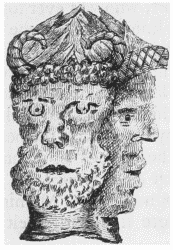
In 1690, a Janus's bead was found in the road to New Cross, near St. Thomas's watering place, one side of which represented the countenance of a man, bearded, with the horns and ears of a ram, a jewel or ornament hanging down near them on each side his head, which was crowned with laurel; on the opposite side was the countenance of a young woman, in antient head attire, which at the same time that it covered the head, projected from it. It was entire, and seemed formerly to have been fixed to a square column, or to a terminus. It was a foot and a half high. It afterwards was deposited in the collection of the learned and curious Dr. Woodward. Below is the figure of it. —See Horsley, Brit. Rom. p. 343.
OUR BOTANISTS have taken notice of the following rare plants, growing in and about this place:
Sinum majus angusti folium, lesser water parsnip. Garyophyllus pratensis, the Deptford or wild creeping pink.
English cudweed.
Tragopogon luteum, yellow goatsbeard.
Buglossum luteum, lang de beefe, in Latin, lingua bovis et buglossum luteum, hieracio cognatum et buglossa sylvestris, or wild bugloss.
Cicutaria palustris, wild water hemlock. (fn. 5)
Blattaria, moth mullin; variat flore albo; growing both here and at Greenwich.
Dipsacus minor five virga pastoris, shepherd's-rod.
Nummularia, money wort; flore purpurascente. (fn. 6)
To this part of Kent, so fruitful to the herbalist, that delight and ornament of our nation, Mr. Cowley, before he removed to Chertsey, frequently retired; where every field and wood could shew him the real figures of which he read, and from which he composed his books of plants, herbs, and flowers; the more happy situation to him, as it was near Mr. John Evelyn, of Saye's-court, who was ever forward to communicate his art and knowledge for the benefit of others.
DEPTFORD was given by William the Conqueror to Gilbert de Magminot, one of his favourites, (fn. 7) together with many other lands, in different counties, consisting of twenty-four knights fees, to hold of the castle of Dover in capite by barony, by the performance of certain services for the defence of it, and these together made up the barony of Magminot.
Gilbert de Magminot (or Maminot, as this name was afterwards more frequently spelt) fixed the scite of his barony here, which therefore was afterwards esteemed caput baroniæ, or head of the barony, and he erected a castle on it, as was usual in those days, every part of which has been long since buried in its own ruins; though some remains of stony foundations seem to point out the situation of it, near Saye's-court, in Bromfield, on the bank of the Thames, near the mast dock. His grandson, Wakelin, died without issue, in the third year of king Richard I. having been a good benefactor to the monks of Bermondsey, to whom, in the year 1157, he gave ten shillings rent, out of the mill of Deptford. On his death his sister Alice became his coheir, and brought this place, with much other inheritance, to her husband Geoffrey, second son of William de Saye, (fn. 8) who granted this manor of West Greenwich (as it was then called) with the advowson of the church and its appurtenances to the Knights Templars, in pure and perpetual alms.
His son Geoffrey regained the possession of it by giving the Knights Templars that of Sadlescombe, in Suffex, for it. He ratified to the canons of Begham the lands of Brocele, which were part of his barony, and the church of St. Nicholas, at Greenwich, which his father had given to them. Geoffrey de Saye, last mentioned, being in arms against king John, with others of the barons, in the 17th year of that reign, his lands and fees, lying in Kent and elsewhere, were given to Peter de Crohun, though after the death of the king he was taken into favour, and his lands were restored in the 8th year of king Henry III. (fn. 9)
William his son succeeded him, and died anno 56 Henry III. holding this manor in capite by barony, and the repair of a house in Dover-castle, called, from its possessors, Saye's-tower. (fn. 10) His son of the same name, accounted at the Exchequer for twenty-seven fees of the honour of Magminot; that is, twenty-six of the old feoffment and one of the new, which shews the large extent of his possessions. He died anno 23 king Edward I. possessed of this manor, leaving Geoffrey his son and heir, (fn. 11) who married Idonea, daughter of William de Leyborne (who survived him) and died possessed of it, in the 15th of king Edward II. leaving Geoffrey de Saye, his son, who, in the 8th of king Edward III. obtained the king's charter for free warren for all his demean lands in his lordships of Greenwich, Deptford, &c. with the view of frankpledge and other privileges, and died in the 33d year of it, leaving William his son and heir, and Maud his wife, surviving, (daughter of Guy de Beauchamp, earl of Warwick) and three daughters, who afterwards became their brother's heirs, as will be further mentioned.
William de Saye died in the 49th of king Edward III. leaving John his son and heir, who died in his minority, and in ward to the king, in the 6th year of king Richard II. being then possessed of this manor. (fn. 11) Upon which Elizabeth his sister became his heiress, who married first Sir John de Fallesley, who had possession granted of the lands of her inheritance, but he dying soon after, she married Sir William Heron, knight.
This family of Saye, from their long possession of this place, fixed the name of Sayes-court on the mansion or scite of this manor, which it still retains. They bore for their coat armour, Quarterly or and gules, which bearing came to them from the Magminots and again from the Sayes to the Peckhams, Parrocks, and St. Nicholas's, but these bore it only in chief. (fn. 12)
Sir William Heron above mentioned possessed this manor in right of his wife, anno 19 Richard II. toge- ther with her, by the name of Elizabeth lady Saye, levied a fine of it, with all other their manors and lands in Kent, to the use of them and the heirs male of their bodies; remainder to her own right heirs. Four years after which she died, s. p. Upon which this manor came to Sir William Heron in her right, and he died possessed of it in the 6th year of king Henry IV. s. p. likewise, Sir John (fn. 13) son of his brother Sir John Heron, being his next heir, all which was found by inquisition taken here at Deptford, and that it was held in capite, and consisted of one capital messuage here and two hundred and twenty-five acres of land, and of rents of assize of free tenements seven pounds eight shillings and two leets, and it was likewise found by an inquisition, taken after her death, that she died, s. p. and that Sir William de Clinton, son of Idonea, sister of William de Saye last mentioned; Mary wife of Otho de Worthington, and daughter of Thomas de Aldon, by Elizabeth, another sister of the said William; and Maud, her sister; and Roger de Fiennes, son of William by Joane, another sister, who afterwards had Stephen de Valoines; were her heirs and next of kin. They most probably joined in the sale of it, for in the 3d year of Henry V. it was found, (fn. 14) that Sir John Philip and Alice his wife held the reversion of this manor, and that Sir William Philip was his brother and next heir.
William de la Pole, duke of Suffolk, at the time of his death, in the 28th year of Henry VI. was possessed of the manor of West Greenwich, leaving John his son, (fn. 15) who, in the 3d year of king Edward IV. was restored to the title of the Duke of Suffolk, void by his father's attainder. His eldest son John seems to have had the property of this manor vested in him during the life time of his father, and was, by a special char- ter, in the 7th year of king Edward IV. in regard of his nearness of blood to that king, created Earl of Lincoln, after which, being highly favoured by king Richard III, and being so eminent a branch of the house of York, he used his utmost endeavours to oppose the earl of Richmond's attaining the crown. To which end, raising an armed power, he marched towards Newark-upon-Trent, and at Stoke, near that place, being met by king Henry's forces, after a sharp dispute, anno 2d king Henry VII. his whole army was routed, and he himself slain there. This manor, thus coming to the crown, did not remain long there, for king Henry next year granted it to Oliver St. John, who died possessed of it in the 14th year of that reign, (fn. 16) leaving the inheritance of it by his will, anno II Henry VII. (fn. 17) to his son, John St. John, who was likewise found to own it at his death, in the 4th year of king Henry VIII. (fn. 18) Before the 29th year of which reign, this manor seems again to have returned to the crown, when, as appears by a deed in the augmentation-office, it was stiled the king's manor of Saye's-court, alias West Greenwich, and is mentioned in it, together with his manor and ville of Deptford Strond, by which it appears that there were then two distinct manors, so named as above. As to the latter, I find that Roger Mortimer, earl of March, who was slain in Ireland, in the 22d of king Richard II. was found to die possessed of a certain scite, called Le Strond, in Greenwich, and seventy-three acres of land in Deptford Strond. (fn. 19) His son Edmund, the last earl of March, died anno 3 Henry VI. possessed of this scite, called his manor of West Greenwich, alias the Strond. (fn. 20) On his death, without issue, Richard duke of York, son of Anne his sister, was found by inquisition to be his next heir. He died anno 3 Edward IV. being possessed of the messuage and premises of Deptford Strond, (fn. 21) and was succeeded in it by his son Edward, earl of March, afterwards king Edward IV. so that it became vested in the crown. It was then esteemed to lie partly within this county, and the remainder of it in that of Surry, within the parishes of Reddriff and Camberwell, but in queen Mary's reign, 1555, it appears to have been esteemed as situated wholly in those parishes within the county of Surry, owing probably to the change made in the boundaries of the two counties, and as such will excuse any farther notice of it in this place, excepting that it is at present so called, and is now the property of the reverend Mr. Hambly.
But the manor of Saye's-court, alias West Greenwich, situated within this parish of Deptford and county of Kent, notwithstanding the scite of it, called Saye'scourt, was demised away, as will be farther mentioned, appears to have remained in the hands of the crown from the above time during the greatest part of king James I.'s reign, and to have continued so at the death of king Charles I. in 1648.
The mansion of Saye's-court appears to have been granted before this, at the latter end of queen Elizabeth's reign, for a term to Sir Richard Browne, who died possessed of it in 1604, and lies buried in this church with his wife, dame Johanna Vigors, of Langham, in Essex. He was a younger son of an antient family at Hitchin, in Hertfordshire, seated at Horseley, in Essex, and being taken into the service of the crown by Robert Dudley, the great earl of Leicester, went governor of the United Netherlands, and was afterwards, by queen Elizabeth, made clerk of the green cloth, in which he contiuued under king James. He left a son, Christopher Browne, esq. who died in 1645, and lies buried in this church, with Thomasin his wife, daughter of Benjamin Gonson, of Much Baddow, in Essex. Their only son and heir was Sir Rich. Browne, gentleman of the privy-chamber to king Charles I. and clerk of the council; and resident from king Charles I. and II. at the court of France, till the Restoration. He had been created a baronet in 1649, and dying in 1683, was buried in this church-yard, close to the wall of the church, on the other side of which his father lies. He married Elizabeth, daughter of Sir John Prettiman, of Driffield, in Gloucestershire, who lies buried by him. By her he had an only daughter and heir, Mary, as will be farther mentioned below. (fn. 22)
The arms on Sir Richard Browne's monument, who died in 1605, are Quarterly, first and fourth, azure a griffin passant or a chief of the second; second and third, or a chief sable. But his grandson, Sir Rich. Browne, bt. appears to have had an alteration granted to his arms; for in the British museum (fn. 23) is a warrant of Charles II. given at Castle Elizabeth, in the isle of Jersey (Jan. 6, 1649) to Sir Edward Walker, garter, to prepare a grant of an additional coat of arms, by way of augmentation, for Sir Richard Browne, bart. viz. Or, a chief sable, and a canton ermine, to be borne before his paternal coat. This canton was afterwards omitted by patent, and Sir E. Walker certified (July 24, 1663) that the above augmentation without the canton, was not, to his knowledge, borne by any family, nor extant in any book of visitation. After which he bore for his arms, Quarterly, first, the above augmentation; secondly, Browne; third, argent, a fret gules; fourth, quarterly indented or and gules, a crescent, for difference.
After the death of king Charles I. the powers then in being passed an ordinance to vest the royal estates in trustees, in order to their being surveyed and sold to supply the necessities of the state; by which survey it appeared that the quit-rents due to the lord of this ma- nor of Saye's-court and Deptford, and le Strond, alias West Greenwich, from the freeholders in free socage tenure, amounted to one hundred and eighteen shillings one penny halfpenny yearly, and that the court baron and court leets, &c. were valued at sixty shillings. And that James I. in consideration of the services done by Christopher Browne, gent. above mentioned, as well as of the charges he had been at in repairing the mansionhouse of Saye's-court, by letters patent, in his 8th year, had granted to him that house, lying in Bromefield, in Deptford, with the orchards, gardens, and closes, then in his possession, and sufficient hay and pasture for the keeping, feeding, and pasturing twelve kine, one bull, and two horses, in winter and summer, upon the grounds at Sayes-court, for forty years, without any rent, and that king Charles had directed his privy-seal to the trustees of his son Charles, prince of Wales, in consequence of which they granted, in his 10th year, the premises to him for twenty-four years, to commence from the year 1651 (being the expiration of the former lease). The premises were reported then to be in the possession of William Prettiman, gent. executor of Christopher, and guardian of Richard Browne, one of his grandchildren, to whom, by his will, he had given his interest in them; (fn. 24) that the yearly value was one hundred and seven pounds, but that there were yearly reprises out of them to the vicar of Deptford, in considerations of tithes, twelve pounds, and four loads of hay, valued together at six pounds. That he was likewise tenant to all the demesne lands, by lease from the commissioners of the public revenue, amounting to about one hundred and sixty-four acres, at the yearly rent of four hundred and twenty-four pounds eleven shillings and seven pence three farthings.
After this the manor, with its appurtenances, and other premises in Greenwich and Deptford, were sold by the trustees to John Bachsted, Ralph Cobbet, and others; and the manor house to William Somerfield. (fn. 25) In which state they continued till the restoration of king Charles II. in 1660, when the manor and those demesnes, undemised by the crown, returned to the royal revenue, part of which, the manor itself, continues at this time. A court leet and court baron is still held for it.
But Saye's-court, by virtue of the above mentioned leases, returned to the heir of Mr. Christopher Browne, (fn. 26) in the person of Sir Richard Browne, bart. his only son, whose sole daughter and heir Mary having, in 1647, married John Evelyn, esq. before mentioned, and brought him her father's interest in this seat as part of her inheritance. King Charles II. (fn. 27) under his great seal, in his 15th year, granted to the above mentioned John Evelyn his capital messuage, or scite of the manor of Saye's-court, with its appurtenances in Deptford, and lands belonging to it, for the term of ninety-nine years, at the yearly rent of twenty two shillings and sixpence. This Mr. John Evelyn, a most ingenious and polite gentleman, and well versed in useful learning, (fn. 28) was the second son of Richard Evelyn, esq. of Wotton, in Surry, and succeeded as heir to his elder brother George, who died without issue, to the seat and estate at Wotton, which he has ever since continued the family seat of his descendants. He died at London, in 1706, and was interred at Wotton, in the chancel there; leaving surviving one son John, and a daughter, Susan, married to William Draper, esq. of Adgecourt, in Surry.
This family of Evelyn came originally from Evelyn, near Tower-castle, in Shropshire, whence they came into Surry, some ages since, along with the On- slows and Hattons, from places and seats of those names. There are some of this name both in France and Italy, written Ivelyn and Avelyn, and in old deeds Avelyn, alias Evelyn. One of this name was taken prisoner at the battle of Agincourt.
John Evelyn, esq. only remaining son of John, as above mentioned, was the ingenious author of the Sylva and several other books, (fn. 29) and having married Martha, daughter and coheir of Richard Spencer, esq. died in his father's life time, in 1699, leaving one son John, and a daughter Elizabeth, married to the honourable Simon Harcourt. (fn. 30) John Evelyn, last mentioned, by his grandfather's will, became possessed, on his death, in 1706, of both the terms in Sayes-court, and the other premises in Deptford, granted by king Charles II. In July 1713, he was created a baronet, and was fellow of the Royal Society, of which his grandfather had been a principal promoter and benefactor.
King George I. in his 10th year, granted the freehold of this estate (an act of parliament having passed for that purpose) to Francis earl of Godolphin, and Hugh visc. Falmouth, in trust for Sir John Evelyn and his heirs for ever, on paying the yearly rent of 1l. 2s. 6d. as a quit rent, and a valuable consideration besides to the crown for them. He married Anne, sister of Hugh, late viscount Falmouth, and dying in 1763, left the possession of Saye's court to his son Sir John Eyelyn, bart. who died in 1767, on which this estate descended to his only son, Sir Frederick Evelyn, bart. of Wotton, in Surry, the present possessor of it. (fn. 31) The Evelyns bear for their coat armour, Azure, a griffin passant and chief or. In this house Peter the Great, czar of Muscovy, resided for some time in 1698, when he, in this yard, completed his skill and knowledge in naval architecture.
BROCKLEY is a place situated partly in this parish and partly in Lewisham. It was once accounted a manor, and was granted, with its appurtenances, by the last Wakelin de Maminot, about the latter end of king Henry II.'s reign, to Michael de Turnham, to hold by the yearly rent of twelve pence, in lieu of all service, for which grant Michael became his feudatory tenant, and paid him forty shillings. Michael de Turnham afterwards sold his land of Brocele, as his free gavilkinde and stockinkinde, to the countess Juliana, wife of Wakelin above mentioned, that she might found a religious house here, Stephen de Turnham, his nephew, consenting to it. The religious of the Premonstratensian order, who were first settled at Ottham, in Sussex, by Ralph de Dene, finding that place very inconvenient, resolved to quit it for one more suitable, and in all likelihood it was these to whom the countess Juliana and Michael de Turnham gave this place, in pure and perpetual alms, for an habitation: which gift was confirmed by Jeffry de Say, the land being part of his barony. But they did not remain long here, for Robert de Turnham, nephew of Michael, gave them an estate at Begham, in Sussex, to which they quickly removed, with the consent of Ela de Sackville, daughter of Ralph de Dene, and he confirmed to them his land here at Brockley, in pure and perpetual alms, to hold of Jeffry de Saye and his heirs, paying him the accustomed rent in lieu of all service and secular exaction; which gift was confirmed by his brother, Stephen de Thurnham. King John, in his 9th year, confirmed the land of Brokele to the abbot and convent of Begham. King Edward III. in his 2d year, granted to them free warren in their lands at Brokele.
This estate remained with them till the dissolution of their abbey, in the 17th year of king Henry VIII. when, being one of those smaller monasteries, which cardinal Wolsey then obtained of the king, by his letters patent that year, for the endowment of his colleges, (fn. 32) it was settled by him on his new foundation, called Cardinalscollege, in Oxford, where it staid only four years, when the cardinal being cast in a præmunire, in 1529, all the estates of this foundation were forfeited to the king, and continned in the hands of the crown till 1532, excepting such as were begged from time to time by the hungry courtiers, which were not a few. (fn. 33)
That part of this estate which lies in Lewisham is now called Forest place, alias Brockley-farm; a farther account of which will be given under the description of that parish. The other part, situated in the parish of Deptford, was granted by queen Elizabeth, by letters patent, in her 10th year, by the description of the scite and capital messuage of the manor of Brockhill to Philip Conway. This is now called Hither or Upper Brockley-farm, and is situated near New-cross, in the parish of St. Paul's, Deptford. It was for some generations in the family of Wickham, of Garsington, in Oxfordshire, who were possessed of a considerable estate besides, both in this parish and that of St. Nicholas, Deptford; all which, by two female coheirs of that name, passed lately in marriage to Thomas Drake Tyrwhitt, esq. and the reverend doctor John Drake, the two younger sons of William Drake, esq. late of Amersham, in the county of Bucks, who in the right of their respective wives are now possessed of them.
There is an old house in Deptford, commonly called the Moated-place or Stone-house, or king John'shouse, from that king's having been supposed to be the builder of it, but with what truth I know not; however, it has been at several times the residence of the kings of England. King Edward III. resided frequent- ly here; and king Henry IV. is said to have resided here whilst his leprosy was curing. (fn. 34) This house remained in the crown at the death of king Charles I. in 1648; after whose death it came under the management of the trustees appointed by parliament in 1649, for the sale of the late king's lands, and was by their surveyor certified to be within the county of Surry, (fn. 35) and as such will excuse further notice of it.
In the 38th year of king Henry VIII. Thomas Bassingburne held in capite a messuage and dovecote, called Skinners'-place, with its apputtenances, in the parish of Deptford Strond, alias West Greenwich, being parcel of the possessions of Thomas Becket's hospital, within the borough of Southwark. Richard Stoneley afterwards held Skinners'-place, but in the 10th year of queen Elizabeth, the lady Anne Parry was in possession of it.
In the 3d of king Edward VI. there was a decree in the court of augmentation concerning the hermitage in Deptford, which, I find was in being in the 4th year of king Henry IV. (fn. 37) King Edward VI. in his 6th year, granted to Edward lord Clinton and Saye, lands in this parish, parcel of the guild of our lady of Rounceval. (fn. 38)
Here are two hospitals belonging to the corporation of the Trinity-house of Deptford Strond, in which the men have an allowance of twenty shillings per week, and the women sixteen. These buildings were erected at two different times; the old part, which is situated near the church, contains twenty-one houses, and the new, which fronts the street, in length, contains thirty-eight. The latter, called Trinity-hospital, is much the finer edifice, and has large gardens belonging to it, notwithstanding which the other has the preference, on account of its antiquity, and the meetings of the corporation, which the master and brethren, hold their by there charter.
Sir Richard Browne, bart. of Saye's-court, elder brother and master, in the year 1672, gave the inheritance of the land on which these alms houses are built. (fn. 39) Captain Richard Maples, who died commander of a ship in the East Indies, in 1680, left to the Trinity-house thirteen hundred pounds, with which part of these alms-houses were built.
The Society of the Trinity-house was founded in the reign of king Henry VIII. by Sir Thomas Spert, commandant of the great ship Henry, Grace de Dieu, and comptroller of the navy, for the increase and encouragement of navigation, for the good government of the seamen, and the better security of merchant ships on our coasts. It was incorporated anno 4th king Henry VIII. who confirmed to them not only the antient rights and privileges of the company of mariners of England, but their several possessions at Deptford, which, together with the grants of queen Elizabeth and king Charles II. were confirmed by letters patent of the 1st of king James II. by their first name of, The Master, Wardens, and Assistants of the guild or fraternity of the most glorious and undivided Trinity, and of St. Clement, in the parish of Deptford Strond, in the county of Kent.
The corporation is governed by a master, four wardens, and eighteen more elder brethren, but the inferior members of the fraternity, named the younger brethren, are of an unlimited number, for every master or mate, expert in navigation, may be admitted as such; and these serve as a continual nursery to supply the vacancy among the elder brethren, when removed by death or otherwise, whereof the master and two of the wardens are chosen annually (fn. 40) every Trinity Monday, usually at their antient house at Deptford Strond, the others being for life.
The master, wardens, assistants, and elder brethren are by charter invested with the powers, among others, of examining the mathematical children of Christ's hospital, and of the masters of his majesty's ships; the appointing pilots to take charge, as well of the ships of his majesty's royal navy, as merchant ships; the settling the several rates of pilotage, and the erecting and maintaining light-houses, buoys, and beacons, and other sea marks, upon the several coasts of the kingdom, and in the mouth of the river Thames, for the better security of ships; to which end, the brethren frequently survey the north and south channels leading to the river Thames; the granting licences to poor seamen, not free of the city, to row on the river Thames, for their support in the intervals of sea service, or when past going to sea; to this corporation belongs the ballast-office for clearing and deepening the river Thames, by taking from it a sufficient quantity of ballast, for the supply of all ships that sail out of it. (fn. 41) After the maintenance of their light-houses and other necessary expences of the corporation, the remainder of their revenue is applied wholly to the relief of poor decayed seamen, their widows and orphans, and none other; and of these there are relieved by them about three thousand, at the expence of about six thousand pounds, by yearly, monthly, or by other temporary charities, more or less, according to their necessities.
The benefits and revenues to support these charities arise from light-money, buoys, beconage, ballastage, and from the benefactions of the brethren and others, which are contingent. And in consideration of their necessary service to the public, and that their ships and servants are to be at the call of government, they have several privileges and exemptions, such as not serving the office of sheriff, or upon juries and inquests, and such like burthens, which others are subject to. And this favour is alike to all the brethren, both elder and younger, their officers and servants. Their coat of arms is, Between a cross-gules, four ships under sail.
CHARITIES
JOHN ADDEY, master builder, of the king's-yard, Deptford, (who lies buried in this church,) by his will, in 1606, gave 200l. for a perpetual annuity towards the relief of the poor of St. Nicholas, Deptford, for ever, which was laid out in the purchase of the Gravelpit-field, in Deptford, the ground being vested in feoffees in trust, and of the annual produce of 126l. 10s. 6d. and by other donations, as after mentioned, and fines received on leases, &c. in New South Sea annuities 1000l. vested in trust, of the annual produce of 30l.
A PERSON UNKNOWN, about the same time, gave (by will, as is presumed) half a quarter of wheat, to be distributed every Good Friday, for which there is now received 10s. and half a load of rushes at Whitsuntide, and a load of wheaten straw at Christmas, for which there is now received 1l. 1s.
JOHN RICH, at what time unknown, and is presumed by will, gave to be distributed in bread weekly, after sermon every Sunday morning, a yearly sum, charged on an estate at Upper Deptford, of the annual product of 2l. 12s.
ROBERT STOUT, at what time unknown, and is presumed by will, gave for the use of the poor of this parish, 1l. 6s. 8d per annum, charged on a house in Upper Deptford.
WILLIAM SEWERS, in 1640, gave by will, to be distributed in bread, on Michaelmas and Lady Days, a sum of money, charged on four acres of land and two tenements in Upper Deptford, now of the annual product of 1l. 6s.
MR. JOINE, at what time unknown, gave to be distributed in bread a sum of money, received by Mr. Gibson, of Loampithill, and charged on land, of the annual product of 1l.
THE REV. ABRAHAM COLFE gave by will, in 1658, a sum of money paid by the Leathersellers company of the yearly product of 6s. 8d. though now 8s. 8d. and likewise to eight poor boys, of Deptford, the privilege of being taught, and a title to all the advantages belonging to any scholars educated in the grammar-school founded by him at Lewisham.
DR. ROBERT BRETTON in 1670, gave by will 200l. on a mortgage of the lands of Richard Maddox, the interest to be paid in the public school for teaching twelve poor children grammar and writing to be laid out in the purchase of lands, the rents to be for a salary to the masters, and if any of his four children died before they received the portion, he gave 200l. more out of the said portion, for teaching twelve more poor children, the same to be laid out in the purchase of lands or houses; and if a second of his four children died before their portion due, he appointed 100l. more of the said portion to be paid to the churchwardens, to be laid out in the purchase of rents, to be paid to the schoolmaster, for teaching six more poor children. N. B. It seems that only 400l. of these bequests were received, and those laid out from time to time in various funds and securities, and now, with Mrs. Elizabeth Wilshaw's and Mrs. Sarah Trott's legacies below mentioned, make 600l. Old South Sea annuities, now vested in trust for this purpose; and Dr. Bretton, at the time of his death, gave 20l. to be distributed to the poor of this parish.
ESTHER POPE, in 1678, gave by will, to the vicar of this parish 20s. per ann. to be distributed by him to the poor at Christmas, charged on two tenements in Lower Deptford, now of the annual value of 1l.
ROBERT CASTLE, in 1698, gave by will, to the feoffees of the Gravel-pit rents, for the benefit of the poor, 200l. which has not been paid.
JOSEPH FOWNES, in 1708, gave by will, to the above mentioned feoffees, to the same use, the sum of 50l.
ELIZABETH WILSHAW, in 1709, gave by will, 120l. the produce to be yearly distributed on the day of her death, Nov. 11, to such poor widows as frequent this parish church.
JUDITH FIOTT, in 1713, gave by will, to this parish, 130l. the yearly produce to be disposed of in putting out apprentice one poor child, born in this parish, annually for ever. N. B. These two last mentioned legacies, with Dr. Bretton's, make the sum, in Old South Sea annuities, as mentioned in his legacy above, of the yearly produce of 18l.
FRANCES ATFEN, in 1713, gave by will, to the feoffees of the Gravel-pit rents, 10l. for the like uses.
ISAAC LOADER, esq. in 1714, gave by will, to the same feoffees, 200l. only 100l. of which appears to have been paid.
WILLIAM HOSIER, esq. in 1717, gave by will a sum of money, the interest of it to be applied for the educating of poor boys, which money is now vested in 300l. Old South Sea annuities, and is vested in trustees, and of the annual produce of 9l.
MARY GRANSDEN, in 1719, gave by will and deed, a farm at Plaistow, in Halsted, in the county of Essex, and two houses in St. Bartholomew's-lane, London, and 80l. in money, for the benefit of poor children, educated and cloathed in the Subscription charity schools in Deptford, which 80l. was laid out, being increased by a number of subscriptions, in building the schools; the same is vested in feoffees in trust, and is of the annual produce of 77l. Mr. Robert Gransden, father of the testatrix, gave in his life time the inheritance of the ground on which the school house stands.
DR STANHOPE, by will, in 1727, gave, for putting out boys apprentice, and every third year for cloathing and fitting girls for service, and for pious books, 6l. per annum, being at that time 150l. New South Sea annuities, at 4 per cent. now 250l. the same being increased by a gift of 42l. 9s. 6d. by William Sherwin and William Collins, and a donation of William Holt, as mentioned below, vested in trustees, and of the annual produce of 7l. 10s. THIS PARISH has a right of presentation of one poor person to queen Elizabeth's college, in Greenwich, founded by William Lambarde, esq. vested in the Leathersellers company.
SIR JOHN SCAMPION, scrivener of London, by his will, in 1563, and the same was established by a commission of charitable uses in 1609, gave 12s. per annum towards the relief of the poor of Deptford, to be paid out of lands in it.
In this parish are two charity schools, for the cloathing and teaching of fifty boys and twenty girls.
By the act of parliament, anno 3 George II. 1730, for providing and maintenance of the minister of the new parish church of St. Paul, built in the parish of St. Nicholas Deptford, in the counties of Kent and Surry, and for making the same a distinct parish, it is enacted, that all gifts, charities, &c. before given to the parish, and then the property of it, should, after the consecration of the new church, be equally divided, one moiety for the benefit of the old parish, and the other for the benefit of the new one, in which state the above gifts and charities remain equally divided between the two parishes at this time.
Since the above year, 1730, the following charities have been expressly given to the one or the other of the two parishes by name.
THOMAS JENNINGS by will, in 1741, gave to be divided between the two parishes of Deptford, the interest to be distributed at the church on Candlemas-day, vested in trustees, the annual produce to this parish of one moiety, being 1l. 10s.
SIR JOHN EVELYN, bart. in 1749, gave by deed, for the use, benefit, and support of the poor of St. Nicholas, Deptford, land, presumed to be vested in his heir, and now of the annual produce of 11l. 11s. In 1751, by the consent of the donor, the two trustees, and an order of vestry, the churchwardens sold to the trustees of the Kentish turnpike road about twenty roods of the said land, to be laid into the road, for 10l. in money, which was vested in Bank annuities, in trust, and is of the annual produce of 6s.
WILLIAM SHERWIN and WILLIAM COLLINS, by deed, in 1752, gave money to purchase lands, the rents of which should be applied to the educating and cloathing seven poor boys of the two parishes of Deptford, of shipwrights, joiners, or housecarpenters; and if none such, then other boys, and putting out one apprentice every year to one of those trades, but not to exceed 14l. in cloathing and apprenticing, which money is vested in Old South Sea annuities, being 1600l. and is of the annual produce of 48l. which is indiscriminately applied to the use of both parishes.
THOMAS FELLOWS, esq. gave by will, in 1752, the interest to be applied to the educating and cloathing as many poor children, boys and girls, as it would afford, the sum of 1000l. 3 per Cent. in the name of the accountant-general of the court of chancery, out of which the parishes have not as yet received any benefit.
MARY WISEMAN, widow, in 1758, gave by will, 200l. the interest to be laid out annually for the cloathing of six poor boys of St. Nicholas and St. Paul, Deptford, to be cloathed in grey, which money has not been received, it not being thought sufficient for the purpose; and likewise the sum of 20l. Old South Sea annuities, to be annually laid out and distributed to poor widows and housekeepers of St. Paul, Deptford, who do not take alms, but are real objects of charity and members and communicants of the church of England, on Feb. 19, yearly, vested in trust, and of the annual produce of 12s.
WILLIAM HOLT, about the year 1766, gave by will, 10l. to be added and applied to the purposes of Dr. Stanhope's donative above mentioned, which was added to the same Bank annuities as his was.
RICHARD BROOKE, in 1767, gave by will, the interest to be distributed to such three poor men and three poor women, housekeepers, not receiving alms, as the minister and churchwardens should think fit, equally share and share alike, the sum of 100l. Consol. Bank annuities, of the annual produce of 3l.
WILLIAM REYNOLDS, in 1768, gave by will, for the support of the charity schools in Deptford, and the benefit of the children taught therein, four leasehold houses, subject to a ground rent of 2l. 4s. per annum, vested in trustees, and of the annual product of 27l. 10s. which is indiscriminately applied to the use of the poor boys of both parishes.
JOHN CHASTER, in 1783, gave by will, to be transferred to the seoffees of the Gravelpit rents, in Deptford, the interest to be applied in putting out as apprentice every year, one poor boy, out of the Subscription Charity-school; a bricklayer's son to have the preference, the sum of 300l. 4 per cent. Bank annuities, vested in his executors, and of the annual produce of 12l. which is indiscriminately applied to the use of both parishes.
RICHARD PHILIPS, in 1784, gave by will, in trust, for the use of the Subscription Charity-schools, Deptford, for educating poor children, 50l. 3 per cent. consol. Bank annuities, of the annual produce of 1l. 10s. which is indiscriminately applied to the use of both parishes.
DEPTFORD, as far as lies within the county of Kent, is within the ECCLESIATICAL JURISDICTION of the diocese of Rochester and deanry of Dartford.
About sixty years ago a second church was built here, and it was then divided into two distinct parishes, now known by the names of St. Nicholas's parish, (the old church, which before comprehended all Deptford,) and St. Paul's parish, the modern church, to which was annexed a district taken out of the former parish of St. Nicholas.
The church of St. Nicholas, of West Greenwich, alias Deptford, was given by Juliana de Vere, widow of Hugh Bigod, and wife of Wakelin de Maminot, lord of this place, to the religious, then residing at Brockley, in this parish; which gift was afterwards confirmed by Jeffry de Saye, and Alice his wife, sister of Wakelin, before-mentioned, who brought this inheritance to her husband. Soon after which, perhaps by their removal from hence to Begham, in Sussex, the patronage of this church again returned to Jeffry de Say; who granted it to the Knights Templars, in pure and perpetual alms. His son Jeffry regained the possession of it, in exchange for other lands, and by his deed gave it to the canons at Begham. (fn. 42)
Gualeranus, bishop of Rochester, (about 1183,) appropriated this church to the abbot and convent of Begham, which was confirmed, as well by pope Honorius III. as by the cardinal legate here, by several of the bishops of Rochester, &c. By an antient valuation, taken in the 15th year of king Edward I. this church was estimated at fifteen marcs, and the vicarage at six marcs and an half. (fn. 43)
The church remained with this abbey till its final dissolution in the 17th year of king Henry VIII. when being one of those smaller monasteries, which cardinal Wolsey obtained of the king that year, for the endowment of his colleges, it was surrendered, with all the possessions belonging to it, into the cardinal's hands; (fn. 44) to whom the king granted his licence, by writ, in his 18th year, to appropriate, consolidate, and annex the rectories, or churches, of Newington, Marden, Tewdeley, Brenchley, Leigh, Yalding, Pepingbury, and West Greenwich, alias Deptford, in the county of Kent, and others in other counties, all which were of the cardinal's patronage, to the dean and canons of the college of Thomas Wolsey, cardinal of York, by him founded in the university of Oxford, (fn. 45) &c. But this church staid with them only four years; when that great prelate being cast in a præmunire, in 1529, all the estates of the college were forfeited to the king, and became part of the revenue of the crown.
Queen Elizabeth, by her letters patent, in her tenth year, granted the church of West Greenwich to Philip Conway. The rent reserved to the crown in the grants of this rectory being 5l. 6s. 8d. (fn. 46) It was afterwards, in the time of the usurpation, granted in fee, under the above rent, to Edmund Downing and Peter Aston.
The vicarage of St. Nicholas is valued in the king's books at 12l. 17s. 3½d. and the yearly tenths at 1l. 5s. 8¾d. There is no vicarage house.
The advowson seems to have remained in the crown from the year 1529, uninterrupted, till the death of king Charles I. in 1648. Soon after which a commission of enquiry into the value of church livings, having issued out of Chancery by order of the state, it was returned by presentment, upon oath, that Deptford was a vicarage, with an house and five acres of glebe land, worth sixty pounds per annum, Master Mallorie enjoying it. The presentation to it afterwards became vested in the family of Wickham, of Garsington, in the county of Oxford, who continued in possession of it for many years. They were likewife owners of the parsonage or great tithes of Deptford, so far as lies in the county of Kent. By two female coheirs of the name of Wickham, this advowson, as well as the parsonage, passed in marriage to Thomas Drake Tyrwhitt, esq. and the reverend Dr. Drake, of Amersham, in the county of Bucks, the younger sons of William Drake, esq. of that place, who, in right of their respective wives are now entitled to them, but the parsonage or great tithes of that part of Deptford, which lies within the county of Surry, which were lately and had been for some length of time in the family of Bowyer, of the county of Somerset, passed by the will of one of them, as well as by descent, into the name of Windham, of the county of Suffolk, in which they continue at this time.
The tower of St. Nicholas church seems very antient. In 1780 it was repaired, and the great bell new cast, the appearance of the rest of the building is very unsightly, a medley of stones and brick, of Gothic and modern building of different times, but the inside is uniform and handsome. The chancel is small, and railed off from the church, it is richly ornamented with carving and paintings, one of queen Anne hangs on the right side of the altar.
In 1630, the number of inhabitants being greatly increased, it was found necessary to new build another isle, on the north side, to which the East-India Company were good benefactors; and the chancel was enlarged and beautified, partly at the cost of Sir William Russell, treasurer of the navy. (fn. 50) But the church, being yet too small, the parish becoming more populous every year, and wanting much repair, they determined to rebuild it, which was begun and finished in 1697. At the same time a handsome organ was erected, and finished, at the cost of different persons. (fn. 51) The greatest benefactor towards this building was Isaac Loader, esq. a generous inhabitant of this parish, who contributed upwards of nine hundred pounds towards the erecting and ornamenting of it, and lies buried within it.
Notwithstanding all this care and expence, the church was still incapable of holding the inhabitants of this extensive and most populous parish, which induced them to petition for another church, to be erected for them in some other part of the parish, by the public bounty, under the acts of parliament for the building of fifty new churches, in or near London or Westminster. A new church was accordingly erected, being a beautiful stone building with a lofty spire, and when finished, w s dedicated to St. Paul, and consecrated on the 30th of June, 1730, by Edmund, lord bishop of London, and an act of parliament passed for the providing a maintenance for the minister of this new church, lately built in the parish of St. Nicholas, and for making it a distinct parish. In which act the sum of three thousand five hundred pounds was settled for the minister's maintenance. The king was to present to the first vacancy, and the patrons of the old church for the future; and Dr. Norton, then minister of the old church, was to continue rector of the new. The rector of St. Paul's, Deptford, has no right to any tithes whatsoever; the vicarial tithes of all Deptford being reserved by the act to the vicar of St. Nicholas, and the great tithes continuing a lay impropriation. What is remarkable in the above act is, that out of two thousand acres of land, which Deptford consisted of, near one thousand nine hundred and seventy acres were taken into the new parish of St. Paul; besides which, four acres of glebe were taken from the old parish, and given to the churchwardens, for the time being, of the new parish, who pay the sum of seventy pounds yearly, as a farther maintenanance to the rector, over and above the three thousand five hundred allotted by the act, which is vested in the Old South Sea annuities for that purpose. The consequence of which unequal division of lands is, that whilst the parish of St. Paul maintains its poor at a yearly assessment of about two shillings and four-pence in the pound, that of St. Nicholas seldom maintains its poor for less than five shillings and sixpence yearly assessment. This being a new church is, consequently, not in charge in the king's books. There is a handsome house built for the rector of it.
In the church of St. Nicholas, among other monuments and memorials, the whole of which are too numerous to mention here, is a monument, in the south isle, for John Hughes, A. M. of Jesus college, in Cambridge, ob. 1710—for Mrs. Mary Gransden, a benefaction to the poor of this parish, ob. 1719; near it is a vault, in which lies Isaac Loader, esq. In the east-cross isle, a monument for Peter Pett, esq. ob. 1652—for R. Evelyn, son of John, ob. inf. and for Mary, eldest daughter of John Evelyn and Mary his wife, ob. 1685, ætat. 19.—a monument for the Brownes, of Saye's-court. In the north isle, a monument for John, eldest son of admiral John Benbow, ob. 1762, ætat. 25. In the middle isle, a monument for Katherine, wife of captain F. Wivell, daughter of captain Christopher Gunman, ob. 1713, ætat. 40. In the great chancel, a monument for G. Shelvocke, esq. secretary of the general post-office, and F. R. S. ob. 1760, ætat. 58, and lies buried with his father—for R. Boyle, eldest son of Richard earl of Cork, ob. 1617 —for E. Fenton, esq. of the body to queen Elizabeth, ob. 1603—a monument for William Hawkyns, esq. of Plymouth, brother of Sir John Hawkyns, knight, ob. 1589. Throughout the church are monuments and memorials of the principal officers of the dockyard and their families, captains of the royal navy, and the like. Within the window of the chancel, above the altar-piece, is a small oval one, representing the nativity of our Saviour, finely executed in coloured glass. In the third window, on the south side, are the following arms, first coat, Argent three castles quarterly, anno 1698; second coat, Or, six mullets sable; the arms of Lowden, anno 1698. In the second window, first coat quarterly, parted per pale argent and sable, a chevron between three martlets counter charged; second, sable, a besant between three eagles heads erased or, a chief indented ermine; third as the second, fourth as the first; over all, an escutcheon of pretence sable, a fess between two chevrons ermine, in chief a covered cup or, anno 1698. For Turner, Second coat, quarterly; first, Argent on a bend quarterly, three escallops or; second quarterly, indented or, and quarterly, in the dexter quarter a cress lozengy; third, sable a lion rampant or; fourth as the first, impaling sable a fess dancette or, in chief three fleurs de lis argent. Over the door of the charnel-house, in the church-yard, is a good piece of sculpture, in stone, representing the Resurrection. (fn. 52)
In the church of St. Paul, on the south side of the chancel, is a sumptuous monument for Matthew Finch, gent. of this parish, ob. 1745, ætat. 70; and for Mr. Benjamin Finch, his brother. On the north side, is a beautiful one, with an urn of Sicilian marble, for Mary daughter of Benjamin and Sarah Finch, wife of Richard Hanwell, gent. of the city of Oxford, ob. 1754, ætat. 25. Arms, Finch impaling Hanwell.
ST. NICHOLAS CHURCH.
| PATRONS, Or by whom presented. | VICARS. |
|---|---|
| The Queen | Robert Foster, clerk, 19th Aug. 1561. (fn. 53) |
| The Queen | Samuel Page, D.D. about 1603, buried here 8th Aug. 630. (fn. 54) |
| The Lord Keeper | Robert Mercer, A. M. 9th Aug. 1630. (fn. 55) |
| Henry Valentine, 8th Dec. 1630. (fn. 56) | |
| Mallory, ejected for nonconformity, by the act, 1662. (fn. 57) | |
| Robert Bretton, D. D. obt. 1672. (fn. 58) | |
| Richard Holden, A.M. ob. 1700. (fn. 59) | |
| George Stanhope, D.D. obt. Mar. 18, 1728. (fn. 60) | |
| William Norton, D.D. obt. May 21, 1731. (fn. 61) | |
| Mrs. Wickham | Isaac Colman, resigned in Jan. 1737. (fn. 62) |
| Thomas Anguish, Jan. 1737, obt. 1762. | |
| William Worcester Wilson, D. D. 1762, obt. 1792. | |
| John Drake, L. D. April 1792. the present vicar. (fn. 63) | |
ST. PAUL's CHURCH.
| PATRONS, &c. | RECTORS. |
|---|---|
| By the act of Parliament, 1730. | William Norton, D.D. by the act, anno 1730, being vicar of St. Nicholas, the old church, obt. 21st May, 1731. |
| The King, by the same act | James Bate, B. D. obt. Septem. 1775. (fn. 64) |
| Mrs. Wickham | |
| John Thornton, esq. of Clapham | Richard Conyers, L. L. D. ind. Sept. 29, 1775, obt. Ap. 23, 1786. |
| Mrs. Wickham | John Eaton, 1786, the present rector. |