The History and Topographical Survey of the County of Kent: Volume 4. Originally published by W Bristow, Canterbury, 1798.
This free content was digitised by double rekeying. All rights reserved.
Edward Hasted, 'The city and liberty of Rochester: General history and description', in The History and Topographical Survey of the County of Kent: Volume 4(Canterbury, 1798), British History Online https://www.british-history.ac.uk/survey-kent/vol4/pp45-86 [accessed 9 May 2025].
Edward Hasted, 'The city and liberty of Rochester: General history and description', in The History and Topographical Survey of the County of Kent: Volume 4(Canterbury, 1798), British History Online, accessed May 9, 2025, https://www.british-history.ac.uk/survey-kent/vol4/pp45-86.
Edward Hasted. "The city and liberty of Rochester: General history and description". The History and Topographical Survey of the County of Kent: Volume 4. (Canterbury, 1798), British History Online. Web. 9 May 2025. https://www.british-history.ac.uk/survey-kent/vol4/pp45-86.
In this section
THE CITY AND LIBERTY OF ROCHESTER.
EASTWARD from Stroud, on the opposite side of the river Medway, lies THE CITY OF ROCHESTER, situated on an angle of land formed by that river, which coming from the south runs northward until it has passed the city, after which it directs its course due east. The jurisdiction of this city was antiently called the hundred of Rochester. (fn. 1)
ROCHESTER was a place of some note in the time of the Romans, owing to its situation at the accustomed pass over the river Medway. It was probably called by the Britons Durobrivæ, from the British word Dour Water, and the termination Briva, which is added to the old names of many places, and might signify among the antient Britons and Gauls, a bridge, or passage over a river; since it is no where used, but in the names of places situated like this at rivers. (fn. 2)
Antoninus, in his Itinerary, calls it by the name of Durobrivis, though it is corruptly spelt various ways in the different copies of it. In the Peutingerian military tables, in the decline of the Roman empire, it is written Roibis; from which contracted, and the addition of the word ceaster (derived from the Latin, castrum, used by our Saxon ancestors to signify a city, town or castle) they called it Hroueceaster, and by a further contraction, Rochester, (fn. 3) and here it is to be observed, that all places ending in chester, fashioned in the Saxon times, have arisen from the ruins of the old Roman castra, not that the former were always placed in the very same scite, though they were never very remote from it. (fn. 4) Hence the antient stations about the noted Roman wall, the ruins of many of which are still visible, are called chesters by the country people. It was accounted in the time of the Romans, one of their stipendiary cities, of which sort they had twelve in this island. (fn. 5)
Most of our antiquaries agree in allowing it to be the station mentioned by Antoninus in his Itinerary, under the name of Durobrivis, situated twenty-seven miles from London. The remains of the antient Roman road, or Watling-street way, leading from London hither, is very visible from Shinglewell, by Cobham-park pales, towards Rochester, till it comes to the north gate of the park, where it runs into the thick coppice, and is lost; after which there are no remains of it, till you come to the top of Chatham-hill, in the high road to Canterbury and Richborough.
Rochester has never been very extensive, and appears to be larger now than at any time heretofore. In the time of Venerable Bede, it was rather esteemed as a castle, than as a city, and accordingly he stiles it the castle of the Kentish men. Great part of the walls of this city still remain, and probably on their original foundation, and there is great reason to think, from the Roman bricks observable in different parts of them, that it was first fortified in the time of the Romans. The walls were built nearly according to the four cardinal points, and from east to west about half a mile distant, but from north to south not a quarter of a mile, so that being originally of so small a compass, this place might well be described in antient grants rather as a castle, than a city. (fn. 6)
The wall is still entire in some places, especially on the east and south sides, the north-east angle still retaining its antient form, height, and embrasures. It is in general about four feet in thickness, and on the east side where it is entire, the height is about thirty feet.
In the year 1225, the great ditch about the city is reported to have been begun, and in 1284, Saloman de Roffa had the king's licence to build about, and on the walls of Rochester, and to hold the buildings in fee.
The city has no gates at present, but the names of several are on record, viz. Broadgate, (fn. 7) afterwards called Eastgate, which stood in the high street, near adjoining to the present free school, part of the portal being still visible on the south side of the street; most part of it remained in the reign of king Henry VIII. when Leland wrote, who calls it a marvellous strong gate, and adds, no more gates appeared here than were commonly used. South gate was near Bully-hill, in the road to St. Margaret's, the arch of which was taken down in 1770. There was another gate, as appears by the Registrum Roffense, called Cheldegate, which seems to have been in the north wall of the city leading to the marshes, that part of the wall being called from it Cheldegate-wall, and the lane in which it stood opposite the college gate Cheldegate-lane. (fn. 8) In the Textus Roffensis there is likewise mention made of a gate beyond the bridge.
WE HAVE no further mention of ROCHESTER, though it was undoubtedly a Roman station, as well as a stipendiary city, till after the rise of the Saxon heptarchy, when it became more distinguished; for king Ethelbert, having embraced the Christian faith in the year 597, built the church of St. Andrew here, and made it a bishop's see; by which he raised this city from obscurity, and gave it a distinguished place in ecclesiastical and civil history.
Rochester, from its situation at the most accustomed passage over the river Medway, has been subject to more misfortunes than perhaps any other city whatsoever. In 676, Ethelred, king of Mercia, having invaded Kent, destroyed this city, and returned with great plunder to his own kingdom. (fn. 9)
During the Danish wars in England, Rochester frequently suffered from the inhumanity of those barbarians, this city being often besieged and plundered by them, the enemy in general committing unheard-of cruelties before they returned to their ships. Terrified and worn down by its misfortunes, this city at length made no further opposition against them, but submitted with the rest of the nation to the yoke of these invaders, in which state it continued, without any particular circumstances happening to it, till the Norman conquest in 1066, when it submitted to the conqueror, on the same terms that the rest of the county did. This place suffered several times dreadfully by fire in the reigns of king Henry I. and II. From which misfortunes it recovered but slowly, and the intestine commotions of the kingdom happening soon afterwards, Rochester suffered again considerably; but Henry III. getting possession of it, and knowing what advantage the preservation of it would be, resolved to augment its strength, for which purpose he repaired and restored the walls to their former condition, and began a large ditch round the city.
As Rochester lies in the direct, and most frequented passage from the continent to London, it would be endless to recount the numbers of royal and illustrious persons, who have continually visited this city, in their way through it. Our public histories are filled with instances of this sort.
However, it may be worth noticing, that queen Elizabeth, in her return from a progress she had made round the coasts of Sussex and Kent, in 1573, took up her abode in this city for five days; on the last of which she honoured Mr. Watts with her company, at his house on Bully-hill. The day after her arrival, she was present at divine service, and heard a sermon in the cathedral. (fn. 10)
King James I together with the king of Denmark, was present at a sermon preached here in 1606, by Dr. Parry, dean of Chester, the most eloquent preacher of his time. (fn. 11)
King Charles II. on his restoration, was received here with great demonstrations of joy, and the mayor and corporation presented him with a silver bason and ewer. After which he rested that night at the house of colonel Gibbons in this city.
King James II. on his abdication, came to Rochester on Dec. 19, 1688, and was received here by Sir Ri chard Head, bart. in whose house he resided till the 23d inst. when he privately withdrew, and taking with him only the duke of Berwick, and two others, embarked on board a tender in the river Medway. (fn. 12)
ROCHESTER, in the time of king Edward the Consessor, was in the king's hands; William the Conqueror, on his obtaining the crown, gave it, with the castle, to Odo, bishop of Baieux, his half-brother. Accordingly it is thus entered in the general survey of Domesday:
The city of Rochester, in the time of king Edward the Confessor, was worth 100 shillings, and the like when the bishop (of Baieux) received it, now itis worth 20 pounds; yet he who held it paid 40 pounds.
On the disgrace of bishop Odo, in the year 1083, this place, with the rest of his possessions, was consiscated to the crown.
From the Norman conquest, the cities and towns of England were vested, either in the crown, or else in the clergy, or in the baronage, or great men of the laity, of which places they were each of them immediate lords. Of these, some of them were vested in the king, antiquo jure coronæ, as part of the original inheritance of the crown, called in Domesday, antient demesne; others by antient escheat, as for want of heirs, or by attainder, forfeiture, feoffment, exchange, &c. &c. (fn. 13)
When the king was seized of any place in demesne, he was lord of the soil, i. e. of all the land within the scite and precinct of it, and of all the houses, shops, and buildings erected on it, the herbage and productions of the earth, profits of fairs and markets, pleas and perquisites of courts, and other profits of every kind within it. And when the king granted a city or town in fee, or perpetual ferm, it was a certain proof, that he was before seised of the whole of the same, its soil, profits, and appurtenances. When a town was put to fee-ferm, the tenure of it was Burgage; and the particular tenements lying within it were said to be so holden. (fn. 14)
King Henry I. let this city to ferm at pleasure, to the townsmen, at the yearly rent of twenty pounds, which was answered by the præpositus, or bailiff of it; and he granted to bishop Gundulf, and the church of Rochester, one fair to be held yearly in it, on the day before, and on the feast of St. Paulinus, with all toll arising from it, &c. (fn. 15)
King Henry II. by his charter, in the 12th year of his reign, granted to the citizens of Rochester, and their heirs, the city in fee (or perpetual) ferm, for twenty pounds sterling per annum, to hold of him and his heirs for ever; together with all pertinencies, liberties, and free customs belonging to it; and that they should have a guild merchant, with sundry other privileges, liberties, and customs therein mentioned.
King Richard I. directed his writ to the bailiff, and whole hundred of Rochester, commanding that no one, unless his servants, should buy any victuals in the city before the monks of St. Andrew's priory had bought theirs within it, which privilege was confirmed by king Richard I. who forbid even his own servants to buy before them. It was made use of by the monks of this priory till its dissolution; the like privilege was exercised by several of the great monasteries in France, till their late dissolution, to the great disgust and inconvenience of every one else.
Before the city was granted to the burgesses in feefarm, they accounted for a certain payment called maltolt, which they received from all persons passing through the city to embark for the holy land, but Richard I. abolished this toll. (fn. 16) King Henry III. by his letters patent, in the 50th year of his reign, not only confirmed the charter of king Henry II. but in recompence for the faithful service of the citizens, and the damages and losses they had sustained in their obedience to him during the time of the troubles then in the kingdom, remitted to them a part of their annual fee ferm; and he granted, that they should be exempt from toll, lastage, stallage, and murage, throughout England and the sea-ports, and should have a free market within their city, and the return of all writs whatsoever.
This city was afterwards taken into the king's hands, where it remained in the 8th year of king Edward I. who then committed it to John de Cobham, to hold of him and his heirs in ferme, for his life, at the like yearly rent, that the citizens were used before to answer for it; which grant was allowed on a Quo warranto, brought against him in the 21st year of that reign.
King Edward III. by charter of inspeximus, in his 4th year, confirmed to the citizens of Rochester king Henry III.'s charter, as did king Richard II. in his 1st year.
King Henry VI. granted several liberties and privileges to this city; and that the bailiff of it, and the citizens, and their heirs, should have the passage called the Ferry, below the city and the town of Stroud, and from the town of Stroud to the city, the King's bridge on the other side of the water being broken; and also the space of the bridge, together with the house called the Barbican; and that they should have one fair in the city yearly, on the feast of St. Dunstan the bishop, May 29, together with great liberties, &c. (fn. 17)
John Lowe, bishop, together with the prior and convent of Rochester, came to an agreement with the bailiff and citizens of Rochester, concerning the bounds and privileges of the city and precincts of the church, anno 1440, 27 Henry VI. in which, among other matters, it was agreed, that the bailiff and his successors might cause to be carried before them, by their sergeants, their mace or maces, and the sword likewise, if the king should ever give them one, as well to and in the parish church as in the cathedral and cemetery, especially on festival days and processions, and solemn sermons, and at the reception and installation of the bishops, and at all other fit times; but that they should make no execution or arrest, or any thing belonging to the same, within the precinct of the monastery and palace of the bishop, unless the same should be specially required of the bishop or prior.
King Edward IV. by his charter, in 1460, in the 1st year of his reign, wherein he recited, that the city was situated in a place most defensible, and fit for the resistance of enemies, who might enter the realm; and that considering their loyalty and services, as well to him as his progenitors, and if they had more ample liberties, their service and readiness would be enlarged, confirmed to them their former charters, and granted to the citizens of Rochester, that instead of a bailiff, they should be called the Mayor and citizens of the city of Rochester, and so to purchase, plead, and be impleaded, &c. The mayor to be chosen on the Monday next after the feast of St. Michael yearly: That on the same day a coroner and two constables should be chosen: That the metes and bounds of the city, as well by land as by water, should be, from the city by land to the hospital called St. Bartholomew's, and from the wharf of the same to the water of Medway in circuit, i. e. to Kingsforowe and Sheracre, and Lancelane unto Horsted-street or farm, and from thence in circuit by the lane that liethbetween the messuage of Gilbert Striche and William Horsted, unto Keneling's Crouch, alias Poule's Crosse, and from thence in circuit to the manor of Neshinden, and from thence to the Mill-hill next Neshinden, and from thence in circuit to the stone, and thence between the King's way leading to Woldham and the manor of Ringes, on the east part of the said manor, and from the said stone to the water of Medway there; and also from the city unto a cross placed in Littleborough, in the town of Stroud; and so in circuit about the said borough unto the city, and also by the water of Medway, that is to say, from Shireness all along up to Hawkewood; but in the charter of king Charles I. part of these bounds is thus expressed—From Horsted unto a mark stone in the highway, leading from Rochester to Maidstone, formerly called Kenelingecrouch, and from thence unto Millhill, nigh to Nashinden, and from thence in circuit to a stone standing opposite the highway leading to Woldham, near the farm called Ringes, and from the said stone to the water of Medway there: That they should have power to search all merchandizes to be shipped there, and have all forfeitables, wrecks of the sea, and fishes within the liberties and precincts of the same; and should have the ferry over the water if the bridge should be broken: And also, assize of bread and ale, and of all victuals and weights and measures, and all other things whatsoever, belonging to the office of the clerk of the market: And be free by land and water throughout England, and have goods of felons, and outlaws of men resident, &c. and should keep a court of portmote, from fifteen days to fifteen days, and should have power to attach by goods and arrest by body, or imprison: And should have cognizance of all pleas, real, personal, and mixed, within their limits, and return of all writs and precepts, and that the sheriff of the city and his officers should be exempt from doing any office: And that they should have all manner of fines, trespasses, deodands, &c. and keep two law days or leers on the Bullie, and a court of pie-powders, and have a fair on St. Dunstan's day; and that they should have pasturage of cattle in the city and Castle ditch, and liberty to build upon Eastgate bridge: That they should be justices of the peace within themselves, and direct their writs to their own ministers, and be exempt from the justices of the peace for the county: That no resident should be charged to bear office out of the city; and lastly, that they should have liberty to purchase twenty pounds per ann. to them and their successors.
The present seal of this corporation, having St. Andrew on his cross on one side, and the castle of Rochester on the other; round the former, Sigillum Commune Civitatis Roffensis; and the latter, Sigillun. Civium Roffensis; appears to be very antient.
These charters and privileges were confirmed by king Henry VIII. and by his several successors down to king Charles I. who, by his charter, in 1630, ratified and confirmed that of king Edward IV. and all other charters granted to this city; and upon petition of the mayor and citizens, that there were some doubts, touching the bounds and limits of the city, they were then further explained and cleared up. By this last charter the present corporation was made to consist of a mayor, twelve aldermen, of which number the mayor was to be one, twelve assistants or common council, a recorder, and town clerk, two chamberlains, a principal sergeant at mace, a water bailiff, and other inferior officers. The day of election for mayor to be on the Monday next before the feast of St. Matthew yearly; and the day of swearing him into his office on the Monday next after the feast of St. Michael. The recorder to be chosen by the mayor and aldermen, and to take an oath of office. The mayor and two aldermen to hold a court of portmore from fifteen days to fifteen days; and lastly, the mayor, recorder, eldest aldermen, and last mayor, for the time being, were to be justices of the peace within the limits of the corporation. Anno 23 George III. an act passed for recovery of small debts in Rochester, and adjoining parishes therein named.
AT THE SYNOD held at Grately by king Athelstane, in the year 928, there was a law made respecting the coinage of money, that there should be but one uniform species of it throughout the whole realm. Much inconvenience had, no doubt, been found from so many different sorts of money as then passed among the king's subjects; for the remedy of which he ordained the above wise law, which entirely abolished the privilege many had used, in coining money of their own, to the great prejudice of individuals, and the diminution of his own crown and dignity. (fn. 18) The profits of these mints, which were considerable, they were still permitted to enjoy; but they had neither the denomination, stamp, or allay, as heretofore peculiar to themselves; for as Mr. Selden observes, after this time no money was coined without the king's name or effigies. The cities and places of public note, where there were mints allowed to be worked for the coinage of money, are named in the above law. Among other places, there were allowed at Rochester two for the king and one for the bishop; that is, where each of them should respectlively take the profits arising from the current money of the kingdom coined at them. (fn. 19)
King John, in his 9th year, issued his writ patent for all moneyers, assayers, and custodes cuneorum, and among others to those of Rochester, to appear at Westminster, to receive his commands, and to bring with them all their dies sealed up with their seals. (fn. 20)
King Stephen, in the year 1149, suppressed most of the mints which had been set up during the troubles of his reign, particularly those of the great barons of the realm, as did his successor, king Henry II. in 1156; and though he, as well as several of his successors, reinstated the archbishop of Canterbury and York, the bishop of Durham, and some other ecclesiastics, in this privilege of a mint, and others had new grants for the like purpose; yet it does not seem that the bishop of Rochester was ever restored to his; nay, it seems probable he had never made use of it at all, no money coined by him having ever yet been met with: and what corroborates this the more is, that not the least notice of this prelate's mint, or of his right to one, is inserted among the numerous records and exemplifications of his privileges in the Registrum Roffense.
The STATE of Rochester, in the reign of queen Elizabeth, may be partly seen by the return to an order made by that princess, in her 8th year, for a survey of the several places in this county, where there were any boats, shipping, or the like; by which it appears, there were here, houses inhabited, 144; ships and boats, 7; one of two tons, one of six, one of ten, two of thirty, and one of seventy; a mayor, aldermen, customer, comptroller, &c. and a searcher of the custom house; four quays—the Town quay, the Watering quay, the Town ditch, and Strowde quay, belonging to the mayor and aldermen; and that there were persons in the place, occupied in merchandize and fishing, 27. (fn. 21)
The CITY at present consists of one principal street, of a handsome breadth and considerable length, having several bye lanes on each side of it. The bridge and the river Medway bound it westward, as the town of Chatham does towards the east.
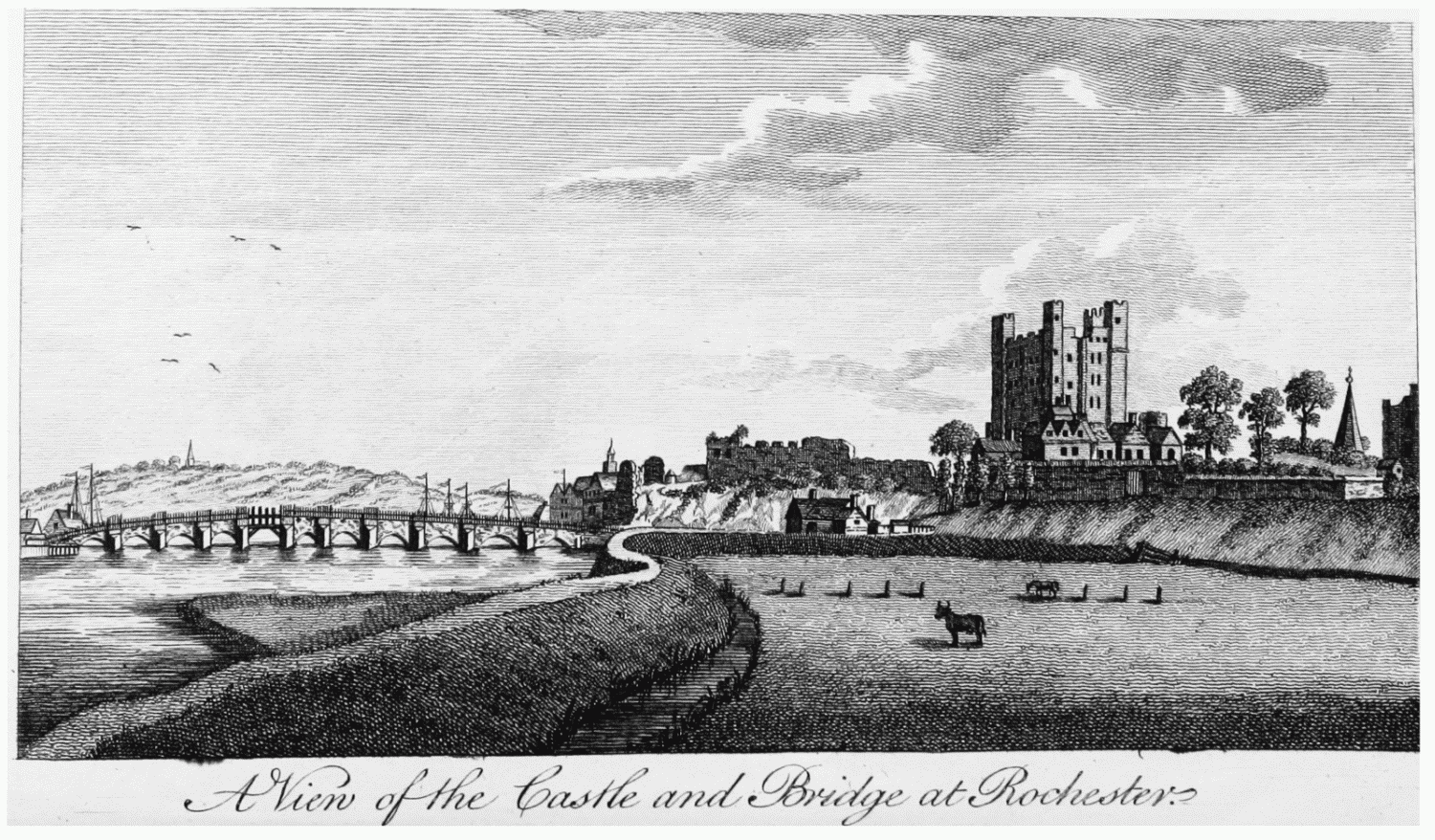
A view of the castle and bridge at Rochester
The castle, the church of St. Nicholas, and the cathedral with its precincts, stand close on the south side of it, beyond which St. Margaret's street extends still further southward, with the church at the further extremity of it. The high road from London to Dover leads through the High street, which has several large inns in it, for the accommodation of passengers, the traffic of the road here being extraordinary great, especially in the times of peace with France. The houses in it are in general well built, and are inhabited by people of wealth and condition, the whole of it having been greatly improved of late years, especially since the act passed in 1769, for new paving, lighting, and watching the city; all which has been some years since effectually carried into execution. The intercourse of the inhabitants with the royal dock, victualling office, navy, and other branches of the shipping, proves a continual source of wealth and employment to them, many of whom are induced to reside here on those accounts, and though there are no particular manufactures carried on here, makes it a very populous and busy town. There is an establishment of the customs here, as one of the out ports, under the direction of a collector, a deputy comptroller, surveyor, &c. and of the exciseoffice, under a supervisor, and other inferior assistants.
The town hall of this city stands on the north side of the High-street, and was first erected in the year 1687. It is a handsome brick structure, supported by coupled columns of stone of the Doric order. The under part of it is open to the street, and, as well as the room above it, is made use of by the judges, whenever the assizes are held at this city. In the upper room all public business respecting the government of this city is transacted, and the elections of members of parliament are made.
The city of Rochester bears for its arms, Or, a cross gules, with an R in the centre; on the chief of the second a lion passant guardant or.
Before the above mentioned building was erected, the antient Guildhall of the city stood on the same side of the High street, a little more to the eastward, on the spot where the present clock house was erected, and the clock given, at the sole charge of Sir Cloudsley Shovel, in 1706, and was given by him to the mayor and citizens for ever. A market is held weekly on Friday, for poultry, butter, pigs, earthenware, garden stuff, &c. on the area before the court hall of this city; and one on the same day for meat, in the shambles, built for that purpose within the clockhouse above mentioned; but this last is now almost deserted, the market of the neighbouring town of Chatham supplying the place of it. A writ of Ad quod damnum was executed on Thursday, June 10, 1787, in order to establish a market for the buying and selling of cattle on the fourth Tuesday in every month. Besides the fair held here by charter, on St. Dunstan's day (now on May 30) there is another held by prescription on St. Andrew's day, which now begins yearly on Dec. 11. On the first day of each fair, cattle is chiefly sold, and each fair continues for three days.
SOME ACCOUNT has already been given in the General History of this county of the first writs directed to the several sheriffs, for summoning the knights, burgesses, &c. to parliament. The first of these writs that has been found is of the 49th of king Henry III. and though there were several parliaments in king Edward I.'s time, before the 18th year of his reign, yet there is no testimony left upon record of any writ or summons to them till that year; in which, as may be seen by the writs directed to the sheriff, two or three knights were to be chosen for each county, but no citizens or burgesses are mentioned till the 23d of that reign.
The earliest return extant for the city of Rochester is in the 23d of king Edward I. anno 1289; from which time, to the 17th year of king Edward IV. they may be found among the bundles of writs, directed to the several sheriffs, remaining in the exchequer; but from that time to the 1st year of king Edward VI. all the writs, indentures, and returns are lost, except one imperfect bundle, No. 33. Henry VIII. in which Rochester is missing, as it is likewise in the 1st year of king Edward VI. but as the names of the several burgesses returned to parliament for this city before that time can afford but little gratification to the reader, they are therefore omitted here.
[Members of Parliament]
THE FOLLOWING IS A LIST OF THEM FROM THE SIXTH YEAR OF KING EDWARD VI.TO THE PRESENT TIME.
KING EDWARD VI.
| Years of the Reign, &c. | Names of the Citizens in Parliament. |
|---|---|
| 6th. Parliament at Westminster | JOHN NORTON, knt. |
| Christopher Roper. | |
QUEEN MARY.
| 1st. At Westminster | Thomas Moyle, knt. |
| Robert Dartnoll. | |
| 1st. At Oxford. | Thomas Moyle, knt. |
| William Roper, esq. | |
PHILIP AND MARY.
| 1st and 2d. At Westminster | William Roper, |
| Edward Bashe. | |
| 2d and 3d. At Westminster | George Howard, knt (fn. 22) |
| William Cobham, knt. | |
| 4th and 5th. At Westminster | Hugh Cartwright, |
| Thomas Page, esq. | |
QUEEN ELIZABETH.
| 1st. At Westminster | Edward Bashe, |
| Tho. Brooke alias Cobham | |
| 5th. At Westminster | Edward Bashe, esq. |
| Richard Watts, gent | |
| 13th. At Westminster | William Holstock, |
| George Catlyn, esqrs. | |
| 14th. At Westminster | George Catlyn, |
| William Partrige, esqrs. (fn. 23) | |
| 27th. At Westminster | Wm. Brook alias Cobham |
| George Bing, gents. | |
| 28th. At Westminster | William Brook, esq. |
| William Lewin, LL.D. | |
| 31st. At Westminster | John Stanhope, esq. |
| William Lewin, LL.D. | |
| 35th. At Westminster | George Chowne, esq. |
| William Lewin, LL.D. | |
| 39th. At Westminster | Edward Hobbye, |
| Tho. Walsingham, knts. | |
| 43rd. At Westminster | The same. |
KING JAMES I.
KING CHARLES I.
KING CHARLES II.
| 12th. At Westminster 1660 | John Marsham, |
| Peter Pett, esq. | |
| 13th. Ditto 1661 | Sir Francis Clerk, knt. |
| Sir William Batten, knt. (fn. 24) | |
| 31st. Ditto 1678 | Sir Richard Head, |
| Sir John Banks, barts. | |
| 31st. Ditto 1679 | Sir John Banks, bart. |
| Francis Barrel, esq. | |
| 32d. At Oxford 1681 | Sir John Banks, bart. |
| Sir Francis Clerk, knt. | |
KING JAMES II.
WILLIAM AND MARY.
| 1st. At Westminster 1688 | Sir John Banks, |
| Sir Roger Twisden, barts. | |
| 2d. Ditto 1690 | Sir Joseph Williamson, knt. |
| Francis Clerk, esq. (fn. 25) | |
| 7th. Ditto 1695 | Sir Joseph Williamson, |
| Sir Cloudesley Shovel, knts. | |
| 10th. Ditto 1698 | Sir Joseph Williamson, |
| SirCloudesley Shovel, knts. | |
| 12th. Ditto 1700 | The same. |
| 13th. Ditto 1701 | Francis Barrel, |
| William Bokenham, esqrs. | |
QUEEN ANNE.
| 1st. At Westminster 1702 | Edward Knatchbull, |
| William Cage, esqrs. | |
| 4th. Ditto 1705 | Sir Cloudesley Shovel, (fn. 26) |
| Sir Staffd. Fairborne, knts. | |
| 7th. Ditto 1708 | Sir Stafford Fairborne, |
| Sir John Leake, knts. | |
| 9th. Ditto 1710 | Sir John Leake, knt. |
| William Cage, esq. | |
| 12th. Ditto 1713 | The same. |
KING GEORGE I.
| 1st. At Westminster 1714 | Sir Thomas Palmer, bart. |
| Sir John Jennings, knt. | |
| 7th. Ditto 1722 | Sir Thomas Palmer, bart. (fn. 27) |
| Sir John Jennings, knt. | |
KING GEORGE II.
| 1st. At Westminster 1727 | Sir John Jennings, knt. |
| David Polhill, esq. | |
| 7th. Ditto 1734 | David Polhill, |
| Nicholas Haddock, esqrs. | |
| 14th. Ditto 1741 | Nicholas Haddock, (fn. 28) |
| Edward Vernon, esqrs. (fn. 29) | |
| 21st. Ditto 1747 | Sir Chaloner Ogle, (fn. 30) |
| David Polhill, esq. (fn. 31) | |
| 28th. Ditto 1754 | Hon. John Bing, (fn. 32) |
| Nicholas Haddock, esq. | |
KING GEORGE III.
| 1st. At Westminster 1761 | Hon. Tho. Parker, commonly called Lord Parker (fn. 33) |
| Isaac Townsend, esq. (fn. 34) | |
| 7th. Ditto 1768 | John Calcraft, (fn. 35) |
| William Gordon, esqrs. (fn. 36) | |
| 14th. Ditto 1774 | George Finch Hatton, |
| Robert Gregory, esqrs. | |
| 20th. Ditto 1780 | The same. |
| 24th. Ditto 1784 | Sir Cha. Middleton, bart. |
| Nathaniel Smith, esq. | |
| 30th. Ditto 1790 | George Best, esq. |
| Sir Rich. Bickerton, bart. (fn. 37) | |
| 36th. Ditto 1796 | Sir Richard King, bart. (fn. 38) |
| Hon. Henry Tufton. (fn. 39) | |
The number of freemen, who vote for members, is at present, about 630.
ROCHESTER, from its having been a station, situated at so important a passage over the Medway, might well be supposed to have been fortified by the Romans; the probabilty of this is strengthened by the Roman bricks still visible in several parts of the walls, and from the variety of Roman coins, from the time of Vespasian downwards, which have from time to time been found in the ruins of the castle. (fn. 40) In the time of the Saxon heptarchy this place continued a fortress of no small account; the whole city as well as the church, was then situated within the walls, and were together comprehended under the name of Castrum and Castellum Hroffceaster, by which the whole place was understood, and not any particular castle or tower in it; notwithstanding which, it seems probable, from the superiority as well as the convenience of the spot, where the present castle stands, that there was at the above time some strong keep or castle at no great distance from the scite of it, all fortified places having such a place of strength on some eminent place within them.
This castle was much damaged by the Danes, at the several times they besieged this city, as has been already mentioned; after which it seems to have lain a long time desolate and neglected, but William the Conqueror repaired it, and put it in a defensible condition, after which he garrisoned it with five hundred soldiers. (fn. 41)
Odo, bishop of Baieux, and earl of Kent, the Conqueror's half brother, had certainly the custody of the castle, and the rebuilding and enlarging of it afterwards was most probably entrusted to his care. The land, on which part of the new fortifications were raised, belonged to the bishop of Rochester, in lieu of which the king gave him in exchange land in the neighbouring parish of Aylesford, as it is thus entered in the record of Domesday, in the description of the king's antient demesne of Aylesford.
The bishop of Rochester also, for the exchange of land on which the castle is placed, possesses so much of this land (viz. of Aylesford) as is worth 17 shillings and 4 pence.
The castle is situated on an eminence adjoining the river Medway, just above Rochester bridge, at the south west angle of the walls of the city. It is nearly of a quadrangular form, having its sides parallel to the above walls. It is about three hundred feet square within the walls, which were seven feet in thickness, and twenty feet high above the present ground, with embrasures. Three sides of the castle were surrounded with a deep broad ditch, which is now nearly filled, up; on the outer side runs the Medway; in the angles and sides of the walls were several square towers, some of which are still remaining on the eastern side. What has been said above must be understood of the whole scite within the castle walls; for what is now usually called Rochester castle, is that noble quadrangular tower, which stands at the south east corner of it, and so lofty, as to be seen at several miles distance; a further account of which will be given.
Odo, bishop of Baieux, who had the custody of this castle, was an ambitious and turbulent prelate, insomuch that he aimed at nothing less than the popedom; but, as he was on the point of transporting himself and his treasures to Rome, for that purpose, his brother returned from Normandy unexpectedly, and surprized him just as he was setting sail, and sent him prisoner to the castle of Roan, in Normandy, where he continued the remaining four years of the Conqueror's reign, his castles and strong holds, as well as his lands and other effects being confiscated, and taken possession of by the king his brother. On the death of the Conqueror, in 1087, he was released from his imprisonment by William Rufus, and com ing over to England, though the king retained the greatest part of his estates, yet he confirmed him in the possession of his earldom of Kent, as well as in many of his former places of trust, among which was the castle of Rochester. But when Odo found he had not the whole sway and disposal of every thing, as formerly, he raised an insurrection in Kent, and having pillaged and destroyed many places in this county, he carried the whole of his plunder to Rochester, from whence he went to Pevensey castle, in Sussex, which he was forced, for want of food, to surrender up to the king, and to bind himself, among other conditions, to deliver up Rochester castle, where the chief of the Norman lords were shut up, under the command of Eustace earl of Bologne. For this purpose he was conducted hither, where he feigned to persuade the governor to deliver up the castle; but Eustace, guessing his meaning, detained him, and the soldiers who conducted him, prisoners; upon which the king, enraged at his deceit, immediately marched with his army to Rochester, having issued a proclamation, declaring every one a Niding (a nickname of reproach given to those who were guilty of the worst of crimes) who did not come to his assistance, by which means the people flocked to his army in great abundance; (fn. 42) and besieging it so vigorously, that those within were compelled to surrender it to him. He afterwards permitted them to depart the kingdom with the forfeiture of their estates, but Odo himself he sent prisoner to Tunbridge castle, and stripped him of all his honours; after which he abjured the realm for ever, and was permitted to go into Normandy.
This castle no doubt received considerable damage in this siege, and it seems as if bishop Gundulf and the prior of St. Andrew's had not been so strenuous in the support of the king's interest as he expected of them, at least he seems to have entertained suspicions of that nature, and under that pretence to have refused to confirm the grant of the manor of Hedenham to the church of Rochester, unless he had one hundred pounds in money given him for so doing, which the archbishop, as well as the bishop of Rochester utterly refused; upon which Robert Fitzhamon and Henry earl of Warwick, as mediators, proposed, that instead of that sum, bishop Gundulf, as he was well skilled in architecture and masonry, should build for the king a tower of stone at his own expence, within the castle of Rochester; which the prelate strenuously refused, lest the future repair and maintenance of it, at the king's pleasure, should fall on the church of Rochester, till after much persuasion and assurance of being freed from every kind of expence for the future, on that account bishop Gundulf consented, and expended sixty pounds, the stipulated sum, in erecting the great square tower above mentioned, called Gundulf's tower, but most commonly the Castle, which has proved a lasting monument of his same through succeeding ages. (fn. 43)
It is almost certain, as well from the largeness of this building, the few years that this bishop lived afterwards, and the smallness of the sum laid out by him, that he did not near finish the building of it. It is a quadrangular of upwards of seventy feet square at the base, the walls of which are twelve feet thick; adjoining to the east angle of this tower is a small one, about two thirds the height of the large tower, and twenty-eight feet square. There were in the large tower three stories of large and lofty apartments, and underneath a vault or dungeon for the safe keeping of the prisoners; and in the partition wall, in the center of the building, a well, two feet nine inches in diameter, neatly wrought in the walls, which well as cends through all the stories to the top of the tower, with each of which it has a communication. This great tower, with its embattlements, is about one hundred feet from the ground, and at each angle of it is another small tower, twelve feet square, and as many high, with floors and battlements above them. Considering how long this fabric has been neglected, there are few buildings perhaps so perfect; indeed the skill and ingenuity, and the nice contrivance of the architect, through every part of the building, both for conveniency and strength, must strike the eye, and gain the admiration of every one.
King Henry I. in his 27th year, granted, with the consent of his barons, to the church of Canterbury, and to William, archbishop of that see, and his successors, the custody and office of constable of the castle of Rochester for ever, with liberty for him and them to build a fort or tower therein, and that the knights, who were bound to the defence of the castle, should continue the same to him, (fn. 44) &c. In the next reign of king Stephen, the archbishop having sworn allegiance to the empress Matilda, this castle was taken possession of by the king's friends, and most probably William de Ipre, earl of Kent, had the custody; for when Robert earl of Gloucester, Henry I.'s natural son, was taken prisoner at Winchester, and was committed to the charge of that earl, he sent him a close prisoner to this fortress. It does not seem to have been afterwards restored to the see of Canterbury; for archbishop Becket upbraided Henry II. with unjustly detaining the custody of it from him, and thereby notoriously violating the privileges of his church; but the king turned a deaf ear to his complaints.
On the accession of king Henry, William de Ipre, with the rest of the Flemings, was banished the king dom, and Henry, son of king Henry II. who was crowned king in his father's life time, gave the earldom of Kent and the castle of Rochester to Philip earl of Flanders; but the young king dying before his father, the earl never took possession of either. (fn. 45)
King John, in his 3d year, is said to have restored this castle to Hubert, archbishop of Canterbury, with whom it continued till the 17th year of that reign, when the king, by his writ, required the archbishop to give up the custody of it to him, and it seems never afterwards to have returned to that see. Notwithstanding the archbishop's acquiescence in the king's demand of it, the discontented barons contrived to get possession of it, and committed it to the custody of William de Albini, a valiant and expert commander; upon which the king immediately marched thither, and having invested the castle, carried on the siege against it vigorously for the space of three months; when the governor and his assistants finding no hope of relief, and that the outward walls were thrown down, and their provisions exhausted, surrendered themselves at discretion. The next year Lewis, the French king's son, being invited over to the assistance of the barons, landed at Sandwich, and immediately marched with his army hither, and invested the castle, which having suffered so considerably the year before, was soon reduced.
In the 10th year of king Henry III. Hubert de Burgh, then sheriff of this county, was commanded to repair the buildings of this castle, then in the king's hands, and two years afterwards, being then earl of Kent, he was, for his eminent services to king John and king Henry III. by the advice of the peers, of the whole realm, made chief justice of England, and had a grant of the castle and port of Dover, with the revenues of the haven, and likewise of the castles of Rochester and Canterbury during life, with the fee of one thousand marcs per annum for the custody of them, to be paid out of the exchequer. But the king's favour towards him declining, he was in the 16th year of that reign displaced from his great office of chief justice, and from the custody of this castle, among others; in all which trusts he was succeeded by Stephen de Segrave, who was displaced from them in the 20th year of that reign; and John de Cobham was appointed constable of Rochester castle in his room.
In the 42d year of that reign, Nicholas de Moels, constable of Dover castle and warden of the cinque ports, was made sheriff of Kent and governor of the castles of Rochester and Canterbury; and in the 44th year of that reign, William de Say was appointed governor of them. (fn. 46) In the 45th year of it, Robert Waleran was made sheriff of Kent, and governor of the castles of Rochester and Canterbury.
In the year 1264, being the 49th of his reign, the king greatly increased the fortifications of Rochester castle, which he entrusted to Roger de Leyborne, as chief constable of it, who had with him John earl of Arundel, Henry Delamaine, John earl of Warren, and others; and it was furnished with men, arms, and provisions, necessary to sustain a siege. Shortly after which, Simon earl of Leicester, who was one of the principal confederate barons, marched with a large army into Kent, to besiege this castle, and on his arrival on the western banks of the Medway, found his passage overt he bridge disputed, and a pallisade and breastwork thrown up on the opposite side, well defended. On which, having sent Gilbert de Clare to attack the south side of the town, the earl himself attacked the bridge, but was twice repulsed by the citizens; at last, by the means of vessels filled with combustibles, he set fire to the bridge, and tower on it, which were both of wood, and in the hurry and confusion occasioned by it, passed the river, and attacked the besieged with such vigour, that he entered the city and spoiled the church, and what was left of the priory; for Roger de Leyburne had before burnt down all the suburbs, and part of the city towards Canterbury, as well as part of the priory. After which the earl made a furious assault on the castle, and became master of every part of it, excepting the great tower, which was so bravely defended by the constable and his associates, that after laying seven days close siege, when it was near being taken, the earl suddenly raised the siege, and returned to London. (fn. 47)
King Henry afterwards gave this castle to Guy de Rochford, a foreigner, one of his favorites, but on his banishment it reverted again to the crown, and the king in his 48th year gave the custody of it to William de St. Clere, who died in his office that year. In the 54th year of that reign Bertram de Criol was made governor of it.
In the 2d year of king Edward I. Robert de Hougham, lord of Hougham near Dover, died constable of this castle, and the year following Robert de Septvans had the custody of it. By the clause-rolls of the 1st year of which reign, it appears that there were two priests called the king's chaplains officiating in the chapel of the king's castle here, whose stipends were fifty shillings a year each, and the sheriff of Kent was commanded to pay them the arrears of the same. Sir John de Cobeham was constable of this castle in the middle of the above reign. In the 33d year of that reign, anno 1304, Stephen de Dene was constable of Rochester castle. He had great contentions with the monks, concerning the taxing several of their lands, which they alledged had never been taxed before, and on a trial in the exchequer, it was given for the monks, and he was displaced.
In the 3d year of king Edward III. anno 1328, William Skarlett was constable, and then distrained one Simon Sharstede for lands in Watringbury for castleguard. In the 18th year of that reign, Sir John de Cobeham, lord Cobham, was constable of the castle and city of Rochester. (fn. 48) In the 33d year of it, John, lord Grey, of Codnor, was made constable of the town and castle of Rochester for life, and John de Newtoun was constable of this castle anno 11, king Richard II.
In the 2d year of king Henry V. William Criol, or Keriel, as this name became now to be called, died governor of it; in which office he was afterwards succeeded by Sir Thomas Cobeham, who held it at his death in the 11th year of king Edward IV. who repaired the walls of this castle, and of the city, which seems to have been the last work that was done to them. In the next century the castle became of little importance, the greatest part of it was suffered to fall to ruin, in which state it remains at present. Some years ago the materials of the great tower, &c. were offered for sale, but the charge of separating and pulling down the stone work and the removing of it was judged to be so heavy an expence, that no one would undertake it on any terms.
The property, or fee simple of the castle of Rochester, after the reign of king Edward IV. rested among the manors of the crown, until king James I. in his 10th year granted it, with all the services belonging to it, to Sir Anthony Weldon, since which it has continued down in the same tract of ownership that Swanscombe manor has, to Robert Child, esq. who died July 28, 1782, and his widow, Mrs. Child, with the other trustees, under her husband's will, then became possessed of it, she afterwards married Francis, lord Ducie, and died in 1793; since which it has remained vested in the other trustees, under Mr. Child's will.
Many estates in this county, Surry and Essex, are held of the castle of Rochester by the tenure of Castleguard; of these the manor of Swanscombe is the principal, the owner of which, as well as the rest, holding their lands of this castle, had antiently the charge of it committed to them, and owed their particular services to the defence of it, called Castle-guard.
These services have been long since converted into annual rents of money, further particulars of which, as well as the list of the manors and lands, which are so held, may be seen under the description of the manor of Swanscombe.
Though there is not any mention made of A BRIDGE at Rochester till the reign of king Henry I. yet it is highly probable there was one here some length of time before, for Ernulfus, bishop of Rochester, who came to the see in the 16th year of that reign, and collected the records contained in the Textus Roffensis, has inserted, among them, several regulations for the repair of Rochester-bridge, and seemingly as antient customs in his days.
Lambarde in his perambulation has given us three extracts from MSS. concerning this bridge, one from an antient record in Christ-church, Canterbury, and the others in the Saxon and Latin tongues, from the Textus Roffensis, before mentioned.
These records do not very materially differ from each other, they contain a curious account of the bridge, the number of its piers, the materials with which it was built, and the method by which it was kept in constant repair. (fn. 49)
By them it appears, that this antient bridge was made of wood, and that it consisted of nine piers, which made ten intermediate spaces in the length of the bridge, and from one end to the other was about twenty-six rods and an half, equal to four hundred and thirty-one feet, which corresponds nearly to the present breadth of the river, where this bridge stood, in a direct line with the high-street of Rochester, and that of Stroud. And that towards the reparation and maintenance of it, different persons in respect of their manors, and lands in the adjacent neighbourhood were bound to bring certain materials, and to bestow both cost and labour in laying them, which duty grew either by tenure or custom, or perhaps by both, and it seems, that according to the quantity and proportion of the land to be charged, the materials found were either more or less. (fn. 50)
The owners of the manors and lands, chargeable with the repairs of this bridge, were used by antient custom to elect two men from among themselves to be wardens, or overseers of the repairs of it, at which time there was a wooden tower erected on the bridge, with strong gates, and it was probably near the east end of it, and was used as a fortification for the defence of this passage into the city.
The first mention of it in our English historians is in Stow's Annals, who writes, that when king John, in the 17th year of his reign, besieged and took Rochester-castle, he attempted to burn the bridge; but Robert Fitzwalter put out the fire, and saved it.
In the reign of king Henry III. it suffered much in consequence of the civil commotions between that king and his discontented barons, particularly in 1264, anno 29 Henry III. by Simon, earl of Leicester, as has been already fully mentioned before in the description of the castle.
In 1281 a sudden thaw swept several of the piers away, and considerably damaged the rest. In which state the bridge continued in 1292, when it was so broken, and out of repair, that people were obliged to go over in boats, and it seems to have lain much in the same condition in the 4th year of the next reign of king Edward II. when it appears by the records in the tower, that the king issued orders for the speedy repair of it, but this reparation seems to have been but slight; for Edward III. having made war with France, found the bridge in so weak a condition, as to make it unsafe for the passing of his army, and other necessary traffic. To remedy which, in the 17th year of his reign, he issued his writ, by virtue of which an inquisition was taken before the king's escheator, by the oaths of twelve men, who found that the bridge ought to be made good by the contributory lands, in their accustomed proportions.
In this enquiry there is mention made of a drawbridge, and a barbican, the work of which belonged to the king; they were both on the west side. It was also found that the master and wardens of Stroud hospital were to repair the bridge and wharf, from the drawbridge to the west end of it. (fn. 51)
Notwithstanding which care, after the taking of Calais in 1347, this wooden bridge being found continually subject to the want of repairs, as well on account of its being old and badly constructed, as from the depth of the river, and rapidity of the stream and tides, and being very unsafe for so considerable a traffic, as must necessarily pass over it, it was resolved, that a new bridge of stone should be built, and placed nearer the castle, where the tide would not run so strong. This is the present bridge, a noble and useful work, which appears to have been completed about the 15th year of king Richard II.
For that year Sir Robert Knolles, and Sir John de Cobham de Kent, petitioned the parliament, that the portions and repairs of the contributary lands should continue so, according to the proportions therein mentioned; and that they might yearly choose from among themselves, two wardens, as had been accustomed, who might receive and purchase lands and tenements to the yearly value of five hundred marcs, and to be impleaded, all which was granted, saving that they should purchase but to the value of three hundred marcs yearly, and it appears that the old bridge was then standing, though in a very ruinous state, the use of which whilst the other was building, might be one of the reasons why the place of its situation was changed.
And in the 21st year of that reign, it was enacted in parliament, that the bridge of Rochester, then newly better made in another place, and all such tenements as were accustomed to pay any rents or customs to the old bridge, should thenceforth pay them to the new bridge.
Sir Robert Knolles (who had acquired great riches in king Edward the IIId's wars in France, and had returned with wealth and honor) and Sir John de Cobham, are celebrated, as founders of this bridge, though the former is said to have principally contributed to the expence of it. At whosoever's cost it was, the donor could not certainly have performed a more public and useful service to his country.
In the above-mentioned petitions for the support of this new structure, which was considerably longer than the former, (the whole length being 566 feet) was set down very accurately in feet, inches, and quarters of inches, the proportion of the repairs belonging to each division, according to the former antient regulations of the lands contributory, for which proportion they are still liable to be called upon, if the lands proper, that is, the rents of the fee-simple estates belonging to the body corporate of the bridge, should prove insufficient.
The bridge, for height and strength, is allowed to be superior to any in England, excepting those at London and Westminster. It has a stone parapet on each side, strongly coped and surmounted with a railing of iron, and has now eleven arches, supported by strong and substantial piers, which are well secured on each with sterlings. The river has a considerable fall through these arches.
The present bridge is about forty yards nearer the castle than the old one, the foundation of which is still visible at low water, when the ground there, excepting in two narrow channels, is frequently dry.
King Richard II. by his writ under his privy seal, in his 22d year, confirmed all these privileges; and further granted, that the persons and landholders of the contributory lands, should be reputed a community by themselves, for the governance of it; and that they might always yearly chuse two persons, that were contributory, to be wardens of the said new bridge, and to keep, oversee, support and maintain the same from time to time in the name of the whole; and further, that as he had granted by his letters patent that the wardens alone might acquire lands, &c. to the value of two hundred pounds per annum, he willed, that the said grant might extend to the wardens and community, and their successors, as well by bequest of lands and tenements bequeathable, as by gift and feoffment of lands, &c. not bequeathable, to hold to them and their successors for ever, the statute of Mortmain, or his former grant notwithstanding; and that the wardens so chosen should be yearly accountable before two auditors, to be assigned by the community. And further, that if the wardens should implead or be impleaded by others, concerning any matters, belonging to the bridge, they should maintain all manner of writs by the name of the wardens, and although they should be removed from their office, nevertheless, the writs should stand good and effectual in law. All which was confirmed by statute in the 9th year of king Henry V.
In the reign of king Henry VI. little more than fifty years after the building of this bridge, it seems to have been much out of repair; for in the year 1446, the king, among other things which he granted to the city at that time, willed, that the citizens and their heirs should have the passage called the Ferry, below the city from the town of Stroud to it, the King's-bridge on the other side of the water being broken; and also the space of the bridge, together with the house called the Barbican. (fn. 52)
In this state Rochester-bridge seems to have continued till the reign of king Henry VII. in the 5th year of which reign, John Morton, archbishop of Canterbury, a man in every respect born for the good of his country, according to the mode of that time, published forty days remission of sins to all such persons as would contribute any thing towards the repair of it. This method seems to have answered his intentions, for the bridge was soon afterwards repaired and made passable, and in the next reign it was ornamented with a coping and iron railing; the former by the bounty of one John Warner, a merchant of Rochester, and the latter by archbishop Warham. (fn. 53) This munificent prelate lived to finish but one half of the iron work, and the succeeding times being turbulent, it remained in that state till the reign of queen Elizabeth, as will be mentioned hereafter.
The fee-simple estates, commonly called the lands proper, vested in the wardens and commonalty of Rochester-bridge, towards the repair and support of it, as they were in the reign of king Henry VIII. were the manors of Langgeden, Little Delce, beside Rochester, Tilbury and Greane, Nashenden, Dartford at Heathe, and of Sharnden in the Isle of Elmley, which was con firmed to the bridge by queen Elizabeth by letters of inst eximus, (fn. 54) and it appears from other printed books that they had vested in them for the like purpose lands and tenements in Frindsbury, in the Isle of Shepey, in Halstow, Hoo, Nashenden, Little Delce, Dartford, Sharynden and Nesse, in the Isle of Elmley, Great Delce in Rochester, at Eastwick and Spurt near Hoo and Greane, tenements in Rochester and in Cornhill, and a rent out of the hundred of Blengate, granted by the king.
It has been mentioned, that the bridge continued in a ruinous condition, notwithstanding the patronage of the archbishops Morton and Warham.
This misfortune had been increasing from the reign of king Henry VI. for the wardens, not being yearly elected by the commonalty, continued in office for many years together, in which time they let good leases to their friends and servants, for long terms, at old rents, notwithstanding they were greatly increased every where, as was the price of all materials-for building; so that the repair and expences of the bridge annually exceeded the income of it, nay these lands proper were so concealed, that very few knew that there were such, neither were the lands contributary to the repair of it ever called upon for that purpose. By this mismanagement, the bridge was so much out of repair, that its ruin seemed near at hand, notwithstanding a toll had been imposed on all passengers and carriages, towards its support, in the reigns of queen Mary and queen Elizabeth, and in the latter a fifteenth was gathered over the whole county, and yet the work decayed more and more.
When queen Elizabeth was at Rochester, in her return from a tour she had made round the counties of Sussex and Kent, in the 16th year of her reign, Sir William Cecil, secretary of state, afterwards lord Burleigh, took that opportunity of acquainting her with the ruinous state of this bridge.
Soon after which, the queen granted a commission to several great officers of state and nobility, as well as to several knights and gentlemen of this county, to examine into these defects, and the causes of them, and devise means for their remedy. In the execution of this commission, though the lord treasurer, the lord admiral, the lord warden, and others of the great nobility, gave their constant attendance and endeavours, yet the laborious part which Sir Roger Manwood, chief baron of the exchequer, took throughout the whole of it, deserves particular commendation, who passing through every difficulty, of which there were not a few, first got the leases of the lands proper, which had been fraudulently obtained, cancelled, and having thus improved the revenues, afterwards contrived a plan, with no small pains, for the perfect reformation and future conduct of both officers, and matters relating to it. And lastly, to perfect his scheme for its present and future preservation, he procured the statute of the 18th year of queen Elizabeth, for the perpetual maintenance of Rochester-bridge, in which it was enacted, that on the morrow after the general quarter-sessions for this county next after Easter (which day being found inconvenient, it was altered by parliament, in the 1st year of queen Anne, to Friday in the week next following the week of Easter) yearly, the wardens and commonalty of the lands contributory to the repair of the bridge, as many as conveniently might, should assemble at the castle of Rochester, and choose two persons of their commonalty to be wardens of the bridge, commonly resident, and housekeeping within the county, and twelve persons of their commonalty, to be assistants to the wardens for one year, after the first day of Pentecost next ensuing, and thus to assemble, and elect in the same place annually for ever. That every year on the Thursday in Whitsun-week, the two late wardens should have their accounts audited in the presence of one of the new wardens, at the least, and four of the assistants, and that no assistance should be demanded from the contributory lands, unless the new fund, or lands proper proved insufficient to defray the expence.
Nine years after which, the several lands proper being found inadequate to the necessary repairs of the bridge, and the wardens and assistants being doubtful of their sufficient authority to levy money on the contributory lands, an act passed for investing them with full power for that purpose, and to distrain in case of refusal; and for the more convenient assembling of the commonalty at the elections above-mentioned, it was further enacted that two householders at least, from every parish contributory within seven miles of Rochesterbridge, in which there were four householders, should be present at such elections, under penalty of ten shillings, and that the wardens, assistants, and inhabitants, should defray their own charges at such times.
That the business of the bridge may never be prejudiced by the want of attendance, the wardens and assistants are usually chosen one half of gentlemen who live in the adjacent country, and the other of the same in Chatham and Rochester. The latter meet weekly for this purpose at the Bridge-chamber, in the CrownInn yard, (where all the business relating to the bridge is transacted) but the former very seldom attend these meetings, though they are almost always present at the two annual meetings at Easter and Whitsuntide, to which matters of greater moment are deferred, at which times they inspect and deliberate on what has been and ought to be transacted at those weekly meetings in this intermediate time, and in future.
The improvements of the estates belonging to the bridge have been so great under the good management of the wardens and assistants, from the above time, that the bridge has not only been kept in excellent re pair, and greatly ornamented, without any further assistance from the contributory lands, but a fund has been accumulated against any sudden accident, or damage that might happen to the fabric. (fn. 55) The yearly value of the lands proper are now about 1000l. per annum. Within these thirty years the bridge was much disfigured by a temporary wooden bridge at the east end of it, where three of the stone arches had been broken, but these have since been rebuilt, and the coping, and iron work made equally handsome with the other parts of it. Both the entrances have been widened, and within these few years further improvements have been made to it at a very considerable expence, which renders it much more commodious and safe for the repassing of travellers than it was before.
At the east end, and fronting the passage over the bridge, was a CHAPEL or PERPETUAL CHANTRY, erected by Sir John de Cobham, one of the founders of the new bridge.
This chapel seems to have been finished soon after the bridge, and was called Allesolven chapel. By the foundation charter, three chaplains, to be appointed by the wardens of the bridge, were to officiate in it, particularly for the use of travellers, and to pray for the souls of the benefactors of the bridge, as well those living, as deceased, and especially for the souls of the lord John of Cobham, the founder and patron, and of Sir Robert Knolles, William Wangford, and Eleanor his wife, John Fremingham, and Alice his wife, William Makenade, Sir William Rykhull, then living, and for the souls of those deceased, viz. Sir William atte Pole, and Joane his wife, Nicholas Potyn, Constance, wife of Sir Robert Knolles, the lady Margaret, wife of Sir John de Cobham, before-mentioned, John Bukyng ham, formerly bishop of Lincoln, Sir William Waleworth, and all faithful people deceased.
They were to reside constantly in apartments contiguous to the chapel, and each of them was to receive an annual allowance of six pounds, at the hands of the wardens of the bridge, out of the revenues of it, who were to be at all expences of repairs, ornaments, utensils, and other matters whatsoever. (fn. 56)
But in the reign of king Henry VI. the revenues of the bridge were so diminished, that application was made to the king for his assistance, towards the maintenance of these chaplains, who, in his 20th year, granted to the wardens and their successors, the sum of one hundred shillings, which the convent and monastery of St. Augustine, near Canterbury, and their successors, used to pay yearly at the exchequer, from the ferm of the hundreds of Ryngleslowe, Dunhamford, and Blengate, in this county, to hold to them and their successors for ever.
What became of this chantry in the reigns of king Henry VIII. and king Edward VI. I have not learned, but in the year 1575, anno 18 queen Elizabeth, there was an arrear of five hundred pounds or more, depending in the court of exchequer, and probably due to the crown from the wardens and commonalty of the bridge, for the salary of the priests of this suppressed chantry. This suit Sir Roger Manwood brought to an issue, and the cause being tried at the assizes, and judgment given in the exchequer, it was for ever discharged.
On the ground where this chapel stood a very neat stone building was erected by the wardens of the bridge, in 1735. The upper part of this building is stiled the Bridge-chamber, in which, and an adjoining room over the Crown gateway, the wardens and assistants hold their weekly and annual meetings. On the front of this new building are the arms, carved in stone, of the principal benefactors to the bridge.
AN ACCOUNT of the river Medway has already been given in the General History of this county, it only remains therefore for some account to be given of THE OYSTER FISHERY on this river, carried on in the several creeks and branches of it within the liberties of this city, for the conducting of which there is a Company of Free-dredgermen established by prescription time out of mind, subject to the government and authority of the mayor and citizens.
But several persons contesting this authority, great inconveniences arose from it, and the fishery was much endangered by it; to prevent which, the corporation and free-dredgermen petitioned parliament for relief in the 2d year of king George II. when an act passed for the better ordering and governing this fishery; for making them secure under the protection of the mayor and citizens, and for confirming and settling their power and jurisdiction over that and the free dredgers belonging to it. By it the mayor and citizens have power once or oftener in every year to hold a court of admiralty, to which the dredgers are summoned, and a jury is appointed from among them, which has power to make rules and orders for the times, when the oystergrounds shall be opened (fn. 57) and shut, and the quantity of oysters which shall be taken on each day of dredging, and also for the preservation of the brood and spat of oysters, and for otherwise regulating the fishery, with power for the jury to impose fines for the breach of all such orders as shall have been approved and confirmed by the mayor and citizens, to whose use all fines are to be applied. Every person is free of this company, after having served an apprenticeship of seven years. Any person catching oysters in this river, not free of the fishery, is termed a cablebanger, and liable to such penalty as the mayor and citizens shall impose on him.
The company frequently buy brood, or spat, from other parts, which they lay down in the river, where it soon grows to maturity. Great quantities of these oysters are sent to London and Holland, and even to Westphalia, and the adjacent countries.