A History of the County of Hampshire: Volume 4. Originally published by Victoria County History, London, 1911.
This free content was digitised by double rekeying. All rights reserved.
'Parishes: Aldershot', in A History of the County of Hampshire: Volume 4, ed. William Page (London, 1911), British History Online https://www.british-history.ac.uk/vch/hants/vol4/pp2-5 [accessed 4 May 2025].
'Parishes: Aldershot', in A History of the County of Hampshire: Volume 4. Edited by William Page (London, 1911), British History Online, accessed May 4, 2025, https://www.british-history.ac.uk/vch/hants/vol4/pp2-5.
"Parishes: Aldershot". A History of the County of Hampshire: Volume 4. Ed. William Page (London, 1911), British History Online. Web. 4 May 2025. https://www.british-history.ac.uk/vch/hants/vol4/pp2-5.
In this section
ALDERSHOT
Alreschate (xiii cent.); Alreshute, Alreshete (xiv cent.); Aldershott, Haldershutt, Aldrisshott (xvi cent.); Aldershot (xvii cent).
Aldershot is situated 35 miles from London, and has stations on the London and South Western and South Eastern and Chatham railways. The parish covers an area of 4,177 acres. In the south the ground is low, but rises slightly towards the north, reaching at Greenham's Hill a height of 413 ft. above the ordnance datum. The River Blackwater forms the southern and eastern boundaries of the parish.
Previous to 1855 Aldershot was one of the most pleasant and picturesque hamlets in Hampshire, consisting of the church, the two important houses called Aldershot Manor and Aldershot Place, two or three farm-houses, and the village green. Mr. Hoyle relates that in 1725 the Bishop of Winchester issued a paper of twelve questions to the clergy of the diocese preparatory to his visitation. One of these questions was: 'About what number of Souls, according to the best information that you can reasonably get, do you suppose to be in your Parish?' The answer of James Forde, minister of Aldershot, to this question was, 'Six score and fifteen.' (fn. 1)
In 1854 the Government purchased three large tracts of land in Aldershot and the neighbourhood, and established a military camp on a very extensive scale, the camps proper being divided by the Basingstoke Canal into two portions, the North and South Camps, consisting of ranges of wooden huts in parallel lines. (fn. 2) In 1890 it was decided to replace the wooden huts by permanent brick structures, now known as the 'Wellington,' 'Stanhope,' and 'Marlborough' lines, which together accommodate over 20,000 men.
Consequent on the establishment of these camps, the village of Aldershot has now become a considerable town, with a population in 1901 of 30,974. (fn. 3)
Many modern conveniences have been added to the camp for the use of the officers and men, including an officers' club, opened in 1896, a library and readingroom, a theatre, and cricket, tennis, and polo grounds. The Church of England Soldiers' Institute in the North Camp, erected at a cost of £1,000, was opened in 1894. The Military or Cambridge Hospital, erected at a cost of over £45,000, stands on an eminence called 'Gun Hill,' near the South Camp, and overlooking the town, from which a gun is fired by electric current from Greenwich daily at 1 and 9.30 p.m. This hospital can accommodate 450 patients.
The Aldershot Cottage Hospital, in Church Lane, was opened in 1897, and has ten beds for patients.
The Ash Victoria Hall, erected to commemorate the Diamond Jubilee of her late Majesty Queen Victoria, was opened in 1898.
The colossal bronze equestrian statue of the Duke of Wellington, which stood since 1846 on the top of the arch at Hyde Park Corner, was taken down in 1883 and erected on a pedestal of red Corshill stone in the South Camp, Aldershot; the statue in its new position was unveiled 19 August 1885.
On the east side of the Long Valley, a large sandy waste used by the troops, stretching northward to the Basingstoke Canal, stands the Queen's Pavilion, which was erected for the use of Queen Victoria.
Aldershot Park, formerly called Aldershot Place, occupies the south of the parish. The house was built in the middle of the 19th century by Charles Barron the younger, who died on 25 September 1859. Some time afterwards the estate was sold to Mr. John Back, on whose death it was purchased by Mr. Charles D'Oridant, late proprietor of the Pavilion Hotel at Folkestone. From the latter it passed by purchase to the present owner, Miss Kennedy. A little farther north is Aldershot Manor, the residence of Mrs. Newcome, situated near the old parish church and churchyard of St. Michael. The Grange is the residence of Mr. William T. Robertson, J.P. Aldershot Lodge, which is at present unoccupied, was for some time the residence of Lieut.-Colonel Henry J. W. Jerome, R.E.
The town of Aldershot is now governed by an urban district council, under the provisions of the Local Government Act of 1894.
The area of Aldershot parish is chiefly covered by common and heath, but there are 321¼ acres of arable land, 600¼ acres of permanent grass, and 2 acres of woods and plantations. (fn. 4) The common fields of Aldershot were inclosed under an award of 6 May 1856. (fn. 5)
A fish pond exists in Aldershot Park estate, but is not mentioned in any of the known records.
In a fine of 1720 there is mention of a wood of 50 acres. (fn. 6)
In the Crondall Customary of 1567 the following place-names occur under Aldershot:—A grove of wood called 'The Home Grove,' a wood called 'Owles Holes,' and a close lying near 'Le Clarcke's Lane Ende,' a grove of wood called 'Rough Grove,' (fn. 7) a close called 'Pillebridge,' a parcel of heath called 'Hopcoxe,' a field called 'Gallowe Hill,' and a wood called 'Cranmore.'
Manors
The manor of Crondall, which was originally held by the Prior and convent of St. Swithun, and on the dissolution of the priory was granted to the newly-constituted Dean and chapter of Winchester, included land in Aldershot, and it still comprises part of that parish. (fn. 8)
The first recorded mention of the manor of ALDERSHOT is in 1537, in which year Thomas Saunders and Henry White, clerk, dealt with it by recovery. (fn. 9) In 1599 Robert White died seised of Aldershot Manor, (fn. 10) which, it seems probable, had been left to him by his father Sir John White of Aldershot, alderman of London, who died in 1573. (fn. 11) Robert left the manor to be divided between his two daughters, Ellen the wife of Richard Tichborne, and Mary the wife of Walter Tichborne, brother of Richard. (fn. 12) Ellen surrendered her moiety of the manor to her sister, who died seised of the whole in 1640, leaving as her heir her son Benjamin Tichborne. (fn. 13) Benjamin evidently died without issue before 1661, for by that year his brother Francis had succeeded to the manor. (fn. 14) Francis died in 1671, and his estates passed to his son White, who held them until his death, which occurred about 1701. (fn. 15) His heir was James Tichborne, who mortgaged Aldershot Manor to Samuel Johnson in 1712, (fn. 16) and to Sir Charles Vernon and George Vernon in 1720. (fn. 17)
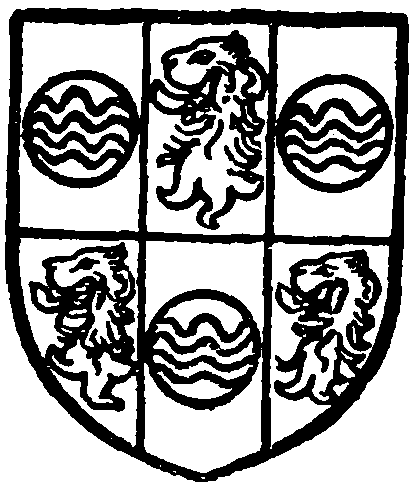
White. Six pieces azure and or with three roundels argent each having two waves vert upon it in the azure and three lions' heads razed gules in the or.
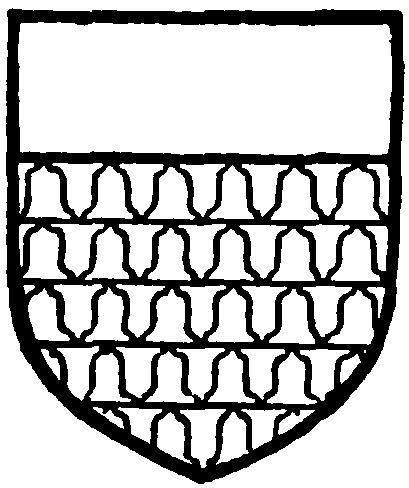
Tichborne. Vair a chief or.
It is uncertain to whom the manor passed on the death of James Tichborne, but in 1778 it was the seat of Godfrey Clarke, (fn. 18) and in 1787 was dealt with by fine between William Assheton and Francis Penyston, (fn. 19) the latter being again mentioned as the holder in 1816. (fn. 20)
It is again uncertain who was the next holder of Aldershot Manor, but the estate now bearing that name was purchased about 1847 from a Mr. Bridges by Captain George Newcome, who died in 1884, leaving the estate to his widow for life. On her death in 1888 the estate passed to Captain Newcome's nephew Major Henry George Newcome, who left it at his death in 1895 to his widow Mrs. Sibylla Caroline Newcome, the present holder. (fn. 21) The present house was built in 1670. Near it are traces of the foundations of an older building. (fn. 22)
Churches
The church of ST. MICHAEL AND ALL ANGELS consists of a chancel 23 ft. 9 in. by 16 ft. 4 in.; nave, 46 ft. 6 in. by 21 ft. 1 in., with a north aisle 18 ft. 2 in. wide, and a south porch and west tower 12 ft. 1 in. by 11 ft. 8 in. The only old parts of the church are the chancel, which seems to be of the 15th century, and is built of chalk and ironstone, with a slight northern inclination from the axis of the nave, and the tower. The nave and aisle are entirely modern. The east window of the chancel has three cinquefoiled lights of 15th-century style, in modern stonework, and in the north and south walls of the chancel are pairs of windows of 15th-century date, the eastern pair having two ogee trefoiled lights under a square head with pierced spandrels, and the western pair two plain trefoiled lights. They have all been much restored.
The chancel arch is modern, of 15th-century style, as is the north arcade of the nave, of four bays, with octagonal columns and moulded capitals. All the windows of the nave and aisle are also of 15th-century style.
The tower is in three stages, and appears to be entirely of 17th-century date, the two lower stages being of ironstone with red-brick quoins, and the top one of red brick, with an embattled parapet. There is a west doorway with plastered jambs and two-centred arch, and a modern two-light south window. The middle and top stage have two-light windows, with plain pointed heads.
All the internal fittings are modern, including the galleries at the west end of the nave and aisle. The font is octagonal with panelled bowl, and stands in the nave under the gallery.
On the north wall of the chancel is an alabaster monument to Dame Ellen Tichborne, 1606 (fn. 23), elder co-heir of Robert White, late of Aldershot, and first wife of Sir Richard Tichborne, second baronet, with a small kneeling figure set in a frame, above which are two shields, now blank, on strapwork panels.
On the opposite wall is another alabaster monu ment, to Mary, co-heir of Robert White of Aldershot and wife of Sir Walter Tichborne, knight. She died in 1640, and is represented kneeling in a small arched recess between her seven sons and six daughters. Above are three shields, the first bearing Tichborne arms, impaling White quartering: Ermine a cheveron sable cotised, with three martlets or on the cheveron. The second shield has the quartered coat of White, and the third is Tichborne quartered with the two coats borne by White.
There are three bells in the tower, of which the treble bears the lion's face, coin, and foliate stamp of the 15th-century group of bells coming from the Wokingham foundry; the second is by E. Knight of Reading, 1624, with an elaborate foliate band near the top. The tenor is inscribed: 'This bell was made 1611,' and has the maker's mark of three bells on a shield between the initials w. y., for William Yare of Reading.
The plate consists of a chalice of 1887, a paten of 1888, a flagon of 1841, and a pewter flagon.
There are six books of registers. The first, the original paper book, contains baptisms 1571–1719, with a gap from 1574 to 1592; burials, 1581 to 1719, and marriages, 1590–1719. The second contains baptisms, 1720–94; burials, 1718–96; and marriages, 1714–54. The third contains marriages only, 1754–1808; the fourth, baptisms 1796–1812; the fifth, burials 1796–1812; and the sixth, marriages, 1808–12.
The church of HOLY TRINITY consists of a chancel, a fair-sized nave with clearstory, north and south aisles, and north and west porches. It is constructed of brick with stone detail and facing, and is designed in an adaptation of 13th-century style. It was built in 1882.
Advowsons
From an early date Aldershot was a chapelry of Crondall, and was served from that church. The earliest known record of the chapel of Aldershot occurs during the episcopacy of William of Wykeham (fn. 24) (1367–98), but it is probable that one existed there long before that date.
It appears from the registers of Aldershot Church, which date from 1571, that the chapelry continued to be served from Crondall until 1828, when a perpetual curate was appointed, (fn. 25) the advowson remaining with the patrons of Crondall Church (q.v.).
In 1864, and again in 1868, endowments for the erection of a parsonage were granted out of the Common Fund, (fn. 26) and in 1873 there is the first record of the institution of a vicar. The living is at the present day of the annual value of £270, and is in the gift of the master and brethren of St. Cross Hospital, Winchester.
The church of St. Augustine, which was built at North Town in 1907 to the designs of Mr. T. G. Jackson, R.A., and the brick-built church of St. Aidan at the West End, which was dedicated in 1901, are mission churches served from the church of St. Michael.
Holy Trinity Church in Victoria Road was erected for a district formed in 1878 in the new part of the town. The living is a vicarage, in the gift of trustees. Holy Trinity iron mission church was erected in 1887.
The Roman Catholic Chapel of St. Joseph in Queen's Road is an iron building (1869) with 400 sittings. The English Presbyterian Church in Victoria Road was erected in 1862 at a cost of £5,000, and has 700 sittings. There is also a Wesleyan chapel in Grosvenor Road, erected in 1874; two Primitive Methodist chapels, one in Victoria Road and the other in Ash Road, a Baptist chapel in Upper Elms Road, Cargate, erected in 1883; and a Particular Baptist chapel in Victoria Road.
In the camps are All Saints' Church for the Wellington lines, St. George's Church for the Stanhope lines, the Marlborough Lines Church, and the Deepcut Barracks Church. In the South Camp is an iron church, seating 900, used by the Presbyterians; while in the North Camp a church of wood and iron, seating 1,000, is used both for Church of England services and those of other denominations, and has about 1,000 sittings. The Roman Catholic Church of St. Louis (1861) is in the North Camp, and that of St. Michael and St. Sebastian (1855) in the South Camp. The camps are also provided with a Wesleyan chapel, a Baptist chapel, and a Jewish synagogue.
The Franciscans have a convent and an orphanage for little boys in the parish.
Aldershot cemetery near Redan Hill was formed in 1860.
Charities
The Parish Clerk's Endowment formerly consisted of 9 acres of land with buildings thereon, known as Upper and Little Claversden, and 2 a. 2 r. 26 p., known as Clerk's Croft, in Church Lane, Aldershot. (fn. 27) The former was sold in 1900 for £5,000, and 2 a. 2 r. 26 p., part of the latter property, of the annual value of £20, was sold in 1903 for £1,800, a portion whereof was permanently invested in £666 13s. 4d. India 3 per cent. stock, with the Official Trustees, and the balance was by an order of the Charity Commissioners of 11 November 1904 authorized to be expended in defraying certain expenses incurred by the trustees in widening a road, making compensation to a tenant, and in defraying the cost of the erection of a parish hall on part of the charity property. The £5,000 above mentioned was invested in £5,263 3s. 2d. Middlesex County 3 per cent. stock in the name of the Official Trustees, who also held £158 0s. 9d. consols, representing a sum awarded in 1855 in lieu of common land taken by the Crown.
The charity is regulated by a scheme of the Charity Commissioners of 2 October 1900, whereby the annual income, amounting to about £180, is made applicable in the payment of £50 to £60 for the salary of the clerk, and the residue for the maintenance of the services of the church.
This parish is also possessed of 5 acres as a re creation ground acquired under the inclosure award of 1856, which is in part maintained by the dividends on a sum of £428 19s. 1d. consols, in the name of the Paymaster-General, arising from the sale in 1869 of an acre of land. Under the same award 2 a. 38 p., known as 'The Green,' was also allotted.
In 1863 Miss Isabella Schroeder, by will, bequeathed £1,000, the interest to be applied for the benefit of the poor, with a preference to poor widows. The legacy was invested in £1,107 18s. 6d. consols, which is standing in the names of the Rev. Henry James West and two others.
In 1875 Thomas Smith, by will proved on 23 December, left a sum, now represented by £151 14s. 8d. India 3 per cent. stock, the income to be applied in aid of the sick poor.
In 1888 Mrs. Harriet Sophia Newcome, by a codicil to her will, proved 20 November, left £300, income for the poor. The legacy, less duty, was invested in £274 16s. 2d. consols, which, together with the stock belonging to the preceding charity, is held by the Official Trustees.
These charities are administered together. In 1905 the income, amounting to £39. 12s., was applied as to £5 in providing flannel and necessaries for needy and sick poor, and the balance in distribution of coal to about 340 poor.
The Cottage Hospital.—Richard Eve, by will proved 28 August 1900, left £2,000, less duty, in augmentation of the maintenance fund. The sum of £1,800, with £200 from other moneys, was invested on a mortgage for £2,000 on the security of leasehold premises known as 63 and 65, High Street, at 4 per cent. per annum.