A History of the County of Hampshire: Volume 4. Originally published by Victoria County History, London, 1911.
This free content was digitised by double rekeying. All rights reserved.
'Parishes: Farnborough', in A History of the County of Hampshire: Volume 4, ed. William Page (London, 1911), British History Online https://www.british-history.ac.uk/vch/hants/vol4/pp15-18 [accessed 1 May 2025].
'Parishes: Farnborough', in A History of the County of Hampshire: Volume 4. Edited by William Page (London, 1911), British History Online, accessed May 1, 2025, https://www.british-history.ac.uk/vch/hants/vol4/pp15-18.
"Parishes: Farnborough". A History of the County of Hampshire: Volume 4. Ed. William Page (London, 1911), British History Online. Web. 1 May 2025. https://www.british-history.ac.uk/vch/hants/vol4/pp15-18.
In this section
FARNBOROUGH
Ferneberga (xi cent.); Farnburghe, Farenberg (xiii cent.); Farnborowe, Fremborough, Fameborough (xvi cent.).
Farnborough is distant 33 miles from London, and 2½ from Aldershot, and has two stations, one on the London and South Western Railway, and the other on the Reading and Reigate branch of the South Eastern Railway. The parish, which is a long narrow strip of land, covers an area of 2,330 acres, including 289½ acres of arable land, 515¼ acres of permanent grass, and 53 acres of woods and plantations. (fn. 1)
The River Blackwater forms the eastern boundary of the parish, which is separated from Aldershot parish by the Basingstoke Canal, the North Camp being in the parish of Farnborough. The ground is low, rising at its highest point to only 286 ft. above the ordnance datum.
The town, chief estates, and residences lie to the north, the southern portion being occupied by the North Camp and Farnborough Common.
The nucleus of the old village is what is now called Farnborough Street, near the South Eastern Railway station. There are still two old houses to be seen, which are the last survival of the old village, and at the cross roads is an old knotted elm, under which the villagers still gather at nightfall. (fn. 2) The road between Farnborough and Farnham is said to have been a resort of the famous highwayman Dick Turpin. (fn. 3) The last of the great prize-fights, that between Heenan and Sayers, took place at Farnborough.
During the past forty years the population of Farnborough has increased from 700 to 10,000. This is due to the formation of the North Camp and also to a public company which bought land in 1863 and developed the district for residential purposes. (fn. 4) Under the provisions of the Local Government Act of 1904 the parish is governed by an Urban District Council of twelve members.
The Town Hall, in the Alexandra Road, is a brick structure with Bath stone dressings, and was erected in 1897 at a cost of £5,000. There are Pine Therapeutic Baths in connexion with the Queen's Hotel.
Farnborough Hill, formerly the property of Mr. Thomas Longman, was purchased by the ex-Empress Eugenie in 1881. The mansion was built in 1860, and stands on a hill in a well-wooded park of 300 acres with gardens. It contains many treasures and relics of Napoleon I; a wing was added in 1883. The Roman Catholic Memorial Church of St. Michael, built by the Empress in 1887, and officially styled 'St. Michael's Abbey,' is served by Benedictines (of the Solesmes congregation), with an abbot, prior, sub-prior, and fifteen clergy. On the right of the altar at the east end of the mausoleum beneath the church is the coffin of the Emperor Napoleon III, on the left that of the Prince Imperial, on which is a tablet recording the death of the Prince 'On the field of honour,' 1 June 1879. Close to the church is a priory, with a covered way to the mausoleum, occupied by Benedictine Fathers from Solesmes.
The Grange, the seat of Mr. Harold Edward Sherwin Holt, present lord of Farnborough Manor, stands in a park, surrounded by an estate of about 400 acres, and was inherited by his mother, the late Mrs. M. Holt, from her uncle, Mr. Sherwin. (fn. 5)
Farnborough Park is the residence of Mr. Charles R. Lupton; and Tredenham Lodge of Colonel Tredenham Fitzherbert Carlyon. Lynchford, an estate of 150 acres, is the property of Mr. Henry William Brake. Synehurst Farm, in the north of the parish near the Surrey border, is called the manor of Synehurst in 16th-century records. It probably had its origin in the lands in Synehurst which Henry de Farnborough, lord of the manor of Farnborough, granted to Osbert de Burstowe in 1259 to hold of him and his heirs for rent of 3s. and suit at the court of Farnborough twice a year. (fn. 6) It was acquired by John Norton, lord of the manor of Farnborough, in the middle of the 16th century, (fn. 7) and was sold with that manor by the description of the 'messuage or farm called Sindhurst with appurtenances in Farnborough, and a parcel of moor called Sindhurst Moor in Frimley,' by his descendant Sir Richard Norton to John Godson and Edward Dickenson in 1619. (fn. 8)
Hillside Convent is a high-class ladies' boarding school, conducted by the nuns of the order of the Sacred Heart, with a lady superior in charge.
The following place-names are mentioned in 17th-century records:—A messuage and garden called Farthingland, and fields called Hookmeade and Windemill. (fn. 9)
Manor
In the Domesday Survey the manor of FARNBOROUGH is assessed at 3 hides of land which Odin de Windesores held of the bishop as of the manor of Crondall. Alwin had held them of the bishop in parage and could not betake himself anywhere.
In the time of Edward the Confessor the land had been and was still worth 60s., although when Odin received it its value had fallen to 40s. (fn. 10) The next mention of Farnborough occurs in 1230, when Simon, parson of Crondall, acknowledged Stephen de Farnborough to be the true patron of the church. (fn. 11)
Stephen was succeeded by his son Henry, who in 1243 was stated to be holding one knight's fee in Farnborough of the Bishop of Winchester. (fn. 12) Henry was still alive in 1284, (fn. 13) but by 1316 he had been succeeded in the possession of the estate by John de Farnborough, (fn. 14) who in 1335 paid 2s. to be released from attendance at the bishop's court of Farnham for a year. (fn. 15) John was followed by Amice de Farnborough, who was holding the manor in 1346. (fn. 16)
By 1353 Farnborough had come into the hands of John de Sherborne, (fn. 17) a London vintner, who soon fell so deeply into debt that his possessions were valued in 1356 and the manor assigned to one of his creditors, William de Briclesworth, for a debt of £100. (fn. 18) In 1428 Joan atte More (fn. 19) was holding one fee in Farnborough, formerly belonging to Amice de Farnborough, and on her death after 1461 (fn. 20) the estate passed to William Dawtrey, who was holding in 1487. (fn. 21) It seems probable that this William left four daughters and co-heirs, for at the beginning of the 16th century the manor is found divided into four parts, one-fourth being held by Ellis Thurwall and Joan his wife in 1502, (fn. 22) and another by Richard Reddysdale and Lucy his wife in 1505. (fn. 23)

Rotherfield. Azure a fesse wavy between three crescents or.
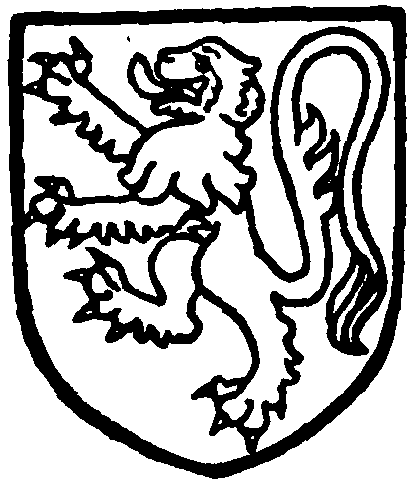
Norton. Vert a lion or.
In 1535 Richard Norton, who had married Elizabeth Rotherfield, daughter and heir of Sir William Rotherfield and Elizabeth Dawtrey, (fn. 24) died seised of a fourth, (fn. 25) and his son John evidently purchased the other threefourths, for he was seised of the whole manor at his death in 1561. (fn. 26) Sir Richard Norton, son of John, died in 1592, (fn. 27) leaving the manor of Farnborough to his son Richard, afterwards Sir Richard Norton. The latter died in 1611, leaving as his heir his son Richard, (fn. 28) who sold the manor in 1619 to John Godson of Odiham and Edward Dickenson of Odiham. (fn. 29) In 1630 John Godson held courts baron as lord of the manor of Farnborough. (fn. 30)
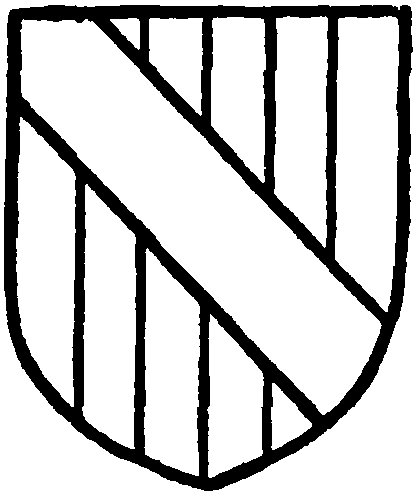
Annesley, Earl of Anglesey. Paly argent and azure a bend gules.
The manor and the house, then called Farnborough Place, seem to have come into the Annesley family, Earls of Anglesey, about the time of the Restoration, for in 1661 Arthur first Earl of Anglesey presented to the church. (fn. 31) In 1702 John Annesley, fourth Earl of Anglesey, dealt with the manor by recovery. (fn. 32) He died in 1710 and was succeeded by his brother Arthur, who died in 1737 also without issue, leaving his estates to Richard Annesley his kinsman, sixth Earl of Anglesey, (fn. 33) who held the manor in 1737, conveying it in that year by fine, possibly for a settlement, to Jack Hatton. (fn. 34) A few years later James Annesley, who was the son of Arthur the elder brother of Richard, laid claim to the succession. Having succeeded in establishing his legitimacy, he recovered the estates from his uncle in 1743, (fn. 35) and dealt with the manor of Farnborough by recovery in 1752. (fn. 36)
Farnborough Manor next came into the possession of Henry Wilmot, fourth son of Robert Wilmot. His son and successor Henry Wilmot was lord of the manor in 1778, (fn. 37) and was succeeded on his death in 1794 by his son Valentine Henry Wilmot, who conveyed the manor by fine to George Pindar in 1817, (fn. 38) and died in 1819, leaving an only daughter, Arabella Jane, afterwards the wife of the Rev. Frederick Sullivan of Kimpton.
It is uncertain who was the next holder, but from 1848 until his death in 1875 Mr. George Morant was lord of the manor of Farnborough. (fn. 39) In 1880 his trustees were lords of the manor, (fn. 40) and by 1885 it had been acquired by Mr. Richard Eve, (fn. 41) who died in 1900. The lordship of the manor was purchased from his executors about 1903 by Mrs. M. Holt, who died in 1905, leaving it to her son Mr. Harold Edward Sherwin Holt, the present owner. (fn. 42)
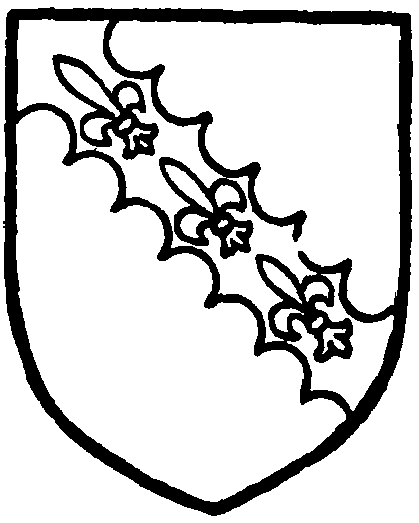
Holt of Farnborough. Argent a lend engrailed sable with three fleurs de lis argent thereon.
A mill worth 10d. existed at Farnborough at the time of the Domesday Survey. (fn. 43) A water-mill and a fishery are also mentioned in 1356, as worth nothing, (fn. 44) and fishings, windmills, and water-mills in Farnborough Manor are mentioned in the indenture of sale of 1619. (fn. 45)
Churches
The parish church, which is of unknown dedication, is situated in Farnborough Park, and consists of a chancel 21 ft. 5 in. by 16 ft. 10 in., a nave 70 ft. long and 23 ft. 11 in. at the east, reduced by about 8 in. west of the transepts, of which the north measures 10 ft. 11 in. by 13 ft. 7 in. and the south 16 ft. 9 in. by 13 ft. 9 in. There is a south aisle 9 ft. 4 in. wide, a west tower, and a north porch. The earliest parts of the church are the north and west walls of the nave, c. 1190–1200, and a south doorway of the same date is now in the wall of the new south aisle. The porch was added in the first half of the 15th century. Early in the 17th century a good deal of work appears to have been done, while the tower probably belongs to the same time. The chancel, transepts, and south aisle are entirely modern. The old work is built with chalk quoins and ashlar, and chalk and ironstone rubble, the modern work being faced with Heath stone.
The east window of the chancel is formed by three trefoiled lancets, while to north and south are, on either side, a single trefoiled light and a window of two trefoiled lights. The chancel arch is of one moulded order, carried on pairs of corbel shafts.
In the south transept are an east window of two uncusped lights and a flat-pointed south-east doorway of early 17th-century date, and the three north windows of the nave are of the same detail as that in the transept, but only the middle window is old. The north door, c. 1190–1200, is between the western pair of windows, and has a semicircular head of two orders, the outer moulded with a filleted roll, and the inner chamfered, with label enriched with dog-tooth. The outer order has shafted jambs, the shafts and bases being modern; but the capitals are old, that to the east being a development of the scallop type, while the other is a good example of transitional foliage. The abaci are square with a quirk and hollow chamfer. On the south is a modern arcade of four bays, that to the east being the south transept arch, separated from the rest of the arcade by a short length of walling. At the west end of the nave is the rear arch of a blocked mediaeval window, through which the west gallery is now entered, and a plain doorway to the tower.
The south aisle is completely modern and lighted by three windows of three uncusped four-centred lights. Towards the west is reset, blocked up, the old south doorway of the nave. It is of the same date as the north doorway, but of plainer detail, having a single chamfered order with a label enriched with billets.
The tower is a wooden structure on a masonry foundation. It is covered in with boarding rebated to represent ashlar joints, and is painted 'stone colour,' and finished with a short slated spire and a wooden cross. The framework, of rough-hewn timbers, is probably of early 17th-century date, the covering being much more modern. It has a plain entrance from the west under a porch, and over it a poor wooden Gothic window.
The porch is of open timber construction and 15th-century date, and on the whole very well preserved. It is of two bays, with five traceried openings in each bay on the north and south, with cinquefoiled ogee heads. The entrance has a flat pointed head with an embattled cornice over, and the plates are also embattled, and there is a pretty cusped barge-board.
The octagonal font is modern and of 15th-century design with a panelled bowl and shafted octagonal stem.
The chancel screen is of early 17th-century date, with poor modern cresting. The lower part is solid, and the upper has heavy turned balusters rather widely spaced, and a square-headed moulded opening in the middle. The head beam is ornamented with a pattern of alternate oblong and oval medallions, and the west gallery is of the same date, with similar ornaments on rail and base, and tall square-section balusters. It is supported upon tapering octagonal columns rounded beneath, with moulded bases. Inserted in the front of the balusters is a row of hat pegs. The seating, pulpit, and other fittings are all modern. The nave roof is old, possibly of 17th-century date, and was intended to be ceiled with a plaster barrel ceiling. The other roofs are modern.
On the north wall of the nave, west of the door, are some remains of wall-painting of a date nearly coeval with the earliest part of the church. The upper parts of three female saints are to be seen with their names in large letters, Eugenia, Agnes, and Maria, the last holding the ointment box and being clearly St. Mary Magdalene. The nimbus of St. Eugenia is ornamented with suns and moons, and that of St. Agnes with a lobed pattern like the petal of a flower. To the west at a higher level is part of an original consecration cross, in a circle of red and yellow. The cross has plain rectangular arms, but a second with expanded arms has been painted over it. In the centre is a hole, and there may have been another below the cross.
The tower contains five bells: the treble, second, and tenor cast by Llewellin and James of Bristol in 1887; the third by Knight, but dated 1633; and the fourth cast by William Eldridge in 1699.
The plate consists of a chalice and paten of 1880, which take the place of old plate then sold, a plated flagon given in 1848, and a plated cup and credence plate.
The first book of the registers contains baptisms from 1584 to 1678, marriages from 1599 to 1681, and burials from 1599 to 1675. The second book contains baptisms from 1682 to 1727, marriages from 1683 to 1726, with notes of licences, and burials from 1681 to 1751, with notes of affidavits of burial in woollen. The third contains baptisms and marriages from 1727 to 1783 and 1754 respectively, and burials from 1751 to 1783. Marriages are continued in a printed book from 1754 to 1786, and baptisms and burials in two more from 1785 to 1810, and from 1810 to 1812.
The church of ST. MARK consists of a chancel, north and south transepts, and a small nave with north and south aisles. It was built in 1881, is constructed of red brick with stone dressings, and is designed in 13th-century style. There is a small bell-gable containing one bell.
Advowsons
The first mention of a church at Farnborough occurs in 1230, when a dispute arose concerning tithes and oblations between Simon, parson of Crondall, and Stephen de Farnborough, a dispute which was ended by an acknowledgement on Simon's part that Stephen was the true patron of the church, and a promise that he would claim nothing in future but a pension of 5s. (fn. 46) The advowson evidently followed the descent of the manor (q.v.) (fn. 47) until about 1822, when Henry Wilmot was the patron. From 1829 to 1843 Mr. G. H. Sumner was the patron, and from 1844 to 1861 Mr. Henry Clayton. (fn. 48) By 1862 the advowson seems to have been acquired by Dr. William Scot, who presented the living to his fifth son, the Rev. Robert F. Scot. Dr. William Scot died the following year, and the advowson was held by the Rev. Robert F. Scot until his death in 1878, when it came into the hands of his elder brother, Major-General Patrick George Scot. (fn. 49) The latter died in 1894, and in 1902 it was sold by his representative to the Rev. William F. T. Hamilton, M.A., vicar of Cromer (co. Norf.), the present patron.
The patronage of St. Mark's Church, in the Alexandra Road, erected in 1881 as a chapel-of-case to the parish church, is in the gift of the Bishop of Winchester.
There are Roman Catholic, Wesleyan Methodist, Primitive Methodist, and Baptist chapels in Farnborough.
The Children's Home in the Alexandra Road was removed to Farnborough from Milton near Gravesend in 1898, and is intended for the reception of 100 boys who have not been convicted of crime.
Charities
The charities in this parish are administered under a scheme of the Charity Commissioners of 2 July 1901, under the title of the Poor's Charity; (1)The Fuel Allotment, comprised in an award dated 1 April 1816; and (2) the charity of William Parkes, founded by will in or about 1730. The trust estate consists of (1) £412 4s. 5d. consols in the High Court of Justice, King's Bench Division, arising from the sale in 1856 of land formerly constituting endowment (2) meadow land at Cove in Yateley, containing 4 a. 2 r. 22 p., and 1 a. of common, producing £8 10s a year, and a sum of £47 12s. 9d. consols, with the official trustees, stated to have arisen from sale of timber.
By the scheme the income of about £20 a year is directed to be applied for the benefit of deserving and necessitous persons of not less than sixty years of age in the supply of clothes, medical aid in sickness, or in temporary relief in money.