
A History of the County of Hampshire: Volume 4. Originally published by Victoria County History, London, 1911.
This free content was digitised by double rekeying. All rights reserved.
'Parishes: Rotherwick', in A History of the County of Hampshire: Volume 4, (London, 1911) pp. 99-101. British History Online https://www.british-history.ac.uk/vch/hants/vol4/pp99-101 [accessed 24 April 2024]
In this section
ROTHERWICK
Retherwic, Retherwyke, Rutherwyk (xiii cent.); Rotherwyke, Rytherwyke (xv cent.); Rotherwicke (xvi cent.).
The parish of Rotherwick covers an area of 1,988 acres, and is situated 7 miles north-east from Basingstoke. The River Whitewater forms part of its eastern boundary, while in the west it is intersected by the Lyde River, which flows into the Loddon at the north-western extremity of the parish. The country is well wooded and fairly level, the greatest height recorded being in Tylney Park—300 ft. above the ordnance datum. The village lies along Cowfold Lane, which branches off from the main road from Odiham to Reading in the north-east of the parish, and is situated about 2½ miles north-west from Hook Station on the main line of the London and SouthWestern Railway. Tylney Park takes up the southwest of the parish, its western boundary being formed by the Lyde River. Tylney Hall, which was rebuilt in 1879 close to the site of the old hall, was considerably enlarged and altered by Mr. Lionel Phillips between 1899 and 1901. It stands on a hill overlooking the village, and is approached by a long avenue of trees. According to the Agricultural Returns for 1905 the parish contains 913¼ acres of arable land, 893¾ acres of permanent grass, and 508½ acres of woods and plantations. The soil is clay mixed with sand and gravel, and the subsoil is clay. The chief crops are a succession of grain. Bricks and tiles are made in the parish. Amongst the place-names occurring in various records are:—Larugmedes, La Lude (fn. 1) (xiii cent.); Bowmeade, (fn. 2) Rooke's Farm (fn. 3) (xvi cent.); Chawcrofts, (fn. 4) and The Pewkes (fn. 5) (xvii cent.). The present Cowfold and Hook Farms suggest the ancient residences of Richard atte Coufolde and Thomas atte Hooke.
Manor
ROTHERWICK was probably comprised in the royal manor of Odiham at the time of the Domesday Survey. Part of it was apparently included in the grant by Henry II to Juliana de Aquila of the manor of Greywell (q.v.), which up to this time had also formed part of Odiham. Thus the manor of Rotherwick was stated in 1422 to be held of the Duchess of York, (fn. 6) who was at that time lady of Greywell. Again, at a somewhat later date, the L'Estranges, who were lords of Greywell, were returned as the overlords of Rotherwick. (fn. 7) Further, in 1590 William Haydok of Greywell sold to Richard More, lord of Rotherwick, ' all his woodgrounds, underwoods, and waste called Rotherwick Wood, and all his other wastes in Rotherwick and Hartley Wespall containing 500 acres, and all his free and customary rents of the same, services, heriots, etc.,—which descended to the said William Haydok as son and heir of James Haydok, deceased.' (fn. 8)
Between 1333 and 1345, Adam Orlton, Bishop of Winchester, granted permission to John atte Hooke (fn. 9) to have divine service celebrated in the manor of Rotherwick within the parish of Odiham. (fn. 10) In 1336 there was a settlement of a messuage, 70 acres of land, 4 acres of meadow, 4 acres of wood, and 20s. rent in Rotherwick and Hartley Wespall upon this same John, who is described in the fine as ' son of Hugh atte Hooke of Berkeley,' (fn. 11) and some forty-three years later Alice the relict of Hugh released all her lands and rents in Berkeley and Rotherwick to her son John. (fn. 12) In 1387, Katharine wife of Sir John de Thorpe died seised of apparently the same estate, (fn. 13) which then passed to Sir Maurice Berkeley, her son by a previous marriage. (fn. 14) Sir Maurice made a grant of his holding for life to Thomas Wyke, who died seised in 1420, when it reverted to Sir Maurice Berkeley, the son of the grantor. (fn. 15) Sir Maurice was seised at his death in 1464 of one messuage, one carucate of land, and 9s. rent in Rotherwick, held of Lord L'Estrange, (fn. 16) and he was succeeded therein by his son William. The estate seems to have passed soon after into the family of More, (fn. 17) Richard More dying seised of 2 messuages, 100 acres of land, 40 acres of pasture, 20 acres of meadow, 20 acres of wood, and 4s. rent in Rotherwick, held of Lord L'Estrange in 1495. (fn. 18) From this date the Mores continued in possession for about a century and a half, and there is evidence that from time to time they added to their estate, (fn. 19) ultimately dignifying it by the name of the manor of Rotherwick. At length in 1629 Richard More, the then owner, sold the manor of Rotherwick to Richard Tylney, (fn. 20) who was already possessed of property in the parish. (fn. 21) Frederick Tylney, descendant of this Richard, built a great mansion called Tylney Hall on his estate in 1700. (fn. 22) Frederick on his death in 1725 was succeeded by his only daughter Anne, who married William, Lord Craven. On the death of Anne in 1730, her only daughter having predeceased her, the manor passed to her cousin Dorothy, the wife of Richard Child, Viscount Castlemaine. (fn. 23) On his wife's succession to her inheritance Richard Child assumed the name of Tylney, and in 1731 was created Earl Tylney. (fn. 24) When he died in 1749 the estate passed to his son John, Earl Tylney. The latter died unmarried in 1784, and thereupon all his honours became extinct. His nephew, Sir James Tylney-Long, bart., succeeded to the property, and his son after him. (fn. 25) The latter dying in 1805 at the age of eleven years, Tylney Hall passed to his sister and co-heir, Catherine TylneyLong, (fn. 26) who dealt with it by recovery in 1810. (fn. 27) Two years later she married William Wellesley-Pole, nephew of Richard Wellesley, second Earl of Mornington, who by royal licence, 14 January 1812, took the additional surname of Tylney-Long between those of Pole and Wellesley. (fn. 28) The.latter, who succeeded his father in the earldom in 1845, died in 1857. (fn. 29) His trustees sold the estate about 1870 to Mr. C. E. Harris, from whom it passed by sale to the present owner, Mr. Lionel Phillips, in 1899.
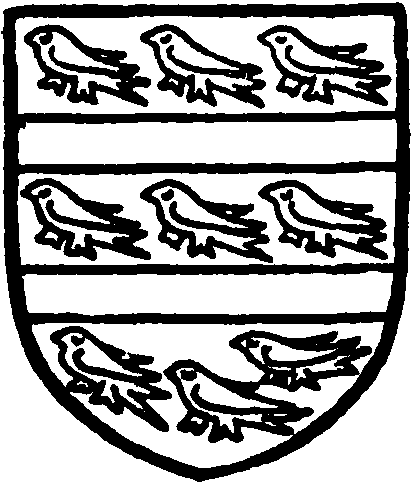
More of Rotherwick. Argent two bars vert letween nine martlets gules.
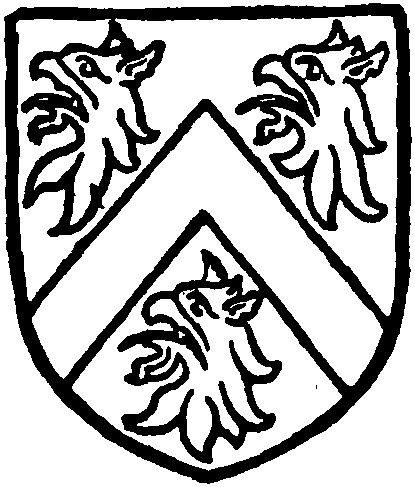
Tylney. Argent a cheveron between three griffons' heads razed gules.
Another estate in Rotherwick, (fn. 30) originally also part of Odiham, was in the 14th century held of the king as of Windsor Castle by suit at Odiham Hundred Court. Richard atte Coufold died seised in 1361, (fn. 31) leaving as his co-heirs his three daughters Edith, Margaret, and Isabel, who married respectively Nicholas atte Broke, William Gregory, and John Helwys. Isabel and Margaret gave up their portions to Nicholas atte Broke and Edith in 1382 and 1383, (fn. 32) respectively. Nicholas at his death in 1396 was seised of a messuage, 2 gardens and a dovecote, 60 acres of land, 12 acres of wood, and 5s. 6d. rent in Rotherwick; his son and heir was John, aged seventeen. (fn. 33) The further history of this holding has not been traced, but it probably became absorbed in the More estate in the 16th century.
Church
The church, the dedication of which is unknown, consists of a chancel 22ft. 4in. by 15 ft. 3m., with a vestry and organ chamber on the north, a nave 52 ft. by 21 ft. 9 in. with a short north aisle 20 ft. 9 in. by lift. 1 in., and a west tower 12 ft. 1 in. square. There is also a timber south porch. All the above dimensions are internal.
The oldest part of the building is the chancel, which is of flint and stone and dates from the latter part of the 13th century and is set with a slight northward inclination from the axis of the nave. The nave was a timber-built structure of 15th-century date with herringbone brick filling, like Mattingley; but in the 16th century was built round with brickfaced walls, and its main timbers cut away, the roof and east and west gables being the only parts now remaining. In the 17th century a red brick west tower was added; the north aisle dates from 1876, and the porch and vestry are modern, and there are many other modern repairs.
The east window of the chancel has three lancet lights under a two-centred arch with moulded label and carved head stops. The centre light is higher than the others, and the spandrels are not pierced. Only a few of the jamb and mullion stones and part of one of the heads are old, of late 13th-century date. The two windows in the south wall of the chancel each consist of a single trefoiled ogee-headed lancet. The inner splays and chamfered rear arches are old, belonging to the first half of the 14th century. Between these two windows is a modern doorway with chamfered jambs and two-centred head. The archway into the vestry on the north side of the chancel is modern and has chamfered jambs and drop arch of two chamfered orders.
The two east windows of the vestry are similar to those of the south wall of the chancel, but one of them is modern and the other is of old stonework retooled, having been formerly in the north wall of the chancel. In the north wall is a modern doorway and a window of two trefoiled ogee-headed lights.
The vestry opens to the north aisle by an arch now filled with the organ. There is no chancel arch, its place being taken by a wooden lintel with modern carved bracket supports. Above the lintel the original gable remains, with vertical timbers filled in with herringbone brickwork.
The arcade opening to the north aisle is of two bays with an octagonal column with moulded base and capital and chamfered responds. The arches are twocentred of two chamfered orders.
The aisle has two modern north windows of two traccried lights each, and under the easternmost is a square-headed doorway.
The eastern window in the south wall of the nave is of 16th-century date and has four cinquefoiled lights under a square head with a modern label and sill. The other south window and the only north window of the nave are modern copies of this and have the same number of lights. About the middle of the north wall of the nave is a blocked doorway, but it can only be seen through one of the wall gratings connected with the heating apparatus.
The south doorway between the two windows is modern and has cement jambs and a four-centred head. At the east end of the south wall of the nave is a small projecting turret which originally contained the stair to the rood-loft; the positions of the steps are now marked by stones in the walls. The turret is now open to the nave, and is spanned by a modern arch; externally it is brick-faced like the rest, and lighted by a narrow modern trefoiled window.
The west doorway of the nave has a semicircular head and a wooden frame. At each side of the doorway is a post supporting a large lintel, part of the framing of the wooden nave. Between the posts are bracket supports. The gable above the lintel is of half-timber work similar to that at the east end, and filled with roughly laid brick, evidently not meant to show. Some of the bricks are moulded for use in cornices or strings.
The west doorway in the tower has a three-centred brick arch and a moulded square-headed wood frame of 17th-century date with an old studded oak door.
Above this is a three-light window with brick mullions, jambs, and three-centred arch.
The tower is of three stages with an embattled parapet. In each side of the top stage is a two-light window with a wood frame. In the west face there is a small single light in the middle stage.
The roof of the chancel is of modern open timberwork, but that of the nave of 15th-century date, of five bays with braces forming four-centred arches beneath the principals and continued upwards as curved struts, two purlins a side with arched wind braces, and a well moulded plate. The main posts are cut away a foot below the plate level.
A simple but good modern screen is set across the opening to the chancel, and in the nave are a number of plain seats with roll-moulded tops, which may be as old as the nave, some of the backs being made of very large planks.
The font has a plain cylindrical bowl on a modern base, and may be as early as the 12th century; it stands close to the south door of the nave.
In the north aisle is a large marble monument of white and grey marble with a pediment carried by Ionic columns, to Frederick Tylney of Tylney Hall, who died in 1725. The monument was erected by his widow Anne, daughter of George Pitt of Stratfield Saye; and a shield of their parted arms commemorates this marriage.
In the north wall of the chancel is a pretty little monument to Anthony More, son of Thomas More of Lancelevey in Sherfield Loddon. The date is almost obliterated, but is perhaps 1583, the last figure only being certain. Above, in a curved pediment, are his arms of the bars and martlets.
On the floor of chancel and sanctuary are several 17th and 18th-century slabs to the Tylney family, the oldest being to 'Richardus Tylney, Armiger,' who died in 1646. This has a shield of Tylney impaling Haydok.
The tower contains five bells, the first being inscribed 'Love God 1630,' and the second 'Fear God 1630,' the letters of both being reversed. The third is a pre-Reformation bell inscribed.
Hac in Conclave Gabrielis nc Page Svave (sic)
a small crown being used as a sign of abbreviation, with a cross of four fleurs de lis between the first and last words. The fourth bell bears the black letter inscription, 'Our hope is in the Lord 1607 r. e.' The fifth is inscribed, ' Sancte Johannes ora pro nobis' in black letter, the initials being crowned. It bears the Reading marks, a lion's face, a cross and a groat, and is of 15th-century date.
The plate consists of a silver chalice, paten cover and flagon of 1568, 16l4, and 1776 respectively, the latter being given by Sir J. Harris in 1875; and a pewter almsdish.
There are six books of registers, the first containing baptisms, marriages, and burials from 1569 to 1630, the second the same from 1630 to 1727, and the third continues them from 1728 to 1754. The fourth book is the printed marriage form with entries from 1754 to 1802, the fifth contains baptisms and burials from 1756 to 1812, and the sixth marriages from 1802 to 1812.
Advowson
Rotherwick was a chapelry dependent on Odiham until 1867, when by order in Council the benefice was declared a rectory in the gift of the Bishop of Winchester. (fn. 34)
In the latter half of the 14th century the parishioners received a warning from the bishop to attend the parish church, and not the manorial chapel, on Sundays and holy days. (fn. 35)
Charities
An annuity of £2 11s. 9d. was formerly applied in the distribution of calico to the poor, supposed to be charged on some moorland and houses.
A sum of 5s. a year known as Poor's Money has also ceased to be paid.
The school, originally erected in 1713 by Frederick Tylney, and endowed by him with£10 a year, was rebuilt in 1872, and has in recent years been considerably enlarged.