A History of the County of Hampshire: Volume 4. Originally published by Victoria County History, London, 1911.
This free content was digitised by double rekeying. All rights reserved.
'Parishes: Sherfield-upon-Loddon', in A History of the County of Hampshire: Volume 4, ed. William Page (London, 1911), British History Online https://www.british-history.ac.uk/vch/hants/vol4/pp103-108 [accessed 30 April 2025].
'Parishes: Sherfield-upon-Loddon', in A History of the County of Hampshire: Volume 4. Edited by William Page (London, 1911), British History Online, accessed April 30, 2025, https://www.british-history.ac.uk/vch/hants/vol4/pp103-108.
"Parishes: Sherfield-upon-Loddon". A History of the County of Hampshire: Volume 4. Ed. William Page (London, 1911), British History Online. Web. 30 April 2025. https://www.british-history.ac.uk/vch/hants/vol4/pp103-108.
In this section
SHERFIELD UPON LODDON
Sirefelda (xii cent.); Shirefeld, Schirefelde, Scirefeld, Shyrefeud, Shyrefeld Werblynton (xiii cent.); Shirfeld on Lodon (xv cent.).
Sherfield upon Loddon is a large parish situated four miles north-east from Basingstoke station on the London and South Western main line to Southampton. The Reading and Basingstoke branch of the Great Western Railway passes near the western boundary, the nearest station on that line being at Bramley The boundaries of the parish are, roughly, the River Loddon on the east; Petty's Brook, a tributary of the Loddon, on the south; Bow Brook, another tributary of the Loddon, on the north; and the Reading and Basingstoke branch of the Great Western Railway on the west. The parish has an area of 2,324 acres of land and 13 acres of land covered by water. Bounded as it is by rivers, the parish is lowlying, the greatest height recorded being 272 ft. above the ordnance datum at Sherfield Hill in the southwest.
The village lies along the main road from Reading to Basingstoke, which enters the parish at Long Bridge over the Loddon and intersects it from northeast to south-west. Wildmoor Lane branches off from this road at Church End, and skirting the park at St. Leonards, leads to the district called Wildmoor, which consists of several isolated farm-houses. The name of one of these, Great Marshall's Farm, is probably connected with the tenure by which the manor was held. At Wildmoor, which was formerly in the hundred of Basingstoke, (fn. 1) lay the meadow land belonging to the manor of Basingstoke. (fn. 2) It was in the charge of a mower or keeper, who was elected at the court of the manor of Basingstoke. (fn. 3) The fishing in the water at Wildmoor seems to have been strictly preserved. (fn. 4) After passing through Wildmoor, Wildmoor Lane trends north and north-west, rejoining the Reading and Basingstoke road south of Wheler's Court. This house was the capital messuage of the Wheler estate in the parish, and to it the manorial rights of Sherfield are now annexed. There the courts leet for the manor were held. The house, which was of Caroline date, was pulled down and rebuilt a few years ago by Mr. James B. Taylor. (fn. 5)
Archer Lodge, (fn. 6) at one time the residence of Mr. Paynton Pigott Stainsby Conant, was pulled down by Mr. John Bramston Stane, who erected a handsome new house, called Buckfield, in the middle of a wood of that name. Mr. Charles Lethbridge added to this house and changed its name in the early part of 1880 to Sherfield Manor. (fn. 7) The present Sherfield Manor, which was entirely rebuilt by Mr. J. B. Taylor in 1898, stands in a park of about 250 acres to the east of the Basingstoke road. Mr. Taylor purchased the estate in 1896, increased the park and laid out extensive grounds and gardens. On the opposite side of the road are St. Leonards' Church and the old manor-house of Sherfield Court, now used as a farmhouse. Behind it is one of the finest moats in the county, within which the original house stood. (fn. 8)
Farther south, standing in a small park, is St. Leonards, which was built as a rectory-house. It, with the glebe land, was bought about 1874–5 by the late Rev. Alfred Gresley Barker, who resided there and provided another house in the village to serve as a rectory. To this estate Mr. Barker added some of the adjoining land of Mr. Henry Lannoy-Hunter of Beech Hill. (fn. 9) St. Leonards was purchased about two years ago by Mr. Eustace Palmer, who changed its name to Drayton House. Near it is Sherfield Hall, formerly known as Hill House, and Sherfield Hill Park. This estate, formerly a farm homestead, was purchased of Mr. Henry Lannoy-Hunter by Baron Pigott, fourth son of Mr. Paynton Pigott Stainsby Conant of Archer Lodge. Moulshay Farm and other farm lands were added to it, and the whole was sold on the baron's death in 1899 to Mrs. Trevor Goff, who added to the house and changed its name to Sherfield Hall. (fn. 10) The house was built by Baron Pigott, and was rented by Major George Frederick Downing Fullerton until August 1909. It is now occupied by Mrs. Goff.
At Lancelevy Farm, to the east of Sherfield, are the remains of a moat. This farm is now included in the Sherfield Manor estate. (fn. 11) The house formerly stood within the moat, but was rebuilt in its present position about two hundred years ago. The house is of the Queen Anne description, and takes its name from the Warwickshire family of Launcelevy. The estate, which is sometimes called a 'manor,' belonged during the 17th century to the family of Palmes, (fn. 12) and the house was once occupied by Sir Francis Palmes, whose daughter Anne married Sir Hampden Paulet. Sir Francis married Mary the eldest daughter of Stephen Hadnall, (fn. 13) a Privy Councillor of Queen Mary, who acquired land in Sherfield in 1578 from Richard More. (fn. 14) The Mores had been in possession of land in Sherfield, apparently the Lancelevy estate, in 1496 and before. (fn. 15) There is another imperfect moat at Breach Farm, but the house is quite modern.
There are no large tracts of woodland in the parish, but there are numerous small copses. The proportion of arable, grass, and woodland in 1905 was 1,057 acres of arable land, 928½ acres of permanent grass, and 182½ acres of woodland. (fn. 16) The soil is mixed, and the subsoil gravel and clay. The gravel was, and is still to a small extent, worked in the district. The chief crops are wheat, oats, and beans.
Thirteenth-century place-names which occur in connexion with Sherfield are la Breche, la Wyldemore. (fn. 17) Sixteenth and 17th-century place-names are Marschall, Lamboll, Dealand, Little Kendall, and Downes Land. (fn. 18)
In 1543 it was ordained at a meeting of the Privy Council that John More was to remove a bridge which he had recently erected over the River Loddon between Sherfield and Hartley. (fn. 19)
Manor
The manor of SHERFIELD UPON LODDON is not mentioned under that name in the Domesday Survey, as it formed at that time part of the royal manor of Odiham. (fn. 20) It remained in the Crown till the reign of Henry II, by whom it was granted, before 1167–8, (fn. 21) to his marshal William Fitz Aldelin on his marriage with Juliane daughter of Robert Dorsnell. (fn. 22) William held the manor by the serjeanty of being the king's marshal. (fn. 23) The manor was said to be held in 1317 in free socage for suit at Odiham Hundred, (fn. 24) and in 1332 for the service of carrying the marshal's wand in the king's house. (fn. 25) In 1375 the service is given as the serjeanty of being marshal de meretricibus and dismembering malefactors condemned, and measuring the gallons and bushels in the king's household. (fn. 26) This service continued till 1603–4, when it is mentioned for the last time. (fn. 27)
Juliane apparently survived William Fitz Aldelin, and died at the end of the 12th century, leaving coheirs Ingram Monceux and William de Warberton or Warblington. (fn. 28) On the actual partition of the possessions of Juliane in 1205 Compton (fn. 29) passed to Waleran Monceux the heir of Ingram, and Sherfield to William de Warblington, who had apparently come of age in 1204 (vide King's Somborne). (fn. 30) William died in 1226, and was succeeded at Sherfield by Thomas de Warblington, who was possibly his son. (fn. 31) Thomas died towards the end of the reign of Henry III, (fn. 32) and the custody of the manor was granted about 1274 to John de Wintershill. (fn. 33) In exchange for certain land which they had taken from the men of Sherfield to throw into their park, John and his wife Amice granted the said men quittance of a certain rent and common in the pastures called Sherfield and la Breche. (fn. 34) Later on the men of Sherfield, claiming to be tenants in ancient demesne as parcel of the manor of Odiham, complained that John and Amice exacted from them more service than they had been accustomed to do when the manor belonged to the kings of England. (fn. 35) In 1274 John de Wintershill was accused of deforcing the king of a certain fishpond in 'Iwode la Wyldemore.' (fn. 36) The heir of Thomas de Warblington was his kinsman Thomas son of William de Warblington, (fn. 37) and in 1281 John de Wintershill and Amice conveyed the manor to this Thomas. (fn. 38) Thomas died in 1316–17, leaving as his heir a son John, (fn. 39) who obtained licence in 1321 to settle the manor upon himself and his wife Margaret in tail. (fn. 40) John died about 1332, (fn. 41) and the manor was delivered to Margaret to be held by her for life. (fn. 42) John's heir was his son John, (fn. 43) who died in 1375 leaving Thomas his son and heir. (fn. 44) Katherine widow of John, who afterwards married Sir John del Hay, held the manor till her death in 1403–4, when she was succeeded by her grandson William son of Thomas de Warblington, (fn. 45) who settled the manor of Sherfield in 1405 upon himself and his wife Julia. (fn. 46) In 1425 William settled the manor upon himself and Margery his wife, widow of Sir Peter Besilles, and their issue male, (fn. 47) and a further settlement was made upon them in 1444, probably owing to the failure of their heirs, with contingent remainder to Henry Puttenham, son of Margaret Puttenham, eldest daughter of John de Warblington, the grandfather of William. (fn. 48) William de Warblington died in 1469, (fn. 49) and his widow Margery, having outlived Henry Puttenham, died in 1484, when William son of Henry Puttenham succeeded to the estate. (fn. 50) William settled the manor in 1485 upon his son George on his marriage with Alice daughter of Thomas Wyndesore. (fn. 51) Robert son of George Puttenham conveyed the manor in 1550 to his second son Richard. (fn. 52) It was either this Richard or his elder brother George who was the author of a treatise entitled The Arte of English Poesie, published anonymously in 1589. The author was the first writer who attempted philosophical criticism of literature, and his book was much appreciated. Ben Jonson's copy of the work is now in the Grenville Library at the British Museum. (fn. 53) Richard Puttenham gave the manor in 1567 to his daughter Anne wife of Francis Morris of Coxwell, (fn. 54) and she and her husband sold it in 1572 in moieties to Thomas Colby and George Speke. (fn. 55)
Thomas Colby died in 1588 leaving a daughter Dorothy, (fn. 56) who afterwards married John Tamworth. (fn. 57) John died in 1594 holding the reversion of half the manor after the death of Elizabeth wife of Sir Michael Moiyns, relict of Thomas Colby, leaving Colby Tamworth his son and heir. (fn. 58) Colby died in 1603–4 in the lifetime of his grandmother Elizabeth Molyns, and of his mother Dorothy, then the wife of Philip, Lord Wharton, leaving his sisters Bridget, Elizabeth, and Catherine his heirs. (fn. 59) Lady Molyns survived till 1606, (fn. 60) and Dorothy, Lady Wharton died in 1621, (fn. 61) when the moiety of the manor passed to her daughters Bridget wife of William Molyns, Elizabeth wife of Sir George Reresby, and Catherine wife of Sir George Dalston. (fn. 62) These co-heirs conveyed the manor in 1623 to Sir Henry Wallop and others, (fn. 63) probably as trustees for a settlement of the Dalstons' share upon Lady Reresby, for two-thirds seem to have passed to her, and were purchased of her by her daughter Lady Elizabeth Foljambe, and sequestered for Lady Reresby's recusancy in 1648. (fn. 64)
The other third, that had belonged to Bridget and William Molyns, apparently passed to Tamworth Reresby, a younger son of Sir George and Elizabeth Reresby, (fn. 65) through his marriage with Mrs. Mary Preston, widow of William Molyns of Sherfield, as he made conveyances of a third in 1661 and 1673. (fn. 66) On Tamworth's death this third passed to Anne daughter and heir of William Molyns, who married Philip Saltmarsh. (fn. 67) It passed from her to her son William Saltmarsh, who in 1756 vested half the manor of Sherfield in trustees for sale. (fn. 68)
Lady Elizabeth Foljambe died in 1695, leaving by her third husband, Viscount Monson of Castlemaine, a daughter Elizabeth who married Sir Philip Hungate, bart., of Saxton. (fn. 69) There is no indication that any part of the manor passed to the Hungates, and it seems probable that Lady Foljambe's share was purchased by the Saltmarsh family, as William Saltmarsh owned half the manor in 1756. (fn. 70) Saltmarsh probably sold the estate to John Hasker, for John and his wife Mary conveyed it in 1758 to Thomas Hasker, (fn. 71) and in 1813 John and Thomas Hasker dealt with the manor of Sherfield. (fn. 72) This probably refers to the Sherfield Court estate, for Anne wife of Philip Saltmarsh is described as the daughter of William Mullens of 'Skervill Court,' (fn. 73) and the Haskers certainly lived at Sherfield Court. (fn. 74) This estate was purchased from Mr. Chute in 1838 by the Duke of Wellington, to whose family it still belongs. (fn. 75)
The moiety of the manor bought by Sir George Speke, sometimes known later as the Wheler Court estate, was held by his widow Dorothy till her death in 1589, when her son Hugh succeeded. (fn. 76) He and his wife Elizabeth made conveyances of a quarter of the manor of Sherfield in 1600–1 and 1605 to William Wollascott, junior. (fn. 77) Possibly he was a trustee for Sir Michael Molyns, of whose will he was one of the executors, (fn. 78) for Sir Michael died in 1615 holding a quarter of the manor of Sherfield, which descended to his son Sir Barentinus. (fn. 79) Sir Barentinus and the executors of the will of his father sold this quarter in 1616 to Sir William Herrick and Christopher Colby. (fn. 80) They may have been trustees for Robert Herrick, Sir William's brother, for part of the manor passed to William Wheler son of Martha daughter of Robert Herrick. (fn. 81) William Wheler was created a baronet in 1660 and died without issue in 1666, having bequeathed his estates on the death of his widow, who died in 1670, to the Rev. Sir George Wheler, Prebendary of Durham. (fn. 82) Sir George died in 1723–4 leaving his son, the Rev. Granville Wheler, his heir. (fn. 83) Granville dealt with the manor in 1727, (fn. 84) but no further connexion of the Wheler family with the manor has been discovered. However the manorial rights of Sherfield ultimately became annexed to this estate held by the Whelers.
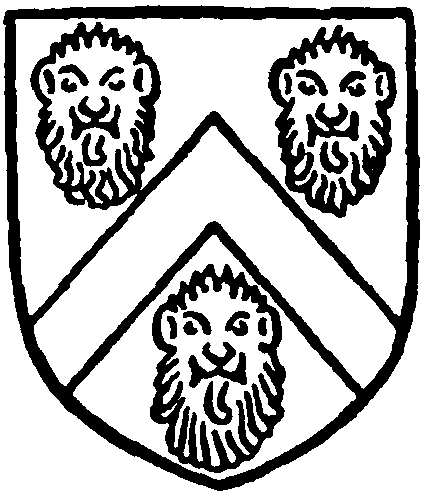
Wheler, Baronet. Or a cheveron between three leopards' heads sable.
The interest of the Spekes in the remaining quarter of the manor has not been traced from the death of Dorothy Speke in 1589. This quarter may possibly have been included in the 'manor of Sherfield upon Loddon,' held in 1755 by John, Earl Tylney. (fn. 85)
Paynton Pigott Stainsby Conant purchased the manor of Sherfield upon Loddon in 1817 or soon after. (fn. 86) On his death in 1862 the manor was bought by John Bramston Stane, (fn. 87) by whose trustees it was sold in 1888 to Charles Lethbridge. (fn. 88) It was purchased of him in 1898 by Mr. James B. Taylor, who sold it in 1907 to Mr. J. Liddell, (fn. 89) the present owner.
Certain land in Sherfield belonging to the corporation of Reading was purchased by John Bramston Stane and added to the Sherfield Manor estate. A park was probably made at Sherfield or an existing one enlarged about 1273 by John de Wintershill, who then held the manor. (fn. 90) It was a deer park as early as 1299. (fn. 91) In 1332 this park, now containing over 250 acres, contained only 40 acres. (fn. 92) John de Warblington in 1368 obtained a grant of free warren at Sherfield. (fn. 93)
A water-mill at Sherfield is first mentioned in 1316–17, but probably existed in the 13th century as John the Miller is mentioned in 1274. (fn. 94) Two water-mills are mentioned in an extent of the manor taken in 1332. (fn. 95) The number of mills had increased in the 17th century, for in 1601 two water-mills and a fulling-mill passed with a fourth of the manor, (fn. 96) and in 1608 four water-mills were annexed to Lord Wharton's share of the manor. (fn. 97) In the 18th century a mill described as a water-corn or fulling-mill belonged to the Wheler estate. (fn. 98) There is now only one mill, known as Longbridge Mill, on the River Loddon, near Long Bridge.
An estate consisting of a messuage and a carucate of land was held under the Warblingtons by the Kendales of Shalden for an annual payment of 3s. 2d. (fn. 99) It is first mentioned on the death of Robert de Kendale in 1330–1, (fn. 100) and descended in the same way as Shalden (q.v.) till 1376. (fn. 101) Its further descent has not been traced.
An estate at Sherfield belonged to the Brocases of Beaurepaire (fn. 102) from the 14th century to the beginning of the 19th, Mrs. Brocas being returned as a ratepayer as late as 1803. (fn. 103)
Church
The church of ST. LEONARD consists of a chancel 22 ft. 9 in. by 18 ft. 7 in., with a small vestry and organ chamber on the north side, nave 65 ft. 4 in. by 22 ft. 3 in., with a north transept 14 ft. 10 in. by 7 ft. 6 in., and a south-west tower 11 ft. 6 in. square, the lower part of which serves as a porch.
The oldest parts of the building are the bay of the north wall of the nave to the west of the transept, which contains an old blocked doorway and the upper stage of an old buttress, and part of the south wall of the nave opposite. They belong to the second quarter of the 14th century, but all the rest of the church has been rebuilt, some of the old details being used. The tower was built in 1872 in memory of a brother of the Rev. A. G. Barker, rector, 1863–75.
The east window of the chancel is partly of 14th-century date, and has three trefoiled lights and net tracery. The mullions and internal splays are modern.
The eastern window in the south wall of the chancel is a single trefoiled light, but only the chamfered external jambs are old stone. On one of them, now set upside down, is scratched an early 16th-century shield with three indistinct charges on a bend, and in chief a human hand or a gauntlet.
The western window in this wall is of early 14th-century style, two trefoiled lights with a trefoil in the head, and is nearly all modern. Between these two windows is a small modern doorway with a modern triangular window over.
The north organ chamber and vestry are modern additions, but the east window of the latter is old and has two trefoiled lights similar to the second south window of the chancel.
The north window in the organ chamber is modern and has three trefoiled lights under a square head. The arch between this chamber and the chancel is of a drop form and has two chamfered orders. The chancel arch is of two chamfered orders, the springing being only a foot or so above the floor.
The west window in the transept and the two easternmost windows in the north wall of the nave are modern copies of the second south window of the chancel. The third north window of the nave is a modern circular light with tracery. The old blocked doorway in this north wall referred to above has chamfered jambs and two-centred head with a moulded label of 14th-century date.
The first window in the south wall of the nave has two trefoiled lights and is of the same date and design as the second south chancel window. The other two windows in this wall are modern copies of the same.
The south doorway is rebuilt mostly of old stones and has two chamfered orders and a two-centred arch of 14th-century detail like the rest.
The west window of the nave is modern and has three trefoiled lights and a traceried head. Beneath it is a late 15th-century blocked doorway with moulded jambs and four-centred head.
The tower is of three stages with a west stair turret. The bottom stage serves as a porch and has a south doorway with moulded jambs and two-centred arch and a small east window. The two upper stages are lighted by modern windows and the top is finished with a shingled octagonal spire. The walls generally are of flint and stone. The lower parts of the chancel walls are of old stonework and the upper parts of flint. The old part of the north wall of the nave is of stone and uncut flint, and the south wall of the nave has many old stones bonded into the flint. All the internal woodwork is modern.
On the sill of the north-west window of the nave are two pieces of an old helmet which were dug up from the foundations of the tower. There is also an old tile representing a man on horseback blowing a trumpet.
In this same window is a panel of 16th-century glass representing St. George and the Dragon. There are also some fragments of late 16th-century heraldic glass in the west window of the transept.
On the north wall of the chancel is a brass to Stephen Hadnall of Shropshire, who married Margaret Atkins, daughter of Thomas Atkins, by whom he had two daughters. He died in 1590 and his wife set up this monument in 1600. Above the inscription is the kneeling figure of a man, and a shield with his arms, Or a sleeve sable impaling those of Atkins of Bristol, Or a quarter-pierced cross flowered at the sides azure between four molets sable.
At the west end of the north wall of the nave is a brass to 'Marye th(e)lder coheire of Stephen Hadnoll Esquier,' who was married to Francis Palmes. She had six sons and four daughters and died in 1595. She is represented above the inscription kneeling between her sons and daughters, and above are three shields, the first being charged with the maunch of Hadnoll; the second has the arms of Palmes, Gules three fleurs de lis argent and a chief vair; in the third shield is a raven.
Below is another brass to Edmund Molyneux, second son of Edmund Molyneux. He was born in 1532, but the blank spaces for the date of his death have never been filled in. Above the inscription is a shield of six quarters: (1) a cross moline; (2) semy of scallops with a lion; (3) a lion; (4) a cross with a flour de lis in the quarter; (5) a cheveron between three crosses paty; (6) a molet. Below is the motto 'En droyt devant,' and above is a crest of peacocks' feathers.
The tower contains six bells, the treble and second being cast by Mears and Stainbank, 1872. The third is by Henry Knight, 1664, and bears his mark, three bells, a battle axe, and the initials E K, all on a shield between the initials H K. The fourth is a pre-Reformation bell and bears the following black letter inscription: 'Sancte Petre ora pro nobis,' and the maker's mark, a circle with four fleurs de lis, &c., round a shield with cross. The fifth bell is also of pre-Reformation date and is inscribed in black letter with crowned capitals, 'Sancte Gabriel ora pro nobis,' with a lion's face and a cross, the marks of the Reading foundry. The tenor is by Joseph Carter, 1582, and has 'Blessed be the name of the Lorde' in rough black letter.
The plate consists of a silver chalice and paten cover of 1651 given by John Boxe in 1652; a silver credence plate of 1901, given at the coronation of Edward VII; a pewter and a brass almsdish and an electro-plated flagon.
The registers are contained in four books, beginning in 1640. The first has baptisms, marriages, and burials from that date to 1746. The second has baptisms and burials from 1745 to 1811, and marriages from the same date to 1753 only. The third contains marriages only from 1754 to 1812, and the fourth baptisms and burials from 1811 to 1812. There are two volumes of churchwardens' accounts from 1691.
Advowson
The advowson of the church of Sherfield upon Loddon was given by William de Warblington to the priory of Merton in 1222. (fn. 104) It remained in the possession of successive priors till the Dissolution, (fn. 105) when it passed to the Crown. It was granted in 1545 to Sir William Paulet, Lord St. John, (fn. 106) who was created Marquis of Winchester in 1551. (fn. 107) The advowson descended with the title of Marquis of Winchester and Duke of Bolton till after 1730. (fn. 108) In 1772 Robert Sloper and Charles Paulet presented, (fn. 109) and two years later the advowson was sold by Samuel Prince to Peter Rich. (fn. 110) In 1780 the presentation was made by John Eyre and in 1815 by the king on account of the lunacy of John. The advowson descended in the Eyre family till 1860, when it passed from the Rev. William Eyre to the Rev. G. H. Nutting. It passed from him in 1863 to George Barker of Stanlake Park, co. Berks. (fn. 111) He died in 1868, and on the death in the following year of his eldest son, George William, without issue, the advowson passed to his third son, the Rev. Alfred Gresley Barker. (fn. 112) He died in November 1906, and the living is now in the gift of his trustees.
There are Baptist, Primitive Methodist, and Plymouth Brethren's chapels at Sherfield.
Charities
In 1735 James Christmas by his will bequeathed £100 to be laid out in erecting a charity school, and £1,100 to be laid out in land, the rents thereof to be applied in schooling, and clothing poor persons, subject to the payment of £10 for bread to the poor of Stratfieldsaye. The trust estate now consists of the teacher's house, let at £12 a year, and £3,437 14s. consols, with the official trustees, arising from the sale of the real estate in the parish of Swallowfield, purchased in 1738. The charity is regulated by a scheme dated 23 October 1883. By an order of the Charity Commissioners of 11 September 1903, made under the Board of Education Act, 1899, the sum of £1,800 consols, producing £45 a year, was directed to be set aside as 'Christmas's Educational Foundation.'
The annual sum of £10 is paid to the overseers of Stratfieldsaye for distribution in bread, and the surplus income of the eleemosynary portion is applied in support of the coal and clothing clubs in Sherfield.
Duke of Bolton's Charity—see under Basingstoke. The sum of £10 16s. is applicable in this parish.
In 1854 Mary Lyford, by will proved in the P.C.C. 21 December, bequeathed £500 consols, the dividends to be distributed yearly in Christmas week equally among ten poor industrious families residing in the parish. The stock is held by the official trustees, who also hold a sum of £666 13s. 4d. consols, the dividends of which, now amounting to £16 13s. 4d., are under the terms of the will of Paynton Pigott Stainsby Conant, dated 16 December 1861, applicable as to three-fourths in beef and bread, and one-fourth in coals among the poor on Christmas Eve.