
A History of the County of Hampshire: Volume 4. Originally published by Victoria County History, London, 1911.
This free content was digitised by double rekeying. All rights reserved.
'Parishes: Maplederwell', in A History of the County of Hampshire: Volume 4, (London, 1911) pp. 149-152. British History Online https://www.british-history.ac.uk/vch/hants/vol4/pp149-152 [accessed 26 April 2024]
In this section
MAPLEDERWELL
Mapledrewelle (xi cent.); Mapelth, Mapeth, Mapeldurewelle, Mapeldorwelle (xii cent.); Mapedrewell, Maperderewell, Mapeldereworth (xiii cent.); Mapuldurwell (xv cent.).
The parish of Maplederwell situated 3 miles south-east from Basingstoke covers an area of 829 acres, (fn. 1) rising from north to south and reaching a height of 352 ft. above the ordnance datum on the southern boundary. The Basingstoke Canal intersects the parish from east to west, and it is also watered by several rivulets which join at Andwell, forming one stream which flows north to empty itself in the Loddon. The village mostly lies to the south of the canal on the brow of the northern slope of downs along a road which runs north to join the road from Basingstoke to Greywell, crossing the canal by Luke's Bridge. St. Mary's Church stands south of the village near the source of one of the streams, while a little to the north is Manor Farm. The Congregational chapel was built in 1864. There are 637½ acres of arable land and 127½ acres of permanent grass in the parish, (fn. 2) while East Moor, East Moor Copse, Middle Copse and East Moor Upper Copse, all in the north of the parish to the west of Andwell, are responsible for the 30½ acres of woods and plantations which it contains. (fn. 3) The soil is loam and the subsoil chalk. The chief crops are wheat, barley, oats and roots. Watercress is also largely grown, while market gardening is carried on by several of the inhabitants. Maplederwell Common was inclosed in 1863, (fn. 4) the rest of the common lands in the parish having been inclosed in 1797 by authority of a Private Act of 1796. (fn. 5) The name 'Estmore' is found as early as the beginning ot the 13th century. (fn. 6)
Manor
MAPLEDERWELL, which Anschill had held of Edward the Confessor, was owned by Hubert de Port in 1086, (fn. 7) being his sole estate in Hampshire. It covered a far larger area then than it does at present, comprising as it did within its boundaries the modern parishes of Maplederwell, Newnham and Up Nately, and the extraparochial district of Andwell. The names of the descendants of Hubert de Port, lords of the honour of Kington, who must not be confused with the successors of Hugh de Port, lords of the honour of Basing, (fn. 8) can be ascertained from charters to Andwell Priory now in the possession of Winchester College. (fn. 9) At the beginning of the 12th century Adam de Port was the lord of Maplederwell and founded the priory of Andwell in the latter half of the reign of Henry I, granting to it with various privileges £7 14s. worth of his land of Nately, (fn. 10) which up to this time had formed part of his manor of Maplederwell. He was succeeded by his son Roger de Port, who granted to the monks the mill and the miller of Andwell, (fn. 11) and was in his turn followed by his son Adam de Port, (fn. 12) who in 1172 was outlawed for treason and forfeited all his possessions. (fn. 13) Cresselin the Jew paid Henry II a large sum for the manor, but in spite of this William Fitz Audelin was holding it of the king's gift in 1185, (fn. 14) and Cresselin died in 1190 without gaining possession of the lands to which he was entitled. (fn. 15) Richard I then granted the manor to Alan Basset to hold of him with Woking (co. Surr.) for one knight's fee. (fn. 16) The exact date of the grant is uncertain, but in 1198 Alan granted 3 hides in Newnham pertaining to his vill of Maplederwell to Hugh de Arundel to hold to him and his heirs for the service of half a knight's fee. (fn. 17) Alan was confirmed in his possession of the manor by King John in 1200, (fn. 18) and in 1223 to end his disputes with the monks of Andwell restored them 'a way sufficient for a horse laden to go along with his leader in the head of his tillage toward the water of Maplederwell to the house of Endewelle,' obtaining in return for them a release of their claim in Hook wood and 'land in the field "del su" of the chapel of Mapeldurwelle.' (fn. 19) Alan died in 1232 and was succeeded by his son Gilbert, (fn. 20) who sided with Richard Marshal Earl of Pembroke in his attempt to make Henry III dismiss Peter des Roches and his other alien counsellors. His property in Hampshire suffered much during the civil wars, his wood of Maplederwell being broken by command of the king, timber carried away from his land, and his houses razed to the ground. The king eventually submitted to the demands of the barons, and in 1234 made due reparation to Gilbert, giving him permission to re-inclose his wood, (fn. 21) to recover his timber and to rebuild his premises. (fn. 22) Gilbert died in 1241 and was followed by his brother Fulk Basset, Dean of York, and afterwards Bishop of London, (fn. 23) who died eighteen years later, when his estates devolved upon his next brother Philip Basset. (fn. 24) Philip stoutly adhered to Henry III and was the last man who quitted the field at the fatal battle of Lewes when the king was taken prisoner by the barons. (fn. 25) He died in 1271, leaving as his heir his only daughter Alina, then wife of Roger Bigod Earl of Norfolk and Marshal of England, and widow of Sir Hugh Le Despenser. (fn. 26) Ela widow of Philip Basset (fn. 27) obtained a life-grant of the manor from Roger and Alina in 1272, (fn. 28) and eight years later was summoned to show by what warrant she took the fines of the breaches of the assize of bread and ale in Maplederwell, as also to show cause why she should not permit her villeins of Maplederwell to make suit at the king's hundred court of Basingstoke. (fn. 29) She died in 1297, (fn. 30) and the reversion of the manor, then held by Alan Plunkenet for life, (fn. 31) passed to Alina, who died in 1306. (fn. 32) Her heir was Hugh le Despenser, generally called the elder, her son by her first husband, (fn. 33) who was holding in 1316 (fn. 34) and two years later obtained a grant for himself and his heirs of free warren in his demesne lands of Maplederwell. (fn. 35) In July 1321 the barons condemned Hugh le Despenser and his son Hugh, generally called the younger, to forfeit all their estates and go into exile. (fn. 36) Circumstances, however, enabled Edward II to recall his favourites the following year, and in May 1322—two months after the royal victory of Boroughbridge—a commission of oyer and terminer was issued to John de Stoner and others on the king's information that John Maltravers, William de Whitefeld and Nicholas de Percy and their followers had entered Maplederwell and other manors belonging to Hugh le Despenser the elder and committed divers trespasses there. (fn. 37) However, the triumph of the Despensers was shortlived, the father being hanged by the forces of Queen Isabel outside Bristol on 27 October 1326, and the son a month later at Hereford. (fn. 38) Edward III in 1327 granted the manor of Maplederwell to Alesia the widow of Edmund Earl of Arundel (fn. 39), who was beheaded at Hereford a few days before the younger Despenser, for his adherence to Edward II. (fn. 40) He soon afterwards, however, made other provision for the maintenance of Alesia and her children, as in 1330 he granted the custody of the manor to William de Horewood le Fitz to hold for life at a rent of £11 18s. 8d. (fn. 41) Finally, in 1337 the king restored it to Hugh le Despenser, son of Hugh le Despenser the younger, to hold to him and his heirs by the services due, (fn. 42) and in 1346 Hugh was stated to be holding half a fee in Maplederwell. (fn. 43) In the inquisition taken after the death of Hugh in 1349 his nephew, Edward le Despenser, son of Edward brother of Hugh, was named as his heir. (fn. 44) This Edward, however, was not seised of Maplederwell at his death in 1375. (fn. 45) Two-thirds were in the possession of his brother Thomas le Despenser when he died in 1381, his nephew Thomas, son of Edward, being returned as his heir. (fn. 46) This Thomas was a favourite of Richard II, and in 1397 obtained the reversal of the attainder of his ancestors. (fn. 47) On the accession of Henry IV he took part in the conspiracy of the Earls of Huntingdon, Kent, Rutland and Salisbury to restore Richard II. This conspiracy proved a failure; Despenser was put to death at Bristol on 17 January 1400, and all his honours were forfeited. (fn. 48) Maplederwell was first of all taken into the king's hands, but later it was restored to Thomas Percy Earl of Worcester, Hugh le Despenser, Thomas Lauton, John Cors, Hugh de Tildesley and Thomas Fauconer, on whom he had settled it in trust three months before. (fn. 49) Richard le Despenser son and heir of Thomas died without issue and under age on 14 October 1414, leaving as his heir his sister Isabel, (fn. 50) whose second husband Richard Beauchamp Earl of Warwick (fn. 51) was stated to be holding in 1428 and again in 1431 half a knight's fee in Maplederwell, formerly belonging to Hugh le Despenser. (fn. 52) Isabel died seised of the manor of Maplederwell in 1440, her heir being her son Henry Beauchamp Earl of Warwick, (fn. 53) who died in 1446, leaving as his heir his infant daughter Anne. (fn. 54) The latter died three years later, and the manor then passed to her paternal aunt Anne, (fn. 55) whose husband Richard Nevill Earl of Warwick and Salisbury, the Kingmaker, in 1464 claimed certain cattle from John Stukeley, lord of Newnham, for issues and amercements of his court of Maplederwell. (fn. 56) After the death of the Kingmaker at Barnet on 14 April 1471 the history of the manor is somewhat obscure, (fn. 57) but it eventually came into the possession of George Lord Abergavenny, son and heir of Elizabeth, who was the only child of Isabel le Despenser by her first husband Richard Beauchamp Earl of Worcester. (fn. 58) George granted it to William Frost of Avington and Juliana his wife, and his grant was confirmed by his son and namesake in 1513 in return for a payment of £150. (fn. 59) Sixteen years later William granted the manor to Corpus Christi College, Oxford, 'for the support to the end of time of a fellow of his own blood.' (fn. 60) In 1535 the Hampshire holdings of the college included the manor of Maplederwell, worth by free tenants £1 13s., by customary tenants £5 3s. 1d., and by rents of demesne lands £6 4s. 10½d., and certain tenements in Up Nately of the annual value of £1 15s. 10d. (fn. 61) The manor and most of the parish belong to the college at the present day.

Basset. Barry wavy argent and gules.

Despenser. Quarterly argent and gules, the gules fretty or, with a bend sable over all.
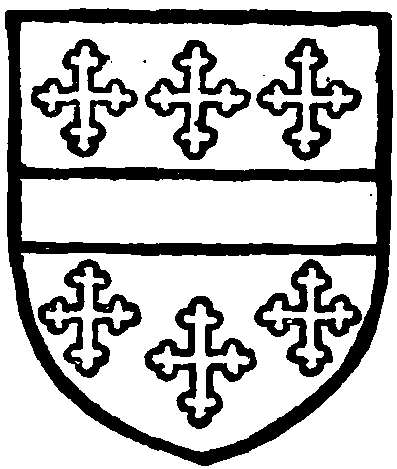
Beauchamp. Gules a fesse between six crosslets or.
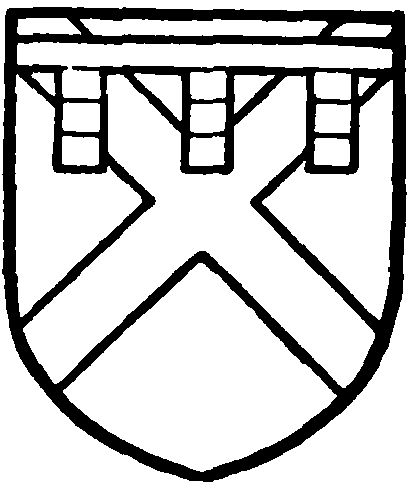
Nevill. Gules a saltire argent and a label gobony argent and azure.
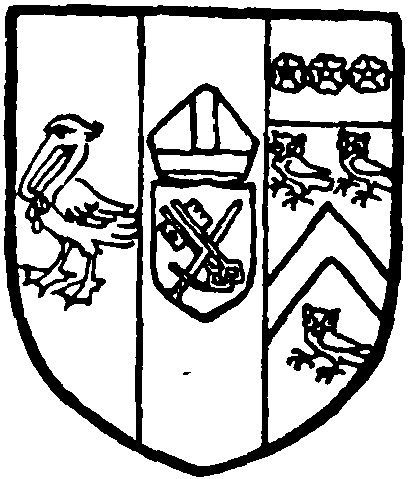
Corpus Christi College, Oxford. Tierced in pale: I Azure a pelican or wounding itself, for Bishop Richard Fox; 2 Argent a scutcheon of the arms of the see of Winchester with a mitre; 3 Sable a cheveron or between three owls argent and a chief argent with three roses gules therein, for Bishop Oldham.
Neither of the mills included under Maplederwell in the Domesday Survey (fn. 62) was in the modern parish of Maplederwell. One is probably represented by Andwell Mill, which Roger de Port gave to the monks of Andwell. (fn. 63) The site of the other is perhaps marked by Lyde Mill in Newnham parish which is worked by the tributary of the Loddon called the Lyde River, and if so it was included in the grant of the three hides of land in Newnham made by Alan Basset to Hugh de Arundel in 1198. (fn. 64)
Church
The church of ST. MART THE VIRGIN has a chancel 13 ft. 8 in. long by 17 ft. 9 in. wide, with a small south vestry, and a nave 36 ft. 8 in. by 18 ft. 10 in. inside, all of flint and stone.
The nave dates from the end of the 12th or beginning of the 13th century, but has been much modernized; the chancel appears to have been entirely rebuilt in modern times, some of the old stones being re-used.
The east window is a modern pointed one of three lights; in the north wall is a tiny lancet, of which the head and a few of the angle quoins only are old. A modern doorway in the south wall opens to the small modern vestry. The chancel arch is modern. The nave has three windows on each side, all single lancets; the outer stonework is all modern, also the heads inside; but there is old chalk masonry in the jambs. In the west wall is a round-headed doorway of a single chamfered order, which is original work patched with late masonry; the door is also old and has chamfered upright battens on the outer face and cross framing on the back. There is a very plain chancel screen, which has four and a half bays on either side of the central opening, and contains a little old work of 15th-century character. On the west end rises a plain boarded wooden bell-turret.
The roof of the chancel is gabled and has a plastered barrel vaulted ceiling; the roof of the nave has rafters set on a four-centred curve and plastered between with old plain tie-beams, braced collars, and purlins.
The altar pulpit, font, &c., are all modern.
In the chancel floor is a slab containing a 16th-century monumental brass partly covered by the organ; the part visible shows a man in a long fur gown and his wife with four sons and four daughters below. The inscription runs, 'Off your charite pray for the souls . . . and Agnes his wyfe on whos . . .'; the rest is hidden by boarding.
There are three bells: the first is inscribed 'Johannes est nomen ejus'; the second has 'Love God 1659'; the third is by Richard Eldridge, 1620.
A silver chalice, paten cover, paten and flagon, all of 1725, belong to Newnham (q.v.), but are used at Maplederwell, which itself possesses only a silver alms dish of 1841.
The first book of the registers contains baptisms from 1618 to 1666 and burials 1618 to 1644; the second book has baptisms and burials from 1666 to 1676 and marriages 1668 to 1673; the third has baptisms, marriages and burials from 1685 to 1744 and continues the first and last to 1808; the fourth has baptisms and burials 1808 to 1811, and the fifth marriages from 1754 to 1812.
Advowson
The tithes of Maplederwell and a yardland in Maplederwell were included in the grant of the chapel of Newnham which Adam de Port made on the day of the dedication of that chapel to the abbey of St. Vigor of Cerisy, of which Monk Sherborne was a cell. (fn. 65) At this date—early in the 12th century—there was no chapel in Maplederwell, but one had been built before the end of the 13th century. Maplederwell has continued in a dependent position on the church of Newnham, the living at the present time being a chapelry annexed to the rectory of Newnham of the joint net income of £250 with 25 acres of glebe and residence.
Ela the widow of Philip Basset founded and endowed a chantry in the chapel, and granted the presentation to the chantry to John of Pontoise, Bishop of Winchester, and his successors. (fn. 66) The bishop presented certain chaplains with the consent of Ela, but on her death Alan Plunkenet, who had obtained a life-grant of the manor, set over the chantry Robert de Norhamptone, who was not instituted in the regular way, his only title being the grant and will of Alan. (fn. 67) An inquiry was held by the official of the Archdeacon of Winchester by the orders of Henry Woodlock, and a return was made on 13 August 1314. (fn. 68) The Bishops of Winchester recovered the right to present, and in 1318 John Sendale conferred the chantry, which was vacant by the death of the last chaplain, Peter de Dupehale, on Ralph Frankelyn of Reading. (fn. 69)
Charities
In 1678 John Smith by deed conveyed to trustees 6a. or. 2p. in the parish of Rotherwick, the rents to be employed in providing clothes for the poor of Maplederwell, among which the kindred of John Smith were to take preference. The land was sold in 1899, and the endowment is now represented by a sum of £469 11s. 3d. consols with the official trustees. The income is £11 14s. 8d. annually.