A History of the County of Hampshire: Volume 4. Originally published by Victoria County History, London, 1911.
This free content was digitised by double rekeying. All rights reserved.
'Parishes: Up Nateley', in A History of the County of Hampshire: Volume 4, ed. William Page (London, 1911), British History Online https://www.british-history.ac.uk/vch/hants/vol4/pp176-179 [accessed 10 May 2025].
'Parishes: Up Nateley', in A History of the County of Hampshire: Volume 4. Edited by William Page (London, 1911), British History Online, accessed May 10, 2025, https://www.british-history.ac.uk/vch/hants/vol4/pp176-179.
"Parishes: Up Nateley". A History of the County of Hampshire: Volume 4. Ed. William Page (London, 1911), British History Online. Web. 10 May 2025. https://www.british-history.ac.uk/vch/hants/vol4/pp176-179.
In this section
UP NATELY
Opnatelegh, Estropnateley, Natale, Natteleges Estrope (xiii cent.); Up Natele, Upnatelegheseththrop (xiv cent.).
Up Nately is situated 4 miles east from Basingstoke and 2½ miles south-west from Hook station on the main line of the London and South Western Railway. The parish contains 1,143 acres of land and 6 acres of land covered with water, and rises from 225 ft. above the ordnance datum in the north to 397 ft. above the ordnance datum on its southern boundary. The north-east of the parish is covered with copses, while the south is open down-country. Basingstoke Canal flows through Up Nately, entering it at Little Tunnel Bridge. The village is situated a little to the south of the canal, and from it roads run north over Brickkiln Bridge and west over Penny Bridge to join the main road from Basingstoke to London at Scures Hill and Hatch respectively. Eastrop Farm and Eastrop Bridge to the east of St. Stephen's Church commemorate the fact that the parish was sometimes known as Nately Eastrop (fn. 1) to distinguish it from Nately Scures. The soil is clay, chalk, loam and sand and the subsoil clay and chalk. The chief crops are wheat, oats, barley and roots. There are extensive brickfields no longer in use in the parish. The chief landowners are the Baroness Dorchester of Greywell Hill, Winchester College and Messrs. Herbert B. Thorp and William Palmer.
The extra-parochial district of Andwell situated north of the Basingstoke Canal contains 148 acres and consists of the Priory Farm with the lands attached, the interesting remains of the Benedictine Priory formerly occupied by a colony of monks from the abbey of Tyron and a water-mill worked by the River Lyde—all grouped together a short distance south of the main road from Basingstoke to London. The soil is clay, sand and gravel and the subsoil clay. The chief crops are wheat, barley and roots, and watercress is also cultivated. Up Nately and Andwell together contain 628 acres of arable land, 281 acres of permanent grass and 122 acres of woods and plantations. (fn. 2) Among place-names found in early records are Hangate (fn. 3) (xv cent.); Slades and Howpitts (fn. 4) (xvi cent.).
Manor
The whole of Andwell and the greater part of Up Nately were included in the great manor of Maplederwell (q.v.) until early in the 12th century, when Adam de Port, lord of Maplederwell, by charter granted £7 14s. worth of his land in Nately and various privileges (fn. 5) to the great Cistercian abbey of Tyron in France. (fn. 6) This charter was confirmed by Henry I. (fn. 7) Tyron forthwith sent a colony of monks to settle in this new estate, which was subsequently known as the manor of ANDWELL. Roger de Port, the eldest son and successor of Adam, much increased his father's benefactions by granting to the monks of St. Mary of Andwell lands at Winchester and Maplederwell, the mill and miller of Andwell and a virgate of land pertaining to the mill, and all the chattels and tithes of the mill once held by the Priory of Monk Sherborne, (fn. 8) and other gifts followed from the de Ports of Maplederwell. (fn. 9) Andwell met with the same fate as the other alien priories in England, being sequestered by Edward III on the ground of the allegiance it owed to his adversary of France. (fn. 10) In 1376 it was committed at a rent of £10 to Thomas Driffed, who guaranteed to find a monk to officiate in the church, to keep the priory, church and buildings in repair, and to pay the tenth as often as one was granted by the clergy. (fn. 11) He failed to keep the contract, however, for commissioners appointed after his death in 1386–7 assessed the dilapidations to the property at £68. (fn. 12) During the latter part of the reign of Richard II the parent monasteries of alien houses were permitted to sell them to other religious houses or to persons who desired to use them for founding charities, hospitals or other works of charity. (fn. 13) William of Wykeham, Bishop of Winchester, availed himself of this privilege by buying Andwell from the abbey of Tyron in 1391, paying £20 to Thomas Thorpe, to whom its custody had been committed in 1387, for his interest therein. (fn. 14) The bishop bestowed the manor or priory of Andwell with all its possessions, then valued at £10 10s. a year, on his newlyfounded College of Winchester, (fn. 15) in possession of which it has continued to the present day. (fn. 16)
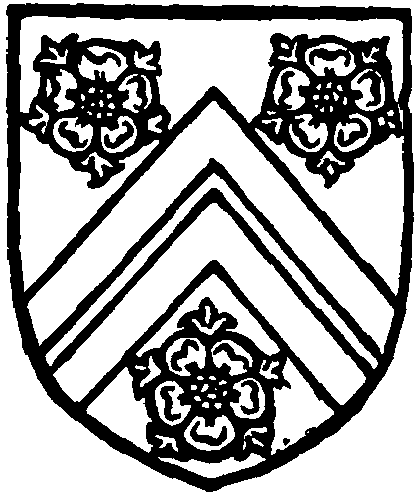
Winchester College. Argent two cheverons sable between three roses gules, which are the arms of William of Wykeham.
The principal remains are those of the church and of a part of the western range, but the approximate position of the other claustral buildings and the site and extent of the cloisters themselves may be deduced with some certainty. The church is on the north of the site, and consists of a small chancel 17 ft. by 16 ft. 6 in. and a nave 38 ft. by 19 ft. 6 in. Nearly the whole of the north and south walls of the nave remains complete with the windows, and probably not reduced in height to any appreciable extent. Of the west wall of the nave about two-thirds to the north has collapsed and is replaced in brick. No traces remain of a chancel arch. Of the chancel only the lower parts of the north and east walls remain now about 6 ft. in height, and probably partly rebuilt at that, for no traces of windows are left. The church is now used as a barn.
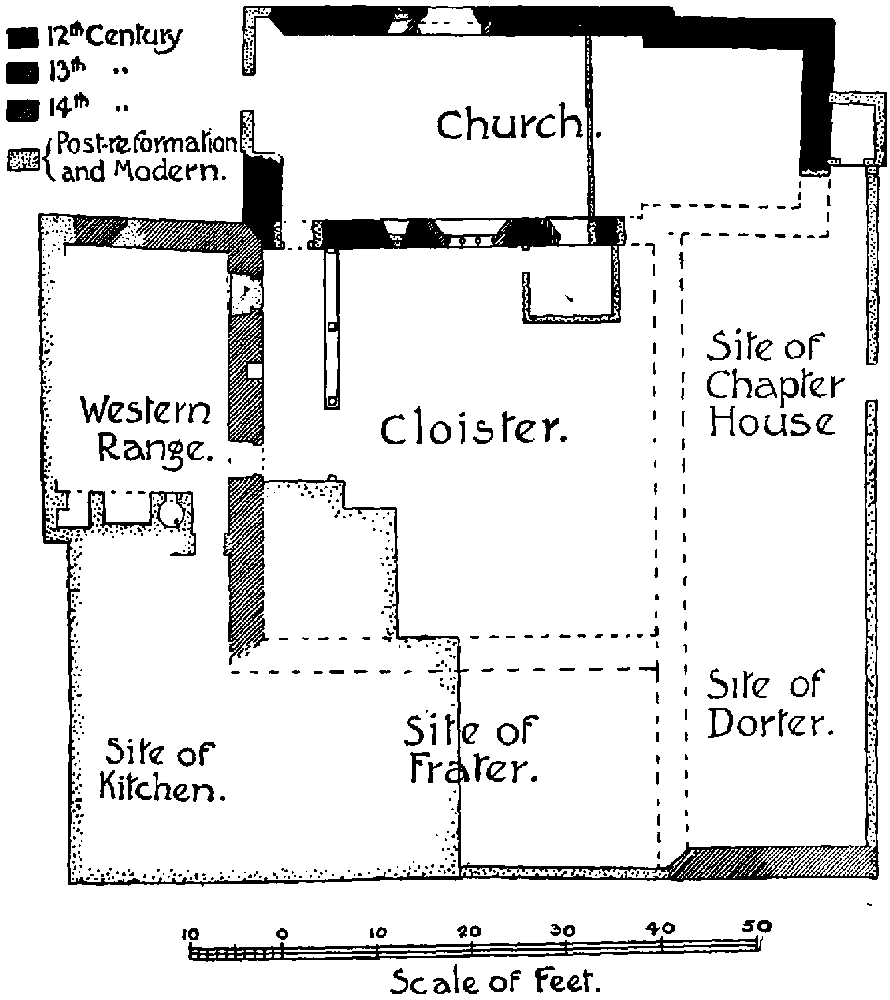
Plan of Andwell Priory, Up Nately
Almost the whole of the east and north walls of the western range remains, two doors being in situ in the former, which is built about in line with the west wall of the church. The western range thus projected west of the church by nearly its full width, the extent of which is now uncertain, for the west wall has disappeared and is replaced by a brick wall of comparatively recent date and possibly not on the old foundations. This part of the building now forms the kitchen of the farm-house which covers the rest of the site of this range, while a later wing dating from about the middle of the 19th century is built east and west and covers the western part of the frater range. Of the latter and of the dorter range, chapter house, &c., nothing is standing above ground except a piece of walling running east and west and apparently part of the south wall of the dorter. A small portion of freestone quoining in this suggests the inside south-west angle of the dorter and gives a line which if carried north intersects the church at about the east line of the nave. The dimensions of the cloisters thus obtained are 41 ft. 6 in. each way, which places the north wall of the modern house on the north line of the frater and conventual kitchen. The site of the cloister and of the destroyed buildings is now the farm-house yard, and the fragments of wall and the buildings are connected up by thin modern walls completing the square. In all cases the old walling is of flint rubble with freestone dressings. The earliest detail remaining is of early 12th-century date and may well be original. The next date of which there is evidence corresponds with the dedication of 1220, (fn. 17) a portion of a window of that time remaining. Finally in the first half of the 14th century the large window of the nave was inserted and the claustral build ings largely reconstructed, if not rebuilt. By the end of the century, however, the place appears to have fallen into disrepair, (fn. 18) but no recognizable traces of the repairs of this time remain. The postReformation work which converted the buildings into a farm-house has no detail of any interest; they are of various dates and of the simplest character.
The north and east chancel walls, which are standing to about 6 ft. in height, have no detail of any sort. At the east of the nave is a dilapidated halftimber partition of 17th-century date, of which a good deal of the herring-bone brick nogging has fallen out. In the south wall are two complete windows and the western jamb of a third. The last, which is the 13th-century one already referred to, and has lost its eastern jamb, head and sill, is placed high up in the wall. The remaining jamb is chamfered and rebated for a glass frame. It has been made into a door, opening into the loft formed by inserting a floor at about two-thirds the height of the walls. The other jamb is roughly made up in 17th-century brickwork and rubble, and the stair or ladder to it which no longer remains was contained in the small half-timber structure of 17th-century date, which is built against the nave at this point and is now much dilapidated. West of this are a window of early 14th-century date and three uncusped lights with interlacing mullions. The sill of this window, unlike the other windows, is only about 4 ft. above the floor and must have cut into the cloister roof. The third window in this wall is one of the 12th century. It has a plain round external head and is possibly rebated, but is now blocked up and obscured by creepers. The splay is wide and the rear arch round-headed. Opposite this on the north is a similar window, also blocked up, which has lost its external head. At the west end of the north wall, high up, are the blocked remains of a wood-framed 17th-century light.
In the middle of the north wall is a tomb niche of late 14th-century date. The head is trefoiled and chamfered and has an ogee label. At the springing are plain moulded circular corbel caps.
The only remaining trace of the west door is a fragment of its abacus, a plain chamfered one of 12th-century date. The extra thickness of the west wall suggests that it was surmounted by a bell gable. The two doors of the western range are both of 14th-century date. Both have two-centred heads and are continuously chamfered, while the door to the south has a drop-arched head. Either of these doors may have opened into the outer parlour. In the north wall of the western range is a fragment of a window jamb but devoid of detail. Between the two doors noted above is a small recess now repaired in brick but apparently an old one.
Andwell Mill probably marks the site of one of the mills included in Maplederwell in 1086. (fn. 19) As stated above, it was granted to the monks of Andwell by Roger de Port, and there are various references to it in records relating to Andwell. In 1291 rents, meadow and a mill in Andwell belonging to the priory were valued at £3 a year, (fn. 20) and three years later the annual value of the water-mill is given as 20s. (fn. 21) In 1324 it was worth £2 a year, (fn. 22) and in 1387 dilapidations of the water corn-mill at Andwell were assessed at £6 13s. 4d. (fn. 23) At the view of frankpledge held at Basingstoke on 12 May 1470 John Baron the miller of Andwell was fined 12d. for taking excessive toll. (fn. 24) In 1294 there is mention of a fulling-mill at Andwell worth 12s. a year. (fn. 25) In 1324 this mill was farmed at 12d. a year. (fn. 26)
A portion of Up Nately continued to form part of the manor of Maplederwell even after the foundation of Andwell Priory. Thus in 1285 Ela widow of Philip Basset, who was then holding Maplederwell for life, obtained licence to alienate a messuage and half a virgate of her land in Up Nately to a chaplain celebrating divine service in the church of Up Nately. (fn. 27) Again, in 1535 the Hampshire possessions of Corpus Christi College, Oxford, to which William Frost had granted the manor of Maplederwell, included lands and tenements assessed at 35s. 10d. a year. (fn. 28)
Other portions of the parish were included in the neighbouring manors of Nately Scures and Greywell, and the Baroness Dorchester as lady of these manors is one of the principal landowners in the parish at the present day.
Church
The church of ST. STEPHEN consists of a chancel 11 ft. 1 in. by 7 ft. 9 in. and a nave 36 ft. by 20 ft. 3 in. with a small west tower 6 ft. square and a north vestry.
The walls of the nave belong to the original late 12th-century building, but they have been entirely refaced, and later windows have been inserted.
The chancel, tower and vestry were built in 1844.
The east window of the chancel is modern and has three cinquefoiled lights under a four-centred head. The chancel arch, which is 4 ft. I in. in thickness, has square jambs and semicircular arch with a grooved and hollow-chamfered abacus at the springing. It is entirely of late 12th-century stonework.
The easternmost of the two windows of the nave is of 15th-century date and has two cinquefoiled lights each under a square head with a moulded label. The other three nave windows are modern copies set in old jambs.
The north doorway is near the west end of the north wall and is of late 12th-century date. The jambs and semicircular arch are of two chamfered orders with a grooved and hollow-chamfered abacus and a label enriched with dog-tooth ornament.
The vestry and the tower have each a plain twolight window under a square head.
The tower is built of brick and flint and has a plain two-light window in each face near the top. The walls of the nave are faced with flint and brick except the east wall, which is plastered flintwork. The vestry is of brick and the chancel flint and brick.
The tower contains two bells, the first bearing the initials R P 1716, and the second being merely dated 1715.
The plate consists of a silver chalice and paten cover of 1681, a silver flagon of 1788, given in 1833 by James Blatch, vicar, and a silver alms plate of 1792, given also by James Blatch, vicar, in 1846.
The registers are kept with those of Basing. The first book contains all entries from 1695 to 1812 except the marriages, which stop at 1750. The second book contains marriages from 1756 to 1812. This is not a book of printed forms, but has simply ruled lines.
Advowsons
Up Nately has from the earliest times been a chapelry dependent on the parish church of Basing (q.v.), the living of which is a vicarage of the net yearly value of £350 in the gift of Magdalen College, Oxford. (fn. 29) The church of the priory of Andwell was dedicated between 1215 and 1238, as appears by an indulgence of forty days granted by John, Bishop of Ardfert (1215–24), who had officiated for Peter des Roches, Bishop of Winchester (1205–38), to all who having confessed and repented had come to the consecration of the church and offered alms, and an indulgence of ten days on like terms to those who had attended the dedication of the altars which had taken place on the Feast of the Holy Innocents. (fn. 30) The advowson of the church or chapel of Andwell was included in the grant of Andwell to Winchester College in 1391, (fn. 31) but it is doubtful whether a chaplain was ever appointed by the college.