A History of the County of Hampshire: Volume 4. Originally published by Victoria County History, London, 1911.
This free content was digitised by double rekeying. All rights reserved.
'Parishes: Godsfield', in A History of the County of Hampshire: Volume 4, ed. William Page (London, 1911), British History Online https://www.british-history.ac.uk/vch/hants/vol4/pp189-190 [accessed 30 April 2025].
'Parishes: Godsfield', in A History of the County of Hampshire: Volume 4. Edited by William Page (London, 1911), British History Online, accessed April 30, 2025, https://www.british-history.ac.uk/vch/hants/vol4/pp189-190.
"Parishes: Godsfield". A History of the County of Hampshire: Volume 4. Ed. William Page (London, 1911), British History Online. Web. 30 April 2025. https://www.british-history.ac.uk/vch/hants/vol4/pp189-190.
In this section
GODSFIELD
Godesfeld, Godefeld (xii cent.).
The parish of Godsfield lies 3 miles north-east of New Alresford. It was formerly extra-parochial, bat is now a parish in Alresford union, and adjoins Armsworth, which lies on the east.
Godsfield Farm, and the remains of the chapel of the Hospitallers, now in disuse, are in the south-east of the parish. The ground is fairly high, rising in some places to over 520 ft. above the ordnance datum. The north of the parish is occupied by a large copse and plantations. There are several old chalk-pits scattered throughout the parish.
Duthy, writing about 1830, states that there was only one house in Godsfield, which was occupied by the farmer and his family. (fn. 1) A few cottages have been added since then, but in 1903 the number of inhabitants was only 13.
The area of the parish is 509 acres, of which 164. acres are arable land, 225 acres permanent grass and 103 acres woods and plantations. (fn. 2)
Constant reference is made in Godsfield and Swarraton charters to the wood of 'Buggenore' and to a well-known landmark at one of its corners known as Buggenores thorn. (fn. 3) The name may be retained at the present day in 'Bogmoor Hill' in Godsfield. This wood also extended into the adjacent parishes, into Brown Candover (q.v.) and into Wield, for in a conveyance (fn. 4) of 1598 we hear of 'Behunger Coppice' and 'Bugner Coppice' situate in the parish of Wield.
Manor
The Hospitallers' manor of GODSFIELD was formed by the consolidation of certain lands, the most important of which were granted them in the 12th and 13th centuries by the Daundelys, lords of Chilton Candover, and by Adam de Port.
The first (fn. 5) of these grants was made not later than the year 1171 by Walter de Andely (Daundely) and comprised all his land ' between the two Bogenores which belonged to Candover' (vide Chilton Candover) as well as pasture for 12 oxen and 200 sheep among his own herds. For this a rent of 5s. a year was to be paid. (fn. 6) As the grantor was a knight holding under the Bishops of Winchester this conveyance was effected in the episcopal court in the actual presence of Henry of Blois, who thus witnessed and allowed it. (fn. 7) Other grants in the neighbourhood followed, and of these one of the most noteworthy was the gift (fn. 8) to the Hospitallers in frankalmoign by Adam de Port the lord of Abbotstone of the whole of his land in Godsfield 'between the new ditch as it extends from the bishop's grove as far as the boundaries of Swarraton.' Again in 1267 the knights exchanged the right of pasture for 12 oxen (fn. 9) against 18 acres in Chilton Candover, and three years later their still more valuable right of sheep pasture (fn. 10) against 50 acres near 'Buggenore.' These gifts were the chief constituents of the manor of Godsfield proper. But in addition, possibly as early as the reign of John, we hear of William of St. Martin and Erenburgia his wife granting (fn. 11) to the Hospitallers an extensive tract of land and pasture in Swarraton, the boundary of which is traced 'from the corner of the wood of Buggenora,' at an annual rent of 20s. (fn. 12) Hugh son of William confirmed his father's grant but remitted the rent.
Again, Hugh de St. Martin, possibly a later tenant of the same family, granted to the knights his manor of Swarraton, as we learn from a release by Roger de Mortimer of his right therein, (fn. 13) and from this circumstance the estate of the Hospitallers was sometimes called the manor of Godsfield and Swarraton (q.v.). The Hospitallers established a preceptory at Godsfield which appears to have been the principal of the three estates of the order in Hampshire, namely, Godsfield, Baddesley and Rownhams, the last two being described as members of Godsfield. The report made on the property of the order in 1338 as regards Godsfield is as follows:—'At Gods field is one messuage in bad repair, with garden worth 3s. 4d. At the same place there are 300 acres of arable land, 100 acres of which are worth 4d., 100 acres worth 2d., and 100 acres uncultivated worth 1d. an acre per annum.' (fn. 14) After the Dissolution the manor of Godsfield was for some time in the possession of Sir Thomas Seymour, and was probably granted to him at the same time as North Baddesley (q.v.). (fn. 15) After his attainder in 1549, all his estates, including the manor of Godsfield, were given to Sir William Paulet Earl of Wiltshire, (fn. 16) afterwards Marquess of Winchester, who in 1570 obtained licence to alienate the manor, (fn. 17) and sold it in the following year to Richard Knight for £361 9s. 2d. (fn. 18) The manor remained in the Knight family (fn. 19) until 1584, when Robert son of Richard Knight sold it to Richard Beaconshaw. (fn. 20) Of the purchase money (£1,000) £600 was forfeited to the queen by reason of the recusancy of the said Robert Knight. (fn. 21)
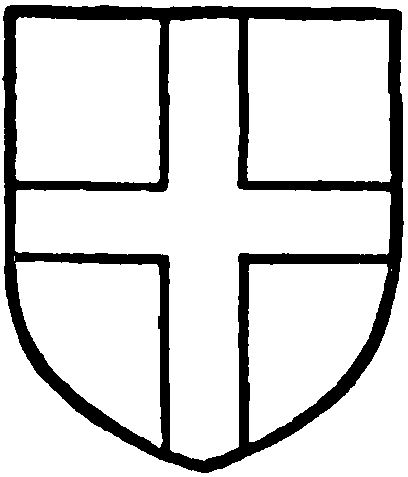
The Hospitallers.Gules a cross argent.
In 1595 Richard Beaconshaw died seised of the manor of Godsfield and Swarraton, which descended to his son William. (fn. 22) Three years later William Beaconshaw conveyed it to William Petre and other trustees, (fn. 23) who in 1607 conveyed it to John Wilmot and William Latton to the use of Charles Wilmot of Culham (co. Oxon.). (fn. 24) The latter was created Viscount Wilmot of Athlone on 4 June 1621, (fn. 25) and remained in possession (fn. 26) of the whole estate until 1634, in which year he sold 'the mansion or manorhouse of Godsfield, and the site and demesne of the manor and all the arable land, meadow, pasture and feedings now used, occupied and enjoyed by Robert Goudge tenant,' to Dame Constance Lucy and Sir Richard Lucy, bart., respectively widow and son of Sir Thomas Lucy of Charlecote (co. Warw.). (fn. 27) This family continued to hold the property generally called the manor of Godsfield until about 1747, when it was sold by Sir Berkeley Lucy, bart., the last male heir of his family. (fn. 28) It is uncertain who purchased it, but shortly afterwards it came into the possession of George Rodney Brydges, who was descended from a younger branch of the family of Sir Giles Bruges. (fn. 29) In 1751 he was found drowned in the canal of his garden at Avington, in the seventy-second year of his age; as he left no issue, the greater part of his estates reverted to the Chandos branch of the family, but he devised his property of Godsfield to George Brydges Rodney, afterwards the great Admiral Rodney, who had been brought up by him. (fn. 30)

Lucy, of Charlecote. Gules crusilly argent with three luces argent.
In 1845 Godsfield was sold to John Houghton of Armsworth House, father of the present owner, (fn. 31) Mr. Thomas A. Houghton.
Godsfield Chapel
Church
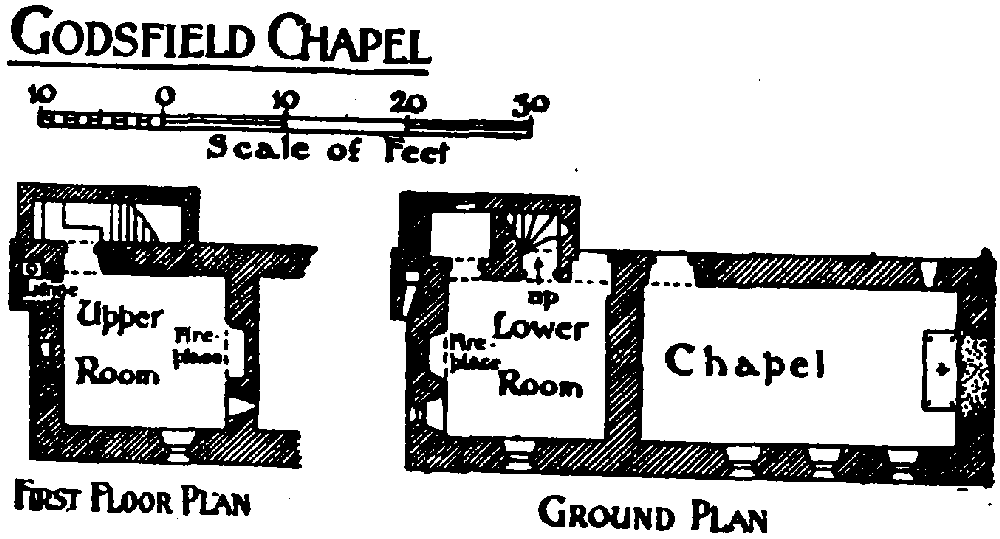
At some distance to the west of the house is the site of the preceptory of the Hospitallers known as Godsfield, of 12th-century foundation. A chapel with livingrooms at the west still stands here, in very good preservation except for the loss of the glazing of the windows, and carefully protected by its present owner. Its arrangements may be seen on the annexed plan. It is all of one date, about 1360–70, built of flint walling with large ashlar dressings, having the chapel, 26 ft. by 13 ft. to the east, and the living-rooms to the west. The east window of the chapel is blocked, but was evidently of three lights, and there are three single cinquefoiled windows on the south, retaining their iron stanchions. In the north wall near the east end is a small opening splayed outward, evidently to give a view of the altar from some building adjoining the chapel on the north, all traces of which have disappeared, and the entrance to the chapel is by a plain pointed doorway at the north-west. Three couples of the original roof remain at the west end, the rest of the roof being modern, as is the wooden floor, which is raised above the level of the old. The position of the altar is marked, and to the north of it is a corbel for an image.
The lower living-room is entered from the northeast, and has a fireplace in its west wall, with a square-headed window close to it on the south, and another in the south wall. On the north side is a projecting block containing a stone stair to the upper room, and beneath the stair a small barrel-vaulted chamber with a window in its north wall, and entered from the living-room; it doubtless served as a storeroom. The upper room has a fireplace with an arched head in the east wall, and close to it on the south a small opening commanding a view of the chapel. In the south wall is a cinquefoiled window, and in the north-west angle a garderobe, close to the door from the stairhead. A recess at the stairhead, corbelled over above, may have contained a press or chest, and the western gable is crowned by an embattled chimney shaft. The wooden joists carrying the floor of the upper chamber are all ancient but one.
Close to the chapel on the north is a modern farmhouse, and to the north-west the broken lines of the ground suggest the existence of remains of ruined buildings beneath the surface.
In a 16th-century survey (fn. 32) of Godsfield the 'faire chappell' was described as adjoining 'a convenient dwelling house for a gentleman builded of tymber with viij or nyne good lodging chambers . . . watered with a well of excellent good water with garden, orchard, barnes, stables and all other outhousing of all sortes sufficient.'
There was a chapel at Godsfield as early as 1338, and for its service the Hospitallers provided a chaplain at the yearly stipend of 4 marks without commons. (fn. 33) He would seem to have been distinct from the professed chaplain John Couffen, who was at this time in residence with the preceptor William de Multon.