A History of the County of Hampshire: Volume 4. Originally published by Victoria County History, London, 1911.
This free content was digitised by double rekeying. All rights reserved.
'Parishes: Upper Clatford', in A History of the County of Hampshire: Volume 4, ed. William Page (London, 1911), British History Online https://www.british-history.ac.uk/vch/hants/vol4/pp359-365 [accessed 5 May 2025].
'Parishes: Upper Clatford', in A History of the County of Hampshire: Volume 4. Edited by William Page (London, 1911), British History Online, accessed May 5, 2025, https://www.british-history.ac.uk/vch/hants/vol4/pp359-365.
"Parishes: Upper Clatford". A History of the County of Hampshire: Volume 4. Ed. William Page (London, 1911), British History Online. Web. 5 May 2025. https://www.british-history.ac.uk/vch/hants/vol4/pp359-365.
In this section
UPPER CLATFORD
Cladford (xi cent.); Clatford (xii cent.); Upclatford (xiv cent.).
Upper Clatford contains 2,209 acres, of which 9 are covered by water, 1,259¼ are arable land, 294¼ are permanent grass and 59½ are woods and plantations. (fn. 1) The soil is light loam, the subsoil chalk. (fn. 2) The chief crops are wheat, barley, oats and turnips. Bury Hill and the extreme north-east corner of the parish are the only parts which rise above 300 ft., and either side of the River Anton, which intersects the north-east of the parish, and Pillhill Brook, which flows into the Anton at Long Bridge, the level is considerably under 200 ft.
The village is long and straggling, lying on both sides of the Andover road, which runs parallel to and west of the Anton and the Andover and Redbridge branch of the London and South Western Railway. The church stands a little away from the village, at its southern extremity, between Sackville Court Farm and Norman Court Farm, both of which perpetuate names notable in Upper Clatford in the 14th century. Redrice House, the residence of Captain Best, the lord of the manor, lies a mile to the south-west in a thickly-wooded park of about 100 acres in extent. The manor-house, which is at present occupied by Mrs. Millman, is situated on the road from the village to Redrice Park. Clatford Lodge, the residence of Rear-Admiral John Locke Marx, M.V.O., lies north of Pillhill Brook.
A detached village formed largely of buildings connected with the Waterloo Iron Works is in the Anna Valley, south of Pillhill Brook and close to the Abbotts Ann boundary. It contains a school and a workmen's hall built by Messrs. Tasker, ironfounders, in 1867.
There are the remains of a camp on Bury Hill.
Oakcuts Woods in this parish and Goodworth Clatford were inclosed in 1855, (fn. 3) and there had also been an award in 1785. (fn. 4)
The following place-names may be mentioned:—'Lardners' and 'Culverhayes' (xvi cent.) (fn. 5); 'Farrail's Downe,' 'Plassetts' and 'Alyffes Water' (xvii cent.). (fn. 6)
Manors
CLATFORD, which does not occur specifically as UPPER CLATFORD until the 14th century, was held by Saxi of the Confessor, and in 1086 it was a royal demesne as of the fee of Roger Earl of Hereford, (fn. 7) who had forfeited his lands for his part in the conspiracy of 1074. (fn. 8) The Abbot and convent of Lire, in Normandy, to whom the advowson belonged, had 3 virgates of land and the tithe of the vill, and Adeline the jester held 1 virgate of the gift of Earl Roger. (fn. 9) The possession of 3 virgates by Lire suggests that Clatford had belonged also to the Earl's father, William Fitz Osbern Earl of Hereford, who founded the abbey in 1045 and endowed it with the church of Clatford and its appurtenances. (fn. 10) The first recorded lord of Upper Clatford after Domesday is Aumary de Turnebu, who was dead by 1195, when the manor was in the king's hands with his heir. (fn. 11) In 1204 King John granted the custody of the manor to Hugh de Nevill, (fn. 12) and in June 1205 gave it to William de Huntingfield for £30, saving to Hugh his chattels and corn. (fn. 13) In November he pardoned William the £30. (fn. 14) The intentions of King John and King Henry III with regard to this manor seem to have been extraordinarily vacillating. On John's rupture with his barons he took it away from William de Huntingfield, (fn. 15) and in May 1215 wrote to the sheriff to give John de Harecourt seisin without delay. (fn. 16) A month later he restored it to William de Huntingfield, (fn. 17) and in the following October gave John son of Henry 20 librates of land in the manor with all William de Huntingfield's chattels and stock found thereon. (fn. 18) In December the king wrote to William Briwere, the sheriff, that he had restored to William Turnebu the land in Clatford which had belonged to John Turnebu his father and ordered him to give him seisin (fn. 19); and in March 1216 Hugh de Nevill was instructed to allow William Turnebu to have the forest liberties which his father had had and which appertained to the manor. (fn. 20) About the same time William Turnebu was granted the corn there which had been William de Huntingfield's. (fn. 21) In 1217 Henry III granted the vill with its appurtenances to Aumary de St. Amand to hold during pleasure, (fn. 22) and in 1219 he gave the manor to William the Marshal, second Earl of Pembroke of that name, since it had been taken into the royal hands by the justices in eyre. (fn. 23) On the death of the earl in April 1231 (fn. 24) Henry III granted Clatford Manor to Waleran the Teuton, promising the new grantee a reasonable exchange when it should be restored to the right heirs of the last Norman holder. (fn. 25) In the following month the sheriff of Hampshire was ordered to let Baldwin de Bethune and Henry de Brayboef, who had each held a moiety of the manor of the bail of William the Marshal, have their chattels and the corn which they had sown there. (fn. 26) This order was countermanded in July when Waleran the Teuton was to have the corn and Baldwin and Henry only their reasonable costs of cultivation and sowing. (fn. 27) In 1232 Waleran surrendered the manor, and it was restored to Richard the Marshal, third Earl of Pembroke. (fn. 28) In 1233 it was committed to Jordan de Doe to support him in the king's service during pleasure, (fn. 29) and in 1235 Gilbert the Marshal, fourth Earl of Pembroke, granted the issues of Clatford and other manors to Eleanor Countess of Pembroke, his sister-in-law, widow of William the second earl and sister of Henry III. (fn. 30) On the death of Anselm the Marshal, sixth Earl of Pembroke, in December 1245, the earldom reverted to the Crown, and the estates were divided among his five sisters and co-heirs or their children. (fn. 31) The fee of Clatford fell to the lot of Roger de Mortimer, lord of Wigmore, who had married Maud, one of the four daughters and co-heirs of Eve, one of the aforesaid five sisters and wife of William de Braose. (fn. 32) Roger de Mortimer was grandfather of Roger first Earl of March, and the overlordship continued with his descendants (fn. 33) until the earldom, with all its fees, merged in the Crown on the accession of Edward IV in 1461. (fn. 34)
Early in the 13th century the demesne of Clatford had become divided into three parts, being held by Philip de St. Philibert, Bartholomew de Sackville, and John de St. Quentin of Richard Seward, who held of the new enfeoffment of Richard the Marshal. (fn. 35)
In 1245 John de St. Quentin's part of the manor, which had been recovered by judgement of court, was restored to the old holder, Waleran the Teuton, with a further promise that he should have the shares of Philip de St. Philibert and Bartholomew de Sackville when the king should have got them into his hands. (fn. 36) This promise was not kept. The Sackvilles and their descendants continued to hold for another two centuries and a half (vide Sackville's Court, infra), and the St. Philiberts (vide Norman's Court infra) held their lands in Clatford for some time longer.
Gilbert de Clare, the Red, Earl of Gloucester, who died in 1295, had free and customary rents in Clatford, which he held of Richard Seward, and it is probable that this holding was identical with the lands of (fn. 37) John de St. Quentin, which had been granted to Waleran the Teuton in 1245 (q.v. supra). His son Gilbert, the eighth earl, on whose death at Bannockburn in 1313 the earldom became extinct, had rents in Clatford to the value of £7 10s. 3d. (fn. 38) Thus in the Nomina Villarum of 1316, although the title was actually extinct at that date, the Earl of Gloucester is given as one of the three holders of Clatford. (fn. 39) In November 1315 the custody of the vills of Petersfield, Mapledurham, Upper Clatford, and Harbridge, the possessions of the late Earl of Gloucester, was committed to Laurence de Rustiton. In December 1316, however, a fresh grant of the custody of all the earl's lands in England until the octaves of Trinity next following was made to Richard de Rodney, Benedict de Cokefeld and William de Aylmer. Somewhat tardy reparation was made to Laurence de Rustiton: in 1320 the treasurer and barons of the Exchequer were ordered to acquit him of 50 marks yearly due on the original grant, (fn. 40) and in 1327 to allow him over £22 due to him in the late king's wardrobe, out of £38 7s. 5½d. which he owed for arrears of ferm. (fn. 41) Hugh de Audley, who married Margaret sister and heir of Gilbert de Clare, and was created Earl of Gloucester in 1337, (fn. 42) died seised of the Clares' rents in Upper Clatford ten years later. (fn. 43) His daughter and heir Margaret (dejure Baroness Audley) married Ralph Stafford first Earl of Stafford, (fn. 44) whose grandson Thomas the third earl was seised of parcel of the hamlet of Upper Clatford at his death in 1392, (fn. 45) as was his brother William fourth Earl of Stafford, who died a minor three years later. (fn. 46) The Staffords apparently continued to hold, and in 1485 John Howard Duke of Norfolk was granted the reversion of the lordship and manor of Upper Clatford, with other estates, of which Sir William Huse, chief justice of the King's Bench, and others had a grant for seven years for the payment of the debts of Henry Stafford second Duke of Buckingham, (fn. 47) who was attainted and beheaded in 1483. (fn. 48) His son Edward, last Duke of Buckingham of that creation, to whom the family honours were restored in 1485, suffered a like fate in 1521 . (fn. 49) The manor of Upper Clatford is mentioned in the inquisition on his lands. (fn. 50)
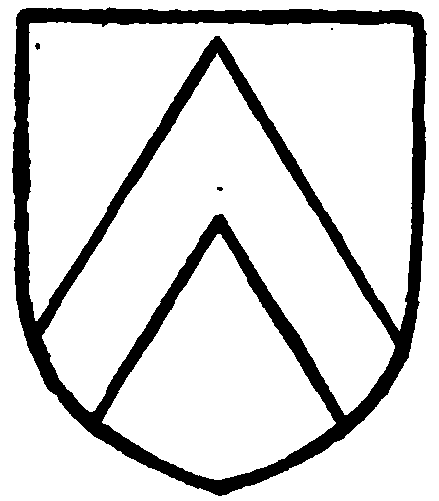
Stafford. Or a cheveron gules.
In 1528 John Bourchier Lord Berners, the translator of Froissart's Chronicle, was granted Upper Clatford and other manors, with the issues of the same, from September 1514. (fn. 51) Lord Berners died without legitimate male issue in 1533, and the barony fell in abeyance between his two daughters. (fn. 52) Upper Clatford came to the younger, Joan, who on her sister's death about 1550 became de jure Baroness Berners. She was the wife of Edmond Knyvett, sergeant porter to Henry VIII, who died in 1539, and in 1544 she sold the manor to John Scullard, (fn. 53) who, or another of his name, died seised thereof in 1590. (fn. 54) John Scullard, senior, and Agnes his wife, in 1611 conveyed the manor with its appurtenances in Upper Clatford and Andover and free fishery in the waters of Upper Clatford to George Scullard, (fn. 55) who in 1634, with his wife Jane and Brocas Scullard, quitclaimed the same premises to Thomas Coteele. (fn. 56) At this date the history of this manor is obscure.
It is known that Thomas Coteele's daughter and heir married Sir Richard Edgcumbe, of Mount Edgcumbe (fn. 57) (co. Cornw.), and a manor of Upper Clatford is found in the possession of their descendant George Viscount Mount Edgcumbe and Valletort in 1786. (fn. 58) However, in 1731, an estate also known as Upper Clatford, with which it is possible the Coteele moiety fused, (fn. 59) was the property of George Tarrant, who conveyed it to William Evans in 1733. (fn. 60) In 1747 Maynard Guérin and Thomas Gatehouse obtained a lease from Richard Lord Edgcumbe of a messuage in Upper Clatford called Poors for a term of ninety-nine years 'should George Tarrant now of Abbotts Ann, Thomas Gatehouse and Elizabeth Gatehouse happen to live so long.' In 1763 Sir Brian Broughton Delves, bart., contracted to buy the manor of Upper Clatford and several messuages and lands in Upper Clatford for £10,000, from the heirsat-law of Maynard Guerin and of Sir Thomas Gatehouse. (fn. 61) In 1769 Sir Brian's widow married Henry Errington, (fn. 62) who was living at Redrice House in 1778. (fn. 63) The subsequent descent of this estate is the same as that of Abbotts Ann (fn. 64) (q.v.), Captain Thomas George Best of Redrice House being the lord of the manor and the principal landowner in the parish.
Owing to the number of contemporary holders and the fact that no distinctive names were at that date applied to the different holdings the descent of the Upper Clatford lands in the 13th and 14th centuries must be to a certain extent conjectural. If, how ever, one may identify the St. Philiberts with the Spircoks of the Feudal Aids and other records the history of one property, which was later designated NORMAN'S COURT, will be greatly simplified. (fn. 65) In 1267 there was a suit as to whether Roger de Mortimer, the overlord, Hugh de Sutton, his bailiff, and others had unjustly disseised William de St. Philibert of his free tenement in Clatford and Andover, comprising a messuage and 2 carucates of land with appurtenances. William had committed felony by killing a man at Lesnes, in Kent, and had afterwards been outlawed for contumacy. Roger, as chief lord of the fee, had fined with the king and entered the premises as his escheat. Such was Mortimer's defence, and St. Philibert, who did not put in an appearance, was amerced. (fn. 66) This William de St. Philibert may have been the same who, being on the side of the barons at the defence of Dover Castle but making his submission after Evesham, had his lands restored to him in 1267. (fn. 67) Be that as it may, in 1275 Thomas de St. Philibert was making a life grant to Roger de St. Philibert of a messuage and 2 carucates and 10 virgates of land in Clatford, which was to revert to Thomas and his heirs. (fn. 68) Thomas Spircok appears in the Nomina Villarum of 1316 as one of the three holders of the vill. (fn. 69) Within ten years or so of that date Roger Norman had acquired property there, of which, however, he was not yet to have undisputed possession. At Easter 1330 the claims of John de St. Philibert and Roger Norman were being tried at the King's Bench. According to the plaintiff Thomas de St. Philibert was seised of the manor of Upper Clatford in the time of Henry III and died without issue, his heir being his uncle Hugh, brother of his father Roger; on the death of Hugh de St. Philibert the manor passed to his son and heir Hugh, whose son and heir was the plaintiff John. Norman denied that Thomas de St. Philibert died seised of the manor, but the jury found against him, he was amerced at £40 and John de St. Philibert recovered seisin. (fn. 70) What seems to be a sequel to this case occurred in the following September, when various persons, including John son of Thomas Spircok, and Thomas and Hugh his brothers, broke into Roger Norman's houses at Upper Clatford, carried off his goods and assaulted his servants. (fn. 71) The identity of the Christian names of these Spircoks with those of the St. Philiberts is noticeable, and the presumption that Norman had succeeded, lawfully or not, to the Spircok holding as he had to the St. Philibert (if the two be not identical) is strengthened by the Feudal Aid of 1346, where Thomas Sackville and he are entered as holding the quarter fee which had once belonged to Thomas Spircok, Clarice Sackville and the Earl of Gloucester. (fn. 72) It will be seen that the judgement given in 1330 as to the right of Roger Norman in Upper Clatford must have been reversed. In 1337 he was granted free warren there, (fn. 73) and died seised of the manor in 1349. (fn. 74) In the following year the manor was committed to the custody of Peter de Bridges during the minority of Giles, heir of Roger Norman. (fn. 75) Giles died in 1362 before coming of age, (fn. 76) and was succeeded by his cousin Margaret wife of John Chamberlayne and daughter of Agnes Norman, sister of Roger Norman, junior, his father. In 1363 Richard de Cavendish and Julia his wife, John de Glemsford and Beatrice his wife, and William Chamberlayne and Christine his wife conveyed the manor to Peter de Bridges, (fn. 77) and in 1391 Richard Becket and Alice his wife, as kinswoman and heir of Roger Norman, obtained an inspeximus and confirmation of the charter of free warren. (fn. 78) In the inquisition after Richard Becket's death, in which Upper Clatford is not mentioned, Alice is called daughter and heir of Richard Cavendish. (fn. 79) In 1395 Sir John Sandys and Joan his wife were dealing with the manor of Upper Clatford, (fn. 80) and in 1406–7 Sir Thomas Skelton was farmer, in the right of his wife, late the wife of Sir John Sandys. (fn. 81) In 1428 Walter Sandys, son and heir of John Sandys, held with Thomas Sackville a quarter of a fee which had formerly (i.e. in 1346) belonged to Thomas Sackville and Roger Norman. (fn. 82) This seems to indicate that the property of the Normans in Upper Clatford had passed to the Sandys family, probably before Richard Becket's death in 1411. According to the assessment of 1431 Sir Walter Sandys of Andover had a quarter of a fee to himself, (fn. 83) and in 1442 his son and heir Thomas Sandys died seised of land, a water-mill and a fulling mill in Clatford. (fn. 84) These premises were held by his second wife Sibyl until her death in 1446, (fn. 85) when she was succeeded by her son Sir William Sandys, who died seised thereof in 1496. (fn. 86) This Sir William was the father of William Sandys, K.G., first Lord Sandys of the Vyne, so created in 1523, whose possessions in Upper Clatford were in 1536 increased by a grant of the lands there that had belonged to Mottisfont Priory. (fn. 87) The Sandys family continued to hold their estate in Upper Clatford for another century. (fn. 88) In 1601 William third Lord Sandys let his waters, fish and fishing in Upper Clatford, Goodworth Clatford and Andover to Andrew Reade of Faccombe for ninety-nine years. (fn. 89) On his death in 1623 the manor passed to his son William fourth Lord Sandys, who died without issue in 1629. (fn. 90) It was then settled on Richard Atkins, son of his niece Mary, wife of Richard Atkins and daughter of Elizabeth suo jure Baroness Sandys. (fn. 91) About 1649 John Trott acquired a lease of the manor from Martha Acheson, wife of Richard Atkins, and his claims to the estate took the Committee for Compounding five years to decide. (fn. 92) The final judgement, however, appears to have been in Trott's favour, and the lease was evidently converted into absolute possession. Thus thirty years later the manor was in the hands of Sir Charles Shuckburgh, who had married as his first wife Catherine daughter and heir of Sir Hugh Stewkeley of Hinton, whose wife was daughter and heir of this John Trott, who had been created a baronet in 1661. (fn. 93) In 1681 Sir Charles conveyed the manor of Upper Clatford, together with Sackville's Court (vide infra), to Eleanor Rawlinson, widow, (fn. 94) who was perhaps the Eleanor Joyce, widow, who called John Rawlinson to warranty in 1721. (fn. 95) The Rawlinsons continued holding the two manors at least as late as 1817. (fn. 96) They were succeeded by the Lywood family, who resided at Norman Court until the close of last century. The site of the manor is marked by Norman Court Farm in the east of the parish on the left bank of the Anton.
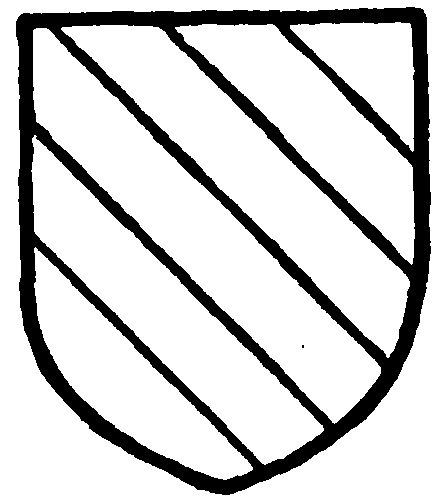
St. Philibert. Bendy argent and azure.
The second of the three holders under Richard Seward mentioned in the Testa de Nevill was Bartholomew de Sackville, whose family continued to hold land in Upper Clatford, known later as SACKVILLE'S COURT, for many generations, and gave its name to a separate manor. (fn. 97) In 1245, at which date only one manor was recognized, Bartholomew's portion was promised to Waleran the Teuton. (fn. 98) In 1316, however, Clarice Sackville had a third share in the vill, (fn. 99) and in 1346 Thomas Sackville and Roger Norman held a quarter fee. (fn. 100) Another Thomas Sackville was holding in 1428, (fn. 101) while three years later John Sackville of Henley-onThames was named as having one-eighth of a fee in Clatford. (fn. 102) In 1435 Sir Thomas Sackville and Anne his wife were parties to a fine concerning the manor of 'North' Clatford. (fn. 103) At some date, which cannot have been very long subsequent, these Sackvilles came to an end with an heiress Margery, who married Thomas Rokes. (fn. 104) The son and grandson of this match were sheriffs of Buckinghamshire in 1477 and 1486 respectively. (fn. 105) In 1508 Sir Richard Empson recovered the manor of Upper Clatford against Thomas Rokes, senior, and Alice his wife, and in 1511, the year after Empson's attainder, (fn. 106) his manor in Upper Clatford, by the name of Rokes' Manor, was granted in fee to Robert Knollys, gentleman usher of the chamber. (fn. 107) Peter Compton, who had possibly acquired the manor by a grant from Robert Knollys, died seised of the same in 1545, (fn. 108) and was succeeded by his son Henry, created Lord Compton in 1572, who died seised in 1589. (fn. 109) His son William, second Lord Compton, sold the manor and free fishery in 1592 to Arthur Swayne, (fn. 110) and in 1615 Edward, son of the latter, died seised thereof, leaving a brother and heir Robert, who five years later quitclaimed the manor of Upper Clatford alias Sackville's Court with free fishery, common of pasture and other premises to Thomas Younge, Richard Pope and Nicholas Blake and the heirs of Thomas. (fn. 111) There is in the Record Office calendar reference to a fine, of which the original is missing, levied in the Easter Term of 1627 or 1628, between W. Blake and others, demandants, and Sir John Philpott, knight, and others, defendants, the result of which was apparently to convey the manor to Philpott, for twothirds of this manor were among his possessions escheated for recusancy, and granted in 1628 to Edward Barnes for a term of forty-one years. (fn. 112) In 1630 William Goldwyer died seised of 'land in Upclatford, late parcel of the demesne of that manor and called Swayne's manor,' (fn. 113) which must have some connexion with the Swaynes who had recently held Sackville Court. William Goldwyer left a son and heir William, who in 1632 with his wife Sarah conveyed the manor of Upper Clatford to John Marke. (fn. 114) Sackville Court is next referred to in 1681, when it was in the same hands as the preceding manor, with which it continued to descend. The site of the manor is marked by Sackville Court Farm in the village near the church.
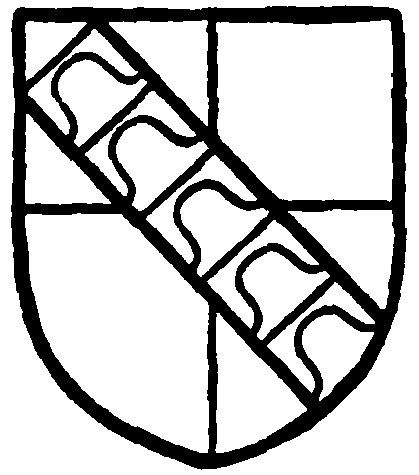
Sackville. Quarterly or and gules a bend vair.
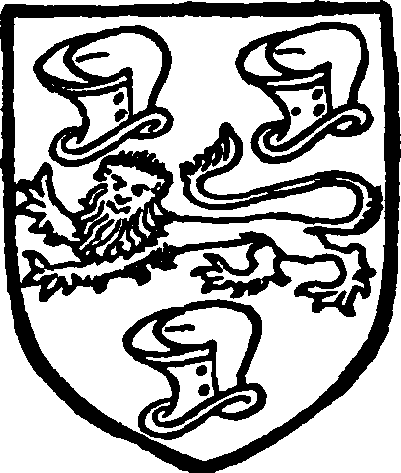
Compton. Sable a leopard or between three helms argent.
In 1086 there were three mills in Upper Clatford worth 57s. 6d. (fn. 115) A fulling mill and a water-mill went with the manor held by the Normans and afterwards by the Sandys. (fn. 116) When this manor became joined to Sackville's Court two water-mills and two fulling mills belonged to the property. (fn. 117) At the present time there are Clatford Mills on the Anton and a windmill in the western border.
Church
The church of ALL SAINTS consists of a chancel 14 ft. 1 in. long by 24 ft. wide with a modern sanctuary 15 ft. 10 in. long by 16 ft. wide, modern north vestry, nave 39 ft. 6 in. by 25 ft. 10 in., modern north aisle 10 ft. wide, south porch and west tower, 8 ft. 2 in. deep by 10 ft. 4 in. wide. All these measurements are internal.
The south walls of the nave and chancel probably belong to an aisleless church to which, at the end of the 12th century, a north aisle was added. The west tower seems to have been built, probably on the site of an older tower, in 1578, and early in the 17th century the nave and aisle were thrown into one, the chancel correspondingly widened on the north, and two bays of the north arcade set up between the nave and chancel in place of a single chancel arch. The tie-beams being of nearly 26 ft. bearing are strengthened by octagonal wooden posts down the middle of the nave.
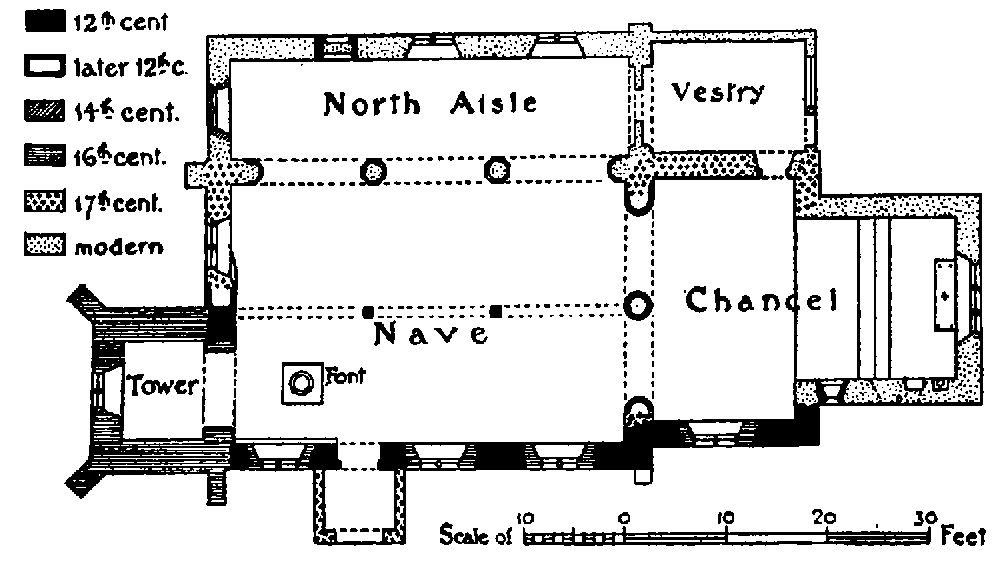
Plan of Upper Clatford Church
Since its rebuilding the church has been restored more than once; in 1890 the north aisle was also added and the eastern part of the chancel in 1894, while the vestry dates from 1903. The tower was restored in 1908.
The modern eastern part of the chancel has a three-light traceried east window and one of two lights on the south; below the latter are credence and piscina recesses, and to the west of it part of a late 12th-century window, which was in the former east wall. It has splayed inner jambs and a semicircular head, with a double external rebate in the head and jambs.
The older part of the chancel has a 17th-century south window of three round-headed lights, and its north wall, against which the organ is set, is pierced by a modern doorway into the vestry.
The arcade between the chancel and nave has a round column and half-round responds. The bases are either buried or missing; at the springing are grooved and hollow-chamfered abaci with a line of bead ornament in the hollow; the arches are roughly four-centred, of a single order with the angles cut off above the springing to fit them to the circular plan of the abaci.
The arcade between the nave and north aisle has three bays of 14th-century style. The three south windows of the nave are each of two lights with plain unevenly pointed heads and are probably of late 16th-century date, and the south doorway, between the second and third, has a single chamfered round arch, thickly colour-washed and of doubtful age. The oak door is old and plain with old wrought iron strap hinges.
The window in the west wall of the nave north of the tower has three uncusped lights with four - centred heads; the tracery appears to be old, but the inner jambs and arch are modern.
The aisle has two north windows, each of three lights. West of these a late 12th-century doorway has been reset; it has plain chamfered jambs and round arch; the abaci are grooved and hollow chamfered.
The west window of the aisle is also a piece of re-used old work, evidently not in its original form; it has two irregularly trefoiled lights and a trefoiled opening over in a two-centred head.
The tower is divided externally into two stages with low buttresses at the west angles and opens to the south-west corner of the nave by a modern arch set on 16th-century jambs. The west window is a small one of two round-headed lights and probably dates from the end of the 16th century. Over it, before the recent repair, were a small blocked light with jambs made up of the broken pieces of a 12th-century pillar piscina (now taken out and put together again) and parts of the head of a cinquefoiled 15th-century window (now on the sill of the west window below). The walling of the lower part of the tower is of flint with stone dressings, but the upper part has a weathered brick string and square-headed brick windows, doubtless dating from the work of 1578. The inner jambs are in some cases partly of stone, some of which are moulded with a sunk quarterround. In the north window of the belfry are two portions of an inscribed stone, apparently recording the building of the top part of the tower in 1578, with the names of the churchwardens.
It reads:—[Repaired in the Year of our]
The chamber is brick lined. The parapet is plain and has small crocketed pinnacles at the angles. The south porch is an 18th or early 19th-century one of brick plastered.
The roof of the nave is gabled and plastered below; it has three 17th-century trusses with moulded tiebeams, on each of which stand three wooden columns supporting the collar above, and moulded principal rafters; a moulded purlin runs down the middle of the ceiling. Two of the trusses are strengthened by octagonal 11 in. posts from the floor of the church. The chancel ceiling is also plastered, with a central ring of raised plaster work.
The font is a very charming piece of work with a shallow round bowl on a slender octagonal stem, of which unfortunately a small piece has been removed, to the great damage of its proportions. On the upper edge of the bowl, in letters inlaid with black composition, is 'Richard Greene of Winterborne Stoke gave this 1629.' The pulpit is of plain 17th-century workmanship with an octagonal sounding-board, and is set in the south-east corner of the nave. Beyond a few plain oak benches the rest of the furniture is modern.
There are no monuments earlier than the 17th century. The churchyard lies to the south and east of the church and has recently been enlarged. A fine avenue of pollard limes leads up to the south entrance from the lych-gate, and there is also a fine yew tree. The lych-gate dates from 1905.
There are four bells; the treble and tenor are by John Stares, 1744, and the second and third by Robert Cor of Aldbourne, 1700 and 1721.
The plate consists of a chalice of 1811 given by Maria Broughton in 1812, a paten of 1631, another of 1654 engraved with an imitation Elizabethan band given by Edward Frowd, rector, in 1852, and a flagon of 1895—all of silver.
The registers begin in 1571. The first book contains baptisms, marriages and burials to 1724, with some gaps; the leaves are of paper and they are now well bound. The second book continues the marriages to 1754 and the baptisms and burials to 1776; this is also all on paper. The third book repeats the last in parchment and continues the baptisms and burials to 1812. The fourth has the marriages from 1754 to 1812, and there is also a banns book for the same period. Two Commonwealth entries record the calling of the banns of two couples in 1656 in the market place of Andover on three several days, after which they were lawfully married; but a third couple who were married the following year had their banns published in the parish church.
Advowson
The church of Upper Clatford was given to the abbey of Lire, in Upper Normandy, by William Fitz Osbern Earl of Hereford, the founder. (fn. 118) With it, as appears from Domesday Book, went 3 virgates of land there and the tithe of the vill. (fn. 119) The Priors of Carisbrooke, as proctors for the Abbots of Lire in England, presented to the rectory, except in war-time, when the temporalities of foreign houses were in the king's hands. (fn. 120) In 1414, after the dissolution of the alien priories, Henry V granted practically all the English possessions of Lire, including the impropriation and advowson of Upper Clatford, to the prior and convent of his new foundation, the house of Jesus of Bethlehem at Sheen, (fn. 121) who presented until the Dissolution. (fn. 122) The patronage during the 16th century has not been discovered, but the rectory and advowson were granted to Edward Downing and Roger Rante in 1591 or 1592. (fn. 123) Sir Thomas Jervoise presented in 1627, and his descendants the Jervoises of Herriard had the advowson until the end of the 18th or the beginning of the 19th century. (fn. 124) The Rev. Edward Frowd, who became rector in 1830, also acquired the patronage, holding both living and advowson until 1863, when the Rev. Thomas Child became patron and incumbent. From him the advowson passed to the Rev. Alfred Child, and was acquired from Mrs. Child about 1891 by Mr. L. Sebastian. From him it shortly passed to Mr. W. S. Boyd, and is now held by Dr. S. S. Ashmore Noakes.
In 1291 the church was assessed at £10 with a pension of 10s.; while the abbey of Lire took £2 from separate portions, no doubt the 3 virgates mentioned in Domesday. (fn. 125) In 1534 it was valued, beyond reprises, at £22. (fn. 126)
A Primitive Methodist chapel was erected in 1883 and another in 1903.
Charities
In 1880 Mrs. Sally Hall Bradshaw by will, proved 26 August (among other charitable legacies), bequeathed £1,000 consols, the annual income to be distributed amongst poor parishioners on Ascension Day, the aged and infirm poor to be especially considered. The legacy, less duty, is represented by £900 consols, with the official trustees, by whom the dividends, amounting to £22 10s. a year, are remitted to the rector and churchwardens. In 1908 there were 30 recipients.