A History of the County of Hampshire: Volume 4. Originally published by Victoria County History, London, 1911.
This free content was digitised by double rekeying. All rights reserved.
'Parishes: Little Sombourne', in A History of the County of Hampshire: Volume 4, ed. William Page (London, 1911), British History Online https://www.british-history.ac.uk/vch/hants/vol4/pp480-482 [accessed 30 April 2025].
'Parishes: Little Sombourne', in A History of the County of Hampshire: Volume 4. Edited by William Page (London, 1911), British History Online, accessed April 30, 2025, https://www.british-history.ac.uk/vch/hants/vol4/pp480-482.
"Parishes: Little Sombourne". A History of the County of Hampshire: Volume 4. Ed. William Page (London, 1911), British History Online. Web. 30 April 2025. https://www.british-history.ac.uk/vch/hants/vol4/pp480-482.
In this section
LITTLE SOMBORNE
Sumburne (xi cent.); Parva Sumburn (xiii cent.); Parva Sombourne (xiv cent.); Lytell Sumbourne (xvi cent.).
The parish of Little Somborne, covering an area of 1,933 acres, lies on the main roads to Stockbridge from Basingstoke and Winchester. The land slopes downwards from west to east and north to south. Woolbury Ring in the north-west reaches a height of 500 ft. above the ordnance datum. Little Somborne House, occupied by Chevalier Guglielmo Marconi, is a modern structure surrounded by a park, south of which is the church of All Saints. The parish contains 1,004 acres of arable land and 266½ acres of permanent grass, while the woods and plantations cover 533 acres. (fn. 1) The soil is loam with a subsoil of chalk, and the chief crops are wheat, barley and oats.
Manors
At the time of the Domesday Survey there were two estates in LITTLE SOMBORNE, one formerly held by Godwin and then in the possession of Bernard Pauncefoot, (fn. 2) and another, which Ednod had held, then belonged to Waleran the Huntsman. (fn. 3) In 1166 Humphrey Pauncefoot held a fee and a half of the old feoffment of Humphrey de Bohun (fn. 4) and this included the estate in Little Somborne which had belonged to Bernard Pauncefoot in 1086. In the 13th century this estate was held for half a knight's fee by Arnulf de Mandeville of Lemuel Pauncefoot, who held of the Earl of Hereford (Bohun). (fn. 5) In 1361 it was said to be held of the Earl of Hereford for the annual service of one red rose, (fn. 6) but in 1396, the last year in which the overlordship is mentioned, Thomas Pauncefoot is given as the overlord. (fn. 7) This is explained by the fact that the honour of the Bohuns Earls of Hereford merged in the Crown in 1372–3.
By 1331 Arnulf de Mandeville had been succeeded by John Devenish of Winchester, of whom the manor was held at a fee-farm rent of £3 10s. (fn. 8) Who was the immediate tenant is uncertain, but he may possibly have been Robert Burbache, the predecessor of Henry Bradwey, who in 1346 was holding half a knight's fee in Somborne. (fn. 9) In 1361 Henry died seised of a messuage, a carucate of land, 16 acres of meadow and 6s. 8d. rent in Little Somborne. His son and heir John (fn. 10) died thirty-five years later seised of the premises described as a messuage, a carucate of land, 16½ acres of meadow and pasture for 700 sheep in Little Somborne. His only daughter and heir Katherine (fn. 11) possibly married the John Philip who in 1428 was holding half a knight's fee in Little Somborne which had belonged to Robert Burbache. (fn. 12) By the end of the 16th century the manor was in the possession of the family of Welles of Brambridge House, being held by Gilbert Welles in 1552–3. (fn. 13) This Thomas, son and heir of Gilbert, was in 1590–1 holding lands in Little Somborne which had belonged to John Philip, and before that to Robert Burbache. (fn. 14) From 1590 onwards the Welles family held Little Somborne (fn. 15) until by the will of Henry Welles dated 2 August 1762 (fn. 16) it passed to his cousin Walter Smythe. (fn. 17) The latter died in 1788, leaving a son Walter, on whose death without male issue the estate passed to his brother Charles. (fn. 18) The latter died in 1832, leaving as heir his niece Louisa daughter of his brother Walter. She married in the same year Sir Frederick Hutchinson Hervey-Bathurst, bart., (fn. 19) who died in 1881. His eldest son and heir Sir Frederick Thomas Arthur Hervey-Bathurst, bart., died in 1900, leaving a son and heir Sir Frederick Edward William HerveyBathurst, bart., the present lord of the manor.

Welles of Brambridge. Sable a cheveron ermine between three martlets argent.
The other estate was held by the descendants of Waleran the Huntsman until the close of the 13th century. In 1271–2 John Waleran granted one messuage, 2 carucates of land and £2 6s. 8d. rent in Little Somborne and Wallop to Robert son of John Waleran, to hold of John and his heirs for a rent of a pair of white (?silver) spurs or threepence at the Feast of the Nativity of St. John the Baptist. (fn. 20) Robert afterwards granted the premises to Oliver de Ingham, who in 1282 died seised of the same, held of Robert Waleran. (fn. 21) Oliver's son and heir John (fn. 22) was seised of the manor in 1294, (fn. 23) but he subsequently granted it to Robert Burbache for life. (fn. 24) He died c. 1308–9, leaving a son and heir Oliver, (fn. 25) who in 1318 granted the reversion of the manor after the death of Robert Burbache to Thomas de Byvedon and Joan his wife and the heirs of Thomas. (fn. 26) From this time the history of the manor is at present indefinite until 1533, when it belonged to Robert Gilbert, (fn. 27) whose son George died seised of the same in 1541, leaving a son and heir John. (fn. 28) From the latter it passed, probably by purchase, to William Waller, who died in 1616, leaving two daughters and heirs: Charity wife of Sir Thomas Phelipps, and Susan wife of Sir Richard Tichborne. (fn. 29) The manor for a time followed the same descent as Leckford Abbess and Abbotts (fn. 30) (q.v.), but its subsequent history is obscure. It is now probably merged in the manor of Little Somborne as owned by Sir Frederick Edward William Hervey-Bathurst, bart.
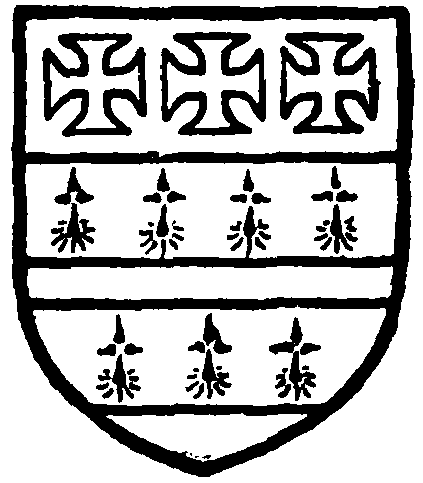
Hervey-Bathurst, baronet. Sable two bars ermine with three corsses forming or in the chief—quartered with Hervey.
There was a mill appurtenant to the manor in 1318. (fn. 31)
Other lands in LITTLE SOMBORNE were held by Arnulf de Mandeville for half a knight's fee of William Briwere as of his manor of Ashley (fn. 32) (q.v.). They were assigned at William Briwere's death in 1233 to William Percy, who had married Joan, one of the sisters and co-heirs of William Briwere. (fn. 33) From him they passed to his daughter Joan wife of John Farlington, (fn. 34) who granted them to Mary de Hoyville for life. (fn. 35) Mary continued to hold them until 1326, (fn. 36) when they escheated to the Crown as parcel of the manor of Ashley (fn. 37) (q.v.). Edward III granted them with the manor of Ashley to Hugh le Despenser, the elder son of Hugh le Despenser the younger, in 1334. (fn. 38) From this date they descended with the manor of Ashley until 1571, (fn. 39) when they were alienated by Edward Bellingham, lord of, Ashley, to William Waller, (fn. 40) and were probably merged in the manor of Little Somborne.
Church
The church of ALL SAINTS consists of a chancel and nave in one range 44 ft. 8 in. long and 14 ft. wide with a wooden bell-cot over the west end. The west end and part at least of the side walls are of pre-Conquest date, with long and short quoins at the western angles and a pilaster strip on the north wall. The other architectural features point to a late 12th-century date, and the blocked arch at the east of the building, formerly opening to a chancel which is now destroyed, suggests that the chancel was of that date.
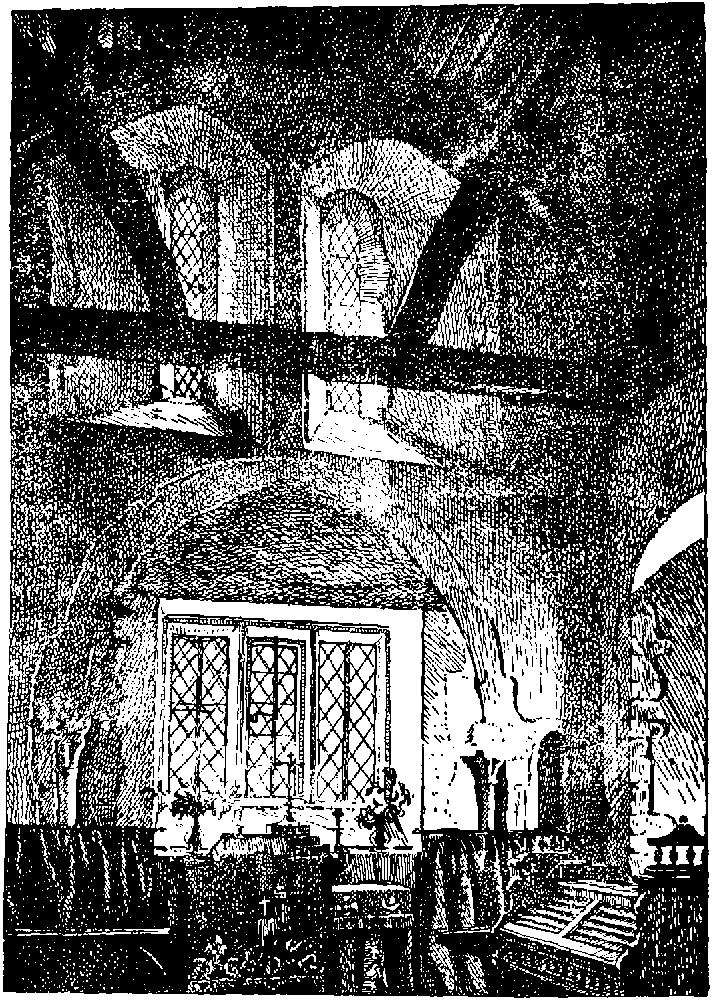
Little Somborne Church: Interior Looking East
The east window, set in the blocking of the chancel arch, is of three square-headed lights with hollowchamfered jambs, mullions and head, and is of late date. The old chancel arch is pointed and was probably of two square orders; the outer has circular jamb-shafts with slender scalloped capitals of a late type. Above are two lancets very much restored, the head of one being modern; they were doubtless originally in the chancel. A little to the south of the chancel arch is a small round-headed image niche probably of the same date as the arch. In the north wall is a single light of 12 th-century date. The splay is fairly wide, and has a round head, while the outer opening is square-headed and has a well-cut external rebate; it seems to be of late 12th-century date. West of this is the north door, now blocked, with a square head and chamfered jambs; the door is of the same date as the window, but the chamfer may have been cut later. About 11½ ft. from the north-west angle of the church, on the outside of the north wall, is the pre-Conquest pilaster strip already referred to. The projecting portion is 6¾ in. wide and projects about 2½ in. from the face of the plaster of the wall. The joints are rather close and the alternate stones are bonded to the wall. The material is Binstead stone from the Isle of Wight, as usual in early work in the county, and the western angles are in the same stone, as is most of the 12th-century work.
At the south-east of the church is a 13th-century lancet of some size and with a wide splay; externally it is chamfered and rebated for a wooden frame. West of this is a 12th-century window nearly opposite, and exactly similar to that in the north wall. The south door is placed about 3 ft. west of the centre of the wall. It is of late 12th-century date with a round head of one slightly chamfered order with a chamfered label and abaci. In the western half of the south wall is a modern squareheaded single light.
The west window is of two trefoiled lights with a quatrefoil over and is a late 14th-century insertion.
The bell-cot is a small weatherboarded and tiled structure partly supported by a roof principal and partly by modern posts. It is quite plain and devoid of detail from which its date might be deduced. The same may be said of the roof, of which the bell-cot really forms a part, and which, though a good deal restored, has old tie-beams and strutted purlins with wind braces. It is ceiled with modern match-boarding.
The fittings are all modern, including the font, which is circular and quite plain, and there are no monuments of any interest.
The bell-cot contains one bell dated 1604.
The plate and registers are included with those of King's Somborne.
Advowson
The advowson of the church of LITTLE SOMBORNE was granted by John Briwere brother of William Briwere the elder to the Prior and convent of Mottisfont, and the grant was confirmed by King John in 1204. (fn. 41) Little Somborne at the present day is a chapelry annexed to the church of King's Somborne.