A History of the County of Hampshire: Volume 4. Originally published by Victoria County History, London, 1911.
This free content was digitised by double rekeying. All rights reserved.
'Parishes: Stockbridge', in A History of the County of Hampshire: Volume 4, ed. William Page (London, 1911), British History Online https://www.british-history.ac.uk/vch/hants/vol4/pp483-486 [accessed 6 May 2025].
'Parishes: Stockbridge', in A History of the County of Hampshire: Volume 4. Edited by William Page (London, 1911), British History Online, accessed May 6, 2025, https://www.british-history.ac.uk/vch/hants/vol4/pp483-486.
"Parishes: Stockbridge". A History of the County of Hampshire: Volume 4. Ed. William Page (London, 1911), British History Online. Web. 6 May 2025. https://www.british-history.ac.uk/vch/hants/vol4/pp483-486.
In this section
STOCKBRIDGE
Le Street (xii cent.); Stocbrug (xiii cent.); Stocbrigg (xiv cent.); Stokbrigge (xv cent.).
The parish of Stockbridge is north-east of King's Somborne on the main road from Winchester to Salisbury. It covers an area of 1,323 acres (fn. 1) of lowlying country which rises to a height of 500 ft. above the sea-level on Stockbridge Down in the east of the parish. As in the 12th century, the town consists of one long wide street, and it is to this characteristic that it owed its early name of The Street. This street crosses the River Test at the junction of the parishes of Stockbridge and Longstock by a bridge of three arches rebuilt and widened in 1799, concerning which a wit remarked that it is built so low that the ducks have to bend their heads in passing under it. Sir Thomas Gatehouse in his Survey of Hampshire (1778) (fn. 2) quotes the following inscription which was then on the bridge, but was probably removed in the repairs of 1799: 'Say of your cheryte a pater noster and an ave for the sowllys of John Gylinges otherwise said Lokke and Richard Gatin and Margaret the wyf of the aforesaid John and Richard, founders and makers of the bridge, on whose sowllys God have mercy.' The town is of little architectural interest, but one house on the south side of the main street is noteworthy for its door of six panels of linen pattern, nine folds to each panel. Being in the main road to the south-west Stockbridge has come into prominence on more than one occasion. It was the scene of the capture of Robert of Gloucester by William of Ypres in 1141. (fn. 3) Edward I stayed here in August 1294, (fn. 4) and James II on his way to Salisbury to meet the forces of the Prince of Orange dined at the Swan Inn in November 1688. (fn. 5) Warner in 1795 describes Stockbridge as a 'noted thoroughfare with some good inns . . . . but a declining place.' (fn. 6) It is now noted only for the excellence of the fishing in the Test. There is a local fishing club known as the Houghton Fishing Club, the meetings of which are held at the Grosvenor Hotel. The Stockbridge Races, discontinued since 1898, were held every June on Danebury Hill, about three miles north-west of the town.
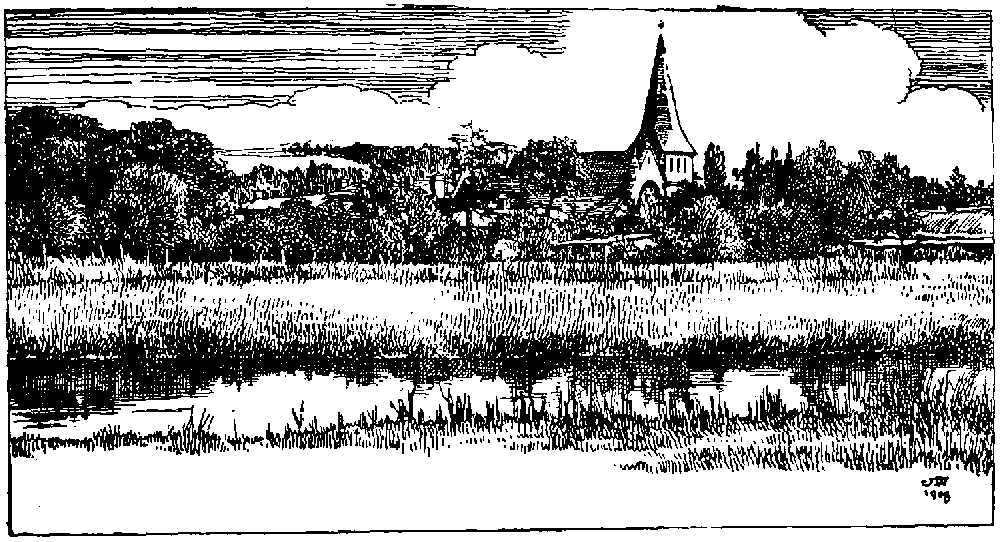
Stockbridge from the North-west
South of the town between the railway and the Marshcourt River, a tributary of the Test, is Common Marsh, probably marking the site of the manor or farm of Marsh Court in Stockbridge which in the reign of Elizabeth was in the possession of the Skilling family. (fn. 7)
Stockbridge has a station on the Andover and Redbridge branch of the London and South Western Railway. There are 662 acres of arable land, 441¾ acres of permanent grass and 5¼ acres of woods and plantations in the parish. (fn. 8)
The following place-names occur: Grovemede (xv cent.) (fn. 9); Horemede, Misleden, Kingsmede, Kings Acre, Le Plash (xvi cent.) (fn. 10); three cottages called the Lady Houses (xvi cent.) (fn. 11); and an inn called The Angell (xvii cent.). (fn. 12)
Borough
Stockbridge is a mesne borough, its descent being identical with that of the manor of Stockbridge (q.v. infra). It owed its early importance to a grant by Richard I to William Briwere of a weekly market in 'The Street' parcel of King's Somborne Manor. (fn. 13) King John confirmed this grant in 1200, (fn. 14) and twenty-one years later King Henry III granted William Briwere the younger the privilege of holding a fair on the feast of the apostles Peter and Paul and the days before and after in his manor of Stockbridge. (fn. 15) The inhabitants apparently never obtained a charter of incorporation. They elected the bailiff and other municipal officers at the court leet of the manor (fn. 16) and by prescriptive right received the profits of courts, tolls,&c., accounting only for the rents of assize to the lord of the manor. (fn. 17) The town seems to have increased in importance until the middle of the 15th century, but suddenly, for some unknown reason—probably from visitations of the plague—the place became almost deserted and the poverty of the remaining inhabitants was so great that the market which had been confirmed to the town by Henry V and Henry VI was discontinued. (fn. 18) However, in the reign of Henry VII the bailiff, tenants and inhabitants of Stockbridge complained that a certain William Middleton, probably as lessee of the borough under the Crown, had several times vexed them by taking by force goods to the value of 10 marks from one Henry Glover, a felon, also '2 hoole brode clothes' which were stolen and brought to Stockbridge, also a horse and two oxen in the same way, and the goods of John Nupert, clerk, curate of Stockbridge and a felon. (fn. 19) The result of the suit is not given, but it is probable that the inhabitants were successful and that the condition of the borough was improving, since the inhabitants were strong enough to make so decided a stand for their rights. In the reign of Edward VI there were fifty-eight burgages in Stockbridge, (fn. 20) and the later prosperity of the town can be judged from the fact that Queen Elizabeth granted the burgesses the right of sending two members to Parliament in 1562–3, (fn. 21) while thirty years later she regranted to them their weekly market. (fn. 22) Elections at Stockbridge were notoriously corrupt, and a private Bill for the disfranchisement of the borough was introduced in 1693, but was negatived at the third reading. (fn. 23) In 1713 a certain Richard Steele was elected one of the representatives, but a year later, being charged with bribery and the writing of seditious pamphlets, he was expelled from the House. (fn. 24) Finally the borough was disfranchised by the Reform Act of 1832, (fn. 25) and the court leet, which existed solely for the purpose of electing a bailiff to act as returning officer of the parliamentary borough, was discontinued. (fn. 26)
The market, confirmed to Stockbridge by Charles I in 1641, fell into disuse during the latter half of the 19th century. (fn. 27) Three fairs existed into the middle of the 19th century—on 10 July, Holy Thursday and the last Thursday in October. Only one survives, that for sheep and lambs held on 10 July.
Manor
STOCKBRIDGE was probably included in the royal manor of King's Somborne at the time of the Domesday Survey, (fn. 28) for it was afterwards called a member of the same. (fn. 29) Thus it was included in the grant of King's Somborne to William Briwere in the reign of Richard I, (fn. 30) and followed the descent of that manor (q.v.) (fn. 31) until 1399, when Henry of Lancaster became King of England, and the two manors merged in the Crown possessions.
In 1402 the king granted Stockbridge to John Perient for life. (fn. 32) The rents of assize were leased in 1689, 1705 and 1735 successively to Thomas Neale, Robert Price and Uvedale Price. (fn. 33) The king was still lord of the manor in 1778, when the rents of assize, amounting to £5 10s. 11d., were payable to the lessee of the manor. (fn. 34) It passed subsequently to Joseph Foster Barham, for many years member for Stockbridge, (fn. 35) who held it in 1830 (fn. 36) and died in 1832. (fn. 37) He was followed by his son John Foster Barham, (fn. 38) whose widow was holding the manor in conjunction with her second husband, George Earl of Clarendon, (fn. 39) in 1839. (fn. 40) Before 1867 the manor had passed by purchase to George Gammie Maitland, (fn. 41) who soon afterwards sold it to Charles Warner of Northlands, Winchester. (fn. 42) From the latter it was purchased by Francis Hardinge, the owner in 1880. (fn. 43) The present lord of the manor is Mr. R. P. Attenborough, who bought the estate in 1902 from Mr. Hicks Withers Lancashire. (fn. 44)
William Briwere the younger granted the mill of Stockbridge with its appurtenances and 40 acres of land in the same vill to the Prior and convent of Mottisfont, (fn. 45) who about the same time acquired a messuage in Stockbridge and 11 acres of meadow in the marsh of Stockbridge which Ralph de Bray had of the gift of William, and a burgage in Stockbridge formerly belonging to Adam le Taillur. (fn. 46) They obtained other small grants of land there at various times, (fn. 47) and in 1291 their property in Stockbridge and Longstock was assessed at £5 6s. 8d. (fn. 48) This land was at the Dissolution granted in 1536 under the name of Stockbridge Manor to William Lord Sandys, (fn. 49) and from this date followed the descent of Longstock Harrington (q.v.), (fn. 50) until as late at least as 1786. The further descent of this estate is unknown, but the land represented by it is probably in the possession of the Attwood family, who own a considerable area in the parish.
Briwere's descendant, Patrick de Chaworth, erected another mill at Stockbridge to the damage of one William Fowell, a burgess of Stockbridge, who, however, in 1259 released his claim for damage to the heirs of Patrick. (fn. 51) In 1548 William Thorpe, lord of Leckford Abbotts, died seised of a water-mill in Stockbridge. (fn. 52)
Churches
The church of ST. PETER consists of a chancel with north vestry and organ chamber formed by a prolongation of the north aisle, a nave of three bays with north and south aisles and north and south transepts, and a south-west tower, surmounted by a shingled spire, the lower part of which forms an entrance porch. The church is entirely modern, but a number of windows from the old church have been restored and incorporated in the new structure.
These include two of late 12th-century date. One of these, serving as the west window of the north aisle, is of two lancet lights with a circular light over and an external label with grotesque animal drips. The second, the east window of the south transept, is somewhat similar but of more advanced design. In the splay, on either side, are two trefoiled image niches. The east window of the vestry is also an old one, and is of three trefoiled lights with net tracery of mid-14-th-century date. In the north aisle are also three late 14th-century windows, one of three, the others of two trefoiled lights, with cusped spandrel lights and square heads, and there is one similar window in the south aisle.
The roofs, seating and fittings are all modern except the font, which is of Purbeck marble and a good deal defaced. It has a square bowl with remains of an arcade, in low relief, of round arches. The stem is round and rather short and the base square, both being quite plain.
Preserved in the church is a small stone gable cross on which is carved a rood of 15th-century date, the figure being rather crudely worked in low relief. Inserted in the vestry walls are also a number of small corbel heads of 15th-century date.
The tower contains six bells. The treble, second and fourth are modern or recast. The third, fifth and sixth were cast by Samuel Knight of Reading in 1691.
The plate consists of a silver-gilt chalice and two patens of 1697, given by George Pitt of Stratfieldsaye and Thomas Jervoise of Herriard, a pair of silver chalices of 1805 and 1813 and a silver flagon of 1879.
The registers are in four books, the first containing baptisms and burials from 1663 to 1768 and marriages from 1663 to 1754; the second, a transcript of the first, containing baptisms and burials from 1698 to 1812 and marriages from 1698 to 1754; the third containing marriages from 1754 to 1794, and the fourth those from 1794 to 1811.
Only the chancel of the old church remains, now occasionally used as a mortuary chapel. It is 24 ft. 8 in. long and 15 ft. 6 in. wide, and is of early 13th or possibly late 12th-century date. A south chapel appears to have been added early in the 13 th century, and a new chancel arch inserted in the latter part of the same century. The only window remaining is to the east, a late one of two trefoiled lights under a square head set in the blocking of an earlier pointed one. In the north wall are two blocked pointed windows possibly of 14th-century date. On the north is a small pointed niche, and just below it a very small piscina with a broken basin. West of this is a blocked-up opening of uncertain date with a rounded head on one side and a wooden lintel externally; it is rather low, does not reach to the ground, and was apparently a squint from the south chapel. In the western half of the south wall is a blocked arch of early 13th-century date of two-centred form and two chamfered orders with plain hollow-chamfered abaci finished with a bead. The chancel arch is also two-centred and of two chamfered orders. The capitals are simply moulded and undercut, the returns being stopped by a beautifully carved grotesque beast which holds in its mouth the end of the astragal. A portion of a moulded base also remains. Inserted in the blocking of the arch is an early 15th-century door moulded with two double ogees separated by a hollow.
The roof is ceiled to the collars in plaster and is of late date, and no seating remains. The old communion rails are in position. They are of 17th-century date and of flat baluster form and are returned to form a square inclosure. A 17th-century table also remains. On the front and back is inscribed, 'Iohn Hammen 1696 ' and on the ends 'R. R. 1696.'
A painted achievement of the royal arms also remains bearing the initials G. R., and the date, 1726.
In the churchyard is a tombstone to a local
worthy, John Bucket, sometime landlord of the
King's Head Tavern, who died in 1804, with the
following ingenious verse:—
And is alas poor Bucket gone?
Fare-well, convivial honest John.
Oft at the well by fatal stroke
Buckets, like pitchers, must be broke.
In this fame motley Shifting scene
How various have thy fortunes been,
Now lifted high, now sinking low,
To-day thy brim would overflow;
Thy bounty then would all supply,
To fill& drink& leave the dry;
To-morrow sunk, as in a well,
Content, unseen with truth to dwell;
But high or low or wet or dry
No rotten stave could malice spy,
Then rise, imortal Bucket, rise
And claim thy station in the skies.
Twixt Amphora and Pisces shine
Still guarding Stockbridge with thy sign.
Advowson
Stockbridge was a chapelry dependent on the parish church of King's Somborne until about 1848, when it was constituted a separate benefice as a perpetual curacy. (fn. 53) The living is now a rectory in the gift of Mrs. Vaudrey Barker-Mill.
One Richard Fromond had licence between 1323 and 1333 to hear divine service in his oratory at Stockbridge. (fn. 54)
There is a Congregational chapel at Stockbridge, built in 1817, and there are also Primitive Methodist and Baptist chapels.
Charities
Church Lands.—The land formerly constituting endowment has been sold and the proceeds invested in £586 17s. 6d. consols. The dividends, amounting to £14 13s. 4d. a year, were distributed in bread among 40 poor persons.
Oliver Oliver by will, proved in 1873, bequeathed £100 consols, the dividends to be applied by the rector and churchwardens in the distribution of bread on St. Thomas's Day.
The Independent Chapel.—Miss Rebecca Welman, by will proved in 1842, bequeathed £1,058 2s. 9d. India 3½ Per Cent. Stock, the dividends amounting to £37 1s. to be paid to the minister of the chapel scheme (as to trustees) 19 January 1883. The several sums of stock are held by the official trustees.