A History of the County of Hampshire: Volume 4. Originally published by Victoria County History, London, 1911.
This free content was digitised by double rekeying. All rights reserved.
'Parishes: Fordingbridge', in A History of the County of Hampshire: Volume 4, ed. William Page (London, 1911), British History Online https://www.british-history.ac.uk/vch/hants/vol4/pp567-577 [accessed 30 April 2025].
'Parishes: Fordingbridge', in A History of the County of Hampshire: Volume 4. Edited by William Page (London, 1911), British History Online, accessed April 30, 2025, https://www.british-history.ac.uk/vch/hants/vol4/pp567-577.
"Parishes: Fordingbridge". A History of the County of Hampshire: Volume 4. Ed. William Page (London, 1911), British History Online. Web. 30 April 2025. https://www.british-history.ac.uk/vch/hants/vol4/pp567-577.
In this section
FORDINGBRIDGE
Forde (xi and xiii cent.); Fordingeburg, Forthingebrigg (xiii cent.).
Fordingbridge, a large parish on the borders of Dorset and on the banks of the River Avon, includes the hamlets of Bickton, Burgate Stuckton and Midgham with Sandle Heath. It contains 6,303 acres, of which 2,471½ acres are arable land, 2,440¾ are permanent grass and 723¾ are woods and plantations. (fn. 1) The soil is mixed, on a subsoil of gravel, clay and sand. The land rises generally east and west from the valley of the Avon from about 84 ft. above the ordnance datum to 181 ft. in the west and 267 ft. in the east. Sandhill Heath was inclosed in 1865. (fn. 2) The main road from Salisbury to Ringwood crosses the Avon at Fordingbridge, where it is joined by the main road from Southampton.
The town is on the right bank of the Avon; St. Mary's Church and the vicarage are at the extreme south of the High Street, and the Town Hall, built in 1879, is almost in the centre. About a mile west of the town is Fordingbridge Station on the London and South Western Railway.
From the 13th to the 15th century Fordingbridge was governed by a bailiff, (fn. 3) but after the last date he was replaced by a constable chosen yearly at the court leet of the manor of Nether Burgate. (fn. 4) The constable was the chief officer until 1878, when government by Local District Council was established. A fire in the town in the 18 th century destroyed many of the houses, which were never rebuilt, but it does not appear that Fordingbridge was ever very important. However, its trade was more extensive before the introduction of railways, since its bridge brought much traffic through the town. The bridge was evidently built before 1252, when the bailiff and men of the town received a grant of pontage for one year (fn. 5) towards its repairs in consideration of the traffic, and because the bridge would 'shortly suffer ruin unless a helping hand provide a remedy.' Several similar grants followed, the last being dated in 1452. (fn. 6) A custom which survived until 1840 (fn. 7) obliged the lord of Fordingbridge during one summer month known as 'fence month' to keep the bridge guarded and arrest anyone found taking venison from the Forest. (fn. 8)
The chief industries of the town at the present day are the manufacture of sailcloth and canvas and the making of bricks and tiles, while the various flourmills, an iron foundry and the Neave's food works also afford employment. Cloth was made here in the 16th century, (fn. 9) and in the 19th century there were factories for the manufacture of sailcloth and canvas and the spinning of flax. (fn. 10) The lord of the manor had a market, evidently by prescription, before 1273, when the court of the market was said to be worth 20s. a year. (fn. 11) It was held weekly first on Saturday and then on Friday until the middle of the 19th century, when owing to its insignificance it was discontinued. A fair is still held on 9 September.
Burgate House (Mr. John Coventry) and Packham House (Mrs. Foley) are in the parish. Fordingbridge was visited by Edward I in 1285. (fn. 12) Roman coins have been found at Godshill, where there are also remains of an ancient encampment. Nathaniel Highmore the physician and Charles Reeve the architect were born at Fordingbridge. (fn. 13)
The ecclesiastical parish of Hyde, including the hamlets of Blisford, Frogham, Hungerford and North Gorley, was formed from Fordingbridge in 1855. The township of Ashley Walk, including Godshill Wood and Inclosure, Ashley Lodge, Mudmore, Ogdens, Amberwood, Eyeworth Lodge, Miller's Farm and Greenhouse Farm, formerly extraparochial, was formed in 1868, and is for the most part in the New Forest. It contains 8,400 acres, of which 1,042 acres are woods and plantations (exclusive of the land in the New Forest), 109 acres arable land and 121 acres permanent grass. (fn. 14)
Woodgreen, which in 1831 was an extra-parochial district in Godshill tithing, is now a small civil parish containing 47 acres.
Manors
The overlordship of FORDINGBRIDGE belonged at the time of the Domesday Survey to Robert the son of Gerald, (fn. 15) who also held the Middle and South Manors of South Tidworth (q.v.), (fn. 16) the descent of which it continued to follow. Before the Conquest Alwi held Fordingbridge of King Edward as an alod, but by 1086 he had been succeeded by a certain Robert. (fn. 17) At the beginning of the 13th century it was held by Hugh de Linguire, who, dying c. 1231, left a niece and heir Alice daughter of his brother Philip de Linguire and wife of William de la Falaise. (fn. 18) From this date Fordingbridge has followed the descent of Rowner (q.v.). (fn. 19)
In 1280 William le Brune claimed a market, pillory, tumbril and assize of bread and ale in Fordingbridge. (fn. 20) His right to the last-named privilege was disputed by Bevis de Clare, the parson of Fordingbridge, who took the amendment of the assize from the tenants of the church. The case was tried before the justices in eyre, and was decided in favour of William le Brune, who obtained a confirmation of the privilege from Edward I in July 1281. (fn. 21)
Two water-mills on the 'little water of Afford' (fn. 22) were parcel of the manor of Fordingbridge from the 11th to the 16th century. (fn. 23) In Elizabeth's reign 'two ancient water-mills and an ancient streame of water' were held of Henry Brune by William Osborne, who complained that a certain John Barter had altered the course of the stream to turn a new mill set up on his copyhold lands within the manor. (fn. 24)
There is still a mill, now known as the Town Mill, on the Ashford Water.
Before the Conquest a certain Chetel held BICKTON (Bichetone, xi cent.; Bikston, xiii cent.; Byketon, xiv and xv cent.; Byckton Romsey, xvi cent.; Bicton alias Bishton, xvii cent.) of King Edward as an alod, but in 1086 it had passed to Hugh Earl of Chester, and was held of him by Hugh Maci. (fn. 25) The overlordship in the 13th century, when it is next mentioned, belonged to the Earl of Salisbury, (fn. 26) and as late as 1641 the manor was said to be held of the king as of the earldom of Salisbury. (fn. 27)
The 13th-century representative of Hugh Maci was Richard Fitz Aucher, (fn. 28) who met with a violent death in 1253, apparently at the hands of a certain Peter de St. Hilary. (fn. 29) Henry Fitz Aucher, probably his son, (fn. 30) died about 1303, leaving a son Aucher, (fn. 31) who in 1349 received from Sir John Rivers a release for himself and his tenants of Bickton from all amercements in court and all services due in the hundred of Fordingbridge. Aucher died before 1343, when his son John and Margery his wife were in possession. After 1346 (fn. 32) John was succeeded by Aucher, probably a son, who is said to have left two daughters Christine and Elizabeth. (fn. 33) At the beginning of the 15th century the manor belonged to a certain Arthur Frank, whose only son and daughter Richard and Elizabeth both died childless during his lifetime, so that on his death about 1421 he was succeeded by Richard Romsey, (fn. 34) on whom he had already settled the reversion. The latter, after holding for forty years, left it to his son John, (fn. 35) during whose tenure an unsuccessful claim was put forward by Edward Lane and Egidia his wife, who claimed to be a descendant of Christine daughter of Aucher. (fn. 36) John Romsey died in 1494, and his son and heir John (fn. 37) in 1503. William, (fn. 38) son and heir of John, whose only son Richard predeceased him, left two daughters and heirs, Anne wife of Thomas Bartholomew, on whom he settled Bickton, and Radigund wife of Thomas Dix. (fn. 39) An annuity of £8 from the manor was settled on Henry Dix, son of Thomas and Radigund, in 1560, (fn. 40) and another similar annuity on Elizabeth, widow of William Romsey, and afterwards wife of Arthur Bulkeley. Owing to the non-payment of the latter annuity a dispute arose in the early 16th century, Thomas Bartholomew and Anne complaining that Arthur Bulkeley and others had entered their manor-house of Bickton, broken down their hedges and gates, driven away their cattle and taken away 'a greate bell hanging in the roffe of the said manor-howse wyche of a veri long tyme hadd hanged there and used as a warnyng bell when any daunger of enemyes fyer or theves were abought the seid howse.' (fn. 41) William Bartholomew, son of Thomas and Anne, succeeded them in the manor (fn. 42) and left it before 1596 to his son Richard. (fn. 43) The latter sold it in 1632 to John Davenant, Bishop of Salisbury, (fn. 44) who died in 1640, leaving it to Edward son of his elder brother Edward. (fn. 45) Edward Davenant appears to have settled Bickton in his life-time on his eldest son John, who in 1664 mortgaged it to a certain John Mynne of Lincoln's Inn. (fn. 46) John Davenant, dying before his father in 1671, made a request that his father would buy back the manor and pay off his debts. (fn. 47) Accordingly the manor passed to John Davenant's eldest son John, who was High Sheriff of Wiltshire in 1686, and was succeeded by a son Edward. (fn. 48) The latter, like his grandfather, was involved in financial difficulties and left his property heavily mortgaged to his three sisters Rebecca, Catherine and Elizabeth. (fn. 49) Bickton seems to have become the property of Rebecca, who with her husband Thomas Hooper sold the manor in 1744 to John Castell. (fn. 50) It was purchased from the latter by Sir Eyre Coote in 1766, (fn. 51) and has passed with West Park (q.v.) to the present Sir Eyre Coote.
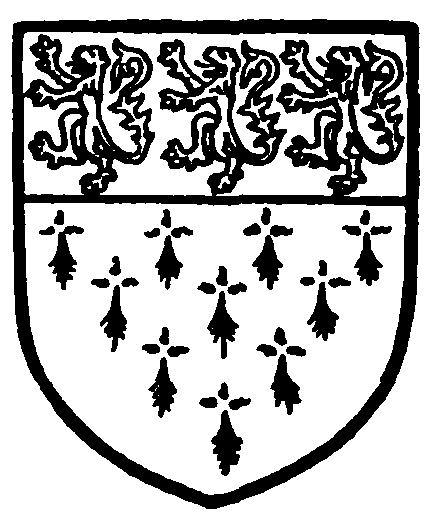
Fitz Aucher. Ermine a chief azure with three lions or therein.
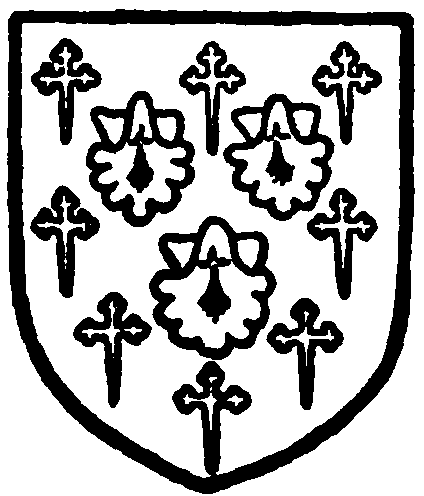
Davenant. Gules three scallops ermine between eight crosslets fitchy or.
One or more mills always belonged to the manor of Bickton, (fn. 52) but only one exists at the present day.
Fishing rights also belonged to the lords of the manor in the 16th and 17th centuries. (fn. 53)
The manor of NETHER BURGATE belonged to the king at the time of the Domesday Survey. (fn. 54) It was granted by Henry II to Manser Bisset, (fn. 55) from whom it descended with Rockbourne (q.v.) to John Bisset, on whose death in 1241 it was assigned to his eldest daughter and co-heir Margery the wife of Richard Rivers. (fn. 56) Margery died in 1255–6, and Henry III then granted the manor to Philip Basset in custody during the minority of her son John. (fn. 57) John Rivers died in 1293–4, (fn. 58) and in the same year the king took homage of his son and heir John Rivers. (fn. 59) This John alienated the manor of Burgate and the hundred of Fordingbridge to his sister Joan in 1310–11, who with her husband, Sir William Tracy, made good her right against her nephew John, son and heir of the last-named John, (fn. 60) at a later date, (fn. 61) and John Tracy, her younger son, was holding the manor in 1339. Two years later he settled the reversion on Thomas de Langley and Margaret his wife, possibly daughter of John. (fn. 62) The former was living in 1361, (fn. 63) but had apparently died before 1364, when the manor was granted in custody to Richard de Pembridge, (fn. 64) and two years later to Richard and his heirs. (fn. 65) Richard, then a knight, died in July 1375, and on the death of his only child Henry a few months later (fn. 66) the manor was divided between Richard de Burley and Thomas atte Barre, sons respectively of the two sisters and heirs of Sir Richard, Amice and Hawise. Thomas, reserving a yearly rent, gave up his share to Richard de Burley, (fn. 67) who in 1386 settled the whole manor on himself and his wife Beatrice with remainder in default of issue male to Sir Simon Burley, to whom it passed on his death a few years later. (fn. 68) After the execution of Sir Simon, the favourite of Richard II, in 1388 the manor again fell to the Crown, (fn. 69) and in 1390 was granted to William de Lekhull and Katherine his wife, who as greatgranddaughter and heir of the first John Rivers and Maud his wife, claimed it after Sir Simon Burley as heirs of Richard Burley under the settlement of 1386. (fn. 70)
Fifteen years later Katherine and her second husband John Hall complained that Sir Richard Arundell and others had violently seized the manor and goods worth £190 11s. with £10 in money and all their title deeds and three bonds for £260, and had bound one of their servants and thrown him into the Avon. (fn. 71) John Hall, who survived his wife, held the manor until his death in 1433–4, (fn. 72) when it passed to her eldest son, John de Lekhull, who took the name of Rivers. (fn. 73) He is supposed to have been murdered by two of his servants. (fn. 74) His kinsman William Bulkeley of Eyton (co. Ches.) was returned as his heir, (fn. 75) but it appeared afterwards that he left a brother Thomas Lekhull alias Rivers, to whom William Bulkeley and his son Thomas surrendered the manor in 1442. (fn. 76) In the following year Thomas settled the reversion of the manor on Thomas Payn and Joan his wife, daughter of Sir Thomas Romsey, with further reversion if they died childless to William Bulkeley. (fn. 77) William Bulkeley, surviving both Thomas Rivers and Thomas and Joan Payn, came into possession of the manor. (fn. 78) His son Charles, who succeeded him, died in 1483, leaving a son Robert, (fn. 79) from whom the manor passed in 1513–14 to his son, also Robert. (fn. 80) The latter in 1535–6 settled it on his son William on his marriage with Joan daughter of Nicholas Luke, one of the barons of the Exchequer. (fn. 81) William succeeded to the manor in 1550 (fn. 82) and died in 1581, leaving it to his eldest son John. (fn. 83) The latter settled it on his wife Anne in 1599, (fn. 84) who after his death in 1607 (fn. 85) let the capital messuage with two mills and a fishery during her life to her four brothers—John, William, Robert and Hugh Grove. (fn. 86) She evidently survived her son William Bulkeley, who died in 1616–17, having in 1611 settled the reversion of Burgate on his wife Margaret daughter of John Culliford. (fn. 87) John Bulkeley son of William, an infant at his father's death, was still holding the manor in 1646. (fn. 88) His successor was another William Bulkeley, a minor. (fn. 89) Between 1670 and 1700 the manor passed to Sir Dewy Bulkeley, who left it to his only son, James Coventry Bulkeley. (fn. 90) From the latter Burgate passed to John Bulkeley Coventry, youngest son of William Earl of Coventry, who took the surname of Bulkeley. (fn. 91) On the death of the latter in 1801 Burgate passed according to his will to his nephew, John Coventry, (fn. 92) the eldest son of George William Earl of Coventry by his second wife, and now belongs to Mr. John Coventry, greatgrandson of the above John. (fn. 93)
The court of Burgate Manor is still held twice a year in the old court-house in the north of the town. (fn. 94)
The mill at Nether Burgate, mentioned in the Domesday Survey, (fn. 95) was attached to the manor.
In the 17th century there were two mills, (fn. 96) one of which was in existence at the beginning of the 19th century, but was pulled down in 1818.
Fishing rights in the Kedell and in the waters of Burgate and Fordingbridge were parcel of the manor in the 17th century. (fn. 97)
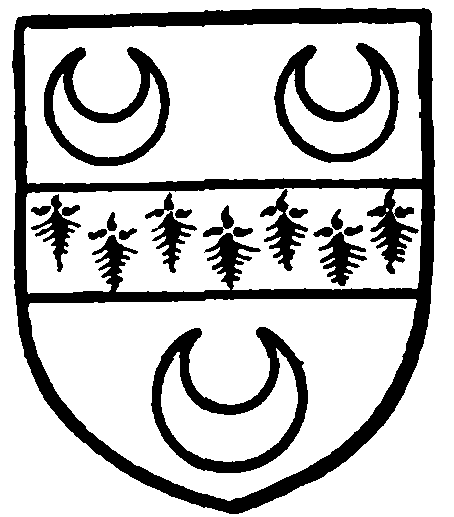
Coventry. Sable a fesse ermine between three crescents or.
OVER BURGATE is probably represented in the Domesday Survey by the virgate of land in Burgate which Ulvric and Colleve had held of Picot, the tenant in chief, before the Conquest. (fn. 98) Its overlordship seems generally to have belonged to the lord of the manor of Rockford Moyles (q.v.). Hugh de Burgate, who was holding one fee in Fordingbridge of the Earl of Hertford (fn. 99) in the 13th century, was probably the same Hugh who, by the name of Sir Hugh de Godshill, granted land in Over Burgate to the priory of Maiden Bradley in 1242. (fn. 100) After his death Over Burgate was apparently divided into four parts, each of which contained the fourth part of a mill. In 1280 William Sprake held half a fee in 'Little' Over Burgate of the Earl of Hertford, (fn. 101) and three-quarters of a fee in Over Burgate, which Ralph atte Beche and others had held, belonged in 1346 to Richard Reyson, John le Monck, John Sprake and Christine Bowyer. (fn. 102) John Reyson, probably son of Richard, died in 1353 seised of his share, which consisted of a messuage, 32 acres of land and 2 acres of moor. (fn. 103) Richard le Monck and Joan his wife, and John le Monck and Margaret his wife, dealt with property in Fordingbridge and Over Burgate in 1354, (fn. 104) and in 1378 Richard Monck and Alice his wife conveyed an estate there to John Waryn and Maud his wife. (fn. 105) William Frebody purchased another estate from Alice the wife of John Chapman in 1402, (fn. 106) and John Frebody, probably his son, was, with John Coke and John Haselber, holding one-third of a fee in Over Burgate in 1428. (fn. 107) John Coke dealt by fine with six messuages and 20 acres of land in Fordingbridge, Over Burgate and Nether Burgate in 1497. (fn. 108) At the beginning of the 16th century the 'manor' of Over Burgate was in the possession of William Coke, probably grandson or great-grandson of John, who settled it on his heirs by his wife Anastasia. (fn. 109) On William's death in 1527–8 the manor passed to his only daughter Margaret wife of Richard Lewis alias Johnson. (fn. 110) She was succeeded by an only daughter Joan, who married Christopher Fetiplace, (fn. 111) and with him sold the manor to Thomas Percy in 1564. (fn. 112) Henry (fn. 113) grandson of the latter mortgaged and finally sold 'the manor or capital messuage' of 'Little Over Burgate' to Robert Waterton of Newport (I.W.) in 1635. (fn. 114) In 1670 it was owned by Robert Blachford, who also owned a moiety of Sandhill Manor, (fn. 115) and in 1702 it was sold with Sandhill Manor by Robert Blachford and Anne his wife, Anthony Morgan and Katherine his wife to Thomas Warre. (fn. 116) Some years later the manor seems to have been purchased by William and Jeremiah Cray and descended with Ibsley (q.v.) to Percival Lewis, to whom it belonged in 1810. (fn. 117) Since that date it has been purchased by Mr. Coventry and has been incorporated with the manor of Nether Burgate.
A mill in Over Burgate, mentioned in the Domesday Survey (fn. 118) and held with the manor in the 14th century, (fn. 119) has long since disappeared.
In the 13 th century the Prior and convent of Beaulieu acquired property in Over Burgate, afterwards described as a manor, from Margery Rivers, the holder of Nether Burgate, and her son John Rivers. (fn. 120) About the middle of the same century Hugh de Godshill granted them and their men of Burgate permission to keep their animals in his bailiwick free of all exactions. (fn. 121) At the Dissolution (fn. 122) it was described as the manor of FREREN COURT (fn. 123) and in 1543 it was granted as 'the manor of Over Burgate or Freren Court' to Robert White and Katherine his wife, (fn. 124) and henceforth followed the descent of Rockford Moyles (q.v.), being later merged in the manor of Nether Burgate.
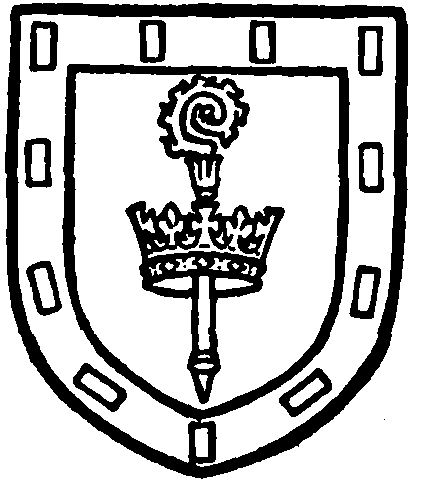
Beaulieu Abbey. Gules a royal crown enfiled with a crozier or in a border sable with billets or.
The so-called manor (fn. 125) of CRIDLESTYLE or EAST MILL (Cridelestrowe, Credelstowe, Estmylne, xiv cent.), held of the lord of the manor of Nether Burgate, (fn. 126) belonged in the 14th century to John de Breamore, (fn. 127) who settled it on himself and his wife Geva, with reversion to his son John and Joan his wife and their heirs. (fn. 128) Eventually in 1377 the manor passed to Joan daughter of the younger John by his second wife Margaret (fn. 129) and wife of William Bayford or Byford. She settled her property on her second husband Thomas Chapeleyn in 1401, (fn. 130) and on his death in 1415 it passed to her daughters by her first husband: Joan wife of Thomas Ringwood and Amelia Clemence wife of Richard Devereux. (fn. 131) The latter, however, either died childless or gave up her claim, since Thomas Ringwood, apparently son of the above Thomas, died seised of Cridlestyle in 1474–5, leaving a son of the same name, (fn. 132) who was succeeded in the following year by his son Charles. (fn. 133) The latter was succeeded in turn by his son John, (fn. 134) his grandson Charles (fn. 135) and his great-grandson Henry, (fn. 136) who, after holding Cridlestyle for over forty years, (fn. 137) sold it about 1592 to William Dodington. (fn. 138) From that date Cridlestyle descended with South Charford (fn. 139) (q.v.) until about 1748, when it was apparently sold to Sir Edward Hulse, bart., (fn. 140) and passed with Breamore (q.v.) to his descendant, Sir Edward Hamilton Westrow Hulse, bart.
The site is now marked by a farm and mill.
One mill, it seems, belonged to Cridlestyle in 1376, (fn. 141) but from the 15 th to the 18 th century two corn-mills and a fulling-mill (fn. 142) were attached to the 'manor.' Since the beginning of the 19th century they have been used for the manufacture of sailcloth and sacking. (fn. 143)
The manor of FOLD (Folle, Folds, La Folde, xiv cent.; Foldes, xvi cent.; Fowles or Folles or Folds, xviii and xix cent.) was held in chief of the royal manor of Lyndhurst. (fn. 144) In 1332 Nicholas de Venuz, a felon, was found to have held a messuage, 188 acres of land, a fishpond and two free tenants in Fold, (fn. 145) possibly the later manor of Fold which before 1340 was granted to John de Breamore. (fn. 146) He left it to his daughter Roycia, (fn. 147) who was evidently succeeded by another John de Breamore, and since that date Fold has followed the descent of Cridlestyle (fn. 148) (q.v.). It was first described as a manor in 1392. (fn. 149) The site is now marked by a farm.
In 1571 the so-called manor of GODSHILL was sold by Henry Earl of Arundel, John Lord Lumley and Joan his wife, eldest daughter of the earl, to a certain Reginald Howse. (fn. 150) Some years later Robert Howse, who seems to have been son of Reginald, sold it to William Dodington, (fn. 151) from which date it descended with Breamore (fn. 152) (q.v.).
In the 14th century the Breamores held under Lyndhurst Manor (fn. 153) land in Godshill which followed the descent of Cridlestyle. (fn. 154) It was evidently sold to William Dodington and became part of the so-called manor of Godshill.
Land in Godshill described in 1403 as a manor (fn. 155) followed from that date the descent of Fordingbridge (fn. 156) (q.v.).
In the 16th and 17th centuries a royal manor of Godshill probably formed part of the New Forest. (fn. 157)
In 1086 Osbern the Falconer held in chief the manor of GORLEY (Gerlei, xi cent.; Gertley, xiii cent.) which Wistric had held of Edward the Confessor as an alod. (fn. 158) At present this entry cannot be connected with either of the two manors of North Gorley existing in the 16th century. One was in the possession of John Bulkeley, who in 1532 dealt with it by fine with Nicholas Tichborne the elder. (fn. 159) Having apparently passed to the Keilways of Rockbourne before 1576 (fn. 160) it was purchased by Sir John Cooper in 1608, (fn. 161) and evidently merged in Rockbourne. The other manor was acquired by the Abbot and convent of Beaulieu from Margery Rivers, John Rivers and others, (fn. 162) and was probably granted, after the suppression, with Freren Court to Robert White, (fn. 163) to whom it belonged in 1564, (fn. 164) from which date it followed the descent of Rockford in Ellingham (q.v.), (fn. 165) being merged in that manor after 1634–5. (fn. 166)
Of the two manors in MIDGHAM (Mingeham, xi cent.; Migham, xii cent.; Mightam, xiv cent.; Miggeham, xvi cent.) that held of Edward the Confessor by two freemen, and afterwards known as North Midgham, belonged in 1086 to Eddeva, (fn. 167) while the other, afterwards known as South Midgham, which Ulviet had held in chief belonged to Alwi son of Torber. (fn. 168)
The overlordship of North Midgham descended like that of Fordingbridge (fn. 169) (q.v.). By the beginning of the 13th century the manor was in the possession of four heiresses, Hawise de Midgham, Margery wife of Alan de Woodford, Clemencia wife of Walter de Breamore and Avice de Midgham. (fn. 170) In 1243 the manor belonged to Ralph de la Falaise and Christine his wife, (fn. 171) from whom it was inherited by Elias de la Falaise (fn. 172) son of William. It escheated like Rowner (q.v.) to the Crown before 1277, and was at first granted to Aumary de St. Amand, to whom it belonged in 1280, (fn. 173) but before 1283 passed to William le Brune (fn. 174) and followed the descent of Fordingbridge and Rowner (q.v.) until the end of the 15 th century, (fn. 175) when it was held by John Parker, the lord of South Midgham, who died seised in 1473. (fn. 176) His son Thomas inherited the manor, but dying childless in 1477 left the manor to his sister and heir Isabel wife of Richard North. (fn. 177)
Richard North, who was still living in 1508, (fn. 178) is said to have had a son John, (fn. 179) who was succeeded by a son Richard, from whom the manor passed to his eldest son by his second wife Anne. (fn. 180) This William sold it in 1608 to John Webb of Odstock (fn. 181) (co. Wilts.), who being a recusant forfeited his property a few years later. However, in 1634–5 his lands were restored and his debts pardoned, (fn. 182) while ten years later he was created a baronet for the loyalty of his family, (fn. 183) and, though this creation was disallowed as being subsequent to 1642 and his estates were sequestered in 1646, they were restored in 1660 and his son John succeeded to both on his death in 1680. The manor remained in the Webb family (fn. 184) until the end of the 18th century, when it was purchased by Eyre Coote of West Park, (fn. 185) in whose family it has since remained.
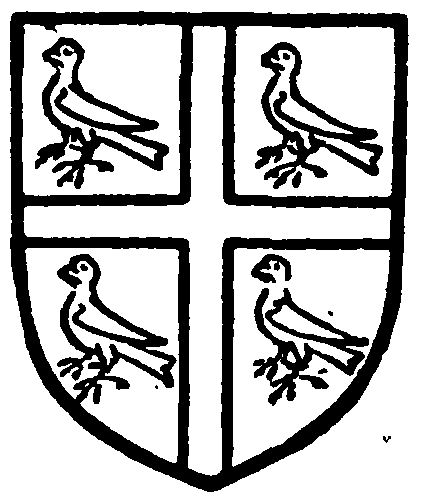
Webb of Odstock. Gules a cross between four falcons or.
South Midgham passed with Hale and West Tytherley (q.v.) to the Cardvilles and was held of them by a family called Aygnel, apparently by the service of attending the Fordingbridge hundred court as tithingmen of Hale and by the annual rent of 2s. 1d. (fn. 186) Laurence Aygnel was probably holding it in 1242 (fn. 187) and John Aygnel in 1316, (fn. 188) but after the last date there is no trace of it until 1473, when it belonged with North Midgham to John Parker. (fn. 189) The two manors have since followed the same descent.
In 1274 land in SANDHILL belonged to Thomas Baldwin and Maud his wife, (fn. 190) Nearly a century later, in 1340, Roger Bubbe granted the manor, probably for a term of years, to Elias de Godele and Ela his wife, (fn. 191) and in 1366 Roger Bubbe, or a son of the same name, settled the manor on himself and Alice his wife, with reversion if they died childless to John son of John Crosse and his heirs, and further contingent remainders to Clementia and Alice sisters of John, and to William Coker. (fn. 192) No further mention can be found of Sandhill until 1507, when Richard Moleyns died seised of the manor held of Robert Bulkeley, and left a son and heir William. (fn. 193) The latter was succeeded by a son Henry, who was holding Sandhill in 1562, (fn. 194) and apparently left it to two daughters or granddaughters, Anne wife of John Somers and Joan wife of Robert Waterton, to whom it belonged in 1612. (fn. 195) The latter, who succeeded to the whole of the manor, left two daughters and co-heirs; one became the wife of Thomas Urrey, the other married one of the Blachfords and left a son Robert. Katherine, only daughter of Thomas Urrey, married Anthony Morgan, and they, with Robert Blachford, conveyed the manor to Thomas Warre in 1702. (fn. 196) Charles and Thomas Taw were holding it in 1722, (fn. 197) but before 1751 it had been purchased by the Bulkeleys (fn. 198) of Burgate, to whom it still belongs.
A reputed manor called ARNEYS or IRISHLAND (Honys or Ernys Court, (fn. 199) xvii cent.), now Amiss Farm, possibly deriving its name from a family called Ernys, who held land in Fordingbridge in the 13th (fn. 200) and 14th (fn. 201) centuries, belonged to the lords of the manor of Nether Burgate from the end of the 15th century. (fn. 202) In 1802 the lord of the manor claimed a place in the New Forest, known as Bulkeley's purlieu, as part of the manor. (fn. 203)
EYEWORTH (Jvare, xiii cent.; Ivory Lodge, xviii cent.), now in the parish of Ashley Walk, was held as an alod by two freemen of Edward the Confessor, belonged to the king (fn. 204) in 1086, and has remained with the Crown as part of the New Forest.
The rectory manor of WOODFIDLEY was granted by Henry VI to the college of St. Mary and St. Nicholas, Cambridge, afterwards known as King's College, (fn. 205) to which it still belongs. In 1670 the provost and scholars claimed, under the charter of Henry VI, hunting rights in this manor, common of pasture in the New Forest, and the hearing of all pleas of trespasses done by them and their men in the forest before the Chief Justice of the Common Pleas. (fn. 206)
Churches
The church of ST. MARY THE VIRGIN consists of chancel 42 ft. 9 in. by 18 ft., with north chapel 43 ft. 9 in. by 18 ft., and south vestries, nave 63 ft. 6 in. by 21 ft. 6 in. with north and south aisles, tower at the east end of the north aisle 14 ft. square, north aisle 7 ft. 7 in. wide, south aisle 14 ft. wide, north porch with a parvise above, and south porch.
The church has been a large and important building from an early date, and in the 1 2 th century had an aisleless nave of the same size as the present one, with a chancel shorter than that now standing, but of equal width. Of this church the west wall of the nave and part of the south wall of the chancel, with the jambs of a doorway in ironstone, yet remain, and a number of details found and now preserved at the rectory show that the date of the work was c. 1160–70. About 1220–40 the church was greatly enlarged and practically rebuilt, the present chancel being built with a vestry on the south and a chapel of two bays on the north-west, while north and south aisles were added to the nave, opening from it by the existing arcades of four bays. Later in the 13th century, c. 1270, the north chapel was enlarged eastwards, being made equal in length to the chancel, and a third bay added to the arcade between chancel and chapel. Nothing of importance seems to have been done in the 14th century, except a little work which has been attributed to Bishop Edington, but in the 15 th the tower was added, the nave clearstory and north porch built, and the south aisle, except its west wall, rebuilt, with a south porch. In modern times the south vestry has been rebuilt and enlarged, and a second vestry added between it and the east end of the south aisle. There has also been a great deal of careful repair to the south arcade of the nave and elsewhere, with a general improvement of the fittings and decoration.
The church is built of ironstone and flint, and the tower is ashlar faced, all the walls being finished with plain parapets, and the roofs covered with lead. The facing work of small flints in the 13th-century work of the chancel and part of the north aisle is interesting and unusual. The tower is in three stages with an embattled parapet and a projecting stair turret near the north-east corner, rising a little above the tower parapet and also embattled on the string; at its base are large grotesque heads at the corners and in the centres.
In the east wall of the chancel are three tall and very wide lancets, with richly moulded drop arches supported both inside and out upon detached banded shafts with moulded capitals and bases; two of the shafts on the outside have been replaced, but otherwise the windows are in good condition, except for a decided lean to the south. Their unusual width suggests that they have been enlarged by cutting back the splays, but the masonry gives no proof of this.
In the north wall may be seen the east jamb and part of the arch of another lancet, blocked at the lengthening of the north chapel, and below and to the west of it is a segmental headed locker 2 ft. 8 in. wide and 1 ft. 9 in. high, rebated for a door. The arcade on the north is of three bays with two-centred arches of two chamfered orders and labels on both faces with foliate stops; the piers are of four engaged round shafts and half-round responds, and plainly moulded capitals and bases following the contour of the piers. The two western arches and the west respond and pier are of the date of the chancel, but the eastern arch is a later copy of them, made with the east pier when the chapel was lengthened; the east respond is the old one moved eastward at the same time. At the south-east of the chancel is a trefoiled piscina recess moulded and having two plain round drains in the sill, the projection of which has been cut away; at the back there is a narrow moulded shelf. There are four tall lancets in the south wall with labels both inside and out with foliated stops, the south-west lancet having on a line with the sills of the first three a transom, and a low side window beneath rebated for a shutter; it seems to be a 14th-century addition. In the south-east vestry two old recesses for cupboards have been preserved, in one of which there is part of an altar stone built in a recess in the wall, two of the incised crosses being visible. The south-west vestry is entered from the chancel by the 13th-century priest's door, formerly external, and to the west of it may be seen the lower part of the jambs of a late 12th-century doorway in ironstone, which is all that remains of the former chancel.
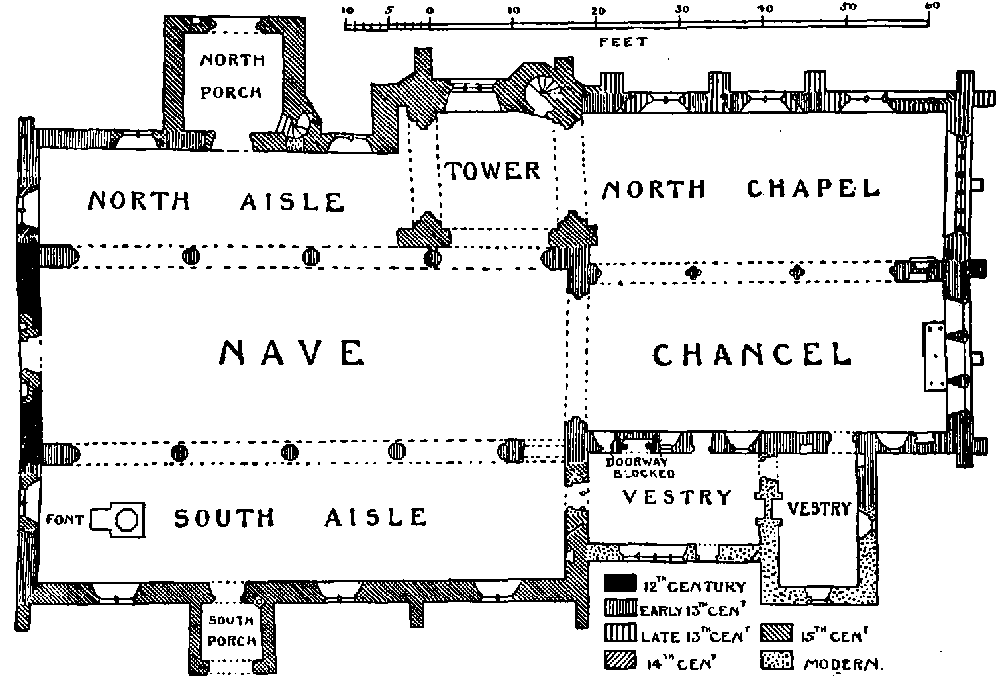
Plan of Fordingbridge Church
The two-centred chancel arch, of two splayed orders, has half-round responds with moulded capitals and splayed angles, and is of 13th-century date, but the capitals have been renewed and the shafts have lost their bases. The king post roof over the chancel dates from 1903.
The east window of the north chapel, of five trefoiled lights with geometrical tracery in the head, is modern, but is perhaps a copy of the original work. The three windows in the north wall, of two trefoiled lights with a trefoil in the head under a two-centred arch, probably date from c. 1270, but have all been repaired; the jambs and springers of three earlier 13th-century windows which they replaced are yet to be seen, the middle one retaining traces of a painted masonry pattern, which can fortunately be pretty closely dated on this account. The break in the wall between the two easternmost windows on the north shows the junction of the older work with the east bay of the chapel. This chapel was not parochial, but belonged in turn to the Templars and Hospitallers, passing finally to St. Cross's Hospital, which still has rights over it.
On the outer face of the east bay of the north wall there is a four-centred recess with a double ogee edge moulding, and within it an altar tomb with a moulded slab and plinth and the remains of originally three square traceried panels set diagonally and containing shields. The end of the 15 th century or beginning of the 16th is the date of the work, and at the back there is a large rectangular stone with remains of a black letter inscription at the top, the rest being defaced by a number of deeply scraped oval grooves, as if for the sharpening of knives. It is locally known as the miracle stone, and said to have been scraped away for its curative powers, a custom which obtains in Egypt with regard to the ancient temples at the present day, but no satisfactory proof seems now obtainable.
At the south-east of the chapel is a trefoiled piscina recess of 13th-century date with a filleted roll stopped on the sill, which is moulded and slightly projects, and seems to have formed part of a stringcourse.
The open timber roof over this chapel is a particularly beautiful one of early 15th-century date, in four bays, with arched braces below the tie-beams, tied to the wall about midway by hammer-beams, and cusped on the under side. The spandrels between them and the tie-beams are filled with pierced tracery, and between the tie-beams and the principal rafters the space is filled with tall cinquefoiled tracery. On the ends of the hammer-beams are figures holding shields and other devices, such as a crown and a mitre, and at the crown of the arches formed by the braces large carved bosses, one being a bearded head, are fixed to the soffits of the tiebeams; the effect of the whole, with the carved bosses at the intersections of the principal timbers and the traceried trusses, is very satisfactory, and it is a great pity that the western bay should be nearly blocked by a huge and unsightly organ.
The nave is of four bays with arcades of 13th-century date, having arches of two chamfered orders, and round pillars with plainly moulded capitals and bases with a simple low plinth and an upper splay. The section of the capitals seems rather of 15th-century than 13th-century character, and may point to a rebuilding of the arcades with old materials when the clearstory was added. The wall space at the east of the south arcade is cut through by a low arch looking like a tomb recess, but much repaired and of uncertain date.
There are four clearstory windows on each side, all of two trefoiled lights under a square head, except the east one on the north, which is a blank arch and has probably always been so, on account of the contemporary tower against which it is set. At the west of the nave is a doorway with a four-centred arch and label with returned stops, on either side of which are external recesses, that on the north cinquefoiled, 9 in. wide and 2 ft. 9 in. from the sill to the springing of its arch; the other is square-headed, 1 ft. 7 in. wide by 2 ft. 1 in. high, and rebated on its edge. The former probably held a figure and the latter a light. Above the doorway there is a large window of five cinquefoiled lights, with a transom and rectilinear tracery under a two-centred head; and above this window on the outside there is a lowpitched gable set back to allow for a passage way in front of it over the window. The work seems to be of late 14th-century date, and has been attributed, but without much evidence, to Bishop Edington.
The queen post roof over the nave with four-centred struts below the tie-beam is probably of 15th-century date, the east truss retaining traces of colour decoration; what was possibly a doorway to the rood loft may be seen on the south wall from the outside.
The tower, containing eight bells, is built at the east of the north aisle, to which it opens by a twocentred arch of two chamfered orders, part of which, being wider than the aisle, extends north beyond the wall, which is returned northwards to inclose it There are a similar arch between the tower and north chapel and one of a single splayed order built against the first bay of the north nave arcade; the window in the north wall is of three cinquefoiled lights with rectilinear tracery under a two-centred arch, and a doorway in the north-east corner admits to the turret stair. In the second stage there is a two-light cinquefoiled window under a square head on the north side, and each face of the belfry has a two-light window under a square head, that on the south side having a large sundial above it, while there is another smaller one on one of the north-east buttresses.
The two windows in the north wall of the aisle, of two cinquefoiled lights with a quatrefoil over, date from the 15th century, while that in the west wall belongs to the 14th.
The north doorway has a low three-centred arch with a single chamfer, and the entrance arch to the porch has a similar arch of two splayed orders. West of this doorway on the outside there is a recess 2 ft. 10 in. from the ground, I ft. 8 in. wide, and 2 ft. from the sill to the apex of its pointed arch, with a projecting hood which is supported upon corbels; this from its position was probably intended to hold a lantern and is not for holy water. There is a parvise above the porch, reached from a stairway at the south-east which formerly opened to the aisle but is now turned by winding steps so as to be entered from the porch. In the north and west walls of the parvise are two-light cinquefoiled windows with square heads.
In the east wall of the south aisle is a modern doorway to the vestry and on the south side of it a 14th-century trefoiled piscina recess; above the doorway there is a square-headed three-light window of 15th-century date. There are three windows in the south wall and one in the west, each of two cinquefoiled lights with a quatrefoil over, like those in the north aisle, and the low-pitched roof is modern. The south porch and doorway are plain work, of the date of the rebuilding of the aisle, and there is a holy water stone in the north-east angle of the porch, below which a late 12th-century capital is built into the wall.
The octagonal font at the west end of the south aisle has a Purbeck marble bowl much damaged by exposure to the weather, with two trefoiled panels on each face. The stem is circular and the base octagonal; it probably dates from the early part of the 14th century. All the other fittings are modern.
On the east wall of the nave north of the chancel arch there is a brass plate mounted upon an ornamental wood framework with figures of a man and his wife kneeling at prayer desks with their three sons and five daughters. There is a shield of Bulkeley with three quarterings, and below is the following inscription: 'Here under lyeth buryed ye bodyes of Wiftm Bulkeley Esquier and Jane his wiffe daughter of Baron luke of ye Quenes highnes exchequer who had between them iii sons Charles, Withn whose bodies lyeth here buried & John, and v daughters. An, Jane, Judyth, Susan & Cilcelei, whom Jesus Christ have mercy and grant them eternal joy.' Above is the date 1568, and over each of the children is the initial letter of their Christian names.
In the churchyard wall near the north gate is set the socket of a large 15th-century churchyard cross, the stump of which was standing early in the last century, but is now entirely removed.
The plate consists of two silver chalices and a paten of 1843 and a silver flagon of 1837.
There are ten books of registers. The first contains baptisms and marriages from 1642 to 1698 (incomplete between 1650 and 1660) and burials 1642 to 1679 and 1695 to 1698. The second contains burials only from 1678 to 1709 and some briefs. The third has all entries from 1698 to 1714, and the fourth the same from 1714 to 1739. The fifth has baptisms and marriages from 1739 to 1754 (some years missing) and burials 1739 to 1801. The sixth has marriages only from 1754 to 1789; and the seventh baptisms and marriages from 1790 to 1804 and burials 1790 to 1803. The eighth has marriages only from 1790 to 1795; the ninth, baptisms 1794 to 1812 and burials 1802 to 1812, while the tenth contains marriages 1795 to 1812. There are also three volumes of sextons' books.
The church of the HOLY ASCENSION, HYDE, built in 1855, is of red brick with stone dressings in 14th-century style and consists of chancel, nave, north vestry, south porch and western turret containing two bells. There is a fine stone reredos. The plate consists of a silver chalice and paten of 1852 and a flagon of 1851, and a silver chalice and paten of 1855 given by the Rev. R. P. Warren, perpetual curate of Hyde at that date. The registers date from 1856.
Advowsons
The church of Fordingbridge existed in 1086 (fn. 207) and evidently belonged to the lord of the manor until about 1256, when Elias de la Falaise granted it without licence for the yearly rent of a rose to Richard de Clare Earl of Gloucester and Hertford. (fn. 208) In 1274 Gilbert son of Richard de Clare being summoned to show by what right he held the advowson acknowledged that the grant of 1256 was made without licence, but successfully pleaded that as this was done a long time ago he ought not to be hindered from presenting. (fn. 209)
On the death of Gilbert in 1295 the advowson descended to his son and heir Gilbert, who held it until his death at Bannockburn in 1314, (fn. 210) when it passed to his second sister and co-heir Margaret, (fn. 211) who in 1317 became the wife of Hugh Audley, created Earl of Gloucester in 1337. (fn. 212) Their only daughter and heir Margaret brought the advowson by marriage to Ralph Lord Stafford, created Earl of Stafford in 1350, (fn. 213) and remained in his family until the attainder and execution of Henry Stafford Duke of Buckingham and Earl of Stafford in 1483. (fn. 214) It was then granted to the College of St. Mary and St. Nicholas, Cambridge, (fn. 215) afterwards King's College, to which it still belongs. (fn. 216)
A vicarage was ordained before 1291, in which year its annual value was £5 6s. 8d. (fn. 217)
Gilbert Kymer, Dean of Salisbury, was rector of Fordingbridge in the 15th century, and William Barford, the scholar and divine, held the living from 1768 to 1773. (fn. 218)
The advowson of the church of Holy Ascension, Hyde, was transferred to the vicar in 1875, (fn. 219) and granted by him to Keble College, Oxford, to which it still belongs. (fn. 220) It is a vicarage, net yearly value £216, including 5 acres of glebe, with residence.
The Hospital of St. John in Fordingbridge was apparently founded by one of the lords of the manor of Nether Burgate before 1272, when John Rivers unsuccessfully claimed the advowson against Nicholas Bishop of Winchester. (fn. 221) The hospital belonged to the bishopric until granted by Cardinal Beaufort about 1445 to the Master and brethren of St. Cross, (fn. 222) to whom the land attached still belongs. (fn. 223) The ruins of the hospital are in the south of the town and on the left bank of the Avon.
There is a Roman Catholic church in the town dedicated in honour of Our Lady of the Seven Dolours and also a Friends' Meeting House, and chapels belonging to the Plymouth Brethren, the Congregationalists and Wesleyans. (fn. 224) The Congregationalists have another chapel at Stuckton, and there is a Primitive Methodist chapel at Sandle Heath.
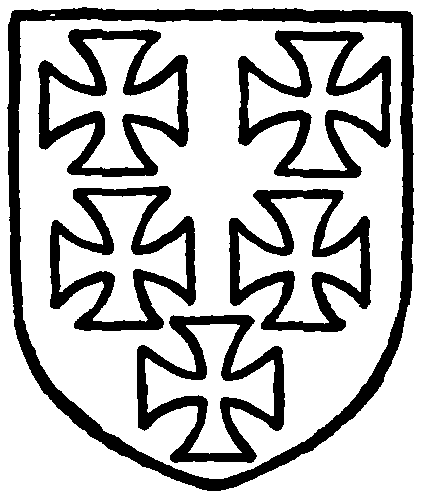
Hospital of St. Cross, Winchester. Azure five crosses formy argent.
Charities
Church Lands.—The parish has from time immemorial been possessed of parcels of land containing together about 5 acres, the rents of which, amounting to £9 a year or thereabouts, are carried to the churchwardens' accounts.
Charity of John Dodington, founded by deed dated 16 January 1638 (see under Breamore).—This parish receives £5 every fourth year, issuing out of lands called Sandy Balls, which is applicable in apprenticing a poor boy.
In 1710 Caleb Gifford by his will charged his lands in Wim borne with 30s. a year, whereof 8s. was directed to be paid to the minister of the Independent Meeting House for preaching a sermon on 30 March (the anniversary of the testator's death), and the residue in the distribution of bread.
The Sunday School.—In 1801 Catherine Eycott Bulkeley by deed gave to the minister and churchwardens £200 consols, the dividends to be applied towards the support of a Sunday School.
In 1865, by an award dated 17 May, a piece of land of about 1 acre, part of Sandle Heath, was allotted to the churchwardens and overseers as an allotment for the labouring poor, subject to a dear rent-charge of £1.
In 1883 Edward Sheridan, by will dated 9 August, bequeathed a legacy, now represented by £213 12s. 9d. 2½ per cent, annuities with the official trustees, the annual dividends, amounting to £5 6s. 8d., to be applied in the distribution of clothes and fuel to the poor of Roman Catholic congregations.
The cottage hospital, or nursing home, originally established in 1871, was permanently settled in 1897 with sums raised for the purpose. In 1898 a sum of £50 India 3 per cent. Stock was transferred to the official trustees to be accumulated until the expiration of the lease of the existing premises.
In 1897 Harry Frederick Withers by his will, proved at London 21 August, left £100, the interest to be applied in augmenting the salary of the minister of the Independent chapel. The legacy was invested in £101 1s. consols, producing £2 10s. 4d. yearly.