
A History of the County of Hampshire: Volume 4. Originally published by Victoria County History, London, 1911.
This free content was digitised by double rekeying. All rights reserved.
'Parishes: Minstead', in A History of the County of Hampshire: Volume 4, (London, 1911) pp. 635-638. British History Online https://www.british-history.ac.uk/vch/hants/vol4/pp635-638 [accessed 11 April 2024]
In this section
MINSTEAD
Mintestede (xi cent.); Menestede (xv cent.).
The parish of Minstead, including Canterton, London Minstead and Alum Green (formerly extraparochial), contains 13 acres of land covered with water and 10,321 acres of land, of which 399 acres are arable, 1,263 are permanent grass and 2,832 woodland (fn. 1) exclusive of the New Forest.
In the small village in the north-east of the parish are the rectory, the village smithy and the inn with its sign, a copy of 'The Trusty Servant' of Winchester College. West of the village are the parish church and the village school. The rest of the village is composed of scattered deep-roofed and thatched cottages. Three streams known as the Fleet Water and the Bartley Water flow through the parish in a south-easterly direction. In Canterton Glen, upwards of a mile from Minstead, is Rufus Stone, marling the site of the oak tree from which the arrow which proved fatal to William Rufus is said to have glanced. Near this glen is Stony Cross, one of the highest parts of the forest, from which Romsey Abbey may be seen.
The soil is loam. The subsoil to the south of Stony Cross is of Barton clay and to the north of Bracklesham beds. The tops of the hills are gravel and are from secondary deposits.
The manor-house is a fine old brick building in a park of 400 acres, of which 200 acres are planted with rhododendrons. Sir John Compton made this his residence at the end of the 18th century and very much enlarged the house. Castle Malwood, rebuilt by Mr. Charles Hill in 1892, is now the property and residence of Mr. Hanbury. At Castle Malwood Lodge, now called 'Malwood,' the residence of Lady Harcourt, is one of those fortified earthworks of which so many exist in this part of Hampshire. Blackwater House is the seat of Mr. Francis Compton, M.A., D.C.L., D.L., J.P., and Canterton Manor of Mr. John Jeffreys, J.P. The ruined manor-house of Canterton, reputed to have been mostly burnt down some centuries ago, is in the occupation of the gamekeeper of Mr. John Jeffreys. (fn. 2)
Manors
Before the Conquest MINSTEAD, assessed at 3½ hides, was held by a certain Godric Malf, whose sons in 1086 were holding half a hide; the remaining 3 hides had been taken into the New Forest. A house in Winchester worth 12d. yearly was attached to the manor. (fn. 3)
By deduction from facts, stated below, it is shown probable that the name 'Ivez' or 'Ives' (fn. 4) was used alternately for that of Minstead in the 12th and early 13th centuries, and yet was also the name of a fee held by a special serjeanty by the descendants of the sons of Godric Malf, including lands in Minstead, Bisterne (in Ringwood) and Totton. These three manors were rom the first closely associated. They were held by Godric Malf before the Conquest, by his sons in 1086, and followed the same descent in later years, so it is reasonable to suppose they were also associated in the 12 th century. Yet Minstead under that name does not appear from the 11th to the 13th century. However, in 1186–7 tallage was due to the king from 'Ivez, Budesthorn (Bisterne) and Todinton (Totton)' which had belonged to Hugh de Ivez and Robert son of Ulf. (fn. 5) At a later date (1189–90) the sheriff was accounting for Robert's portion only, (fn. 6) and two years later the tallage for that portion was rendered by the men of Bisterne and Totton. (fn. 7) The portion of Hugh de Ivez had undoubtedly by that time passed to his heir, and that heir was probably the Andrew de Ivez who at the time of the Testa de Nevill was holding I virgate of land in Totton, (fn. 8) and was probably identical with the Andrew de Minstead who was about this time, according to an undated charter, granting out adjoining lands to Guy de Testwood. (fn. 9) At the time of the Testa de Nevill Reginald de Bettesthorne, who also evidently held the portion in Totton that had belonged to Robert son of Ulf, (fn. 10) and Maud de Ivez were holding jointly in Ivez a carucate of land for the service of one man armed with a halberd for forty days in England and for finding the king whenever he should stay at Ivez straw for the couch and fodder for his horse. (fn. 11) Maud de Ivez, probably widow of Hugh (fn. 12) and mother of Andrew, was probably holding her moiety in dower, but she evidently died before 1248–9, in which year Andrew de Ivez or Minstead (as he is alternately called) was said to hold jointly with John de Bettesthorne, then a minor, son and heir of Reginald and Maud, half a hide in Testwood, Eling and Bisterne by serjeanty. (fn. 13) This land was described on the death of Andrew the same year as land and a mill in 'Ives' held for half the above serjeanty. (fn. 14) His son and heir William, already thirty years old, succeeded to this property (fn. 15); the other half remained with John de Bettesthorne son of Reginald and Maud. Thus in 1255–6 John de Bettesthorne and William de Ivez were said to be holding their land conjointly by the above serjeanty, (fn. 16) while in 1279–80 they were given as John de Bettesthorne and William de Minstead. (fn. 17) Moreover, at these same dates William as William de Minstead was granting out neighbouring lands in Totton and Testwood (q.v.).
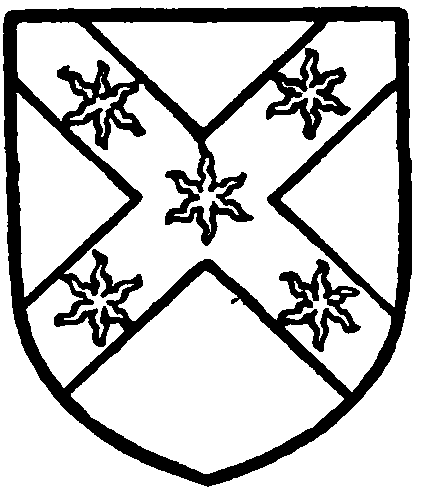
Bettesthorne. Argent a saltire gules with five stars or thereon.
After this time the name of 'Ivez' disappears, but the Minsteads and the Bettesthornes were holding side by side in Minstead and Totton their respective halves of the fee. Thus in 1272 settlement was made on John de Bettesthorne (fn. 18) and Margaret his wife of one messuage, 1,050 acres of land, 1,000 acres of wood, 3s. 5d. rent in Minstead, the advowson of Minstead Church and land and rent in Totton, &c., representing the Bettesthorne moiety. (fn. 19) In 1316 Walter de Bettesthorne, presumably son of John and Margaret, was holding Minstead conjointly with Juliane widow of William de Rivers, who represented the Minstead interest, (fn. 20) and was probably widow of John de Minstead (fn. 21) (who seems to have been a son of William) before her marriage to William de Rivers. She was, it seems, succeeded by a Thomas de Minstead, possibly her son by her first husband. Thomas died in 1361, leaving two infant daughters and heirs, Isabel aged three and Christina aged one and a half years. (fn. 22) In the meantime the Bettesthorne moiety of Minstead had passed from Walter to Richard, presumably his son, who also died in 1361, leaving as his heirs two daughters, Joan and Margaret, and one grandson, John Bradeway son of his daughter Agnes. (fn. 23) The Bettesthorne moiety was thus divided into thirds.
In 1361–2 Joan and Margaret were said to be holding their share of the messuage and lands in Minstead for the serjeanty above described conjointly with the heirs of Thomas de Minstead. (fn. 24) A year later (1363) they settled their two-thirds on themselves for life with reversion to John de Bettesthorne (fn. 25) son of Roger de Bettesthorne and lord of Bisterne (q.v.). This John is said to have died in 1380, (fn. 26) and to have been succeeded by a son John who died in 1399 (fn. 27) holding the two-thirds of the Bettesthorne moiety of Minstead jointly with the heirs of Thomas de Minstead. The third which John Bradeway held was at his death in 1396–7 also said to be held jointly with the heirs of Thomas. (fn. 28) However, Elizabeth wife of John Berkeley (fn. 29) acquired the twothirds by inheritance from her father John de Bettesthorne, (fn. 30) and her son and heir Maurice Berkeley acquired not only the Bradeway third, (fn. 31) but also the Minstead moiety, since he died in 1460 (fn. 32) seised of the whole manor, leaving a son and heir also Maurice known as Maurice Berkeley of Bisterne. The latter at his death in 1474 (fn. 33) left a son William, who was concerned in the rebellion of the Duke of Buckingham against Richard III and was attainted in the first Parliament of that reign. (fn. 34) His estates were apparently forfeited and Minstead was granted in the following year to John Hoton 'for his good service against the rebels,' to hold by a rent of £5 yearly. (fn. 35) He could, however, have held the manor for a short period only, as in 1489 Katherine formerly wife of William Berkeley, now married to Sir Henry Grey of Codnor, brought a suit against Katherine sister and heir of William and John Brewerton her husband for one-third of the manor of Minstead as her dower. (fn. 36) The result appears to have been in favour of the latter, as in 1494 she died seised of the manor. (fn. 37) She left as her heir a daughter Werburg, aged six years, who married first Sir Francis Cheyney and afterwards Sir William Compton of Compton Wynyates (co. Warw.), Groom of the Bedchamber and favourite courtier of Henry VIII, who was knighted after the battle of the Spurs for his valiant conduct. (fn. 38) Werburg predeceased her husband three years (fn. 39) and he then held the manor till his death in 1528. (fn. 40) He left as heir a son Peter, aged six years, (fn. 41) whose wardship was granted by the king first to Cardinal Wolsey (fn. 42) and after his disgrace to George Earl of Shrewsbury, who married him in 1537 to his daughter Anne. (fn. 43) Peter died in 1544, leaving a posthumous son Henry, (fn. 44) who was created Lord Compton in 1572. He was among the peers who tried Mary Queen of Scots and at her funeral is described as one 'of the four principal assistants to her corpse.' (fn. 45) He died in 1589 (fn. 46) and was succeeded in his Hampshire estates by his youngest son Henry. In 1649 Richard son of the latter conveyed the manor to trustees for the purpose of barring the entail. (fn. 47) He suffered a recovery of the property and in 1670 he appeared before the judgement seat held at Lyndhurst before Vere Earl of Oxford, justice in eyre—the last held for the New Forest—to assert formally his claim to the manor. The record of this court is interesting as showing the special privileges attached to the manor of Minstead. After describing the estate as 'adjoining to the waste soil of the forest of Charles II without any separation or enclosure,' he claimed for himself and the tenants of the manor common of pasture and common of mast' without paying anything therefor,' free ingress and egress in the waste lands of the forest, to search for all his animals there straying, the right to hold view of frankpledge twice a year, the right to estrays found in the manor and honey found in the woods; also to have all his woods in the custody of his own woodward appointed at the court baron of the manor and his manor free of forest officials. He also claimed the right to the left shoulder of all deer found within the woods of the manor. Finally on the day of the holding of the view of frankpledge he claimed for himself and his steward the right to kill and carry away one deer. (fn. 48)
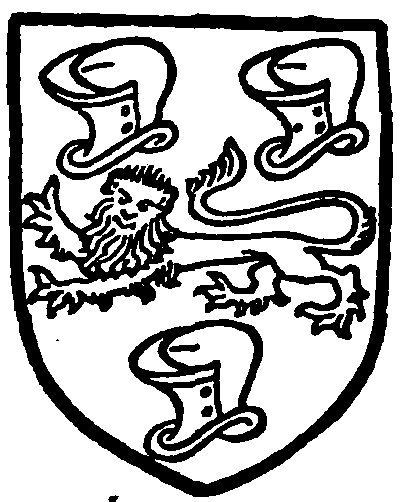
Compton of Compton Wynyates. Sable a leopard or between three helms argent.
Richard Compton died in 1684 and was succeeded by his only surviving son Henry, who had married Elizabeth daughter and co-heir of Sir Thomas Hoby. (fn. 49) Henry died in 1702 and was followed by a son Hoby, at whose death unmarried in 1714 (fn. 50) the estate was inherited by his brother Henry, (fn. 51) who also died without issue in 1724. By his will dated the previous year his Hampshire property, including Minstead, passed to his wife Eleanor daughter of John Willis of Ringwood, who married as her second husband Dr. Charles Bave. On her death without issue in 1742 she left Minstead to her nephew Henry Willis, second son of her brother James Willis, on condition that he took the name of Compton. (fn. 52) He was Sheriff of Hants in 1758 and was a noted racing man, being an original member of the Jockey Club founded in 1753. His racing career extended from 1751 to 1786, during which time his horses ran in 119 races, of which he won forty-one. (fn. 53) He died at Bath in 1786, leaving a son Henry, who succeeded, but only survived him one year, when the property passed to his brother John, who was Sheriffof Hants in 1797 and kept the hounds from 1800 to 1803. (fn. 54) He died in the latter year, his eldest son Henry Combe then being a boy of fourteen. Henry became Sheriff of Hants in 1819 and took a prominent part in suppressing the 1830 agrarian riots at Fordingbridge. One of the pikes with which his men were armed is now in the manor-house. (fn. 55) His son Henry who succeeded him was sheriff in 1871, and on his death in 1877 his son Mr. Henry Francis Compton became lord of ' the manor of Minstead and Brook,' as the manor, including all his property at Brook, is known at the present day. (fn. 56)
In the time of the Confessor CANTERTON (Cantortun, xi cent.) was held by Chenna and was assessed at half a virgate. He was, however, only allowed to retain one half of his holding, the remainder being taken into the New Forest. It had formerly been worth 20s.: in 1086 the shares of the king and his tenant were 16s. and 4s. respectively. (fn. 57)
The records of the early history of Canterton are very scanty, but at an early date it gave its name to a family who were possessed of land in the neighbourhood and certainly held property in Canterton as early as 1227, as in that year Roger de Sevenhamton gave a messuage and all his lands in Canterton which he had of the gift of Ralph de Canterton to the church of the Holy Trinity at Mottisfont. (fn. 58) From scanty documentary evidence it is clear that this family continued to hold property in Canterton during the next two centuries. In 1316 Nicholas Canterton was returned as lord of the vill of Canterton, (fn. 59) and he was apparently succeeded by a son Andrew who was collector of customs in the port of Southampton in 1343. (fn. 60) In 1473 John Canterton died seised of Canterton, (fn. 61) then for the first time called a manor, which he held jointly with Alice his wife of the Earl of Arundel at a rent of 6s. 1d. Alice survived and continued to hold the property till her son came of age. (fn. 62) From him it appears to have passed to William Canterton, who in 1556 conveyed the manor by fine to Philip Darvalt, (fn. 63) probably only for the purpose of a settlement, as the same year John Ringwood and Jane his wife transferred it to Alexander Mill. (fn. 64) In 1580 Roger Mill (probably a son of Alexander) and Alice his wife conveyed the manor toNicholas Fuller, (fn. 65) who the same year jointly with Sarah his wife sold it to Thomas Goddard, member of an old Wiltshire family who had held land in Hampshire since the reign of Henry I, and with whose descendants it remained for a century and a half.
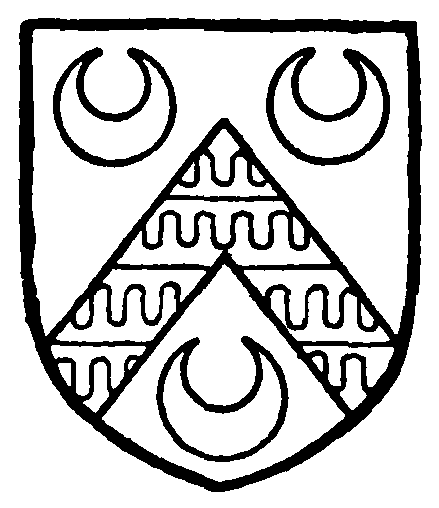
Goddard. Gules a cheveron vair between three crescents argent.
In 1608 Thomas Goddard was summoned before the Attorney-General to show by what right he held the manor of Canterton. Thomas in his reply stated that he held it under the king as of his manor of Lyndhurst by suit of court and the payment of a small annual sum (fn. 66) —an answer presumably satisfactory to the court, as Thomas was holding the manor at his death in 1623. (fn. 67) He was succeeded by a son Henry, who died four years later, having left the manor by will to his nephew Henry, then an infant, son of his brother William. (fn. 68) On the death of William in 1640 Alice his widow petitioned for the wardship of her son, (fn. 69) who subsequently succeeded and was holding the manor in 1684. (fn. 70) In 1703 David Goddard, probably son or grandson of Henry, sold the property to Richard Paulet of Little Testwood, (fn. 71) whose kinsman John Henry Beaumont fifteenth Marquess of Winchester sold it in 1887 to Mr. John Jeffreys, the present owner. (fn. 72)
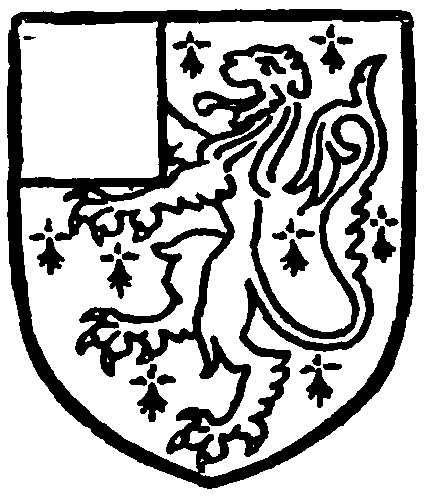
Jeffreys. Ermine a lion and a quarter sable.
Previous to the County of Southampton Act of 1895 (fn. 73) part of the manor of Canterton was in Wiltshire.
In the defence of Thomas Goddard in 1608 he mentions 'an ancient farm with a dwelling-house belonging to the demesne of the manor called the site or farm of the manor of Canterton with common of pasture in the commons and wastes of Brook Heath and Shave.' (fn. 74)
A mill was attached to the manor of Canterton as early as 1348, (fn. 75) probably the water-mill of which mention is made in several documents of the 17th century. (fn. 76) The last notice of it is in 1703. (fn. 77)
Church
The church of ALL SAINTS consists of chancel with a large pew on the north and a south vestry, nave with a north pew and large south transept, west tower and north porch. The internal arrangement produces a very quaint effect, the transept being almost as long as the nave, and two large galleries entirely fill up the west end of the church. The chancel and nave are of stone, partly plastered, and all the rest of the building is in red brick. The chancel and nave seem to date from the first half of the 13th century, but the font belongs to the latter part of the 12th century and some of the walling of the church may be as old as it is. The brick additions are all of 18th-century or later date, including the tower, which, however, appears to have replaced an earlier one, for in the west wall of the nave are the jambs of a segmental headed arch, which may be of 13th-century date. The east window of the chancel is a modern double lancet. The pew on the north side has a fireplace, carpet and cushioned seats, while that to the north of the nave, though larger, has fewer domestic comforts. The chancel arch dates from the first half of the 13th century and has three engaged shafts in the jambs, while the arch, of two chamfered orders, is nearly straight-sided and has been rebuilt, the original curve being clearly shown on the stones of the arch. The north door is of the same date as the chancel arch, and has two orders with continuous edge-rolls broken by a shallow undercut abacus at the springing; the label is double chamfered. The porch is of brick and on the outer doorway are the initials and date R E W S C W 1683, doubtless, in spite of their spacing, those of the churchwardens for the year.
The south transept has three windows, each of three wood-framed lights. On the south wall of the nave below the gallery is a three-light trefoiled 16th-century window, the head in a very distorted condition, and over it is another light for the gallery. The 'three-decker' pulpit, though disfigured by graining, makes a very effective group, with its hexagonal canopy, the shape of which is spoilt by an added piece at the back; it is partly of 17th-century woodwork and on the north side of the steps to the chancel is the mutilated base of a 15th-century screen. Most of the benches in the chancel and nave have moulded back rails and are probably of 17th-century date, and the gallery fronts are very good specimens of 18th-century panelling.
The font stands in front of the pulpit and has a square Purbeck marble bowl with four restored angle shafts, stem and base. On its west face is cur Lord's Baptism, on the east an Agnus Dei, on the north a lion with two bodies and a single head, and on the south two eagles having what may be a conventional tree between them. The surface is a good deal damaged, as the font has been buried in a garden.
The bells are three in number, the first bearing the inscription' Love God R B 1604'; the second 'Sancta Maria'; the third 'In God is My Hope.'
The plate consists of a silver parcel-gilt chalice of probably 17th-century date, a silver paten with gilt edges of 1836, a silver paten of 1876, a flagon parcel gilt of 1739 and a plated almsdish.
The first book of registers contains mixed entries 1683 to 1762, the second baptisms and burials 1764 to 1812.
There is also a copy 1762 to 1768 with mixed entries.
Advowson
The first mention of a church in Minstead is in 1272, when, attached to the Bettesthorne moiety of Minstead, it was settled on John de Bettesthorne and Margaret his wife. (fn. 78) In 1291 it was assessed with the chapel of Lyndhurst at £6 13s. 4d. (fn. 79) It followed the descent of the manor, (fn. 80) Mr. Henry Francis Compton, the lord of the manor, being the present patron.
Among possessions forfeited for superstitious uses in the reign of Edward VI was land worth annually 1s. which had been 'appointed for ever to have continuance, of whose graunt they know not, to mayntayn 2 lightes.' (fn. 81)
Charities
Charity cf Thomas Brown, founded by will 1667. (See under Christchurch.)—The yearly sum of £6 is received by the rector, who is entitled to retain 10s. for a sermon on New Year's Day, the residue in the distribution of clothes or bread.
In 1814 the Rev. Scrope Berdmore, D.D., by his will directed his executor to place the sum of £200 stock in such a manner as that the annual interest might be received by the rector to be distributed by him among the poor people of the parish on or about 6 April. The trust fund consists of £200 consols with the official trustees. The yearly income of £5 is distributed in bread.