A History of the County of Sussex: Volume 7, the Rape of Lewes. Originally published by Victoria County History, London, 1940.
This free content was digitised by double rekeying. All rights reserved.
'Parishes: Kingston near Lewes', in A History of the County of Sussex: Volume 7, the Rape of Lewes, ed. L F Salzman (London, 1940), British History Online https://www.british-history.ac.uk/vch/sussex/vol7/pp57-60 [accessed 1 May 2025].
'Parishes: Kingston near Lewes', in A History of the County of Sussex: Volume 7, the Rape of Lewes. Edited by L F Salzman (London, 1940), British History Online, accessed May 1, 2025, https://www.british-history.ac.uk/vch/sussex/vol7/pp57-60.
"Parishes: Kingston near Lewes". A History of the County of Sussex: Volume 7, the Rape of Lewes. Ed. L F Salzman (London, 1940), British History Online. Web. 1 May 2025. https://www.british-history.ac.uk/vch/sussex/vol7/pp57-60.
In this section
KINGSTON NEAR LEWES
Kyngestona, Chingestona (xii cent.); Kyngeston (xiv cent.).
The village of Kingston lies at the foot of the Downs, in a long deep coombe, protected on its northern and western sides by high ranges of hills. It is rather more than a mile to the south-west of Lewes, and lies removed from the main roads. It can be reached by a lane which runs through Ashcombe Hollow from the Brighton road, or by Wellgreen Lane off the Newhaven road. A footpath which leaves the Newhaven road near 'Spring Barn' also leads into Kingston.
At the head of the village street, which is lined with old cottages, behind the church, stands the old house of Kingston Manor. This is a half-timbered structure, the date of which, mid-16th-century, is easily determinable, as it is partly built from material taken from Lewes Priory, destroyed in 1538. The house is of four bays, the centre two being the hall, which has a parlour at each end, the bedchambers being above on the first floor. The front faces north-east, and the present entrance, believed to be on the site of the original, is at the north corner of the hall. At the opposite corner of the hall is the site of the original fire-place, now completely remodelled; this and the fire-place of the adjoining parlour, now entirely blocked in, are set side by side in a very large external stack, built against the south-west side of the house. This stack is entirely built of ashlar and carved stones from Lewes Priory, (fn. 1) and has a curiously carved band from the same source. The house is built on upturned Norman capitals from the priory, one of which has been exposed at the east angle, and another, removed when a bay window was built to the upper parlour, is used as a mounting-block in the stable yard. The house appears to have had the usual outshut pantry on the south-west side, north of the stack, but this was removed about 1700 and replaced by a new wing with a good staircase. The upper parlour was remodelled at the same time and the old fire-place blocked up. The hall and lower parlour still show their old chamfered and stopped beams, and the latter has had a fire-place added to it, in the end wall, in the 18th century. Beneath the lower end of the house are cellars, some of which are blocked up.
On the south-east side of the village street, opposite the church, stands the manor-house of Hyde Manor. Although the front to the road is of the 18th century, with a good front door and hood, the interior still retains traces of the original half-timber structure, which was of the usual three-room plan, lying south-west and north-east, the latter being the upper end. The upper parlour has been remodelled, but portions of the old beamed ceilings remain in the other two ground-floor rooms. All the fire-places have been remodelled, and it is doubtful whether the entrance is in the original position. The upper floor and the roof have been altered beyond recognition: a 17th-century wing contains the kitchen and offices, and at the opposite end of the house is a 19th-century drawing-room. Beneath the lower parlour is a cellar, and under the kitchen is another, apparently older than the work above it.
Three-quarters of a mile north of the church, on the Brighton road, is a small circular structure of brick, with a frieze, cornice, and conical dome, all of brick, dating from about 1800. (fn. 2) New houses are being built along the road from the village towards this point, and along the ridge between it and the end of the village street, which is also being extended towards the LewesNewhaven road.
Westward of the village the land rises to a height of over 600 ft. at Kingston Hill and Newmarket Hill. From the flat top of the former, of which W. H. Hudson writes in Nature in Downland, there is a splendid view over the fields and meadows of Kingston and Iford, or northwards towards the wooded Weald. A bridle path, called Jugg's Road, crosses Kingston Hill and Newmarket Hill, following the crests of the hills, from Lewes to Brighton. The Downs in this neighbourhood are dotted with tumuli and mounds in which flint implements and urns containing human remains have been found. On the lower slopes of the Downs there is rich arable. Fruit also is grown. Higher, where the ground is covered with turf and patches of furze, sheep are pastured. The part of the parish east of the Newhaven road is flat and marshy and is used as grazing ground for cattle.
The ancient parish had an area of 1,676 acres, (fn. 3) but in 1881 33 acres were included for local government purposes in the municipal borough of Lewes, and in pursuance of the Local Government Act (1894), these became Kingston Urban. (fn. 4) In 1934, by the East Sussex Review Order, a further part of the parish was transferred to the borough of Lewes. (fn. 5) The population of the parish at the census of 1931 was 259.
By an Inclosure Act of 1830, 2,405 acres in the parishes of Kingston and Iford were inclosed. (fn. 6) Until recently Kingston Windmill and Ashcombe 'six-sweep' mill stood on the ridge overlooking the village. (fn. 7)
Formerly the courts leet for the hundred of Swanborough were held at Kingston. (fn. 8)
In the 17th century the common fine was 8s. per annum and was levied on copyhold and freehold tenements without respect to the size of the holding. Towards this fine every cottager paid one penny. The alderman of the hundred for his pains, and in satisfaction of the money which he disbursed at the sheriff's tourn twice every year, was allowed sixteen sheaves of wheat levied on certain lands within the borough. By ancient custom, Bishop's Dyke had to be scoured and Drinker's Bridge, Middle Bridge, and Wish Bridge repaired by the borough. (fn. 9)
Manors
Kingston is not mentioned by name in Domesday Book, but between 1091 and 1098 William II of Warenne confirmed to the Priory of St. Pancras, Lewes, the tithe of 2 hides there, (fn. 10) and a hide and a half which Ailwin of Winchester held in Kingston. (fn. 11) In 1095 William confirmed to them the gift of the church and 8 hides of land there. (fn. 12) William, the third earl, in 1138 gave a further 3 hides. (fn. 13) In addition, one of the Earls Warenne gave half a hide in free alms and confirmed the gift of a hide of land made by Richard de Essarz. (fn. 14)
The Prior of St. Pancras was holding the manor of Kingston in 1316 (fn. 15) and in 1537, at the Dissolution, conveyed it to the king as the manor of KINGSTON NEAR LEWES. (fn. 16) It was granted in February 1538 to Thomas Cromwell (fn. 17) and after his downfall it reverted to the Crown. From this time all traces of this land as a manor seem to disappear, but in 1540 the king continued and extended to Nicholas Jenney a 21 years' lease of tithe of corn in the parish and herbage for sheep and cattle among the cattle of the tenants of Kingston near Lewes, which grant had been originally made to him by Cromwell in 1539. (fn. 18) In 1556 Richard Crane bequeathed to his son Peter a messuage and a garden of half an acre in Kingston near Lewes, held of the queen in socage, as of the late priory of Lewes. (fn. 19)
Meanwhile, what seems to have been a second manor of KINGSTON NEAR LEWES was in the possession of Richard, Earl of Arundel, at the time of his forfeiture and death in 1397. (fn. 20) It was straightway granted with the rest of the rape by the king to Thomas, Earl of Nottingham and Duke of Norfolk. (fn. 21) No earlier traces of this manor have been found. (fn. 22) It returned, with the rape, to Thomas, Earl of Arundel and Surrey, who was holding it in 1412. (fn. 23) Before he died in 1415 he granted the manor to trustees, who in 1423 obtained licence to grant two-thirds of it, after the deaths of John Hanslap and John Kelsale, tenants for life, to the Hospital of Holy Trinity, Arundel, which the earl had founded. (fn. 24) The remaining third, held by his wife Beatrice, Countess of Arundel, in dower, was to fall to the hospital at her death. (fn. 25)
These lands came into the king's hands in 1546 on the suppression of the hospital and were granted, together with the other possessions of the hospital to Sir Richard Lee. (fn. 26) In November 1546, Lee was granted licence to alienate the manor to John and Richard Crane. (fn. 27) Richard Crane died seised of what was described as the manor of Kingston next Rottingdean, in 1556, holding it in chief of the Crown, and was succeeded by his son Peter. (fn. 28) Andrew Crane was in 1581 lord of a manor of Kingston to which pertained land in Rottingdean, (fn. 29) and in 1594 Peter Crane conveyed this manor to Thomas Sackville, Lord Buckhurst, (fn. 30) whose grandson Richard, Earl of Dorset, sold it in 1623 to John Morley. (fn. 31)
The manor subsequently passed to William Vinall, (fn. 32) who was dealing with it by fine in 1663, and at his death in 1680–1, to his son William. In 1716 William Vinall and his wife Elizabeth, Thomas Simmons, and Stephen Heaver sold the manor to Francis Zouch. (fn. 33) The manor remained in the Zouch family until 1750–1, when the Rev. Charles Zouch and Dorothy his wife sold the manor to John Crouch. (fn. 34) Afterwards the manor passed to the Maitlands. Robert Maitland, the younger, and Elizabeth his wife held courts between December 1779 and July 1789. (fn. 35) Between September 1811 and October 1818 the manor was in the hands of John Maitland, Ann Maitland, and George Wiltsher, the testamentary guardians of Robert Maitland, an infant. (fn. 36) Robert Maitland held courts in his own right in July 1825, 1826, and 1829. (fn. 37) He sold the manor before 1835 to the trustees under the will of Charles Goring of Wiston. In December 1837 the manorial court was held by Mary Goring and in October 1858 by the Rev. John Goring. (fn. 38)
Although the manorial rights were allowed to lapse, the Goring family continued to own much land in the parish. The present owner of the manor-house, Sir Amherst Selby-Bigge, acquired it from a descendant of the Gorings in 1919.
In 1256 Alice, widow of Hugh de Plaiz, remitted her claim to one-third of a manor in Kingston in dower to her step-son Richard de Plaiz. (fn. 39) This has not been identified.
Half a knight's fee in Kingston was held of Earl Warenne in 1242–3 by Warin de Kyngeston. (fn. 40) John de Kyngeston held land there in 1296; (fn. 41) Isabel his widow, in 1327, (fn. 42) in which year Philip was an assessor, and Philip and Gilbert de Kyngeston in 1332. (fn. 43) In 1428 the heir of Philip Kyngeston was holding ¼ fee there. (fn. 44) What this represents it seems impossible to determine, but the overlordship may have formed part of Edmund Lenthall's share in the division of the rape, since in 1444 he was dealing with fees in places including Kingston. (fn. 45)
The manor of HIDE or HYDE appears to have had its origin in land in Kingston held between 1296 and 1332 by Richard and Simon de la Hyde successively. (fn. 46) It appears, later, to have formed part of the knight's fee in Smithwick (fn. 47) and Kingston, held in 1439 by the heirs of Saer and Geoffrey de Rosey or de Roset, which was assigned in that year to the Duke of Norfolk's share of the rape. (fn. 48) The subsequent history of the overlordship, as of everything else connected with the manor, is confused, for while Thomas Michell towards the end of the 16th century paid his dues for wardship and marriage to the Earl of Arundel, in 1631 the lord of Portslade (q.v.) claimed that Michell had held the land of him as 1/5 knight's fee. (fn. 49) Michell's successor, however, was still included among the free suitors of Lewes. (fn. 50) His lands called Le Hide were held as one knight's fee. (fn. 51)
The only members of the Rosey family whose connexion with the manor can be traced are William Drosey and Lucy, apparently his daughter, to whom he conveyed in 1338–9 the reversion of certain land and pasture in Kingston by Lewes, held for life by Ralph Rademelde. (fn. 52) Subsequent holders of Hide in the late 15th century are said to have been the Gartons and the Hilders. (fn. 53) In 1567 Hide, here first called a manor, was held by Thomas Michell of the inheritance of his mother, Mary Michell, (fn. 54) whose father probably married the daughter of the last Hilder. (fn. 55) He was still holding the manor in 1617 (fn. 56) but was dead by about 1624. (fn. 57) He had married Jane, a daughter of John de la Chambre of Rodmell and Lewes (fn. 58) and at some date, vaguely described as 'in the times of James and Charles, kings of England', a John de la Chambre was said to hold these lands in Kingston as one knight's fee. (fn. 59) In 1630–1, however, Thomas Michell's widow Jane and her second husband, Stephen Ridge, (fn. 60) together with Jane's widowed sisters, Anne Alchorne and Elizabeth Scrase, and John Thorpe, probably the son of another sister, Mary, (fn. 61) conveyed the manor to Anne's son, John Alchorne. (fn. 62) For the next 150 years the history of the manor is difficult to trace, (fn. 63) for although courts of the manor are said to have been held in 1766, 1775, and 1777 to 1778, their holders, namely, John Crouch, Elizabeth Maitland, and Robert Maitland and his wife Elizabeth, (fn. 64) were lords of the manor of Kingston (q.v.). Moreover, the Alchornes reappear in possession in 1782, at which date William Alchorne and Elizabeth his wife, and Thomas Alchorne conveyed the manor to Thomas Rogers. (fn. 65) In 1825 Thomas Rogers and Thomas Attree Rogers and Mary Elizabeth his wife quitclaimed the manor to Thomas King. (fn. 66) Afterwards the manor passed to the Goring family, John Goring holding courts there from March 1864 to June 1879. (fn. 67) The manor-house, for all manorial rights have since lapsed, subsequently descended in the families of Howell, Rea, and Scrase-Dickens. It is now in the occupation of Captain Richard Kelly. (fn. 68)
Church
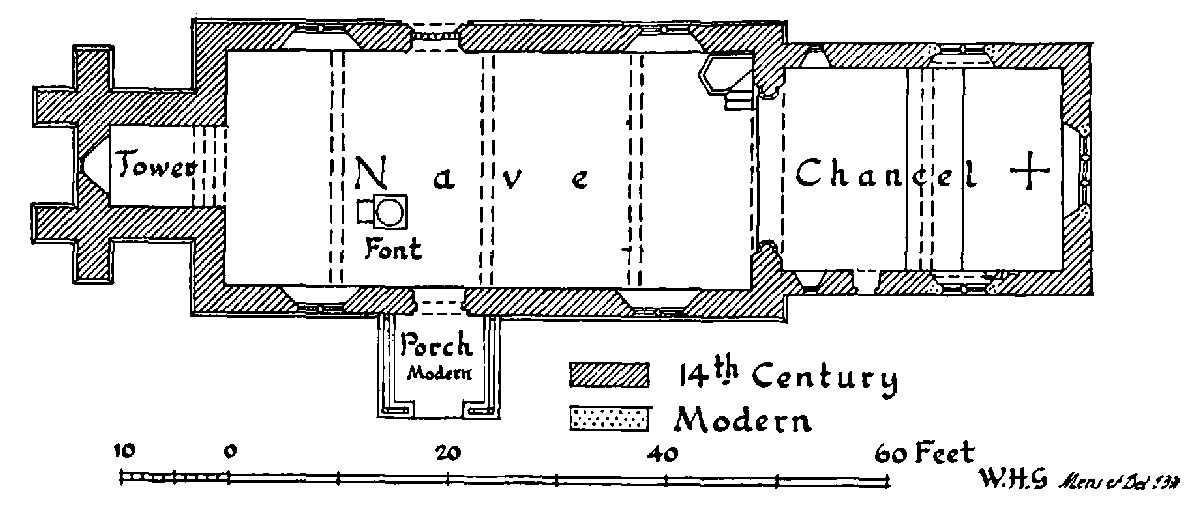
The church of ST. PANCRAS stands near the head of the village street, and on its north-west side. It consists of a nave, chancel, western tower, and south porch. The external wall-facing is flint rubble, and the dressings are of stone, which has, however, been largely renewed during restorations. The nave and chancel are broad and lofty, and appear to belong to the 14th century, but the tower is curiously small and slender, and may be of earlier date, though the absence of original detail makes it impossible to ascertain its period. The east window is of three lights with trefoiled ogee heads, above which is a pair of quatrefoils with another above, the whole enclosed within a two-centred arch and typical of the 14th century. There is a drip-mould with plain square stops. The lighting on both sides of the chancel is symmetrical. The easternmost window in each case is of two lights with a quatrefoil above beneath a two-centred head. Both have drip-moulds, that on the north finishing in plain stops, and the southern having figure-heads. On each side of the chancel, near the nave, is a long window of a single trefoil-headed light with a low sill, apparently a pair of low-side windows. (fn. 69) The heads of these windows are in a brown sandstone, unlike the rest of the stone used in the church, and they have no drip-moulds. On the south side of the chancel is a small priest's door with a two-centred head, the stones of which do not meet at the apex, but are separated by a flint key-block. The nave is lit on each side by a pair of two-light windows similar to those in the chancel; the drip-moulds have simple stops, those on the north being slightly different from those on the south. The blocked north door has a two-centred head and its mouldings are a hollow chamfer and an ogee wave. The south door is similar and has a drip-mould terminating in stops similar to those of the adjoining windows. The door is protected by a modern timber porch on a stone base, which replaces an earlier simple stone porch. The tower is very plain. It has paired buttresses at its western angles, no setoffs, and a pyramidal shingled roof. The west window of the tower is a simple trefoil-headed light, that of the ringing-floor has a plain head, and single lancets light the north, south, and east walls of the belfry. A clock now obscures the eastern lancet.
PARISH CHURCH of ST. PANCRAS KINGSTON NEAR LEWES
The chancel windows have internal scoinson-arches, but these are absent from those of the nave. The lowside windows have flat internal sills considerably lower than the sills of the windows themselves. In the south wall, just east of the larger window are two small ogeeheaded recesses, the eastern and smaller of which is slightly higher than the other. They are too small to be aumbries and have no drains. The chancel arch is twocentred, and very wide and lofty, of two heavily chamfered orders with no capitals separating arch from imposts. The filled-in holes for the rood-beam may be seen. The tower-arch is plain, segmental-pointed, and has no imposts, springing from the side walls of the tower in the same fashion as may be seen in the late12th-century tower-arches of neighbouring churches. The roofs of both nave and chancel appear to be modern reconstructions. The font is of unusual pattern, having a circular, heavily moulded bowl and a slightly narrower circular stem resting on a square base. It may be of the late 13th or early 14th century.
The communion table is Elizabethan, and at the west end of the nave is a fine Jacobean chest. (fn. 70)
The tower contains three ancient bells, one marked with the founder's name, Walter Wimbis, and the other two invoking the Virgin and St. Anne. (fn. 71)
The church possesses a communion cup and paten with the mark for 1568; a chalice, paten, and flagon of silver, 1872–4; and a silver alms-dish of about 1700. (fn. 72) The registers begin in 1654.
The building was badly damaged by lightning in 1865, and restored at that time, and again in 1874.
Advowson
Peter the sheriff gave one acre of land at Kingston for the building of the church and Hugh, sheriff of Lewes, was ordered by William II of Warenne to give the monks of St. Pancras seisin thereof to the use of the church. (fn. 73) This gift, together with the church, was confirmed to the monks by the same earl (fn. 74) and the church was held by the priory until the Dissolution. (fn. 75) The vicarage was endowed about 1190 by Seffrid II, Bishop of Chichester, with a messuage and 2 acres less one rood, adjoining the cemetery and meadow of the church: also all obventions to the altar except from the land of Warenne, and 12 semes of corn yearly to be received out of the barn of the monastery of St. Pancras. (fn. 76) In 1291 the church was valued at £14 13s. 4d. and the vicarage at £4 6s. 8d. (fn. 77) The living was valued at £8 13s. 9d. in 1535. (fn. 78)
From the Dissolution the advowson appears to have descended with Iford, to which it was actually united in 1666. (fn. 79) By 1558 the advowson of Kingston is said to have passed into the hands of Richard Bakere and Richard Sackville. (fn. 80) In 1563 Richard Sackville was sole patron, (fn. 81) and his son, Thomas, Lord Buckhurst, was patron in 1603. (fn. 82) From this time the patrons are the same for both churches.