
A History of the County of Sussex: Volume 7, the Rape of Lewes. Originally published by Victoria County History, London, 1940.
This free content was digitised by double rekeying. All rights reserved.
'Parishes: Westmeston', in A History of the County of Sussex: Volume 7, the Rape of Lewes, (London, 1940) pp. 116-119. British History Online https://www.british-history.ac.uk/vch/sussex/vol7/pp116-119 [accessed 26 April 2024]
In this section
WESTMESTON
Westmaestun (viii cent.); Westmestun, Westmyston (xi-xv cent.).
This parish is a long narrow strip, about a mile wide, running parallel with Ditchling and having Streat on its eastern side. It has an area of 2,095 acres. In 1934 a detached portion including Novington was transferred to East Chiltington, a parish which for many centuries had been a chapelry of Westmeston. The soil is loam, chalk, and clay, with a subsoil of chalk and ironstone, and the chief crops are wheat, oats, peas, beans, and turnips. The southern end of the parish is downland, rising abruptly to an altitude of 800 ft. on the eastern side of Ditchling Beacon, and running south to High Park Corner. At the foot of the Downs a road runs eastward to Lewes, the church and the few cottages of the village being situated at its junction with Underhill Lane, coming from the west, and the road from Ditchling, coming from the northwest. The altitude of this part of the parish is about 325 ft., and it slopes gradually down to 129 ft., rising again to 200 ft. at the northern end. At that end it is crossed by the road from Burgess Hill to Chailey, and the railway line from Haywards Heath to Lewes. There is a good deal of woodland in the north of the parish. There is a church mission room in the north of the parish, on the edge of Ditchling Common. Hailey Farm lies north of the village, on the boundary of Streat parish.
Westmeston Place stands on the west side of the road from Ditchling, a little north of the church. The house is of two stories with attics; the walls are chiefly flint, plastered in part, with tile-hanging; the roofs are tiled, with Georgian and later chimneys. The plan is Lshaped, with the ends to north and east, the west wing, with a westerly projection, containing the kitchen and offices. The south range contains the principal rooms and incorporates work of several periods, with a modern addition to the east. The west gable and most of the south wall date from c. 1500, and there was alteration in the mid 16th and early 17th centuries. This gable contains two windows lighting the parlour; to the south an early-16th-century two-light with four-centred heads, chamfered mullion, and ovolo label, and north of it a mid-16th-century three-light with filleted-roll mullion and ogee-moulded label. Over each is a twolight window, the south of mid-16th and the north of early-16th-century type. The attic window may be possibly of the late 15th century, having three pointed lights in a square head with hollow-chamfered mullions. The scullery projection on this side shows at first-floor level a remnant of 15th-century cinquefoil tracery in three slender panels reset as ornament.
The south front, disguised beneath plaster or modern brick, with tile-hanging, has a wide chimney projection. The porch west of this is of flint with sandstone dressings, not central with the entrance, and is of doubtful date, its openings, of 16th-century type, being possibly insertions. A chamfered four-centred doorway opens eastwards, at right angles to the main entrance, which is of similar form; the south wall has a fourcentred light in a square head with ogee-moulded jambs, and in the west wall is an oblong chamfered window. The north exterior shows work of various dates and projections in flint and modern brick, with a bay window to the hall. The kitchen range is in flint pebble with brick quoins and has tile-hanging on the north wall at first-floor level.
The early-16th-century hall was probably open to the roof, with a two-storied parlour block to the west; the main fire-place remains, though modernized, on the south wall. The first floor may have been inserted when the staircase was added, c. 1560–70; this shows an early type of Elizabethan newel—one square central post with a large finial at first-floor level; there is a turned balustrade above. The staircase curtails the bay window on the east side, but this six-light transomed window has square heads and filleted-roll mouldings, original only on the first floor, and does not seem much earlier. Joining the bay to the hall are contemporary moulded posts, the easternmost forming, on each floor, the jamb of a square opening spanning a passage. These suggest that the stairs led to a gallery along the north side of the hall. The square opening is not in line with the wall between the present dining-and sitting-rooms, but that above aligns with the thinner wall between two bedrooms. The easternmost of the bedrooms has early-17th-century panelling, and a typical Jacobean overmantel. The fire-place is apparently later. The parlour, now the lounge, is separated from the entrance passage by a screen, now open, with Elizabethan balusters. In the north-west angle of this room is a stone fire-place, probably contemporary with the staircase; it has a four-centred head and cavetto- and ogeemoulded jambs. The letters I and M are carved in shields in the spandrels, probably for John Michelborne. (fn. 1) There is an iron fire-back dated 1571. The attic stair is in a projection west of the bay window. There is a wattle-and-daub partition between the hall and parlour attics, with a four-centred opening in it. The kitchen wing shows a wide blocked fire-place, and some stop-chamfered ceiling beams.
Old Middleton, off the main road to Lewes, has a late-18th-century brick front to a probably 17thcentury house.
There are a few early-17th-century cottages in the north of the parish, on the road from Wivelsfield Green to Streat. One, in a field near North America Farm, is timber-framed with later brick and tile-hanging and contains a central chimney-stack with wide lintelled fire-places, and exposed ceiling beams. Whitecote, opposite North America Farm, is probably contemporary, and has a wide fire-place and external stack.
Middleton Common Farm lies on the north side of the road from Burgess Hill to Chailey. It is a timberframed house of two bays, with square panels, tiled roof, and a modern brick extension to the north. The central chimney is partly of 17th-century date, and serves a wide fire-place with bread oven.
Manors
The manor of WESTMESTON was held before the Conquest by Countess Gueda for 12 hides. It was held of her directly by her villeins and there was no hall or demesne land. After the Conquest it was held of William de Warenne by Robert de Pierpoint. (fn. 2) The overlordship descended with the barony and rape in the same manner as that of Hurstpierpoint in Buttinghill Hundred (q.v.).
In 1428 the manor was held as half a knight's fee. (fn. 3) John de Warenne in 1312 received the grant of an annual fair at Westmeston at Martinmas (11 Nov.). (fn. 4)
Westmeston descended for some time with Hurstpierpoint (q.v.), the chief seat of the Pierpoint family, but round about 1284–5 was held in dower by Maud, widow of Robert de Pierpoint. (fn. 5) She was still alive in 1296, (fn. 6) but her son Simon appears to have been holding it about 1317. (fn. 7) In 1412, when Sir William Bowet was lord of the manor, Westmeston was valued at £17. (fn. 8) It came, with Hurstpierpoint, into the possession of George Goring, but in 1607–8 was sold by his widow Anne and her son George, to Walter Dobell of Falmer, (fn. 9) who also acquired the neighbouring manor of Streat (q.v.). With Streat Westmeston subsequently descended. The present owner of both the properties is Miss Coke-Richards, but Mr. W. R. FitzHugh retains such manorial rights as still persist. (fn. 10)
In this manor the custom of Borough English obtained. (fn. 11)
The manor of MIDDLETON is first mentioned at the end of the eleventh century, when the tithes from it were given by William de Warenne I to the priory of Lewes. (fn. 12) It was kept in the hands of the lord of the rape, and is recorded as a demesne manor of the Earls of Warenne in 1296 and 1327. (fn. 13) It passed with the honor of Lewes to the Earls of Arundel, and descended with them until the death of Thomas, Earl of Arundel, in 1415. (fn. 14) On the division of his property Middleton was assigned to the Duchess of Norfolk (fn. 15) and followed the subdivisions of that third of the honor of Lewes (q.v.), being eventually held in moieties by the Earls of Derby and the Dukes of Norfolk. Henry, Earl of Derby, in 1576 conveyed his moiety to Sir John Jeffrey, chief baron of the Exchequer, who died in 1578 holding it by fealty and rent of 2d. (fn. 16) His daughter and heir Elizabeth married Edward, Lord Montagu, (fn. 17) and their daughter Elizabeth married Robert, Earl of Lindsey, Great Constable and High Chamberlain of England, who received a conveyance of this moiety of Middleton from his father-in-law in 1634. (fn. 18) In the same year, however, Robert, Earl of Lindsey, and Elizabeth and their son Sir Montagu Bartie, Lord Willoughby, sold the property to Nicholas Chaloner of Chiltington for £300. (fn. 19) In 1637 Nicholas and his son sold it to William Michelborne of Stanmer for £350, (fn. 20) and it was sold by Edward Michelborne, his youngest son, to Walter Dobell in 1666–7. (fn. 21) John Michelborne had conveyed the estate to John Juxon in 1653, but this claim was acquired by Walter Dobell in 1665. (fn. 22) The other half of Middleton having been purchased from Thomas, Earl of Arundel, by Dobell's greatgrandfather in 1611, (fn. 23) the whole manor was once more in the same hands, and it has descended with the manors of Westmeston and Streat (fn. 24) (q.v.) to Mr. W. R. FitzHugh, (fn. 25) who sold the house to Miss R. Coke-Richards.
HAILEY PARK in Middleton [Haylly (xv cent.); Heyghley, Haileigh (xvi cent.)] is first mentioned as a Park between 1442 and 1450 (fn. 26) when Stephen Wybbyshay was the Duke of Norfolk's keeper. It descended with the manor of Middleton, and was still inclosed in 1634. (fn. 27) It is now a farm.
STANTONS (historically part of Westmeston, but transferred in 1934 to East Chiltington) originated in the quarter knight's fee held in the 13th century by John de Staunton of Simon de Pierpoint (fn. 28) lord of Westmeston. It was possibly identical with the 3 hides and 3 virgates in Westmeston held by a certain knight of Robert de Pierpoint in 1086. (fn. 29) The mesne lordship remained with the Pierpoints and the Dacres, but in the 15th century Stantons was held of their manor of Hurstpierpoint. (fn. 30) The undertenancy appears to have lapsed and in 1428 this ¼ fee was held by the heirs of Michael de Poynings. (fn. 31) His son Sir Richard died seised of lands in Westmeston in 1387, and his widow held in dower what was described as a 'manor of Westmeston', until 1394. (fn. 32) From Robert their son, who died in 1446, Stantons passed to his grand-daughter Eleanor, wife of Henry Percy, Earl of Northumberland, (fn. 33) and in 1484 descended to her son Henry. (fn. 34) Henry, Earl of Northumberland, grandson of the latter, sold the manor in 1531 to Sir Thomas Neville, (fn. 35) who together with Robert Southwell conveyed it in 1539 to John Michelborne. (fn. 36) The manor, known as Westmeston alias Stantons, remained in the Michelborne family until 1644, (fn. 37) when William Michelborne, grandson of the purchaser, sold it to John Juxon. (fn. 38) Sir William Juxon, son of John, sold it in 1665 to Walter Dobell, (fn. 39) after which it descended with the main manor of Westmeston (fn. 40) and presumably became merged in it.

Michelborne. Or a cross between four eagles sable.
Church
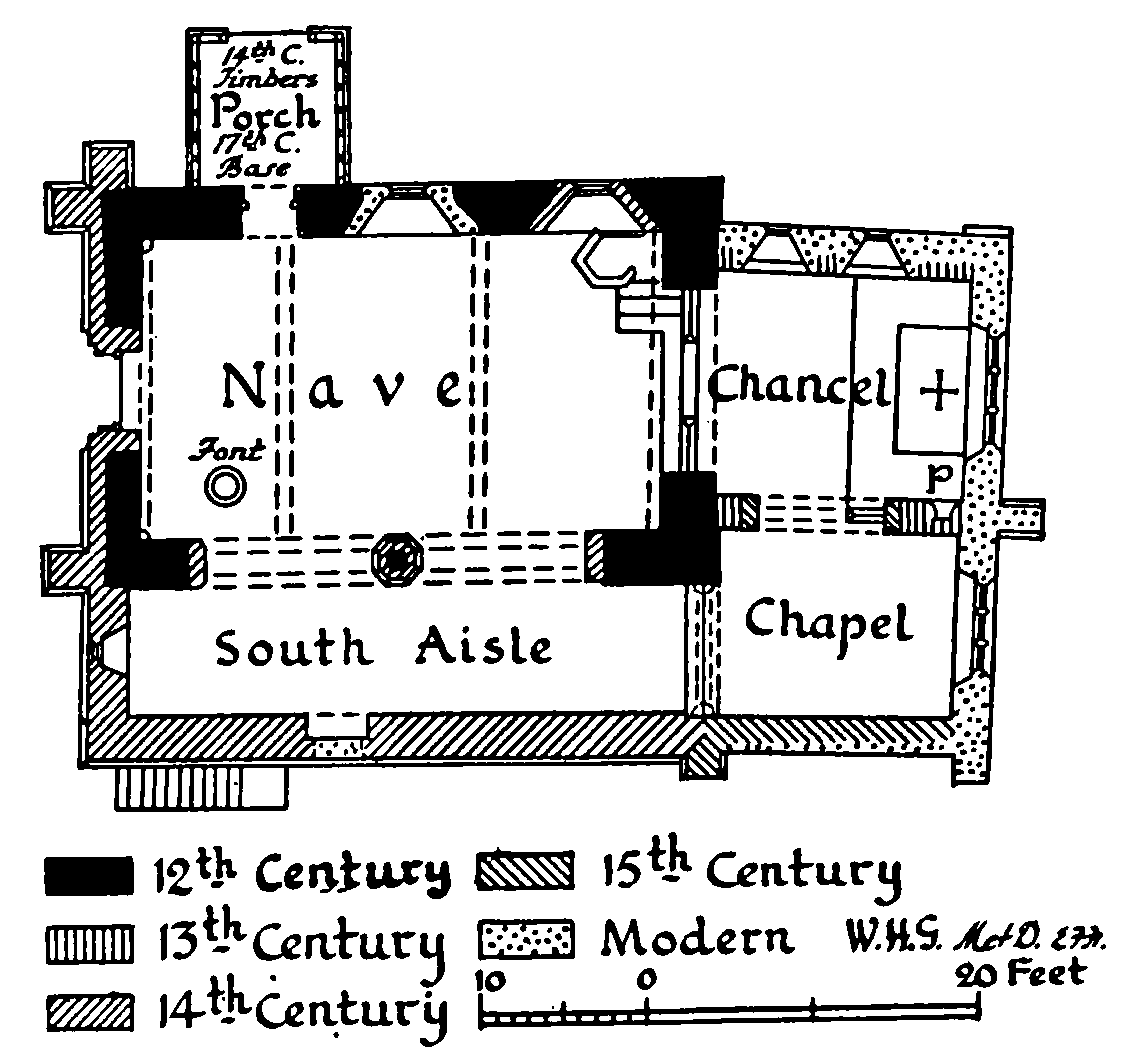
The parish church of ST. MARTIN stands on a slight eminence off the LewesDitchling road. The walls are flint, plastered in part, with sandstone dressings; the roofs have tiles on the north and chiefly Horsham slates on the south. The nave was built soon after 1100, and the original north doorway remains. It is probable that the chancel was reconstructed in the 13th century, and its east and north walls were again rebuilt, from the base, in the 19th century. The arcade of the south aisle dates to the early 14th century, and in the last years of that century the whole west wall was refaced, and the bell-cote probably reconstructed. The south chapel was added c. 1500, but its east wall was rebuilt with that of the chancel in the 19th century. The north porch incorporates parts of the original 14th-century structure.
The chancel (15 ft. 6 in. × 13 ft. 6 in.) has a rebuilt east wall with modern three-light window. The north wall is refaced, with two new lancet windows, but the south wall is of 13th-century date, and has a trefoilheaded piscina with soffit cusps and roll mouldings to its outer order; the sunk circular drain remains. West of it is a late-15th-century arch to the south chapel: it is of two orders, the outer chamfered with a plain triangular stop, the inner hollow-chamfered and carried on corbels, which are polygonal in form. The abacus is chamfered with ogee under-surface, and the bell and astragal roll-moulded. The chancel arch was recut in recent years; it was of 12th-century date.
PARISH CHURCH of ST. MARTIN WESTMESTON
The south chapel (14 ft. × 11 ft.) was added c. 1500, but the east wall has been rebuilt from the base, and has a modern three-light window; it has a gabled roof. The south wall has been refaced. The west arch into the south aisle resembles the north arch into the chancel, but there are squared abaci to the corbels, which are larger and cruder, the polygonal stem being straight instead of curved; the springing is slightly lower to the north.
The nave (31 ft. 5 in. × 18 ft. 2 in.) has a 12thcentury north wall, with, towards the east, an early14th-century trefoil-headed window, probably inserted with the south arcade; the restored segmentalpointed rear-arch is similar to those in the north wall of the chancel. The western window is a modern copy, and does not occur in Sharpe's drawing. (fn. 41) West again is the north doorway; it has a round chamfered head and projecting imposts, with roughly chamfered underside, and restored flat-headed rear-arch. The south arcade and aisle date from c. 1330. The arcade is of two bays with obtuse-pointed arches of two chamfered orders; the outer order has its chamfer continuous to east and west, but the inner is there carried on corbels.
The pier is octagonal with scroll-moulded abacus, roll astragal, and chamfered base. The corbels are contemporary, but of smaller size and more delicate mouldings.
The west wall of the nave was refaced at some period in the late 14th century, and right-angled buttresses were added at the north-west angle of the nave, and a similar buttress in two stages bonded in to nave and aisle on the west. These buttresses have a hollowchamfered plinth which continues along the west wall almost to the south-west angle of the aisle. (fn. 42) It turns down on either side of the contemporary west doorway. This has an equilateral arch in two orders, the outer hollow-chamfered, with a spear-shaped stop, the inner wave-moulded and worn; the hood has a straight chamfer and returned ends; there is a restored flatheaded rear-arch and original chamfered jambs with triangular stops. Above it is a window of similar date, with two ogee-trefoiled lights with ogee frame and a label of similar profile to that of the doorway; there is a flat rear-arch. North of the window the wall is plastered externally, but appears to resemble in material the rest of the west wall—namely well knapped flint.
The south aisle (33 ft. 6 in. × 7 ft. 7 in.) is 14th-century, and the nave roof continues over it. The south wall is old and leans outwards but modern brick cellarage and steps have been built underneath, with a new flint plinth. The old part is plastered and separated from the wall of the chapel by a low buttress. In the west bay is a 14th-century south doorway with flat chamfered reararch, blocked externally. The vestry is screened off west of it. The west wall, except for the modern southwest angle, is part of the later 14th-century rebuild, and has a trefoiled ogee window with triangular rear-arch.
The north porch has a 16th- or early-17th-century brick base on which is re-used 14th-century timbering on the north side, an obtuse-pointed arch, and trefoiled barge board. The bell-cote to west is probably repaired late-14th-century work, with shingled sides and pyramidal cap. There are louvre openings to north and south. The roofs: there are two old ties, slightly chamfered, in the nave, and timbering strengthening the bell-cote at the west wall. The floors are tiled—there are three steps and a low wall at the chancel arch and one step at the altar rail.
The font is of 12th-century chalice form. The pulpit dates to the later 17th century. There are no signs anywhere in the church of the mural paintings discovered in 1862. These were: east wall of nave, Agnus Dei, 12th century: north side, Scourging and Magi, 12th century; below, part of a 13th-century subject. South side: Descent from the Cross, Christ delivering the key to St. Peter and book to St. Paul—12th century. Below, Crucifixion—13th century. Soffit of chancel arch—Signs of the Zodiac, and on a panel below—Demon threatening a soul in a shroud. North wall of nave—? Betrayal, St. Peter cutting off the ear of Malchus, Martyrdom of St. Vincent, part ? of Doom—all 12th century. (fn. 43)
There is a War Memorial of 1914–18 on the south wall of the nave. There are three bells, one dated 1712, by Samuel Knight of London, and the others 1636, by Bryan Eldridge of Chertsey. (fn. 44) The plate includes a cup and paten with 1718 hall-marks, and a flagon with 1746 hall-mark. (fn. 45)
The registers date from 1587.
Advowson
The advowson of the rectory of Westmeston appears in the possession of Simon de Pierpoint in 1329 and 1331. (fn. 46) It descended with the manor until the beginning of the 19th century, (fn. 47) and was held in 1805 by Thomas Lane. (fn. 48) Before 1809, however, it had been acquired by William Campion of Danny, and has since descended in that family. (fn. 49) The living was united with that of Streat in 1909, presentation being made alternately by the two patrons. Col. Sir William Campion, K.C.M.G., D.S.O., presented in 1935.
The chapelry of East Chiltington (q.v.) was attached to Westmeston until 1909, when it was transferred to Plumpton.