
A History of the County of Sussex: Volume 7, the Rape of Lewes. Originally published by Victoria County History, London, 1940.
This free content was digitised by double rekeying. All rights reserved.
'Parishes: Slaugham', in A History of the County of Sussex: Volume 7, the Rape of Lewes, (London, 1940) pp. 181-186. British History Online https://www.british-history.ac.uk/vch/sussex/vol7/pp181-186 [accessed 24 April 2024]
In this section
SLAUGHAM
Slacham (xi cent.); Slagham (xiv cent.).
This is a long, narrow parish running up the western boundary of the rape to a point on the main road from Brighton to London just south of New Town and Crawley, and has a projection eastwards taking in Highbeeches Forest, bounded on the north by Stanford Brook. In the south the parish becomes broader, and the hamlet of Warninglid is situated there, at the crossing of the road from Cuckfield to Lower Beeding, and a smaller one running north to Slaugham Common and Handcross. The elevation of the parish there is 369 ft. Northward of Warninglid it dips to a lake near the ruins of Slaugham Place, and rises again to the village, at 200 ft., which lies along the road coming west from Staplefield. From this road several others lead north to Handcross on the eastern edge of the parish. The church is in the centre of the village, on the south side of the road. Slaugham Common lies west of the village. In the south-western corner of the parish are woods with several hammer-ponds.
North of the village the ground rises to the Forest ridge, reaching a height of 504 ft. at Handcross and the main road from Brighton to London runs up the eastern boundary north of this part. At Pease Pottage a road branches off west to Horsham, and further north the ground slopes down again to about 270 ft.
The area of the parish is 5,482 acres, and it is divided into four districts: Handcross, Pease Pottage, Warninglid, and Slaugham. Church Mission Rooms are situated in the three first. There are Baptist and Methodist chapels at Handcross.
The soil is sand and clay, and the subsoil clay, gravel, and sand. The chief crops are oats, mangoldwurzels, and wheat.
The village is a small one, with a small triangle north of the church, and a short street running north from it. The Chequers Inn has some slight signs of age, but is now mostly modern. The cottage next south is probably of the 17th century: it is stone-fronted, and has a tiled roof with a central chimney-stack of thin bricks. A house, north of the triangle, is of the 17th century; the walls are of brick, with tile-hanging to the upper story, and the roof is tiled: above it is a central chimneystack of thin bricks. Inside some framing shows, and there is a wide fire-place. Another house behind it, to the north-east, of L-shaped plan, has a heavy projecting chimney-stack of stone of late-16th-century date: it has three shafts of thin bricks, the middle diagonal, the outer two square, with moulded bases.
Bosworth House, east of the triangle, is of 15th-century origin. The original part is rectangular, facing south. A wing was added to the north late in the 16th century, making the plan L-shaped. The hall appears to have been of two bays, and had a solar or buttery wing east of it: if there was a west wing it has been destroyed. A part of the 15th-century roof remains in place at the east end of the hall, with a strutted kingpost and braced central purlin below the collar-beams. Much of the roof, including the middle truss, was altered when a heavy chimney-stack was built in, in the east bay of the hall, in the 16th century. Some of the smoke-blackened common rafters are left in place: they are 9 in. by 5 in., laid flatwise. There are also original wide flat joists in the lower ceiling of the east wing. The room on the site of the west bay of the hall has the timbers exposed inside, including the story-posts of the former middle truss, and a ceiling-beam between the two posts: the ceiling has wide flat joists. The fire-place is a very large one with corner seats. The staircase is next north of the chimney-stack. When the late-16th-century wing was added another great chimney-stack was inserted, intruding on the original east wing: this has wide stone fire-places back to back, and a rebated shaft above. The 16th-century wing has open-timbered ceilings, with heavy chamfered beams: it has projecting windows with moulded mullions and transoms in the gabled north end. This gabled wall shows the framing externally, but elsewhere it is mostly replaced by brick or tile-hanging.
Naylands, about ¼ mile west of the village, on the south side of the road, is a house of c. 1600 with a timber-framed north front and a tiled roof with a rebated central chimney-stack.
Denman's Farm, nearly a mile west-south-west of the church, is a 17th-century house showing square framing in the upper story of the north-west front: the roof is covered with Horsham slabs and has a plain central chimney-stack.
Bell's Farm, about 150 yards farther west (apparently once called Hampshire Farm) is an early-15th-century house retaining much of the original structure. It had a hall-place of two bays, 12 ft. and 10 ft., with an east solar and west buttery wing. A floor was inserted in the usual manner in the hall and a chimney-stack built in at the east end of the hall c. 1600. The east solar wing was destroyed, apparently late in the 17th century. The chimney-stack had two wide stone fireplaces back to back: that to the east wing now shows externally and is blocked. The refacing of the wall next south of the stack is of late-17th-century brick. The wall next north of the stack retains an original four-centred oak doorway—now also blocked with 18th-century bricks—and inside, the same wall, on either side of the stack, has the original moulded wallbeam of the hall, of a rather more elaborate moulding than the later 15th-century beams. In the upper story is the tie-beam—hollow-chamfered—of the middle roof-truss, but it has been cut through in the middle and fitted with later framing for head room, the kingpost, &c., being destroyed. But the closed west wall of the hall has original framing, with curved braces below both the lower plain wall-beam and upper tie-beam; above the latter is a strutted king-post. In the same wall, on the ground floor, is another original fourcentred doorway, one of a pair close together, that opened into the two rooms of the buttery. The southern of these rooms has a heavy ceiling-beam and exposed joists. The roof-rafters are of heavy scantlings, 8 in. by 5 in., set flatwise. The later ceiling-beams and joists in the inserted 16th-century floor on the hall-site are stop-chamfered. The north front has much of the original framing, with curved braces in the upper story. The old entrance to the hall-screens is replaced by a modern one, but a row of peg-holes in the lintel shows that it had an arched head. The other walls are weather-boarded. The roof is covered with Horsham slabs and has at the east end a rebated chimney-shaft of thin bricks. A barn of three bays has some early medieval framing with curved braces reaching from floor to tie-beams in the end walls: the roof is modern and covered with tiles.
The ruins of Slaugham Place, built by John Thorpe (fn. 1) for Sir Walter Covert in the time of James I, are much as described in 1858 by W. H. Blaauw, (fn. 2) but inevitable decay has advanced a little more since his description was published. The remains indicate a complete courtyard plan about 80 ft. square, surrounded by ranges some 25 to 30 ft. wide, and with the kitchen and offices to the south-west. The great hall was in the west range, the principal entrance with an arcade of five bays was on the north side, and a secondary entrance with a smaller arcade on the east. There was a large outer area of gardens and courts, with boundary walls that had turrets at the angles and a gateway to the east opposite the east arcade. Part of a moat filled with water remains to the south of the house and garden.
The chief survivals are the arcades, and the lower parts of the walls of the west range, and kitchen and offices north of it. The remainder is little more than foundations. The most conspicuous feature is the arcade of the outer side of the north range. Three semi-circular arches are complete, and parts remain of the others: they have coffered soffits with pyramidal pendants. The piers, 4 ft. broad, have attached fluted pilasters on the north face with Doric capitals and bases on tall enriched pedestals. The piers of the middle bay are deeper than the others, so that the bay projects, and in the reveals are shell-headed niches. Above the arches was an entablature of which the architrave and parts of the frieze are left in place. In the spandrels of the arches, and also along the frieze, are many shields of arms, all with the Covert arms impaling or impaled by other coats. Those in the frieze alternate with roses and stag's-head skeletons. The three arches that stand on the inner face of the (former) east range have round heads with coffered soffits and plain imposts. Of the west side of the courtyard, the hall doorway exists, in a projecting bay: it has rusticated half-round shafts on pedestals and a round head with a moulded archivolt: above it is a stone entablature. North of it are mullioned windows of two, two, and three lights, the last being in another projecting bay. South of the doorway is a three-light window to a small chamber south of the hall, and next south is another projecting bay, which retains one light of a very tall window, and below it a complete three-light window to a basement. In the wall between the two small chambers lighted by the latter windows is a gap indicating a former archway. The kitchens were south of these and extending westwards. There are remains of three fire-places in the south wall. The westernmost is 13¼ ft. wide and 4¼ ft. deep and has a four-centred brick arch, and some of the flue above. Next west is one moulded jamb of a tall window that pierced the west wall of the kitchen. The similar fire-place next east is 8 ft. 3 in. wide, and there is a gap for an oven between the two fire-places. The third and easternmost fireplace was that of the 'pastry': it is like the other, but only 7 ft. 2 in. wide, and has a domed oven at the back of it. Above it is a gap indicating another fire-place to an upper story. The chambers north of the kitchen and other walls are shown by low walls only. The south wall, which forms the north side of the moat, is of ashlar. There is the bottom of a three-light window at the south end of the east range. At the angle of the wall with the east garden-wall is a three-quarter octagon of brick with stone dressings. In it is a three-centred south doorway of brick, and small lights: a stone doorway with a three-centred head opens, in the north-west side, to the garden. Another turret exists farther north, and between the two, central with the house, is a gateway with rusticated stone pillars and iron gates with an ornamental 'overthrow'. The wall extends northward up to a square turret or summer-house, and there is another at the south-west angle beyond the kitchen.
The village of Warninglid consists of a single street. A few of the buildings are ancient. A row of cottages on the west includes one with 17th-century timber-framing in the upper story and a rebated chimney-shaft above the tiled roof. Another farther south has walls of stone and timber-framing, and a tiled roof with a plain late17th-century chimney-shaft. At the south end of the east side is a house and shop (Post Office) with lower walls of brick and stone, and tile-hanging above, and a Horsham-slab roof with an early-17th-century central chimney-shaft of thin bricks and of cross-shaped plan.
The village of Handcross is a long street forming a part of the present main Brighton road. Most of the buildings are modern, but at the south end of the west side is the Red Lion Hotel, dating probably from 1550, or possibly earlier. The building has been much renovated, but ancient open-timbered ceilings and wall-framing are visible inside; there are no visible remains of the roof-construction. A business office on the ground floor is lined with reset panelling, some of it Elizabethan with L-shaped panels of raised mouldings, other of the typical early-17th-century panelling. The external elevations are of brick and tile-hanging, and there is a gabled wing on the east front repeated at the back. The original entrance doorway remains in place with moulded posts and lintel. A low cottage adjoining the north side has been absorbed by the inn and its upper floors removed to make an open saloon: it has two roof-trusses with straight braces under the tie-beams.
Nashland Farm, about ¾ mile north of Handcross, is a 15th-century house of simple detail. It has the typical central-purlin roof-construction with king-post trusses, and curved braces are seen in both outside walls and partitions forming the ends of the hall. The hall was of one bay, with solar and buttery wings north and south of it. An upper floor was inserted in the hall, and the central chimney-stack built in the north wing in the 16th century. It has a wide fire-place with a chamfered lintel, corner seats, and small recesses. The partition between the lower room on the site of the hall and the south wing is a plain one of board and batten type, unusual in Sussex and probably original. The external walls of the lower story are of modern brick, and the entrance in the west front has been furnished with a porch. This has a lintel carved with the initials and date 16 IGI 73 (73?): said to have been brought from Chod's Farm, Handcross, a house which still retains a 17th-century chimney-shaft at the north end, and wide fire-place with a lintel inscribed 'BILT 1690'.
Manors
SLAUGHAM is not mentioned in Domesday Book, but as the tithes were granted to the Priory of St. Pancras at Lewes between 1091 and 1098 by Hugh son of Golda (fn. 3) it is probable that he was then holding it. Slaugham, however, is not found among the estates of his descendants the Plaiz family, but in the 13th century it appears in the hands of the Poynings. The manor was subsequently held of Earl Warenne by the service of inclosing one perch of the earl's park at Cuckfield, (fn. 4) and the overlordship descended with the rape. (fn. 5) The first of the Poynings family recorded as holding lands in Slaugham was Luke de Poynings, in 1273. (fn. 6) Michael de Poynings had a park there in 1296, (fn. 7) and his successor Thomas obtained a grant of free warren there in 1328. (fn. 8) Slaugham descended with Twineham and Poynings in the Poynings family (fn. 9) until Eleanor, Countess of Northumberland, grand-daughter of Robert Poynings, died in 1484. (fn. 10) It seems to have been conveyed by her son Henry, Earl of Northumberland, to John Drakys before 1488, (fn. 11) perhaps acting for William Covert, who died seised of it in 1494; (fn. 12) and it remained with his descendants for almost two centuries, (fn. 13) in the same manner as Twineham Benfield (q.v.), except that after the death of Thomas Covert in 1643 Slaugham did not pass directly to his brother Sir John, but was held during her life by Diana Baynham only child of Thomas Covert. (fn. 14) In 1672 Sir John Covert conveyed the manor of Slaugham to Sir William Morton, (fn. 15) from whom it passed before 1714 to James Morton son of Sir John's daughter Anne. (fn. 16) In 1727, however, the manorial court was held by Samuel Thornton of Fingles in Ireland. (fn. 17) Slaugham was shortly afterwards acquired by Charles Sergison, who died in 1732, bequeathing it to his nephew Thomas Warden Sergison, (fn. 18) after which Slaugham descended, like Cuckfield (q.v.), in that family, the present owner being Major-Gen. Sir Bertram Sergison-Brooke, C.M.G., D.S.O. (fn. 19)
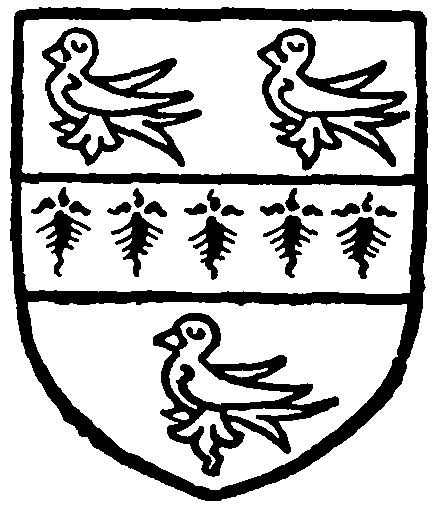
Covert. Gules a fesse ermine between three martlets or.
The custom of Borough English obtained in the manor. (fn. 20)
The manor of HYDE first appears in 1596, when it, with common of pasture in the forest of St. Leonard, was transferred by Hugh Boord and Roger Aderton and Thomasine his wife to Thomas Aderton. (fn. 21) Thomasine was the daughter of Richard Ockenden of Ashford, Kent; (fn. 22) Hugh was a son of her second husband George Boord; Roger Aderton, her third husband, died in 1602, leaving 'lands in Slaugham called the Manor of Hyde' to his nephew and heir Thomas Atherton. (fn. 23) Thomas was executed for the murder of his wife, (fn. 24) and after the death of Thomasine in 1614 the manor passed to Atherton Denham, son of her daughter Margaret and Benjamin Denham. (fn. 25) Her son and heir Sir Stephen Boord in 1623 unsuccessfully claimed it against Atherton Denham and Dorothy his wife, who in 1634 conveyed it to Edmund Middleton, (fn. 26) and he and his wife Anne, possibly the daughter of Atherton Denham, (fn. 27) sold it to John Gillam in 1640. (fn. 28) It is next heard of in 1729, when Daniel Heathfield and Judith his wife were dealing with it, and in 1734 they conveyed it to Letitia Marsh. (fn. 29) The only other known reference to the manor is in 1775, when Susan Haner, widow, conveyed it to Thomas Milward. (fn. 30)
The manor of WARNINGLID [Warthynglythe, Warynglide (xiv cent.); Warnynglyth (xv cent.); Wardyngleys, alias Warnynglegh (xvi cent.)] was probably held by the Poynings with the main manor of Slaugham, but was retained by that family until 1531, when Henry, Earl of Northumberland, conveyed it to Thomas Nevill. (fn. 31) It came, like Crawley, into the hands of Sir Robert Southwell and Margaret, (fn. 32) and in 1541–2 was released by them and Thomas Nevill to Thomas Brygham and Thomas Austen. (fn. 33) In 1549–50 the two latter conveyed Warninglid to John Agate, (fn. 34) in whose family it remained for more than a century. John Agate was succeeded in 1588 by his son Thomas, who died about 1625. (fn. 35) Thomas's son Henry was succeeded in 1641 by his infant daughter Mary, (fn. 36) who appears eventually to have married Richard Blower. Mary and Richard were holding Warninglid in 1671, (fn. 37) and in 1679 Mary granted the reversion of the manor after the deaths of herself and her husband to William Holt. Mary Blower was still holding it, as a widow, in 1687–8, when she conveyed it to Thomas Ellis. (fn. 38) Further records of the property are wanting.
Church
The church of ST. MARY consists of a chancel, south chapel, nave, south aisle, south porch, and west tower: there are also modern north vestries. The nave is of early-12thcentury date and retains an original doorway in its north wall: possibly the chancel is of the same period, but it retains no 12th-century features. Near the end of the 13th century a narrow south aisle was added, with an arcade of two bays, and the west tower built. The chancel-arch is probably of the same period. In 1613 the south chapel was erected by William Covert: it had a doorway in its west wall. The south aisle was widened to its present limit in 1827, with its own east wall. In 1858–60, however, the wall was pierced by an archway, the west wall of the Covert chapel removed, and the two parts connected by the closure of the gap between them. The upper part of the tower was rebuilt and the organ chamber and vestry added. (fn. 39) In 1879 the south porch and a north vestry were added and the organ was removed from the west gallery.
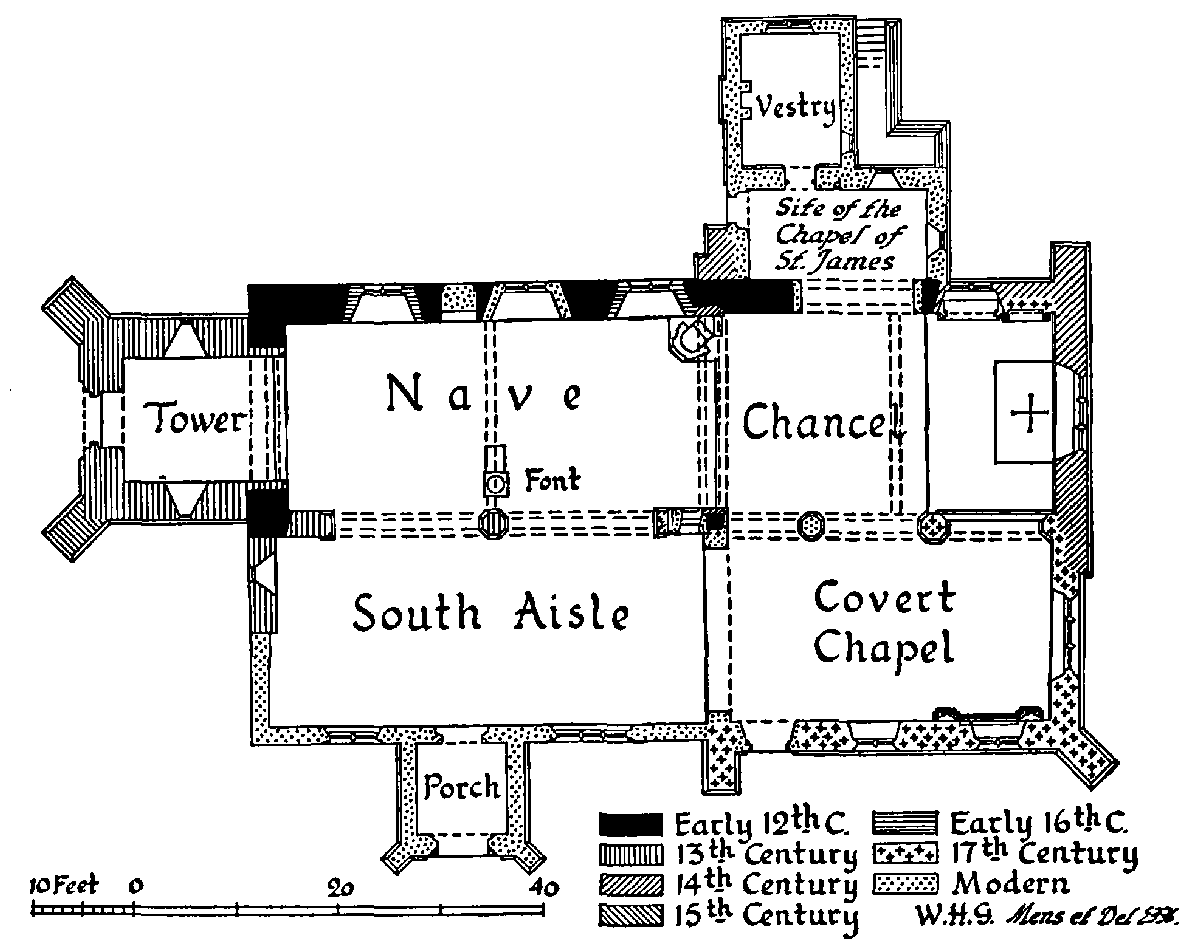
PARISH CHURCH of ST. MARY SLAUGHAM
The chancel (34 ft. by 19 ft.) has an east window of three trefoiled lights and tracery in a two-centred head, with an external hood-mould and head-stops. It is of early- to mid-14th-century date with some modern repairs. In the north wall is a window of two trefoiled ogee-headed lights and a quatrefoil in a two-centred head, perhaps of the same date, but all restored. Next west is a modern archway to the organ chamber. In this wall are two recessed tombs with brasses described below. On the south side an arcade of three bays opens into the south chapel. The western bay—a narrow one—is of 1858–60; the other two bays are contemporary with the chapel and have a middle octagonal pillar with moulded capital and chamfered base and east respond to match: the other pillar is modern, with the west arch. The two-centred chancel arch is a plain one of two chamfered orders dying on the side walls of the nave. The chancel walls are of rubble of local stone and have north and south buttresses to the east wall. The roof is modern, except for one tie-beam apparently of the 14th century, and is covered with tiles.
The south chapel (34 ft. by 17 ft.) bears the date 1613 on the kneeler-stone to its west gable and the initials W.C. on that of its east gable. It has an east window of three cinquefoiled lights and tracery and two south windows of two lights, all with pointed heads and external hood-moulds: a south doorway at the west end, and the west archway to the aisle are modern. The walls are of ashlar. The roof has a plastered coved ceiling and is covered with Horsham slabs.
The nave (41 ft. by 19 ft.) has three north windows: the middle one of two lights is modern: the other two are of the early 16th century: each has two plain fourcentred lights under a square head. Between the second and third windows is the 12th-century doorway: it is blocked and externally appears only in outline, showing grooved and chamfered imposts: inside it forms a round-headed recess with rough square jambstones. Its threshold is 3 ft. 6 in. above the present nave floor-level. The north wall is of an irregular rubble mainly of iron-stone, but near the base is some attempt at herring-bone coursing. The south arcade is of two bays and dates from c. 1290. The middle pillar is octagonal with a moulded capital and base, and the responds are square with chamfered angles. The eastern has a similarly moulded capital and chamfered base, and in its reveal is cut a rounded niche with a trefoiled ogee-head of the 14th century. The capital of the west respond was apparently destroyed for a gallery, now removed. The arches are of two chamfered orders and are pointed, the arcs being struck from centres well below the level of the capitals: they have medium-sized voussoirs. The wall, east of the east respond, has a piercing with a half-arch, perhaps a modern entrance to a pulpit. The roof is modern and is covered with tiles. The south aisle (19 ft. wide) has two south windows with tracery and a doorway, all modern. The west end includes the original west wall of the 13th-century narrow aisle, which was roofed continuously with the nave; it is built of uneven rubble with angle dressings and contains an original lancet window; there is also a modern west window. The ceiling is plastered and the roof covered with slates.
The west tower (12 ft. square) is of three stories, undivided externally. The walls of the top story are of modern squared rough ashlar, those below are of ancient uneven rubble. At the west angles are 15thcentury diagonal buttresses, partly restored. The archway from the nave is a simple pointed opening of two chamfered orders dying on to the side walls. The late13th-century west doorway is also a plain one of two chamfers: above it is a trefoil-headed light and in the side walls are narrow round-headed lights. There are no windows to the second story. The bell chamber has modern lancets in three walls and on the north side is a clock-face dated 1881. The roof is pyramidal and has a weather vane.
The south porch and the two north vestries are modern.
The font is of late-12th-century date, made of Sussex marble. It has a square, slightly tapering bowl: the north and south sides of it are treated with four very shallow round-headed panels; on the east face is carved a fish, and on the west three sprays with voluted tendrils, all in very low relief. The stem is cylindrical and surrounded by four round shafts: the base is moulded and common to both the stem and the shafts.
There is a communion table, now in a vestry, probably of Archbishop Laud's time. Another small table of later 17th-century date stands in the aisle: it has turned legs and fluted top-rails. Next it is a small iron chest, or strong-box, of the 16th century, with a lock covering the underside of the lid. The pulpit, of foreign workmanship and probably of the 17th century, was given in 1890 in memory of Sir Robert Loder, bart. It is enriched with jewel-ornament, cherubs' heads, &c., and has Corinthian shafts at the angles. Set on the north wall of the chancel are six sides of a former pulpit of the early 16th century: two are carved with figures, one of St. Peter holding a key and open book, the other, probably St. John, holding a closed book in the left hand: the right hand is now missing: the lower panels of these two sides are carved with the initials I W bound together with cords: the other panels have linen-fold ornament and in the lower panels of two of them are the initials [AF], now damaged. Another carved panel, with the figures of the Blessed Virgin and Child and St. Anne, is now in the vestry.
On the east wall of the south chapel is set, upright, a floor slab containing the brass effigy of John Covert, 1503. (fn. 40) He is represented in armour with a sword on his left side and a dagger on his right, and his head resting on a helmet. The figure is only 2 ft. 2 in. high, and is set in an earlier large canopy, with cinquefoiled pointed head in an ogee gable, which is crocketed and has a cusped-wheel tympanum. The soffit of the canopy is ribbed and has foiled compartments. The side posts have moulded bases, offsets, and gabled heads with crocketed finials: parts are missing from these, also two upper shields. There are two lower shields, one a modern plate, the other (sinister) charged with the Covert arms, and an inscription plate.
In the north wall of the chancel is a recessed tomb and canopy of early-16th-century detail. The tomb has a moulded slab, and a panelled front of four bays with tracery about central shields, now fitted with modern brass plates. The recess has octagonal shafts, with concave sides and moulded capitals and bases, and a very flattened Tudor arch with a pendant keystone and plain spandrels. Above it is a frieze of quatrefoiled circles and a moulded cornice, on which are caps to the pilasters over the shafts and keystone, and a row of cresting. The reveals of the recess are panelled and the soffit has ribbed lattice ornament. In the back of the recess have been re-set the brass effigies of Richard Covert (1547) and three of his wives, with an inscription plate, &c. The man, 12¾ in, high, is shown in armour, kneeling on a cushion above a square-tiled pavement: he is turned three-quarter face to the dexter. Behind him is the first wife, 12 in. high, in pedimental headdress, tight bodice, cuffs to the sleeves, full skirt, and girdle with a long pendant. The second wife is similar, 13 in. high. The standing figure, 13½ in. high, of the third wife is in similar costume, but the head-dress is more elaborately embroidered and the girdle is a sash rather than a belt. Each of the figures has a scroll inscribed with a different text. A small plate has the figure of Christ rising from the sepulchre with sleeping soldiers around. An inscription plate, below the man and first two wives, reads:
'Here lyeth Richard Covert Esquier and Elizabeth first wyfe of ye sayd Ric one of the dowghters & heiers of John Faggar Esquier & Elizabeth his wyfe, & Elizabeth sec[o]nde wyfe of ye afore sayd Ric' Covert the dowghter of George Nevyle Knyght lord Burgevenne & Jane Ascheburnhame dowghter of William Ascheburneham of Ascheburnham Esquier also Blanche Vawhan the dowghter of John Vawghan of Burgevenne Esquier last wife of the said Ric.' whiche sayde Ric decessed the VII day of June Ao d[omi]ni 1547 on whos soull ih[es]u have mercy.'
Another plate below the third wife reads: 'Hec filia Willi Asscheburneham Armygery tercia uxor Richardi Covert Armygery Cuius Anime propicietur deus Amen.' There are also four shields, two with the arms of Covert, the third with Covert impaling three pelicans (Pelham) and the fourth Covert impaling a fesse between six molets (Ashburnham). The second and third shields probably belong to the 1503 brass.
Next east is a grey marble monument containing a brass effigy and inscription to Dame Jane daughter of John Covert, wife first of Sir Francis Fleming and then of Sir John Fetyplace, 1586–7. It is set in the back of a shallow recess which is flanked by detached round shafts supporting an entablature and pediment: in the tympanum of the pediment is an oval convex panel between two double roses. The base has a moulded slab and carved front with fleur de lis and other ornament in low relief. The effigy, kneeling before a prayer-desk (to sinister) on which is a book, is in Elizabethan costume with a hooded head-dress, ruff, stomacher, and full skirt. There are two shields of arms, of Fleming and Fetyplace respectively, impaling Covert.
Against the south wall of the south chapel is a large stone monument to Richard Covert, 1579. It has a square recess with a moulded frame: this is flanked by wide shallow pilasters and in the middle of each is a half-round Corinthian shaft. Above all is an entablature with an enriched frieze of strap-ornament and flowers. The shafts stand on high pedestals with panels carved with trophies of fruit and flowers and the main base between the pedestals has panels carved with trophies of arms, swags, and symbols of death, and three shields of arms of Covert impaling (1) a fesse between three leopards' heads, for Vaver; (2) a cheveron between three wheat-sheaves, for Faggar, and (3) quarterly 1 and 4 a cross for Bohun, 2 and 3, two crescents and a sinister quarter with a bird therein, intended for Cooke. (fn. 41) In the recess, in almost complete round carving, are the well-sculptured kneeling figures of Richard and seven sons facing east, and behind them Ann (Hendley) his first wife with seven daughters and Cicely (Bowes) his second wife. Richard and his second, third, and fourth sons are represented in military costume, he himself being in armour. In front of him and his wives are prayer-desks with open books. There is no inscribed epitaph, but above each figure is an initial R(ichard), W(illiam—shown as a boy), W(alter), I(ohn), T(homas), M(ynors), A(lexander), F(rancis), A(nn Hendley), M(ary), E(llen), A(nn), I(oan), E(lizabeth), D(ulcibella), M(argery), and C(iceley Bowes), and, above, is a small panel with the date 1579. Higher in the recess, in high relief, are three achievements of arms, the shields charged: dexter Covert; middle Covert impaling Hendley, quarterly 1 and 4 fretty a martlet in each fret, 2 and 3 a saltire engrailed ermine between four roundels in chief a sitting hind: sinister Covert impaling Bowes, ermine three bows a chief with a swan holding in its beak a gem ring between two leopards' heads. Above the monument are three funeral helmets with vizors, the outer two bearing the Covert crest of a gold leopard's head.
On the wall above the window which is partly covered by this monument is a scrolled cartouche of the Covert arms, of the 17th century, and in the window head is a coloured quarry of the leopard's head crest.
The communion plate includes a silver cup of 1586 with the usual band of foliage ornament about the bowl, and a pewter plate; the other pieces are of the 19th century. (fn. 42)
There are five bells of 1773 by Thomas Jannaway.
The registers date from 1654.
A slab by the west doorway, outside, appears to be a much broken coffin lid.
In the churchyard are several ancient table-tombs, one to thomas norvode 1615. The north entrance to the churchyard has a modern lych-gate and south of the south chapel is a large yew-tree.
Advowson
The advowson of Slaugham rectory is first mentioned in 1339, when it was held by Thomas de Poynings, (fn. 43) and it subsequently descended with the manor (fn. 44) until 1879, when it was conveyed by Warden Sergison to the rector, the Rev. R. A. Watson. (fn. 45) It had, however, returned to the Sergisons by 1894, and was still held by the family in 1907. (fn. 46)
The present patron is Col. John Raymond Warren, O.B.E., M.C., T.D., D.L., J.P.