A History of the County of Sussex: Volume 7, the Rape of Lewes. Originally published by Victoria County History, London, 1940.
This free content was digitised by double rekeying. All rights reserved.
'Parishes: Worth', in A History of the County of Sussex: Volume 7, the Rape of Lewes, ed. L F Salzman (London, 1940), British History Online https://www.british-history.ac.uk/vch/sussex/vol7/pp192-200 [accessed 30 April 2025].
'Parishes: Worth', in A History of the County of Sussex: Volume 7, the Rape of Lewes. Edited by L F Salzman (London, 1940), British History Online, accessed April 30, 2025, https://www.british-history.ac.uk/vch/sussex/vol7/pp192-200.
"Parishes: Worth". A History of the County of Sussex: Volume 7, the Rape of Lewes. Ed. L F Salzman (London, 1940), British History Online. Web. 30 April 2025. https://www.british-history.ac.uk/vch/sussex/vol7/pp192-200.
In this section
WORTH
Orde (xi cent.)
Worth is a large parish on the northern border of the county and the north-east corner of the rape, having an area of 13,331 acres. The main road from Brighton to London runs up the western border of the parish, and the Southern Railway line parallel to it about 1½ miles to the east. Three Bridges station is on this line, where a road comes east from Crawley, and is a junction for lines to Horsham and East Grinstead. On the branch line to East Grinstead the stations of Rowfant and Grange Road are also in Worth parish. Woolborough Farm is in the north-western corner of the parish.
Three-quarters of a mile east of Three Bridges station, at Pound Hill, the greater part of the village is situated, and here the eastern road is crossed by another running north from Balcombe to Redhill. The church of Worth, with a few houses, lies ½ mile south of Pound Hill and is reached by two roads. Crabbet Park is situated in the north-eastern angle of the crossroads at Pound Hill, and Worth Park is about a mile to the north.
South of the church the ground dips to a stream, to a level of about 250 ft., and then rises towards the Forest. Worth Forest and Old House Warren lie on the east side of the railway line and climb to a ridge of 500 ft., on which Paddockhurst is built. Tilgate Forest, on the west side of the railway, rises to about 440 ft. in the south-western corner of the parish. The Stanford Brook here forms the boundary. The soil is sand, with a subsoil of loam, sand, and stone.
A road running east along the forest ridge from Paddockhurst leads to the village of Turner's Hill, with the Church of St. Leonard, a separate ecclesiastical parish since 1895, with an area of about 4,000 acres, at an altitude of 585 ft. Here a number of roads cross, from Lindfield to Caterham, from Handcross to East Grinstead, and another coming from Three Bridges. The village lies 1½ miles south of Grange Road station. The soil here is sandy loam, with a subsoil of sandstone. Fen Place is east of it, and Burleigh House near the eastern boundary of the parish, just south of the railway.
North of Turner's Hill and beyond the railway is Crawley Down, with All Saints Church, a separate ecclesiastical parish since 1862, with an area of 4,550 acres. It is 3 miles east of Worth village and close to Grange Road station. The village is upon a triangle of roads, with the church in the southern angle, from which point a road leads south across the railway towards Turner's Hill.
On the northern edge of Worth parish is Copthorne, constituted an ecclesiastical parish in 1881, with the church of St. John the Evangelist. It is 2½ miles northeast of Three Bridges station. It has an area of about six square miles. The kennels of the Crowhurst otterhounds are at Berrylands. Farther west along the northern boundary of the parish is the hamlet of Tinsley Green, between the main line and the road to London.
There are Countess of Huntingdon chapels at Copthorne, Crawley Down, and Turner's Hill, and a Methodist chapel at Crawley Down.
Rowfant is a stone-fronted building facing south. The western half has a symmetrical Elizabethan front (fn. 1) with a central porch and two gabled bay-windows, the main wall being on one plane. But the house was originally a timber-framed building of about the end of the 15th century. The south range had a hall of four 10½-ft. bays and at least a west solar wing, behind which was a narrower and lower wing, making the plan L-shaped. This was all that was retained by the Elizabethan builder when he skilfully imposed his symmetrical stone front on to the earlier structure. He appears to have left the other sides unaltered, and it was not till 1759 that the west side was faced with brick and probably lengthened northwards. The eastern half of the main part, matching the Elizabethan front, was added in the 19th century, with additions at the back.
The main lines of the plan include a middle entrance hall embracing two bays of the former hall, a gablefronted east wing (with a square bay-window) on the site of the two eastern bays of the hall, now the drawingroom, and a slightly wider gable-front covering the original west wing and containing a sitting-room. The wing behind this contains the present dining-room.
The south front is of ashlar with a plinth, a moulded string-course at the first-floor level, on the whole front, and also at the second-floor level of the bays. The twostoried porch and both bay-windows have gable-heads with corbelled kneelers and ball-finials. The slopes of the gable-heads of the bay-windows are continued down the main walls to the main eaves, and have moulded barge-boards instead of copings to the lower parts. The west side of the western gable has, above it, the brick return-wall of the heightened west wall. The entrance to the porch has plain chamfered stone jambs and square head: the inner doorway is of oak. The windows also have plain chamfered jambs, heads, and mullions. Rain-water heads are dated 1759. The roofs are covered with Horsham slabs. The chimney-stack above the east side of the drawing-room has three diagonal square shafts of brick. The west front of the older part is of 1759 brickwork, and is symmetrical. The middle part (the wall of the dining-room) is recessed slightly but has a large three-sided bay-window of one story. The 18th-century windows were tall and narrow with flat arches, but in the upper story stonemullioned windows were substituted in the 19th century and a range of 'Dutch' gables raised above the second floor.
The chief evidence of 15th-century origin is contained in the roof-space above the entrance hall and east drawing-room, where there is a range of four kingpost trusses, 10½ ft. apart, dividing the length into four bays. The king-posts carry four-way struts below a central purlin and collar-beams. The fifth, easternmost, truss disappeared with the Elizabethan alterations. The first-floor ceilings are raised above the original tie-beams, which are seen below them in the upper chambers. Those below the westernmost and the next two king-posts are in place, and are highly cambered beams, hollow-chamfered, with curved brackets under their ends: some of the brackets have been removed. The beam that comes over the middle of the chamber over the entrance hall, being only about 8 ft. above the floor, has had its under-face hacked away to get rid of the camber and make it approximately level, probably for an 18th-century plaster or wood casing: there is a later post under the middle of it with a curved bracket. The king-post that comes over the middle of the drawing-room is supported on a beam that runs east and west as a tie for the Elizabethan crosswing. It is cambered and has the mortices for former end-brackets, and is clearly one of the 15th-century tiebeams re-set. The two north story-posts at the angles of the hall are seen both on the first floor and ground floor. The west wall of the hall, next to the west wing, shows in its west face a heavy wall-beam, of which any mouldings are hidden on the hall side by panelling. The west wing, which was the solar, has had its roof altered for an attic chamber, but on the first floor the original tie-beam of the middle truss is left in place with its east post; both have mortices for former brackets, and the beam is cambered but has had its soffit cut away like the others: the floor of this bedroom is 1ft. 9 in. above that over the entrance hall. It is probable that the ground-floor room and this room were equal in length (north to south) to the width of the hall until 1759, when they were reduced by some 6 ft. to their present size and the chimney-stack between them and the diningroom was rebuilt, the ground floor being heightened at the same time. The dining-room wing also has lost its original timbers in the attic, but retains two of the original tie-beams in the first-floor chambers. The floorlevel of these is now about 3 ft. above that over the entrance hall, and in the north wall over the diningroom is a cambered beam, 5 ft. 5 in. above the floor, hollow-chamfered, and retaining its eastern curved bracket: it has a closed partition below it and may be the original end wall of the wing; the north face of the beam is scored with chases for the studding of 18thcentury framing, now replaced by plastered framing under the beam. In the southern bedroom, over the dining-room, is a beam 15 in. wide, cambered and morticed for brackets, but cut away below, as the others, and raised some 2 ft. in modern times. The roof of the back wing has also been heightened, as the tiebeam in the north wall is now well below the eaves.
The entrance hall has a north fire-place of stone dated 1597. It has moulded jambs and a four-centred arch in a square head; the spandrels are carved with dogs' heads and the initials HN and AN; the face of the mantel is carved with roses and other patterns. This and a fire-place in the sitting-room with the same initials were brought from elsewhere about fifty years ago. (fn. 2) The hall is lined with modern panelling, but the doorway into the west sitting-room has a 16thcentury moulded oak frame and eight-panelled door. The sitting-room fire-place, just mentioned, has basestops to the jambs curiously carved with human faces and foliage ornament. It is flanked by quasi-Ionic pilasters supporting a fluted frieze and carved shelf. The room has a high dado of early-17th-century panelling. A deep recess east of the fire-place extends to the original length of the room. The ceiling has a chamfered beam and original wide flat joists. The drawing-room has a small stone Tudor fire-place in the east wall of the south half, with a fluted frieze. The room has a high dado of Elizabethan panelling, some of it modern copy. The ceiling-beams are modern. The room was lengthened about 3 ft. at the north end, for access to the modern east half of the house, but the original corner-post of the former hall was left in place in the east wall. The square bay-windows in the south front of this and the west room are 5 ft. deep. The dining-room contains no ancient features: it is lighted by the middle bay-window of the west front. The upper rooms have modern fire-places but contain some early-17th-century panelling.
Behind the entrance hall, in the angle with the wing, is the main staircase. It is remodelled, but the walls housing it are Elizabethan in the upper part and show an east gable-head with a moulded barge-board and pendant; the lower part has been altered to make a larger half-landing in the east face. The staircase rises only to the first floor: above it is a bedroom (behind the gable): this has a blocked Elizabethan window of five lights in its north wall, with moulded oak mullions. The bathroom next north, which covers the window, is modern, but the lower parts of this section show some 16th- or 17th-century timber-framing with brick infilling in the north wall next to a modern staircase.
Crabbet Park is a large mansion in the Classic Renaissance style of the late 18th century, with walls of stone with balustraded parapets and middle pediments. The roofs are covered with Horsham slabs. The front entrance on the north side has a round pediment, and the windows are tall and narrow. On the east side is a portico of half-round plan. West of the house is a large pavilion, having red brick walls and a cemented colonnade and portico on the north front: the parapets have balustrades.
Street House by the north-west gateway to the churchyard is of 17th century or earlier origin, but has been much altered inside. The walls are of timber-framing largely covered with weather-boarding: the roof is covered with Horsham slabs, and above it is a central chimney-stack of thin bricks. One door in the west front is ancient: the room inside it has exposed chamfered ceiling-joists. The building is said to have been formerly an inn and this was the tap-room.
Frogs Hole Farm, ¼ mile south-west of the church, is a house of c. 1540. The timber-framing is exposed at the back, showing curved braces to three bays, and one original three-light window with diamond-shaped mullions. The chimney-stack is at the north end of the house and has a large fire-place.
Standing Hall Farm, 1 mile south-east of the church, is partly an early-17th-century house of three bays, facing north and south, with a later-17th-century bay at the east end. The walls are of square timber-framing, the roof tiled: the central chimney-stack is of the local rebated type.
Cold Harbour Farm, ½ mile south-east of Standing Hall, is a timber-framed house dating from c. 1600. It has chamfered joists to the ceilings of both stories, and a central chimney-stack with a large fire-place of stone. The front has the lower story of brick and the upper tile-hung. The roof is partly thatched and partly tiled: the chimney-stack above the roof is modern.
A cottage 1½ miles east of the church, north of the Turner's Hill road, is of about the same period. It faces south and has timber-framed walls to both stories, and a tiled roof. It has open-timbered ceilings with chamfered and square joists and a central chimney-stack with a wide fire-place and the usual rebated shaft of thin bricks.
At Turner's Hill most of the houses are of the 18th century or later, but The Crown Hotel, an old coaching inn, has timber-framing, ceiling-beams, &c., inside, which point to a late-16th-century origin, with later lengthenings to east and west. The central chimneystack has a 10-ft.-wide fire-place in which is an ancient iron crane and apparatus for a turnspit. 'The Old Manse' on the other side of the road is largely modern, but has an old tile-hung wing above which is a late16th-century chimney-stack with V-shaped pilasters.
Miswell House, formerly Miswell Farm, ½ mile to the north, is of two parallel ranges; the front one is modern; the other and shorter one is a 15th-century building with Elizabethan fire-places. The remains appear to be one 12-ft. bay, forming one half of the original hall, into which a 16th-century floor had been inserted, and a two-story wing south of it, 12 ft. wide, now used as kitchen and scullery. The typical kingpost roof construction remains in the upper story, and the lower story of the wing (the kitchen) has wide flat ceiling-joists. The walls are timber-framed with curved braces and square panels, and the roof is covered with Horsham slabs. A square bay-window was added at the north end in the 16th century, and the chimney-stack then added at the east side of the hall-bay now forms an internal stack for the whole house: on the ground floor it has a west fire-place 8 ft. wide with an oak lintel inscribed with the precept in black-letter capitals: 'Who wasteth wanteth who saveth maketh.' The upper fire-place also has its lintel carved with floral patterns and also once had an inscription on it, which was cut away by a former tenant; there are other carvings on the timbers of this room (the upper part of the hall), but these appear to be modern.
'Yew Tree Cottage', about ½ mile north of Miswell House, is now two tenements. The southern is comparatively modern, but the northern dates from c. 1500 or perhaps earlier. The original framing with curved struts to the angle-posts is exposed inside. The northern of the two rooms of the lower story has fairly large ceiling-joists, laid flatwise. The southern room has stop-chamfered joists, and across the south end is a heavy chamfered beam which divided it from the early Tudor chimney-bay. This is now partly filled in with an early-17th-century chimney-stack with an 8-ft. fireplace, the ceiling of the rest of the bay being plastered. The upper rooms have plastered ceilings hiding the roof construction. In the back wall of the north bay is an original window of four lights with diamondshaped oak mullions. The roof is tiled and has a hipped north end: the chimney-stack of 17th-century bricks is of cross plan.
Sandhill, east of Yew Tree Cottage, is a 17th-century or earlier building, facing west. The front is of three bays; the northernmost bay is of 17th-century thin bricks to the lower story, the upper has old timberframing with brick infilling, some of it set herringbonewise; the other two bays retain the story-posts but have been otherwise faced with 18th-century brickwork. North-west of the house is a 16th-century barn of timber-framing, now converted into a hall: it is of five bays and has the original trusses with curved braces below the tie-beams, and the side-purlins have curved wind-braces.
Sandhill Gate Farm, about 350 yards to the north, is a 17th-century house of timber-framing, weatherboarded in the south front but exposed at the back. The roof is tiled: the chimney-stack is at the west end and has a rebated shaft. Inside is a wide fire-place and next south of it is the original winding staircase, with an oak central newel, leading from ground floor to attic. The rooms have stop-chamfered ceiling-beams and joists. In the back wall is an original upper window with moulded frame and mullions.
Hophurst, about 1 mile north-east of Crawley Down Church, is a late-16th-century house facing south-east: it has a cross-wing at the north-east end, flush with the main wall in the front, but with a projecting half-gable head on a moulded bressummer and shaped brackets: this wall shows square-panelled timber-framing. At the back the wing projects slightly and has a half-gable head. A fine central chimney-stack of the usual rebated style contains wide fire-places, and there are open-timbered ceilings. One original window remains in the south-east front with diamond-shaped mullions.
Gibbshaven, north of Hophurst, is a 17th-century timber-framed house and has a rebated central chimney-stack. A lower wing at the back joins the house up with a square granary. 'Smugglers' Farm', about a mile west of Gibbshaven on the north side of the road from Copthorne to East Grinstead, is of the same period.
At Wakehams Green is a late-17th-century farmhouse with brick and tile-hung walls and a large square central chimney with round-headed panels in the sides; and at Tinsley Green is a contemporary timber-framed cottage with a tiled roof and a brick chimney-stack at one end. On the Crawley road west of Pound Hill are two thatched cottages of the 17 th century, one with timber-framed walls and the other of brick and stone.
Manors
WORTH, which in the 11th century was in Surrey, in Reigate Hundred, was held before the Conquest by Oswol, of King Edward the Confessor, for half a hide. In 1086 it was held by Siward, of Richard de Tonbridge, (fn. 3) the ancestor of the Clares, Earls of Gloucester. Subsequently, however, it came into the hands of the Earls Warenne, probably at the time of the creation of the earldom of Surrey in 1088 or 1089. In 1244 Worth, with other fees, was assigned in dower to Maud widow of Earl William de Warenne, (fn. 4) and the overlordship thereafter descended with the Rape and Barony of Lewes, passing in 1439 to the Bergavenny branch, along with the rest of the fees formerly held by the Plaiz family. (fn. 5)
The first subtenant of the manor to be mentioned is Hugh de Plaiz, who died in 1244. From this time the manor descended, with the manor of Iford in Swanborough Hundred (q.v.), to Roger Lewknor, who died in 1543. (fn. 6) Worth was then evidently apportioned to the heirs of his eldest daughter Joan or Jane, who married as her second husband Sir Christopher Pickering, and whose daughter Anne, together with her second husband Sir Henry Knyvett, sold it in 1545 to Thomas Michell. (fn. 7) The latter died childless in 1551 and in 1553 his nephew and heir Edmond Michell (fn. 8) conveyed the manor to John More, (fn. 9) from whose widow Agnes it passed in 1557 to their son Edward More. (fn. 10) Edward was succeeded before 1565 by another John More, who in 1571 settled the manor on himself with remainder to his son Edward. (fn. 11) Sir Edward More was in possession in 1602, (fn. 12) settled Worth in 1613 on his eldest son Adrian (fn. 13) (who predeceased him) and Adrian's wife Anne daughter of Sir Nicholas Parker, and died in April 1623, when it passed to his infant grandson Edward son of his younger son William. (fn. 14) This Edward More was dealing with Worth in 1643 and 1649, (fn. 15) although Adrian's widow Anne still held it for life, and as she next married Sir John Smith, a recusant, the estate was sequestered. (fn. 16) Anne died in 1651 and the sequestration was discharged in 1652 on the petition of Edward More. (fn. 17) Subsequently, at the end of December 1657, the manor was conveyed by Edward More to Sir John Smith, who continued to hold it until his death in 1662. (fn. 18) His son John (fn. 19) succeeded him and effected several mortgages to pay off his debts, finally selling his estates in 1698 to Leonard Gale of Crawley (fn. 20). After his death in 1750 it was held in common by his three daughters, Sarah, afterwards wife of Samuel Blunt of Horsham, Elizabeth wife of Henry Humphrey, and Philippa wife of James Clitherow, who appear in possession of third parts of Worth from 1750 to 1761. (fn. 21) Two of the sisters, including Sarah Blunt, having died by 1762, their lands were divided by Act of Parliament into three lots, and the manor and forest lands of Worth, with Crabbet (q.v.), were assigned to Samuel Blunt as representing his wife Sarah, who had died in 1758, leaving a daughter Charlotte. Samuel married as his second wife Winifred daughter and heiress of Robert Scawen of Reigate Manor, (fn. 22) and from them Worth descended to Francis Scawen Blunt, who died in 1842, (fn. 23) and has remained in that family. Wilfrid Scawen Blunt, who died in 1922, married in 1869 Lady Anne Isabella King-Noel, later Baroness Wentworth, and Worth descended to their daughter Judith Anne Dorothea, Baroness Wentworth, the present owner.
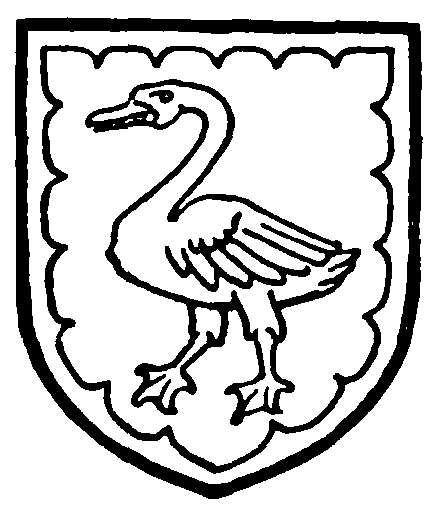
More. Sable a swan argent within a border engrailed or.
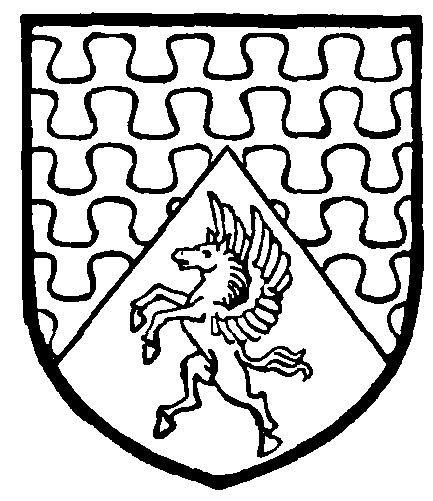
Blunt. Party cheveronwise barry nebuly or and sable in chief and gules a pegasus argent in base.
The manor of CRABBET had its origin in one knight's fee held by Richard de Plaiz. (fn. 24) The overlordship appears to have descended with the Abergavenny share of the barony. Lands called Crabbetts were held in June 1504 by military service, (fn. 25) and in 1589 Edward More was holding the manor. (fn. 26) Sir Edward More, described as a free tenant of the manor of Keymer, held Crabbett in 1624. (fn. 27) Crabbet then followed the descent of Worth, (fn. 28) being bought in 1698 by Leonard Gale. (fn. 29) Crabbet Park is now the residence of Baroness Wentworth, lady of the manor of Worth.
A manor of WORTH, closely connected with the forest of that name, was held in demesne in 1285 by the Earl of Surrey; (fn. 30) and in 1304, after the death of Earl John de Warenne, the issues of the forest include 66s. 3d. from 'perquisites of the court'. (fn. 31) The manorhouse probably served as a hunting lodge, letters being dated there in 1318 and 1320 by John de Warenne, (fn. 32) and in July 1384 by Richard II. (fn. 33) In 1439, when the forest was divided between the three heirs to the barony, each was to have a share of the manor of Worth, 'if there be any beyond that forest'. (fn. 34) John, Duke of Norfolk, died in 1476 seised of the manor of Worth, valued at 10s., (fn. 35) and it was among the manors surrendered by his widow to the Crown; (fn. 36) but after that no more is heard of it, and the manorial centre of the forest was apparently shifted to Highley in Balcombe (q.v.).
The FOREST OF WORTH, which extended over the parishes of Worth, Crawley, Ardingly, Slaugham, and Balcombe, was part of the Warenne possessions since the Conquest. (fn. 37) It descended with the rape (fn. 38) and underwent the same partitions. In 1439 it was agreed that Edmund Lenthall's share should be the first third part of the forest, beginning in the outer eastern side and stretching westwards. The Duke of Norfolk's strip came next, and finally that of Elizabeth wife of the Lord Bergavenny. (fn. 39) Eventually the forest, like the rape, was held by the Lords Bergavenny, the Earls of Derby, and the Earls of Arundel. By this time, however, that half of the forest of Worth held by the Bergavenny family was known as the forests of Tilgate and Strudgate. (fn. 40) The remainder, under the name of the forest of Worth, was held, late in the 16th century, half by Henry, Earl of Derby, and half by Philip, Earl of Arundel, and descended with their shares of the manor of Highley (q.v.), (fn. 41) to which it pertained.
TILGATE is said to have been sold by Edward, Lord Bergavenny, by the end of the 16th century to Sir Walter Covert and Sir Edward Culpeper, (fn. 42) but Sir Walter died seised of the whole of it in 1632, holding it of the king in chief by knight service. (fn. 43) It was described at this time as a capital messuage and farm, (fn. 44) and is first called a manor in 1647. (fn. 45) It subsequently descended for a time with the manor of Slaugham (q.v.), passing from the Coverts to the Sergisons. (fn. 46) Before 1870 it had been acquired by John Nix, (fn. 47) in whose family it has since remained, the present owner being Mr. Charles George Ashburner Nix.
STRUDGATE, of which early tenants may have been Richard de la Strode in 1278 (fn. 48) and Richard atte Strode in 1327, (fn. 49) was sold by Edward, Lord Bergavenny, to Sir Edward Culpeper of Wakehurst, (fn. 50) who, with his father Thomas Culpeper, had previously had a lease of it. It bordered upon Wakehurst to the north. (fn. 51) Strudgate remained in the possession of the Culpepers until 1694, when it was sold with Wakehurst (q.v.) (fn. 52) to Dennis Liddell, (fn. 53) and continued with that manor until 1817. It was then sold, after the death of RearAdmiral Joseph Peyton, to Charles Wetherell. (fn. 54)
Parks
John de Warenne claimed free warren and liberties in his park of Worth in 1279, (fn. 55) and it is said to have descended with the barony. (fn. 56) Two parks were among the appurtenances of the manor of Worth in 1397 and were granted to the Duke of Norfolk. (fn. 57)
In 1326 Ralph de Cobham died seised of a park in Worth consisting of 232 ½ acres of pasture and moor, newly enclosed without the assent of the tenants. (fn. 58) In 1368 his son Sir John de Cobham quitclaimed a 'manor' of Worth to Edward III. (fn. 59) This may or may not have any connexion with the LITTLE PARK of Worth which Henry Lechford left to his son Richard in 1567. (fn. 60) In 1615 it is said to have been owned by Nicholas Threele; (fn. 61) but Drew Stapley (son of William Stapley of Hickstead) died in possession of it in 1637, when it passed to his daughter Elizabeth wife of Thomas Shirley of Wiston. (fn. 62) It remained in the Shirley family until late in the 18th century. (fn. 63)
In about 1835 a farm of some 300 acres in Worth, called the Great Park and Little Park, was owned by Mr. White of Horsham. (fn. 64) The late Sir Francis A. Montefiore owned the Worth Park estate, which included the residence of Worth Park until that was sold for a school in 1920. (fn. 65) In May 1936, after Sir Francis's death, the greater part of the estate was sold by order of the Public Trustee, his executor.
The manor of WOOLBOROUGH (Wolbergh, xiv cent.) was held in the early 17th century of the manor of Cuckfield for rent of 6s. 8d. (fn. 66) A William de Wolbergh is mentioned in 1296, (fn. 67) and Thomas de Wolbergh in 1327, (fn. 68) and in 1344 this or another Thomas, with Anne his wife, settled property in Worth, perhaps identical with the manor, on themselves and their sons. (fn. 69) Thomas de Wolbergh died in 1350 and his property passed to his son John. (fn. 70) Wolborough is first referred to as a manor in 1488, when Elizabeth Uvedale, widow, died seised of it, leaving it to her son Robert. (fn. 71) Nothing further is heard of it until 1533, when it appears to have been in the possession of Thomas Chapman. (fn. 72) Before 1570 it had come into the hands of Thomas Michell, (fn. 73) who in 1574 conveyed it to Henry Bowyer. (fn. 74) The latter died in 1589, (fn. 75) and his son Sir Henry in 1606, when Wolborough passed to his cousin William Bowyer. (fn. 76) William's son John succeeded his father in 1632 (fn. 77) and in 1653 conveyed the manor to Walter Hendley, (fn. 78) grandson of Sir Henry Bowyer's sister. Sir Walter evidently conveyed it to his daughter Mary and her husband Sir William More, bart., for they were in possession of it in 1670, and just previous to Sir William's death in 1684, (fn. 79) but after that the descent is lost sight of.
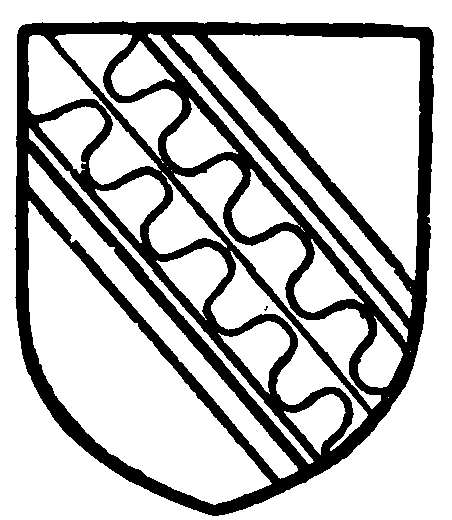
Bowyer. Or a bend vair cotised sable.
The reputed manor of BURLEIGH ARCHES appears to have been carved out of the manor of South Malling. Land at 'Burhlee' was given in about 765 by Aldwulf, king of the south Saxons, to Earl Hunlabe for the building of a monastery. (fn. 80)
In 1066 'Berchelie' was held by the archbishop in right of his monastery of Canterbury, but by 1086 it was held by a certain William under the Count of Mortain. (fn. 81) It must soon have been recovered, and perhaps remained in the hands of the archbishops, as it derived its descriptive name from them, as members of the College of South Malling, the estate being subsequently part of the canons' manor of South Malling. (fn. 82) After the suppression of the college, Burleigh Arches seems to have been assimilated with the so-called manor of CLARKES, lying in Worth, West Hoathly, and East Grinstead, which Richard and Thomas Michelborne settled in 1571 for life on Thomas Whiting (possibly the son of their sister Margaret) and his wife Joan. (fn. 83) Richard Michelborne died seised of the estate in 1588, and bequeathed it to Ann Beard for her life. (fn. 84) Meanwhile, however, John Byshe had been holding property called Burley, in Worth, at the time of his death in 1583. (fn. 85) This was held of the Dean and Chapter of South Malling, 'now suppressed', in socage as of the manor of South Malling. (fn. 86) He also had held a messuage in which he lived, called The Bryddes, in Worth, of Richard Michelborne as of his manor of Clarkes. (fn. 87) In 1619 a property known as CLARKES alias BURLEY ARCHES was bequeathed by Richard Infield to his eldest son Richard. (fn. 88) Catherine daughter of Joan and Richard Compton, and grand-daughter of the above Richard Michelborne, had married Richard Infield of Gravetye in West Hoathly, so that it seems likely that the property had come through the Michelbornes. (fn. 89) Richard Infield the younger died in 1625 and this property evidently descended with Gravetye (q.v.), appearing as the manor and farm called Clerks alias Burley Arches, in the possession of Edward Payne of East Grinstead, who died in 1660. (fn. 90) He bequeathed it to a younger son Charles, (fn. 91) who in 1676 made a settlement of it, as the manor of Burleigh Arches, upon Robert and Henry Payne, probably his brothers, and the heirs of Robert. (fn. 92) All the brothers were dead by 1708. (fn. 93) In 1776 the manor was held by Gibbs Crawfurd, who had married Anne Payne, and it apparently descended in that family. (fn. 94)
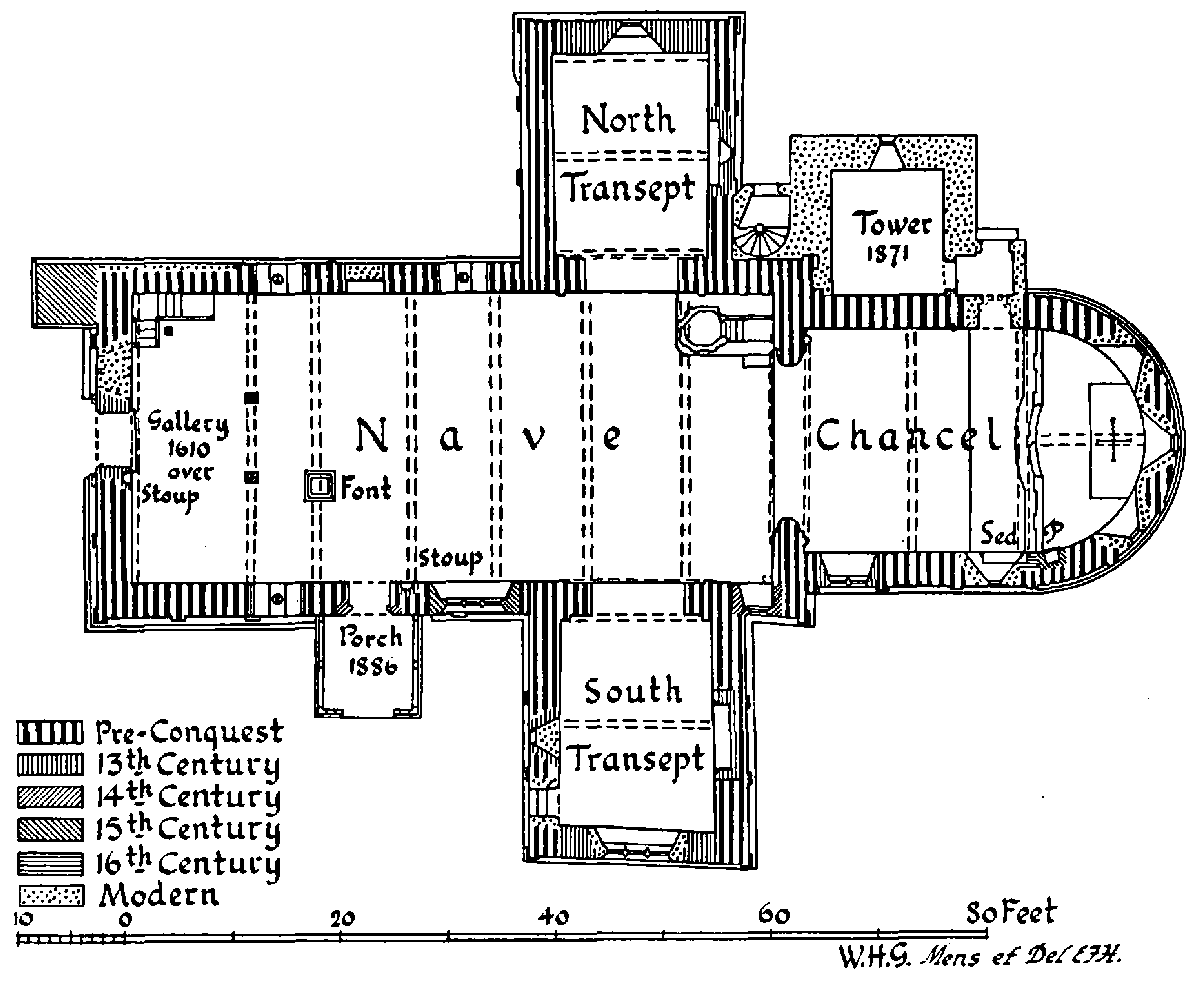
PARISH CHURCH of ST. NICHOLAS WORTH
Churches
The parish church of ST. NICHOLAS consists of an apsidal chancel, rectangular nave, and north and south transepts or chapels near the east end of the nave. North of the chancel is a tower added in 1871, with a spire, and the south doorway has a porch added in 1886.
The church is a remarkable example of a pre-Conquest building of cross-plan dating practically from one period. Whether it can be assigned to an earlier date than the first half of the 11th century is doubtful; while it presents the characteristic bays divided by pilasters, there are no traces of the usual 'long and short' work except in the varying heights of the stone courses in the pilasters. None of the pilasters is carried higher than the intermediate string-course at a little more than half-height of the walls. Above the string-course the nave retains three of the typical baluster windows of the period. They were not visible when S. Walford described the church in 1856, (fn. 95) the walls being then covered with plaster inside and out. The north wall of the nave has lost its pilasters entirely, the whole wall having been rebuilt, or at least refaced, below the string-course, with medieval ashlar, and it is probable that both end walls of the transepts were reconstructed perhaps as early as the 13th century, losing both pilasters and string-courses: the slightest of traces remain in the north transept of one of the former intermediate pilasters. In Walford's time the apse was heavily buttressed, there being as many as six, three of them of brick. These were removed when the church was restored in 1871, and of necessity the pilasters had to be restored, while new windows were inserted in the upper half of the wall. The ancient round-headed doorways remain in the side walls of the nave, tall and narrow openings, now recesses. A late-13th-century doorway of less height was inserted in the south side and a similar doorway in the west wall appears to have been a new insertion of that time. There is a small window at the east end of the south wall of the 14th century, and the large south window is of the 15th century. Another 15th-century window, mentioned by Walford, in the apse, was removed at the restoration.
The chancel (33 ft. by 21½ ft.) has a half-round apsidal end with three modern single lights of 12th-century character. There are also one north and two south similar windows. Below the western south window is a 13thcentury window of two lancets with a sunk spandrel in a semicircular head and with a segmental-pointed reararch. The jambs are rebated for shutters. In the north wall is a modern archway to the organ chamber under the tower, and a doorway to the vestry below it. The chancel-arch has half-round responds, 3 ft. wide, against square reveals flanked by pilasters, square on the west face and half-round on the east. The responds have square capitals, rounded on the under edges, with grooved and rounded abaci. The pilasters meet the lower sides of the capitals. The responds lean outwards, but there seems to have been a later repair of the pilasters to make them vertical. The head is round, of one square order and with a square archivolt. Owing to the spread of the responds, it is depressed to less than the true half circle.
The walls are of an irregular wide-jointed rubble containing much ironstone, and have a plinth or footings of two rough square stages. Below the window sills is a plain string-course, and below this the wall surface is divided into bays by roughly dressed square pilasters, six bays to the apse and three to the south wall. The rubble above the string-course is smoother than that below, probably the result of the renovation of 1924. This date appears on the rain-water heads below the eaves guttering. The roof is modern and has three tie-beams.
In the south wall of the apse is a 15th-century piscina with a trefoiled pointed arch in a square head and a quatrefoil basin. Next west is a recess with a Tudor arch in a square head perhaps intended for a sedile.
The nave (60 ft. by 27 ft.) has an archway into each of the transepts, with plain square responds flanked by square pilasters of rough-tooled ashlar, with square capitals and abaci, and round heads with plain square archivolts. The reveals, pilasters, and capitals have been largely restored in the south arch and partly in the north arch. Some of the stones in the reveals are very large.
In the north wall, high up, are two windows, each of two round-headed lights divided by a round baluster mullion: these have square capitals and bases. The jambs are also square, with square imposts. The balusters and much of the other stone-work of the windows have been restored: the arches appear to be ancient, except that of the west light of the western window. In the south wall is a similar window opposite the western north window, also largely restored. The other original window was displaced by a large window of the 15th century: this is of three cinquefoiled lights and vertical tracery in a two-centred head with a moulded label and a chamfered pointed reararch. East of the transept-archway in the south wall is a 14th-century single light with a trefoiled ogee head. A tall, narrow round-headed doorway remains in either wall. The north doorway is blocked but forms a recess inside, with ancient square jambs and square imposts. Externally the line of its west jamb is visible and most of the inner ring of its arch and part of the outer ring show in the wall surface. The south doorway is also blocked, but set in it, much lower down, is the present late13th-century south doorway, with chamfered jambs and pointed head and an external hood-mould without stops. In the west wall above a similar doorway is a window of three cinque-foiled lights and tracery of c. 1300 in a pointed head with an external hoodmould having return-ends. In the gable-head above is a plain bulls-eye light.
The south and west walls are mostly of rubble, similar to the chancel, but in the west half of the south wall are two short courses in which the stones are set aslope in the fashion of the later herring-bone work. Both walls are divided, like the chancel, into bays by pilasters of rough-dressed stones: the south wall had five bays west of the transept, but only a scar remains where the pilaster by the south doorway existed, and the first pilaster is cut short by the 15th-century large window. At the east and west angles the pilasters, about 1 ft. wide and 4 in. deep, rise to the kneelers of the gable-heads. The others are stopped by a string-course below the level of the sills of the baluster windows, which is about 3 ft. above the chancel stringcourse. The west wall had five bays, but only traces remain of the pilaster next south of the doorway and window. Most of the courses in the pilasters have tall stones alternating with shorter. The walling west of the south doorway and in the upper stage of the south-west angle has been repaired or refaced at some remote period with ashlar masonry. The ashlar appears in the west wall as well as the south, and by it is a roughly vertical crack in the walling, now filled in. The walls have rough square footings. The east gable-head has a modern coping and gable-cross. The west gable-head is mostly of rough ashlar of later repair, and has further modern repair at the top, and a modern coping. At the north angle, projecting westwards, is a large buttress of three stages of the 15 th or 16th century. The north wall has lost its pilasters, and the masonry below the string-course is nearly all of coursed ashlar in a grey stone, and has a chamfered plinth; above the stringcourse it is of rubble. The roof is tiled: under the south eaves are four old stone corbels, survivals probably of an earlier and different kind of roof. The framing of the roof is modern: it is divided into seven bays by arched trusses and tie-beams. In the south-east angle of the nave inside is another plain corbel, probably for a rood-beam.
The north transept (19 ft. by 14½ ft.) has a tiny lancet window in the east wall: this is set in a 13th-century altar recess which is 5 ft. 10 in. wide and 1 ft. deep. Its sill is 2 ft. 4 in above the floor, and it has a pointed arch. In the north wall is a single modern trefoiled lancet with a segmental-pointed rear-arch. The west wall is unpierced. It is divided outside by pilasters below the string-course, as in the nave, and the wall is of rubble. The north wall has been largely patched in later periods with ironstone and other material, and below the lancet window are the lower stones of an earlier lancet. The original pilasters at the angles have had their inner arrises cut back, and the intermediate pilasters have been cleared away, but a slight seam shows where the eastern existed. The gable-head is modern.
The south transept appears to have had an original round-headed recess, 8 ft. 3 in. wide, in the east wall, filled in and fitted in the 13th century with a smaller pointed recess, 6 ft. 1 in. wide and 4 ft. 3 in. to the apex above the sill, which is 2 ft. 6 in. above the floor. The round arch was some 2 ft. 6 in. higher. In the south wall is a modern window of three lights and tracery. In the west wall is a modern doorway at the south end, and north of it is a blocked window. The walls are of rubble, and both east and west walls have the pilasters below the string-course dividing them into three bays, but there is none in the south wall except at the angles. Both transepts are considerably lower than the nave: the string-courses are approximately level with those of the chancel and are close up to the eaves.
The roof of the north transept is modern. That of the south transept is medieval and is of trussed-rafter type with two plain tie-beams.
The north tower, standing east of the north transept, is modern: it is of three stages and is surmounted by a shingled oak spire.
There is also a modern south porch of timber.
There are some remains of medieval painting on the rear-arch of the small 14th-century window east of the south transept archway: it is in red colouring with foliage and flower design. In the north transept window is a 14th-century shield of the arms of Warenne. Some early-17th-century panelling of various kinds has been reset against the west wall of the south transept: some has a fluted frieze and rosettes, and other parts have scrolled foliage in low relief. Some plainer panelling of much the same period is reset in the north transept. It was probably from former pews.
At the west end of the nave is a gallery. The front is supported by two oak posts with moulded capitals and bases, and has symmetrically turned balusters and a moulded top rail. The fascia of the sill is carved with an inscription in ornate lettering: This gallerie is the gift of Anthony Lynton late rector of this parrish who deceased the xv day of ivne anno domini 1610.
The font is probably of the end of the 12th century. It has a square bowl with a different treatment of ornament in each of its four faces. The east has two tiers of six arches, the lower pointed, the upper trefoiled; the north side has a double cross in relief, with a horizontal stem and two shorter upright arms, all with flowered or two-foiled ends; the south has six quatrefoils in two rows, with pointed foils, and the west eight quatrefoils in two rows with rounded foils. The stem is cylindrical, with four small attached shafts cut from the solid: these have moulded capitals and bases of about mid-13th-century date: this stone is said to be another bowl, but looks as though it was made purposely as a stem to carry the earlier bowl above.
East of the south doorway and south of the west doorway, set in pointed recesses and with half the bowl nowcut away, are stoups, probably 14th century.
The communion rail, probably of the 17th century, is of German workmanship. It is elaborately carved with biblical and Christian symbols. The pulpit, dated 1577, is said to have come from Wörth in Germany: it is carved with the figures of Christ and the four Evangelists. Both were introduced into this church in the 19th century. In the south transept is a chest of c. 1600 with a raised three-sided lid hung with straphinges, and with staples for three locks. There is another small one of hutch type in the north transept, probably of late-17th-century date. In the tower is a late-17th-century table with turned legs. Two candelabra of the late 17th century hang in the nave, each with twelve arms.
The memorial of the Great War 1914–18 is on the south wall of the nave: it is a marble tablet with Doric shafts, and has a crucifix above the entablature.
The six bells are of 1844, by C. Oliver of London.
The communion plate includes a cup of 1635 inscribed 'For the parish of Worth in Sussex, 1635', a cover paten of the same date, a paten of 1692, and a flagon of 1704, all silver-gilt.
The registers date from 1558. There is also a book of churchwardens' accounts for 1528–1695.
The north-west entrance to the churchyard has an old open-framed lychgate of timber, dating probably from the 16th century, and from it an avenue of limetrees leads up to the west doorway. There are several yew-trees in the churchyard.
There are three modern churches in the parish: ST. LEONARD'S Church, Turner's Hill, is built of rusticated masonry in the late-13th-century style, and consists of a chancel, nave, north and south aisles, designed by L. W. Ridge in 1895, and a west tower, added by Sir Aston Webb in 1923; there are also an organ-chamber and a vestry. The roofs are tiled.
ALL SAINTS Church, Crawley Down, is of Sussex stone in the early-13th-century style. It has a chancel, nave, north, and south aisles, north vestry, and west and south porches. Above the west end is a bell cote. The roofs are covered with slates.
ST. JOHN'S Church, Copthorne, is also in the 13th-century style and of Sussex stone externally and of brick internally. It consists of a chancel, nave, narrow north and south aisles, and a north-west tower, serving also as a porch and surmounted by a stone spire. The roofs are tiled.
Advowsons
The advowson of Worth belonged to the manor, (fn. 96) and descended with it until 1698, but was not sold with it to Leonard Gale, being specially reserved by John Smith, who sold it later to one of the Shelleys of Highley. (fn. 97) In 1704 presentation was made by Ambrose Parker, in 1745 by Carey Hampton, and from 1760 to 1766 by James Weller. (fn. 98) The advowson was held by the Bethunes of Rowfant from 1786 to 1858, (fn. 99) when it was sold by the Rev. George C. Bethune to George Banks, who died in 1862, leaving it to his son George Wilson Banks. He was the patron until his death in 1896, (fn. 100) after which it was acquired by Mr. John Goddard, who gave it to the Rev. Arthur Bridge (rector 1896–1917). (fn. 101) It is now in the hands of Mrs. E. N. W. Waller-Bridge.
In 1862 the ecclesiastical parish of Crawley Down was formed from Worth, All Saints Church being a vicarage in the gift of the rector of Worth.
In 1881 the ecclesiastical parish of Copthorne was formed from parts of Worth and Crawley Down, and from Burstow and Home in Surrey. The church of St. John the Evangelist is a perpetual curacy vested by Order of Council in Dame Jane Walter Lampson, widow of Sir Curtis Miranda Lampson, bart., and her heirs. She left it by will in 1890 to her daughter Hannah Jane Locker Lampson, with remainder to her grandson the Rt. Hon. Godfrey L. T. Locker Lampson, M.P., the present patron. (fn. 102)
In 1895 yet another ecclesiastical parish, taken from Worth, Crawley Down, West Hoathly, and Ardingly, was formed at Turner's Hill. The church of St. Leonard is a vicarage in the gift of the Bishop of Chichester.
In 1934 a new church, with a curate's house and hall, was built at Three Bridges.
Charities
Thomas Whitfield, by an indenture dated 20 Mar. 1623, gave a rentcharge of £10 for the benefit of the poor of the parish. The rentcharge is now payable out of the Rowfant estate.
A gift of land was made to this parish at a remote period, upon trust, to apply the income in supplying poor parishioners with agricultural tools, &c. The property acquired under this gift now consists of 4 acres of land known as Rushey Croft, in Crawley, let at an annual rent of £11.
John Smith's Charity. This parish receives a yearly sum representing four twenty-second parts of the General Charity of John Smith. In 1936 £20 was received.
The above-mentioned charities are now administered by a body of trustees appointed by a Scheme of the Charity Commissioners dated 18th June 1935 under the title of the United Charities. The Scheme directs the income of the charities of Thomas Whitfield and John Smith to be applied for the general benefit of the poor, and the income of the unknown donor's land to be applied in the supply of agricultural tools to poor residents.