
A History of the County of Warwick: Volume 3, Barlichway Hundred. Originally published by Victoria County History, London, 1945.
This free content was digitised by double rekeying. All rights reserved.
'Parishes: Alcester', in A History of the County of Warwick: Volume 3, Barlichway Hundred, (London, 1945) pp. 8-22. British History Online https://www.british-history.ac.uk/vch/warks/vol3/pp8-22 [accessed 26 April 2024]
In this section
ALCESTER
Acreage: 1,782.
Population: 1911, 2,168; 1921, 2,259; 1931, 2,195.
Alcester is a long, narrow parish extending to the south-western boundary of the county, which is here formed by the Ridgeway. The town lies in the southeast corner, near the junction of the Alne and the Arrow. The hamlet of Kings Coughton is about ¼ mile to the north, beyond the junction of the Birmingham and Droitwich roads, and there are one or two scattered farms.
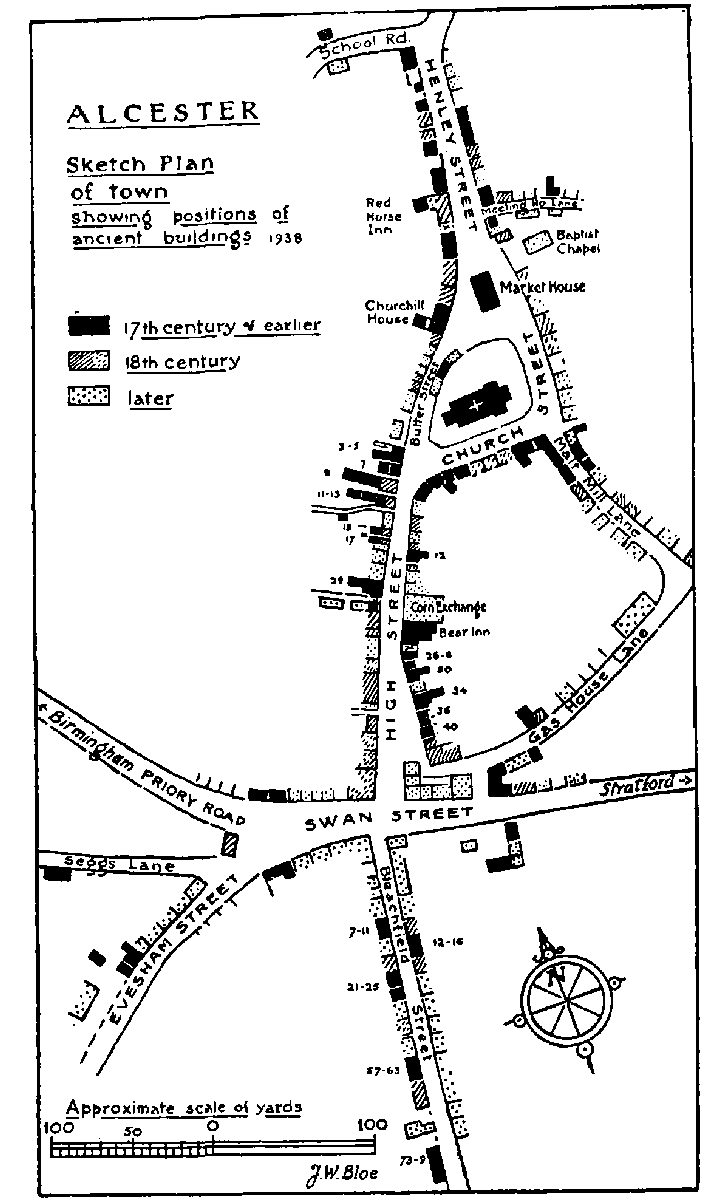
ALCESTER Sketch Plan of town showing positions of ancient buildings 1938
The main road from Stratford to Worcester enters the parish at Oversley bridge and runs through the town from east to west. The greater part of the town lies to the north of this road. High Street branches off from it at right angles and leads up to the church. The broad lower part of High Street was known as the Bull Ring, (fn. 1) and the late Georgian houses on the east side clearly represent an encroachment on an original open space. (fn. 2) High Street continues, as Church Street, round the eastern side of the churchyard and so into Henley Street, which leads northwards out of the town over Gunnings Bridge. Henley Street was from earliest times the site of the market, which is said to have been held between the house formerly belonging to Richard le Rous and Gunnyld bridge in a charter of c. 1274. (fn. 3) High Street and Henley Street are also connected on the west of the church by Butter Street, a short, narrow passage not used for wheeled traffic, with the houses on the east side abutting on to the churchyard. This is the sole remnant of a range of buildings which once encircled the churchyard and was known as the Shop Row. (fn. 4) Parallel with High Street on the east side is Malt Mill Lane, running from Church Street into Gas House Lane, which joins the Stratford road. On the east side of Henley Street is Meeting House Lane, so called from the Baptist Chapel built c. 1735–6. Its earlier name was Tibbetts Lane, and two centuries ago it appears to have circled round the back of Church Street and joined it at the top of Malt Mill Lane. (fn. 5) Leading off from High Street are several passages or, in the local phrase, 'cheweries'. One of these, Bull's Head Yard, on the west side near the top, is the old Colebrooke Lane. (fn. 6) To return to the Stratford road; Bleachfield Street branches off southward from it opposite High Street and leads into what is now a field-path to Oversley Mill. The Bleachfield seems always to have been the poorer quarter of the town. A little farther west another turning, Birch Abbey, leads directly to the Mill past the old Grammar School. (fn. 7) Between the two the Stratford road, here called Swan Street, forks to the right up Priory Road to Birmingham and to the left to Evesham and Worcester, with Seggs Lane (fn. 8) continuing in a straight line between the two branches. Seggs Lane crosses the railway line and then becomes Allimore Lane, leading to the Gorralls and Cold Comfort Farm. (fn. 9) Two fields on the right of Priory Road, behind the cemetery, are named Abbey Meadow and Priory Close and mark the site of the ancient Abbey of Alcester. Nothing now remains above ground, but excavations begun in 1938 partially revealed the plan of the abbey.
The site of Alcester has been occupied since very early times. Neolithic remains were discovered in Meeting House Lane in 1927 (fn. 10) and evidence of Roman occupation has been accumulating since the 17th century, (fn. 11) though no systematic excavation of the whole area has yet been attempted. The most notable of recent finds is a 1st-century vase, 16 in. high, which was discovered in 1925 at Blacklands, a meadow by the Arrow, south-west of the town. (fn. 12) Roman tesserae have been found on different sites, such as Blacklands, Meeting House Lane, and Folly Field (just over the boundary in Arrow parish), and coins carry the history of the settlement down to the time of Honorius. (fn. 13) Such long-continued occupation may be partly explained by the meeting-place of roads here: that from Stratford coming in on the east, (fn. 14) and the Ryckneild Street, running from the Fosse near Bourton-on-theWater to 'Letocetum' near Lichfield, crossing the Arrow near Oversley Mill (fn. 15) and entering the town approximately along the line of Bleachfield Street. (fn. 16)
By the early 19th century there were five turnpiked roads in the parish—to Stratford, (fn. 17) Bromsgrove, Wootton Wawen, Droitwich, and Evesham. Alcester acquired a certain importance in coaching days from its situation on one of the main routes from London to Shrewsbury and Holyhead. Most of the coaches called at the Swan, which was obviously rebuilt during this period. (fn. 18) Coaches were running as late as 1850, (fn. 19) but a station was opened on the Evesham-Redditch Railway in 1866, and the present G.W.R. line from Bearley was opened ten years later.
Two bridges, known as Gunnings Bridge and Oversley Bridge, cross the Arrow at the entrances into the town from Henley-in-Arden and from Stratford, respectively. Each is on the site of an earlier structure. 'Gunnyld bridge' being mentioned in 1274. (fn. 20) In the early 16th century the supervision of these bridges seems to have devolved upon the priest of St. Mary's Chantry. By an agreement of 1543 between Sir Fulke Greville, lord of the manor, and Roger Metcalfe the priest, the latter was to receive, in compensation for certain rights in dispute between them, an annual rent of 20s. towards the maintenance of the bridges, which was to be augmented, if necessary, by means of 'a testimoniall signed and sealed by the said Sr Fo. Greville & other to gather the devoucõn of people for the same'; and if these two sources proved inadequate, Sir Fulke was to bear the extra charge himself. (fn. 21) In 1612 the Hundred jury presented Gunnings Bridge at Quarter Sessions as being 'in great decaye to the anoyance of the said Towne being a greate markett Towne', but stated that it was not known who was liable to repair it. Sir Fulke Greville (grandson of the Sir Fulke above mentioned) thereupon offered to build at his own expense 'a good Stone Bridge lyklie to enduier to Posterytie' and his offer was accepted by Quarter Sessions in 1613. (fn. 22) A further presentment in 1667, however, led to a prolonged dispute between Lord Brooke and the justices as to liability for repair. (fn. 23) The map of 1752 shows only a very narrow bridge here, and the present one, of three arches in red brick with stone dressings and modern parapets, may well have been built after the road to Wootton Wawen was turnpiked in 1814. Oversley Bridge had become acknowledged as a county bridge by 1659 and considerable repairs, at a cost of £165, were carried out then and in the following year. (fn. 24) The present bridge, of three main and three smaller arches, has a stone bearing the date 1600 built into the south parapet. Part of the walling and the main arches on this side, which are of lower lias stone, may well be of that date, and there are remains of two cutwaters. These are shown, together with four on the north side, on the map of 1752. But the bridge has been widened on the north to about twice its original width. The parapets are modern.
The Town Hall, a two-storied building of 17th-century date, stands to the north of the church. The lower story consists of a stone colonnade, filled in in 1873, and was built about 1618, in which year Sir Fulke Greville, lord of the manor, gave £300 to build a Market House for the town. (fn. 25) It was originally intended to build the whole in stone, but this was found to be too costly (fn. 26) and it was decided to make the upper story of timber. This was not completed, however, until 1641. The architect for the lower part was Simon White of Chipping Campden, who agreed to make eighteen pillars for the colonnades in his quarries there. The inhabitants were to supply the rest of the stone from the quarries at Great Alne—and this lower lias appears in the spandrels of the arches. In 1919 the Town Hall was bought from the lord of the manor by the town as a war memorial.
The colonnades have Doric shafts, with a marked entasis and semicircular arches with key-stones. The sides have six bays, the ends two bays, but the southwestern bay is a solid one containing the modern staircase and former lock-up, with a doorway in the west wall. All the arches have been walled up, with doorways and windows in the blockings. The top of the masonry has a moulded string-course.
The upper story, which is gabled at the north and south ends, has the original timber work covered with modern plaster and false framing; the windows are modern. It has a long hall of five bays divided by the four main trusses of the roof. These have moulded wall posts and stop-moulded tie-beams supported by curved braces. The tie-beams have had their middle portions cut away so that they now form hammer-beams and carry queen-posts and curved braces under the collarbeams; most of the queen-posts are re-used timbers. The tie-beams have varied ornament on their sides and on one is carved the date 1641. The ceiling was formerly plastered at the collar-beams but was uncovered in 1938.
The oldest house appears to be 'The Old Malthouse' at the corner of Church Street and Malt Mill Lane, which dates probably from about 1500. It has close-set timber-framing and tiled roofs. It is of L-shaped plan with elevations to north and east, with jettied upper stories, now underbuilt on the north front. This front has two gable-heads, a little apart; the eastern, forming the end of the east range, is original and has a heavy tie beam, &c. The barge-board is moulded and decorated with sunk trefoiled arches, each middle foil containing a blank shield. The other gable, although of close studding, was probably a later 16th-century addition to provide for an attic chamber; it has a diapered bargeboard of that period. Bay windows have been added to the lower story. Through the middle of the front is a passage way to the back courtyard. It is entered by an archway in the brickwork, but retains within it, at the original plane of the ground story, an oak arched and square-headed doorway.
The long east side, towards Malt Mill Lane, used as a storehouse, is divided into ten approximately 7½-ft. bays, indicated by the projecting ends of the main beams and the main posts to the ground story. The north-east angle has a diagonal beam, but the post below it and the next two posts have been replaced by brickwork. The other eight posts have small pilasters cut out of the solid on the face of each and curved brackets under the beams. The fourth and fifth bays have close studding, the others rectangular framing with altered windows.
The upper story has a moulded bressummer resting on the ends of the projecting beams and joists. No significance is given to the bays in the upper story, all the studs being alike. It has four original windows, of which the second and the southernmost, unglazed, have each three diamond-shaped mullions. The framing towards the courtyard has rectangular panels and no overhang. The chimney-stacks are modern.
The front block is divided into two tenements, each with a shop. The eastern has chamfered beams and wide flat joists to the lower story. The front room above has an early-17th-century plastered ceiling with enriched ribs and floral ornament. The eastern part of the western tenement was the original two-storied hall-block. The lower room (now a shop), off which the through passage has been cut, has an original ceiling with moulded beams and joists, and the roof to the room above has cambered tie-beams supported by curved braces, and side-purlins and collar-beams supported by posts from the ties. The western part was remodelled in the 17th century and the wing extended to the rear: this extension contains a wide fire-place, but all the other fire-places are modern insertions.
Adjoining the south end of the east range is a house, probably slightly later, also of close studding on stone foundations and with a jettied upper story and taller roof. The bressummer to the overhang is boarded. It is of three 7½-ft. bays with main posts and brackets; the southernmost post has a pilaster with a moulded capital to carry the bracket.
Nos. 18 and 19 Church Street, farther west, were a mid-16th-century house, of about 48-ft. frontage, now in two tenements. The upper story of the north front, which has two gable-heads, was jettied but is now underbuilt with 18th-century brick. The framing is of fairly close-set studding with plastered infilling. Both gables have barge-boards with diaper carving, like that to 'Malt House', and pendant-posts at the apices. The window in the east gable, to the second floor, has moulded oak mullions. The roof is tiled, and above the middle part is a late-16th-century brick chimney-shaft of star-shaped plan. The central passage through the building shows wide flat ceiling joists. At the back of No. 19 is a 17th-century gabled wing of rectangular framing with a jettied upper story, partly underbuilt.
No. 5 Church Street was formerly the Angel, once the principal inn in the town. It is mentioned in 1628, (fn. 27) but the present house has a late Georgian front on a red brick building of about a century earlier. Only the broad carriage way at the side remains to indicate its original function.
The house now Nos. 20 and 21, of about 28-ft. frontage, is an early-17th-century building of squarepanelled framing and two gable-heads of geometrical panels. The lower story has had an 18th-century bay built out in front containing two doorways and wide windows.
The house adjoining, No. 2 High Street, is similar in front, with square framing and two gables with geometrical panels, but a plaster panel below the junction of the two gables bears the date 1625, and the gables have barge-boards carved with scroll patterns. The ground story has been underbuilt.
The remainder of the buildings in the High Street have 18th- to 20th-century fronts, but a number are of 16th- or 17th-century origin, the evidence being found in the interiors or in the back parts of the premises. The buildings are numbered from north to south, with the even numbers on the east and odd numbers on the west side.
On the east side Nos. 26, 30, 32 (formerly the Talbot Inn), 36 and 38, 40, and 42 ('Stone House', so called from its front of coursed ashlar), all have remains of 17th-century construction.
No. 12 is a low two-storied house of timber-framing; the upper story is plastered, but above the shop front some of the framing is visible, and there are 17th-century beams in the ceiling of the shop, and in the through passage south of it. The extension to the back is of square timber-framing.
The Corn Exchange, occupying the site of No. 22, was built in 1857 and is said to have displaced several ancient thatched cottages. There was a 'chewery' north of it now abolished.
The Bear Inn is a low building covered with roughcast cement and having four gabled dormers to the upper story. At the back is a timber-framed wing with a gabled roof, and there are old ceiling beams inside. On the front is a porch in the open sides of which are incorporated some 17th-century turned balusters.
No. 34 was formerly the Three Tuns Inn. The front, formerly jettied, has a plastered upper story; the back wall is of 17th-century timber-framing. A central chimney-stack has three shafts above the roof with V-shaped pilasters, and inside are wide fire-places back to back, and ancient ceiling-beams. A late-17th-century extension behind has stop-chamfered beams and joists.
The Royal Oak Inn, the last house on this side, is probably an ancient building entirely renovated except for a chimney-stack of late-17th- or 18th-century bricks.
Of the older houses on the west side most of the visible evidence is in the north half of the street. Nearly all have modern shop fronts.
House, Nos. 3 and 5, has a plastered or rough-cast front but shows 17th-century framing in the gabled north side and in the extension behind the south half (No. 5). There are old ceiling-beams inside.
No. 7 has a plastered front with a jettied upper story, but has been heightened to three stories and much modernized. The south side-passage has a late-16thcentury entrance with a moulded oak frame and the remains of one of the brackets of the overhang. The passage has a side wall of close-studding and old ceilingbeams, but none is visible in the shop. The back wall is gabled and faced with plaster: above its roof is a late16th-century square chimney-stack with four shafts of brick with V-shaped pilasters.
No. 9, now a shop, was formerly the Bull's Head Inn. It has a brick front, but was timber-framed with a jettied upper story. The south side, to Bull's Head Yard, has old ceiling-beams and framed walls. The long back extension is of late-16th-century timberframing, much altered in the lower story, on stone foundations. Some of the small upper windows remain, with moulded mullions. The rear-most part, now a storehouse, divided by story-posts and beams into three 6-ft. bays, has an enriched plastered ceiling to the lower story with mouldings and scroll ornament to the main beams. Each bay has three moulded square panels containing a central Tudor rose surrounded by four single roses and four shields enclosing flower patterns. The first floor is cemented. The roof has collar-beams and side-purlins and had a second story lighted by gabled dormer windows.
House, Nos. 11 and 13, is brick-fronted and of three stories: the back part of it is of timber-framing and has a chimney-stack of c. 1600 with three square shafts in line, with V-shaped pilasters. The extension behind this is also of 17th-century timber-framing and has a brick gabled west wall.
House, Nos. 17 and 19, is of brick, but each half has at the back a 17th-century timber-framed extension.
No. 29 is modern brick-fronted, but the shop has chamfered ceiling-beams. The back part is of the 16th century and has a gabled west end with a jettied upper story of close studding, and moulded ceiling-beams inside; a wide fire-place has been reduced. A further extension behind the north part (printing works) is of 17th-century framing and has a chimney-stack with two square shafts set diagonally.
No. 31 was probably an inn and has on its north side a heightened wide passage way for coaches. This shows old timber-framing in its side-walls, and blocked doorways, the southern with a four-centred head. The ceiling is of very wide flat joists. There is also framing in the back wall, but the front is of 18th-century brick.
The houses to the south are of late-18th-century or later brick, except No. 55 (Midland Bank) which is of earlier 18th-century brickwork with a plastered coved eaves-cornice to the tiled roof.
A house which has side elevations to Swan Street and Gas House Lane and its west front to the short road between the two is built on the lines of a medieval building, with a middle block and gabled cross-wings, but dates probably from the early 17th century. The wings had jettied upper stories on the west front; these have been underbuilt, and the wall continued in the same plane across the front of the main block, which is thus recessed above. The whole front is plastered and the doorways, windows, and barge-boards are modern. The side elevations are timber-framed in the upper stories and of brick in the lower. The south side has some leaded lights. The building is now divided into eight or more tenements.
Two cottages farther east in Gas House Lane, one on either side of the road, also have 17th-century framing.
A house of two stories, on the north side of Swan Street close to the Birmingham road, now divided into three or four tenements, shows some 17th-century timber-framing in the west half. Another, opposite, is also probably of the early 17th century. It has a timberframed north front, many of the timbers renewed, with a middle block of two stories, and end wings with jettied upper stories. The east wing is gabled and has been underbuilt; the west wing is jettied on modern beams and brackets, but it has been heightened and the gable turned the other way.
No. 2 Malt Mill Lane, opposite the 'Old Malt House', has a modern front block, but the back wing, which has a date 1610 on an internal beam, is of timberframing and plaster with a jettied upper story on its north side. It has bow windows to the lower story and three-sided oriel windows to the upper on shaped brackets. The south side, also of framing, has no overhang. Inside are stop-chamfered beams and one room is lined with late-17th-century panelling. The roof is tiled.
The next house to the south, Nos. 4 and 6, is a 16thcentury building with a jettied upper story towards the street, partly of close-set studding, and with an oriel window. The north part of the overhang has been underbuilt with brick. Inside are heavy wide ceiling joists. A back wing, of timber-framing, has chamfered beams.
The next house, No. 8, is a taller timber-framed building of the late 17th century and has a plastered coved cornice at the eaves.
Other houses in the lane are of the 18th century or later and of brick.
Butter Street has 18th-century and later buildings on its west side. The Rectory, a three-storied brick house at the south end, was built in 1796. (fn. 28) On the east side, bordering the churchyard, are three houses, the middle one of which shows some 17th-century framing.
Henley Street is more unspoilt than the High Street; about half the buildings retain their 17th-century or earlier fronts and about half the remainder are of the 18th century.
Churchill House, at the junction with Butter Street, has a red brick front block of 1688. It is of two stories and attics. The upper story has an iron-railed balcony on to which opens a doorway of stone with an architrave, entablature, and broken curved pediment. The main cornice is of wood enriched with carvings and modillions. In the roof are flat-topped dormers. Inside, the room south of the middle entrance passage is lined with early-17th-century panelling and has an overmantel with round-headed carved panels. The room above it has a fine plastered ceiling dated 1688 and with the initials L / TE (fn. 29) : the ornament is bold and the heavy cornice has scrolls and flowers; the room is lined with bolection-moulded panelling. The main staircase behind this block has square newels and twisted balusters.
The back part of the house is of earlier 17th-century timber-framing and has a gable-head: inside are chamfered ceiling-beams.
A lower extension is also of framing with wattle-anddaub infilling.
A little farther north is a building of c. 1600, of two stories, the upper jettied and of framing in square panels. Only a few old timbers remain in the lower story; dividing it into three unequal bays are the main posts, with pilasters worked on them and carrying enriched scrolled brackets under the overhang. The bressummer is moulded.
The Red Horse Inn, formerly the Greyhound's Head, (fn. 30) has a gabled back wing of square framing and curved braces of about the same period. Northwards are four or five other 17th-century houses: one shows timber-framing, others have been plastered or otherwise refronted.
On the east side are four 17th-century houses. No. 44 at the south corner of Meeting House Lane is probably of mid-to-late 17th century with square framing and a gabled north end. Nos. 40 and 42 is an early-17thcentury house with a jettied upper story on its long side towards the street and on the gabled south end; the bressummers are moulded and posts with carved scroll brackets divide it into three bays. Farther north is a refronted plastered house with a 17th-century brick chimney, and next north of that is an early-17thcentury house of square framing with two gables, formerly jettied, now underbuilt with brick.
In Meeting House Lane, on the north side, is an early-17th-century house, 'Oak House', of square framing with a jettied upper story in its long south front on the ends of projecting joists and four moulded brackets. The east and west ends are half-gabled. A back wing has a projecting chimney-stack of the same period.
Bleachfield Street is a street of small houses divided into tenements. Four houses are of square framing of the second half of the 17th century. Nos. 7, 9, and 11 on the west side and Nos. 12, 14, and 16 on the east are of two stories and attics with gabled dormers. Nos. 21, 23, and 25 and Nos. 59, 61, and 63 are lower buildings of one story and attic with gabled dormers. All have tiled roofs.
A long brick building, Nos. 73, 75, 77, and 79, at the south end of the west side, of one story and attic with gabled dormers, is probably of the late 17th century. It has a square plinth, a string-course at the first-floor level, and the steep-pitched tiled roof has north and south gable-ends with brick copings. There are two chimney-stacks of 17th-century bricks.
School Road, leading from Henley Street to the Birmingham road, has one 17th-century timber-framed cottage (No. 2) with a reconditioned front, and old gable-ends.
In Evesham Street, on the north side, No. 21 shows old framing in the west gable-head and in the back extension, and No. 21 has front and back walls of old framing and a large projecting chimney-stack. Behind the last is another small cottage of similar framing.
In Seggs Lane is a mid- to late-17th-century cottage of two tenements and of one story and attic, wholly of square timber-framing.
Beauchamp's Court, about ¾ mile north-west of the church, on the Birmingham road, marks the site of the ancient manor-house of Alcester. In 1340 Giles de Beauchamp obtained a licence to crenellate his manorhouse here and to surround it with a wall of stone and lime. (fn. 31) It was apparently rebuilt or enlarged in the reign of Henry VIII, for Leland notes (1545) that Fulke Greville 'now buildithe at Beauchamp's Hawle, and takythe stones from Alcestre priorie'. (fn. 32) It ceased to be the principal seat of the Grevilles after the 1st Lord Brooke had acquired and restored Warwick Castle in the reign of James I. The last member of the family to occupy it was probably William Greville who died in 1653. (fn. 33) It was empty in 1665 and by 1667 had been partly pulled down and the remainder let as a farm-house. (fn. 34) Some farm buildings of 17th-century timber-framing still survive, but the present house is comparatively modern and is said to have been rebuilt with materials from the manor-house at Pophills in Salford Priors parish (q.v.) which was demolished in 1848. (fn. 35) It lies outside the moat.
Moat Farm, ¼ mile farther north, is of L-shaped plan. The two-storied main block, running east and west, is of the late 17th century. The wing extending to the north is of one story and attic and of the late 16th century. It retains some of its original timbers in the west side and north gable-end and has two gabled dormers. Inside are wide flat ceiling joists and heavy beams, and a fire-place 8½ ft. wide with corner seats: above it is a chimney-stack of thin bricks.
Kings Coughton Farm farther north has a late-18thcentury main block facing the road, with a red brick west front and slate roof. Behind it is the original lower 17th-century house of timber-framing, of L-shaped plan with gables to the south and east; the roof is tiled.
Alcester Heath Farm, about ½ mile west of Kings Coughton, is an old farmstead with a timber-framed barn attached to the house, which is also timber-framed but much altered.
Alcester Lodge opposite is a late-16th-century timber house encased in 18th-century brickwork and enlarged: it has chamfered beams and a 9-ft. wide fire-place of stone, above which is a chimney-stack of thin bricks with stone quoins and four square shafts, of brick, set diagonally. The farm buildings are of timber-framing, partly with close-set studding.
Alcester Warren, about 1½ miles farther north-west, is a three-storied house of red brick, of the late 17th century; it has tall mullioned and transomed oak window frames. The farm buildings, including a granary and two three-bay barns, are of early-17thcentury timber-framing with tiled roofs.
Borough
Alcester may be 'the celebrated place called Alne' where an ecclesiastical council was held, c. 709, to consecrate the foundation of Evesham Abbey by Ecgwin, Bishop of Worcester. (fn. 36) According to the Evesham Chronicle (c. 1125) Ecgwin preached to the wealthy, hardhearted people of Alcester, but the many smiths in the place drowned his words with the sound of their hammers and anvils. He therefore invoked Divine retribution upon them in the form of an earthquake, which swallowed up both town and smiths; the site of the town was given to Evesham Abbey and though many had since tried to follow the trade of a smith there, none had succeeded. (fn. 37) Rous (d. 1491) records a similar legend relating to St. Chad, which was still current in Leland's time. (fn. 38) Chad came to preach at Alcester but was driven forth by the inhabitants; deciding that he had to deal with beasts and not men, he therefore laid a curse upon them, as a result of which the monastery there was removed to another place.
Alcester owed tallage of 3 marks in 1199. (fn. 39) A tenure in burgage, at an annual rent of 2½d. is mentioned in a grant of land to the abbey in 1207, (fn. 40) and in 1251–2 the town is described as having been a free borough from the time of Henry I. (fn. 41) Like many other small places in Warwickshire, it sent members to the Parliament of 1275, (fn. 42) and in the following year occurs the first mention of a borough court. (fn. 43) There were twelve burgesses, each paying a rent of 8d., in the Botreaux moiety of the manor in 1304. (fn. 44) The charter granted to Sir John de Beauchamp, lord of the whole manor, in 1446 included the right to hear pleas of piepoudre and other pleas of debt and trespass and conferred upon the tenants freedom from toll, stallage, pontage, pavage, pondage, murage, quayage, and cheminage throughout the king's dominions. These privileges, together with the market and fairs, of which the history is traced below, were confirmed by Philip and Mary and by Elizabeth. But by 1612 the original charter of 1446 had been lost and the inhabitants petitioned Sir Fulke Greville to obtain a renewal of it. (fn. 45) A new charter was therefore granted in 1617. (fn. 46) In addition to the usual manorial officers—of whom the High and Low Bailiffs are still annually elected—there were also, in the 17th and 18th centuries, two Proctors, who appear to have been chosen by the parish vestry. (fn. 47) Their functions, so far as they can be deduced from their few surviving accounts, seem originally to have corresponded to those of the Chamberlains in a corporate borough. They administered a revenue of some £19 a year derived from town houses and lands—including the Moors. Out of this they provided, among other things, for legal charges, the repair of the Grammar School, and the occasional entertainment of eminent persons passing through the town. But by the later 17th century the office is becoming merged in that of churchwarden: one person often serves in both capacities and their accounts are not infrequently combined. The last reference to the Proctors occurs in 1709. (fn. 48)
The town possesses a bailiff's mace of the late 17th century. It is about 2 ft. in length, with a hemispherical knob at one end, and at the other a flat circle, 2¼ in. in diameter, engraved with the Stuart royal arms.
Economic And Social History
There appears to have been a market at Alcester at a very early date, for Walter de Beauchamp, c. 1274, granted to his free burgesses and tenants here the right to hold their weekly market on a Tuesday, as in ancient time, and in addition a Thursday market as well. (fn. 49) This second market, however, is not again referred to. In 1359 John de Beauchamp complained that Sir William le Botiller of Wem, the younger, Robert de Knightele, and others had prevented him from holding his market at Alcester by driving away twenty of his cows, carrying away other goods, and assaulting his men. (fn. 50) In 1292 Walter de Beauchamp obtained from Edward I a grant of an annual fair to be held in Alcester on the eve, day and morrow of St. Giles and for five days following. (fn. 51) The date was changed to St. Faith in 1302, (fn. 52) and again, to the vigil and feast of St. Barnabas and the six following days, in 1320. (fn. 53) The charter to Sir John Beauchamp in 1446 confirmed the market and the annual fair, which was then held on the Sunday after St. Faith, and added another fair on the eve, feast and morrow of St. Dunstan. (fn. 54) All these privileges were confirmed and a third fair—to be held on the eve, feast and morrow of St. Giles and for five days following—was granted by the charter of 1617. (fn. 55) In 1792 the three fairs were held on the Tuesdays before 25 March, 15 May, and 17 Oct. (fn. 56) Both fairs and market were still being continued in 1831, (fn. 57) and though the market is described in 1830 as small, (fn. 58) they probably survived for some years afterwards, since the Corn Exchange was built in 1857. But by 1888 they had all fallen into abeyance, (fn. 59) no doubt as the result of the agricultural depression of the '70's. The October fair now survives as Alcester Mop.
In 1304 the market tolls were worth 10s. (fn. 60) In the early 16th century they were being paid to the priest of St. Mary's Chantry, but in 1543 the lord of the manor re-established his right to them. (fn. 61) In 1652 they were valued at £13. 13s. 4d. (fn. 62) In 1765 the Earl of Warwick surrendered the tolls of fairs and market for the benefit of the town. (fn. 63)
The goods permitted to be sold in the market under Walter de Beauchamp's charter comprised animals, flesh, wheat, rye, barley, oats, beans, pease, woollen and linen drapery, bread, iron goods, tallow, grease, fish, leather goods, baskets, hides, wool, linen, geese, hens, cheese, bacon, eggs, salt, and spices. The name of Bleachfield Street bears witness to a linen industry which can be traced back to the early 13th century. (fn. 64) A John le Lyndraper, and a Juliana la Dyare, occur in 1332, (fn. 65) and in 1440 there is mention of William Botreaux, lyndraper, (fn. 66) presumably a member of the family which then held half the manor. Weaving long flourished here and the Rev. Samuel Clarke, rector 1633–45, speaks of the town as consisting of knitters. (fn. 67) Of those contributors to the 1663 Hearth Tax whose occupations can be traced, about a quarter belong to some branch of the cloth trade. In 1691 we find the parish officers buying looms, (fn. 68) no doubt to 'set the poor on work', a policy which in general was becoming rare at that date. The 1663 list also includes two salters and three glovers—both of them industries we might expect to find here from the proximity, respectively, of Droitwich and Worcester. The mention, in 1767, of an inn called the Glove and Cross (fn. 69) is further evidence of the gloving trade in Alcester, which survived well into the last century. But the prosperity of the town must always have depended very largely on its position in the centre of a corn-growing district. In 1597 the Warwickshire Justices complained to the Privy Council of the 'extreame want and scarsety of graine' among the poor at Stratford and Alcester, which they attributed to the farmers of the neighbouring counties, who had used to supply those markets, having taken their produce elsewhere. (fn. 70) Alcester is noted by a traveller in 1746 as 'a very good market for corn'. (fn. 71) A natural product of the corn trade was malting, which, after the manufacture of needles, became perhaps the most important industry in Alcester in later times. Within living memory there were seven malting kilns working here, (fn. 72) but they are now all closed down. The earliest dated evidence of needle-making in Alcester occurs in 1678. (fn. 73) By the early 19th century the industry was said to employ between 500 and 600 persons. (fn. 74) Out of the 189 charity children of Alcester apprenticed 1802–27, 61 were bound to needle-makers, 38 of them to 14 different firms—apparently of very varying sizes—within the town. (fn. 75) The fact that only 3 of these 14 appear among the 9 needle-makers recorded here so soon afterwards as 1830 (fn. 76) reflects the conditions of swift, competitive expansion with its accompanying instability which for a time must almost have transformed the traditional economic life of the town. There is some evidence that in the late 17th and early 18th centuries nail-making and gun-making were also carried on here—though probably on quite a small scale—and attracted a certain number of migrants from the Black Country. (fn. 77) To-day the only industries in Alcester are a needle mill and a spring factory, the latter a branch of Messrs. Terry and Sons of Redditch.
Alcester must have suffered severely in the Black Death, for an inquisition on Elizabeth wife of Reynold de Botreaux in 1350 shows tenements to the value of 100s. in rent in the hands of the lord owing to the deaths of the tenants. (fn. 78) From the 15th to the 17th century there is recurring evidence of Welsh immigration, which was no doubt due to the position of the town on or near several important roads leading from the Principality. In 1413 two Welsh residents of Alcester, Geoffrey Taillour and Mathew Carpenter, were exempted from the Royal Proclamation of that year ordering all Welsh and Irish in England to return home. (fn. 79) In the parish register for the reigns of Elizabeth and James I a number of families bear obviously Welsh names, (fn. 80) some of which appear to have become anglicized by the second or third generation. There are a few such entries as late as the Civil War. The 17th century witnessed a considerable growth of prosperity in Alcester, the copyhold rents of the manor increasing by approximately four times in value between 1610 and 1684. (fn. 81) The other side of this picture, however, is shown in the threat of Lord Conway's tenants here in 1623 that they would leave unless their rents were abated. (fn. 82) The population, c. 1670, seems to have been about 1,200–1,300. (fn. 83) It rose slowly throughout the 18th century, (fn. 84) and in 1801 stood at 1,625. During the next thirty years, however, it increased by about 50 per cent., and the rising proportion of persons per house shows especially the influence of the wave of semi-industrialization during this period. A description in 1830 states that 'the town generally speaking, has become very much increased in size and appearance, there being many new buildings recently erected'. (fn. 85) But during the '30's the population began to decline and has on the whole continued to do so down to the present time. (fn. 86) As with many small country towns of its type, the coming of the railway must have deprived it of much of its former importance.
Common Fields And Inclosures
The single common field of the manor, known as Alcester Field, lay east and south of the town, between the Arrow and the Birmingham road. There were in addition two tracts of common and waste. One of these, the Moors, lay immediately behind the High Street and the Birmingham road, being bounded on the north by what is now School Road. This is now divided into gardens and paddocks. North of the town, and extending to the western limits of the parish, was Alcester Heath. Kings Coughton had at one time its separate common fields—the Upper and Lower Field—but by 1771, when the Inclosure Act (fn. 87) was passed, these had been divided by hedges, though they were still reputed Lammas land. About the middle of the 16th century Sir Fulke Greville had converted a large part of the heath into a park (fn. 88) —the situation of which is indicated by Alcester Park Farm. Still earlier, in 1525, Sir George Throckmorton had taken 18 acres of land belonging to Alcester into his park at Coughton. (fn. 89) There must have been much more early inclosure, for the Award of 1771 covered only 616 acres—about a third of the parish. Of this the heath comprised 229 and Alcester Field 233 acres. There were in 1771 282 'ancient messuages' in the town to which common rights were attached, held by 74 different proprietors—110 of them by the lord of the manor. But between the Act and the Award a good deal of consolidation took place, with the result that the number of proprietors was reduced to 31. Altogether 38 persons received allotments in the Award. The chief beneficiaries were the lord of the manor (226 acres, including 159 in the Heath) and the rector, who received 94 acres in lieu of tithe. The two next largest holdings, totalling 101 acres, in Kings Coughton, seem to have been formed mainly by the acquisition of common rights above referred to. Altogether it seems unlikely that more than 8 or 10 of the proprietors had held land in the open field, apart from rights of common. The cost of inclosure was £910 14s. 9d., an average of £1 9s. 7d. per acre.
Manors
The manor of Alcester is not described in Domesday, but later evidence clearly shows it to have been of the ancient demesne of the Crown. (fn. 90) It was given by Henry I to Robert Corbet, lord of a large fee in Shropshire, for his services. (fn. 91) One of Robert Corbet's two daughters and co-heirs was the mother of Reynold, Earl of Cornwall, by Henry I, and a charter of Reynold, dating between 1163 and 1175, (fn. 92) confirms to William the son of Alice Corbet, his aunt, lands in Cornwall originally given as a marriage portion to Alice and her husband William de Botreaux (Boterell'). Reynold probably held the whole manor of Alcester for several years until his death in 1175. (fn. 93) It then escheated to the Crown, and so remained until 1190. (fn. 94) Half of Alcester, together with Broom, was held sometime between 1190 and 1197 by Henry de la Penne, and this portion of the manor was again in escheat from 1197 to 1201. (fn. 95) Shortly after this the two parts into which the manor must have been divided after 1175 were held separately by the descendants of the two daughters of Robert Corbet. The mother of Reynold had married Herbert FitzHerbert, son of a chamberlain of Henry I, and Alice her sister had married William de Botreaux. (fn. 96) Herbert died in 1155, and his son Herbert in 1204, (fn. 97) when Peter son of Herbert got by royal grant half the manor of Alcester which his father had held. He was pardoned the 20 marks which he was to have paid to the king, and Hamo Falconer, who had evidently succeeded Henry de la Penne here as he had at Broom (q.v.) in Bidford, was compensated elsewhere for the loss of this estate. (fn. 98) Peter was deprived of Alcester by King John in 1216, probably for disloyalty during the civil strife, and his fee there was given to William de Campvill to hold as long as the king should please, but in 1217 Peter recovered his moiety of Alcester, having made his peace with Henry III. (fn. 99)
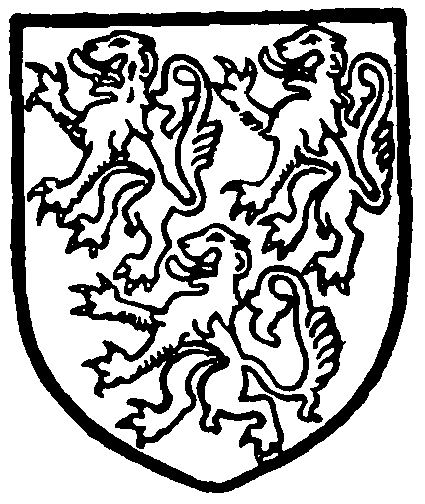
FitzHerbert. Gules three lions or.
The de Botreaux moiety of the manor of Alcester was held by William son of William and Alice de Botreaux in about 1212. (fn. 100) His elder son William died in 1243, when his Warwickshire estates went to his brother Reynold, (fn. 101) who held this moiety of Alcester in 1251. (fn. 102) Reynold joined the Barons against Henry III, and at the inquiry held into the lands of the rebels in 1265 he was said to have land in Alcester worth £5. (fn. 103) Seven years before his death in 1274 he enfeoffed his son and heir William with his moiety of Alcester. (fn. 104) This William died in 1302, and his son, also William, (fn. 105) in 1321 transferred the manor to Reynold de Botreaux, (fn. 106) presumably his brother. (fn. 107) Reynold and Isabel his wife in 1330 settled it on themselves in tail male. (fn. 108) When their son Walter de Botreaux became lord of Alcester in 1349, as he was still in his minority, the wardship was granted to Ralph Sabecot. (fn. 109) Walter became 21 on 12 March 1353, and, in proof of his age, it was shown that William Grym, rector of Alcester, had entered Walter's name at birth in a missal of St. Nicholas Church, at Alcester, where he was born. (fn. 110) In 1364 Walter paid £16 for a royal licence to grant for life to John, son of Giles de Beauchamp, and John le Rous of Ragley rents from arable and meadow lands, from a shop and tenements in Alcester, worth annually £8 19s. 3d., with remainder of the lands to them on the death of any of the tenants. (fn. 111) This grant was probably of the site and demesnes of the de Botreaux moiety, for when Christiana, widow of John Rous, died in 1416, she was said to be seised of half the manor of Alcester, held in chief by military service and worth 10 marks annually. (fn. 112) Because of the minority of her grandsons and successive heirs, William and John Rous, the estate was in the King's hand from 1416 to 1428, when John was declared to be the heir. (fn. 113) In 1523 Thomas Rous died seised of the reversion of half the site of Alcester manor, held of the heirs of Lord Beauchamp. (fn. 114) The lordship meanwhile evidently remained with the Botreaux, as Thomas Botreaux, in 1444, had licence to grant to Sir John Beauchamp of Powick and his heirs, a moiety of the manor of Alcester, to be held in chief. (fn. 115)
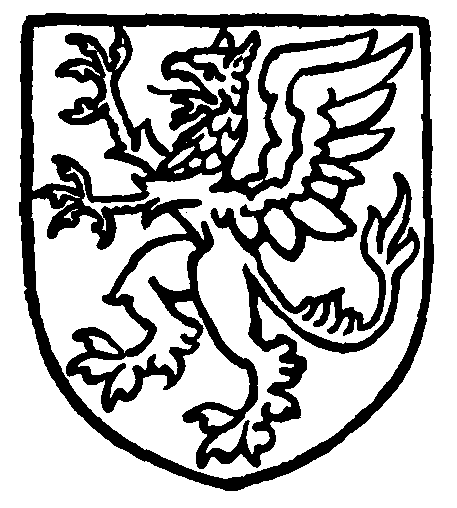
Botreaux. Argent a griffon gules.
In 1211–12 Peter FitzHerbert and William de Botreaux, as tenants in chief, held their fees in Warwickshire, presumably the whole manor of Alcester, as three parts of a knight's fee. (fn. 116) In 1251 each of the two portions of the manor was held of the king by serjeanty, and was worth £14 in annual value. (fn. 117) In 1274 Reynold de Botreaux was said to have held his part of the manor of Alcester by service of finding in the king's army a moiety of a serjeant for forty days. (fn. 118) The total value of this moiety of the manor in 1304 was £7 13s. 7d. (fn. 119) In 1361 a knight's fee in Alcester, representing the overlordship of both moieties, was included in a settlement made by Thomas Beauchamp, Earl of Warwick, (fn. 120) and from this time the manor of Alcester was held as of Elmley Castle. (fn. 121)
The moiety of the manor of Alcester which Peter FitzHerbert held between 1204 and 1221 passed to Herbert, son and heir of Peter, to whom Emma, the widow of Hamo de Brome (or Hamo Falconer), in 1240 remitted all claims to a third of his moiety as dower of the freehold of her husband in Alcester, for 15 marks. (fn. 122) The manor was perhaps leased by Herbert before his death in 1248 to Robert de Chaundos, who in 1249 claimed a tenement in Alcester against Herbert's brother Reynold FitzPeter, (fn. 123) and was holding the manor in 1252. (fn. 124) It seems to have been enfeoffed to Walter, son of William de Beauchamp of Elmley, before 1263, when Reynold, then lord of the manor, brought a plea for the moiety of Alcester against Walter in the king's court. Walter failed to appear and the manor was taken into the king's hand. (fn. 125) In 1266 Walter sought the recovery of the manor from the Crown, and in 1272 bought the half manor for £100, to hold of Reynold and his heirs by doing the foreign service of ½ knight's fee for all service. (fn. 126) From this time the Beauchamp family held this half manor of Alcester and Walter de Beauchamp describes himself as lord of Alcester, c. 1274. (fn. 127) Walter was permitted by the king in 1291 to bring 60 acres of his wood in Alcester within the forest of Feckenham into cultivation, and in 1300 the king granted him free warren in his demesne lands of Alcester. (fn. 128) His eldest son Walter, joint lord of Alcester with William de Botreaux in 1316, (fn. 129) died in 1328. His brother, Giles, who was said in 1329 to hold it as ½ knight's fee of Reynold FitzPeter, (fn. 130) was granted in 1340 the right to fortify and embattle his manorhouse at Alcester. (fn. 131) The acquisition of the other portion of the manor of Alcester by Sir John Beauchamp of Powick in 1444 from Thomas Botreaux made him lord of the whole manor. In 1446 Sir John was confirmed in his possession of the manor and town of Alcester by royal charter, and also in a long list of liberties, which he and his ancestors had always had there. (fn. 132)
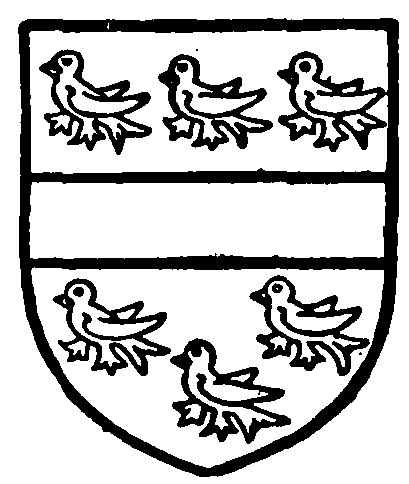
Beauchamp of Powick. Gules a fesse between six martlets or.
In the following year Sir John Beauchamp was raised to the peerage as Lord Beauchamp of Powick. He died in 1475 (fn. 133) and was succeeded by his son Richard. Richard, who was married to Elizabeth Stafford in 1449 in the oratory of his father's manor-house at Alcester, (fn. 134) died in 1503, leaving three daughters and having settled the manor on Robert, Lord Willoughby de Broke, the husband of Elizabeth, the eldest. When Lord Willoughby died in 1521 his three granddaughters, Elizabeth, Anne, and Blanche, were his heirs, for his son Edward had predeceased him. (fn. 135) They were all minors and the wardship of Elizabeth, the eldest, was granted to Sir Edward Greville of Milcote, who married her to his second son, Fulke. (fn. 136) In 1526 Fulke and Elizabeth (who was still a minor) obtained livery of a third part of the manor of Alcester and other lands of Robert, Lord Willoughby, (fn. 137) and in 1536 they acquired the whole, Elizabeth's sister Anne having died a minor in the wardship of the Crown. (fn. 138) Theirs is the alabaster tomb in the church. Sir Fulke died in 1559 and his widow in 1565 holding the manor of Alcester of William Savage as of the manor of Elmley Castle. She left as her heir her son Fulke, then aged 20. (fn. 139) Fulke died in 1606 and was succeeded by his son, the 3rd Sir Fulke Greville (fn. 140) (1554–1628), the poet and friend of Sir Philip Sidney and the most famous of his line. In the year before his father's death he had obtained from the Crown a grant of Warwick Castle, which thereafter became the chief seat of the family. In 1621 he was created Baron Brooke of Beauchamp's Court. His death without issue caused a break in the direct line and he was succeeded in his title and estates by his cousin Robert Greville, whom he had appointed as his heir. (fn. 141) In the family of Greville, Lords Brooke (created Earls Brooke in 1746 and in 1759 Earls of Warwick), the manor of Alcester continued to descend until 1813, when George, 2nd Earl of Warwick, sold it to the Marquess of Hertford. (fn. 142) The 8th Marquess of Hertford is the present lord of the manor.
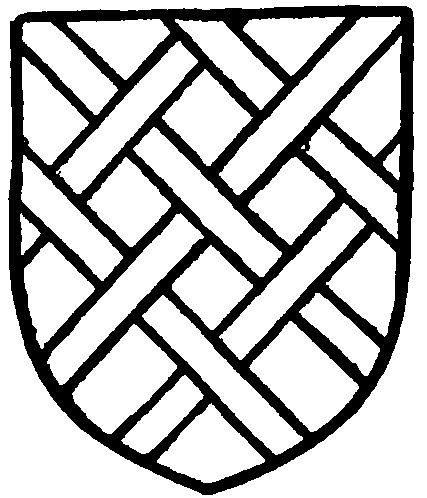
Willoughby. Or fretty azure.
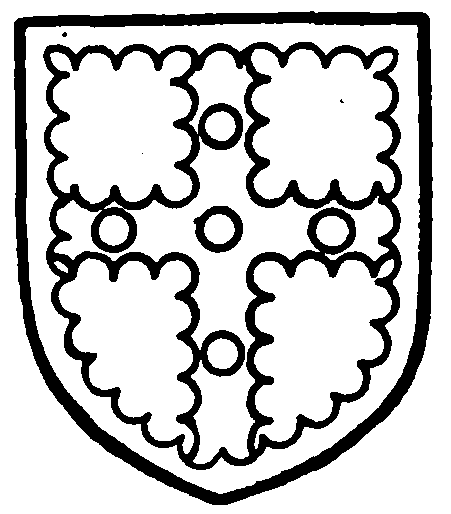
Greville. Sable a cross engrailed or charged with five roundels sable all within a border engrailed or.
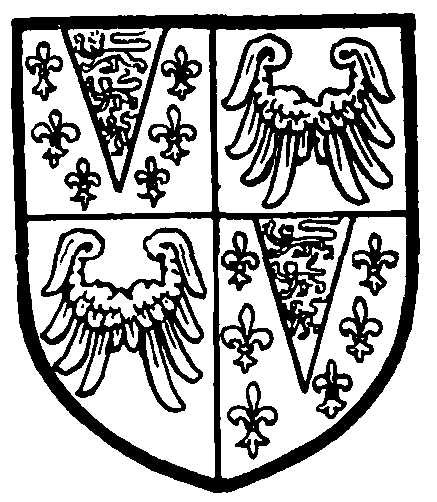
Seymour, Marquess of Hertford. Quarterly: I and 4, Or a pile gules between six fleurs de lis azure with three leopards or upon the pile; 2 and 3, Gules a pair of wings or.
An estate sometimes described, in the mid-16th century, as the manor of Alcester is probably to be identified with the possessions of the priory in the town. These were granted after the Dissolution to Thomas Cromwell and escheated to the Crown upon his attainder. (fn. 143) Henry VIII leased them to Fulke Greville in 1541, (fn. 144) but in 1544 made a grant of them—under the description of the manor of Alcester, the site of the priory, and various lands and tenements belonging to it—to William Sewster and his son John. (fn. 145) In the same year John Sewster acknowledged the receipt from Lady Elizabeth Greville of £237 18s. 10½d. in part payment of a fine for the purchase of 'the scite and manor of Alcester' then in the tenure of Elizabeth and her husband on a lease for their lives from the king. (fn. 146) The transaction was completed in the following year, the total fine being £437 18s. 10½d. (fn. 147)
In 1545 the 'Rentes of the pryore late disolvyde' amounted to £6 5s. 6d. out of a total for the manor of £17 7s. 10d. (fn. 148) They seem still to be separately accounted for, as 'the Kinges Landes', in 1610. (fn. 149) Their value had then fallen to £4 14s. 2d., no doubt because part of them was already reckoned in with the chief manor. In time these priory estates would naturally lose their separate identity and it appears from the rental of 1684 that the process of absorption was by then complete. (fn. 150)
BEAUCHAMP'S COURT is described as a manor soon after the Dissolution, when it is said to have been held successively by Lord Beauchamp and Lord Brooke. (fn. 151) It is so described also in several documents, as late as 1741. (fn. 152) An annual portion of 20s. out of Beauchamp's Court was payable to Evesham Abbey in 1535 (fn. 153) and was still being paid, to the Commonwealth, in 1650. (fn. 154) The manor of Beauchamp's Court, if such it was, may have comprised the hamlet of Kings Coughton.
Mill
In 1241 William de Botreaux and Peter FitzHerbert each granted to the monks of Alcester their half of the mill which the monks had constructed outside their court and of the meadows called Halimede and Mulneholme belonging to it. (fn. 155) The medieval mill therefore must have been close to the site of the present one, which is on the Arrow, near where the Abbey stood. One Bartholomew was paying 5d. chief rent for the mill in 1545. (fn. 156) A horse mill is mentioned in 1560. (fn. 157) In 1805 the Priory Mill was conveyed by the Earl of Warwick to the Marquess of Hertford (fn. 158) and it seems about this time to have been used for needle-making as well as for grinding corn. (fn. 159) It is now known as Ragley Mill.
The manorial fishery was in the Alne and is described in 1800 as extending from the place where the river entered the manor to Oversley Bridge. (fn. 160)
Church
The parish church of ST. NICHOLAS consists of a chancel, north and south chapels, nave, north and south aisles, and a west tower.
The west tower is of the 14th century with a 15thcentury doorway in it. The north and south aisles, i.e. the whole interior of the body of the church, were rebuilt 1729–33 by Edward and Thomas Woodward of Chipping Campden, at a total cost of £1,020, (fn. 161) but some parts of the north and south walls of the aisles of the medieval church seem to have survived this drastic reconstruction. The east end was rebuilt in 1870, replacing an 18th-century chancel which was little more than an altar recess. (fn. 162)
The chancel (28½ ft. by 18½ ft.) has a modern east window of five lights and tracery, and in each side-wall is a single trefoiled lancet. West of them are arcades to the chapels, of 13th-century style, each with a wide bay between two narrow bays. In the south wall are two sedilia and a piscina recess without a basin, all of modern stonework. Both the north chapel, or organ chamber, and the south chapel have an east doorway and a side window of three lights and tracery. In the north wall of the former is reset an ancient piscina basin of quatrefoil circular form in a modern recess. The modern chancel arch has shafted responds and the west arches to the chapels plain responds.
The nave (c. 68 ft. by 18 ft.) has on either side a colonnade of five bays with Doric columns on high square stone bases; they carry horizontal plastered architraves or lintels from which rises the coved ceiling of the nave: the aisles have flat plastered ceilings. Both aisles have five side windows tallying with the colonnades; they are each of three cinquefoiled lights and modern tracery of early-14th-century character in fourcentred heads: the moulded jambs of the windows appear to be medieval—perhaps dating from about 1500. The walls are cemented externally, but the moulded plinth may also be of c. 1500. Buttresses divide the walls into five bays, those at the angles being set diagonally: on them are restored pinnacles. In the west wall are round-headed doorways of the c. 1730 period, entrances to former galleries. The battlemented parapets are modern.
The west tower (13¼ ft. square) is of the 14th century in the lower half, which is built of coursed ashlar, and perhaps rebuilt or refaced later in the upper half, which is of rubble with an intermixture of squared stones in courses. There are pairs of square buttresses at the west angles, and at the south-east a semi-octagonal projecting stair-turret. Moulded string-courses occur at the springing level of the west window, at the base of the bell-chamber, and at the parapet, which is probably of the 18th century: it is embattled and has pinnacles above the angles and in the middle of each side.
The archway from the nave is a plain one of three chamfered orders, continuous in jambs and two-centred head. The west doorway is a 15th- or early-16thcentury insertion with moulded jambs and four-centred arch in a square head, and with plain shields in the spandrels: it has been much repaired with cement. The 14th-century west window is of three trefoiled lights—the middle with an ogee head—and leaf-tracery in a two-centred main head, with an external hood-mould rising from the moulded string-course: the internal splays are of squared rubble and the pointed rear-arch is chamfered. In the south wall is an ogee-headed doorway to the stair-turret: there is also an outer doorway to the turret, probably a modern piercing: the turret is lighted by plain loops. The next story is lighted by lancet windows: higher up, but below the bellchamber, is a modern clock-dial set splay-wise across the south-west angle so as to be seen from the main street of the town. The bell-chamber has in each wall a window of the 14th century, of two trefoiled ogeeheaded lights and a quatrefoil in a two-centred head.
The font and other furniture are modern. A screen at the east end of the north aisle—to the organ chamber—contains the mutilated remains of a screen of c. 1500, mostly applied to modern woodwork: they include a number of elaborately traceried heads of bays, foiled circles with rosette centres, twelve paterae with roses or foliage, six lengths of running foliage ornament (two vine-leaf), a length of a cornice with vine foliage, &c. A chest with a rounded lid is probably of the late 16th century: it is bound by iron straps and has three staples, one for a lock and two for padlocks.
Fixed on the south wall of the tower is a benefaction board fitted with painted doors in the form of a triptych. The list of charities from 1562 to 1904 is inscribed on parchment or paper and enframed under glass in a shallow cupboard. This has an enriched top rail and cornice and a moulded bottom rail carried on brackets: below it is another rail carved with half-sunflowers and foliage. The interesting feature of this fitting is the doors, which are each of two panels covered with paintings. On the internal faces are four pictorial subjects representing acts of charity, with the participants dressed in the costume of c. 1600. In the dexter upper panel are five bearded men, two donors and three tradesmen, a barber with scissors and comb, a carpenter with saw and square, and a butcher with cleaver and axe. A panel above the figures is inscribed in black letter: 'Blessed is he that considereth the poore and needy. Psalme 41: 1.' The lower panel has three donors and two beggars. The donors—all men—hold clothing, food, and washing utensils: one beggar is blind and holds an alms-tray and white staff: the other is a cripple with a wooden leg. The inscription reads: 'He that hath pittie upon the poore lendeth unto the Lord. Pro: 19: 17.' The sinister upper panel represents a school with two gowned teachers, and six boys and girls at their lessons: one holds a horn-book with the alphabet: there is a large fire-place with a sway and pot. The text reads: 'To do good and to communicate forget not. Heb: 13:16.' The lower panel is a prison scene, the prison being a battlemented structure of stone with two prisoners appearing at the windows. The donors are a man and woman accompanied by their maid who wears cap and apron and carries a tray of food. The man holds a flask and cup, and the woman a basket (of eggs?). The text reads: 'The mercifull doeth good to his owne soule. Pro: 11: 17.' The external faces are painted with black-letter inscriptions. The upper dexter panel reads: 'Behold within this table are the names with the memorable acts of those who have most liberally extended their bountye to help tradesmen and releeve poore and aged people dwelling within the Towne and Parish of Alcester.'
The others are texts, and the retouched date 1683, which was evidently 1603.
At the west end of the north aisle is a well-preserved altar-tomb (fn. 163) with the alabaster effigies of Sir Fulke Greville, 10 Nov. 1559, and Lady Elizabeth (Willoughby) his wife, 156–. (fn. 164) The knight wears the full plate armour of his younger years, sword and dagger: his hands are in prayer and his feet rest on a lion: about his shoulders is a chain with a pendent cross. He wears three rings on the fingers of each hand. His head rests on his helmet, which bears a crest of a greyhound's head. His armour is painted black with gilded enrichments. The lady, on his left, wears a close-fitting cap and veil, a small ruff and a necklace. The tight bodice is held by knotted cords, and has slashed and puffed sleeves, also pendent false sleeves with cheveron ornament: an overskirt is folded back revealing the pleated underskirt. From her waist is a pendent chain with a flat round sachet. Over all she wears a mantle loosely tied across her breast by pendent cords with tasselled ends. Her head rests on a cushion. Her hands are in prayer and she wears three rings on each. At her feet is a tiny dog biting the end of her overskirt. The effigy has remains of colouring, the mantle being red; the other garments were probably black. The top slab has moulded edges in which is the carved inscription. At the angles of the sides of the tomb are round shafts with spiral ornament, and similar intermediate shafts divide the longer sides into three bays. Each middle bay bears a shield of arms in a garter, the dexter Greville, the sinister Willoughby. In the other bays are represented the children as weepers: the dexter bays have three and four sons respectively, the eldest in armour, the others in gowns, except the sixth who is shown in grave-clothes. On the sinister side are eight daughters, the sixth being in grave-clothes. At the head end of the tomb is a quartered shield of Greville in a garter with nude men as supporters. At the foot end, under the wording: 'Arma Richardi dni. de bello campo, baronis de Powick & dni. de Alincester' are (1) a shield with the quartered Greville arms, (2) a lozenge with the twenty Willoughby quarterings, and between them (3) a small shield of Beauchamp quartering Ufflete. The quarterings of Greville and Willoughby are repeated on small shields below the top string.
Above the tomb, fixed to the respond of the colonnade, is a funeral helmet with a comb and beaver, and a painted framed wooden panel charged with the Greville arms.
There are eight other funeral monuments of the 18th and 19th centuries, the oldest being Timothy Howes, 1709. One to John Brandis 1724 is signed by Edward Woodward of Campden, another to Sir Hamilton Seymour, G.C.B., with his seated effigy is signed 'Gleichen, 1882'. In the south chapel is a reclining effigy of Francis Ingram Seymour Conway, Marquess and Earl of Hertford, died 1822, by Sir Francis Chantrey.
In the nave is a brass candelabrum with two tiers of arms inscribed 'Ye gift of ye Rt Revd Father in God Dr John Hough Ld Bp. of Worcester, 1733'.
There are six bells of 1735 by Abel Rudhall.
The church plate is modern, dating from 1884.
The registers begin in 1560.
Advowson
The church of Alcester is not included among the grants to the abbey in Ralph's original foundation charter, which is at Coughton Court. Nor is it mentioned in the confirmation of this charter by Robert, Earl of Leicester, (fn. 165) and by King Stephen early in 1140. (fn. 166) The only evidence that the abbey ever possessed it is contained in an undated confirmation charter of the reign of Henry II. (fn. 167) It must in any case have been lost soon afterwards, as were many other of the possessions of that house during its early history, for Henry II is said to have granted it to the Priory of Cookhill. (fn. 168) In 1227 the advowson was in dispute between the Prioress of Cookhill and Peter FitzHerbert and William de Botreaux, lords of the two moieties of the manor. (fn. 169) In 1247 the church was said to belong to Cookhill, (fn. 170) and the priory continued to present down to the Dissolution. (fn. 171) The advowson then passed to the Crown and was granted, with the site of Alcester Abbey, to William Sewster and his son John in 1544. (fn. 172) Though not mentioned, it may have been included in Sewster's conveyance of this property to Fulke and Elizabeth Greville in the following year. Fulke Greville the second presented in 1578 (fn. 173) and the advowson thenceforward follows the descent of the manor, though three successive presentations, in 1619, 1620, and 1623, were made by the Crown. (fn. 174)
In 1247 (fn. 175) and 1291 (fn. 176) the church was valued at £8. In the latter year the nuns of Cookhill were said to enjoy a portion in it of £113s. 4d. The same valuation is given in 1341, the glebe being then worth £3, (fn. 177) and again in 1428. (fn. 178) In 1535 it is rated at £14 2s. 10½d., including £1 6s. 8d. for the glebe; a pension of 10s. 5d. was then payable to the Prioress and Convent of Henwood. (fn. 179) In 1646 the Committee of Plundered Ministers ordered the living to be augmented out of the sequestrated profits of the rectory of Brailes, belonging to William Bishop, a Papist. (fn. 180)
The present dedication, in honour of St. Nicholas, appears in 1227 (fn. 181) and 1333. (fn. 182) But in 1428 the church was said to be dedicated in honour of St. Faith. (fn. 183) According to Dugdale the change was made on the occasion of a rebuilding. (fn. 184) It is not known when the original dedication was restored.
There were two chantries in the church, dedicated respectively in honour of St. Mary and of All Saints. The former was probably founded by John Boteller, who presented to it one Robert, his chaplain at Oversley, in 1286. (fn. 185) The priest was required to sing mass daily at 6 o'clock in the morning in the parish church of Alcester and to pray for the souls of the founders. In 1547 the endowment of the chantry was valued at £6 11s. 6d., out of which rents to divers persons were payable to the amount of 16s. 5½d. No land had been sold and there were no goods, plate, or ornaments. (fn. 186) The property comprised 13 houses and cottages, 9 tenements, an inn and a shop and lands in Alcester, a croft in Oversley and Lady Meadow, and land in the common fields in Kinwarton. (fn. 187)
The advowson of this chantry descended with the manor of Oversley (q.v.) until the end of the 15th century, when it came into the hands of the Beauchamps, Lord Beauchamp (presumably Richard) presenting in 1490. (fn. 188) The original chantry was in the parish church, but about this time it is said to have been rebuilt, at the request and expense of the rector and principal inhabitants, on land granted to them by Lord Beauchamp. The town seems thus to have acquired the advowson, which was held by the rector and eight others, presumably townsmen, in 1513. (fn. 189) One reason for rebuilding the chantry may have been to provide a school, since it is stated that Richard Norman, who became priest in 1490, 'kept a scole there according to the Foundacyon'. (fn. 190) This school survived the dissolution of the chantry, for in 1562 Queen Elizabeth granted to the Lady Elizabeth Greville a sixty years' lease of some of the former property of the chantry including 'A house . . . which was formerly the preist's house . . . and is now occupied as a school house' and the grant contained 'A covenant not to convert the preistes Chamber to noe other use then a schole.' (fn. 191) Walter Newport's bequest of 1591, which has been regarded as the foundation of Alcester Grammar School, may therefore have been made to maintain a school which had already been in existence for more than a century. (fn. 192)
The chantry of All Saints was founded by John son of Giles de Beauchamp, who obtained licence of alienation in mortmain to the extent of £5 to assign to a chaplain to celebrate daily in the parish church of Alcester; in part satisfaction whereof in 1362 he granted to Henry le Walkere, chaplain, 11 messuages, a shop, 11 acres of land and 4 of meadow, worth £2 11s. 8d., to hold as of the annual value of £3. (fn. 193) John Merton and Robert Canell, chaplains, granted to Henry Eorle, chaplain of this chantry, 4 messuages and 4 acres of land in 1411. (fn. 194) The advowson of this chantry descended with the manor of Alcester. (fn. 195) The endowment in 1547 amounted to £5 7s. 4d., including reprises, paid to the king, of 9s. 3d. (fn. 196) No land had been sold and there were neither goods nor ornaments. (fn. 197) The property comprised a house and a shop, 13 tenements and land in the common fields in Alcester, and 9 acres of land in Kinwarton. (fn. 198) At this time there were said to be over 460 houseling people in Alcester and the chantry priests were wont to help daily in the administration of the sacraments, since 'without the helpe of them the person there is not able to serve the seyd cure'. (fn. 199) In 1553 a pension of £5 was being paid to the former priest of St. Mary's Chantry and of £4 18s. to the former priest of All Saints. (fn. 200) Grants of part of the former possessions of the chantries were made to John Hulson and Bartholomew Brokesby, citizens and scriveners of London, in 1549, (fn. 201) and to Edward Aglionby of Balsall and Henry Higford of Solihull in 1553. (fn. 202) By 1562 other portions of the property of both chantries had come into the hands of Lady Elizabeth Greville. (fn. 203) Several houses, shops, and cottages formerly belonging to both chantries were granted by the Crown to Francis Phillips and others in 1611. (fn. 204)
In 1333 Pernell widow of Robert Squier of Alcester gave 3 messuages and land and rent to maintain a priest celebrating daily in the church of St. Nicholas for the souls of Edward III, herself, and her husband and their families; (fn. 205) but no more is known of this chantry.
Nonconformity
The beginnings of Nonconformity in Alcester may be attributed to the Rev. Samuel Clarke, rector 1633–45. When he first came here, so he tells us, the town was the rendezvous of the 'many great Papists' of the neighbourhood and the inhabitants were so 'much given to Swearing, Drunkenness, and prophanation of the Sabbath, opening their Shops; and selling Wares (especially Meat) publickly' as to earn it the name of 'Drunken Alcester'. Clarke energetically set himself to reform this laxity and was the only one, even of the Puritan clergy of the neighbourhood, who refused to read to his congregation the Book of Sports of 1633. His ministry was attended with such success—aided by the Divine vengeance which followed upon disregard of his precepts—that, in his own words, the town became 'Exemplary and eminent for Religion all over the Country'. (fn. 206) The steward of the manor, Matthew Bridges, was a major in the Cromwellian army and one of the most active justices on the Warwickshire bench during the Interregnum. In 1657 he was commissioned by Quarter Sessions to remove 'the Rood loft and all superstitious paint' from the church. (fn. 207)
There were three Dissenting congregations in Alcester in the 17th century—the Presbyterians, Baptists, and Quakers. They must however have been largely drawn from the surrounding district, since the Compton Census of 1676 records only 16 Nonconformists in a total of 299. (fn. 208) The Presbyterian church was probably founded by Clarke's successor, Samuel Tickner, who continued to live and preach here after his ejection from the rectory in 1662 and died in 1685. (fn. 209) But the first recorded minister was Joseph Porter, (fn. 210) whose house was licensed for worship in 1689 (fn. 211) and who died in 1721. He established an academy in his house for the instruction of young men for the ministry. (fn. 212) The chapel in Bull's Head Yard, now derelict, bore on a rainwater head the date 1723; but there is said to have been a chapel on the site already in use in 1693. During the 18th century the congregation adopted Unitarian tenets. Except for an interval of eleven years, 1882–93, the chapel was in use until 1901, when it was dismantled. The fittings, which included a fine late-17thcentury three-decker pulpit, brought from the church after the restoration of 1870, and other good woodwork of the period, were sold by auction and the income was handed over to the Trustees of the Presbyterian chapel at Evesham. (fn. 213)
The Midland Baptist Association met at Alcester in 1657. The first minister here was John Willis, who attended the Assembly in London in 1689 and died about 1705. In 1712 the church had 98 members, of whom rather less than half came from outside Alcester—11 of them from Henley-in-Arden. The first meeting-house was licensed in 1736. The present chapel, which occupies the same site, dates from 1869. Separate churches were formed from this congregation at Henley-in-Arden in 1803 and at Astwood Bank in 1813. (fn. 214)
The Friends' Meeting at Alcester was founded in 1660 by Richard Hubberthorne and in 1677 the Viscountess Conway became a member of it. In the latter year a meeting-house was secured on lease. It was rebuilt in 1699 (fn. 215) and may perhaps have been the house of Richard Laggett for which a licence for Quaker worship was issued in 1701. (fn. 216) In its early days the congregation was subject to much persecution (fn. 217) and seems never to have been a very flourishing one. In 1835 the meeting-house was converted into a private dwelling and let. (fn. 218) It stands in one of the courts on the east side of High Street.
The first reception of Methodism in Alcester was even less favourable than that which the inhabitants were traditionally said to have accorded to the preaching of St. Egwin, more than a thousand years before. In 1812 a Methodist minister, Michael Cosin, who came to preach here, was attacked and beaten by a mob, and about the same time a Mr. Heaton who came from Redditch with the object of establishing a church, was similarly treated and dragged along the gutter. A Methodist congregation was in existence however by c. 1840 (fn. 219) and the present chapel in Priory Road was built in 1872.
The Roman Catholic Church in Priory Road was built in 1888.
Charities
John Bridges in 1659 gave a close containing about 1½ acres called Maggotts, together with the four alms-houses (called Priory Almshouses) adjoining in Priory Lane, for the use of four widows for ever. The close is now let on a lease expiring in 1997 at a rent of £6 15s.
George Ingram in 1680 gave the four almshouses in the Bleachfield (called Bleachfield Almshouses), and a close adjoining, for the use of poor unmarried men or women aged 50 years or upwards. Part of the close was sold under the authority of the Charity Commissioners in 1927 and the proceeds invested in 3½ per cent. Conversion Stock, producing £5 8s. 10d. annually. The remainder of the close, consisting of garden land, is let at the total rent of £6 per annum.
Brooke Bridges' Charity. By indenture dated 29 Nov. 1780 it was recited that Brooke Bridges by codicils to his will dated 30 Sept. 1700 gave sums of £400 and £600 to purchase lands, and that out of the profits thereof 40s. per annum should be paid to the persons inhabiting the almshouses of Alcester given by his father and his uncle, George Ingram, and the residue should be applied to the repair of the almshouses and to poor persons. The estate purchased at Alne Hills, Great Alne, containing some 127 acres. is let at a yearly rate of £108 (approx.).
Thomas Lucas in 1706 gave a house in Feckenham (co. Worcester), the profits to be equally distributed among the four poor people inhabiting the four almshouses in Bleachfield. The endowment is now represented by a rentcharge of 15s. per annum out of land in Feckenham.
The above-mentioned charities are administered by trustees, three of whom are appointed by the parish council of Alcester, and the annual income, amounting to £140 (approx.), is applied in payments to the almspeople and in maintaining the eight almshouses.
Molly Hodgetts by will proved 23 Jan. 1833 gave the sum of £100, the interest, now £2 10s., to be paid to the four tenants of the four almshouses in Priory Lane.
John Watts by will proved 5 June 1847 gave £100 to the Trustees of the Bleachfield Almshouses, the income to be distributed to the almspeople. The endowment is now represented by £78 4s. 11d. Consols held by the Official Trustees of Charitable Funds and the income amounts to £1 19s. 4d.
William Smallwood (Almshouse) Trust. By an indenture dated 23 Jan. 1895 it was recited that William Smallwood gave £2,000 to build almshouses for the poor of Alcester, and £2,000 for endowing the same. Six almshouses were built at a cost of £1,340 18s., the residue of the bequest being invested. The almshouses are held upon trust for the accommodation of poor persons resident in the parish, with a preference for tradesmen and their widows in reduced circumstances. Stipends are paid to the almspeople at the discretion of the trustees, who have power to provide water, gas, fuel, medical attendance, and funeral expenses. The endowment now consists of the almshouses and stock held by the Official Trustees of Charitable Funds producing an annual income of £117 6s. 6d. and the charity is administered by seven trustees appointed by an Order of the Charity Commissioners.
Penelope Morgan in 1720 gave £10, the interest to be given to the church poor of Alcester.
William Oakes by will dated 19 Mar. 1766 and Elizabeth Oakes by will dated 29 Sept. 1769 each gave £100 to purchase land, the profits to be expended in bread for the poor. In 1872 £200 was applied in paying off a mortgage on Moor Fields, interest at 4 per cent. being paid.
Samuel Dobbins in 1766 bequeathed £20, the interest to be paid to the poor. The endowment produces 18s. 10d. annually.
William Gibbs in 1759 by will gave 40s. per annum charged on a house in Evesham Street called the White Lion for distribution to the poor. The rentcharge is received regularly.
Lovel Hodgett in 1816 gave £200, the interest to be distributed in bread to the poor. The endowment produces £5 2s. 8d. annually.
Angel House Charity. The origin of this charity is unknown; it consists of a rentcharge of 10s. issuing out of Angel House.
The six above-mentioned charities are administered by the Rector of Alcester and two trustees appointed by the parish council, and the income amounting to £16 11s. 6d. a year is distributed to the poor in groceries.
Lady Elizabeth Greville in 1562 gave twelve black gowns to twelve poor widows for ever. In the returns under Gilbert's Act in 1786 this gift is said to have been a rentcharge of £5 10s. given by will and to have been paid by the Earl of Warwick. The endowment is now represented by a charge of £6 issuing out of land in Alcester now forming part of the estate of the Marquess of Hertford and is expended in accordance with the terms of the bequest.
Robert Wilcox by will dated 24 Dec. 1627 gave his house and close at King's Coughton for the maintenance of three sermons, the residue to be given to the poor of the parish. The property was sold in 1922 and the proceeds invested in 3½ per cent. War Stock held by the Official Trustees of Charitable Funds. The interest amounting to £6 1s. 10d. annually is applied by the High and Low Bailiffs in accordance with the trusts.
Thomas Wilson by will proved 19 Feb. 1863 gave £100 to the churchwardens, the interest to be applied in bread and meat for twenty-five poor and aged widows. The endowment is now represented by £146 16s. 6d., 3 per cent. Local Loans producing £4 8s. yearly, which is applied as directed by the will, by two trustees appointed by the parish council in place of the churchwardens.
Francis Mosley Spilsbury by will proved 2 Jan. 1879 gave £100, the interest to be paid in equal shares to twelve poor persons living in Alcester, with a preference to those of the Roman Catholic religion. The charity is administered by the rector and one trustee appointed by the parish council, and the income amounts to £2 10s. 8d.
Richard Fisher by will proved 28 July 1884 gave £200, the income to be distributed to the poor in bread, beef, and coal. Owing to an insufficiency of assets the original bequest was reduced and the endowment is now represented by £46 3s. 2d. Consols held by the Official Trustees of Charitable Funds. The interest is applied under an order of the Charity Commissioners dated 16 Nov. 1905. The Rector is now sole trustee.
Gould's Gift. John Granger Gould by will proved 29 Oct. 1904 bequeathed £1,000 to the vicar and churchwardens of St. Nicholas' Church, Alcester, the interest, now £41 1s., to be distributed to twelve poor persons over 60 years of age resident in the parish and church persons.
Hawes Close. By deed dated 8 Aug. 1655 it was recited that the close called Hawes Close adjoining Priory Lane and one ridge of land were in 1665 purchased by the town stock of John Bridges, the yearly profits to be applied to the discharge of public duties of the church and town. The land was sold in 1920 and the proceeds invested in 3½ per cent. Conversion Stock producing an annual income of £38 1s. By an Order made under section 75 (2) of the Local Government Act 1894 it was directed that half of the income should constitute the endowment of the Church Charity and the remainder the endowment of the Town Charity. The charities are administered as directed, the Church Charity by the rector and churchwardens and the Town Charity by the rector and two trustees appointed by the parish council.
Moor Fields Charity. The origin of this charity, the endowment of which consisted of two closes called the Moors, which were taken out of the common moor by Sir Fulke Greville, lord of the manor, is unknown. By an indenture dated 16 Nov. 1733 the trustees were empowered to raise moneys and to apply the same together with the rents and profits of the lands for the use of the church, churchyard, and mounds if there should be any occasion, but if not to apply the rents for the use of the parish in general. The land is now let at a yearly rent of £24 (approx.), which is applied in paying interest at 4 per cent. on a sum borrowed to repay a mortgage, the residue being paid to the Parochial Church Council for application in accordance with the trusts. The trustees are the rector, churchwardens, and High Bailiffs.
Church Street Property. The origin of this charity is unknown. A lease dated 21 Mar. 1787 recites that the Bailiffs and churchwardens were entitled to the freehold of five houses in Church Street as trustees for the inhabitants and that such endowments had from time immemorial been administered for such purposes as the major part of the inhabitants in vestry assembled had from time to time thought proper to direct. The houses are let at a yearly rent of £60 (approx.) and the income is spent in grants for public purposes.