A History of the County of Warwick: Volume 3, Barlichway Hundred. Originally published by Victoria County History, London, 1945.
This free content was digitised by double rekeying. All rights reserved.
'Parishes: Beaudesert', in A History of the County of Warwick: Volume 3, Barlichway Hundred, ed. Philip Styles (London, 1945), British History Online https://www.british-history.ac.uk/vch/warks/vol3/pp45-49 [accessed 30 April 2025].
'Parishes: Beaudesert', in A History of the County of Warwick: Volume 3, Barlichway Hundred. Edited by Philip Styles (London, 1945), British History Online, accessed April 30, 2025, https://www.british-history.ac.uk/vch/warks/vol3/pp45-49.
"Parishes: Beaudesert". A History of the County of Warwick: Volume 3, Barlichway Hundred. Ed. Philip Styles (London, 1945), British History Online. Web. 30 April 2025. https://www.british-history.ac.uk/vch/warks/vol3/pp45-49.
In this section
BEAUDESERT
Acreage: 1,308.
Population: 1911, 187; 1921, 231; 1931, 240.
Beaudesert is a small parish lying across the River Alne to the north and west of Henley-in-Arden. The main village, consisting of the church and a single short street of houses, stands close to the river and directly opposite Henley Church: the present bridge, built in 1854, replaces one shown in Moll's map of 1724; there was also a ford. Two houses on the south side of the street, one of which is called 'Manor House', retain some 17th-century framing. Another, on the north side, near the bridge, has late-16th-century framing at its west gable-end and conceals an original jettied upper story behind its modern brick front.
Behind the village to the east rises the hill, locally known as 'The Mount', crowned with the earthwork remains of the castle of the De Montforts. The fortified area, roughly rectangular in shape and about 250 ft. long, is surrounded by a deep moat (dry) that nearly disappears on the west side, where there is a steep declivity. (fn. 1) Hardly anything is known of the architectural history of the castle. It was certainly in existence by about 1140, when Thurstan de Montfort obtained a charter for a market in his castle of Beldesert. (fn. 2) Its importance probably declined after 1369, when the De Montfort estates passed to the Earl of Warwick (see below). In 1411 the constable of the castle paid 18d. to the carpenter for mending the porch of the hall and 16d. for felling the necessary timber in the park; (fn. 3) but as no mention is made of the castle in a survey of 1547 it may be presumed by that time to have fallen into ruin. When Dugdale saw it there was not 'any one stone left visibly upon another', and the earthworks themselves had been much reduced and filled up by the plough. (fn. 4) Since then some slight remains have from time to time been discovered: Matthew Bloxam, about 1840, dug up a piece of a 13th- or 14th-century moulded capital; (fn. 5) about 1855 some wooden pipes, probably belonging to a conduit, were dug up because, as they had gone rotten, the ground above them had given way, so that the cattle fell in and broke their legs. (fn. 6)
The castle was surrounded by two parks. A park is mentioned in 1296, (fn. 7) and the Great Park and the Little Park, the former including 300 acres of wood, thirty years later. (fn. 8) The account roll of 1411 already quoted, mentions payments in connexion with the park; and in 1547 the Great and the Little Park were let for £26 13s. 4d. and £19 respectively. (fn. 9) Both were disparked about this time, but the name of the Great Park, which was situated near the present Park Farm, was still surviving in 1680. (fn. 10)
The altitude of the ground varies between about 240 and 300–400 ft. Along the ridge east of the Mount an old trackway runs northwards to Camp Hill, forming the north-western boundary of the parish for some distance. It is known as Edge Lane and must be the 'road going towards Lapworth' mentioned in a document of about 1360. (fn. 11) Its course is interrupted at one point by a cutting for the now-disused railway which connected Henley-in-Arden with the BirminghamPaddington line.
The soil is marl and loam and the subsoil consists of Keuper marls with its interbedded formation of Arden sandstone. Wheat, beans, and oats are the chief crops, but the land is now given up mainly to grazing.
Beaudesert has produced a minor poet in Richard Jago, the author of Edge Hill (1767) and a member of the local coterie that included Somerville and Shenstone. He was the son of the Rev. Richard Jago, rector of Beaudesert, and was born here in 1715. Practically his whole life was spent in Warwickshire, for he was educated at Solihull School before going up to Oxford, was ordained curate at Snitterfield in 1738, and held the livings of Harbury and Chesterton 1743–71, and Snitterfield, where most of his poetry was written, from 1754 until his death in 1781. (fn. 12)
Manor
BEAUDESERT is not mentioned in Domesday and it seems to have been included in Preston Bagot in that survey. The Saxon Britnod's portion of 5 hides recorded therein (fn. 13) appears without doubt to have been the present-day Beaudesert, (fn. 14) which name was given to it by the Norman family that settled there and means the beautiful waste. Britnod's portion passed from the Count of Meulan to Henry de Newburgh, Earl of Warwick, who enfeoffed his great-nephew Thurstan, (fn. 15) the first of the De Montforts of Beaudesert, and the builder of the castle. There are indications that the Warwick overlordship continued throughout the Middle Ages. Thus the manor reverted to Thomas de Beauchamp, Earl of Warwick, on the death of the last De Montfort about 1369 (see below), and in 1547 it is described as 'parcel of the possessions of Richard, Earl of Warwick (i.e. 'the kingmaker'), attainted'. (fn. 16)
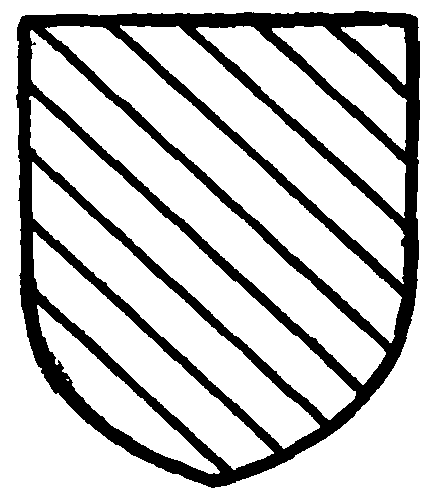
Montfort of Beaudesert Bendy of ten pieces or and azure.
Thurstan obtained from the Empress Maud about the year 1140 the right to hold a market on Sundays at his castle of Beaudesert. (fn. 17) He was succeeded by his son Henry, (fn. 18) whose son Thurstan gave to the nuns of Pinley the tenth part of the provisions in victual for his household with other things pertaining to his kitchen. (fn. 19) Dying in 1216, he was succeeded by his son Peter, a minor, who was a ward of William de Cantelupe. (fn. 20) Peter, on 10 February 1227, obtained the grant of a market on Monday and a yearly fair at his manor of Beaudesert to be held on 'the eve, feast, and morrow of St. Giles'. (fn. 21) He became the most powerful of all the De Montforts and in him the family was at the height of its glory. In the Barons' wars he sided against the king and was one of those who formulated the Provisions of Oxford in 1258. (fn. 22) He was taken prisoner at Northampton, but was released (fn. 23) and was elected one of the Council of Nine. (fn. 24) He was slain fighting beside Simon de Montfort at Evesham in 1265. Early in the following year the Abbot of Bordesley and the Prior of Studley were directed to make an extent of his manors of Beaudesert, Whitchurch, Wellesbourne, and Edstone. (fn. 25) His eldest son Peter by his wife Alice daughter of Henry de Audley, was taken prisoner at Evesham and placed in the custody of Thomas de Clare, to whom his forfeited lands were granted, but shortly afterwards he was pardoned and his lands restored to him. (fn. 26) He married Maud de la Warre and died in 1287. The manors and estates descended to his son John, who married Alice daughter of William de la Planche. (fn. 27) John their son, aged 5 at his father's death, in 1296, is named as heir to the castle of Beaudesert. (fn. 28) This John was concerned in the execution of Piers Gaveston, (fn. 29) but was afterwards pardoned and died fighting for the king at Bannockburn. (fn. 30) As he left no issue, most of his manors, including Beaudesert and Henley, passed to Peter his brother who, by his wife Margaret daughter of Lord Furnival, had one son named Guy, married to Margaret daughter of Thomas de Beauchamp, Earl of Warwick, upon whom in 1349 the manor and castle of Beaudesert and the manor of Henley were settled in tail male, with contingent reversion to the Earl of Warwick. (fn. 31) Guy having died in 1361, before his father, leaving no issue, the reversion of the manors after Peter de Montfort's death came to the Earl of Warwick, who died in 1369, (fn. 32) and his son Thomas in 1376 granted the manors to his brother Sir William de Beauchamp, Lord Bergavenny, for life. (fn. 33) At his death in 1410 they were divided between William Boteler of Sudeley and Baldwin Freville, (fn. 34) son of Sir Baldwin Freville, (fn. 35) who were descended from sisters of the last Peter de Montfort.
The Boteler inheritance consisted of the castle, park, and part of the manor of Beaudesert, together with the borough of Henley, (fn. 36) and was thereafter known as the manor of HENLEY BEAUDESERT. From William, who died in 1417, it passed to his brother, Sir Ralph Boteler. He, dying without issue in 1473, was succeeded by his nephews Sir John Norbury and William Belknap (fn. 37) who were forced to sell the manor to Edward IV in 1477. (fn. 38) The manor appears to have remained with the Crown, (fn. 39) but Edward VI granted it in 1547 to John Dudley, Earl of Warwick, afterwards Duke of Northumberland. (fn. 40) John Dudley was executed in 1553 and his estates were forfeited to the Crown. Queen Elizabeth in 1562 granted the manor to his son Ambrose Dudley, Earl of Warwick, (fn. 41) who died in 1589 without issue; and two years later the Queen leased it to William Harmon. (fn. 42) From 1592 to 1609 Thomas Spencer is named as lord of the manor, being farmer under the Crown. (fn. 43) In 1611 Anne, queen of James I, was holding it as her jointure. (fn. 44) William White from 1614 to 1629 and William Baldwin from 1637 to 1647 are stated to be lords; (fn. 45) and they probably farmed it under the Crown. In 1656 Richard Walker was farmer of the manor. (fn. 46) Dugdale, writing in 1656, says 'in our time' the site of Beaudesert Castle and the Park wherein it stood were purchased from the Crown by 'Alderman Cawdwell a Londoner'. (fn. 47) In 1669 Sir Robert Cordell, bart. and Margaret his wife were holding the manor. (fn. 48) They sold it in 1672 to Thomas Archer of Umberslade by the name of the manor of 'Henley in Arden Beaudesert'. (fn. 49) Some time between this date and 1734 (fn. 50) the Archers sold the Beaudesert portion of the manor to the Smiths of Wootton Wawen, who thus became lords of the whole of Beaudesert.
The other portion of the manor of Beaudesert, inherited in 1410 by Baldwin Freville, passed at his death in 1418 through his sister and coheiress Joyce, the wife of Roger Aston of Tixall, Co. Stafford, to their son Robert Aston (fn. 51) who was aged 4 in 1419. It remained with the family of Aston, and Sir John Aston, at his death in 1523, was holding it of the Marquess of Dorset as his manor of Wootton. (fn. 52) His son Edward, then aged 30, was his heir. From him it went to Sir Walter Aston his son, who died in 1589 (fn. 53) leaving a son Edward, then aged 38, who sold it in 1594 to Francis Smith of Wootton. (fn. 54) It descended with the manor of Wootton Wawen (q.v.) and on 14 April 1880 the whole manor of Beaudesert was sold by Sir Charles Frederick Smythe, bart., to Thomas Cattell the father of Mr. Samuel K. Cattell of Packwood, the present owner.
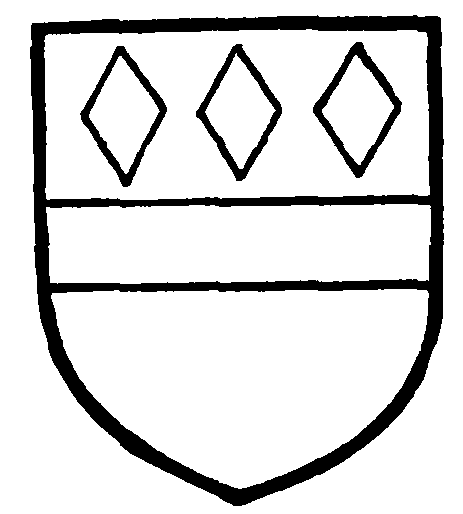
Aston. Argent a fesse and in the chief three lozenges sable.
Church
The parish church of ST. NICHOLAS consists of a chancel, nave, and west tower. It is a fine example of the middle of the 12th century, but has suffered alterations of a peculiar nature for which only conjectural reasons can be offered. It preserves most of the original chancel walls, a fine chancel arch, and a doorway now in the south wall and much restored. The only obvious addition is the 15th-century west tower; it was built almost wholly south of the original axis of the nave, into which its north-east angle intruded. For some unknown reason the original north wall was subsequently removed and the present north wall erected, perhaps in the late 16th century, some 5 or 6 ft. within the position of the old wall, encroaching directly on the north respond of the chancel arch. Possibly this reduction of the width of the nave from 24 ft. to 18 ft. was to provide a smaller span for the roof. The chancel lost its original vaulting and the nave, which probably had a range of upper windows, was reduced in height. The lower part of the south wall does not appear to have been much disturbed but the fine doorway is set in a greater thickness (17 in.) than the wall and it is probable that it was originally in a thick west wall (perhaps carrying a bell-cote) and was re-set here by the builder of the west tower.
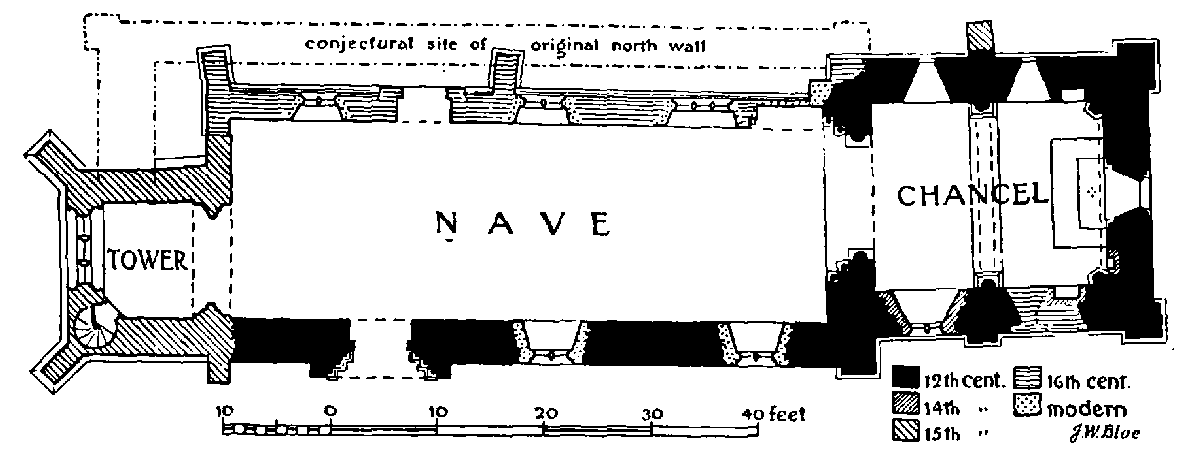
[Plan of Beaudesert church]
The church was restored in 1865, (fn. 55) when the chancel was again provided with vaulting, and the north respond of the arch was opened out again by recessing the nave-wall. Some recent repairs to the tower have been executed in artificial stone.
The chancel (about 22 ft. by 17 ft.) has a 12thcentury east window, 2 ft. 8 in. wide, with a round head; it is of two square orders externally with nookshafts with scalloped capitals and moulded bases: these carry the outer order of the arch, which has soffit zigzag ornament, and the hood-mould has pyramidal diaper ornament. Internally the reveals and arch are splayed and the window has an outer square order with nookshafts; the north shaft has its capital carved with primitive foliage, the southern is scalloped; the arch they carry has soffit zigzag ornament and an outer ring of diaper and a hood-mould with nail-head and diaper ornament.
The side walls are divided into two bays by vaulting shafts. Those on the east angles are semi-hexagonal and have scalloped capitals with bead enrichments and grooved or moulded and chamfered abaci. The intermediate shafts are half-round. The northern capital is carved with interlacing ornament and is flanked by scalloped corbel-capitals to carry the diagonal ribs. Those in the south wall are scalloped, with bead, cable, and other enrichments. The two west angles have capitals with variously treated scallop ornament and are carried on short lengths of shaft cut away to form corbels; each is decorated with a band of twisted ornament. The vaulting is modern. In each of the two bays of the north wall is a plain round-headed window, 17 in. wide. That in the east bay is west of central, and east of it is a locker of uncertain date with a modern door. In the south wall the western bay has a late13th-century window of two trefoiled lights with a quatrefoil above but no main arch. In the east bay, seen only outside, are the remains of a 12th-century window, now blocked: it appears to have been of two orders; the dressed stones of the outer order of the west jamb are left, with a piece of the sill and stones indicating capitals and part of one half-round ring of stones, probably the hood-mould. It appears to have been a smaller light than the east window, but with some resemblance to it and of the same height. It is set very close to the west edge of the bay, and east of its position is another square locker with rebates for a door. At the south end of the east wall is a small pointed recess with an edge-roll mould; it has no basin but was presumably a 13th-century piscina.
The east angles have clasping buttresses of ashlar, the northern partly repaired with cemented brickwork. In the south wall is an original intermediate shallow buttress, but that on the north side is replaced by a later and deeper medieval buttress. Below the silllevel of the windows is a double-chamfered stringcourse that passes round the shallow buttresses: only a little of it is left in the south wall. The north wall has a chamfered plinth: that of the south wall is almost all buried: the buttresses have rough footings. The masonry of the walls varies and indicates repairs of different periods.
The chancel arch has a semicircular head of four orders, the innermost bevelled, the second with soffit cheveron ornament, the third with facial and soffit cheveron ornament and pellets in lozenges at the angles, and the outermost with both facial and soffit cheveron ornament and an edge-roll. The hood-mould is plain. The responds are of three square orders towards the nave, the innermost having a middle half-round shaft and the other two with nook-shafts in courses, all with variously treated scalloped capitals, and moulded bases: the greater part of them has been restored. An unusual feature in an arch as late as this is that the inner order sets well back on the capitals of the innermost shafts. The abaci of the outer order are continued along the wall as a string-course; below it the masonry is old ashlar; above it, it is modern and in the gable-head are two windows to the space above the chancel-vault, differing in design, each of two trefoiled lights and a piercing in a two-centred head; probably late-13thcentury, reset.
The nave (56 ft. by 18½ ft.) has three north windows set high in the wall, the eastern of three trefoiled lights and the second of two, both with square heads, the third is of two cinquefoiled lights under a pointed head; all modern except the inner splays. Between the second and third is a re-set 12th-century doorway with a plain round head. At the east end is a modern recess to clear the chancel-arch. The wall is of coursed rough ashlar and has two string-courses, above each of which it is thinned outside a few inches: the lower is probably of the 12th century, re-used, and one piece of it has some diaper ornament: it is carried over the doorway as a hood-mould. The upper is a plain weather-course below the sills of the windows. The wall has three buttresses, the eastern flush with the north wall of the chancel.
In the south wall are two modern windows each of two trefoiled lights and tracery in a pointed head. The south doorway west of them is of the 12th century, but much restored. The round head is of five orders; the innermost is bevelled, the second has soffit cheveron ornament, the third and fourth have both soffit and facial cheveron ornament, the latter with foliage spandrels; the outermost is treated on both faces with a running lozengy pattern: there is no hood-mould. In the middle of the third order is reset a stone carved as a mask and in the fourth a human-head corbel, both as quasi-keyblocks. Each jamb has three restored nookshafts with moulded bases and scalloped capitals; only the two outermost capitals are ancient. The 13 ft. length of walling in which the doorway is set projects 17 in. from the main wall and is of modern red sandstone ashlar. The main wall is of approximately rectangular stones roughly coursed and wide-jointed. It has a high string-course, above which is about 2 ft. of thinner modern masonry up to the eaves. West of the doorway this thinner wall has the lower remains of a blocked window of two square orders, possibly of the 12th century.
The roof may be of the 16th or 17th century: it is of four bays divided by trusses with tiebeams, queen posts, strutted collar beams, and rough principal rafters; the purlins have straight wind-braces. The wall-plates are modern.
The west tower (about 10½ ft. by 8½ ft.) is built of ashlar of large grey local stone and is of three stages, the lowest a tall one. The string-course at the top of the lowest stage is omitted on the east wall, where there is some indication of a former higher flat roof to the nave, and above it modern repair where probably the original still higher gabled roof abutted it. The plinth, in two stages, is moulded and hollow-chamfered. At the west angles are diagonal buttresses of three stages up to the bell-chamber. At the east angles are square buttresses flush with the east wall, the northern showing inside the nave and meeting with a straight joint the piece of nave-wall north of it. The parapet is embattled. In the south-west angle is a stair-vice lighted by two south loops with crocketed hood-moulds, and entered by a doorway in the splayed angle, with a four-centred head.
The archway to the nave is tall and narrow, and of two orders; the inner is rounded and has a very wide fillet in the reveal and the outer has a shallow casement. Both are continued on the two-centred head but the inner has moulded capitals. The west window is of three cinquefoiled ogee-headed lights and vertical tracery in a two-centred head; below the transom the lights are cinquefoiled: the hood-mould has large headstops, crockets and a foliage finial, and is continued to the buttresses as a string-course. The jambs have a casement mould outside and splays inside. In the external south face of the lowest stage is an image-niche with a moulded and carved bracket and a ribbed canopy with a crocketed hood-mould and foliage finial. In the south and west sides of the short second stage are small trefoiled lights with similar crocketed hood-moulds. In the west half of the north wall is a patch of later masonry between two vertical seams, about 5½ ft. apart, to about the height of the nave-wall, probably marking where the west wall of the original nave met this wall. The part east of this patching has two courses of ashlar footings projecting about 1 ft. and, while the string-course and the crocketed window seen in the west and south faces are absent, there is a later rectangular hole above this part. Also in the angle of the east buttress with the wall is a corbel that may have helped to support the nave roof timbers. The bell-chamber has in each wall a window of two cinquefoiled lights and a quatrefoiled spandrel in a two-centred head; the hood-mould has carved stops, crockets and finials. The tiled roof is pyramidal and has a weather-vane.
The 15th-century font is octagonal; the bowl is moulded on the underside and has a vertical strip of repair let into the middle of the north side. East of the south doorway are the remains of a stoup. The chancel has a low screen: the north half has three bays of late14th- or early-15th-century date, each with a trefoiled ogee-head with soffit cusps, and tracery. Three of the benches in the nave, and one in the tower, are of the 16th century with shaped standards.
There are three bells, the treble inscribed ave maria gratia pelan and the second ihesvs nazsarinvs rex ivdeorvm, both in Lombardic capitals; they date from about 1350. The third is dated 1711, by Joseph Smith of Edgbaston. (fn. 56)
The plate includes an Elizabethan cup with a fringed stem and band of engraved ornament, and a cover paten; neither has a hall-mark.
The register of baptisms begins in 1661, of marriages in 1664, and of burials in 1662. (fn. 57)
The church was valued at 40s. in 1340 and the living at £7 16s. in 1535. (fn. 59)
Advowson
The advowson accompanied the manor until the death of Ambrose Dudley in 1590. (fn. 60) Although alleged to be conveyed by Sir Edward Aston with his portion of the manor in 1594 to Francis Smith of Wootton, (fn. 61) it clearly remained with the Crown, (fn. 62) and was in the gift of the Lord Chancellor when the livings of Beaudesert and Henley were united in 1915. At that date Whitley was taken from Wootton Wawen and Impsley and James's Farms from Ullenhall to be added to the new ecclesiastical parish of Beaudesert-cum-Henley-inArden. It passed out of the gift of the Lord Chancellor on 11 March 1915 into the joint patronage of the Bishop of Coventry and the High Bailiff of Henley (fn. 63) with whom it still remains.
John Doughty, M.A., who became rector in 1636 was a noted High Churchman. He was ejected by the Parliament but was afterwards made a Canon of Westminster and was buried in Westminster Abbey in 1672.
Charities
Mary Weale (1680), Ann Cowper (1685), and Joseph Morteboys (1727) made bequests of £15, £5, and £10 respectively, to the poor of the parish. These sums are now represented by a rent-charge of 30s. issuing out of Crockett's Farm, Beaudesert.
Elizabeth Reeve, by will dated 7 December 1770, bequeathed 16s. a year to the poor of Beaudesert. The 16s. was regularly paid by Richard Reeve together with £1 of his own. Upon his decease, by his will proved in 1811, he gave £50, which was to include the gift of Elizabeth Reeve, to the poor of the parish. The endowment produces £1 4s. 8d. annually in dividends.
Gibbs's Charity. The endowment of this charity consists of a rent-charge of £1 5s. charged upon property in Birmingham, purchased from the proceeds of the sale of two cottages. (fn. 64)
The income of the above-mentioned charities is distributed by the vicar and churchwardens to the poor inhabitants in money.