A History of the County of Warwick: Volume 3, Barlichway Hundred. Originally published by Victoria County History, London, 1945.
This free content was digitised by double rekeying. All rights reserved.
'Parishes: Honiley', in A History of the County of Warwick: Volume 3, Barlichway Hundred, ed. Philip Styles (London, 1945), British History Online https://www.british-history.ac.uk/vch/warks/vol3/pp120-123 [accessed 30 April 2025].
'Parishes: Honiley', in A History of the County of Warwick: Volume 3, Barlichway Hundred. Edited by Philip Styles (London, 1945), British History Online, accessed April 30, 2025, https://www.british-history.ac.uk/vch/warks/vol3/pp120-123.
"Parishes: Honiley". A History of the County of Warwick: Volume 3, Barlichway Hundred. Ed. Philip Styles (London, 1945), British History Online. Web. 30 April 2025. https://www.british-history.ac.uk/vch/warks/vol3/pp120-123.
In this section
HONILEY
Acreage: 655½
Population: 1911, 43; 1921, 80; 1931, 68.
Honiley is a small parish of irregular shape, between Kenilworth and Wroxall. The north-eastern boundary dividing it from Kenilworth is formed by a stream, probably to be identified with Merbroc which is mentioned in a deed of 1208 as a boundary of Honiley near the park of Kenilworth. (fn. 1) A branch road from the Birmingham and Warwick high road passes through the north-western corner of the parish and near to Church Farm, a 17th-century building, and Moat Farm; (fn. 2) the latter is actually in Haseley parish, but there are remains of a moat east of Heath Farm, a late18th-century house north-west of the church, and slight traces of another moat are marked on the 6-in. O.S. map just north of the church.
In 1086 Honiley was well wooded, the 'hay' being half a league long by as much broad. (fn. 3) The land which Henry de Bereford reserved for himself in 1208 was largely woodland. (fn. 4) The two woods Shortwood and Nuthurst are named. There is said to have been a park called Mountfort's Park in the extreme east of the parish, lying between Turtle Hill and Fern Hill in Kenilworth parish. (fn. 5) There are still some copses in the parish, the largest being Featherston Grove and Wakefield Wood.
The fact that Honiley manor lay partly in the parishes of Haseley and Hatton gave rise in the late 16th century to much controversy concerning payment of tithes (fn. 6) from William Richards Coppice, Dowrie Grove, and three fields called Greenfields or William Richards fields. John Hill, the farmer of Honiley manor and rectory, claimed the tithes as his, and brought many witnesses to testify that the fields were in Honiley. The Throckmortons, farmers of Hatton rectory, claimed that the closes were in Beausale in the parish of Hatton, and that the tithes had belonged in former times to the nuns of Wroxall in right of their parsonage of Hatton, and they found many witnesses to testify to this. Hercules Morrell, minister of Hatton, said that he had seen an ancient writing of 'Earl Beacham's' time purporting that the ground in controversy was in Hatton, as part of Beausale, and that the inhabitants of Beausale had always encompassed it in their perambulations. Witnesses were questioned about the course of the perambulations of the two parishes, and it was shown that the Gospel Oak where the curate of Honiley read the Gospel at the perambulation in Rogation Week stood in William Richards Coppice. Another reading was made at a gate of one of the fields at the heath-side, and this was followed by a 'drinking' made by 'old Thomas Bearge' for the men of Honiley. John Steakes, who leased these fields about 1570, cut down the Gospel Oak, (fn. 7) and the perambulations seem to have been discontinued about 1550. Several of the witnesses affirmed that Wroxall parish stretched between Hatton and Honiley.
Old Honiley Hall was a large house, probably built by Roger Burgoyne (1625–36), consisting of a long central range facing south, with five gabled bays, those at the ends projecting southwards, with narrow wings at each end, probably later additions, set at right angles to the main block. (fn. 8) It was pulled down about 1820, and the present Hall was built on a new site in 1914.
Manor
Before the Conquest HONILEY was held by Alwold, a free man. In 1086 it belonged to the Count of Meulan, (fn. 9) and it passed with his other Warwickshire estates to Henry, Earl of Warwick, and his descendants, who were still overlords in 1386. (fn. 10)
Part of the manor was given by Waleran, Earl of Warwick (1184–1204), to Ralph de Grafton, who obtained other land at Honiley from Hugh Fitz William of Hatton. (fn. 11) Ralph died about 1204 and his lands became the subject of a dispute between Ralph Boteler and Henry de Bereford. (fn. 12) Henry proved his claim to be heir of Ralph de Grafton, (fn. 13) and undertook that when the land had been delivered to him he would give Petronella widow of Ralph onethird of the land and a reasonable share of Ralph's goods. (fn. 14) In 1207 Petronella was disputing the ownership of land in Honiley with Margaret de Grafton, Ralph's sister. (fn. 15) Petronella by a former husband Geoffrey Pecche (fn. 16) had a son Richard Pecche, who on his marriage with Hawise daughter of William de Arderne acquired land in Honiley from his father-in-law. (fn. 17) In 1208 Henry de Bereford granted to Richard Pecche half the lands of Ralph de Grafton and the reversion of the other half after his own death, and at the same time Petronella released to Henry all her demands upon the chattells of Ralph de Grafton. Richard undertook to keep in repair the fence between his land and that of the Earl of Warwick and of Hugh Fitz William. (fn. 18) Margaret sister of Ralph de Grafton quitclaimed to Richard Pecche all her rights in this land, and Margaret's daughter Felice confirmed this. (fn. 19) After Richard's death his widow Hawise granted certain land at Honiley to Richard de Gimescote, who had married her daughter Petronella. (fn. 20) The manor passed to Richard's son John, whose son (fn. 21) Sir John Pecche granted it in 1318–19 to his younger son Nicholas for his life. (fn. 22) Sir John confirmed this gift to Nicholas in 1334. (fn. 23) Nicholas was collector of a fifteenth in co. Warwick in 1348, (fn. 24) and presented to the church of Honiley in 1354. (fn. 25) On his death before 1366 (fn. 26) the manor passed to his nephew Sir John Pecche, (fn. 27) who died seised of it in 1376, leaving a son John aged 15. (fn. 28) John died ten years later, and his two infant daughters Joan and Margaret were his heirs. (fn. 29) Katherine, mother of the two children, married Sir Kinard de la Bere, and he and Katherine presented to the church on three occasions between 1396 and 1410. (fn. 30) In 1411 Honiley was settled on Katherine for her life, with remainder to her daughter Margaret and her husband Sir William de Mountfort of Coleshill. (fn. 31) Sir William survived Margaret and died about 1452, (fn. 32) when his son Sir Baldwin succeeded. Sir Simon son of Baldwin was indicted of treason in 1465, but was pardoned in the following year, (fn. 33) and in 1480 Honiley manor was settled on him and his wife Emily. (fn. 34) Sir Simon was attainted for rebellion in 1495, (fn. 35) and the manor passed to the Crown.
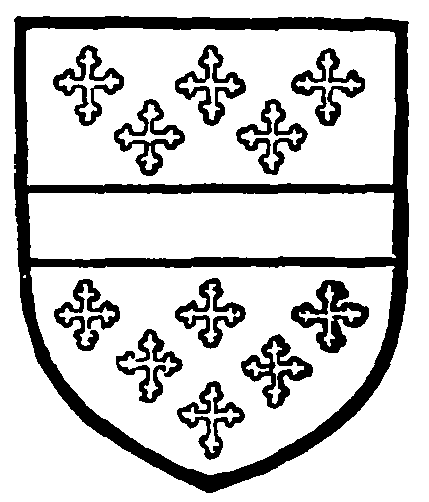
Pecche. Gules crusilly and a fesse argent.
It was granted in 1496 to Gerald, Earl of Kildare, and to Elizabeth his second wife, with other lands which had belonged to Sir Simon de Mountfort. A similar grant was made in 1503, (fn. 36) but both were found to be invalid and they were surrendered in exchange for a new grant by Henry VIII in November 1510. (fn. 37) Elizabeth survived her husband and died seised of the manor in 1516. Her eldest son Henry died, a minor, a few days after his mother, and the manor passed to her second son Thomas, (fn. 38) who in 1529 settled it upon his wife Margaret. (fn. 39) Thomas died in 1531 and his brother James, afterwards Sir James, succeeded. (fn. 40) He took part with his nephew Thomas, Lord Fitzgerald, Earl of Kildare, in 1534 in the Geraldine Rebellion and was executed with four of his brothers at Tyburn on 3 February 1537; (fn. 41) so once more the manor passed to the Crown. It was leased for 21 years in 1541 to George Hawe, (fn. 42) and in 1548 was granted in exchange for other lands to Sir Thomas Palmer the younger. (fn. 43) He leased the manor for 41 years in 1553 to William Hill, (fn. 44) but Palmer was attainted in 1553 for his adherence to the Duke of Northumberland, (fn. 45) and the manor reverted to the Crown. It was granted by Queen Mary in 1554 to Michael Throckmorton (fn. 46) and was among his possessions when he died at Mantua in 1558. (fn. 47) His son Francis sold it in 1580 to Robert, Earl of Leicester. (fn. 48) The sons of William Hill, who were then in possession of the lease, attempted to prove that Francis Throckmorton had never entered into the manor or received any rents from it. (fn. 49) The testimony of witnesses was unreliable, as they feared to offend either of the parties, and the matter seems to have been settled after the death of the Earl of Leicester by an assignment by his widow Lettice, then wife of Sir Christopher Blount, of all her interest in the manor to Thomas Hill, one of the brothers. (fn. 50) John Hill sold the manor in 1624/5 to Roger Burgoyne, (fn. 51) who died at Honiley in 1636, when his son John succeeded. (fn. 52) John was created a baronet in July 1641 and died in 1657. (fn. 53) Honiley manor passed to John Burgoyne, (fn. 54) who with his wife Penelope sold it in 1685 to John Baker (fn. 55) in trust for Francis, Lord Carrington, and this manor formed part of the settlement which he made on his second wife Anne daughter of William, Marquess of Powis, in 1687. (fn. 56) Lord Carrington was succeeded in 1701 by his brother Charles, who conveyed the manor to William Hungate and others in trust to sell. (fn. 57) Hungate sold it in 1707 to John Sanders. (fn. 58) The Sanders family remained in possession until about 1779, (fn. 59) when John Tibbits succeeded John Sanders, and took the name Sanders. (fn. 60) He was patron of Honiley in 1783, but before 1814 the advowson, and presumably the manor also, had passed to the Rev. John D'Ewes, who had in 1785 assumed the name of Granville. (fn. 61) John died in 1827 and his nephew Court Dewes of Colwich Abbey, co. Staffs., on succeeding to his uncle's estates took the name Granville. (fn. 62) He sold Honiley manor to Edward Willes of Newbold Comyn in 1836. (fn. 63) Edward died in 1847 and his widow Mrs. Emily Willes was lady of the manor in 1850. (fn. 64) Her son William succeeded and died in 1885, and the manor was held by his widow, from whose trustees it was purchased in September 1913 by the late Herbert Louis Wade, J.P. In March 1932 he conveyed the estate to his son Captain M. C. Wade, M.C., J.P., the present owner. (fn. 65)

Sanders. Party cheveronwise sable and argent with three elephants' heads razed and counterchanged.
Church
The parish church of ST. JOHN THE BAPTIST was built in 1723. The inscription on the west tower reads: ad gloriam dei iohannes sanders: arm: propriis sumptibus hanc ecclesiam aedificavit anno salutis: mdccxxiii.
The church is built of Arden sandstone and has a nave 38 ft. by 20 ft. with a half-round apse for the chancel, and a west tower. The walls, of ashlar, have pilasters at the angles and on the north and south sides, with moulded caps and entablatures below the main moulded cornices, which break forward over them. The roofs have low parapets. The windows are roundheaded and have imposts and key-blocks. The middle of the three to the apse is taller than the other two, and the key-block inside is carved with cherubs. The nave has four windows each side. The westernmost bay has a lower window than the others and a bull's-eye window above to light the gallery.
The west tower (about 8½ ft. square) has anglepilasters to the lowest story and an entablature, level with that of the nave, containing the inscription and date. The west doorway (fn. 66) is round-headed and has a pair of doors with fielded panels; above it is a bull'seye window to the gallery. The tower projects into the nave, so that the inner moulded and square-headed doorway has very deep internal splays. The second story, which also has a moulded cornice, is lighted by round-headed windows, the lower halves walled up. The third stage is much narrower and has carved consoles at the angles with pilasters above them, over which the moulded cornice breaks forward. On these are pinnacles of obelisk form. The stage is lighted by circular windows. Above is an octagonal stone spire with a ball and weathercock at the apex.
The apse inside has four marble wall-pilasters with moulded bases on pedestals and Corinthian capitals about 2 ft. below the ceiling. The ceilings, level throughout, are of plaster and have moulded and bracketed cornices. The west gallery is supported by two fluted marble Corinthian columns carrying an entablature of oak with a dentilled cornice. The gallery front has pilasters above the columns and fielded panels between them: the cornice is moulded. The stair up to the gallery is probably original; it has a plain panelled balustrade.
A chest with fielded panels serves as the communion table. There are two chairs with elbows, one of the 17th century and the other later. The communion rails have very heavy turned balusters and moulded top and bottom rails. The apse is paved in black and white marble. The oak pulpit has four sides of a hexagon with fielded panels: the base is modern. The pews, 4 ft. high, have standards and hinged doors, &c., of fielded panels. In the front desks are eight carved friezepanels. The four northern have pierced designs of conventional foliage. Three of the four southern, also pierced, are carved with monograms I.S. and foliage, the other has a crest of an elephant's head (for Sanders) and palm leaves. The gallery has original benches with shaped standards.
The stone font is modern, but in the deep north splay of the inner west doorway is a coved half-round niche fitted with a partly projecting marble basin. It has no drain but was probably intended to serve as a font.
There are five bells of 1731 by Thomas Eayre of Kettering. (fn. 67)
The registers begin in 1745.
Advowson
The advowson of the church of Honiley was given to Richard Pecche by William Arderne. (fn. 68) Sir John Pecche of Hampton-in-Arderne gave it in 1318 to his son Nicholas, (fn. 69) and it descended with the manor. (fn. 70) It was not specifically granted with the manor to the Earl of Kildare, but Edward, Thomas, and Francis Hill, tenants of the manor, presented in 1574, (fn. 71) and about 1650, when Luke Milbourne was perpetual curate here, the patronage appears to have been in the hands of the Burgoynes. (fn. 72) The advowson is not mentioned in conveyances of the manor until 1707. It was then sold with the manor by William Hungate to John Sanders. (fn. 73) From that time it has passed with the manor.
The benefice was very poorly endowed; in 1535 its value was only 33s. 4d., so that no incumbent could be maintained, and the parishioners subscribed to hire a friar to hold services. (fn. 74) Later in that century the salary of the curate appears to have been raised by a rate upon the parishioners proportionate to their rents (fn. 75) and in 1586 amounted to £5. (fn. 76)
Dr. Thomas in his edition of Dugdale (1730) inserted a long extract from an alleged court roll of 18 Henry VIII. (fn. 77) According to this the church was founded by Simon de Montfort, Earl of Leicester. It also asserted that Honiley was an exempt peculiar, and that St. John's Well (marked on the 6-in. O.S. map just north of the church) was a place of pilgrimage, 'St. John's bath' and 'our Lady's bath' being used respectively for the cleansing of male and female incontinent penitents. There is no supporting evidence of any peculiar jurisdiction here, or of any connexion of Earl Simon with the manor, but the pilgrimage story may embody a genuine tradition.