A History of the County of Warwick: Volume 3, Barlichway Hundred. Originally published by Victoria County History, London, 1945.
This free content was digitised by double rekeying. All rights reserved.
'Parishes: Kinwarton', in A History of the County of Warwick: Volume 3, Barlichway Hundred, ed. Philip Styles (London, 1945), British History Online https://www.british-history.ac.uk/vch/warks/vol3/pp126-129 [accessed 1 May 2025].
'Parishes: Kinwarton', in A History of the County of Warwick: Volume 3, Barlichway Hundred. Edited by Philip Styles (London, 1945), British History Online, accessed May 1, 2025, https://www.british-history.ac.uk/vch/warks/vol3/pp126-129.
"Parishes: Kinwarton". A History of the County of Warwick: Volume 3, Barlichway Hundred. Ed. Philip Styles (London, 1945), British History Online. Web. 1 May 2025. https://www.british-history.ac.uk/vch/warks/vol3/pp126-129.
In this section
KINWARTON
Acreage: 471.
Population: 1911, 55; 1921, 52; 1931, 39.
Kinwarton is a small parish lying about a mile northeast of Alcester and bounded on the south and east by the River Alne. The ground is mostly low-lying, with a maximum altitude of 206 ft. and some of the fields near the river are liable to floods.
The road from Alcester to Henley-in-Arden runs through the middle of the parish. A branch road leads off to the church and rectory about a quarter of a mile to the south and thence continues as a field-path down to a ford across the Arrow below Hoo Mill. From the north side of the main road a by-road branches off to Coughton. This seems to have been only a bridle-path in 1664 and 1763, (fn. 1) and an estate map of 1752 (fn. 2) marks as the usual road to Coughton another to the south-west of it, afterwards inclosed in the grounds of Kinwarton House.
There is no main village, (fn. 3) apart from the church, the Rectory, which is a large red brick building of three stories and built in about 1788, (fn. 4) and Glebe Farm, which stand close together near the river-bank. Glebe Farm is of mid-17th-century square timber-framing, with tiled roofs. The plan is of T-shape, the ends of the wings being gabled. A barn and other farm-buildings west of the house are also timber-framed. A small cottage to the north-west, with plastered outer walls and a thatched roof may also be of the 17th century. In the glebe land north of the church is a round dovecot, built of rubble of thin stones with some plaster rendering. It dates from the 14th century, and may in fact be the dovecot which Robert Green granted to William de Boys, Abbot of Evesham (1345–67). It has a doorway with an ogee-arch in one stone. The conical roof is tiled and has a louvred lantern, probably of the 17th century. It is about 24 ft. in diameter and the wall is about 3½ ft. thick with the stone nests, of which there are about 600. The pivoting central post with the gantry and ladder for access to the nests, remains in good condition. (fn. 5)
Near by was the site of the Manor House, to which the dovecot belonged, a small inclosure surrounded by a moat. In the 17th and early 18th centuries it was occupied by the Hopkins family, being described as the Manor House in 1624 (fn. 6) and 1663, (fn. 7) and in 1722 as the Great Farm. (fn. 8) In the Hearth Tax returns, 1662–74, it is rated at 6 hearths. It was pulled down before 1752, when the map marks only its site.
The parish was inclosed by an Act of 1803. (fn. 9) The Customs of 1722 refer to several recent inclosures and state that they were then still liable to be common with the adjoining fields. The map of 1752 shows that most of the parish was still cultivated on the strip system, with some inclosures near the village. From a deed of 1616 it appears that the yard-land here was then about 25 acres. (fn. 10)
Manor
Land in Kinwarton was given to Evesham Abbey by Cenred King of Mercia in 708. (fn. 11) At the Domesday Survey the abbey owned 3 hides there which were held by Ralph, (fn. 12) most probably the brother of the reigning abbot Walter. (fn. 13) These lands were probably held by military service, for it is recorded that Abbot Reynold (1122–49) 'removed the houses of the knights of Kinwarton and Coughton and others from the place where the garden of the monastery and the croft of St. Kenelm now are, with which the abbey was, as it were, besieged'. (fn. 14) Ralph of Kinwarton held 3 hides of the abbey in 1166 by service of finding one fully-armed knight to serve the king, his expenses being paid by his overlord. (fn. 15) In 1199 Ralph recognized the right of Joan wife of Richard de Brusle to certain lands in Kinwarton which had been settled on her in dower by his son Robert, (fn. 16) but in 1214 these lands were again in dispute between Joan de Brusle and Ralph's son Alexander. (fn. 17) In 1251 Robert de Bruily sued the Abbot of Evesham for these lands, (fn. 18) but in 1282 the abbot recovered them, (fn. 19) and in 1290 he successfully claimed view of frank-pledge in Kinwarton. (fn. 20) About this time Ralph de Hengham was the tenant of the manor, doing military service with the king on behalf of the abbot. (fn. 21)
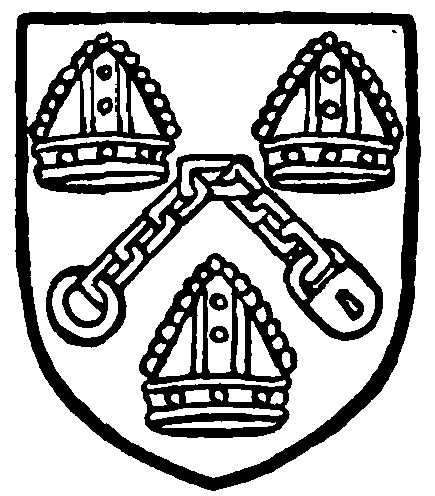
Evesham Abbey. Azure a chain with its padlock set cheveronwise between three mitres argent.
In 1327 the abbey regained possession of some land and rent in Kinwarton which had been let to Walter de Beauchamp, (fn. 22) and the abbey's chronicler notes appreciatively that Abbot Boys (1345–67) acquired from Robert Green, 5 houses, 2 fishponds, a dovecot and 4½ virgates of land in Kinwarton, the net value of which was 53s. 4d. (fn. 23)
In 1535 the manor was valued at £8 8s. 3d., of which £3 19s. 6d. was accounted for by the demesne. A pension of 18d. a year was payable out of the profits of the manor to St. Mary's College, Warwick. (fn. 24)
After the Dissolution the manor of Kinwarton was granted in June 1540 to Anthony Skinner of London and Jane his wife. (fn. 25) Anthony, who was the son of Robert Skinner of Shelfield, (fn. 26) died on 19 November 1558, succeeded by his son George, then aged 48 years. (fn. 27) He died in June 1595 and the manor passed to his brother William (fn. 28) who settled it on his son Anthony in November 1596. William died in 1602 and his son twenty years later, when the manor descended to his grandson William, (fn. 29) who sold it for £2,500 to Fulke Greville, first Lord Brooke, in 1624. (fn. 30) It remained in that family for several generations, George, Earl Brooke and Earl of Warwick, levying a fine there in 1804. (fn. 31) Thomas Brown was lord of the manor in 1850, (fn. 32) as was John Brown in 1872. At some time between 1876 and 1880 John was succeeded by Captain F. Gerard and he, between 1921 and 1924, by Mrs. E. C. Riddell, the present lady of the manor. (fn. 33)
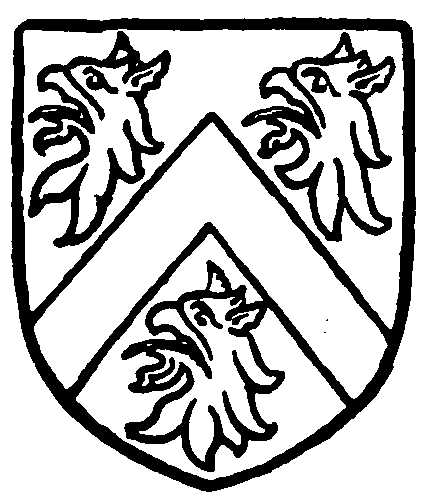
Skinner. Sable a cheveron or between three griffons' heads razed argent.
The manor court appears to have fallen into disuse by the early 18th century, since in 1722 the customs of the parish were declared by a parish meeting held in the church and are recorded in the earliest volume of the Registers. They refer mainly to common rights and there is also mention of the duty of keeping a bull for the use of the parish which devolved upon the tenant of the Great Farm.
Church
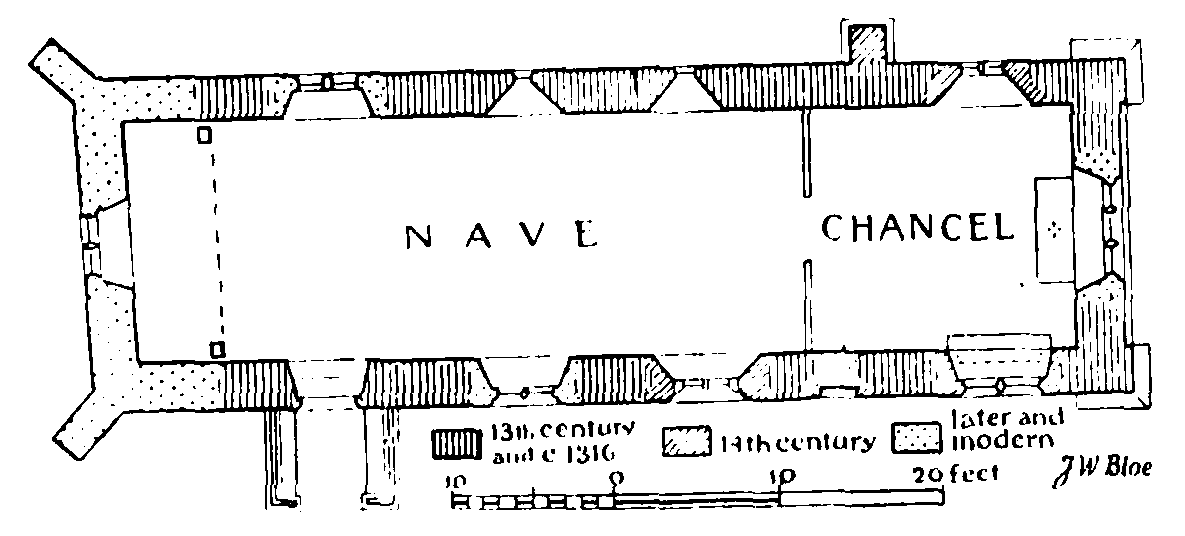
The parish church of ST. MARY THE VIRGIN is a rectangular building about 57 ft. long by 14½ ft. wide with no structural division between chancel and nave. The chancelscreen is about 16 ft. from the east wall. Dugdale states that Walter de Maydston, Bishop of Worcester, on xv cal. July 1316 did consecrate and dedicate both it (the church) and the high altar. The church was probably largely rebuilt at this date, but some of the walling, especially at the east angles, appears to be of much earlier origin.
In modern times the upper part of the east wall has been rebuilt, new windows inserted and the west end lengthened about 5 ft., or rebuilt.
The east window of three lights and tracery is modern: below the sill outside are two modern courses of weathering: below this the wall is 4 or 5 in. thicker than above and is of ancient and very rough rubble work. The thinner wall above is mostly of modern lias rubble. At the angles are low clasping buttresses with tabling or offsets of three courses at about midheight on the east and outer side-face of each; the lower parts have some unusually large stones of a rough coarse limestone, possibly of the 12th century. In the north wall are four windows. The easternmost is of two plain square-headed lights: the head, of lias stone, is probably of the 16th or 17th century, but the jambs, of a yellow stone, and the wide internal splays, of the early 14th century. The second window, to the nave, is a 13th-century lancet with rebated and chamfered jambs and head of a sandy limestone, wide plastered splays and chamfered segmental rear-arch. The third is a later trefoiled lancet, perhaps of 1316, with very obtuse internal splays and a segmental-pointed reararch. The fourth window is a modern one of two lights displacing a former doorway of which two chamfered jamb-stones remain at the base of the wall. The wall is of ancient rough rubble and just west of the 13thcentury lancet is a rough seam: it has no dressed angle stones but at the foot appear to be some re-used stones with 12th-century tooling. About 5 to 7 ft. from the west end is a sloping crack in the masonry and probably beyond that the wall has been rebuilt in some later period. The wall leans outward, especially at the 13th-century lancet.
[Plan of Kinwarton church]
Of the three windows in the south wall the easternmost is of two trefoiled ogee-headed lights and a quatrefoil in a two-centred head of yellow Cotswold stone: the jambs and mullion are chamfered outside and, with the trefoiled heads, are rebated inside, and the splays are acute instead of wide as in the other windows: the rear-arch is chamfered on two edges. The window appears to be some 20 years later than the 1316 period and its recess contains a pair of canopied sedilia, presumably of that date, having a middle shaft and edge-rolls on the jambs, all with moulded capitals and bases, carrying stilted and segmentalpointed arches with hood-moulds: the recess is only 8 in. deep and the stone seat projects, without a riser for support. The second window is a rare example of an ancient oak-framed window of two cinquefoiled pointed lights and a foiled spandrel in a two-centred head. The woodwork is very weather-worn outside and may best be considered as a 16th-century replacement in wood of an early-14th-century stone window; the outer chamfered jamb-stones are also ancient: the sill is modern. The internal splays are very obtuse. Between the two windows is a small priests' doorway now blocked; it has chamfered jambs and pointed head with a flat keystone, perhaps reset. The old oak door is still in place and has three panels formed by applied ribs. The third window is a modern one of two trefoiled lights and a quatrefoil in a two-centred head.
The south doorway, farther west, has chamfered jambs and two-centred head; it is probably of the 1316 period. The wall is of rough rubble-work in the lower part of the chancel but the upper part is largely of coursed square stones, probably of 1316. There are slight traces of a seam west of the second window and practically opposite to that in the north wall: west of this the masonry is of rather larger but irregular stones: it leans outward much as the north wall. The westernmost 7 ft. has been rebuilt, as on the north side. The west wall is modern but has many re-used ancient stones; the west window of two lights and a cinquefoiled circle is also modern. At the angles are diagonal buttresses. The top of the wall is a half-gable. Above is a wooden bell-turret with a shingled pyramidal roof. The chancel has a modern roof of three bays with wind-braced side purlins. The junction with the nave roof comes approximately at the seams in the side walls. The nave roof has a slightly higher ridge and is probably of the 15th century: it is of trussed-rafter type, each having curved braces that form a pointed arched wagon-head vault. In the middle is a moulded tie-beam, probably of the 16th century. At the junction of the two roofs is a 15th-century rood-beam, moulded on the west face; in the middle is a notch, now filled in, perhaps for the former rood, and in the soffit are six mortices for former studs or posts below it.
The framing inside for the bell-turret is partly of the 16th or 17th century, reinforced with modern framing.
The south porch, of weather-boarded framing on low stone walls, is modern. The south doorway has an ancient door with five panels formed by applied ribs, and with lattice framing at the back: it is hung with plain strap hinges and has an ornamental ringhandle.
The font has a cup-shaped bowl with a projecting half-round mould round the rim; it is of yellow stone and has been retooled below the rim-mould, but may date from 1316. The cylindrical stem and square base of white stone seem to be later. The staples remain in the top of the font and it has a flat circular lid of three boards with two moulded cross-battens, and this is held in place by a 2 ft. 5 in. iron rod that passes through the staples and has a loop-handle and a smaller loop at the other end to receive a padlock. It is probably of the 16th century and is a remarkable survival of a pre-Reformation usage. In the quatrefoil of the south window of the chancel is a 14th-century glass representation of the Virgin, crowned and nimbed, carrying the Child on her left arm and holding a lily in her right hand. She wears a bordered white robe and a golden-brown mantle. Below her is a yellowwinged and green-tailed monster. She stands in a niche that has a trefoiled segmental arch and crocketed gable, between a pair of enriched posts with crocketed finials: the background in the niche is chiefly of flowered blue and has four golden fleurs-de-lis about the figure; the filling in the top foil about the gable head is ruby glass and has two cinquefoil flowers. In each of the two side-foils—flanking the niche—is a kneeling figure of a bearded man with long hair and having a nimbus; he wears slate-blue tinted armour with a yellow baldrick; the field about him is in white and yellow with foliage and flower designs in line. In the bottom foil, below the niche, is the inscription, in Lombardic capitals: WILLI : ATTE: YE: WODE: ET: LETICIE; UXORIS SUE: QUI: FECRUT: ISTA: FEN. (fn. 34) Below it is a ruby band and a pale green quatrefoil flower. The lower lights of this window and also the wood-framed second window contain a fairly large number of ancient quarries in plain white or greenish-white glass.
Set on the north wall of the nave is an alabaster carving, 12¼ in. high by 12½ in. wide, representing the Presentation of the Virgin, with Joachim and Anna. She is shown standing on a stair, behind which is a bishop, and, in the spandrel of the stair, a censing angel; behind the parents are five women. The tablet, part of the bottom of which has been cut away, was found in 1836 in a carpenter's shop at Binton by the Rev. W. S. Rufford, the rector: it was presented to this church in 1933 in memory of him and his father, the Rev. Francis Rufford, rector of Kinwarton. (fn. 35)
In the nave is an 18th-century brass candelabrum with a globe and moulded stem and three tiers of scrolled arms, eighteen altogether.
There is a bell of 1716 by Richard Sanders of Bromsgrove.
The communion plate includes an Elizabethan cup 5½ in. high with the usual band of engraved ornament, and a knop in the stem: it has the London hall-mark for 1571: the cover paten is inscribed with the same date. There are also a small paten of 1651 and a flagon of 1735, both given by F.E. and S.C. in 1735.
Standing in the churchyard, forming part of a modern funeral monument, is a fragment of a late11th-century cross-shaft, 3 ft. 1½ in. tall, 1 ft. 8 in. wide, and 1 ft. 3½ in. thick: it is carved on three faces with interlacing knot ornament now almost weathered away: the fourth face is rough. A modern cross has been placed on top of it.
The register of baptisms begins in 1566, of marriages in 1571, and of burials in 1596. The first volume of the registers, which goes down to 1722 (with a few isolated entries for 1743–5), is now in the custody of the Clerk of the Peace at the Shire Hall, Warwick.
Advowson
The advowson of the church, to which the chapels of Alne and Weethley (q.v.) were annexed, was held by Ralph of Kinwarton and given by him, with the consent of his son Alexander, to the Abbey of Evesham, probably towards the close of the 12th century. (fn. 36) In 1248 the patronage was transferred to the Bishop of Worcester, on the final settlement of a long-standing dispute between the bishops and the abbey concerning rights in the churches of the vale of Evesham. (fn. 37)
The bishops continued as patrons until the present century, but at some time between 1916 and 1921 (fn. 38) the advowson was transferred, with that of Great Alne, to its present holder, the Bishop of Coventry.
The chapelry of Weethley was separated from Kinwarton and annexed to Alcester in 1876. (fn. 39)
The church was valued in 1291 at £16, with the chapel (fn. 40) (i.e. of Great Alne), in 1341 at £12, (fn. 41) and at £17 10s. 11d. in 1535. (fn. 42)
In the 17th century the repair of the church was provided for by the rent of a pasture known as the Church Hookes, which was let by the rector and churchwardens at £6 yearly in 1657 and 1663 and at £9 5s. in 1685. (fn. 43)
Charities
Isaac Dipple by will of 3 March 1729, gave £10 to the poor of Kinwarton. The charity is administered by the rector and churchwardens and the income from this and another £10, of which the origin is unknown, amounting to 16s. 8d., is distributed to the poor of the parish.
Mary Purton by will proved 5 April 1933 gave to the rector and churchwardens £300, the income, which now amounts to £9 11s., to be applied in the repair and upkeep of the fabric of Kinwarton Church.