A History of the County of Warwick: Volume 3, Barlichway Hundred. Originally published by Victoria County History, London, 1945.
This free content was digitised by double rekeying. All rights reserved.
'Parishes: Salford Priors', in A History of the County of Warwick: Volume 3, Barlichway Hundred, ed. Philip Styles (London, 1945), British History Online https://www.british-history.ac.uk/vch/warks/vol3/pp155-165 [accessed 1 May 2025].
'Parishes: Salford Priors', in A History of the County of Warwick: Volume 3, Barlichway Hundred. Edited by Philip Styles (London, 1945), British History Online, accessed May 1, 2025, https://www.british-history.ac.uk/vch/warks/vol3/pp155-165.
"Parishes: Salford Priors". A History of the County of Warwick: Volume 3, Barlichway Hundred. Ed. Philip Styles (London, 1945), British History Online. Web. 1 May 2025. https://www.british-history.ac.uk/vch/warks/vol3/pp155-165.
In this section
SALFORD PRIORS
Acreage: 4,769.
Population: 1911, 823; 1921, 1,052; 1931, 828.
Salford Priors is a large parish at the south-western extremity of the county. It is divided from Bidford, on the east, by the River Arrow, which joins the Avon about a quarter of a mile below Salford Church. The present junction, however, is said to be formed by an artificial cut, (fn. 1) and a few yards above it a brook, known as the Old Arrow, branches westwards, describing a rough semicircle and flowing into the Avon at Cleeve Mill. The Old Arrow forms both the parish boundary and the county boundary with Worcestershire, and the island between it and the Avon, known as Worcester Meadows, is in Cleeve Prior parish. Salford is divided from Worcestershire on the south-east, below Cleeve Mill, by the Avon, and on the west by a tributary which is called Smalemeresuche in the cartulary of Evesham Abbey, where it is mentioned as the boundary between Abbots Salford and Harvington. (fn. 2)
The land slopes gradually down towards the river, the altitude varying from 341 ft. at Rough Hill in the eastern extremity of the parish to 95 ft. at Salford Bridge. The low-lying ground by the Avon and Arrow was formerly very marshy, and such field-names as Broad Marsh, Britain's Marsh, and Durham's Marsh occur frequently in 17th-and 18th-century deeds. On the south side of the church, facing towards the ford at Cleeve Mill (the Heneford of the Evesham cartulary) (fn. 3) is a turret which may have carried a beacon for the guidance of travellers. The whole area was drained during the early 19th century. (fn. 4)
The parish includes, besides the main village, the hamlets of Abbots Salford, Wood Bevington, Cock Bevington, and Dunnington, and several scattered farms, such as Pitchill, Mudwalls, and Rushford. Pitchill, where there once seem to have been a number of houses, now demolished, was alternatively known in the 17th and 18th centuries as Woodchurch, (fn. 5) a name probably given it by Sir Simon Clarke (see below) from the Kentish village whence his ancestors came.
The Evesham-Stratford main road passes through Abbots Salford and Salford Priors, crossing Ban Brook and the Arrow by a bridge a few yards east of the railway station, but its original course can be traced over the field a little to the south, leading down to the Arrow just below its junction with Ban Brook. Here must have been the ford from which the village takes its name, the road being the Salt Way from Droitwich to Hillborough (q.v.). Salford Ford is mentioned in 1654 (fn. 6) and may well have been in use until the present bridge was built in 1806. (fn. 7) It was probably owing to the lack of a bridge here that the Stratford-Evesham road was never turnpiked and was not considered of sufficient importance to be marked west of Bidford on any 18thcentury map. In the 17th century there was another road from the ford to Bidford which crossed a meadow called Avenham (fn. 8) and probably kept near the river, thus avoiding the ascent of Marriage Hill. A dispute about it between Sir Francis Throckmorton, who wished to stop it up, and Fulwar Skipwith was referred in 1661 to Sir Charles Lee of Billesley, who decided that there was no 'ancient common highway' there. (fn. 9) Right of way was still being claimed 50 years later, (fn. 10) but all trace of the road has now disappeared.
The Evesham-Alcester road, which was turnpiked, runs northwards through the middle of the parish. It is connected with Abbots Salford by New Inn Lane, formerly known as Horse Lane, and farther north is twice cut by secondary roads running at right-angles to it: one, at Iron Cross, from Salford Priors village and by Park Hall to Cock Bevington and Abbots Morton; and the other, at Dunnington, from Broom to Weethley Gate, where it branches to Worcester and Redditch. The eastern section of this latter road, formerly known as Mill Lane or the Millway (fn. 11), appears to date from the beginning of the 17th century, since a custumal of 1633 mentions 'nine plecks of Meadow in Donington Field . . . unto Broom Mills whereof one of them is now made a highway or common passage'. (fn. 12) The original road, marked in 18th- and early-19th-century maps, but now only a cart-track, crossed the Arrow about half a mile lower down, probably by the 'Sheephouse Ford' mentioned in the early 17th century. (fn. 13)
The road from Park Hall to Dunnington, across what was once Dunnington Heath, used to be known as Gallows Lane, from the gallows that stood on the Heath in the 18th century. (fn. 14) Among other road-names, the High Street, Merwey, and Honiwei occur c. 1237. (fn. 15) Honiwei is probably the right of way over Honyam Meadow in Abbots Salford Manor that was still existing in 1600. (fn. 16) Seaver's Lane, Cann Lane, Wicksford Lane, King's Lane, and Pitchell Lane are all mentioned in the 17th or 18th centuries. (fn. 17)
Salford Priors village is now largely modern, but on the north side of the road between the church and Abbots Salford are three attractive detached cottages of the 16th or 17th century, with timber-framed walls, whitened infilling, and thatched roofs; and there are several others between the church and the railway station. In the field known as the Vineyard, adjoining the church on the west, are some mounds and ditches which have often been supposed to mark the foundations of the manor house. They seem rather to belong to old gravel pits, though, as the manor court was being held at the Vineyard in 1547, (fn. 18) a house belonging to the abbots of Kenilworth may once have stood near this site. But the manor house of later times stood about ¾ mile to the north, on the site of the present Park Hall, between Salford Priors and Dunnington. It was known as Clarke Hall in 1703 (fn. 19) and was prob ably the manor house included in Sir Simon Clarke's purchase of the manor in 1610. The Parkers held it during the 18th century (see below) and it first appears as Park Hall about 1750. (fn. 20) It was completely destroyed by fire in 1879, when the present building was erected. (fn. 21) The old house seems to have been comparatively small, with only five hearths, according to the Hearth Tax Returns. A late-18th-century estate map shows it with elaborate iron gates and an ornamental garden on the north side. (fn. 22)
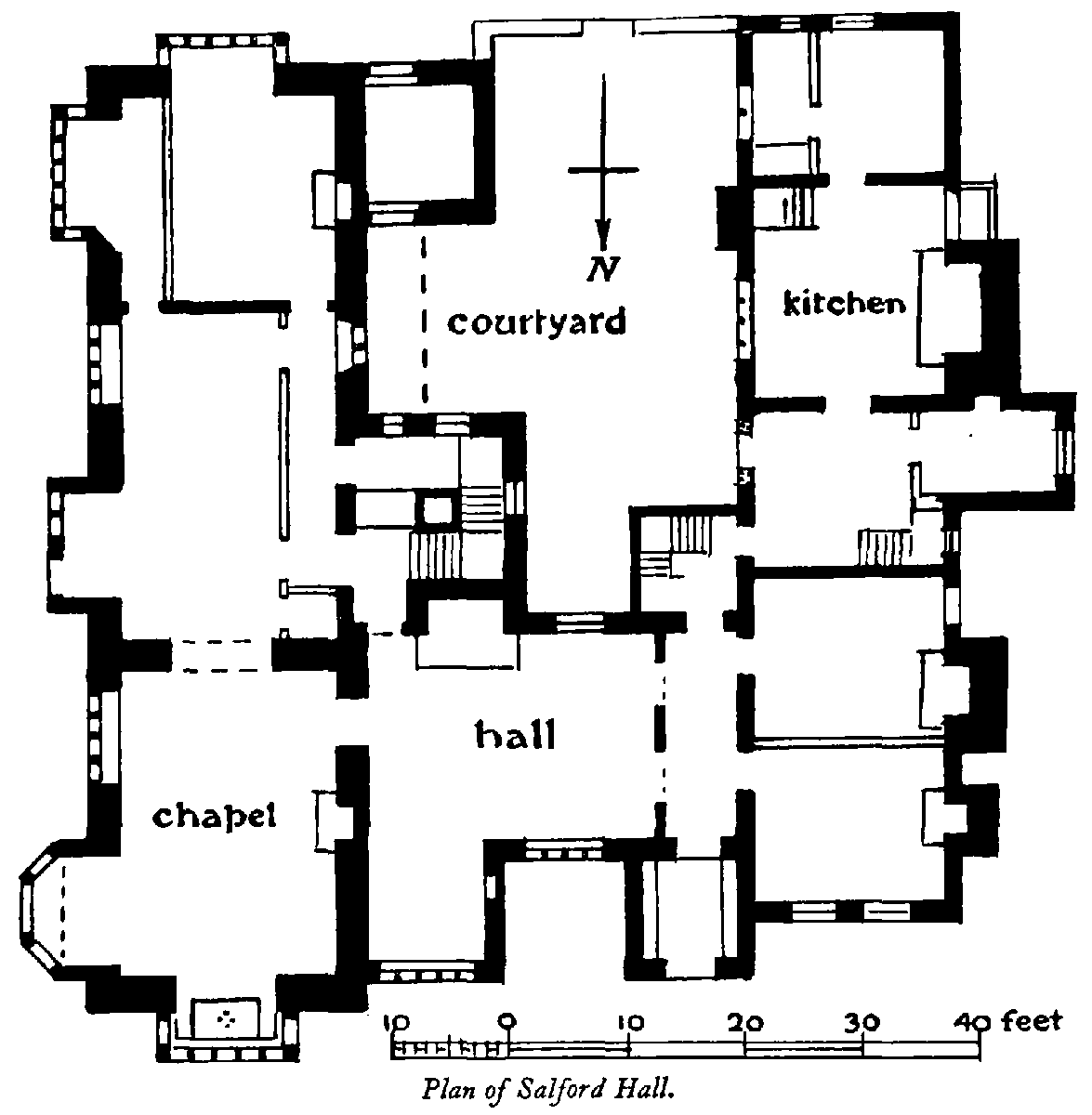
Plan of Salford Hall.
Salford Hall at Abbots Salford, 7/8 mile south-west of the church, is a large house with some timber-framing, but mostly of stone and with tiled roofs. The plan mainly consists of three ranges about a rectangular courtyard, the entrance front and hall facing north, and a wall closing the south side of the courtyard. The west range probably belonged to a late-15th-century house built by the Abbots of Evesham, and is said to have had a chapel east of it which disappeared in later alterations. The north and east ranges were added by John Alderford, whose motto appears above the north porch, with the date 1662, a restorer's mistake for 1602. He used the local blue lias, Cotswold oolite, and sandstone. The work of enlargement was completed by his son-in-law and successor, Charles Stanford. (fn. 23) The Stanfords were a Roman Catholic family and early in the 18th century converted the ground floor of the north range to its present use as a chapel, which was served by Benedictine monks from 1727 until nearly the end of the century. From 1807 to 1838 the house was occupied by a community of English Benedictine nuns from Cambrai, whence it is still locally known as the Nunnery. (fn. 24)
The north elevation, mostly of two stories, is in various planes, the middle part being recessed between the projecting porch-wing and the bay window of the main hall. The end of the east range is advanced still farther. The gabled end of the west range projects a little short of the face of the porch and has 18thcentury sash windows with a port-hole window in the gable. The porch-wing next east is of three stories and has a curvilinear gable-head. The entrance has a fourcentred and square head: over it is a restored panel containing a shield charged with a saltire, presumably for Alderford, and an entablature with the frieze inscribed 'Moderata Durant 1662'. The upper windows are mullioned. The recessed main wall of the hall has a similar gable-head, and windows of four lights with transoms to the two stories. The square bay window of the hall, next east, has a large window of five lights and two transoms. The upper window and gablehead to the bay are like the others. The end of the east range, of three stories, has a window of four lights and a transom in its gable-head. To the lower two stories is a bay window with a tiled roof: each window is of five lights and side lights, with a transom: both are blocked.
The east elevation is symmetrical and has three square bay windows of three stories carried up to gables high above the main eaves so that all the ridges are level. In the middle bay is a doorway: the bottom of the northernmost has been altered to a deeper bay with splayed sides. The south wall is like the north end. All the windows have chamfered mullions. The sides of these two ranges towards the courtyard have similar windows in their main walls, mostly of three lights. In the angle between the two is the main stair-wing, gabled on the west face, of three stories, with windows in both walls. Another wing projecting at the south end into the courtyard is also gabled and similarly lighted: a bridge connects the two wings. In the main wall, close to the stair-wing, is a cellar doorway with a very heavy stone lintel.
The west range, being the oldest part and having suffered many changes, is of more irregular appearance. The west elevation has two ancient projecting chimneystacks of stone, carrying square shafts of thin bricks. The southern belongs to the kitchen. Adjoining, north of it, is a small wing of three stories, the two lower of stone with mullioned windows, the third of plastered timber-framing with a gable and an oak-mullioned window. The main wall between the wing and the northern stone chimney-stack is plastered and has 18thcentury sash windows, but the head is gabled and has early-17th-century moulded barge-boards. The southernmost part of the range has stone walls to the lowest story with late-16th-century windows in its south and east walls: these windows differ from the others in having moulded jambs and mullions and moulded labels. The upper story is plastered, on timber-framing. The south end is gabled and contains a three-light window with moulded oak mullions. Towards the courtyard the other windows are modern and in the roof is a gabled dormer window.
In the angle of this range with the north is the stairwing of c. 1500, the upper two stories built of close-set timber-framing, and with blocked windows of three lights with moulded mullions. It contains an original central-newel winding stair, altered in the lower part and connected with the screens-passage of the hall, which is entered from the north porch. The oak screen between the passage and hall is of five bays, two of which are doorways; the others are plain closed panels divided by moulded muntins and rails.
The hall has a four-centred fire-place in the south wall, and in the east wall a doorway with a 17th-century pediment and shield with the arms of Stanford. In the north bay window are three early-17th-century shields of arms: 1. with Alderford quartering Everard, Sheldon, and Ruding, impaling Littleton, with the inscription: 'Alderford and Littleton: Moderata Durant.' 2. broken but showing the quarterly coat of Alderford and having the inscription 'Iames Dvrant' in letters of different sizes. 3. Alderford impaling Dormer (the arms of his second wife) and the motto 'Moderata Durant'.
The east range is occupied by rooms now used as a chapel (northernmost), ante-chapel (middle), and a vestry and another chamber at the south end.
The main staircase is of closed well type: the steps are thick oak battens, except at the top, where they are solid balks. The upper rooms have four-centred stone fire-places: the middle room is lined with oak panelling of c. 1600 and has an overmantel of three bays with carved terminal figures on brackets and enriched roundheaded panels. In the window are some small shields of arms of the Stanfords and their alliances. The southernmost room is also lined with panelling. The second floor has a long gallery, open from end to end. The roof of the north range near the west end of it has side-purlins with straight wind-braces.
In the west range the kitchen has a wide fire-place and a moulded ceiling-beam; the second room from the north, which was originally one with the north room, has some reset early-17th-century panelling. The room over the kitchen is lined with bolection-moulded panelling of the 18th century.
North of the house is an early-17th-century gatehouse, the lower story of stone rubble, with roundheaded gateways. The upper part is of timber-framing with herring-bone struts: the gables are steep-pitched and have barge-boards carved with a continuous lozenge pattern. On the south gate is a later sundial. To the west is a fine large timber barn and other farm buildings.
The hamlet of Wood Bevington, surrounded by remarkably fine elm trees, lies about 2½ miles northwest of the church. It has a manor house and about eight timber-framed cottages.
The Manor House belonged to the canons of Kenilworth. The main part of the present fabric, though now much altered, is perhaps the work of William Grey, who was tenant here in the reign of Henry VIII. The original plan was H-shaped, the middle block, facing south, containing the hall with the porch and screens-passage east of it. There is no evidence that it was ever open from floor to roof. The west cross-wing contains the 'great parlour', with a cellar behind it. The front (south) part of the east cross-wing is said to have formed part of a chapel, of which the chancel projected to the east. A small two-gabled wing projecting from the northern half of the west wing was added probably in the early 17th century. After the house had passed to the Archers in 1670, the nave of the chapel became the 'small parlour', the chancel being turned into a study, and the back part of the east wing, containing the kitchen, &c., was rebuilt and heightened. The greater part of the exterior was covered with roughcast about 1790, and in 1821 somewhat drastic alterations were carried out by an architect named Pain. It was then that the chapel-chancel was demolished and a stack of two chimneys on the east wing, probably similar to the two still surviving on the west, pulled down. (fn. 25) Subsequent additions include the lean-to buildings behind the hall.
The south front shows some timber-framing in the middle block (the hall). The main posts dividing it into four bays rise from ground to eaves. The lower story, between them, is of modern brick, the upper of closely set studding, partly restored. The windows are modern: the entrance doorway against the east wing has an 18th-century setting with pilasters, &c., but contains a more ancient nail-studded battened door, with ironwork of c. 1600. The gabled east and west wings project about 2 yards; the upper story of the west wing is said to have been jettied. The eaves of the wings are lower than that of the hall block.
The west elevation has a projecting chimney-stack to the great parlour fire-place, of stone with red angledressings, and carrying a pair of conjoined diagonal shafts of thin bricks. In the north half is a shallow wing, projecting only about 6 ft., forming the 'far cellar' inside; it shows the old close studding internally; the head has a pair of gables of comparatively ornate timber-framing with curved struts, &c. The back of the main west wing is gabled and some plain timbering is exposed in the head.
The east side of the east wing is of brick, the south part modern, where it was made good after the chancel of the chapel was removed, the taller northern part of c. 1700. Most of the original windows were shortened in 1821 or later.
A passage from the south entrance is cut off from the east end of the hall by a plastered partition. The hall has a wide north fire-place with chimney-corner seats and tiny lockers. On the west side of it is the ancient stair-case with windows, rising from the hall and enclosed by timber-framed walls. The ceiling has two crossbeams, one roughly chamfered, and the floor is paved with diagonal squares of grey stone and slate of the later 17th century.
The 'great parlour' occupying most of the west wing has early-17th-century panelling and an 18th-century marble fire-place. An outer doorway next north is now closed to form a cupboard and another doorway opened into the 'far cellar'. An old partition of close timbering divides it from the buttery at the north end of the wing, now the 'cellar'.
The 'little parlour' in the east wing, formerly part of the chapel, has no old features. (fn. 26) The dairy and kitchen behind it show an old ceiling beam or two.
In the upper rooms can be seen some of the woodwork of the front wall and a few ceiling beams. The bedroom over the hall is lined with 18th-century bolection-moulded panelling and has a fire-place of the same period flanked by Ionic pilasters. (fn. 27) There is no distinctive construction in the roof of the middle block, which has been much repaired, but the north half of the west wing has framing of c. 1500 with wind-braced purlins. The roof over the chapel-wing has old sidepurlins.
In the hamlet, all within ¼ mile east and south-east of the manor house, are six timber-framed cottages with thatched roofs, all apparently of 17th-century origin.
Bevington Lodge, ¼ mile farther east, is a larger house, now divided into tenements. It has timberframed walls, a thatched roof, and a fine heavy chimneystack of lias stone rising above the gable with the diagonal shafts of thin bricks. The house is probably of late-16th-century origin.
There are two other 17th-century timber-framed cottages about ¼ mile to the south of the last, one thatched, the other tiled; and at Weethley Gate, at the junction of main roads on the north edge of the parish, are two similar thatched cottages.
At Cock Bevington and along the main road from Dunnington to Evesham there appear to be no ancient buildings. Many of the cottages here seem to have been built during the 1780's to replace those pulled down on the inclosure of Dunnington Heath. (fn. 28)
The soil is varied, consisting principally of gravel on the upper and marl on the lower grounds, with some alluvial mould in the river meadows and various outcrops of stiff clay. There were formerly salt springs here: tithe of salt is mentioned in the 12th century, (fn. 29) and Dugdale derives the name of the village from 'a salt spring that hath been there as the inhabitants doe observe, from the accesse of Pidgeons to the place where it was, which is now choakt up'. (fn. 30) There was a salt spring at Pitchill as late as the middle of last century. (fn. 31) Some unsuccessful efforts were made at the end of the 18th century to mine coal on the eastern borders of the parish, (fn. 32) and until about eighty years ago there was a cottage industry in glove-making, supplied from Worcester. (fn. 33) The sole occupation is now agriculture, which consists largely of fruit-farming and marketgardening. (fn. 34) There are several small woods, including Salford Coppice (probably the Salford Grove which belonged to Evesham Abbey) (fn. 35) and Bury Coppice, which formed part of the manor of Wood Bevington. (fn. 36) In 1326 the Prior of Kenilworth's wood of Wolvedon, pertaining to his manor of Salford, had been taken into the royal forest of Feckenham without warrant. (fn. 37)
Bevington, like many Warwickshire villages, suffered from the Tudor inclosure movement. In 1506 William Grey, the tenant of the manor, depopulated two messuages and a cottage there and turned 64 acres of arable into pasture, so that 40 people were rendered destitute and homeless. (fn. 38) His son William continued the process and by 1547 180 acres had been inclosed and 6 houses pulled down, 4 of which, however, were afterwards re-edified. (fn. 39) There is mention of inclosures having taken place in Salford Priors by 1633, (fn. 40) and the whole manor was inclosed by agreement probably in the early 18th century. (fn. 41) Dunnington Heath, where the tenants of Salford Priors, Cock Bevington, and Wood Bevington enjoyed their common rights, was inclosed by an Act of 1783. (fn. 42) Bevington Waste, formerly an extensive tract of underwood, was converted to arable about 1872. (fn. 43)
There is a village hall erected in 1913 and a railway station on the L.M.S. line from Birmingham to Evesham (originally the Evesham-Redditch Railway).
The only native of Salford who has attained to any eminence is Valentine Green, the 18th-century mezzotint engraver, who was baptized here on 16 October 1739. (fn. 44)
Manors
SALFORD MAJOR was given by Kenred, King of Mercia, to the Abbey of Evesham in 708; (fn. 45) but by Edward the Confessor's time it had passed to the Countess Godiva, and in 1086, when it was assessed at 3 hides, it was held of the king's alms by Levitha the nun. (fn. 46) In 1122 Geoffrey de Clinton granted it in his foundation charter to Kenilworth Priory. He claimed to hold it by the service of a knight's fee of Roger, Earl of Warwick, who had apparently inherited it from Earl Henry his father. But Levitha recovered the manor by a suit in the king's court and the king established against the earl that she held it of the Crown in almoin. Geoffrey's grant to the canons of Kenilworth was thereupon confirmed by Earl Roger with Levitha's consent, by his mother the Countess Margaret, and by a charter of Henry I. The canons were to hold it free of all service and Geoffrey was likewise acquitted of the service he had owed to his overlord. (fn. 47)
The manor remained until the Dissolution in the possession of Kenilworth Priory, whence it derived the name of SALFORD PRIORS. In 1285 the Prior successfully claimed gallows and weyf here. (fn. 48) The manor was worth £21 6s. 8d. annually in 1291 (fn. 49) and £37 17s. 1d. in 1535. (fn. 50) In 1539 it was valued with its members, but excluding the township of Wood Bevington (q.v.), at £49 18s. 5d. (fn. 51)
After the Dissolution the manor remained in the hands of the Crown and appears in 1553 as part of the jointure of Queen Katherine Parr. (fn. 52) In 1604 James I granted it to Lord Hume in trust for the payment of his debts, (fn. 53) and in 1610, on the nomination of William Garway and others, it was granted to Simon Clarke (fn. 54) (1579–1652), who became a notable figure in the Warwickshire of his time. He was the son of Walter Clarke of Ratcliff, Bucks., by Elizabeth daughter of Simon Edolph, and traced his descent—with what pride the monument in the church bears witness—from the ancient family of Woodchurch, of Woodchurch, Kent. (fn. 55) He became a baronet in 1617 and was twice married: in 1604 to Margaret daughter and co-heir of John Alderford of Abbot's Salford (q.v.), who died in 1617, and afterwards to Dorothy daughter of Thomas Hobson, the famous Cambridge carrier. He was probably living at Salford from the time of his first marriage, since two of his sons, John and Walter, were baptized here in 1606 and 1607 respectively. But in 1618 he purchased the manors of Bidford and Broom (q.v.) and thereafter seems to have occupied Broom Court. Sir Simon was a friend of Dugdale's and was himself something of an antiquary. Anthony à Wood tells us that Dugdale, when collecting material for the Antiquities of Warwickshire, 'found none more knowing in, and forward to encourage such a work'. (fn. 56) In the Civil War Sir Simon was active in support of the king and, though in 1646 he declared his readiness to submit to the Parliament, was fined £800. (fn. 57) He died at Broom Court in 1652. (fn. 58)
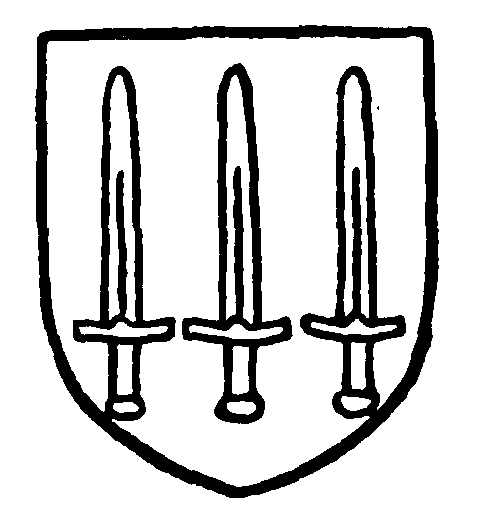
Clarke. Gules three swords palewise argent.
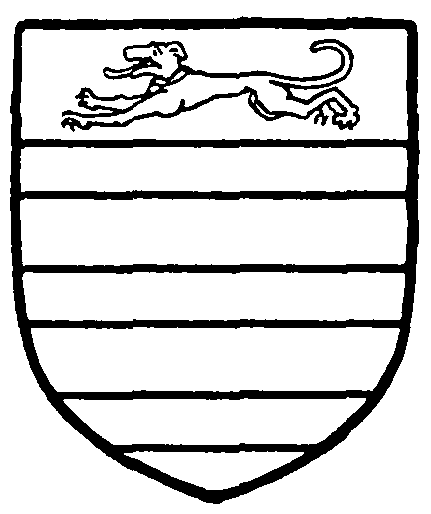
Skipwith. Argent three bars gules with a running greyhound sable collared or in the chief.
In 1630 the reversion of the manor of Salford Priors was said to be held by 'Mistress Egiocke', (fn. 59) probably as the result of a mortgage, for Sir Simon Clarke afterwards conveyed the manor to his wife Dorothy, who had discharged his debts. This conveyance must have been made before 1 January 1649, when Sir Simon is described as only a life tenant. (fn. 60) His son John, who became the 2nd baronet, appears nevertheless to have inherited some interest, since on 1 March 1653 he demised an annuity of £200 out of the manor to his mother, for 99 years. (fn. 61) Lady Dorothy Clarke, who died in 1669, bequeathed the manor by will to Fulwar Skipwith, the husband of her niece Dorothy daughter of Thomas Parker of Anglesey Abbey, Cambs. (fn. 62) Skipwith became a baronet in 1670 and died in 1677. The manor passed successively to his grandson and heir Francis, to his great-grandson Francis in 1728, and to the latter's son Sir Thomas George Skipwith in 1778. Sir Thomas George died without issue in 1790 (fn. 63) and his widow Selina sold the manor to the Marquess of Hertford, in whose family it has since remained.
Through the annuity of 1653 already mentioned, the Clarke family retained some interest in Salford Priors for about half a century after the death of the 1st baronet. In 1654 the Lady Dorothy Clarke assigned the annuity in trust for Fulwar Skipwith, who in 1662 conveyed it for life to Simon son of Peter the second son of Sir Simon Clarke, who became the 3rd baronet in 1679. Sir Simon's extravagance completed the ruin of an estate that had been heavily encumbered since the Civil War. The property was several times mortgaged and finally in 1702 passed to William Parker, who died in 1730 and is buried in the church. It remained in the Parker family until 1803, when William Parker, the great-grandson of the original owner, sold it to the Marquess of Hertford. (fn. 64)
SALFORD MINOR was included in Kenred's grant to Evesham Abbey in 708 (fn. 65) and, unlike Salford Major, remained in the possession of that house until the Dissolution, being therefore distinguished as ABBOTS SALFORD. It seems to be included, under the name of Salford, among the manors acquired by Abbot Ethelwig (1059–77) and seized, after 1077, by Odo Bishop of Bayeux. (fn. 66) But the monks had in any case recovered it by 1086, when it is assessed at 2 hides. (fn. 67) In 1206 (fn. 68) and again in 1291 (fn. 69) the manor appears as appropriated to the cook of the monastery and valued at £3 5s., and, according to the latter survey, the abbot held in addition a carucate of land here worth 4s. In 1535 the manor was valued at £10 19s. 8d., out of which a pension of 5s. was payable to the Abbot of Kenilworth. (fn. 70)
The manor came into the king's hands at the Dissolution and in 1545 was granted to Sir Philip Hoby, (fn. 71) who conveyed it in the following year to Anthony Littleton (fn. 72) fourth son of John Littleton of Frankley, (fn. 73) whence it sometimes appears as Littleton's Salford. The manor was the subject of a complicated series of conveyances and Chancery suits, arising no doubt out of Littleton's embarrassments. (fn. 74) It appears to have descended, however, to John Alderford, who married Littleton's daughter and sole heir. (fn. 75) There was no issue by this marriage, but Alderford, after his wife's death, was married again, to Elizabeth Morgan (née Dormer), by whom he had two daughters: Eleanor, the wife of Charles Stanford, and Margaret, who married Sir Simon Clarke. (fn. 76) On his death in 1606, therefore, the manor passed to Eleanor and her husband, (fn. 77) and remained in the Stanford family for about two centuries. Charles Stanford was succeeded by his son John, who died in 1649. (fn. 78) John was apparently a Royalist in the Civil War, but his son William was allowed to succeed him, under the Act of Pardon, without payment of a fine. (fn. 79) On William's death without issue in 1690, the manor came to his younger brother John (d. 1713), who married Mercy daughter of Francis Sheldon, and left a son and heir William. William married Mary daughter of Richard Betham of Rowington, by whom he had four sons and two daughters. He died in 1767 (fn. 80) and was probably succeeded by his son Robert, the last of the line, (fn. 81) who was certainly holding the manor in 1776 (fn. 82) and who died in 1789. His widow, who died in 1812, bequeathed the manor in her will to Robert Berkeley of Spetchley, at whose request, it is said, the community of nuns from Cambrai had been allowed to settle at the Hall. On Berkeley's death in 1845 the manor passed, again by bequest, to George Eyston, whose descendant, John Eyston, sold it in 1944. (fn. 83)
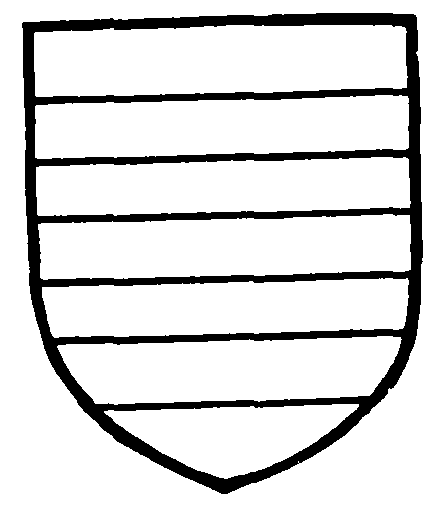
Stanford. Argent three bars azure.
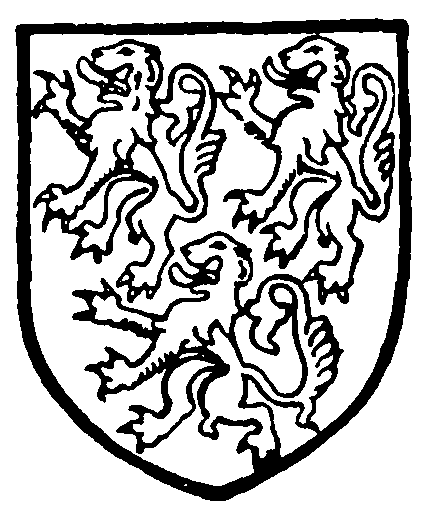
Eyston. Sable three lions or.
WOOD BEVINGTON, COCK BEVINGTON, and DUNNINGTON belonged to Kenilworth as members of Salford Priors. The two latter have continued to descend with Salford since the Reformation. (fn. 84) In 1532 the Abbot of Kenilworth granted a 70 years' lease of the township of Wood Bevington, with free warren and common of pasture in Dunnington Heath, to William Grey, (fn. 85) whose father had been the tenant here in Henry VII's time. William, his wife Joan, and Elizabeth and Anne his daughters were shortly afterwards received into the fraternity of the convent. (fn. 86) Elizabeth, her father's heir, afterwards married Edward Ferrers, by whom she had five daughters. Ferrers died in 1578 and his widow, who survived until 1602, in 1585 entailed the greater part of the property, the fee simple of which had presumably been acquired from the Crown, on her eldest daughter Elizabeth and her husband Thomas Randolph. (fn. 87) The remainder was conveyed to Randolph by the surviving younger daughters or their heirs in 1620. (fn. 88) His son Ferrers Randolph, who succeeded in 1628, (fn. 89) was already mortgaging parts of the property as early as 1630 (fn. 90) and in 1636 sold the whole to St. John's College, Oxford, for £3,633 13s. 4d. and became the tenant of the college on a 300 years' lease. (fn. 91) He was further impoverished during the Civil War by the depredations of both sides, 'dwelling equallie distant betweene their twoe strong Garrisons of Warwick and Worcester', (fn. 92) and in 1652 was obliged to surrender the lease for nonpayment of rent. It was then assigned by the college to John Hatt of London, who died in 1657, leaving it to his second son Charles. (fn. 93) In 1670 Charles Hatt and his brothers sold the remainder of the lease to Robert Archer, (fn. 94) who came apparently from Lincolnshire. He died before 1703 and was successively followed by his son Joseph (d. 1715) and his grandson Robert. On the latter's death without issue in 1725, the estate devolved upon his four sisters, Anne, Elizabeth, Mary, and Martha. The family came to an end with the death of Martha Archer in 1791 and the lease was then purchased by Viscount Beauchamp, afterwards 2nd Marquess of Hertford. (fn. 95) St. John's College sold the freehold of the property to the Trustees of the Ragley Estate in 1930. (fn. 96)
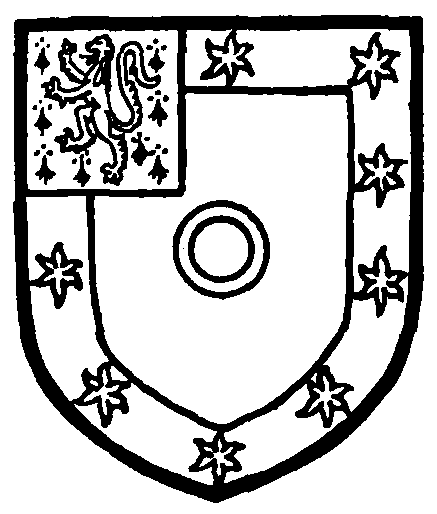
St. John's College, Oxford. Gules a border sable charged with eight stars or and a quarter ermine with a lion sable therein, a ring or for difference.
POPHILLS is first mentioned in 1262. (fn. 97) John Swane of Alcester and Elizabeth his wife granted a close and pasture called Popehyll in the lordship of Salford to William Hues of the Mourehall in 1508. (fn. 98) In 1591 the manor of Pophills was sold, with that of Ragley (q.v.), by George Brome to Sir John Conway. (fn. 99) This is the only reference to Pophills as a manor, but in 1661 the estate was bought by William Rawlins, fourth son of Edmund Rawlins of Stratford and Elizabeth daughter of Thomas Graynger of Dunnington, (fn. 100) from Robert Pearce of Norton, near Evesham, who had previously bought it from John and Richard Edgiock. (fn. 101) William Rawlins died in 1662 and the estate passed in succession to his son Edmund (d. 1695) and his grandson Thomas (d. 1752). Thomas left it to his nephew William (d. 1790), whose son, also William, sold it to the Marquess of Hertford in 1812. (fn. 102) A curious late17th-century picture shows the house as a moderatesized two-storied building with annexe, dove-cot, and barn. (fn. 103) It was pulled down about 1848, traditionally because, since the suicide of a daughter of the family, who drowned herself in the Arrow, it had acquired the reputation of being haunted. All that remains of it is a timber-framed barn. It is said that the windows of the house were removed to the house in Alcester now occupied by Lloyds Bank, and that other of the materials were re-used in the building of Beauchamps Court near Alcester (q.v.). (fn. 104)
The abbots of Evesham also held property in Salford Priors, comprising Salford coppice and various other lands, which was granted to Sir Philip Hoby in 1545 (fn. 105) with Abbots Salford and seems thereafter to have descended with that manor. (fn. 106) 'Bivington' also was said to be appropriated to the infirmary of the Abbey in 1206, and lands in 'Byvyngton' are afterwards stated to have been granted to the infirmary by Abbot Ralph (1214–29). (fn. 107) In 1535 the property was valued yearly at 6s. 8d. from Wood Bevington and £3 6s. 8d. from Cock Bevington. (fn. 108) The property afterwards passed to Ralph Sheldon and in 1611 was sold by George Salter to Thomas Randolph. (fn. 109) The Cock Bevington portion included the Stony Lands, which are separately mentioned in the licence to purchase the Bevington estate granted to St. John's College in 1636. (fn. 110)
According to the Salford Priors Custumal of 1633 grants of copyhold were limited to five lives in possession and reversion and a copyhold tenant might sublet on an annual tenancy. In a contemporary Chancery suit relating to Abbots Salford it was maintained that the grants by copy of Court Roll contained the clause sibi et suis which virtually converted the copyholder into a freeholder and the then lord of the manor, Charles Stanford, was accused of having broken the custom by granting a life tenancy. (fn. 111)
There was a mill at Salford Priors, valued at 5s. in the Domesday Survey. (fn. 112) In 1291 there were two mills, both farmed by the Prior of Kenilworth. (fn. 113) Two mills, under one roof, are mentioned, with a fishery formerly belonging to the Abbot of Kenilworth, in 1610. (fn. 114) The approximate site of these mills may perhaps be identified from the field-names Great Millham (fn. 115) and Millham, (fn. 116) both of which are on the west side of the Arrow, respectively above and below the junction with Ban Brook.
The mill at Abbots Salford, valued in 1086 at 10s. and 20 sticks of eels, (fn. 117) was by 1206 appropriated to the steward of Evesham Abbey. It was then worth 20s., (fn. 118) of which 6s. 8d. was due to the manciple. (fn. 119) The mill was probably situated on the Avon near Cleeve Mill, as appears from an undated lease to Philip the steward of the mill with Mulecrofte, the mill pool, and an acre of meadow by the ford of Clive. (fn. 120) The path across the fields from Abbots Salford village to Cleeve Mill may therefore be the mill road mentioned in a deed of c. 1236. (fn. 121)
A fishery in the Avon pertaining to the manor of Abbots Salford is mentioned in various conveyances 1627–1784. (fn. 122)
Church
The parish church of St. Matthew consists of a chancel with a modern south vestry and organ-chamber, nave, south aisle, and west tower. (fn. 123)
The nave and west tower date from about the middle of the 12th century. There was also a south aisle, probably narrow, with an arcade of three or four bays. The subsequent development of the plan to its present lines was rather abnormal. Whether there was a 12thcentury chancel or not is uncertain, but the nave was rather long for its width. Yet it was lengthened still farther, to the east, by some 17 or 18 ft. in the 13th century, perhaps absorbing the original chancel, and a new chancel was built east of it some 3½ ft. wider than the nave. The south arcade was also provided with another bay, but whether this opened into a transept or lengthened south aisle is not now evident: 13th-century windows were also inserted in the north wall of the nave. About 1340 the south aisle was widened, to exceed the width of the nave, and lengthened westwards to cover the south side of the tower. The south wall was provided with a projecting stair-turret, about midway in its length, which had an image in a niche in its south front, afterwards supplemented by two other images in niches. The stair now merely leads to the roof of the aisle (from which access may be gained to the upper part of the tower), and its position in the wall seems to be arbitrary, but there is little doubt that it originally served a more important purpose and probably carried a beacon or cresset to serve as a guide for travellers crossing the river Avon, towards which it faces. The niches doubtless held statues of the tutelary saints of the ford, to whom invocations might be offered before attempting the crossing, or thanksgivings after a safe passage. Later in the 14th century the large window was inserted in the north wall of the nave: it has a remarkable piece of 'flamboyant' tracery, unusual in this country.
When Sir Simon Clarke became lord of the manor of Salford he enlarged and heightened the west tower in 1633, probably for a peal of bells. To broaden the base for his superstructure he thickened the south wall externally, and rebuilt the archway from the nave to the tower, east of the original opening. On this he added his bell-chamber, &c. The original 12th-century archway and wall above it were cut away, but the jambs with 12th-century tooling on the ashlar work are left in place. Both the present arch and the upper part of the tower are remarkably good imitations of the 15th-century style for a construction of 1633. The north wall of the nave was entirely rebuilt in 1874 and the organ-chamber was added in 1894.
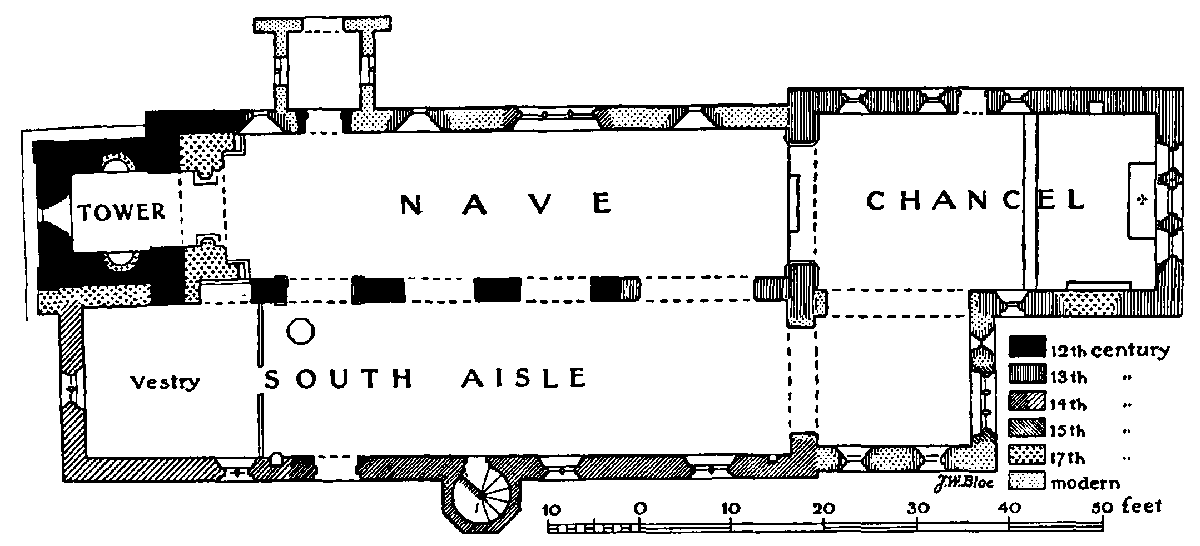
[Plan of Salford Priors church]
The chancel (36½ ft. by 19 ft.) has a triplet of lancet windows in the east wall, the middle light wider than the others: the jambs and heads outside are of two chamfered orders, and have hood-moulds which continue as string-courses, stopping about 2 ft. short of the side walls: inside they are splayed and the lights are flanked and divided by detached round shafts that have moulded 'hold-water' bases, intermediate bands, and moulded capitals, and carry the rear-arches: these are two-centred, the middle arch stilted, and are of two filleted roll moulds, the outer forming a hood-mould: the upper halves of the capitals of the single intermediate shafts branch out into triple form in order to receive the mouldings of the arches where they meet: the windows are of early- to mid-13th-century date. In the north wall are three lancets with obtuse inner splays, having angle-dressings, and chamfered reararches: the latter spring from corbels carved, four of them as human heads and the other two with later shields charged with the arms of Clarke. Under the westernmost is a small rectangular low-side window with rebated jambs and obtusely-splayed reveals. Between the first and second windows is a priests' doorway with chamfered jambs of a cream-coloured stone and two-centred head of red sandstone. Stringcourses below the windows internally and externally are carried over the doorway as hood-moulds. Near the east end is a plain rectangular locker. In the south wall is a lancet opposite the easternmost north window: it is similar except that the rear-arch has no corbels. West of it is a modern archway to the vestry-organ-chamber. The 13th-century chancel-arch is a plain one of two chamfered orders, the outer continued from the jambs, the inner carried on tapering corbel-capitals with moulded abaci. The voussoirs are mostly small, with later repairs in larger stones. The chancel walls are of squared rubble of lias stone. Below the east windowsills is a moulded string-course which is continued in the side walls, where it drops to a lower level. The east gable-head has been restored. In the south wall, about 7 ft. from the east end, is a patching of sandstone, evidently the filling in of a window done when the 1669 monument to Dorothy Clarke was erected.
The organ-chamber has an east window of three trefoiled ogee-headed lights and vertical tracery, apparently all modern, but the inner splays are probably of the 15th century, perhaps from the former east window of the south aisle. Next north of it is reset a rectangular low-side window like that in the north wall of the chancel, but only 7 in. wide in the clear. In the south wall are two lancet windows reset from the south wall of the chancel and partly repaired with sandstone and other stone.
The nave (61½ ft. by 15½ ft.) is narrow for its length. The north wall, rebuilt in 1874, has four reset and restored windows, and the north doorway. Three of the windows are 13th-century lancets with obtuse internal splays and chamfered rear-arches carried on corbels carved with foliage. The second window from the east is of three trefoiled lights and flowing leaf tracery in a two-centred head with an external hoodmould; it is of mid-14th-century date. The north doorway is of mid-12th-century date: it has recessed jambs, with original nook-shafts having carved capitals and moulded bases: the east shaft is treated with twisted ornament, the west with a lozengy pattern: the east capital has interlacing spiral ornament; the western is scalloped and has foliage in the tympanum of each scallop: the abaci are moulded, the eastern retaining part of its original diaper. The arch is semicircular with cheveron ornament and its tympanum is diapered. The hood-mould, chamfered on both edges, is plain.
The south side of the nave has four arches. The easternmost, of 12½-ft. span, is of the 13th century, and is similar to the chancel arch. The other three, of about 8-ft. span, of the 12th century, are separated by piers or stretches of wall 5 ft. 2 in. wide and have plain responds of ashlar: the capitals are scalloped and have plain chamfered abaci. The responds are square except in the middle bay of the three: in this both reveals are canted to the east from nave to aisle, for some unknown reason. The arches are two-centred and of two square orders with medium to small voussoirs: they have chamfered hood-moulds towards the nave with moulded stops: at the apices are carved human heads. The responds are of an admixture of white and yellow masonry; the two eastern bays have diagonal tooling; the western has vertical tooling and also has chamfered bases or plinths to the reveals: this is lacking in the others. The westernmost respond is partly, and its capital wholly, restored. Above the arcade is a modern clearstory of four windows. The roof is also modern and has a pointed waggon-head ceiling divided by trusses into four bays.
The south aisle (16½ ft. wide) is slightly wider than the nave, and extends nearly to the west face of the tower. In the south wall are three windows: the two eastern are of c. 1340; the easternmost is of two cinquefoiled ogee-headed lights and leaf tracery in a twocentred head: it is of yellow stone and slightly later than the second, of red sandstone, which is of two trefoiled ogee-headed lights and more simple tracery in a twocentred head with an external hood-mould. The third is of two trefoiled lights and pierced spandrel under a square head, probably of the late 14th century. Below it is a modern doorway opening into the space now used as a vestry. The main south doorway, just east of the last, is of the 14th century: it has jambs and twocentred head of two moulded orders divided by a three-quarter hollow; it has a moulded label. The west window is tall and narrow, of two cinque-foiled lights and leaf-tracery in a two-centred head. The jambs, head, and rear-arch differ from the others in being moulded.
About mid-way in the south wall is the projecting semi-octagonal turret, already referred to, with a winding-stair leading up to the aisle-roof. It is entered by a pointed doorway in the aisle. At the top of the central newel, level with the top step, is a 14th-century moulded capital; putlog holes at the same level, in the drum, suggest that the original floor or roof was here. On the capital stands another 4½ ft. of round shaft, having also a moulded capital of later date, under the flat roof of stone slabs. This was evidently a later heightening and has a doorway, on to the leads of the aisle, with chamfered jambs and a rough flat lintel. The original moulded parapet string-course remains outside and has five carved gargoyles: one a bearded king, another a monster on which a woman rides astride: she wears a wimple head-dress: the others are diverse monsters. On the south face is an original niche for an image: it has a moulded bracket, plain square jambs, and a projecting canopied head with trefoiled ogee arches and a ribbed soffit. At a later period two other niches were cut in the re-entering angles of the turret with the main wall: they are hollowed out of the masonry and fitted with sills and canopies after the style of the first niche.
The south wall of the aisle is of lias rubble, interlaced with courses of large squared stones, of a yellow sandy limestone, especially west of the turret: the angledressings are of the same yellow stone. There is also a course of red and grey stones above the chamfered plinth. The parapet, east of the turret, retains three interesting carved gargoyles or water-spouts to the parapet. One is a woman holding a pitcher; the second is a grotesque bird; the third is an erotic woman, the water spouting from her body. On a west angle-stone is a well-cut sundial. At the top of the west wall on either side of the middle window are reset from elsewhere two 14th-century windows, now forming recesses, each of two trefoiled ogee-headed lights and cusped piercings in a square head.
The west tower (8 ft. 8 in. square) dates from the 12th century, enlarged and heightened by Sir Simon Clarke in the 17th century, but owing to the re-use of older material and the copying of medieval forms the alterations look at least a century before his time.
The original lower half of the tower is built of ashlar and has a splayed plinth and shallow clasping buttresses to the west angles. The original archway to the nave has been removed, but its responds remain. The existing archway, built east of and against the 12-century tower, is two-centred and of two chamfered orders; the responds have moulded capitals, and the inner order has plain square bases. The outer order towards the tower is flush with the reveals of the former 12thcentury arch, which it meets with straight joints. The inner order is a mixture of white and red stone and the arch has fairly small voussoirs: it also has a hood-mould with a kind of billet ornament. Probably this and part of the other stonework of the arch belonged to the 12thcentury archway and were re-used by Sir Simon. Flanking the archway and projecting into the nave are two buttresses of two stages with moulded plinths and offsets. At the same time Sir Simon widened the base of the tower by adding 2 ft. 9 in. of rubble masonry against the south side of the 12th-century structure, inscribing it outside with the date ano 1633. This thickening brought the external south face out flush with that of the nave, of which the original southwest angle is probably concealed within the walling. Furthermore, the thickening does not extend far enough eastwards to meet the south arcade wall but stops short (inside the aisle) to form a recess (now cupboard) 5 ft. 9 in. wide, with a square pier 3 ft. 6 in. wide between it and the west respond of the 12th-century arcade, and with a segmental-pointed arch. At the back of this recess, which is 2 ft. 5 in. deep, is the moulded plinth on the south side of Sir Simon's buttress. It is possible from its position that the recess is the remnant of yet another 12th-century archway of the south arcade.
The interior of the lowest story, west of the 12thcentury ashlar responds, is faced with Roman cement, and in the middle of each side is a 17th-century round recess. The west window is of the 12th century and has rebated angles to the internal splays, in which were nook-shafts, now missing excepting the scalloped capitals: the round head inside is cemented. Externally it has roll-edged jambs with plain imposts: the rollmould of the head is enriched with indented or tooth ornament, as is also the hood-mould. A patching of masonry outside, below the window, and the continuation of the splays of the window inside down to the floor to form a recess, indicate a former doorway.
The second story has smaller 12th-century windows in north and west walls, and in the south wall a 17thcentury doorway, with a four-centred head, which opens from the flat roof of the south aisle into a stair-vice in the south-east angle. The doorway opens into an L-shaped passage, in the thickness of the wall, from which the stair-vice rises, and also from which another doorway with a three-centred arch opens into the first floor of the tower. Putlog holes in the walls about 3 ft. above the present floor show that there was a higher floor or platform at the level of the threshold of the doorway.
The bell-chamber is lighted in each wall by a tall narrow window of two cinque-foiled ogee-headed lights and vertical tracery in a two-centred head: the lights are divided by a transom below which they have cinquefoiled ogee-heads and foiled piercings. The heads have hood-moulds with carved stops that are met by a string course. The bell-chamber walls are of lias rubble. The parapet is embattled and has a moulded string-course with carved gargoyles: above the angles are pointed pinnacles carved with shields bearing the arms of Sir Simon Clarke.
In the south aisle are two piscinae: one near the east end is a plain pointed recess and has a broken basin: presumably early-14th-century. The other is west of the south doorway and is of later 14th-century date: it has moulded jambs and pointed heads and a moulded sill with a half-round basin.
At the east end of the south aisle is a 17th-century communion table with turned legs and fluted top-rails.
The church contains a number of funeral monuments, six of the 17th century and others later.
The largest is on the north side of the chancel at the east end, to Walter (1607) and Thomas (1616) sons of Sir Simon Clarke, and to Margaret his first wife (1617). It is really a large panel or tablet flanked by flat pilasters of black marble, having Corinthian capitals and bases of white marble and supporting an entablature. Sir Simon made it the occasion for a display of his family pedigree from early Norman times, with the name and coat of arms of each member down to his own. (fn. 124) In the middle is a small rectangular niche containing the reclining figure of Margaret.
On the south wall at the east end is a monument in painted stone to Dorothy (Hobson) widow of Sir Simon Clarke, 1669. It has a square recess flanked by black marble Corinthian shafts. The upper part of the recess is brought forward for the inscription tablet, and has an entablature with an enriched cornice and a pediment. In the middle is a lozenge of arms. In the lower part of the recess, which is fairly shallow, is the reclining effigy of the lady, her left arm resting on a cushion and supporting her head and her right hand resting on an open book. (fn. 125)
On the north wall of the chancel over the doorway is a stone monument with a shell-headed niche in which stands, on a cushion, the pretty painted figure of a child in a close-fitting and ruffed head-dress, embroidered lappets and tippet, red bodice with slashed and padded sleeves, her hands in prayer, red farthingale with yellow apron having scalloped edges, and shoes. On a separate tablet below is the inscription:
'Here lieth Margaret, Grandchilde to Sr Simon Clarke Kt. & Barronet. She died Januarie 14th, 1640 aged 3 yeares and halfe.
As careful nurses to their bed do lay,
Their children whiche too long would wantons play,
So to prevent all my insuing crimes
Nature my nurse laid me to bed betimes.'
'In memory of home ye Ladie Dorothie Clarke her loving grandmother erected this.'
Above are the arms of Clarke impaling Hobson.
Lying in the south aisle is the shaped lid of the stone coffin that Sir Simon Clarke caused to be made during his lifetime. (fn. 126) It is carved with the Woodchurch-Clarke arms and inscribed: 'Sir Simon Clarke Knt & Barronet is heere intumed died A[n]no D[omi]ni 1651 Jan: 15.'
There are other 17th- and 18th-century monuments and floor-slabs to members of the families of Alderford, Stanford, Archer (of Wood Bevington), Parker, Walford, and Andrews.
In the south aisle, lying loose, is a small headless image, kneeling with hands in prayer.
The pulpit is a modern make-up from a combined pulpit and reading-desk of 1616. Most of its carved panels are sacred subjects made for the remodelled pulpit, the original panels being discarded as too secular for the purpose and now in the parish chest. Four are carved with grotesque monsters and foliage and three with the arms of Sir Simon Clarke (six quarters) impaling Alderford (four quarters). (fn. 127)
There are eight bells, five by Richard Sanders (1735) and three modern. (fn. 128)
The communion plate includes a cup and cover paten, a stand paten, and a plain flagon, all of 1722, the gift of Mrs. Maria Best. They have cases of leather-covered wood.
The registers date from 1568.
The Roman Catholic chapel at Abbots Salford has a baptismal register dating from 1763.
The school at Dunnington is also licensed for Divine Service and there is a Baptist Chapel at Dunnington erected in 1878.
Advowson
There was a priest at Salford in 1086. (fn. 129) The church was granted with the manor to the canons of Kenilworth by Henry I and confirmed by Simon, Bishop of Worcester. (fn. 130) The canons presented up to 1520, but shortly before the Dissolution they made over the advowson to Thomas Smith, clerk, who, with William Gower, afterwards assigned it to Edward Brookes of Evesham, patron in 1546. (fn. 131) The advowson seems afterwards to have come into the hands of the Crown and in 1610 was granted to George Whitmore; (fn. 132) but it had passed to Sir Simon Clarke by 1633 and descended from him to the Skipwith family, (fn. 133) who retained the advowson for some sixty years after they had parted with the manor. Between 1854 (fn. 134) and 1857 it passed from Sir Gray Skipwith of Alveston Manor to the Rev. Samuel Ellis Garrard, who presented himself in the latter year; (fn. 135) and on his death in 1860 his son Samuel Ellis Garrard succeeded, both as incumbent and patron. (fn. 136) In 1902 Mr. Garrard transferred the advowson to its present holders, the Peache Trustees. (fn. 137)
The church was valued at £10 13s. 4d. in addition to the vicar's stipend of £6 13s. 4d., in 1291 (fn. 138) and at £12 1s. (fn. 139) in 1535, at which time the vicarage amounted to £7 9s. 7d. (fn. 140) In 1568 Richard Wootton and Paul Raynesford conveyed the rectorial tithes to Sir Christopher Browne. (fn. 141) But the rectory and church were included in the grant to George Whitmore in 1610 and the rectory and advowson thereafter descend together. When the Skipwiths sold the estates they indemnified the various owners for the loss of the tithe. (fn. 142)
The rectorial tithe of Wood Bevington descended after the Reformation with the township, though it was claimed by Fulwar Skipwith as lay rector of Salford about 1660. (fn. 143)
The chapel at Abbots Salford, which probably formed part of the Abbot of Evesham's house there (see above), is first mentioned in 1162–70. (fn. 144) The Abbot of Evesham enjoyed a pension of 30s. out of the church in 1291 (fn. 145) and in 1535 held the tithes of Abbots Salford, valued at £3 6s. 8d. (fn. 146) These tithes were granted in 1545 to Sir Philip Hoby, (fn. 147) who conveyed them in the same year to George Willoughby. (fn. 148)
Two private chapels are mentioned in the parish in the 14th century: in 1339 Emma Wilkynes received a licence from the Bishop of Worcester for a chaplain to celebrate in her oratory at Wood Bevington, (fn. 149) and in 1344 a similar licence was granted to Agnes Austin of Salford for a chapel in her house. (fn. 150) The second chapel was probably at Abbots Salford, where there are references to a family of Austin from the 13th to the 15th century. (fn. 151) The name of Chapel Oak Farm on the Evesham-Alcester road may commemorate one or other of these chapels.
Charities
William Parker by will dated 1729 gave a rentcharge of £6 for hats and coats to six poor men or boys. The charge now issues out of property at Alcester known as 'The Folly' and is distributed by the vicar and churchwardens in accordance with the terms of the will.
John Smith by will proved 20 April 1886 gave to the vicar and churchwardens the residue of his estate upon trust, for investment, the interest to be distributed in the form of blankets, sheets, garments, bread, and coal to the poor of the parish. The income of £3 3s. is so distributed.
Henry Samuel Gunn by will proved 2 Dec. 1937 bequeathed to the vicar and churchwardens £100, to apply the income for the purpose of keeping the churchyard in order.