A History of the County of Warwick: Volume 3, Barlichway Hundred. Originally published by Victoria County History, London, 1945.
This free content was digitised by double rekeying. All rights reserved.
'Parishes: Spernall', in A History of the County of Warwick: Volume 3, Barlichway Hundred, ed. Philip Styles (London, 1945), British History Online https://www.british-history.ac.uk/vch/warks/vol3/pp172-174 [accessed 30 April 2025].
'Parishes: Spernall', in A History of the County of Warwick: Volume 3, Barlichway Hundred. Edited by Philip Styles (London, 1945), British History Online, accessed April 30, 2025, https://www.british-history.ac.uk/vch/warks/vol3/pp172-174.
"Parishes: Spernall". A History of the County of Warwick: Volume 3, Barlichway Hundred. Ed. Philip Styles (London, 1945), British History Online. Web. 30 April 2025. https://www.british-history.ac.uk/vch/warks/vol3/pp172-174.
In this section
SPERNALL
Acreage: 1,110.
Population: 1911, 55; 1921, 59; 1931, 49.
Spernall parish is bounded, approximately, by the River Arrow on the west and on the east by the Alne Hills. The ground rises from 178 ft. at the bridge to over 400 ft. at Round Hill, which is partly in the parish of Great Alne. The village consists only of the church and rectory and a few scattered farms and cottages. At some time between 1195 and 1361 the parish was largely depopulated by pestilence, so that many of the villein tenements, which had hitherto accounted for almost the whole population, came into the hands of freemen. (fn. 1) In the 17th century the population seems to have mainly consisted of substantial farmers, for in 1625 it is described as a place with 'few or no poor at all in it and many wealthy inhabitants', (fn. 2) and the Hearth Tax returns (1662–74) show the high average of about 2.5 hearths per house.
The Rectory is a brick-built house of rectangular plan facing north, and is probably of early-18th-century date. (fn. 3) The walls were plastered and a south wing added in 1800. (fn. 4) There are original chimney-stacks in the side walls, one with a wide fire-place. The staircase, with 2-in. turned balusters, is also original, and one room has 18th-century bolection-moulded panelling.
A road branching eastwards from the BirminghamAlcester main road at Spernall Ash crosses the Arrow near the church, where the present bridge replaces a ford, and continues up the hill to Shelfield and Aston Cantlow, the eastern portion of it being known as Burford Lane. About a quarter of a mile beyond the church there is a branch northwards to Morton Bagot and another southwards to Great Alne.
The subsoil is Keuper red marl, with thin seams of gypsum, one of which has been worked. (fn. 5) There was also brick-making here in the 17th and 18th centuries, (fn. 6) but the population is now wholly agricultural. The parish is well timbered, the largest woods being Spernall Park (fn. 7) and Morgrove Coppice.
Manor
In 1086 a certain Hugh held 2 hides in SPERNALL from William Buenvasleth. (fn. 8) The overlordship of the Earl of Warwick is mentioned in 1328, when John Durvassal was said to have held the manor by the service of coming to Warwick Castle or to the manors of Claverdon, Tanworth, or Sutton, if the Earl were there, at Christmas, Easter, or Whitsuntide, and serving as his chief butler, taking for his fee as his ancestors had been accustomed; (fn. 9) and again in 1397 when, the Earl being a minor, the manor was taken into the king's hands. (fn. 10)
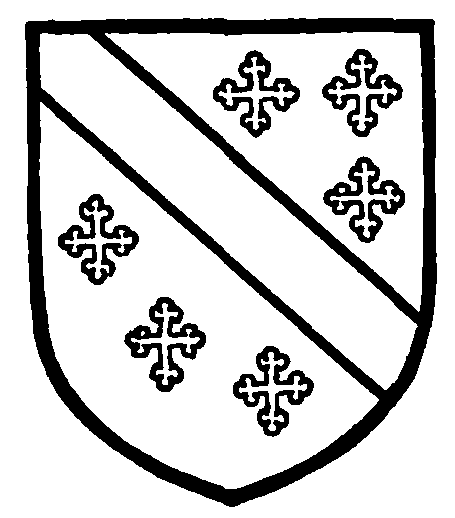
Durvassal. Argent a bend sable between six crosslets gules.
The first family connected with the manor is that of Durvassall: Dugdale mentions a William Durvassal in the time of Henry II: (fn. 11) his successor John left a son John, who was under age in 1220 (fn. 12) and is probably the John Durvassal who conveyed to Roger (his second son, according to Dugdale) (fn. 13) 2 carucates and 40s. rent in Spernall in 1246. (fn. 14) Ten years later Roger Durvassal also acquired 40s. rent in Spernall and Henley from Robert de Chandos and Eva his wife, who quitclaimed for themselves and the heirs of Eva, (fn. 15) perhaps a sister of Roger. (fn. 16) In 1316 Spernall is given as a hamlet of Morton Bagot, and was held by Thomas Durvassal. (fn. 17) This Thomas was son of Philip son of Roger and his son was John, who was living in 1347. (fn. 18) The official records, however, state that 'John Doruesale', who died in 1328, leaving a son John then 28 years old, had held the manor of Spernall of the Earl of Warwick. (fn. 19) It would seem that the name of the deceased tenant was wrongly returned as John instead of Thomas. In 1331 the manor was settled on John Durvassal and his wife Sybil. (fn. 20) John Durvassal of Spernall is again mentioned in 1347; (fn. 21) and in 1363 John de Raggelaye was pardoned for the death of Nicholas Durvassal of Spernall, (fn. 22) probably the son of John. In 1378 Rose, the widow of Nicholas and then wife of Richard Mountford, (fn. 23) disputed against a William Durvassal the right of her daughters, Eleanor and Elizabeth, to a tenement in Spernall. (fn. 24) This Eleanor married John Holt, to whose son Walter the manor later came. (fn. 25) This William Durvassal (perhaps illegitimate) seems to be identical with William Spernore, knight of the shire for Worcester in the Parliament of 1397, (fn. 26) and obtained a life interest in the manor. In 1401 the manor of Spernall, then held as half a fee, on the death of William Spernore, reverted to Walter Holt, a minor, under the guardianship of his father John Holt. (fn. 27) A year later (probably on the death of John Holt) a certain William Philips was given the custody of the manor, then worth 10 marks yearly. (fn. 28) Dugdale says that Walter Holt came of age in 1402–3 and had livery of the manor, that he shortly afterwards enfeoffed John Reve, vicar of Coughton, on whose death it passed to his brother Thomas Reve, who in turn 'quitted all his right therein' to William Wybbe, esq., in 1428–9. (fn. 29) John Throckmorton in 1441 acquired half the manor from Henry Beaumont and Joan his wife, (fn. 30) and the other half two years later from William Vernon and Margaret his wife. (fn. 31) Joan, according to Dugdale, was the granddaughter of William Durvassal, but there seems no foundation for his guess.
From this time Spernall has followed the descent of Coughton (q.v.).
According to a papal licence of 1400 Spernall was the original site of the Priory of Cookhill, and their buildings here, at that date in ruins, included a church and cemetery a cross-bow shot from the parish church. (fn. 32) Cookhill certainly held lands in Spernall by grant from William Durvassal (probably temp. Henry II) (fn. 33) and this property, valued at 23s. 4d., was described in 1535 as the demesne (terra dominicata) of ST. GILES. (fn. 34) The chapel of St. Giles, which may have been the original church of the Priory, was granted, with other of its lands, to Thomas Broke in 1541 and to Nicholas Fortescue in the following year. (fn. 35) It had probably by then been converted into a farm-house, since in 1547 Thomas Broke was occupying the 'messuage or chapel of St. Giles, called Saint gyles chapel in Sparnall'. (fn. 36) In 1608 Nicholas Fortescue's grandson Nicholas was holding a third part of the chapel, lately held by William his father. (fn. 37) John Fortescue received a grant of 'the messuage and chapel called St. Giles's' in 1663 (fn. 38) and in 1697 was said to have been seised of the manor of St. Giles. (fn. 39) The present farm-house of that name is modern.
Part of the lands of Cookhill Priory situated near Hasden's Cross in Spernall had by 1651 come into the possession of Ralph Price of Spernall, yeoman, whose second son Thomas sold them to Sir Robert Throckmorton of Coughton in 1708. (fn. 40)
A mill worth 4s. and yielding 7 sticks of eels is mentioned in Domesday (fn. 41) and was held with the manor in 1328. (fn. 42)
Church
The parish church of ST. LEONARD consists of a chancel and nave, and a south porch used as vestry. The chancel is entirely modern, but the chancel arch is of the 12th century and some of the masonry of the side walls of the nave may be of the same period: the old windows in them are of the late 14th century, and there seems to have been some extension to the west about that time, probably for a bell-cote. In 1844 the walls were partly rebuilt and the church generally restored. The very good oak seating and panelling were installed in 1935.
The engraving of the church in the diary of Henry Teonge (1825) shows that the earlier chancel was probably of the 16th century and had a high-pitched roof with a timbered gable of which the tie-beam was cambered over the three-light east window. There seems also to have been a single-light window in the south wall.
The present chancel (12 ft. 9 in. by 10 ft. 2 in.) has an east window of wheel design and small roundheaded side windows. The chancel arch is of the 12th century rebuilt, with shafted jambs which are all modern; the head is old: it is semicircular, of small voussoirs, with an edge-roll to the west. The roof has wind-braced side purlins.
The nave (37 ft. 3 in. by 15 ft. 10 in.) has two north and two south windows. The eastern pair are late14th-century, of two cinquefoiled lights and a multifoiled spandrel-piercing in a two-centred head: both are of red sandstone. The western windows are similar but modern. The north doorway, between the two windows, has a four-centred head of one piece of white stone, possibly of the early 16th century, but the chamfered jambs are of older brown stone, probably 14thcentury: random dates, e.g. 1732, have been cut on them. The early-16th-century oak door has plantedon moulded ribs dividing it into three panels, with the remains of trefoiled ogee heads with rose cusp-points and tracery. Above the middle panel are remains of carved letters (I P?); over the dexter a grotesque human head and foliage, and over the sinister a monster. The door is nail-studded and hung with strap-hinges, the applied tracery covering the upper hinge.
The south doorway is square-headed, of uncertain age, and opens into a small modern porch-vestry; the door in it is of c. 1600 and is of plain battens with applied moulded ribs dividing it into five panels: it has been rehung outside inwards.
At the west is a modern window set high up, of two lights and a trefoil in a two-centred head.
The north wall is of old ashlar up to the western window; west of this it is of 19th-century brickwork. The south wall is of old ashlar up to a height of about 7 ft.: above that, from the east to west of the porch, it has been rebuilt with grey-white limestone: the west part is of old wide-jointed rubble of grey stone. The west wall is of old rubble up to the base of the gablehead, which is modern and has a bell-cote with one bell: there are two old square buttresses at each angle and one in the middle, all on rough footings.
The roofs presumably are modern but the nave roof may have early timbers re-used: it is of two wide bays with a short east bay and a half bay at the west. The three trusses are arched under the collar-beams and the side-purlins have curved wind-braces: the rafters are wide and laid flat-wise. They are covered with tiles.
There are fragments of 15th-century glass in the heads of the lights, and piercing above, of the northeast window of the nave; all foliage designs.
The communion rails are of the 18th century: the font and all the furniture are modern. The communion plate includes a cup with incised ornament and a baluster stem: it is inscribed: 'William Wiggett churchwarden of Spearnall 1672: 08: 12:00' but is stamped with the London hallmark of 1655.
The single bell is a modern recasting of one cast from the two bells that were here before the restoration of 1844. (fn. 43)
The registers date from 1562, but are defective before 1666.
Advowson
The church first appears, at the end of the 12th century, as a chapelry of Coughton which belonged to the canons of Studley. (fn. 44) In 1218 Nicholas, Prior of Studley, granted the advowson of the chapel of Spernall to Sarah, Prioress of Cookhill, reserving to his house the annates. (fn. 45) In 1291 the Studley portion was valued at £1 5s. and the Cookhill portion at £1. (fn. 46) The whole was valued at 40s. in 1341, divided equally between the great tithes and the glebe. (fn. 47) The patronage remained with Cookhill until the Dissolution, (fn. 48) when it apparently came into the hands of the Fortescue family. Elizabeth, the widow, and William, the son, of Nicholas Fortescue held it in 1575 (fn. 49) and William's son Nicholas in 1608. (fn. 50) The Crown presented in 1612, (fn. 51) no doubt owing to the recusancy of Nicholas Fortescue, who, however, was still holding the advowson when he died in 1633. (fn. 52) His son William presented in 1637 (fn. 53) and John Fortescue in 1670. (fn. 54) By 1690 the advowson had apparently passed to John Allen, (fn. 55) and Thomas and afterwards Robert Hunt appear as patrons in 1728. (fn. 56) Thomas Chambers of Gorcott Hall, Studley, presented five successive incumbents between 1753 and his death, at the age of 91, in 1802. (fn. 57) His grandson the Rev. Thomas Chambers, vicar of Studley, is described as patron on his memorial tablet in the church. He died in 1836 and his younger brother Charles (d. 1854) was holding the advowson in 1850. (fn. 58) Since 1869 the living has been in the gift of the Lord Chancellor. (fn. 59)
Henry, Bishop of Worcester (1193–5), decreed that the canons of Studley should have the right of burial of all servile, and the nuns of Cookhill of all free, tenants in the parish, and a decision of Bishop Reynold Brian (1352–61) confirmed to Studley the burial rights over all tenants of land that had originally been held in villeinage. (fn. 60) This ruling was confirmed by Bishop Whittlesey in 1367. (fn. 61) A licence of Pope Boniface IX in 1400 allowed the people of Spernall to construct and inclose their own cemetery close by their parish church. (fn. 62)
Among the 17th-century rectors was Henry Teonge the diarist. He was born in 1621 of a local family (fn. 63) and became first rector of Alcester and then in 1670 of Spernall. But after five years here he found himself in financial difficulties and obtained a chaplaincy in the Navy, making a voyage to the Mediterranean and the Levantine ports and taking part in the operations against Tripoli under Sir John Narborough. During this time he 'gott a good summ of monys' and returned to Spernall, but two years later he was again in straitened circumstances and went once more to sea. He returned finally to Spernall in 1679, where he died eleven years later. He had three sons, the eldest of whom was vicar of Coughton from 1675 to 1683 and took duty at Spernall while his father was abroad. Henry Teonge's diary, which was published in 1825, gives a good contemporary picture of life in the Navy. (fn. 64)
Charities
In 1709 John Saunders left £10, on which the yearly interest was to be distributed to the poor of the parish. By will dated 21 November 1723 the Rev. Thomas Allen, a former rector, bequeathed a rent charge of 10s. on his estate at Great Alne to the poor of the parish, 5s. to be distributed on St. Thomas's Day and 5s. on Good Friday. At the time of the Charity Commission of 1815–39 this was paid by Mr. Stephen Morgan, the then owner of that estate, and was distributed on Good Friday, together with Saunders's charity, in small sums of about 2s. each. In 1806 Ann Bates left £20 for the same purpose, invested on security of the tolls of the turnpike road from Stratford to Bromsgrove; in 1839 this yielded 20s. a year, which was distributed in small sums in June. (fn. 65)
Saunders's Charity and Bates's Charity are now invested in 3½-per-cent. War Loan and produce 22s. annually for sick and poor, and Allen's Charity is used for the same purpose.
A tablet under the west window of the church records that the Rev. John Chambers, by his will dated 3 May 1832, left £50, whereof the interest, together with the tithe from Aunetts Field in the parish of Studley, was to be applied by the rector for the education of the poor children of the parish. There is now an annual income of £2 3s. 6d. from charges on land in Studley, known as Chambers's Charity, but the £50 left for educational purposes cannot be traced. (fn. 66)