A History of the County of Warwick: Volume 3, Barlichway Hundred. Originally published by Victoria County History, London, 1945.
This free content was digitised by double rekeying. All rights reserved.
'Parishes: Henley-in-Arden', in A History of the County of Warwick: Volume 3, Barlichway Hundred, ed. Philip Styles (London, 1945), British History Online https://www.british-history.ac.uk/vch/warks/vol3/pp206-212 [accessed 30 April 2025].
'Parishes: Henley-in-Arden', in A History of the County of Warwick: Volume 3, Barlichway Hundred. Edited by Philip Styles (London, 1945), British History Online, accessed April 30, 2025, https://www.british-history.ac.uk/vch/warks/vol3/pp206-212.
"Parishes: Henley-in-Arden". A History of the County of Warwick: Volume 3, Barlichway Hundred. Ed. Philip Styles (London, 1945), British History Online. Web. 30 April 2025. https://www.british-history.ac.uk/vch/warks/vol3/pp206-212.
In this section
HENLEY-IN-ARDEN
Henley-in-Arden has one long High Street, (fn. 1) rather over ½ mile long, running north and south, along both sides of which are practically all the older buildings of the town. Some 45 buildings show visible remains of the 17th century or earlier, including the church and Gild Hall, which are nearly midway on the east side at the turning to Beaudesert. Many other buildings have 18th-century exteriors, some probably with earlier remains internally.
The Gild Hall dates from the 15th century. Later it was used for shops, but was restored in 1915 by Mr. W. J. Fieldhouse, when the upper hall was opened out and a great fire-place and chimney-stack inserted, besides other stacks against the east side. Many of the timbers were renewed and old timbers were reset from elsewhere. All the doorways and windows are modern. The lower story is used for offices, the upper story has a long chamber of four bays with the modern wide fire-place at the south end of it and beyond it a small chamber and the modern staircase. A view in the Aylesford collection, of 1821, shows the lower story to have been then chiefly of stone; it is now of timber-framing, with modern brick infilling, and on stone foundations. The north end has a jettied gabled upper story and is all of close-set studding, as are the east and west sides, but the south end is of square framing. The three roof-trusses dividing the four 12 ft. bays of the long upper hall have cambered tie-beams with curved brackets and stiffeners and on them are vertical posts to the collar beams, many of them re-used timbers: partitions below the tie-beams are indicated by mortices. In a small window at the south end is reset some 15th-century coloured glass: it includes the remains of a figure of St. Anthony and a shield of the arms of John, Lord Dudley (1440–87). In the hall is a 17th-century long table and other furniture, and a set of eleven 18 in. pewter dishes inscribed 'Henley 1677', and four 9¾ in. plates.
North of the Gild Hall is a tapering island almost entirely of 18th-century and later buildings. North of it, in the roadway, is the medieval market cross with two well-worn steps, a base, and tapering shaft about 10 ft. high having slight remains of moulded capping. The head, which fell in 1894, had niches carved with the Rood, the Trinity, St. Peter, and (?) the Virgin and Child. (fn. 2)
Opposite it, on the east side of the broadened High Street, is the Post Office, a stone building of three stories and of about 1750.
The next house, proceeding northwards, was the old George Inn, now reconstructed and used as a private house. The old timbers, probably of the 16th century, have been re-used in the front. It has a staircase dated 1699 and preserves the old sign of St. George and the dragon painted on mahogany.
Next to this is a late-17th-century house of two stories and attics, now two tenements, nos. 115 and 117. The street-front is of red brick with black headers and rusticated stone angle-dressings and has a perished entablature of stone at the eaves of the tiled roof.
About 40 yards farther north is 'The Gables', (fn. 3) a much altered house of 15th-century origin. The main part of it is rectangular; the timber-framed-and gabled end towards the street has a jettied upper story with a 15th-century moulded bressummer, on curved brackets and projecting joists, above which the upper wall is modern. On the south side is a great projecting chimney-stack of stone, probably 16th-century; inside the upper story has an ancient stone square fire-place with a chamfered lintel; the lower fire-place is modern. The roof, above a later ceiling, appears to be a plain one of king-post type with braced tie-beams, &c. Against the north side are two shorter parallel wings, mostly of modern brickwork, but with some 17th-century framing and two contemporary windows.
The Three Tuns Inn, next north, has a 17th-century timber-framed back wing. Next but one northwards is a succession of eight ancient buildings. The southernmost, of the 16th century, has a jettied and gabled upper story to its north half, of square timber-framing supported by curved brackets and projecting joists: the south half has a modern front but shows ancient open-timbered ceilings inside. Behind the gabled part is a chimney-stack of square and diagonal brick shafts. The next is a long building of four bays with main story-posts, and close-set studding, and is probably a somewhat earlier 16th-century house. At the north end of the front is an original 4½-ft. doorway with chamfered posts and lintel, now widened by cutting away its south post. The lower rooms have opentimbered ceilings.
The Blue Bell Inn is a late-15th-century building of L-shaped plan, the north part of which has a jettied and gabled upper story to the street, of close-set studding and with a cambered tie-beam and collar-beam. The south gable end of the south wing shows close-set studding inside and a very heavy cambered tie-beam, the lower room (bar or tap-room) having chamfered cross-beams in the ceiling. The part with the front gable end has original wide flat ceiling joists to the lower story and braced tie-beams and wind-braced purlins to the roof above. There is a high gateway (for coaches) north of the gabled wing, having above it an upper story of close vertical studding, all higher than the original part and probably of the 17th century.
Next north is a lower 17th-century building of square framing with two front gables and a wide gateway for carts north of it. The lower stories of all these buildings are altered for shops, &c. The next, nos. 85 and 87, is largely refaced with brick but has a gabled cross-wing at its north end with a jettied upper story, all of close-set studding and with a heavy cambered tie-beam to the gable-head. It is probably of c. 1540. The next, no. 83, is a low building of modern brick with a shop and wide gateway but shows ancient open-timbered ceilings inside.
The next two adjoining buildings are now a private hotel; the southern is of 17th-century square framing. The front, of two stories and attics, has two gabled bays or wings separated by a wide gateway and middle block. The northern building is a long low structure of two 10-ft. and three 12-ft. bays, all of close-set studding, and with a jettied upper story along the whole street front; it is probably of the early 16th century. Two chimney-stacks, with wide fire-places, were built against the back in the 17th century; the northern has the original pilastered brick shaft above. The lower ceilings are plastered but show the ancient chamfered beams. The upper story has partitions incorporating the original cambered tie-beams, with curved braces below them and vertical studding below the collar beams. Some linen-fold and some late-16th-century panelling is reset in the back lean-to addition.
About 90 yards farther north is a 15th-century house of the type with jettied upper stories to the front (12 ft. and 9 ft.), representing the solar and buttery wings, and a 10½ ft. middle block with curved braces from the sides of the wings and a timber coving so that the eaves is in one plane. The framing has close-set studding to both stories and on the wider northern wing is an original four-centred doorway to the former screens. This wing shows the original wide flat ceiling-joists, but the roof trusses, &c., are hidden by later ceilings.
Adjoining north of the last is a 17th-century building of square framing, with gabled dormer-windows, and five other buildings, three to the north and two to the south, also show some framing of this period.
There are fewer early buildings on the west side of the street. Opposite the Gild Hall is the White Swan Hotel, (fn. 4) dating from the late 16th century and partly refronted in the late 17th century. The middle block of the front has a wide gateway in its north half with square timber-framing above, the south half being of red brick with stone angle dressings and having a twostoried bay window of five sides with old moulded and channelled stone mullions. North and south are gabled cross-wings, the northern with close-set studding to the ground story. The upper story and gabled top story are faced with square framing containing ornate geometrical panels: the first floor and the gablehead are jettied and have moulded bressummers. The south wing has a timbered gable-head but the remainder is of brick and stone. Both wings have modern bay windows.
Next south is a long building, now shops, having two gables in the north half of the front and some square framing of the 17th century. A large house to the north, now two tenancies, Nos. 94 and 96, has a modernized main middle block and gabled end crosswings of square framing of the 17th century, originally jettied in front.
Opposite the market cross is an altered house and shops showing some old square framing in the gabled ends. The former Bear Inn, now two tenements, is mentioned in 1654 as a place where the Justices held their sessions. (fn. 5) The lower part of the north half (now called Cromwell House) is of 18th-century brick, but the third story has two gables of old square timberframing, a late-17th-century heightening of the earlier timber front, as is shown by the early-17th-century timbers now exposed inside. There are also chamfered ceiling beams, &c., and a wide fire-place, above which are three diagonal square chimney-shafts. Some closeset studding in the back and north side walls may be relics of a still earlier building. There is a 17th-century staircase with turned balusters. A two-storied house farther north has 16th-century close-set studding to the upper story, of two bays; it was originally jettied and has a bressummer with the perished remains of carving and moulding. The tiled roof is steeply pitched and behind it is a chimney-stack of three diagonal shafts. A house at the corner of the road to the railway station has a wing with a jettied gabled upper story and shows some 17th-century square framing in the north side. Burman House, about 60 yards to the north, is a late17th-century house with a plastered front divided into three bays by pilasters and having a stone eaves-cornice. It has an original staircase from ground to second floor with plain newels, turned balusters, and moulded handrails. No. 42 also has some framing in the front, the lower story with close vertical studding. Near the north end of the street is a house with two end gables towards the street: the upper story retains its 17thcentury square framing.
In the street, to the south of the church, some 16 buildings, situated on both sides, have noticeable remains. The first house, at the corner of the Beaudesert road, is of c. 1700 and has a stuccoed front and gable-heads with plain copings and ball finials. No. 157 is a low structure of the 17th century, showing old framing in the north gabled wall and having moulded ceiling beams; the front is of 18th-century brick. Nos. 163 and 165 and 'The White House' (restaurant) farther south have 17th-century square framing in the front.
A brick-fronted house, No. 179, has early-17thcentury square framing with a heavy chamfered tiebeam and curved braces in the gabled north wall. A much altered low building No. 207 is now mostly of red brick but retains in the front the angle-posts and large curved braces of a formerly jettied upper story, perhaps of c. 1500.
Another building, Nos. 227. 229, and 231, also brick-fronted, has some ancient timbering in the north gabled end; and No. 255, near the south end of the east side, has some 16th-century close-set studding.
On the west side, north of the Baptist chapel, is an unusual type of building now two tenements, Nos. 122 and 124, but perhaps designed for some other purpose. It is of square plan, about 36 ft., and built of late-16thcentury red brick with a chamfered plinth and a projecting moulded string-course, protected with sloping tiles, at the first-floor level. It has a pyramidal tiled roof with a rectangular chimney-stack of thin bricks at the apex. The windows are mostly plain square openings fitted with modern frames. There appears to have been a doorway, now walled up, in the south side. The present doorways, on the east and south, are not old.
Three consecutive buildings, next south of the chapel, have remains of old framing. The middle house, No. 130, now named 'The Old White Horse', is of two stories and attics, the upper story and twin gabled-heads being of 16th-century close-set studding, and there are signs of former small square windows besides the present larger windows.
Farther south, at the north corner of a side street, is a large building, now divided up, Nos. 148 et seq. The long main range runs north and south; it is gabled at the south end. At the north end is a projecting cross-wing, gabled front and back, and paired with it and of the same projection in front is another adjoining its south side. About midway in the south range is a smaller gabled wing that was probably a porch-wing originally, and there is another nearly opposite to it at the back. The two north wings are jettied in front, the northernmost curved bracket surviving, and are additionally supported by modern posts below the overhang. Most of the framing is of close-set studding of c. 1550, but the upper framing of the second north wing is much later. The northern of the two bays of the main block next to this wing is also of square framing in the upper story. The former porch-wing, now fitted as a shop, may have been jettied originally; in the south side-wall of its upper story is a 16thcentury peep-hole of two tiny trefoiled lights.
A long building, known as 'The Yew Trees' from the five trees in front of it, is of some antiquity (a gabled wing at the back is probably of the late 15th century) but has been altered so many times that it is now difficult to trace the original plan. Approximately it has a main block running north and south with two gabled wings in front, of the 16th century or early 17th century, the northern of shallow projection, the southern flush with the main wall: next north of the last is a porch-wing of the same period and north of this a modern wing projects. At the back the main wall has three gables; the southern of close-set studding to the third story only, and the other two, which are at a higher level and of square framing, probably a later 17th-century heightening. Projecting from the north end of this front is the oldest gabled wing, of two stories of close vertical studding. The upper room inside shows the wall-framing and is open nearly to the apex of the roof. The house has been lengthened to the south about 18 ft. by a brick addition. Extending to the north is another range about 40 ft. long: the lower story is cemented, the upper is of 16th-century close-set studding and has two gabled half-dormer windows. This also has a small wing of 17th-century framing projecting at the back, and above the main roof is a 17th-century chimney-stack of four diagonal shafts in a row, across the ridge. The upper story of the porch wing has two geometrical panels in front; the entrance is square-headed and the inner entrance has a fine old nail-studded door. The room to the north of the entrance lobby has a great stone fire-place with a moulded surround enriched with spiral foliage ornament. The small room south of the lobby has a plainer stone fireplace dated 1651. The two rooms behind these have now been thrown into one: it has an early-16th-century stone fire-place at the south end with moulded jambs and four-centred arch with carved foliage spandrels. It has an overmantel of five bays of double curved rib or vine panelling, and the chamber is lined with linenfold panelling, all of the early 16th century but not all indigenous. Some of the ceiling beams are chamfered, some moulded. At the north end of the room is a 17th-century staircase with pierced balusters moulded to the rake of the stair.
About 100 yards farther south is a cottage of three tenements, Nos. 172, 174, and 176, of 17th-century square framing on stone foundations. The timber walling leans outwards and No. 172 has been refaced with brick set vertically.
The first mention of Henley is about 1185, when Henry de Montfort granted a mill there to the Abbey of Conches, (fn. 6) the parent house of the Priory of Wootton Wawen. The vill seems to have developed as the trading centre for Beaudesert, as in 1220 Peter de Montfort had a charter for a weekly market at Henley on Mondays and a yearly fair on the eve and day of St. Giles's Feast, (fn. 7) but six years later, when he had come of age, the same market and fair were granted to Peter as for Beaudesert. (fn. 8) In 1265–6 the fairs brought in £15 and the tolls and escheats 5 marks yearly. (fn. 9) After Peter de Montfort was slain at the Battle of Evesham in 1265 Henley was burnt down, (fn. 10) perhaps in revenge for the part he had taken against the king. In 1284 Peter's son, also Peter, claimed divers liberties held by his ancestors including right of gallows, assize of bread and ale, market, and free warren, all of which were allowed. (fn. 11)
Borough
In an extent of John de Montfort's lands in 1296 Henley is styled a borough, having then 69 burgesses who paid £7 18s. 10d. rent, a park and 2 water-mills, pleas and perquisites of court amounting to £1 18s., held of Edmund, Baron of Stafford. (fn. 12) The town in 1326 is stated to consist of a messuage called 'La Parksshepene', 3 water-mills, 300 acres of wood within the Great Park, £10 5s. rent service from the burgess tenants of the borough of Henley, with tolls and other liberties. (fn. 13)
As evidence of the continued progress of the town the 'good men' of Henley on 10 Aug. 1336 (fn. 14) obtained leave from the king to take market tolls for three years to pay the cost of paving the streets; two subsequent renewals of the patent were granted for the same purpose, namely on 28 Jan. 1343 (fn. 15) for three years, and on 28 Jan. 1383 (fn. 16) for five years.
An outstanding event in the town's history was the charter granted by Henry VI on 26 May 1449 to the then lord, Sir Ralph Boteler. After confirming the franchises enjoyed by former lords, including view of frankpledge and a Monday market, it goes on to confer other privileges: no sheriff or other officer shall enter into the town or manor to execute anything therein, and no buyer for the king's household shall take any goods from Ralph, his heirs, or any tenant of the same against their will. The tenants shall be quit of tolls and similar dues throughout the realm. Ralph shall have two yearly fairs, one on Tuesday in Whitsun and the two following days, and the other on the day of St. Luke and the two days following. (fn. 17)
When Edmund Brereton, the king's bailiff of Henley, presented his accounts in 1487 the rents of assize of the free tenants amounted to £8 19s. 8d., and the perquisites of the court £1 15s. The bailiff received 2d. a day, and 17s. 10d. was paid to the steward and other officers and tenants for holding courts for the good government of the demesne. (fn. 18)
In a valuation made in 1812 fairs were said to be held on Lady Day, Whitsun Tuesday, and St. Luke; the tolls produced £15, the charges made being: for each horse sold 4d., each beast 2d., each sheep 1d., standings 6d. to 1s. 6d. each. (fn. 19) These fairs continued until towards the end of last century but the only survival now is 'The Mop', a pleasure fair held on 11 October (fn. 20) at which tolls are still collected for 'Standings'. The Monday market is also a thing of the past, but auction sales of cattle are held fortnightly and of dairy produce, &c., weekly. Quit rents of varying sums are still payable by 69 burgesses as in the past and amount to £4 8s. 2¾d.; cottage rents are due from 4 cottages at Littleworth and amount to 4s.
Although Henley was a seignorial borough with market and fair it never became an incorporated town and it occupies a small portion of land within the lordship of the same name. Its government was by Court Leet and Court Baron, and the lords have continued to hold their courts here, though sometimes at long intervals, until the recent extinction of such courts. The officers of the court are a high bailiff, low bailiff, constable, ale taster, butter weigher, two brook lookers, two affearers, a mace bearer, and a town crier. Their duties are now nominal, except those of the high bailiff, who takes the lead in all public matters in the town.
At Henley, as in some other places, by-laws were made against the later drama. In 1609 and 1610 it was laid down by the manor court, 'that neither Master Bailiff nor any other inhabitant shall license or give leave to any players to play within the Towenhale upon pain to forfeit 40s.', (fn. 21) but this order was relaxed, for in 1615 a company of players visited the town and other places in the neighbourhood. (fn. 22)
At the Easter Quarter Sessions in 1655 the court 'being informed that usually heretofore there have been at Henley in Arden severall unlawful meetings of idle and vain persons about this time of the year for erecting of May poles and May bushes and for using of Morris Dances and other heathenish and unlawful customs the observation whereof tendeth to draw together a great concourse of loose people . . . do order the same to be suppressed'. (fn. 23)
During the Civil War Prince Rupert, who was in charge of the Royalist forces, marched his soldiers through the town in 1643 on his way to Birmingham and pillaged the neighbourhood. (fn. 24)
In the early part of the 19th century a number of trades were carried on at Henley, including the making of nails, needles, and fish-hooks; (fn. 25) also ropemaking, tanning, brewing, basket-making, brickmaking, and flax-dressing. (fn. 26) The coming of the stage coach increased the demand for inn accommodation as there was a frequent service of coaches passing through between Birmingham and London. (fn. 27)
In 1563 the number of families was 113, (fn. 28) which had only increased to 115 by the year 1730. (fn. 29) In 1811 the population was 1,055 and there were 242 houses; ten years later the population had increased to 1,249, an increase probably due to the activity in the nail and needle industries. By 1861 the number of inhabitants had fallen to 1,069, its industries having probably been removed to the larger industrial centres. In 1931 it was 1,045.
As early as 1688 the Baptists established themselves here, but Nonconformity seems to have made little headway until the 19th century, for we find that there were only 52 dissenters in 1821, all of whom were Baptists. (fn. 30) The present Baptist Chapel was built in 1867 at the cost of Mr. G. F. Muntz of Umberslade. (fn. 31) The building was burnt out in Feb. 1936, but was reopened in Sept. 1937.
The hymn-writer Benjamin Beddome, son of a Baptist minister, was born at Henley on 23 Jan. 1717. (fn. 32) The Society of Friends held meetings here before 1689. A Meeting House was built in 1727, (fn. 33) but by 1826 it was being used by the overseers for the poor. (fn. 34)
The Congregationalists established a station in the town in 1836 which only lasted a few years. (fn. 35) A small congregation of Primitive Methodists is mentioned as being in Henley in 1863, (fn. 36) but it died out. The introduction of Wesleyan Methodism into the town dates from March 1891, when services were first held in an old building adjoining the site of the present chapel, built in 1894.
The Council School was opened on 28 April 1884. Before that date the children attended either the National School, in a room at the rear of the halftimbered house now used as the Church of England Sunday School, or the British School, mainly for Nonconformists, which was built in 1863.
It appears that up to 1805 all the private mental homes in the county were at Henley and Wootton Wawen. (fn. 37) The only one to survive is that at Henley which is now known as Glendossill.
A branch line to connect Henley with the main Great Western Railway line at Rowington was begun by a private company in 1860, but it was abandoned for lack of funds. The Great Western Railway Company, however, completed it more than 30 years later and it was opened on 6 June 1894. During the war of 1914–18 the 'metals' were taken up and the line has not since been used. In 1908 the present North Warwickshire line was opened for traffic by the same company and brought the town into closer touch with Birmingham and Stratford-on-Avon.
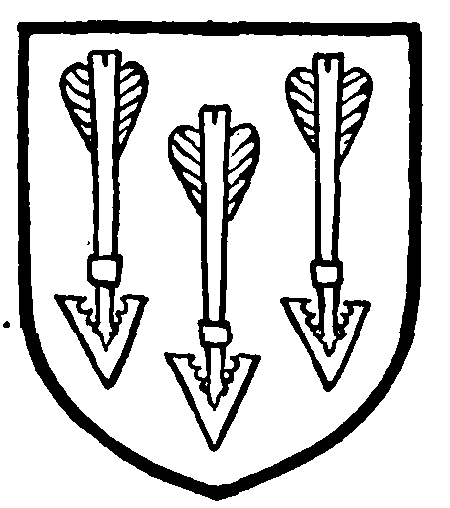
Archer of Umberslade. Azure three broad arrows or with their points downwards.
The Public Hall was built in 1909 at a cost of £1,400. It was used as a Voluntary Aid Auxiliary Hospital during the war of 1914–18. Near-by is the Police Station, at the rear of which is a room where Henley Petty Sessions (fn. 38) are held.
Manor
The manor of HENLEY descended with Beaudesert (q.v.) until the time of the lordship of the Archers of Umberslade. From Thomas Archer, who purchased it in 1672, it passed through his son Andrew (fn. 39) to his grandson Thomas, who was created Baron Archer of Umberslade. He was succeeded by his son Andrew, 2nd Lord Archer, who died in 1778 without a son, when the manor went to his daughters as coheirs. (fn. 40) It was then held by the husbands of these coheirs, but in 1812 Christopher Musgrave, who had married the second daughter, the Hon. Anne Elizabeth Archer, is named as lord. (fn. 41) In 1840 this lady herself is stated to be holding it, and she was succeeded by her son Capt. Christopher Musgrave, who was in possession of it in 1850. (fn. 42) From him Darwin Galton of Claverdon purchased it in 1873. At his death in 1903 it passed to his widow Mrs. P. M. E. Galton and descended to Edward Galton Wheler, his nephew, who sold it to William John Fieldhouse, C.B.E., J.P., of Anstey Manor in 1914. Mr. Fieldhouse died in 1928 and left it to his son and daughter, Ernest Francis Fieldhouse and Olive Nancy the wife of Major C. W. Barnard, M.C., of Oldberrow, who now hold it jointly.
In 1608 (fn. 43) the bounds of the manor are defined as running from 'the Little Parke Corner' to Blackford Bridge, down the stream to Hobdayes Mille alias Nethermill (now Blackford Mill), by the Mille Lane to Stratford road and so by Gallowes slade to Mayoes Lane (running past May's Wood), up the lane to Newenton Ponde, to Fulses bridge (over a ditch near the junction of Oldberrow Road), then northwards for ½ mile to the Great Park and along its south edge to a close called Parke Shipton (fn. 44) stile and to the lane opposite Little Park Corner. There were then 61 free tenants, but only 20 of them held any land, mostly less than 5 acres, apart from that attached to their houses; this points to Henley having retained its original status of a predominantly trading centre.
Church
The church of ST. JOHN THE BAPTIST consists of an undivided chancel and nave (about 74 ft. by 21½ ft.) with a north aisle and vestry, a tower west of the aisle, and a porch west of the nave. The main body of the church is probably of about 1450 and the aisle somewhat later in the same century. The tower is earlier than the aisle and probably also than the nave, as it is not placed symmetrically with either and encroaches on both with its buttresses. The church was restored in 1900.
The east window is of five cinquefoil lights and vertical tracery with moulded labels and head-stops. In the north wall is a four-centred doorway with shafted moulded jambs and head. West of it is the north arcade of four bays: it has tall octagonal pillars with plain bases and moulded capitals. The arches are of depressed four-centred form with moulded labels that have head-stops of men and women with varied headdresses. There is no west respond, as the arcade abuts the tower archway and the arch is carried on a corbel carved as a winged monster. In the south wall are five three-light windows, in keeping with the east window. The labels have head-stops, each with a different kind of tall head-dress; one has a mitre, another is double-horned. The walls are of squared rubble with a moulded plinth. Between the south windows are buttresses with moulded offsets to the two stages.
The entrance is in the west wall and has moulded jambs and four-centred arch with a crocketed moulded label with king and queen head-stops. The window above is of four lights and tracery like the others.
The north aisle (fn. 45) has an east and two north windows each of three ogee-headed lights and vertical tracery in a four-centred head; the internal labels have grotesque reptilian stops rather like those in the clearstory at St. Peter's, Wootton Wawen. The north doorway, which has been set inside out, has mouldings like those of the west and vestry doorways. The aisle walls are of rubble and have a plinth of different mould from that of the south wall.
The gabled roof of the main part is in five bays, divided by trusses with braced cambered tie-beams and queen-posts with curved braces under a collar-beam. The side-purlins have curved wind-braces forming four-centred arches. The trusses are carried on stone corbels carved as angels with shields. The aisle has a lean-to roof of four bays, divided by main crossbeams with curved braces under their lower ends carried on plain stone corbels.
The tower is of two stages, built of ashlar externally and rubble internally. It has diagonal buttresses, the eastern two projecting into the nave and aisle: the parapet is embattled. At the south-west angle is a stair-vice with a pointed doorway. The archway towards the nave is of two chamfered orders, the inner with moulded capitals; the head is two-centred. The west window is of two trefoiled pointed lights and a quatrefoil of late-14th-or early-15th-century form in a four-centred head. The next story has a single trefoiled light, over which the string-course is lifted, in each of the three outer walls, and the bell-chamber has in each wall a transomed window of two cinquefoiled lights and tracery in a four-centred main head with a label and carved stops.
The west porch, against the south side of the tower, has an entrance like the inner west doorway, but with beast or monster stops to the label. The south face is divided into six panels with trefoiled heads, of which the two middle bays form a two-light window. At the south-west angle is a diagonal buttress, and the parapet is embattled. It has a flat roof of ancient timbers.
The font is octagonal with a shallow bowl of the 17th or 18th century, plain stem, and chamfered base. It has a flat lid with a turned middle post.
The pulpit is of the early 16th century; it has six sides of a duo-decagonal plan. Each side has a panelled traceried head formed by a pair of trefoiled pointed arches with rosette cusp-points and springing from a middle carved corbel, and a pair of quatrefoiled circles. Below, each panel is carved in relief with a linenfold pattern. The moulded oak top-rail and the stone base are modern.
The oldest mural monument is to Simon Kempson (son of William Kempson of Hillborough) 1719, aged 77, and Margaret (Betham) his wife, 1699.
The memorial of the 1914–18 war is a brass plate.
In the tower are the painted Royal Arms of the Hanoverian period.
There are six bells, rehung in 1910.
The plate includes a large plain cup given in 1732; a paten given in 1792; and a flagon, probably of the Restoration period. (fn. 46)
The registers begin in 1679 and are almost confined to baptisms; there being no burial ground at Henley, only a few burials in the chapel itself are recorded, and no marriages until 1864, except for a few in the first volume, covering 1679–1766, and in the single year 1816.
Advowson
Although a felon is said in 1262 to have taken sanctuary in the church of Henley, (fn. 47) it is almost certain that this refers to Beaudesert, as there is no other reference to a church here until 1367, when it is recorded that a chapel had been built at the cost of the inhabitants because of the distance and foulness of the ways in winter between the village and the parish church of Wootton Wawen. (fn. 48) In 1369 William Fifhide was licensed to alienate in mortmain three messuages in Henley for the support of a chaplain to celebrate in a chapel which he intended to build there, (fn. 49) presumably as part of the new parish chapel. No trace of these buildings remains, except perhaps the tower, the body of the present church being a century later in date. The chapel remained subordinate to Wootton, but was so closely identified with the gild (see below) that it was seized into the king's hands in 1546. The inhabitants, however, successfully pleaded to be allowed to retain it. (fn. 50) During the Commonwealth, in 1658, a grant of £30 was made for the maintenance of a minister at Henley. (fn. 51)
Henley became a separate ecclesiastical parish in 1914. The inhabitants had long had the appointment of their minister, (fn. 52) but when Henley living was united with Beaudesert (in Crown patronage) in 1915 the combined benefice was put under the joint patronage of the Bishop of Coventry and the High Bailiff of Henley. (fn. 53)
It seems likely that the religious activity of 1367–9 may have been connected with the founding of the important GILD, though the first known reference to this is in 1408, when John Brome of Lapworth and Margery his wife granted the reversion of lands in Henley and Studley to 'the Gild of the Holy Trinity, St. John the Evangelist and St. John the Baptist'. (fn. 54) In 1428 the Pope granted an indult to choose confessors to the brethren and sisters of this confraternity, (fn. 55) and in 1434 John Stokes, then Master of the Gild, was one of those from whom the knights of the shire were commissioned to receive the oath. (fn. 56) The commissioners in 1546–7 (fn. 57) stated that the gild was founded by Ralph Boteler (fn. 58) for four priests to sing divine service within a chapel of St. John the Baptist and to pray for the founders' souls, and that he gave thereunto lands and possessions of the yearly value of £27 16s. 3d. These rentals were received from properties at Henley, Beaudesert, Wootton Wawen, Lapworth, Tanworth, Beoley, Warwick, Preston Bagot, Claverdon, Ullenhall, and Whitley. There were then three priests, of whom John Whately was paid £5 10s., and the other two £5 each, yearly; also an organist, who received £2 a year and a dwelling with a garden. A sum of 13s. 4d. was spent on obits and alms to the poor. The confiscated property was disposed of piecemeal, (fn. 59) 'the Gilde' (presumably the Gild Hall) being subsequently bought by 'Mr. More, a Bedfordshire man'. (fn. 60) In 1623 the Gild Hall is described as a building of 5 bays, with a kitchen and a barn, then converted into a tan house of 4 bays, and a garden of ¼ of an acre, extending to 'Belsore' brook. All of which was in the tenure of Wm. Smyth, tanner, and of the yearly value of 10s. (fn. 61)
A 15th-century seal (fn. 62) showing the Trinity in a canopied niche, with St. John the Evangelist and St. John the Baptist in smaller niches on either side, seems to belong to the gild, though the legend—sigillum burgen[sium?] de henleye—identifies it with the borough. As the borough was not incorporated it is probable that the burgesses acted in a corporate capacity through the gild.
Charities
George Whateley's Charity. By deed dated 28 Sept. 1586 George Whateley granted to trustees a messuage (now the Church of England Sunday School) in Henley, and rents of 20s. from land in Ullenhall and of 10s. from a house in Evesham, half of the annual income to go to a schoolmaster in Henley and the other half to the poor of the town. The house in Evesham was bought under a bequest in Richard Whateley's will, of 28 Nov. 1603. The property, now represented by investments, produces an income of £34 10s. 10d.
John Whateley's Charity. In 1581 John Whateley left a house and garden in Henley for the 'neediest inhabitants' of the town. The property was sold in 1930 and the proceeds invested, producing £3 8s. annually.
Thomas Wheatley's Charity. The origin of this charity is unknown. The endowment consists of a rent charge of £2 formerly received from the Mayor of Coventry out of certain rents receivable by him and distributed to four poor men of Henley. The charge is now paid by the Trustees of the Coventry Charities.
John Heming in 1620 gave four tenements for the use of the poor. The property was sold in 1924 and the proceeds invested, producing £10 11s. 10d. annually.
John Randall in 1626 granted to trustees a yearly charge of 20s. issuing out of Lankford Meadow and Godson Close, Preston Bagot, to provide two gowns yearly for two poor widows of Henley.
Oliver Dalton by will dated 31 Aug. 1636 gave to the minister and churchwardens an annuity of 20s. issuing out of Ivy House, Packwood, to be distributed among 20 poor people of Henley.
Lady Fullwood's Charity. According to the Parliamentary returns of 1786 Lady Fullwood gave a rentcharge of 17s. 9d. for the poor of Henley, but the date and particulars of the gift are not known. The charge is made up of small yearly payments from property in Henley and Tanworth and is regularly received.
William Chambers by deed dated 23 March 1641 (–2) granted a yearly rent of 6s. 8d. out of a cottage in Henley adjoining the Swan upon trust to pay the rent to 20 poor widows. The charge is now paid out of premises called Burman House.
Foulke Bellers by will dated 15 Sept. 1633 gave a yearly sum of 12s. to 10 poor widows of Henley payable out of several houses in Evesham. Of this sum, later reduced to 10s., part is represented by £10 Consols, producing 5s. annually; the remaining 5s. is now paid out of No. 66 High Street, Evesham.
Barbara Ingram by will dated 4 July 1698 gave a yearly rent-charge of 12s. out of a cottage at Ullenhall to be distributed in bread to the poor of Henley and Ullenhall equally.
John Hemming by will dated 28 Feb. 1683 (–4) gave the yearly sum of 40s. charged on his house at Beaudesert, for setting poor children to school.
Edmund Fullwood in 1702 conveyed to trustees 4 acres called Little Whistons, in Tanworth, for the poor of Henley. Part of the land was taken by the Stratford-on-Avon Canal Company for a yearly rent of 7s. 8d. and the remainder was sold in 1927, and the proceeds invested produce £5 0s. 2d. annually.
Christopher Baker by will dated 21 March 1716(–7) devised three tenements in Henley to trustees to pay 20s. yearly to the parson of Henley, 5s. to be expended in good and pious books to be given to poor children, and the remainder to the poor. The property was sold in 1917 and the income amounts to £4. 7s. 6d.
Unknown Donor's Charity. The endowment of this charity consists of a house in High Street, Henley, let at £5, and a rent-charge of 10s. issuing out of a close called Woad or Wad Close. (fn. 63)
Joseph William by will dated 8 May 1796 gave to the chapelwardens £50, the interest to be applied for the poor of Henley, one moiety in money and the other in bread. The legacy is now represented by £50 Consols.
Simon Kempson in 1674 granted a yearly rent of 10s. out of land called Tenter Close for the benefit of the inhabitants of Henley.
The above-mentioned charities are now regulated by a scheme of the Charity Commissioners of 8 July 1879 (as varied by a further scheme of 3 Feb. 1911) under the title of the Henley-in-Arden General Charities. The schemes appoint a body of 10 trustees and provide for the application of the income of the charities amounting to about £75 per annum; viz. after the payment of costs and of £1 5s. to the vicar of Henley out of the Baker Charity and 18s. to the churchwardens out of the Fullwood Charity, one moiety of the income to be applied to educational purposes and the remaining moiety to poor persons resident in Henley.
William Randoll by will dated 11 April 1642 gave a legacy with which land was bought in Alveston, Tiddington, and Hampton, the rent of which was applied in setting out poor children as apprentices. The land was sold in 1924 and the endowment now produces £77 3s. annually. The charity is administered with the General Charities, any surplus after apprenticing children being applied to educational purposes.
Edwin Lancaster by will dated 2 Feb. 1922 gave to the trustees of Randoll's Charity a legacy amounting to £1,618 8s. 3d., producing £57 9s. 8d. in dividends, which are applied for the relief of the poor.
Hopkins' Charity. Daniel Morris Hopkins by will proved 12 Aug. 1880 gave £250, for the benefit of the poor. The annual income of £10 3s. is distributed to poor widows by the trustees of the General Charities.
William John Fieldhouse by will proved 5 Feb. 1929 gave to the vicar and churchwardens £500, the interest to be distributed in bread and meat to poor aged persons. The interest, amounting to £23 7s. 8d., is so distributed.
Harriet Radburn by will proved 2 June 1908 gave £200 to the Baptist Church, Henley-in-Arden, the interest to be paid to the deacons for the support of the pastor of the church. The interest now amounts to £6 7s. 4d.
Frederick Johnson by will proved 7 Dec. 1903 bequeathed an estate amounting to £1,753; and of this £953 0s. 10d. was expended in the erection of almshouses and the balance was invested to produce an endowment of £30 17s. 2d. annually.
The Rev. Devereux Wilson of Oldberrow by will of 19 May 1725 gave certain rent-charges for the support of a charity school to be erected in Henley and for the augmentation of the grammar school 'at present erected in Henley'. This charity is now represented by stock producing £5 4s. 6d., all of which is paid through the rector towards the work of the Sunday School.