A History of the County of Warwick: Volume 3, Barlichway Hundred. Originally published by Victoria County History, London, 1945.
This free content was digitised by double rekeying. All rights reserved.
'Parishes: Wroxall', in A History of the County of Warwick: Volume 3, Barlichway Hundred, ed. Philip Styles (London, 1945), British History Online https://www.british-history.ac.uk/vch/warks/vol3/pp215-220 [accessed 30 April 2025].
'Parishes: Wroxall', in A History of the County of Warwick: Volume 3, Barlichway Hundred. Edited by Philip Styles (London, 1945), British History Online, accessed April 30, 2025, https://www.british-history.ac.uk/vch/warks/vol3/pp215-220.
"Parishes: Wroxall". A History of the County of Warwick: Volume 3, Barlichway Hundred. Ed. Philip Styles (London, 1945), British History Online. Web. 30 April 2025. https://www.british-history.ac.uk/vch/warks/vol3/pp215-220.
In this section
WROXALL
Acreage: 1,651.
Population: 1911, 148; 1921, 143; 1931, 117.
Wroxall lies about 6 miles north-west of Warwick and 14 miles south of Birmingham, the road between those towns running north to near the centre of the parish, where a height of 415 ft. is reached, and then bending to the north-west. At the bend a road leads north-east past Manor Farm, a typical late-17thcentury brick building, and then turns east to Honiley. Just beyond the start of this road a small road branches off north and then west to Nunley Farm. The land is slightly undulating, ranging between 375 ft. and 415 ft., and the soil is varied, with a clay subsoil, growing chiefly wheat and beans. The southern portion of the parish, west of the Warwick-Birmingham road, is mostly occupied by the Abbey (fn. 1) estate, including the church. There are a few small woods and coppices in the centre of the parish. The common fields were inclosed in 1835–6.
The extent of the parish was formerly larger, including two detached portions: Shortwood Farm (c. 40 acres), wholly surrounded by Beausale, and Mousley End Farm (c. 173 acres), between Rowington and Shrewley. These were attached to Beausale and Rowington respectively between 1883 and 1886, and finally amalgamated with those parishes in 1893. (fn. 2)
Apart from the church (see below) there are only scanty remains of Wroxall Priory. (fn. 3) The roofless ruins of two buildings exist south of the church. The smaller is about 16 ft. square and 37½ ft. from the church, nearly opposite the thickened solid bay of the south wall. It has a west doorway similar to the north-west doorway of the church, with the same peculiar foiled rear-arch. The chamber was vaulted. The north and south walls each have a 3-in. shaft in the middle and in the west angle, of octagonal form with 14th-century moulded capitals, and one or two lower stones of the chamfered ribs. The eastern shafts are covered by the later east wall. The walls inside are ashlar-faced with square blocks. Externally, the west wall has a straight joint 3 ft. 9 in. north of the doorway, and north of that is later repair. The north wall is of ashlar with some brick and tile creasing: a length of 5 ft. 10 in. at the west end has two weather-courses or offsets 4 ft. 9 in. and 6 ft. 5 in. above the grass. The middle part of the wall is of 17th-century red brick with stone angles. The south wall is of ashlar. The east wall is thinner than the others; it is of ashlar and had a window with rough square jambs; a broken south edge shows that it continued to the south. It is probable that this was the Chapter House, and it appears to have extended eastwards, or it may have had an apse.
The other ruin, nearly 80 ft. south of the church, has the east and parts of the north and south walls of a hall, probably part of the priory frater originally and afterwards adapted. It is about 17 ft. wide, and about 35 ft. of the length remains from the east wall to the broken ends of the side walls. The east wall, 3ft. 10 in. thick, alines slightly west of the west wall of the other building; it is of coursed ashlar with fairly wide joints: a rough doorway cuts through the north end and at the south end is a buttress of two stages.
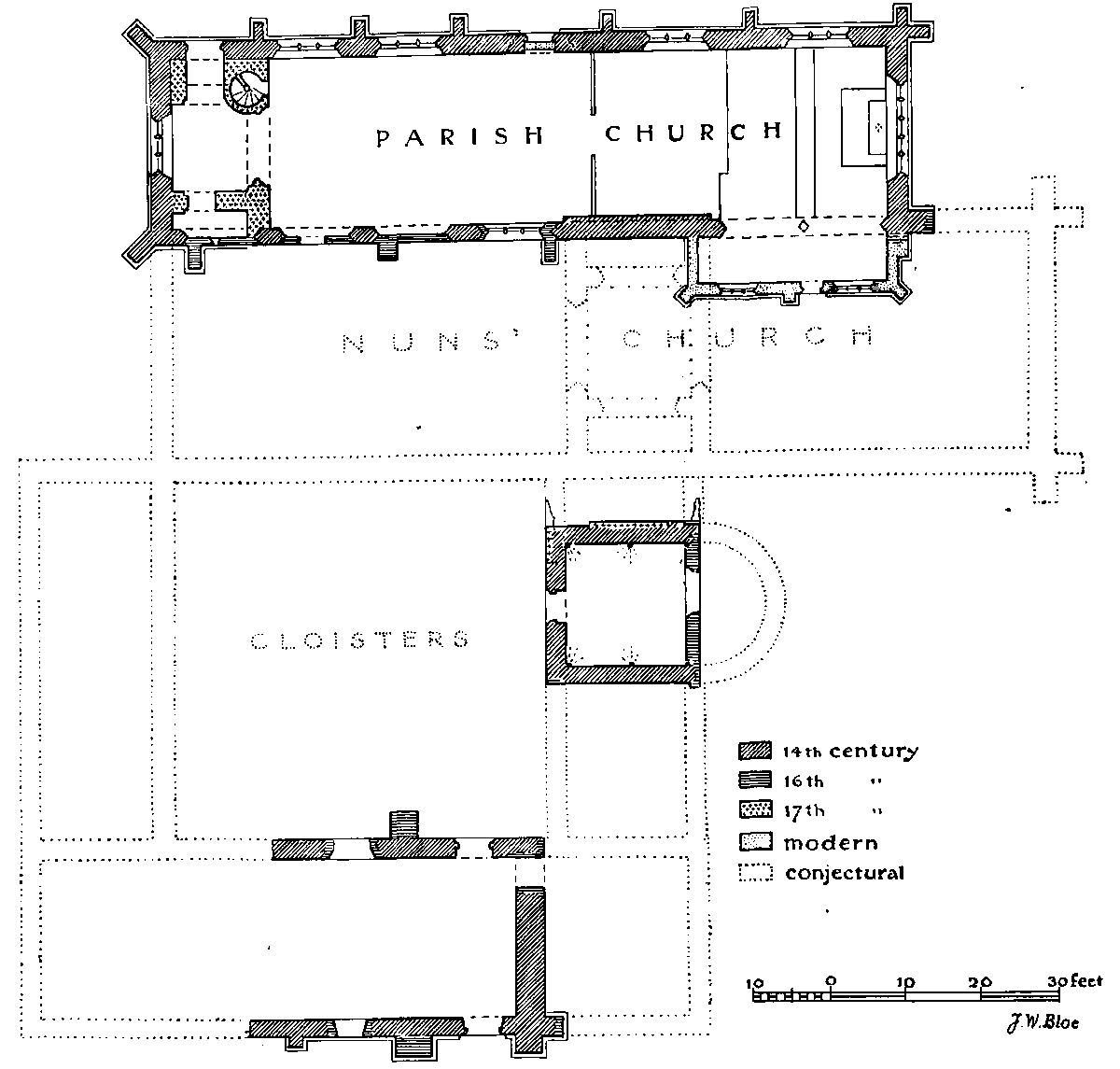
[Plan of Wroxall priory]
Original doorways to the screens passage pierce the north and south walls at the east end. The northern has jambs and pointed head of two orders, the inner chamfered, the outer moulded, and a hood-mould of the 14th century. The segmental-pointed rear-arch is chamfered. The south doorway has been robbed of its outer stonework. A window in each wall, next west, retains only the ashlar splays and the southern has a chamfered, segmental-pointed rear-arch. A buttress between the north doorway and window is of two stages and has a plinth like that of the church. The south wall has three buttresses with chamfered plinths. The walls are 2ft. 8 in. thick and have good ashlar faces inside and out.
In the smaller building are many loose stones and a disused font of the 16th century: this is octagonal and has splayed sides to the bowl, with a roll lower edge, and stem with broach stops at the base. The loose stones include three rounded bosses carved with foliage, one with a man's head in the centre; also a stone with a quatrefoil piercing, and several pieces of coffin lids, one with a raised plain cross and stem, another with an incised cross with flowered ends. Piles of other stones are used in the grounds for rockeries, &c.
The house built by the Burgoynes about the end of the 16th century occupied the site of the whole of the western range of the cloister. It had symmetrical wings projecting westwards, with a porch in the angle of the south wing and the hall block; the back (east) elevation was of half-timber construction and probably earlier, perhaps retaining some of the monastic masonry in its lower story. The whole was demolished by Mr. James Dugdale about 1864. (fn. 4) The present house and its auxiliary buildings are entirely modern. In the gardens north-west of the church is an early-18th-century iron gate with gate-posts of red brick, having moulded stone caps and urns as finials. Another pair of gate-posts east of the church has rustications of brick, stone moulded caps, and ball finials. Contemporary brick walls at right angles to each other connect the two. The curious garden walls, built with curves to form wind-breaks, are attributed to Sir Christopher Wren.
Manor
WROXALL does not appear in the Domesday Survey, but, in the reign of Henry I, Henry de Neuburgh, Earl of Warwick, was chief lord of the fee and one Richard held the manor of Hatton with Wroxall of him. (fn. 5) Hugh son of this Richard founded the priory of Wroxall in about 1141. (fn. 6) He gave to the nuns 'all the land of Wroxall' together with lands round about, and also, inter alia, the church of Hatton.
The manor of Wroxall belonged, therefore, to the priory from the time of its foundation until its dissolution in 1535, (fn. 7) the prioress being the lady of the manor. It appears that at the time of the dissolution Sir Edward Ferrers (fn. 8) of Baddesley was steward of the Prioress Agnes Little and one Richard Shakespeare (fn. 9) was her bailiff. In June 1542 Henry VIII granted to Richard Andrewys of Hayles, co. Glos., and Leonard Chamberlyne of Woodstock, co. Oxon., inter alia, certain lands and other hereditaments, including the court baron and court leet in the parish of Wroxall, late of the priory of Wroxall. (fn. 10) At the same time they were permitted to alienate them (fn. 11) and accordingly conveyed them to Robert Burgoyne. The transaction was confirmed on 8 Dec. 1544, when Henry VIII granted (fn. 12) to Robert Burgoyne and John Scudamore the house and site of the late priory of Wroxall, the fishing of Wroxall Poole, together with the gardens, orchards, &c., then in the occupation of Richard Coke; (fn. 13) also the rectory and tithes of the parish of Wroxall, for £588 12s. 4d. John Scudamore at once released his interest to Burgoyne. (fn. 14) Robert was the younger of the two sons of John Burgoyne of Sutton, co. Bedford, and was one of the commissioners appointed by Henry VIII to take surrenders of monasteries in Warwickshire. He died in 1545 (fn. 15) and probably never resided at Wroxall. He was succeeded by his son Robert, who was residing in the parish in 1580, (fn. 16) and who appears to have pulled down part of the religious house and built a mansion in Elizabethan style on the site of the west side of it, adapting the southern and eastern sides of the original building to domestic uses. (fn. 17) Here he lived till his death in 1613. (fn. 18) He married Judith daughter of Sir Thomas Wroth of Enfield, Middlesex, and was high sheriff of the county in 1597. His son Roger appears to have resided chiefly at his ancestral estate at Sutton, but he was high sheriff of Warwickshire in 1631, and he added to the Wroxall estate certain lands in Balsall and was also lord of the manor of Honiley (q.v.). He died in 1636, (fn. 19) being succeeded by his son John, who appears also to have resided at Sutton. He was Member of Parliament for the county of Warwick in 1641 and was created a baronet in 1642. He appears to have settled the Wroxall estate upon his eldest son Roger some time before his death, which occurred in 1657. Sir Roger Burgoyne, having taken a prominent part in the Civil War upon the side of the king, was abroad when he succeeded to his father's title and estates, but he returned to Wroxall in 1661. (fn. 20) He repaired the church in 1663 and emparked about 60 acres of land round the mansion. He died in 1677 and was succeeded by his son Sir John Burgoyne, who married Constance daughter of Richard Lucy of Charlecote. Sir John died in 1705 and his son Roger, dying in 1711, was in turn succeeded by his son John. Sir John Burgoyne unfortunately survived his father only six weeks and on 29 Aug. 1713 the Wroxall estates of the family of Burgoyne, after an uninterrupted succession for 169 years, were sold (fn. 21) by Constance (Middleton) widow of Sir Roger Burgoyne, and the trustees of her marriage settlement (fn. 22) to Sir Christopher Wren, the famous architect, who at the time was SurveyorGeneral to Queen Anne, for £19,600. At this date the estate consisted of 1,850 acres, including 60 acres of wood in the park, and Shortwood, containing 60 acres and 270 acres of common. Sir Christopher Wren died in 1723 and was buried in the choir of St. Paul's Cathedral. He probably never had much personal connexion with Wroxall, but his son Christopher resided in the parish and in 1715 married Constance widow of Sir Roger Burgoyne. By his first wife, Mary Musard, who had died about 1711, he had had one son, also named Christopher, who succeeded his father in 1747 and resided here. He died in 1771, leaving the estate to a fourth Christopher, who was his second son, the oldest, Thomas, having predeceased his father. From 1771 onwards the family does not appear to have resided at Wroxall, the house being let to Samuel Aston of Birmingham, who in 1806 purchased property in Rowington (q.v.). This fourth Christopher Wren died in 1797 and was succeeded by his son Christopher Roberts Wren, who in 1801 was in India and remained there till 1812, when he returned to Wroxall. Soon after his return he began to restore the church and spent large sums upon the mansion, which until then had remained almost unaltered since it was built by the Burgoynes. He was sheriff of the county in 1820 and died in 1828. The Wroxall estates then descended to Theodosia Ann Martha, youngest daughter of Christopher Roberts Wren, who in 1837 married Chandos Hoskyns, second son of Sir Hungerford Hoskyns, bart., of Harewood and Morehampton, co. Hereford. Chandos Hoskyns, upon his marriage, assumed the additional name of Wren and quartered the arms of Wren with Hoskyns. He did much to transform the landscape of the parish from its former bleak appearance to the present wooded and park-like one. Mrs. Wren widow of Christopher Roberts Wren was the tenant for life of the Wroxall estates and resided there until her own death in 1853. In 1860 Chandos Wren Hoskyns retired to Harewood. He sold his Wroxall estates in 1861 to James Dugdale of Dovecot House, near Liverpool, who demolished the old mansion and built a new one on an adjoining site. James Dugdale was sheriff of the county in 1868 and died in 1876. His eldest son James Broughton Dugdale died in 1932 without issue. The present owner, Lt.-Commander James George Greville Dugdale, R.N., J.P., is a nephew of the previous owner and a son of Frank Dugdale, esq., and Eva Sarah Louisa, a daughter of George Guy Greville, Earl of Warwick. The house is now tenanted by a school for girls.
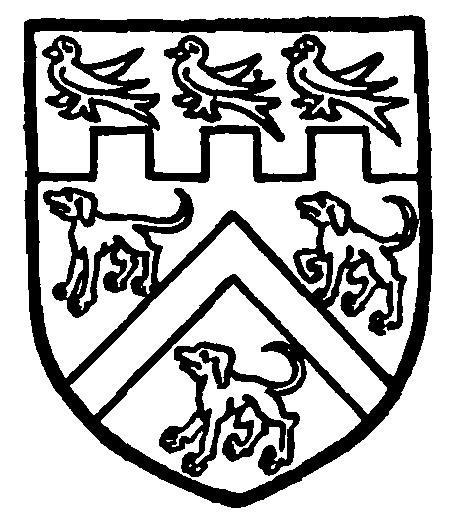
Burgoyne. Gules a cheveron or between three talbots argent and a chief battled argent with three martlets azure therein.
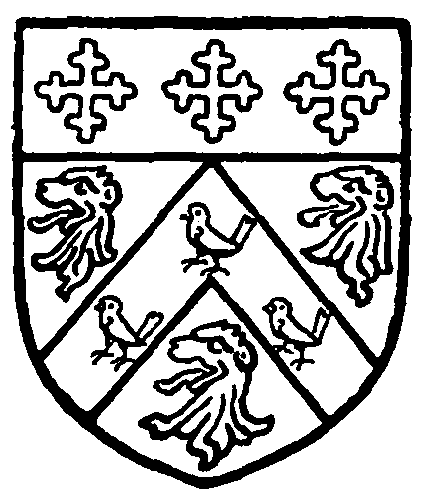
Wren. Argent a cheveron sable between three lions' heads razed azure with three wrens argent on the cheveron and a chief gules with three crosslets or therein.
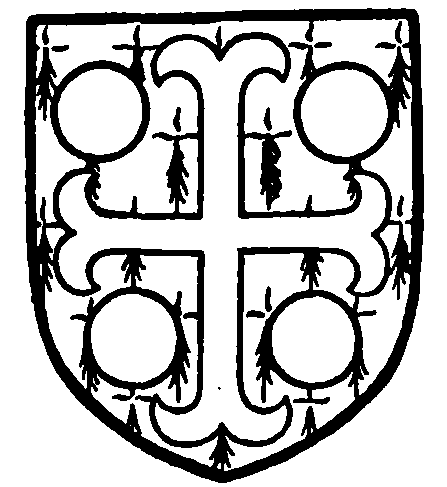
Dugdale. Ermine a cross moline gules between four roundels azure.
Church
The parish church of ST. LEONARD was originally structurally part of the priory church, but it is probable that this part was always assigned to the parishioners and that the destroyed portion south of it constituted the church of the nuns. It is a rectangular structure 94 ft. long by 22 ft. wide, dating from about 1315 (fn. 23) and having the west tower of 1663–4 (fn. 24) built within the west end. At the east end of the south side is a modern organchamber.
The east window is of five cinquefoiled lights and vertical tracery in a two-centred head with a chamfered segmental rear-arch—probably 15th-century tracery in a 14th-century opening. The east wall is of ancient ashlar with a moulded plinth and has a low-pitched gable. At the angles are pairs of square buttresses: the northern are original, the south buttress on the east face is a wider one with the plinth on the north face only, and next it at the top is a short sloping chase, indicating that the buttress was the stump of the north wall of the former main chancel, the chase marking the line of its roof.
The north wall is divided into six bays by original buttresses; the three eastern bays average 18 ft. in width, and the three western 12 ft. The wall is of lias ashlar and has a moulded plinth and an embattled parapet. In each bay except the westernmost is a window of three trefoiled lights with foiled piercings above the side lights, the middle light reaching to the apex of the two-centred main head; the segmentalpointed rear-arches are chamfered. The sections of the jambs and mullions are the same as those of the east window. The third has a higher sill and below it is a blocked 14th-century doorway, 3 ft. 4 in. wide, with a pointed head and of two orders; the inner has a hollow containing ball-flower ornament; the outer order may have been similar but is perished. In the westernmost bay, now giving access to the tower, is another pointed doorway, 3 ft. 1 in. wide, with jambs and head of two double-chamfered orders. (fn. 25) It has a cinquefoiled segmental rear-arch and segmental-pointed relieving arch. There was formerly a porch (? 16th century), but this had disappeared before 1867. (fn. 26) A rain-water head in this bay is inscribed C.W. 1714, and two others J.D. 1868. The interior of the wall is ashlar-faced, the courses being broken above the windows—probably later repair. A straight joint 1 ft. 6 in. east of the splay of the third window and parts of another about 3 ft. farther east suggest that there was a cross-wall, but there are not similar lines on the south side.
The south side has an arcade at the east end, of two bays, opening into the shallow modern organ-chamber. The middle pier is a square with sunk-chamfered angles and four attached round shafts; it is a modern copy of the original (fn. 27) and similar to the responds, which have 14th-century moulded capitals and bases. The pointed arches are of two sunk-chamfered orders and of medium-small voussoirs. The arcade was walled up like those to the west, and opened out when the chamber was added. The next bay is a solid one of ashlar, with very large stones; it is 19½ ft. long and breaks forward 6 in. inside, so that it is 3 ft. 4 in. thick as against 2ft. 8 in. for the remainder of the south wall. It sets back to the main face about 5 ft. below the wallplate of the roof. In it, at a height of 15 or 16 ft., is a sunk square panel with chamfered edges. It may be a former opening, but no trace of it is visible outside. The external face is patched with red sandstone and there is a weatherworn sloping line as though the wall was met by a former roof either of a cross transept or the aisle of a central tower of the same type as that of Rowington Church. (fn. 28)
The remainder of the south wall contained an arcade of four bays of from 10 to 10½ ft. span each, divided by piers or short lengths of wall of from 2½ to 3½ ft., with moulded responds like those to the eastern arcade. All are walled up. The filling of the easternmost is flush with both faces and contains a window in red sandstone of three plain pointed lights in a two-centred head, presumably of post-Reformation date. The filling walls of the other bays are in the outer half of the thickness only, so that the moulded responds are partly exposed. In the third bay is a comparatively modern doorway with chamfered jambs and four-centred head. The main wall is of ashlar inside and out, with broken courses above the second and third arches. The blocking walls are of red and grey stone and have three buttresses against them. The parapet is plain and there are rain-water heads inscribed 1714 C.W., R.B. 1663, and J.D. 1868. The west window, now in the tower, is similar in detail to those in the north wall, but taller, and in the gable-head, lighting the first floor of the tower, is an original square-headed loop-light. The west wall is of ashlar and has later diagonal buttresses.
The west tower, of 1663–4 (about 10 ft. square), is built of red brick, the lower part being set within the nave. The east archway is of stone and has moulded responds with moulded capitals, and a two-centred head. North of it is a stair-vice with a round outer south face encroaching partly on the north respond of the archway. It is of brick with stone dressings and has a segmental-headed doorway towards the nave. North of the tower is a 5-ft. vaulted passage to the original north doorway, all of brick. South of the tower the residual space in the width of the nave forms a small vestry: this and the opposite side have lean-to tiled roofs against the tower. The tower above is of two stories and has west buttresses flush with the nave wall. The lower story on the south side has a loop-light with stone jambs and a modern trefoiled head. On the north side the wall at the same level is treated with a range of eight V-shaped pilasters or indentations in brick; at the east angle the stair-vice projects as a half-round, and has quatrefoil loop-lights. The bell-chamber is lighted by windows of two pointed lights in square heads with labels: in the north window the lights are trefoiled: others are restored with red sandstone. The parapet of brick is embattled and has a stone stringcourse. The circular stair-turret rises above it and has an embattled parapet.
The modern organ-chamber is only about 6 ft. deep. The eastern of its two south windows, probably reset from the blocked arcade, has three trefoiled lights in a four-centred head: probably of the early 16th century, but much restored. The other is a copy.
The roof of the main body is low pitched: it is divided into ten bays by the beams (with king-posts) carried on wall-posts and curved braces on modern stone corbels. The wall-plates are moulded and there are five purlins and a ridge pole, and they carry wide, flat rafters. Most of the old timbers had to be replaced in 1867, but the original design was carefully copied. (fn. 29)
The door in the north entrance may be of the 17th century: it has panels formed by nail-studded applied moulded ribs.
A good deal of ancient coloured glass, mostly of the 15th century, is preserved, mixed with modern work, in the east and north windows. The east window is mainly modern, but includes two panels, the Annunciation and the Presentation, which are partly ancient. The former shows the Virgin before a desk with an open book, in an ermine gown and blue mantle; the heads and upper parts are modern. The latter is old in the lower half; it shows the Virgin in a red and ermine gown and enriched blue mantle, the Child naked, St. Joseph in red and blue and holding a basket with two doves. The yellow and white tabernacle work in the heads of the lights is ancient, as are two winged monsters in the two smallest tracery lights.
The easternmost north window contains Our Lord in Majesty in a blue gown and yellow mantle, partly restored; St. Margaret and the dragon—only the scarlet dragon is ancient; St. Catherine—parts of the yellow mantle are ancient. Below each are remains of a kneeling figure, and other fragments. A part of the grisaille pattern background is also ancient. The second window is filled with similar grisaille pattern, partly ancient, as is some of the border of running vine pattern. The third window has a panel, with an arched and gabled canopy, containing a figure of St. Benedict in mass vestments and holding a book and staff: the head is later and does not fit. In the west light is the kneeling figure of a donor in a blue mantle: the head is a modern jumble; and in the east light is the kneeling figure of a Benedictine nun. The fourth window has repaired figures of St. James as a pilgrim, St. Bartholomew, and St. John holding a book. Below are the kneeling figures of a donor (filled in with jumble) and of a lady in a yellow gown and veiled head-dress with a gorget: each of the figures has a coffer by it. At the bottom of the lights are three old shields of arms:—1. bendy or and azure (Montfort); 2. gules two bars vairy (Say); 3. bendy argent and azure (? for Montfort). (fn. 30) The fifth window includes an Annunciation which may be partly ancient. Also a seated figure of a man in a brown cap, yellow mantle, and red gown, with a modern scroll, 'Ecce virgo concipiet' and ancient name, 'Isaia Prophet'. Of three shields at the foot of the window, one is ancient; it is charged: argent three bends azure (probably for Montfort).
The font is modern. The pulpit is modern but incorporates carved panels of the 15th century; below these is a traceried frieze. Dividing chancel and nave is a modern screen. A high dado of oak panelling round the nave and tower is made up from late-17th-and early-18th-century pews.
On the south wall of the nave is a 15th-century brass figure, 2 ft. 1½ in. high, of a woman in a veiled headdress and loose gown with a girdle and loose sleeves. It is said to have been brought from Brailes church. (fn. 31)
There are monuments to members of the Wren and Burgoyne families. There are three bells: the first of 1664 by Henry Bagley, the second of c. 1600 by a Newcombe of Leicester, and the third inscribed 'Assit Principio Sca Maria Meo' by Thomas Bullesdon of London. (fn. 32)
The registers (fn. 33) begin in 1556 but are missing for the period 1604–41.
Advowson
The precise legal status of Wroxall Church is not easy to ascertain, but it appears that it is a parish church or public chapel within the meaning of 4 Geo. II c. 76. sec. 22. It was originally the church of the nuns of Wroxall, who evidently assigned part of it to the use of their tenants and provided for the services of the church. The rectory belonged to the priory in such circumstances as to except it from the operation of 4 Henry IV, c. 12, by which religious houses were compelled to appoint as vicar a secular priest, not a member of the house and not removable at the pleasure of the house; and also to provide for his sufficient endowment. The nuns had complete rights over the fabric of Wroxall Church, and although the parishioners had, and still have, a prescriptive right to have services performed in the church, the incumbent was and still is a curate who has not, like others in similar circumstances, become a perpetual curate, because the owner of the church was not obliged to provide a fixed endowment for him; he therefore obtained no perpetual tenure, and remains in office only during the pleasure of the owner of Wroxall Priory. The legal position of the nuns in regard to the church passed to the Burgoyne family and subsequent owners of the estate after the Reformation.
Charity (fn. 34)
About 1504 a sum of £28 was given to trustees for the benefit of the poor of this parish. Part of this was used to buy land called Hudspits in Haseley, and part to buy land in Honiley (Waltham's Farm and Wood), and in 1522 these two trusts were amalgamated. (fn. 35) In 1683 lands in Rowington, which had long been in the hands of the Shakespeare family, were bought and assigned to trustees to use the rents for apprenticing poor children of Wroxall. All these lands were retained intact until 1836, when certain exchanges were made.
The charity is now regulated by Schemes of the Charity Commissioners of 14 June 1878 and 14 Sept. 1897. The 1897 Scheme appoints a body of 7 trustees to administer the charity, and the 1878 Scheme directs that out of the net income a yearly sum not exceeding £90 shall be applied to educational purposes, the residue to be applied for the benefit of poor inhabitants and for apprenticing in accordance with the directions contained in the Scheme. The income of the charity amounts to about £190 per annum derived from the rent of several properties and interest on various sums of stock.