
A History of the County of Warwick: Volume 5, Kington Hundred. Originally published by Victoria County History, London, 1949.
This free content was digitised by double rekeying. All rights reserved.
'Parishes: Chadshunt', in A History of the County of Warwick: Volume 5, Kington Hundred, (London, 1949) pp. 31-34. British History Online https://www.british-history.ac.uk/vch/warks/vol5/pp31-34 [accessed 26 April 2024]
In this section
CHADSHUNT
Acreage: 1,388.
Population: 1911, 36; 1921, 64; 1931, 59.
Chadshunt is a small parish, roughly rhomboidal in shape. The south-western boundary of the parish crosses the Kineton-Southam road at right angles at a point about ½ mile distant from Kineton. A stream which runs to the south of, and parallel to, this road marks the south-eastern boundary of the parish, while to the north-east the parish extends as far as the farm known as Bloxham's Barn, which lies on the KinetonSoutham road at a point half-way between the churches of Chadshunt and Gaydon. The parish rises gradually towards the north and east, its lowest point being in the neighbourhood of 250 ft. above Ordnance Datum, on the stream at its south-eastern corner, and the highest, about 422 ft. in the west of the parish near its northern boundary.
The parish is entirely agricultural, and by far the larger proportion of the land is under pasture. A stone quarry exists near the church, but it has not been worked for many years. The surface soil is a stiff clay, with loam in the northern part of the parish, bedded on blue lias.
The Broom, Stratford, and Blisworth line of the L.M.S. Railway runs for a short distance through the parish, crossing its southern corner, but there is no station within the parish boundaries.
The village of Chadshunt, situated at the junction of the lane from Lighthorne to Radway with the KinetonSoutham road, consists of little more than the church, Chadshunt Hall and outbuildings, and two farms.
Manor
The manor of CHADSHUNT was one of the 24 manors given to the monks of St. Mary's, Coventry, by Leofric, Earl of Mercia, in 1043, (fn. 1) and confirmed to them by Edward the Confessor in the same year. (fn. 2) In 1086 the Abbot of Coventry held 5 hides in Chadshunt valued at £7, (fn. 3) and the manor remained in the possession of the monks until the middle of the 12th century. In a charter of confirmation of King Stephen, however, made between the years 1145 and 1154, the monks are said to have recently recovered Chadshunt by precept of Pope Eugenius III. (fn. 4) Nevertheless, the same pontiff in 1152 confirmed Chadshunt to Walter Duredent, Bishop of Coventry and Lichfield, as of the temporalities of his see, (fn. 5) and it is certain that the successive bishops enjoyed possession of it. The Bishop of Chester, as he was then styled, was lord of the manor in 1279; (fn. 6) in 1291 the annual value of the bishop's temporalities at Chadshunt amounted to £12, (fn. 7) and four years later the bishop claimed view of frankpledge and assize of bread and ale together with other rights in his manor of Chadshunt. (fn. 8) The manor remained in the possession of the see (fn. 9) until 1547; on 20 February of that year the manor of Chadshunt and certain other properties were alienated by Bishop Richard Sampson to Thomas Fisher alias Hawkyns, for an annual rent of £50. The transfer was confirmed on 15 April of the same year, and on 14 December 1548 the bishop sold the estates to Fisher and released him from the £50 rent. (fn. 10) The transaction was probably, and reasonably, challenged by Sampson's successor Ralph Bayne, as in 1558 Fisher agreed to pay to the Bishop of Coventry and Lichfield a yearly rent of £82 10s chargeable on the manors of Tachbrooke, Bishop's Itchington, Chadshunt, and Gaydon, and the rectory of Fenny Compton. (fn. 11) Thomas Fisher died in 1578, and was succeeded by his son Edward, then 30 years of age. (fn. 12)
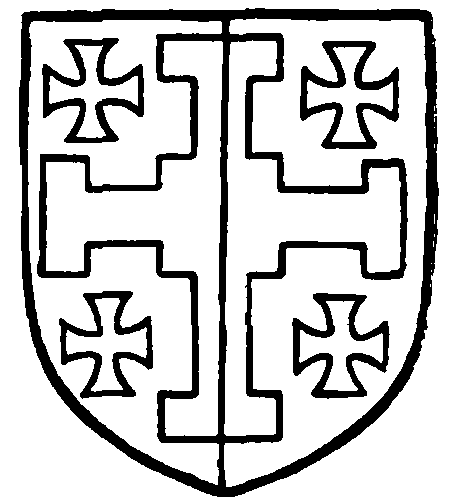
See of Lichfield. Per pale gules and argent a cross potent between four crosses formy counterchanged.
On 17 May 1552 Thomas Fisher enfeoffed Thomas Newsham or Newsam with the manor of Chadshunt, reserving the advowson, tithe, and church barn, to be held as of the manor of Tachbrooke, (fn. 13) in exchange for 13 yardlands in Itchington and a sum of £140. (fn. 14) On the death of Thomas Newsham on 7 September 1577 (fn. 15) the property went to his son Walter, who died in 1621. (fn. 16) Walter Newsham's son and heir John then inherited the property, and, dying in 1645, was succeeded by his son Thomas. (fn. 17) Thomas Newsham died on 10 March 1654 leaving his estates to a younger son Charles Newsham, who reached his majority in the same year. (fn. 18) Charles Newsham married twice, and on his death in 1705 Chadshunt passed to John his son by his first marriage. (fn. 19) John Newsham also married twice, on the second occasion Anne daughter and coheir of James Craggs the elder, one of the Postmasters General. (fn. 20) The only child of this marriage, James Newsham, was baptized on 9 October 1715, (fn. 21) and was but 9 years old when his father died in 1724. (fn. 22) James Newsham adopted his mother's surname of Craggs towards the middle of the 18th century, (fn. 23) and after squandering his fortune, mortgaged his estates to the Hon. Charlotte Digby. Following a decree of 22 June 1764 the property was put up to auction and bought by the Earl of Ilchester for £19,720. (fn. 24) James Newsham Craggs died in Flanders in 1769, (fn. 25) and on 7 March 1772 his kinsman, Newsham Peers of Alveston, co. Warws., agreed to purchase the Earl of Ilchester's interest for £22,293 15s. 5d. (fn. 26) Negotiations for the resale of the estate by Newsham Peers to the Earl of Catherlough were in progress at the time of the transaction, and in a codicil of 22 February 1772 appended to his will the earl directed that his executors proceed with the purchase of the estate in the event of his demise. (fn. 27) Robert Knight, Earl of Catherlough, died on 30 March 1772 (fn. 28) leaving his property to his natural son Robert Knight, a minor. His trustee was lord of the manor of Chadshunt in 1785. (fn. 29) Robert Knight the younger married Frances daughter of Lord Dormer on 12 June 1791. Their second daughter Georgiana married Edward Bolton King of Umberslade, co. Warws., (fn. 30) and resided at Chadshunt Hall, (fn. 31) though Robert Knight retained the lordship of the manor until his death, which occurred on 5 January 1855. (fn. 32) Georgiana King died in 1858, (fn. 33) and Edward Bolton King became lord of the manor. He died on 23 March 1878, (fn. 34) and was succeeded by his son Capt. Edward Raleigh King, who was lord of the manor in 1888 and 1900. (fn. 35) In 1924 Lord Willoughby de Broke was reported to be lord of the manor. (fn. 36)
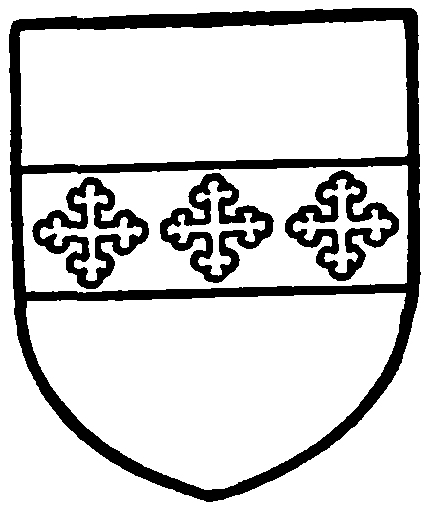
Newsham. Azure a fesse argent with three crosslets gules thereon.
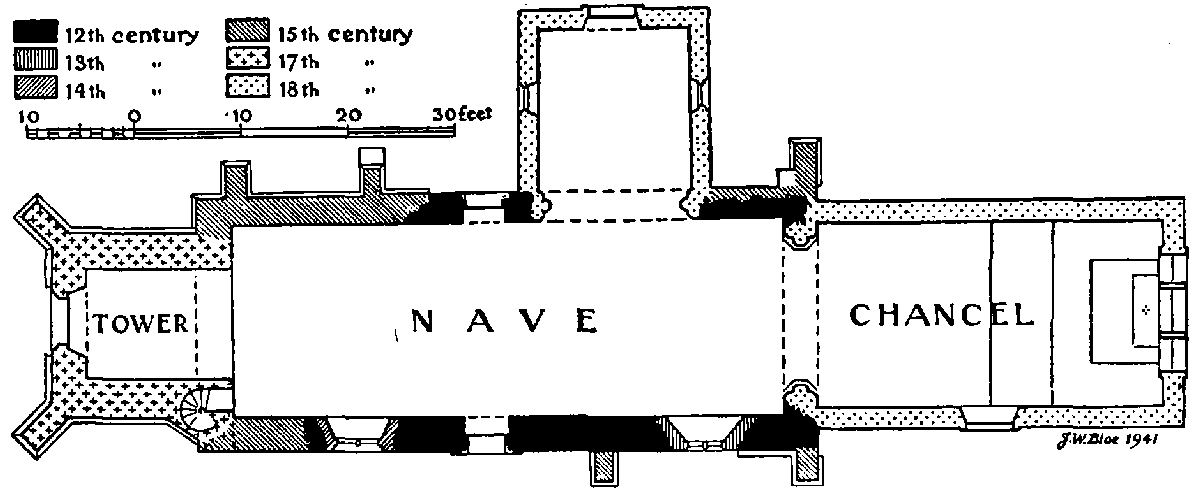
Plan of Chadshunt Church.
Church
The parish church of ALL SAINTS consists of a chancel, nave, north transept, and a west tower.
The nave is of mid-12th-century origin and retains the original north and south doorways. They are almost centrally placed and probably the nave was lengthened in the 14th century about 10 ft. westwards.
The clearstory of the nave and a new roof were added fairly early in the 15th century, the south wall was refaced externally, and buttresses were added. The west tower is a 17th-century addition or rebuilding, and the chancel and north transept were built c. 1730. An inscription plate records repairs of 1866, when new roofs were placed on the nave and tower; as the ancient timbers still survive, this evidently refers only to the lead covering and perhaps the rafters. A further restoration was carried out in 1906.
The chancel (about 31½ ft. by 17 ft.) has an 18thcentury east window of three lights, the middle light round-headed, also a round-headed south window: both have plain architraves. The north wall is unpierced. The floor is paved with black marble and white stone and is level with that of the nave. The coved ceiling is plastered. The walls are of brown Hornton stone ashlar. The east wall has a pedimental head differing in pitch from that of the gabled roof, which stands up above that of the nave.
The 18th-century chancel arch is of two chamfered orders.
The nave (about 51 ft. by 18 ft.) has a similar 18thcentury archway in the east half opening into the north transept. Next west of it is the 12th-century north doorway (3½ ft. wide in the clear): it has jambs of two square orders with the moulded bases and cushion capitals of nook-shafts with moulded and chamfered abaci. The west shaft remains, but the east shaft is missing. The semicircular head has a half-round bowtell to the soffit of the outer order and a double-chamfered hood. Externally the wall about the doorway is of irregular rubble-work, but to the west of it it changes to bands of ashlar alternating irregularly with courses of rubble-work, indicating a later lengthening of the wall. The two buttresses against it are of the 15th century. The nave-wall, to the east of the north transept, is of 15th-century rough ashlar in large courses and has an angle buttress. The buttresses and west bay have moulded plinths.
The only window in this wall is just west of the doorway in the clearstory; it is of two trefoiled lights under a square head with an external label and a segmental rear-arch.
The south doorway is similar to the other; it is complete but rather weather-worn. An attempt was made in the 14th century to give the head an ogee point at the apex. Both doorways have high semicircular rear-arches. The south window east of the doorway is of two 13th-century lancets and has very obtuse internal rubble splays and a chamfered segmentalpointed rear-arch. The window west of the doorway is a 14th-century insertion of two trefoiled ogee-headed lights and a quatrefoil in a two-centred head with an external hood-mould and pointed rear-arch. The masonry about the 13th-century window is rather more irregular than the remainder, which is of coursed Hornton stone ashlar. The ashlar west of the 14thcentury window is smoother than the rest. A stringcourse marks the base of the clearstory, which has three square-headed windows like that opposite. There was formerly a south porch. Below the eastern window is a 13th-century piscina with a trefoiled niche under a gable-head; about half the round basin is left. Next west are built in the half of a trefoiled ogee-head of a window, a fragment of a coffin-lid with a raised cross, and a stone with an 11-in. circular sinking, probably the space for a head in a stone coffin.
The roof is a low-pitched one of the 15th century, restored, and covered with lead. It is divided into five bays by six trusses having tie-beams, supported by wallposts and straight braces on stone corbels, and carrying king-posts. There are also wall-braces to the two east bays. The tie-beam is carved with square paterae; the second is moulded and has a soffit-boss carved with a Paschal Lamb and over it on the west face a bearded king's head. The third tie is chamfered and has a foliage boss. The western three are moulded, probably Tudor work, and two have rose-bosses. These last four ties have modern braces under the ends. The rafters are modern. Two of the stone corbels—the fifth and sixth on the north side—are carved with grinning faces. There are two lower corbels at the east end for a roodbeam.
The north transept (about 15 ft. deep by 14 ft. wide) has a considerably higher floor, probably above a vault. It is of similar material and date as the chancel. In the north wall is an elliptical-headed doorway and over it a round-headed window, and in the side walls similar windows. At the north end of the west wall is another doorway, walled up. The roof has a panelled barrel-vaulted ceiling.
The west tower (about 10¼ ft. square) is built of Hornton stone ashlar and has a chamfered plinth. The bell-chamber, which is diminished from the lower part, has a chamfered string-course at the base. The parapet is embattled. At the west angles are diagonal buttresses to the lower stage and at the south-east angle a splayed stair-vice, lighted by narrow loops, and also stopping below the bell-chamber. The two-centred archway to the nave is of two chamfered orders, the inner dying on the reveals. The doorway to the vice faces the nave south of the archway. In the west wall is a four-centred chamfered doorway with an old ribbed door, and over it a window of two plain four-centred lights under a square head. The bell-chamber has similar windows.
The three windows of the north transept contain twelve panels of Flemish coloured glass depicting various Biblical subjects, of early-18th-century date, set in surrounding glass dated 1855.
The font has a 12th-century round bowl; the sides are carved with an interlacing arcade and the moulded top edge is enriched with a kind of dog-tooth ornament. The base-mould of the bowl is of three cable-beads. The base has a 13th-century 'hold-water' mould and it is set on a sub-base which has a plain round mould above a splay.
In the floor of the nave is a brass inscription to Theophilus Wilkins of Gaydon 1613.
Below the south-east nave window is a mural brass plate to William Askell of Gaydon, 6 February 1613(4). It is engraved with his kneeling figure in a long mantle and ruff before a prie-dieu. On the south wall high up is a monument in various marbles to Michael Askel, Senior, buried 1697, John Askel of Gaydon 1697, Susannah wife of Michael 1697–8, and Michael, Junior, 1712 in his 34th year. The monument was erected by the only surviving daughter Susannah in 1713 and inscribed 'Richard Taylor fecit London'.
A mural monument in the chancel is to Walter Newsam of Chadshunt, 1621, and Fridayswed (Ailworth) his wife. It has panelled pilasters with trophies in relief and an achievement of arms.
There are six bells by Richard Keene of Woodstock, the treble and tenor dated 1693, the other four 1669. (fn. 37)
The registers begin in 1701.
In the churchyard, south of the nave, is the base of a medieval cross with the dilapidated remains of steps.
Advowson
The advowsons of the churches of Chadshunt and Bishop's Itchington were early attached as prebendal benefices to the precentorship of Lichfield Cathedral. When, in 1155–9, (fn. 38) Walter Duredent collated himself to the Prebend of Chadshunt and Itchington, mention is made of the fact that the previous holder, William de Vilers, was Precentor of the Cathedral. (fn. 39) Towards the end of the 13th century Chadshunt became a chapelry of Bishop's Itchington. The last extant reference to it as ecclesia occurs in 1282, (fn. 40) and since in 1291 it is not mentioned by name in Pope Nicholas' Taxation while Bishop's Itchington is described as possessing chapels (fn. 41) (which it had not previously done), it is highly probable that the subordination took place during the intervening nine years. In 1341 it is definitely stated to be a chapelry of Bishop's Itchington. (fn. 42) From that date until 1879 its history is dealt with under Bishop's Itchington (q.v.), and for its history from 1879 until the present day reference should be made to the history of the parish of Gaydon, with which Chadshunt was then amalgamated.
Dugdale states that a well and oratory dedicated to St. Chad, and standing near the church, were certified to have an annual income of 16 marks in 6 Edward VI. (fn. 43) A similar tradition, differing in certain minor respects, is given in a transcript of a letter written by Thomas Newsham to Sir Simon Archer during the 17th century. (fn. 44) At the present day a well remains in the grounds of Chadshunt Hall, though the statue of St. Chad which surmounts it, and the railings with which it is surrounded are of no great antiquity. (fn. 45)