
A History of the County of Warwick: Volume 5, Kington Hundred. Originally published by Victoria County History, London, 1949.
This free content was digitised by double rekeying. All rights reserved.
'Parishes: Cherington', in A History of the County of Warwick: Volume 5, Kington Hundred, (London, 1949) pp. 38-41. British History Online https://www.british-history.ac.uk/vch/warks/vol5/pp38-41 [accessed 26 April 2024]
In this section
CHERINGTON
Acreage: 879.
Population: 1911, 203; 1921, 250; 1931, 218.
The parish forms a long narrow strip, 2½ miles from north to south with a breadth varying between ¼ and ¾mile. At its widest point, near the centre of the parish, it is crossed from east to west by the River Stour. The country is hilly, rising rapidly northwards from 267 ft. at the bridge over the Stour, near Cherington Mill, to just over 500 ft. on Cherington Hill. A little south of the bridge lies the village, at the height of about 300 ft., and farther south the ground rises steeply to 640 ft. at Margett's Hill on the boundary of the parish.
Since 1910 the ecclesiastical parish has included the hamlet of Stourton, historically part of the parish of Whichford (q.v.).
The small village lies mostly south of the church and is of the usual picturesque Cotswold type with most of the buildings of stone with various roofs of thatch, tiles, stone tiles, and slates. Several of them may be of 17thcentury origin but more or less modernized.
The most noticeable building is 'Dickins' Dairy', a two-storied building about 500 yds. south-west of the church, now two tenements. The north front towards the road is of two periods, the west half being built of coursed rough ashlar and the east half, probably the older, being of small rubble, meeting the other with a vertical seam, and also with some ashlar at the east end. For its present usage it has been altered in recent years and has two modern doorways, but several of the windows in each story have chamfered jambs, mullions, and square heads with labels of the 17th century. In the middle, east of the break, is an oval bull's-eye window to the lower story and above it is a curvedheaded panel that probably had an inscription or carving originally. The east and west ends have coped gable-heads: the roof is stone-tiled. The chimneyshafts have been rebuilt. At the back is a staircase-wing.
The old manor-house farther east on the south side of the road may also be of 17th-century origin, but its windows, &c., have been modernized: the walls are of rubble and the roof stone-tiled; the chimneys are of ashlar. Another house east of it has been incorporated in a block of tenements: it has yellow rubble walls and three stone mullioned windows with labels of the 17th century, and similar roof and chimney-stacks.
Manor
CHERINGTON was in early times part of Brailes, of which it was a hamlet in 1316, (fn. 1) the over-lordship being in the hands of the Earls of Warwick. (fn. 2) In 1200 Henry le Falconer and Annore his wife recovered the advowson of the church of Cherington against Waleran, Earl of Warwick. (fn. 3) Henry had paid 200 marks in 1195 to marry Annore de la More and to have the custody of her daughter Sarah. (fn. 4) Annore was widow of Robert Bibois, who was a falconer and held lands in Wiltshire and Warwickshire, (fn. 5) including Cherington, in which he had endowed her. (fn. 6) Sarah married Reynold de Clifton in 1199, (fn. 7) and their daughter Lucy established her claim to present to the church of Cherington in 1225. (fn. 8) Annore de la More had died before 1221, leaving a young son whose custody had been obtained by Ralph de Wylinton. (fn. 9) In 1235 William Bonchevaler was holding a knight's fee in Cherington, Bedsworth, and Wiggins Hill in Sutton Coldfield (q.v.). (fn. 10) Four years later Bartholomew de Turbervill conveyed 3 virgates in Cherington and Wiggins Hill to William son of Ralph de Wylinton, (fn. 11) and in 1242 the knight's fee in these two places was held by Ralph de Wylinton, (fn. 12) who was returned as lord of Cherington in 1279. (fn. 13) By 1315 the fee had been divided, Cherington accounting for ¾ fee and Wiggins Hill ¼ though both were held by Sir John de Wylinton, (fn. 14) who had received a grant of free warren in his lands at Cherington in 1311. (fn. 15) By 1330 the manor had come into the hands of Sir William Lucy, (fn. 16) and from that time descended with Charlecote (q.v.) in the Lucy family until about the end of the 17th century. (fn. 17) Shortly before 1730 the land seems to have been sold to the tenants, (fn. 18) and the manorial rights were probably bought by one of the Sheldons, as William Sheldon occurs as lord of the manor between 1740 and 1765, and Ralph Sheldon between 1784 and 1817. (fn. 19) By 1821 he had been replaced by Sir George Phillips, bart., (fn. 20) who was still lord of the manor in 1850. (fn. 21) His granddaughter Julia married Adam, Earl of Camperdown, (fn. 22) and their son Robert was lord of the manor in 1900, (fn. 23) but the manorial rights appear now to be extinct.
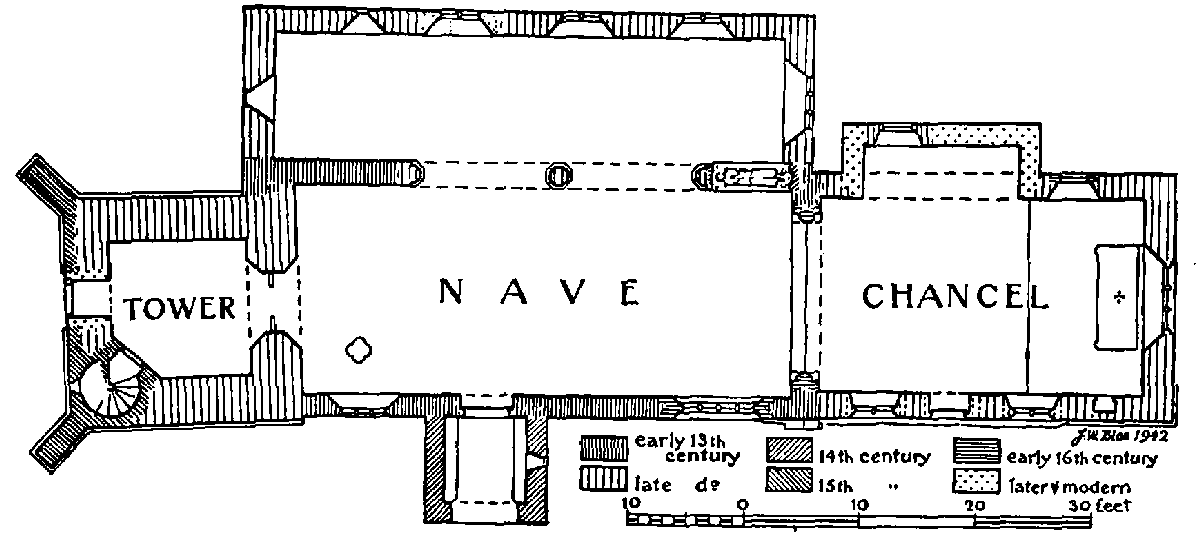
Plan of Cherington Church.
Church
The parish church of ST. JOHN THE BAPTIST consists of a chancel, nave, north aisle, south porch, and west tower.
The nave dates from the early 13th century; the chancel with it was probably rebuilt entirely, widened and lengthened, late in the century, but there has been a great deal of restoration and repair to it since, including the rebuilding of the south wall. The north aisle with its arcade and the lower half of the tower were also additions of the late 13th century. The clearstory and roof of the nave and the upper half of the tower are 15th-century additions. The south porch is of early14th-century date.
There were restorations during the 16th and later centuries, known dates being 1877, 1909, and 1917. The organ-recess north of the chancel is the work of one of these last two periods.
The most remarkable feature in the church is the tomb and unique effigy of a franklin in the nave, of the early 14th century.
The chancel (27½ ft. by 16½ ft.) has a late-13thcentury east window of three lancet lights below an external hood-mould that forms a two-centred arch and has mask stops. Except the hood-mould the external stonework is modern, but the obtuse internal splays, of rubble with ashlar dressings, and chamfered rear-arch, of small voussoirs, are original. In the apex of the window-head outside is reset an early humanhead corbel or label-stop. On the north side near the east end is a wide single trefoiled light with splays of the same period as those of the east window, but external masonry of the 16th or 17th century and an inner wood lintel. West of it is a modern organ-recess, 13 ft. wide by 4½ ft. deep, in the back of which is reset a similar window. In the south wall are two windows, each of two cinquefoiled pointed lights under a square head, modern except for parts of the internal splays; between them is a priests' doorway, also entirely renewed. Near the east end is a late-13th-century piscina recess with a trefoiled head: the hood-mould that formed a two-centred arch has been cut back and the basin abolished.
The walls are of small grey rubble-work with large angle dressings. The east wall above the sill level is cemented outside and the coped gable-head has an early-17th-century moulded and pierced square pinnacle set diamond-wise. The south wall has some larger ashlar stones mixed with the rubble-work, and about 5 ft. from the east wall inside is a vertical setback, showing that from just above the sill level the upper part of the wall west of this line has been rebuilt to make it plumb vertical. The easternmost 9 ft. of this wall outside has a low chamfered plinth, the rest having only rough footings, suggesting a medieval lengthening of the chancel. The plinth is lost below ground in the east and north walls. The south wall is practically flush with the south nave wall, which it meets with a straight joint, the nave wall with its angle dressings being the earlier. Internally the walls are of light cream-coloured irregular rubble, the plaster having been removed in 1909.
The low-pitched roof, restored in 1909, is of three bays with re-used chamfered and cambered tie-beams, with modern braces, carried on original moulded stone corbels. It is covered with slates.
The chancel arch is probably of c. 1500: it is of two chamfered orders, continuous from responds to twocentred head except for shallow impost mouldings to the inner order. The head is of medium to large voussoirs and has a relieving arch above the middle part.
The nave (43½ ft. by 18 ft.) has a late-13th-century north arcade of two 12½-ft. bays with an octagonal pillar and responds; these have moulded capitals and bases: the high segmental-pointed heads are of two chamfered orders. The 7½-ft. length of wall east of it was pierced a few years later for the tomb and effigy described below. There is also an unpierced 10 ft. of wall west of the arcade. The walling above is of rubble.
In the south wall are two lower windows and four upper windows. The eastern lower window, close to the east end, is a large one of c. 1500 encroaching on the clearstory above. It is of four cinquefoiled ogeeheaded lights and trefoiled tracery lights under a square head with an external label, all of yellow-grey stone. The jambs have large splays inside and out and the rear-arch is cambered. The other window close to the west end is of three 13th-century narrow lancet lights, the middle taller than the others, under an unpierced segmental-pointed head; it has wide internal splays of rubble with angle-dressings of cream stone; the chamfered segmental-pointed rear-arch has a relieving arch above it.
The south doorway has 13th-century jambs with a shallow edge-roll, and a two-centred, almost semicircular head. One stone just below the springing level in the east jamb has been reset and has a scratched massdial upside down.
The four clearstory windows are each of two trefoiled pointed lights under a square head of the 15th century, except the easternmost, which is of modern stonework and shorter because of the tall window below it.
The south wall is built of mixed irregular rubble, mostly of yellow Hornton stone, with grey and yellow east angle-dressings flush with the chancel wall. It has no plinth, but at the east end are footings and what appears to have been the base-stone of a former small buttress projecting 9 in. and 16 in. wide. The clearstory wall above is of rubble of smaller texture. The plain parapet is of 18th-century ashlar and has obelisk pinnacles. The east end has a low-pitched gable with a similar pinnacle at the apex.
The nave roof is of the 15th century. It is lowpitched and of five bays with trusses having moulded cambered tie-beams, wall-posts, and curved brackets. They are carried on variously carved stone corbels with grotesque beast and human heads. There are intermediate moulded principals, side-purlins, and ridgepole. On the east wall of the tower are the marks of the earlier high-pitched gabled roof. The roof is covered with lead.
The south porch is built of larger rubble than that of the nave and more regularly coursed. The south front has a coped gable with restored kneelers, and an entrance with chamfered jambs of one order and pointed arch of two orders, flanked by ashlar work, probably all of the 14th century. On a stone west of the entrance is a scratched sundial and there are remains of another east of the entrance. The roof is covered with stone tiles.
The north aisle (43½ ft. by 10½ ft.) has a late-13thcentury east window of three lancets of one small chamfered order below a two-centred head with an external hood-mould, all modern externally except the jambs. The old internal splays are obtuse, of rubble with tooled dressings. The lintel is of wood.
In the north wall are four windows: the eastern and second of two plain pointed lights and a quatrefoiled spandrel in a two-centred head. The obtuse splays are like those of the east window but the jambs, &c., are of the 18th century. Inside the head is treated peculiarly, the arch being carried up as a slightly projecting wide fillet and finished with a foliated finial below the chamfered two-centred rear-arch, possibly a copy or restoration of an original feature. The third is a modern similar window in place of the former north doorway: the straight joints remain below the window. The fourth window and that in the west wall are 13thcentury single lancets, partly restored. Under the east window and partly along the north wall inside up to the blocked doorway is an original chamfered string-course. The modern third window also has a projecting ledge or string apparently made up from the voussoirs of the hood-mould of the former doorway. The walls are of small grey rubble-work without plinths but with rough footings exposed. The west wall has a broken vertical straight joint at its junction with the north-west angle of the nave. The plain parapets have been restored. The low-pitched gabled roof of four bays is probably of the same period as the nave-roof; the trusses have moulded tie-beams.
The west tower (about 12 ft. square inside) is of two stages divided by a 15th-century moulded stringcourse: there is another set-back about half-way up the upper stage. The plinth is chamfered. The embattled parapet is of 18th-century restoration except for the string-course, which has carved spouts at the angles.
The 13th-century masonry of the lower halves of the north and south walls is of streaky small rubble with very small quoins at the south-east angle up to about a yard below the 15th-century string-course and about level with the nave parapet. Above this level the masonry with its angle-dressings is larger and of yellower stone.
At the west angles are 15th-century diagonal buttresses with ashlar outer facings, in three stages up to the same height as the older part. These are of roughly squared yellow stone mixed with larger stones, and the lower part of the west wall is similar, indicating that it was rebuilt or refaced when the buttresses, and probably the south-west stair-vice, were added.
The small pointed archway to the nave, of light yellow stone, is of three chamfered orders dying on plain splayed responds, of 13th-century date. The west doorway is a 17th- or 18th-century insertion and has a square head. Above it is a plain small rectangular window. The stair-vice has a pointed doorway and is lighted by west loops up to the bell-chamber. In the south wall is another rectangular light just below the moulded string-course. The bell-chamber is lighted by 15th-century windows of two trefoiled ogee-headed lights and a quatrefoil in a two-centred head: the jambs have casement moulds and the hood-moulds have beast-head or grotesque stops.
The furniture is modern except the oak front of the communion table. This is made up from a former reredos that was brought from the chapel of Weston House when it was pulled down early in the 19th century. It was discarded in 1877 and the woodwork stored in an out-house at the rectory until 1909, when it was repaired and placed in the present position. (fn. 24) There is little doubt that it was originally a secular overmantel dating from the early 17th century. It is of three bays divided by pairs of Corinthian shafts on enriched pedestals. The middle bay that contained the achievement of arms now has a panel painted with an 1hs in glory surrounded by cherubs' heads. The side panels now inclose painted boards with extracts from the Communion Service below cherubs' heads.
There is a great deal of coloured glass in the windows: practically all of it was collected by the Rev. John Warner, D.D., rector from 1741 to 1764. Some of it is said to have come from Winchester and other pieces, mostly armorial, from the manor-house of Kiddington, Oxon. In the north windows of the chancel and organrecess are early-16th-century pieces with the Tudor rose and portcullis and the arms of France quartering England. In the south-east window of the nave are armorial pieces from Kiddington. In the east window of the aisle are the Royal arms and other shields (one entitled Underhill Carlton), the head of our Lord (once set in the reredos), a small figure in a green mantle, and other fragments. In the north windows are many other fragments, some heraldic, reset in modern diamond-shaped panels and mostly of the early 16th century.
East of the nave arcade is the piercing already mentioned containing the tomb and recumbent effigy of an unknown man dating from c. 1320. The effigy is a most interesting one and may be unique. It represents a man in civilian costume with a long robe reaching nearly to the ankles, divided in front in the lower part, and having loose sleeves through which appear his arms in the tight sleeves of the tunic laced with points. Over this is a tippet and a hood that is turned back from the head to show the man's curled hair. A hip belt is decorated with rivet-heads and a buckle from which, on his left side, the strap is looped over to hang pendantwise. On the right front is a sheath for his anelace, suspended from the girdle by a cord. The cushion at the head is supported by angels (now headless), the hands are in prayer and the feet rest on a lion. The figure is now generally accepted as being that of a franklin as differing from that of a knight. (fn. 25)
In the two long sides of the base or chest are five niches with trefoiled and crocketed ogee-heads, divided by pilasters with crocketed pinnacles. The second from the west on the north side has an original bracketpiscina. The opening in which the tomb is set was obviously pierced after the arcade and chapel-aisle were built and this piscina replaced one then removed. The arch is of an ornate cinquefoiled ogee form; its mouldings are enriched with carvings, the innermost hollow having four-lobed square paterae (almost of the earlier dogtooth pattern) conjoined by a central running stem; the outer hollow has flatter square paterae. The hoodmould has a hollow in which are ball-flowers, and is crocketed: the finial is missing. The hood-moulds die onto the east wall, but the west end on the nave side is carried on a crowned female head with long side-hair, veiled head-dress, and gorget; above it is a panelled pinnacle with a gabled and crocketed finial. Above the arch is a relieving arch.
In the chancel is a mural monument with a Latin inscription to the Reverend Christopher Smith, rector, died July 1688, aged 78, and his wife Constance, died May 1686, aged 66. It is a black oval tablet in a laurel frame with flanking drapery in painted stone.
The five bells include two of 1742 by Henry Bagley and three of 1842.
The plate includes an Elizabethan cup and cover paten of c. 1570 with only the maker's mark. The bowl has been repaired with two vertical strips on opposite sides as though it had had later handles affixed which were afterwards removed.
The registers begin in 1683.
Advowson
Ralph de Wylinton was returned as patron of the church of Cherington in 1279, (fn. 26) and the advowson continued to descend with the manor until at least 1658. (fn. 27) In 1688 presentation was made by Constance Warkman, widow; in 1696 by Francis Sheldon; in 1723 by Alexander Denton; and in 1742 by the Earl of Lichfield, (fn. 28) who was apparently still patron in 1763. (fn. 29) By 1780 the patronage had been acquired by the Rev. Richard Nicoll, D.D., (fn. 30) who became Chancellor of Bath and Wells in 1783 and died on 20 January 1813. (fn. 31) The advowson presumably descended to his son the Rev. Thomas Vere Richard Nicoll, whom he had presented to the living in 1794 and who held it until his death in 1841. (fn. 32) It seems then to have been acquired by the Rev. Power Turner, who was rector and patron in 1850, (fn. 33) and has remained in this family, the patronage of the combined benefices of Cherington, Stourton, and Sutton-under-Brailes being held in 1940 by Mrs. Charles Henry Turner, alternately with the Bishop of Coventry. (fn. 34)
Charities
Church Lands. The origin of this charity is unknown. The endowment originally consisted of a piece of pasture land containing 1 r. 23 pls. at Stourton. The land was sold in 1929 and the proceeds, amounting to £31, invested; the income, amounting to £1 2s. 2d., is applied towards church expenses.
Richard Badger's Charity. The share of this charity applicable for the Parish of Cherington with Stourton consists of 1/42 part of the income of the charity, amounting to £17 16s. 9d., and is applied towards keeping the parish church in proper repair and maintaining divine service. A similar amount representing the poor's share is applied for the benefit of deserving poor residents.