A History of the County of Warwick: Volume 5, Kington Hundred. Originally published by Victoria County History, London, 1949.
This free content was digitised by double rekeying. All rights reserved.
'Parishes: Halford', in A History of the County of Warwick: Volume 5, Kington Hundred, ed. L F Salzman (London, 1949), British History Online https://www.british-history.ac.uk/vch/warks/vol5/pp89-92 [accessed 6 May 2025].
'Parishes: Halford', in A History of the County of Warwick: Volume 5, Kington Hundred. Edited by L F Salzman (London, 1949), British History Online, accessed May 6, 2025, https://www.british-history.ac.uk/vch/warks/vol5/pp89-92.
"Parishes: Halford". A History of the County of Warwick: Volume 5, Kington Hundred. Ed. L F Salzman (London, 1949), British History Online. Web. 6 May 2025. https://www.british-history.ac.uk/vch/warks/vol5/pp89-92.
In this section
HALFORD
Acreage: 956.
Population: 1911, 223; 1921, 204; 1931, 199.
This small parish lies to the east of the River Stour, a tributary of which forms its southern and eastern boundaries. The north-western boundary runs near and parallel to the Roman Fosse Way, which crosses the Stour at Halford Bridge. The bridge, which is mentioned in 1278, (fn. 1) is called in 1633 'a great bridge and very useful to passengers passing from Warwick to Shipston'; (fn. 2) it was broken down by the Royalists in 1644, (fn. 3) and apparently again later by the Parliamentarians 'for the safety of the county', wherefore it was agreed in 1650 that the cost of its repair should, on this occasion, be borne by the county. (fn. 4) Immediately north of the bridge, between the Fosse Way and the Stour, lies the village. Most of the buildings are of local grey lias, many with dressings of a harder yellow stone. One house, much renovated, north of the church is in part of early-17th-century timber-framing, a rarity in this district; the main portion of the house is of stone with later 17th-century mullioned windows with labels. Three cottages east of it retain similar windows.
Manors
William Giffard held 2 knights' fees of the Earl of Warwick in 1166, (fn. 5) and gave 1 hide in Halford to the canons of Kenilworth. (fn. 6) He evidently held the manor of HALFORD as he presented to the church, as did his nephew and heir Andrew Giffard of Fonthill (Wilts.). (fn. 7) Andrew left four coheirs, of whom Robert de Mandeville disputed the right of presentation with the Bishop of Worcester in 1235, (fn. 8) at which date ½ fee in Halford was said to be held of the Earl of Warwick by 'Robert'. (fn. 9) In 1242 the ½ fee was held by 'the heir of Andrew Giffard'. (fn. 10) One of the coheirs was presumably represented by John de Fosse who held ¼ fee here of Guy, Earl of Warwick, in 1316; (fn. 11) and in 1400 this ¼ fee was still said to be held of the earl by 'the heir of John de Fosse'. (fn. 12)
In 1279 Margery de Cantilupe held a watermill and land here of the Earl of Warwick as 1 knight's fee. (fn. 13) She was daughter of William Cumin, one of the Giffard coheirs. (fn. 14) Apparently it passed from her, or her son John de Cantilupe, to Alan la Zouche, who died in 1314 seised of 1 knight's fee in Halford, held of him by Sir Robert Burdet. (fn. 15) The fee was assigned in 1315 to Alan's younger daughter Maud and her husband Sir Robert de Holand, (fn. 16) who died seised of it in 1328. (fn. 17) Maud, kinswoman and heir of a later Sir Robert de Holand, (fn. 18) married Sir John Lovell and was holding the fee at her death in 1422. (fn. 19) When her grandson William, Lord Lovell, died in 1455 the fee was held of him by Robert Burdet; (fn. 20) but after this no more is known of it. Apparently this fee, which was closely associated with the mill, was absorbed into Snitterfield, as in 1521 the Crown granted to Thomas Blakford a lease for 21 years of the watermill of Halford in the lordship of Snitterfield, late of the Earl of Warwick, with the weir and fishery in the Stour from the mill to Halford Bridge. (fn. 21) A similar lease in 1523 to Richard Warwyk (fn. 22) was probably non-effective, as on the expiry of the first lease it was renewed to Edward Blakford in February 1544. (fn. 23) In 1564 Bartholomew Hales and Mary his wife (in whose right he held the manor of Snitterfield) (fn. 24) sold two watermills and land in Halford to Richard Buller. (fn. 25) He died in 1593, seised of the mills and fishery, leaving a son Richard, (fn. 26) who was succeeded by his son Richard in 1628. (fn. 27)
Among the gifts confirmed to the Abbey of St. Evroul in 1176 by Roger, Bishop of Worcester, were at Halford 2/3 of the tithes of the demesnes and the tithes of the mill. (fn. 28) The donor, though not specified, was probably Robert, Earl of Leicester, at whose request the confirmation had been made. No later connexion with St. Evroul can be traced, but the Leicester interest may account for part of Halford being held, as a member of Ettington, of the Duchy of Lancaster in the 16th century. (fn. 29)
The Priory of Kenilworth held by grant of William Giffard 1 hide (fn. 30) in Halford, which produced 46s. in rents in 1535. (fn. 31) These lands were granted in 1545 to John Pope of London (fn. 32) and later in that year were conveyed by him to Robert Halford of Armescot. (fn. 33)
Church
The parish church of ST. MARY consists of a chancel, nave with a north porch, south aisle, and a tower west of the aisle.
Drastic restorations have obscured the history of the development, but the nave dates from about 1150, as shown by the chancel arch and two doorways. A small north window of 12th-century character is all modern but probably represents an original opening. There is no evidence for the date of the medieval chancel; its size suggests a 13th-century enlargement, but probably it suffered alterations after the Reformation—a date 1674 is inscribed on one of the pavement steps—and these have been replaced by modern windows, &c. The nave was lengthened in the 13th century and the west wall built with clasping buttresses at the angles, and shortly afterwards (c. 1270) the south aisle was added, with an arcade of three bays, and the tower west of it, both with similar clasping buttresses, that at the northwest angle of the tower adjoining and forming a straight joint with the like south-west buttress of the nave. In modern times, evidently owing to weakness, the arcade has had to be rebuilt. The north-east window of the nave is of exotic design and material for this part of the county, being of red Kenilworth stone, and it is suggested that the window was brought from Kenilworth Abbey after the Suppression. The north porch is not easy to date but may be of the 17th or 18th century. Modern restorations took place in 1862 and 1883.
The chancel (about 27½ ft. by 14½ ft.) has an east window of three lights and geometrical tracery and two windows in each side wall, each of two lights and tracery, all of the 19th century. Between the two south windows is a doorway to the modern small vestry, which also has an outer west doorway. The chancel walls, only 26 in. thick, are built of grey coursed and squared lias ashlar. On the riser of the lower step to the sanctuary is the inscription wt 1674 and ccc 1838. The roof is modern, of steep pitch and divided into three bays by pointed trusses; it is covered with new tiling.
The chancel arch is of mid-12th-century date: the head is semicircular, of one square order on the east face and two on the west with a three-quarter rollmoulding in the angle. The responds have nook-shafts with capitals of cushion form but carved with primitive foliage and at the angle a tiny head with volutes like a ram's head, the neck-moulds being cabled. The moulded abaci—a hollow between two small beadmoulds, the upper cabled—have enriched vertical faces, the northern hatched, the southern with lozenges conjoined. The south base is moulded and carved with diaper ornament: the northern is plainer.
South of the arch the wall is pierced by a squint westward into the nave. On the west face it is a cutting of ½ in. slits forming a cross 16 in. wide by 9 in., and a rectangular recess to the east; it is probably a 16th- or 17th-century feature.
The nave (about 47 ft. by 20 ft.) has a large 13thcentury window at the east end of the north wall of red Kenilworth stone. It is 5½ ft. wide and consists of three sharply pointed lights below a restored two-centred hood-mould; the jambs are of two chamfered orders. It probably came from elsewhere and may have had plate tracery above the lights originally. Farther west is a small window, 1 ft. wide, of Norman character but entirely modern: the head is carved. It may possibly be a restoration of an original window.
The north doorway, a little west of the middle of the wall, 3 ft. 8 in. wide, dates from the mid-12th century. The head is semi-circular and filled with a tympanum carved with a seated figure with outspread wings and arms holding a scroll or riband and with flowing drapery from the wrists. The outer order has an edge-roll, and two other smaller rolls treated as cables. The hollowchamfered hood-mould is enriched with billet ornament and the vertical face of it with a conjoined lozenge pattern. The jambs, of two square orders, have a nookshaft in each jamb with enriched capitals: the eastern, of cushion form, has a small pelleted angle-mould rising from a human head set upside down, and its vertical faces have sunk panels with pellet edging; the neckmould is cabled. The west capital is a little more elaborately carved with the standing figure of a man at the angle, holding a sceptre in his right hand and grasping with his left hand the stalk of a plant on which are standing on his left a lion and on his right a griffin. Below these are spurs with fleur-de-lis heads. The abaci are moulded but the bases have lost their true forms.
The north wall is of grey lias coursed rubble to the east of the porch, with ancient large yellow quoins at the east angle: between the windows is a modern buttress. The 13-ft. stretch west of the porch is unpierced and is of lias stone with an admixture of large square yellow stones. The east wall has a modern coping and bell-cote to the gable. The west window, of three trefoiled lights and tracery in a pointed head, is modern. The walling is similar to that west of the porch, and at the two angles are clasping buttresses of yellow ashlar. The wall is gabled and the valley between nave and aisle has an outlet about a yard north of the tower with a very large carved gargoyle. There is a low modern buttress below the window.
The south arcade, of three 11-ft. bays, has octagonal pillars and two-centred arches of two chamfered orders. It is all modern (fn. 34) except for the lowest voussoirs of the east half of the east bay and for the semi-octagonal responds, which retain the mid-late-13th-century moulded capitals, somewhat retooled. The 13-ft. length of wall west of the arcade is plastered and shows no signs of piercings but probably had an upper doorway on to a former gallery entered by a stair through the north wall of the tower.
The aisle (about 33½ ft. by 15 ft.) has a 13th-century east window of three trefoiled pointed lights below a two-centred arched hood-mould, with sinkings in the masonry above the side-lights, all of lightish yellow stone. The south window, in the middle of the aisle wall, is similar without the sinkings and with ogee middle foils. The chamfered rear-arches are segmentalpointed. The south doorway, reset opposite the other, is of much the same detail and date, except that the tympanum shows no signs of carving and the carved capitals are badly weatherworn. In the east end of the south wall is a piscina with a trefoiled ogee head, all restored except the foils of the head: the quatrefoil basin may be old.
The east and south walls are of grey lias stone, mostly coursed. At the south-east angle is a clasping buttress like those west of the nave. The walls have no plinth, but at plinth-level along the south wall is a scrollmoulded string-course. The east wall meets the more ancient south-east angle of the nave with a straight joint.
Both roofs of the nave and aisle are modern: they are gabled and are divided into four and three bays respectively by trusses with arches below collar-beams.
The south-west tower (about 7½ ft. square) is of three diminishing stages, with walls of grey lias rubble, partly coursed, and containing a few yellow and other harder stones, in the lowest stage, at the angles of which are clasping buttresses similar to the nave buttresses. The adjoining buttresses in the west wall meet with a straight joint. The upper stages are of similar lias masonry but mostly of smaller stones and with ancient yellow angle-dressings. The two-centred archway to the aisle is of the full width of the tower: it is of two chamfered orders, the outer plastered, the inner dying on the responds. In the north wall is a deep cupboard with a round-headed doorway cut through the wall. It contained a staircase up to a former gallery in the nave; but if the piercing was made especially for this purpose it must have been a laborious task and may therefore have been an ancient feature adapted to its later use, and later still walled up on the nave side. In the west and south walls are 7-in. lancet lights, with hoodmoulds to both lower stages, the jambs of one chamfered order. Above the upper lights are very small circular panels that may have been tiny lights or vent-holes. On the east side the same place is occupied by a narrow rectangular loop. Some way below it is a string-course level with the point of the aisle roof, and below that are traces of a previous roof parallel with but higher than the south slope of the present roof. The bell-chamber has windows of two lancet lights and of two chamfered orders in yellow stone. The parapet, of the 15th century, is embattled with returned copings to the merlons and with panelled pinnacles at the angles. This parapet with one course below its string-course is of a darker yellow-grey stone.
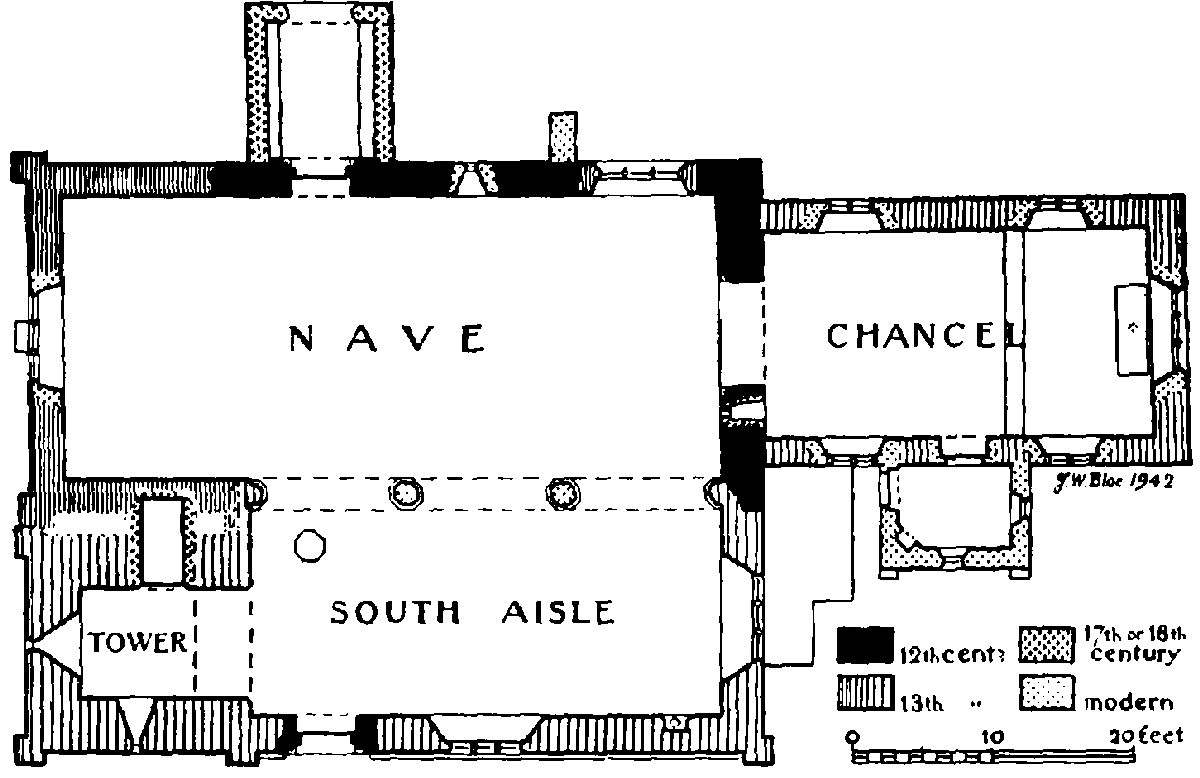
Plan of Halford Church.
The font, probably 14th-century, is octagonal; the bowl is deep with a splayed lower edge, and has in each face a shallow trefoiled ogee-headed panel with foiled spandrels. The stem has a top roll-mould and the base is chamfered. It has a 16th-century tall oak pyramidal cover with crocketed ribs at the angles and a central finial carved with five mitred heads.
In the chancel is an early-17th-century chair, made up partly with a 15th-century stall, probably from Kenilworth Abbey. It has moulded elbows and capping and a tip-up seat with a misericord carved with a bearded man performing a tumbling trick in a pair of branches, his head appearing between his legs. On either side of him is a human head. The back is of the normal early-17th-century type, with a carved panel between guilloche-decorated pilasters and enriched round head. In the vestry is a late-17th-century table with a modern top, probably a former communiontable.
A stone grave slab in the chancel floor is incised with a long cross with flowered ends and a chalice in the stem. The stepped base is inscribed 'memento'. A black-letter Latin inscription reads: 'Hic jacet magister Henricus Kynnysberie quondam Rector istius ecclesie qui obiit io die mensis Marcii anno d[omi]ni mcccclxxxviio cui' anime p[ro]picietur deus. Amen.' (fn. 35) Another slab has the initials and dates wh 1617 and jh 1659: others are later. A mural tablet is to Frances wife of George Granger, (fn. 36) 1674. Another mural tablet at the west end of the nave is to Arthur Rowney (1690) and Elizabeth his wife (1698), and was erected by their daughter Elizabeth widow of Nathaniel Mason. It also commemorates Thomas Rowney (1700) and two infants, her brother and sisters, and has a shield of arms.
In the churchyard south of the chancel is a headstone to Jane wife of Thomas Halford 1659(60) and another to Francis Wills 1682(3). There also lies south of the chancel a much damaged coped and tapering slab with a raised long cross carved on it, probably medieval.
Preserved in the church are three old thatch-hooks for fires.
There are three bells: (fn. 37) the first is medieval (14th century) inscribed: 'Agios in honore sancti Johannis Baptiste sum renovata'; the second (a 15th-century bell) recast in 1883; and the third by Henry Bagley, 1639.
The registers begin in 1545.
Advowson
The early history of the church is rather obscure; the Priory of Kenilworth seems to have had some right to it, but William and Andrew Giffard are said to have presented to the living, and in 1235 the Bishop of Worcester was claiming the right of presentation against the Giffards' representative Robert de Mandeville. (fn. 38) Eventually, in 1247, the bishop's right to the advowson was established with the consent of the Prior and Convent of Kenilworth. (fn. 39) The latter were evidently rewarded by the assignment of a pension, and in 1291 the church was only worth £4 13s. 4d. in addition to the priory's portion of £3 6s. 8d. (fn. 40) In 1535 the rectory was valued at £10 9s. 9d., exclusive of a pension of 40s. to Kenilworth, and of a payment of 8s. to the Carthusian Priory of Shene (Surrey). (fn. 41) The origin of this last payment is not clear, but as Shene had received a good deal of property formerly belonging to alien houses, including some elsewhere belonging to St. Evroul, it may possibly represent the tithes which had been granted to St. Evroul in the 12th century (see above).
The advowson remained with the Bishops of Worcester until 1919, when it was transferred to the Bishop of Coventry. Since 1933 the rectory of Newbold-onStour has been annexed to Halford.
Charity
Richard Badger's Charity. The share of this charity applicable for the parish of Halford consists of 1/42nd of the income of the charity, amounting to £17 16s. 9d. annually, and is applied by the rector and churchwardens towards keeping the parish church in proper repair and maintaining divine service. A similar amount representing the poor's share is also received and applied for the deserving poor resident in the parish.