
A History of the County of Warwick: Volume 5, Kington Hundred. Originally published by Victoria County History, London, 1949.
This free content was digitised by double rekeying. All rights reserved.
'Parishes: Idlicote', in A History of the County of Warwick: Volume 5, Kington Hundred, (London, 1949) pp. 95-98. British History Online https://www.british-history.ac.uk/vch/warks/vol5/pp95-98 [accessed 24 April 2024]
In this section
IDLICOTE
Acreage: 1,419.
Population: 1911, 101; 1921, 92; 1931, 84.
This small parish is bounded on the north and west by a tributary of the River Stour. The ground rises gradually from 212 ft. at the northern boundary to 433 ft. on the crest of Idlicote Hill on the southern edge of the parish. To the south of the village, which lies centrally, there is a considerable amount of woodland, but to the north is open grazing and arable land.
There is little of interest in the tiny village, which lies north-east of the church. A few of the houses are of stone but there are more of brick. A stone cottage at the east entrance to the grounds of the House and church has mullioned windows with labels, probably of the 17th century; and a farmhouse east of the village pond has mullioned windows without labels. Idlicote House, north-west of the church, was considerably altered in 1863 and was thoroughly restored in 1895. In the grounds, north of the church, is an unusually large octagonal structure of white stone with red Kenilworth stone dressings and with an embattled parapet about a pointed roof. An upper window on the west side has mullions and label, and there are high modern ogee-headed windows on the other walls. There are large facial decorations in the forms of cross loops on the sides, but little of the masonry appears to be ancient. It is obviously a comparatively modern rebuilding but may have been brought from Kenilworth Abbey, where it possibly served, at least in part, as a dovecote.
Manor
In 1086 Robert de Stafford held 5 hides in IDLICOTE which had formerly been held by Anegrin and Ordec. (fn. 1) The overlordship continued in the Stafford family, one knight's fee here being part of the barony of Hervey de Stafford in 1212 (fn. 2) and remaining with his descendants the Earls of Stafford as late as 1393. (fn. 3)
Nicholas de Stafford, son of Robert, gave the manor to Geoffrey de Clinton, Chamberlain to Henry I, and Geoffrey bestowed it upon his foundation of Kenilworth Priory. (fn. 4) In 1279 the canons held in demesne 3 carucates of land and a windmill, and their tenants held 15½ virgates. (fn. 5) Their estate was valued at £5 15s. in 1291, (fn. 6) in which year they obtained a grant of free warren here. (fn. 7) In 1535 the priory received a total of £21 15s. 6d. in rents at Idlicote, and paid a fee of 13s. 4d. to Henry Rowley as bailiff of the manor. (fn. 8) After the Dissolution the manor was granted in 1542 to Thomas Cawarden and Elizabeth his wife in tail male. (fn. 9) He presumably died without male issue, as the manor reverted to the Crown and was granted in 1562 to Lewis Greville, (fn. 10) who six years later sold it to William Underhill. (fn. 11) The latter died in 1570 leaving a son William, then aged 14½. (fn. 12) This William, who owned New Place in Stratford-on-Avon and sold it to William Shakespeare on 4 May 1597, married his first cousin Mary, daughter of Thomas Underhill of Ettington, and died on 7 July 1597 of poison administered by his eldest son Fulk, a youth of 18, who was subsequently executed for the murder. (fn. 13) Fulk was succeeded by his brother Hercules who was knighted in 1617. (fn. 14) He died in 1658, his heir being his nephew William who was knighted at the Restoration. (fn. 15) Shortly after that event Sir William Underhill was cast in £1,500 damages for having wounded Walter Devereux with a pistol, and, on his refusing to pay, the sheriff gave Devereux full possession of the house and lands at Idlicote, but a party of Sir William's men made forcible entry and ejected Devereux's men, killing one of them. (fn. 16) Sir William died, in his 87th year, in 1710, (fn. 17) and his grandson Samuel, who had married Catherine, widow of Jonathan Fogg, in 1755 sold the manor to the Hon. Heneage Legge (2nd son of the Earl of Dartmouth), who had married his stepdaughter Catherine Fogg. (fn. 18) After the death of Legge in 1759 (fn. 19) the manor was sold to Sir Robert Ladbroke, whose son sold it to the Rev. Thomas Fisher. (fn. 20) From him it was bought in 1807 by Samuel Peach, (fn. 21) who died in 1832, and eventually the property came to his great-nephew, Henry Peach Keighley, who took the name and arms of Peach. (fn. 22) From him it was acquired by Lord Macclesfield, (fn. 23) and about 1900 the estate was bought by Lord Southampton; in 1936 Mrs. Horton was lady of the manor. (fn. 24)
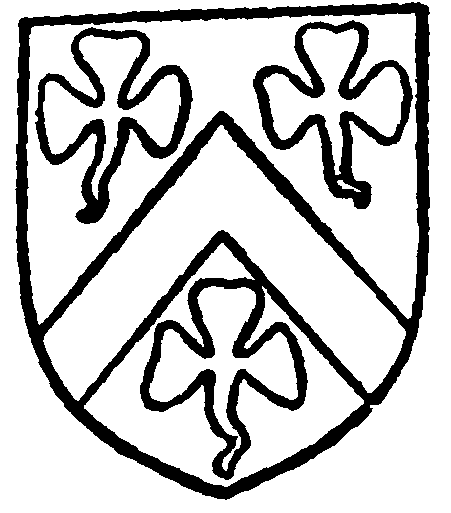
Underhill. Argent a cheveron sable between three trefoils vert.
Church
The parish church of ST. JAMES THE GREAT is a small building consisting of a chancel, south chapel, nave with a north porch, and a south aisle.
The nave dates from the early or mid-12th century, the chancel was rebuilt in the second half of the 13th century, and the south aisle was added at the end of the same century. The west gallery was inserted in the 17th century and a great deal of the furniture was put in at the same time, although altered afterwards.
The south chapel was built late in the 17th century as a mortuary chapel for the Underhill family of Idlicote House.
Repairs and alterations have been done at various periods. The west wall of the nave was rebuilt in the 17th century, and there is much modern stonework.
The chancel (about 24 ft. by 14 ft.) has a 13thcentury east window of three lancets, the middle taller than the others, under a plain external hood-mould forming a segmental-pointed arch; the two-centred rear-arch is hollow-chamfered. At the west end of the north wall is a low-side window (the only piercing) of the same period, with moulded jambs and pointed head with a hood-mould, mostly of filleted rolls and a hollow, all in whitish yellow stone. The lower half of it has been walled up.
On the south side is a late-17th-century arcade of two round-headed bays with key-blocks. The middle column is round, the responds half-rounds, with moulded Classic capitals having square abaci. The arcade is recessed towards the chancel and the space is bridged by a horizontal lintel. East of the arcade is a 13th-century piscina with chamfered jambs and trefoiled head: the basin is circular and at the back is a credence-shelf.
The gabled east wall is coated with cement outside. The north wall has 18th-century facing in grey ashlar. At the north-east angle is a modern diagonal buttress: another buttress in the middle of the wall is older—16th or 17th century.
The gabled roof is modern and is covered with tiles.
The south chapel, of the late 17th century (about 17 ft. wide and the length of the chancel), has an east and south window, both modern, each of three cinquefoiled ogee-headed lights and vertical tracery, replacing original low windows. In the south end of the west wall is a doorway with an old battened oak door with ornamental (probably modern) strap hinges. The ceiling is a segmental arc and the walls have an original frieze, cut through for the modern windows. The walls are of grey-brown ashlar and have diagonal angle buttresses.
The nave (about 31½ ft. by 18 ft.) has a squareheaded window in the east half of the north wall, of two trefoiled ogee-headed lights, of 14th-century origin but reset and the lights widened from about 13 in. to 18 in. The jambs and mullion are chamfered outside and rebated inside but the mullion has been reset inside out: all of a deep red stone. In the west half is the 12th-century north doorway. It has a plain round head of square section and a chamfered hood-mould carved with billet ornament. The jambs have engaged three-quarter-round shafts with scalloped capitals, and grooved and chamfered abaci extended to take the ends of the hood-mould.
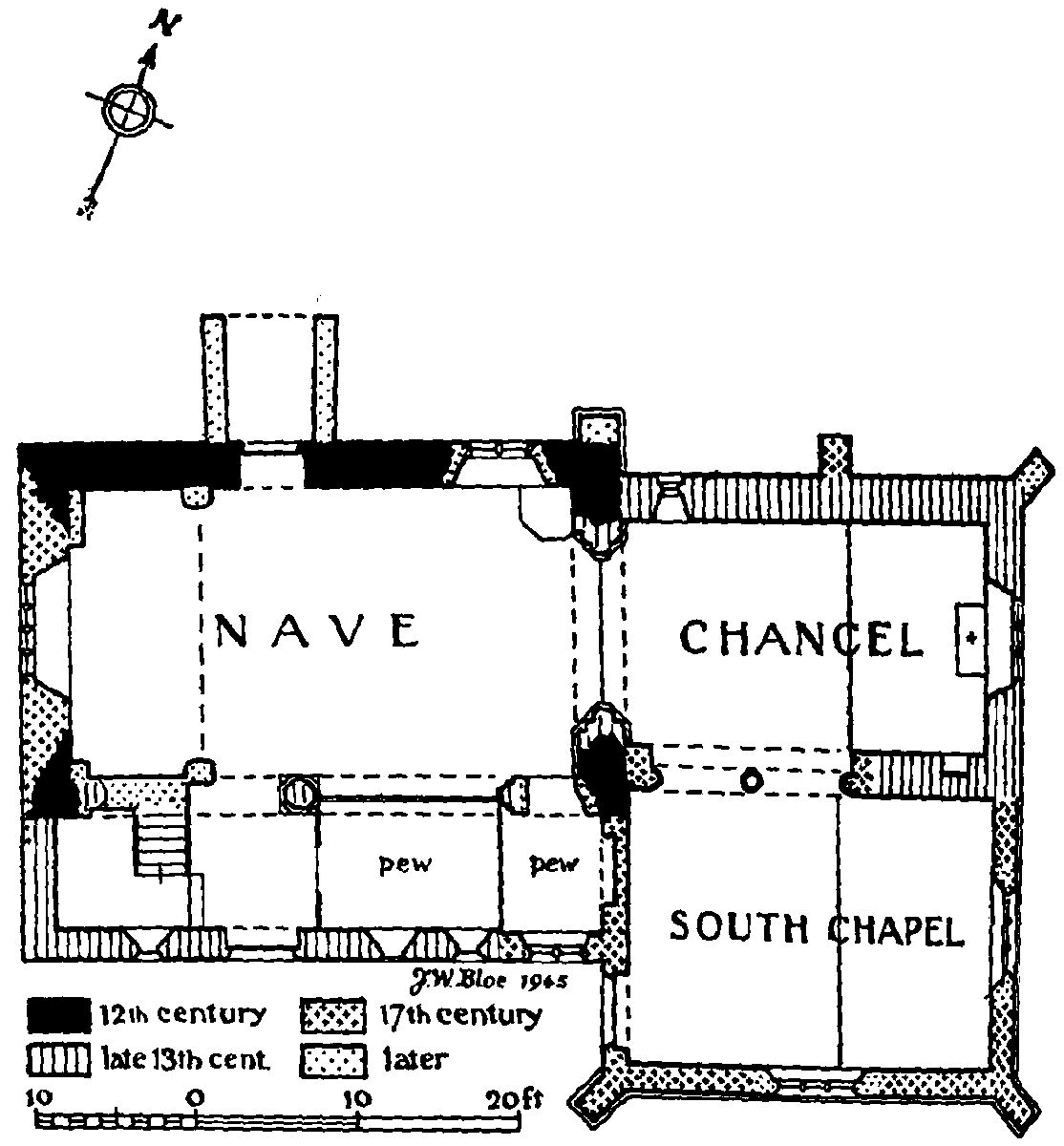
Plan of Idlicote Church.
On the south side is an arcade of two bays with pointed heads of two chamfered orders with large voussoirs. The pillar is octagonal with a moulded capital having a top-heavy square abacus and no neckmould. The pillar proper is only 2 ft. 7 in. high, in large courses, and stands on a moulded base with a chamfered square sub-base, in all 2 ft. high. The responds match, all being of yellow Hornton stone. The short stretch of wall east of the arcade was pierced by a 17th-century square-headed doorway to admit to the Rectory pew, which occupies the east end of the aisle; and from the west reveal of this doorway a squint was cut through the respond to give a view of the west part of the nave.
At the west end of the nave is a gallery and four plastered posts to carry the bell-cote. The west wall below the gallery is pierced by a wide four-light squareheaded window of the 17th century with an external label. Above the gallery are 18th- or 19th-century single lights.
The north wall is of very irregular grey stone rag of the 12th century, with modern patching over the reset window and with ancient grey ashlar long quoins at the west angle. To the west of the porch most of the top of the wall is of 17th-century ashlar.
The aisle (about 7 ft. wide) has four south windows. The first, at the east end of the wall, is a 17th-century insertion of two square-headed lights with a transom and label to serve the Rectory pew. Its inner splays and lintel are lined with 17th-century panelling. The other three windows are single lancets with jambs differing in section, the eastern being double-chamfered, the middle single-chamfered, and the western chamfered and rebated, all of brown-yellow stone and probably of the end of the 13th century. The coeval south doorway has chamfered jambs and pointed head with a plain hood-mould. On an east jambstone is a scratched mass dial, and there is another on a west stone of the westernmost lancet.
The end walls are unpierced, but at the south end of the east wall is a 4ft. recess with chamfered jambs of blue-brown hard stone; it has a modern wood lintel but in the plaster above are slight traces of a former pointed head. It was formerly a way through to the south chapel.
The south wall is of alternate courses of grey and yellow stone, except the upper part between the 17thcentury window and the lancet west of it, which is of 17th-century larger courses in brown stone.
The west wall is similar up to about 10 ft. but meets the walling of the nave west wall with a partly straight joint. The nave wall is of alternate courses of grey lias and dark yellow Cotswold stone up to the same height (probably of the 17th century): above this it is of larger coursed ashlar which is continued without break in the upper part of the aisle wall. The wall is gabled, with a plain coping, which is continued down in one slope to the south-west angle, presumably a later rebuilding. Over the west end is a square bell-cote of timber-framing covered with rough-cast and having a low pyramidal roof covered with red tiles and with a central weathervane.
The gabled nave-roof, probably of the late 14th century, is divided into two bays by a simple hammerbeam truss with curved braces below a collar-beam and with wall-posts and curved brackets below the hammerbeams. The ends of the hammer-beams are doubleovolo moulded, and the lower ends of the wall-posts are moulded pendants in lieu of corbels.
The rafters, which are carried on two purlins each side, are set closely together in the east bay but are later and more widely spaced in the west bay. The lean-to aisle-roof, probably of the 17th century, has stop-chamfered main beams.
The north porch is of 18th- or 19th-century date: it has plain side-walls of stone and no arch in front.
The plain communion-table may be of the 17th century. The communion-rail is of mid-late 18th century and has turned balusters. Across the arches of the late-17th-century arcade is a rail of the same date with symmetrical turned balusters and a carved top-rail: perhaps a former communion-rail.
The font is medieval but hard to date: its bowl is a plain cylinder, 2½ ft. in diameter but only 2 ft. high, on a dwarf stem and plain base of square section. It has a late-17th-century flat oak cover with a central turned knob and crowned by six ogee-shaped brackets rising and meeting in a central turned head: the sides of the arms are carved with nail-head or jewel ornament.
The pulpit in the north-east corner of the nave is of three-decker type of the late 17th century and has two sides of a half-hexagonal plan. The angles have pairs of moulded posts and the sides are of two tiers of panels with raised mouldings: the book-rest is also moulded. Above it is a sounding-board with a modillioned cornice and turned pendants at the angles. The clerk's desk below, south of the pulpit, is made up of early-17thcentury butt-jointed panelling.
There is much other old woodwork, but largely spoilt by modern graining and varnish.
The pews in the nave are mostly of high panelling of the 17th and 18th centuries with doors: one door is hung with late-16th-century cocks'-head hinges. The Rectory pew at the east end of the aisle is lined with 17th-century butt-jointed panelling, also the reveals of the entrance from the nave. The low door in this entrance is of 18th-century woodwork, but one of its hinges is of cocks'-head type. The large Idlicote House pew, west of it, is also of panelling of c. 1700.
The west gallery-front is of two tiers of 17th-century panelling with mitred mouldings. A straight staircase leads up to the gallery, of solid oak balks and with an original octagonal newel with a ball-head. In the gallery are the remains of an old barrel-organ—the case, the barrel with pins, and the broken-up mechanical works.
There is a 17th-century oak chest of which the three front carved panels have been made into doors: the top is modern. Another chest is of late-17th-century hutch type with shaped brackets below the front, which is plain except for three groups of three flutings cut in the bottom part. It had three locks, two now covered.
In the south chapel is a late-17th-century carved stone achievement of the arms of Underhill, probably from a monument. There are 10 mural tablets of the 18th and 19th centuries to members of the Peach family and others. The oldest is to Heneage Legge, second son of William, Earl of Dartmouth, 1759.
Scratched on a diamond quarry in the north window of the nave is: 'Willm Pillway Jun. Shypston Plummar & Glazier 1740.'
The single bell is dated 1656 (or 1636?), by Henry Bagley. (fn. 25)
The registers date from 1556.
Advowson
The advowson has consistently followed the descent of the manor. In 1291 the church was valued at only £4 13s. 4d., with an additional 10s. paid to the Priory of Kenilworth. (fn. 26) It was never appropriated, and in 1535 the rectory was worth £12 17s. 3d. (fn. 27) During the 17th and early 18th centuries most of the Underhills were Roman Catholics and accordingly presentations were usually made by their assigns. (fn. 28) The living was united to that of Honington in 1930.
Charities
Richard Badger's Charity. The share of this charity applicable for the parish of Idlicote consists of 1/84th of the income of the charity, amounting to £8 18s. 4d., and is applied by the rector and churchwardens towards the cost of keeping the parish church in repair and maintaining divine service. A similar amount is also received and applied for poor residents in the parish.
Mrs. Margaret Underhill by will dated 22 Dec. 1780 bequeathed to the minister, churchwardens, and overseers of the poor £100, the interest, now amounting to £6 15s. 4d., to be distributed among poor inhabitants of the parish.