A History of the County of Warwick: Volume 5, Kington Hundred. Originally published by Victoria County History, London, 1949.
This free content was digitised by double rekeying. All rights reserved.
'Parishes: Packwood', in A History of the County of Warwick: Volume 5, Kington Hundred, ed. L F Salzman (London, 1949), British History Online https://www.british-history.ac.uk/vch/warks/vol5/pp129-132 [accessed 2 May 2025].
'Parishes: Packwood', in A History of the County of Warwick: Volume 5, Kington Hundred. Edited by L F Salzman (London, 1949), British History Online, accessed May 2, 2025, https://www.british-history.ac.uk/vch/warks/vol5/pp129-132.
"Parishes: Packwood". A History of the County of Warwick: Volume 5, Kington Hundred. Ed. L F Salzman (London, 1949), British History Online. Web. 2 May 2025. https://www.british-history.ac.uk/vch/warks/vol5/pp129-132.
In this section
PACKWOOD
Acreage: 1,760.
Population: 1911, 860; 1921, 888; 1931, 753.
The east and north boundaries of the old parish of Packwood (fn. 1) are formed by two small streams which meet at Darley Green. (fn. 2) One bend in the course of the northern stream includes in the parish some 600 yards of the Oxford to Birmingham branch of the Great Western Railway, with part of Knowle Station.
There has been a good deal of modern building on the west of the parish round Hockley Heath and Four Ashes, but there is no village near the church.
Packwood Hall to the west of the church is largely a modern building, facing west, but retains an east wing of 17th-century timber-framing. The interior of it seems to be almost entirely modernized. South of the churchyard is a small house, mostly with modern brick and rough-cast walls, but preserving a little 17thcentury timber-framing. Two of the detached outbuildings have similar framing.
Packwood Farm, ¼ mile east of the church, is a late16th-century house of L-shaped plan, facing west; the wing behind at the north end shows original timberframing in the walls, but the front range is faced with modern brickwork; it has two gable-heads, now roughcasted, but said to be of herring-bone framing. The square central chimney of 18th-century bricks has a wide fire-place to the north room, which also has an open-timbered ceiling with a chamfered beam and wide joists. North of the road to Baddesley Clinton, opposite Gospel Oak Cottage, Lapworth, is another small house, facing south; it has an 18th-century brick front with a string-course and cornice, but 17th-century timberframing is exposed in the gabled ends.
Windmill Farm, 3/8 mile north of the church, east of the road to Four Ashes and Dorridge, is a late-16thcentury house with an 18th-century pilastered brick front, but retaining some heavy timber-framing in the back wall and the end gable-heads. The back has a little close-set studding above a former window now altered to a doorway. The roof is tiled and has a central chimney with two diagonal shafts.
Aylesbury House, about ¾ mile west of the church to the north of the road from Hockley Heath, is a large mid-late-18th-century red brick building, facing south, of three stories with two bay-windows of the full height, and a middle doorway with a stone architrave. The windows have stone key-blocks, and the moulded eavescornice is also of stone. Ivy Farm, 3/8 mile north-east of Aylesbury House, west of the road to Dorridge, is a mid-17th-century house of T-shaped plan facing south with the cross-wing at the west end. The exterior is mostly of brick and rough-cast, but a little timber-framing remains in both wings. The east part, the stem of the T, is a low building with gabled upper dormers; its central chimney-shaft has two round-headed panels in each of the long sides: the wide fire-place has been reduced and the room it serves has an open-timbered ceiling with chamfered joists and beam. The outbuilding against the east end has a higher eaves than the house, and against it is a lower timber-framed outbuilding. A 17th-century barn south of the house, of three bays, retains the story-posts in later brick walls, and has original roof-trusses. About ½ mile farther north, on the west side of Grange Road, is an isolated barn of 17th-century timber-framing with brick nogging and a tiled roof.
Packwood House (fn. 3) stands about ½ mile SSE. of the church. The main part dates from the first half of the 16th century and is a square building of two stories and attics facing east and west. Against the north side is a modern stair-hall and a long corridor-gallery leading northwards to a former barn now converted into a music-room. A long and lower range, running east from the corridor-gallery and turning north at the east end to form an L-shaped plan, was added in the time of Charles II for offices, &c., and there are other detached outbuildings farther east, partly of the same period.
The main block is of timber-framing with gables on all faces, but the framing is plastered externally. An extant sketch of 1756 shows the framing, which was fairly ornate, with herring-bone patterns, &c. Most of the windows are modern, replacing ugly sash frames. There is one surviving Elizabethan window, now in an upper internal partition in the north part of the west half, which suggests that the original plan was L-shaped. This wall and the others of the lower room (inner hall) south of it are of close-set studding. The north-east angle of the room has an Elizabethan fire-place with brick jambs and a carved stone lintel; the ceiling has chamfered beams. The south-west chamber (drawingroom) has two 16th-century moulded ceiling beams and is lined with panelling of c. 1600. It has an east fire-place of stone with a four-centred arch and a massive moulded stone shelf. The overmantel of oak is of two bays divided and flanked by round shafts and having two round-headed panels with pilasters carved with snaky monsters; the frieze above is carved with similar monsters.
The south-east room (dining-room) has similar ceiling beams and panelling but its west fire-place is modern. The north-east hall now includes two stories, the upper floor having been removed and the two windows replaced by one tall window. Close studding shows in its west wall and it has an ancient stone fireplace, and on its south side a 15th-century oak screen to cut off a passage from the east entrance, both brought from elsewhere. In the east entrance is an original nail-studded oak door. The east porch is old, 17th or 18th century, but the west porch is modern.
In the upper rooms is a good deal of wall panelling of the 17th century, mostly brought from elsewhere, and carved oak chimney-pieces; several doors have 'cock's-head' hinges. The Elizabethan window in the partition between the rooms over the inner hall and north-west study was of four lights with a transom, and has ovolo-moulded mullions. In most of the windows of both stories are set panels of stained glass, partly heraldic, partly pictorial, collected from various sources by the owner; much of the glass is foreign. The roofs retain some ancient timbers; they are tiled. In the south half above the dining- and drawing-room fire-places the chimney-stack has a group of four octagonal shafts of thin bricks. That in the north half, over the hall fire-place, is an irregular stack of diagonal shafts.
The late-17th-century range extending east containing the kitchen, &c., is built of red brickwork. Its south elevation is divided into bays by pilasters, all under a moulded cornice. Above this the higher middle bay has a great painted sundial between brick pilasters, and a stone pediment with three ball-finials. A doorway farther west, flanked by pilasters and opening on to a stair, has a four-centred head: an archway west of it now has a modern window in its blocking. The easternmost bay of the elevation is the gabled end of the range nearly at right angles to it; this wall is of speckled red and black brickwork and the gable-head has a clock dial, and immediately behind it is a lantern above the roof. The east range has been converted into cottages. Its east elevation is also of red and black brickwork and divided into bays by pilasters. In the south half is a wide gateway to the courtyard behind; it has a modern arch and the bay has a gable-head with another sundial in a brick frame; above the roof is a lantern with a cupola. Another bay in the north half also had a wide archway, now blocked. The original windows had plain brick architraves; they are altered to smaller modern windows of stone. In the roof are gabled dormers. The north end-wall is gabled and has original slits in it and a modern window; an upper roundheaded window may be an older insertion. The sides toward the courtyard are more or less similar.
The former barn, north of the corridor-gallery, shows some 18th-century brickwork in its gabled north end, but its west side is of modern brickwork. A great chimney-stack has been built on the east side and has a late-16th-century stone fire-place from a house in High Street, Stratford-on-Avon: the stone overmantel has carved initials j s (said to be John Smith), s m, and r s. The original upper floor has been removed, except for part at the south end retained to form a gallery. The roof is divided into bays by trusses with curved timbers rather like medieval crucks, rising from the old first-floor level. In the hall is an ancient long table and four tapestries formerly at Baddesley Clinton.
The public roadway passes through the grounds north to south immediately east of the late-17th-century L-range, through gateways of which the square rusticated brick posts remain. There is also a gateway off it into the east forecourt of the house, with ball-finials, and another into the garden north of the building; the latter has a pair of early-18th-century wrought-iron gates with scroll and leaf ornament, and an overthrow with a shield painted argent two cheverons sable. The boundary walls are also old but restored in the upper half. Other gate-posts mark the entrance to the stable yard east of the roadway and to the ground north of the stables. The stables, now garages, &c., are also partly of late-17th-century brickwork, and there is a dove-cote above the roof. Farther north, another building (cowhouse originally?) is also in part of red and black brick.
The garden-court south of the house has a summerhouse or gazebo at each corner of it. The north-eastern is probably original and has brickwork with black diaper ornament; the south-western is of later date, and the other two are modern. South of this garden is the famous group of yew-trees in topiary work, dating from the second half of the 17th century, and traditionally said to represent the Sermon on the Mount.
Manor
PACKWOOD does not figure in the Domesday Survey under that name, but as it appears subsequently as a member of Wasperton (fn. 4) it may represent the woodland, ½ league long by 2 furlongs broad, then attached to that manor, which in 1086 belonged to Coventry priory. (fn. 5) In 1194 Packwood was among the estates of which possession was disputed between the Bishop and the Prior of Coventry. (fn. 6) Two years later one Philip of Kineton released to Master Roger of Charlecote his rights in the 'vill' of Packwood, (fn. 7) but the manor evidently remained in the hands of the priory, (fn. 8) as it was among the places in which the prior and convent had free warren within their demesnes in 1257, (fn. 9) and it was included in the charter of confirmation issued in 1267. (fn. 10) In 1279 the prior held Wasperton and Packwood under the charter of Edward the Confessor and had at Packwood 2 carucates in demesne, with six freehold and two bond tenants; there was an inclosed park and a wood outside it. (fn. 11) The demesne was worth 10s. in 1291, the fixed rents being £4 13s. 4d., and there was a mill worth 6s. 8d. (fn. 12) In 1410 the prior had 'a manor surrounded with pools, a great wood called the Park' and three groves called Lusteley Groves. (fn. 13)
In 1535 the manor, which was then assigned to the office of the Steward of the priory, was farmed at £7 14s. 4d.; (fn. 14) there were other rents from tenements amounting to £14 17s. 10d.; (fn. 15) and the bailiff of Packwood, Thomas Huchyn, received a fee of 26s. 8d. (fn. 16) After the Dissolution the manor was sold to William Sheldon in 1544. (fn. 17) He must have disposed of it shortly afterwards to Robert Burdett of Bramcote, who died seised of the manor in January 1549. (fn. 18) His grandson Robert sold it about 1606 to Thomas Spencer of Claverdon, (fn. 19) from whom it passed to his great-nephew, Sir William Spencer of Yarnton, (fn. 20) whose son, Sir Thomas, still held it in 1661. (fn. 21) It seems to have been divided between four daughters of Sir Thomas Spencer. (fn. 22) One of these, Elizabeth, and her husband, Sir Samuel Gerard, were dealing with a quarter of the manor in 1687 and 1692. (fn. 23) A second, Katherine, dealt with another quarter with her first husband, John Dormer, in 1694, (fn. 24) and with her second husband, George Mordaunt, in 1709, (fn. 25) at which time they owned also another eighth of the manor—one of the sisters having presumably died without issue. A third, Constance, married George Marwood, and in 1710 her daughter Jane, then an orphan, with her grandfather, Sir Henry Marwood, dealt with a quarter of the manor. (fn. 26) Finally, in 1715, Edward Warren and Margaret, Rachel Spencer, spinster (probably representing Jane, eldest daughter of Sir Thomas Spencer and wife of Robert Spencer, Viscount Teviot), Cholmeley Turner and Jane (Marwood), George Mordaunt and Elizabeth, and John Dormer, made a conveyance of the whole manor, (fn. 27) presumably for sale. It was sold to 'Mr. Russell of Warwick, formerly a menial servant to the Spensers of Claverdon, who left it to his two daughters'. (fn. 28) These two daughters, Jane Russell and Lucy, wife of Thomas Pulleine, were ladies of the manor in 1727, (fn. 29) and they sold it to Sir Horace Mann, from whom it descended to Earl Cornwallis, and so to his greatgrandson Philip Wykeham Martin, (fn. 30) with whose representatives it has remained.
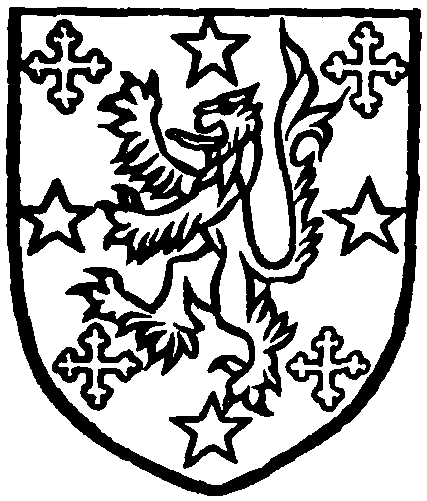
Wykeham - Martin. Gules a lion within an orle of alternate crosslets and molets or.
A considerable part of the parish of Packwood lay in the manor of Bromes or Broom Hall in Lapworth (q.v.).
Church
The parish church of ST. GILES consists of a chancel, north organ-chamber, nave, north transept, north vestry, south porch, and west tower.
The nave and chancel date from the end of the 13th century and the west tower was added late in the 15th century at the cost of Nicholas Brome of Baddesley Clinton (fn. 31) (died 1517). The north transept was built in 1704 by Thomas Featherston. The organ - chamber and vestry are modern. The church was restored in 1885. There were formerly three dormer windows on the south side of the nave roof.
The chancel (about 22½ ft. by 14½ ft.) has a late-13th-century east window of three plain pointed lights and intersecting tracery in a two-centred head with an external hood-mould and head-stops. The jambs are of two chamfered orders, the outer hollow, and the internal splays, which are very obtuse, are carried up from the floor. The chamfered rear-arch is segmentalpointed. In the north wall is a modern archway to the organ-chamber, and east of it a similar window with wide splays but of two lights. The south wall has a like window opposite, and near the west end a narrow low-side window rebated for the shutter. Between them is a priest's doorway, blocked with stone; it has chamfered jambs and pointed head with a hood-mould and an east mask-stop. Near the east end is a small piscina with chamfered jambs and trefoiled pointed head with soffit cusps. The octofoiled basin is partly in a projecting corbelled sill.
The walls are of coursed ashlar in white stone and have chamfered plinths and old eaves-courses. At the angles are old diagonal buttresses. The roof is probably of the 17th century and is in two bays with middle and west queen-post trusses. The purlins have straight wind-braces. Modern battlements have been fixed on the old stop-chamfered tie-beams.
The chancel arch is two-centred and of two chamfered orders, the outer continuous and with base-stops, the inner carried on moulded corbel-capitals of the late 13th century. Above the arch and not quite concentric with it is a later relieving arch of three large voussoirs on each half. North of the arch (3 ft. 2 in.) are the remains of a small niche, probably for an image, and south of the arch is a short length of straight joint and patching with large stones, some modern, which may indicate a former rood-stair. The masonry flanking the arch is of small courses of original yellow and white stones, but where the relieving arch comes, and above it, the courses are larger and probably of the 15th century.
The east wall of the organ-chamber has a reset lowside window from the north wall of the chancel, and in the north wall is a modern window.
The nave (42½ ft. by 21½ ft.) has an early-18thcentury archway on the north into the transept, with half-round shafts to the responds, with moulded capitals and plain abaci, square on plan. The north doorway, farther west, has original chamfered jambs and pointed head. It opens into a modern vestry in place of a porch. West of it is a late-13th-century light with a trefoiled head.
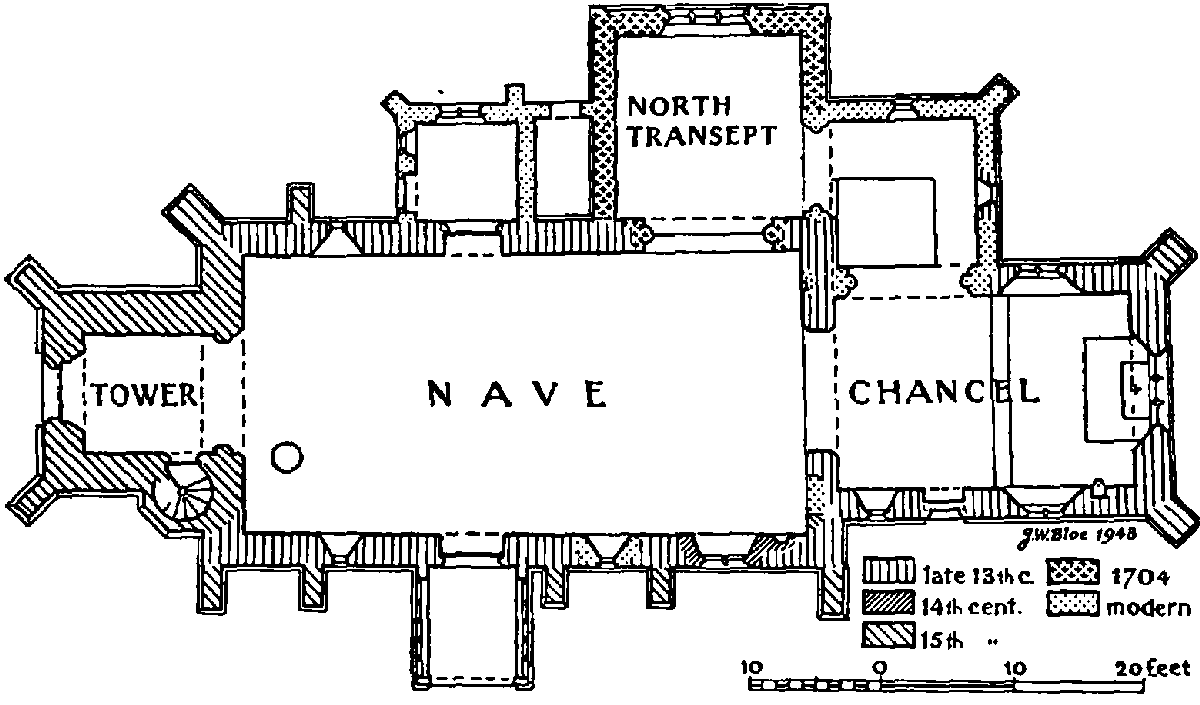
Plan of Packwood Church
In the south wall are three windows; the easternmost is of two plain pointed lights below a two-centred head. The jambs are of two orders, the inner ovolomoulded. The window is ancient outside and leans outward with the wall, but internally the west splay has been rebuilt plumb vertical and above the springing level on the east side of the face has been brought out to the modern vertical face over it by a corbel-course. The second window, all modern, and the western, original with restored splays, are single lights like the north-west window. The south doorway has chamfered jambs and two-centred head, retooled. It has an ancient door with planted-on ribs making four long panels, and has vertical and horizontal framing at the back.
The piscina near the east end has a trefoiled ogeehead with retooled soffit cusps. The sill is modern.
The walls are of white stone ashlar but have been much patched and partly rebuilt; they have chamfered plinths. The north wall has one and the south has five square buttresses. They are all old although probably not all original with the walls, and have higher plinths. At the north-west angle is an old diagonal buttress.
The gabled roof of three bays is probably of the 16th century but has been reinforced with brackets, &c. The two intermediate trusses have stout old tie-beams and moulded wall-plates and purlins. The other trusses are modern and have no tie-beams. The sloping weather course on the east face of the tower indicates an earlier, slightly higher, roof.
The transept (14 ft. square), built 1704 of brickwork, has an original round-headed north window, now furnished with modern mullions and tracery bars in an attempt to 'Gothicize' it. It has a moulded stone architrave and impost moulds, and the keystone is carved with a grotesque face. The walls have pilasters at the north angles. The roof has a coved ceiling of plaster rising above a moulded cornice.
The west tower (about 9 ft. square) is of three stages with moulded string-courses, the lowest stage of more than half the whole height. The walls are of ashlar and have a moulded plinth. At the west angles are original diagonal buttresses of four stages reaching to half-way up the third stage. On the south side is a projecting semi-octagonal stair-turret with a pointed stone roof reaching the parapet string-course. It is entered by a pointed doorway in the south wall and lighted by plain loops. The parapet is embattled, with returned copings to the merlons, and crocketed pinnacles above the angles. In the string-course and at the angles are gargoyles.
The pointed archway towards the nave is of two chamfered orders, the inner with a moulded capital.
In the west wall is a doorway of two hollowchamfered orders with a four-centred arch in a square head with a label. The spandrels are carved, the north with a Tudor rose and foliage and the south with a crowned head and foliage. Above it is a window of three cinquefoiled ogee-headed lights and vertical tracery in a two-centred head. The jambs and head have a wide, hollow mould. The second stage has rectangular lights in the west and south sides.
The bell-chamber windows are each of two trefoiled pointed lights and plain spandrel in a three-centred head; they have middle transoms. The jambs and heads have a large outer splay.
The tower has a hexagonal-pointed roof with a weather-vane.
On the face of the stair-turret is a large sundial with the restored painted date 1680 in Roman numerals.
The south porch, of timber-framing on low stone walls, is modern.
The communion table is of the 17th century and has turned and carved bulbous legs and carved top-rails. The rails, also of the 17th century, have turned, twisted balusters and a moulded top-rail.
In the transept window is some coloured glass reset from the chancel east window. It includes a late-13thcentury Crucifixion, much worn with age. It has a white figure in a blue background and yellow foliage, and is set in a trefoiled pointed niche-arch under a gable with crockets. The pilasters of the niche are of ruby glass and flanked by buttresses panelled with window tracery in black line. There is also a shield of the Featherston arms. There are also some fragments of 13th-century glass in the side windows of the chancel, patterns in black line on white and two roundels quartered green and yellow.
Above the chancel arch towards the nave are the remains of 15th-century wall-paintings, representing the popular allegory of 'the three Kings and the three Dead men'. (fn. 32) They include a figure, north of the arch, of a bearded man, with his left hand upwards, palm outwards. Behind him is another figure in a red garment: both stand on scrolls. South of them can just be discerned the figures of the three corpses.
The font, probably of the late 13th century, has a tapering round bowl with a rim mould round the top. The octagonal stem and base are modern.
The screen to the chancel arch is of the 15th century. It has a moulded doorway with a four-centred head and two bays each side with trefoiled pointed heads. The posts are moulded.
In the nave are two benches, 6 ft. 3 in. long, with shaped standards and with seats hinged on pivots. A like standard has been re-used as a support for a modern seat. They are probably of c. 1500.
In the organ-chamber is a dug-out chest, 5 ft. 8 in. long, 2 ft. 4 in. wide, and 1 ft. 8 in. high, with a curved top and a heavy lid let into the rebated sides and ends. It has strap hinges and straps for former hasps. There is one middle lock and marks of two other former staples and hasps.
On the north wall of the nave is a monument to William Hovell, died 1610, Prudence (Davers) his wife, and a daughter Dorothy, with a shield of arms. On the south respond of the chancel arch is a marble monument to John Featherston, Sept. 1670, with a shield of arms. A marble monument in the north transept is to Thomas Featherston, its builder, died 1714, and there are memorials to other members of the family.
There are six bells, (fn. 33) five by Henry and Matthew Bagley, 1686, and provided by Thomas Featherston, and the treble by Barwell of Birmingham, 1907.
The registers begin in 1668.
Advowson
The church of Packwood was a chapel of Wasperton, served by a priest, for whose salary the small tithes and certain glebe lands were assigned. (fn. 34) In 1535 it was called a parish church, the stipendiary priest then receiving £5 yearly. (fn. 35) The advowson and rectory were granted to William Sheldon in 1544 with the manor and have followed its descent, a grant of the 'free chapel' of Packwood to Edward Wymarke in 1588 (fn. 36) never having taken effect. It was described in 1831 as 'a perpetual curacy in the peculiar jurisdiction of the Manorial Court of Packwood'. (fn. 37) About 1850 it seems to have become independent of Wasperton and now ranks as a vicarage.
Charities
Arthur Walwyn Burdett by will proved 23 March 1910 gave to the minister and churchwardens of Packwood £180, the income to be applied towards the upkeep of the churchyard. The endowment now produces annually in dividends £4 5s. 6d.
The Johnson Memorial Charity. By a Declaration of Trust dated 11 April 1893 it was directed that a sum of £150 should be paid to the Official Trustees of Charitable Funds and the income applied by the vicar and churchwardens of Packwood for the relief of the sick and convalescent poor of the parish. The dividends amounting to £3 15s. 8d. annually are so applied.
Thomas Harborne by will dated 2 March 1710 gave to the poor of Packwood the use or interest of £40 to be paid to them in bread on 25 March yearly. The endowment now consists of an annuity or rent-charge of 40s. issuing out of land in Knowle and is applied for the benefit of the poor of the parish. The charity is administered by two trustees appointed by the Urban District Council of Solihull.