
A History of the County of Warwick: Volume 5, Kington Hundred. Originally published by Victoria County History, London, 1949.
This free content was digitised by double rekeying. All rights reserved.
'Parishes: Tanworth', in A History of the County of Warwick: Volume 5, Kington Hundred, (London, 1949) pp. 165-175. British History Online https://www.british-history.ac.uk/vch/warks/vol5/pp165-175 [accessed 11 April 2024]
In this section
TANWORTH
Acreage: 9,808. (fn. 1)
Population: 1911, 2,231; 1921, 2,859; 1931, 2,839.
This large parish, measuring roughly 5 miles from north to south by 4 miles from east to west, is bounded on the south for a distance of 2 miles by the River Alne. (fn. 2) On the west the Portway divides it from Worcestershire for a mile, and the boundary then turns north-east along a small stream which now runs into the large reservoir at Earlswood that feeds the Stratford-on-Avon and Birmingham Canal, which crosses the parish from south-east to north-west. The road from Birmingham forks on Shirley Heath, just outside the parish; one branch runs south as Salter Street; the other, to Henley, south-east as Monkspath Street, (fn. 3) crossing the River Blythe at Monkspath Bridge. A little west of the bridge the main stream of the Blythe, here running north, is joined by another stream from the west. The parish, which is slightly undulating, lying for the most part between 450 ft. and 500 ft., is watered by a number of small streams, and there are many ponds, as well as several moated sites. Tanworth is described by Dugdale as 'meerly Woodland' (fn. 4) and the centre and west of the parish is still heavily wooded.
The village, standing mostly to the west of the church, is on the southern edge of the old parish, the south side of the main street being actually in Aspley, which was a hamlet of Wootton Wawen until 1895, when it was transferred, with Forde Hall, to Tanworth. Some half a dozen houses in the village show timbering of the 17th century. A branch of the Great Western Railway from Henley-in-Arden to Birmingham, opened in 1908, runs past the village, with a station at Danzey Green and another at Wood End. To the north-east, about 1½ miles from the church, is Umberslade, a large rectangular stone house built by Thomas Archer before 1741 (fn. 5) but modified by Mr. Muntz during the 19th century (fn. 6); it has an entrance porch of classical columns, and the walls have rusticated quoins and baluster parapets. The house stands in the middle of a park of 200 acres containing three or four large ponds or lakes. The great avenue leading from the house slightly south of west to the road above the village is shown in Beighton's map of 1729, and there is an indication of a park. In 1630 the Archer estates included a messuage called Omberslade Hall, the Old Park of Tanworth, and Lodbrooke's Park. (fn. 7) The latter, which in 1544 contained 288 acres, (fn. 8) lay 2 miles west of Umberslade, but the position of the Old Park (126 acres) is not certain; it is referred to in 1480, when William Turnour was appointed marshal of the king's stud in certain parks including Tanworth. (fn. 9) On the south edge of Umberslade Park is the deserted moated site of Codbarrow Manor. Some 2 miles north of the park another moat, approached by a track from the lane leading west from Box Trees on the Henley road over Kineton Bridge to Illshaw Heath, marks the site of Sidenhall. About a mile north-west of this, and the same distance west of Monkspath Bridge, at Cheswick are the earthworks and moat of a fortification of uncertain date known as 'The Mount'. (fn. 10) Three-quarters of a mile south-west of Cheswick is Bedsworth (formerly Bettlesworth) on Salter Street, near which there was in the 16th century a 'great pool', (fn. 11) shown on Beighton's map of 1729 but now apparently absorbed into the canal reservoir.
Henry, Earl of Warwick (1204–29), had a watermill in Tanworth for the repair of whose mill-leet he acquired land from Roger de Rounishull near the road to Beaudesert. (fn. 12) In 1316 there were two water-mills attached to Tanworth manor. (fn. 13) One was no doubt on the Alne where a mill still stands; the other may have been Botley Mill, lower down the river, which is shown by Beighton and of which the site is marked on the O.S. 6-in. map. In 1627 there were three mills on the Archer estates, (fn. 14) of which one was probably at Monkspath, where a mill is mentioned in 1322. (fn. 15) In the same year there is a reference to the road from Beyeford mill to Tanworth church, (fn. 16) and an undated deed, probably slightly earlier, mentions the road from Benethford mill to 'le ded cherles ford'. (fn. 17) This mill seems to have been near Bedsworth, as in 1539 Thomas Grene of Benffordes place in Tanworth had a lease of land at Betsworth with permission to build a water-mill of two bays there. (fn. 18) The O.S. map marks a disused windmill standing above Tanworth Mill, and this is shown on Beighton's map. Another must have existed on the western edge of the parish in 1374 in 'Wynmelfelde' (now Windmill Naps), close to which was 'le Tylhouse Ovene' and Tylers Grove (still so called). (fn. 19)
The commons of Earlswood and Shirley Heath were inclosed in 1855, involving the closing of nineteen roads. (fn. 20)
Forde Hall, ¾ mile south of the church, is now mainly a modern brick building but incorporates at its north end an early-17th-century house or wing of timber-framing which has undergone some alteration and skilful restoration with re-used timbers. A gable at the west end of the north side has obviously been widened, the original east hammer-post of the former 15-ft. gable being still in place. At the east end of the block is an original projecting chimney-stack of thin bricks with three detached diagonal shafts. It has a wide fire-place, now fitted internally with a smaller grate and a small window. The lower rooms have open-timbered ceilings. The roof is tiled. A neighbouring farm building appears to pre-date the house and may have had some domestic use originally. Its outer (east) side has a projecting middle bay with timber-framed gable-head in which is some attempt at cusping or foil work. The main wall north of the bay preserves a little close-set studding, but that south of it and the west face are of later square framing and there is a good deal of later brickwork.
Danzey Green Farm is a mid- to late-18th-century house of brick facing west; its wide windows have flat gauged arches with painted key-stones, and the middle doorway a segmental arch. About ½ mile east of it is the derelict Danzey windmill with clap-boarded walls and a brick basement. Only one stretcher remains in each of the four arms of the sails.
Little Bickerscourt Farm, about ¾ mile east of Danzey Green, is a cottage, facing south, of 17th-century timber-framing which has been largely replaced with later brickwork. Dairy House Farm, just south of Umberslade Park to the west of the road, is a low 17th-century house considerably restored. It has ancient ceiling-beams and shows some wall-timbers inside, but externally is covered with rough-cast. The central chimney-stack has a wide fire-place. There is a good three-bay barn of heavy square timber-framing with brick nogging and a tiled roof. The Birches, Kemp's Green, is a mid-18th-century brick house facing east, but has a back-wing (dairy, &c.) of 17th-century timber-framing. In the garden is a large mortar (the 'old font'), a round basin with tapering sides and four lugs.
Old Grove Farm, a mile west-north-west of Umberslade Park, is a much-restored house of 17th-century origin; many of the timbers are modern with roughcast infilling, but old framing shows in the north-east end-wall. East of the house is a small barn with some 17th-century framing.
High Chimneys, ¾ mile north-east of the last, has been rebuilt in brickwork, except a pair of projecting chimney-stacks in front, in line one with the other and joined by a flush lobby with the entrance. They are of 17th-century brickwork and each has a pair of diagonal shafts. A small early-18th-century timber-framed farm building north-west of the house is said to have been used for storage of flax. A little east of it, on the east side of the road from Hockley Heath, is 'The Homestead' (formerly Yew Tree Farm), an early-17th-century house, mostly with later brick walls, but showing original timber-framing inside, including ceiling beams with wide chamfers. The north room of the main block has a wide fire-place; the south room was later converted into a bakehouse with a large fire-place and oven, and the upper into a granary. A later crosswing at the north end, making the plan L-shaped, shows some 17th-century brickwork in the gabled east end. The roof is tiled and the central chimney partly ancient.
Sidenhales, a mile north of the last, dates from c. 1600. It is of L-shaped plan, the main part facing south and the east gabled cross-wing projecting in front. On the east side of the wing is a 9½-ft. projecting chimney-stack of stone with a chamfered plinth, and a plain shaft of thin bricks. The walls of the house are mainly of later brickwork, but story-posts remain in the north wall. The south-east room has a heavy chamfered ceiling-beam and 18th-century joists, the beam having mortices for former wide flat joists: the projecting chimney has a wide fire-place. To the north is a space enclosed by a moat. It is now overgrown, but is said to contain foundations and paving of the former Manor House. Perhaps the stone for the chimney-stack came from these remains.
Winterton Farm, ½ mile west of Sidenhales, is a midto late-18th-century house of two stories and attics with red-brick walls and tiled roofs. The front has a roundheaded middle doorway with wooden pilasters and pediment and the sash-windows have flat gauged arches. A farm-house farther south at Warings Green west of the roadway is practically a replica of Winterton.
Moat House, a mile south-west of Winterton, may be of late medieval origin, judging from its plan and the low height of the middle block, which was probably the one-storied hall. The plan is of half-H shape, facing north, the east and west gabled cross-wings projecting in front. The middle block is of two large bays; behind the eastern is a massive projecting chimney-stack, 12 ft. wide, of 17th-century brickwork with a plain shaft. It has a great fire-place, now a recess with a smaller grate in it and a side window. Behind the western bay is a recent addition brought out to the same plane as the chimney-stack; this bay has an open-timbered ceiling, the ceiling of the other is plastered except for the chamfered main beam. The front wall is plastered, painted in the upper part with imitation half-timber work—square panels with quadrant ornamentation, which the occupier suggests is a copy of the framing under the plaster. The west wing, gabled on its west side as well as front and back, preserves much of its original square framing seen inside but covered outside by a facingboard on each timber for preservation. The lower rooms have open-timbered ceilings. Other walls are of brick, the east wing being much more altered than the other, although it has open-timbered ceilings.
Against the east side of the east wing is an addition of c. 1700, built slightly askew with the older part, perhaps because of the moat. It is of red brick with anglepilasters to the gabled east wall and a string-course at the first-floor level. The lower room has an opentimbered ceiling and in the north wall are coved recesses flanking the modernized fire-place. The south half of the rectangular moat, with water, survives. A drive from the public roadway leads to the north front over a former bridge which has ornamental open cemented parapets, apparently of the 19th century.
Claybank Farm, ½ mile south of Moat House, is a small late-16th-century house, facing nearly east. The plan is rectangular, of only two rooms, and the walls of timber-framing, the lower story having much close-set studding and the upper square framing with rough-cast infilling. At the south end is a projecting chimneystack with a plain shaft and a wide fire-place. The ceilings are open-timbered: they have been heightened slightly with later joists, the original main beams showing the mortices of the former wide flat joists. The roof is tiled.
White House Farm, a mile east of the last near Terry's Green, is of similar size and construction but much more restored: the lower story is underbuilt. It has a central chimney-stack with a wide fire-place. Another house ¾ mile south-east of the last is now a butcher's premises, and much altered but retains some of the old framing, open-timbered ceilings, and wide fire-place. A little farther south is 'Arden Cottage', of the same type, showing rather more of the original framing but much renovated inside. It has a wide fireplace in the central chimney and plastered ceilings with rough main beams.
Beaumont Hill Farm, near Wood End and ¾ mile north of Tanworth Church, is a large 18th-century brick house, facing west. The back part is of earlier 18th-century work than the tall front block, which is of the end of the century. The estate was part of the endowment of the chantry (see below) and was bought from the Throckmortons by the Hunts, who sold it in about 1820 to the Burmans. In a bell-turret is a bell with the date 1712 and the initials I.S. (probably Joseph Smith, bell founder of Edgbaston). (fn. 21)
St. Patrick's Church, Earlswood, originally built in 1840, was rebuilt (except the tower, added in 1860) in 1899, of red brick with stone dressings in the 14th-century style. It consists of a chancel with a vaulted apse raised above an open arcaded basement, nave, and west tower. The interior is of yellow-brick facing and has wooden-vaulted roofs which are tiled.
Jerrings Hall, a mile north of Earlswood Church to the west of the road, is a 17th-century house of rectangular plan, facing east, to which a wing was added at the north end, projecting east, about 1730, making the plan L-shaped. Most of the walls are faced with brick or rough-cast, but the southernmost bay of the west side is of old timber-framing. The house formerly extended some distance farther south; foundations are said by the owner to be buried in the soil. The central chimney-shaft is square and of thin bricks. It has two wide fire-places back to back, and the two middle rooms of the four in the range have open-timbered ceilings. There was an earlier house on the site or near it, as some of the timbers have obviously been re-used. For instance, the middle beam of the room north of the stack is a 15th- or 16th-century widely chamfered timber that has been jointed on to a short end, in the chimney-breast, which has a smaller stopped chamfer. In the upper room south of the stack is a heavy tie-beam against the chimney-breast, highly cambered on the upper surface, on hammer-posts. It forms part of a 17th-century truss with sloping struts and collar-beam. But only about a foot south of it is another similar truss with a lighter tie-beam, and there is a similar truss near the south end; the purlins of this bay have rough windbraces. The 'roof is tiled, the ridge of the north half being higher than that of the south. The early-18th-century wing is of brick: the windows in the ground and first floors of the east end-wall are wide openings of three lights, the middle light having a round head. In the wing is a staircase with balusters of c. 1730. The house, which derived its name from the medieval family of Gerin, was the home of the Field family for more than 200 years, from about 1670.
Light Hall, ½ mile farther north, is a large late-18th-century red-brick building of three stories. The front is divided into three bays by brick pilasters of full height with stone bases and caps, and has a moulded stone cornice. The middle doorway has a curved pediment: the side bays have modern bay-windows. The other windows have flat arches or lintels of stone or cement.
Monkspath Hill Farm, west of the main road from Hockley Heath to Birmingham and 2 miles north of Nuthurst Church, appears to have been an early-17th-century house, facing east, with a cross-wing projecting in front which was added or rebuilt in 1691. A much longer and lower wing also extends east from the south end; this seems to be an 18th-century addition, but part of it adjoining the main block may be of the original period. In the east gable-head of the short north wing is a round stone inscribed wp 1691 and a smaller added date 1810. The latter refers to the east gable-wall, but the north side and west end of the wing are of the 1691 brickwork. The wing has a central chimney-stack with two diagonal shafts; its fire-places are modern. The main block has walls of later brickwork but has front and back gable-heads that are plastered, probably indicating timber-framing: it is also gabled at its south end. At the back is a 17th-century projecting chimneystack with a plain shaft: it has a wide fire-place: the room it serves has a plastered ceiling except for the chamfered main beam. The long south wing overlaps the east gable of the main block. It is of 18th-century brickwork and has a wide fire-place near the east end with a plain shaft. The kitchen which it serves has an open-timbered ceiling. North of the house is a long six-bay barn with walls of heavy timber-framing and two great doorways in each side.
A mile farther north on the same side of the road is a cottage of 17th-century blackened timber-framing with whitened brick infilling; the roof is tiled and has a plain central chimney.
An Association for the Prosecution of Felons was founded at Tanworth in 1784 and, although no longer functioning, survives as an excuse for an annual dinner in May. Since 1874 the chairman has been a member of the Burman family. (fn. 22)
Manors
Tanworth was in early times a member of the manor of Brailes, and Dugdale is probably correct in identifying it (fn. 23) with the block of woodland, 3 leagues by 2 leagues, attached to that manor at the time of the Domesday Survey. (fn. 24) With Brailes, therefore, it had belonged to Earl Edwin, was in the king's hands in 1086, and was given to Henry de Newburgh when he was made Earl of Warwick. The manor of TANWORTH descended with the earldom, Alice widow of Earl Waleran receiving dower therein in 1207, (fn. 25) and Earl Guy de Beauchamp holding it of the king as a hamlet of Brailes in 1315, (fn. 26) at which time it was valued at £34 16s. 4½d. (fn. 27) In 1348 Thomas, Earl of Warwick, had licence to lease it for life to Peter de Mountfort at a rent of 10 marks. (fn. 28) With the other Warwick estates it passed to the Crown in the reign of Henry VII, and in October 1544 it was sold to Sir George Throckmorton. (fn. 29) Thomas Throckmorton in 1604 sold it to Andrew Archer of Umberslade, (fn. 30) with which estate it descended until the death of the second Lord Archer in 1778, when the manor of Tanworth went to his youngest daughter Harriet, who in 1790 married Edward Bolton Clive. From them it was bought in 1826 by Edward Bolton King and thus reunited to Umberslade. (fn. 31)
The estate of UMBERSLADE was given in the reign of Henry II by Henry de Vilers and Roger de Hulehale to Robert Archer (Sagittarius) and Saliit his wife, (fn. 32) and remained in the hands of their direct male descendants for 600 years. Robert's son William acquired additional land (fn. 33) from Earl Waleran (1184–1204), and his son John was granted by Earl Thomas, to whom he was acting as 'champion', (fn. 34) extensive rights of hunting and hawking in return for a render of twelve broad arrow-heads and two capons at Whitsun. The member of the family (fn. 35) who attained most lasting distinction was Sir Simon Archer, born in 1581 and knighted in 1624, a learned and industrious antiquary, to whose assistance in the compilation of his Antiquities of Warwickshire Dugdale expresses his indebtedness. (fn. 36) His great-grandson Thomas was created Baron Archer of Umberslade in 1747 and died in 1768. (fn. 37) The title became extinct in 1778 on the death of his son Andrew, who left four daughters, of whom the eldest, Sarah, received Umberslade (with Clay Hall, Codbarrow, and Ladbroke Park). She married the 5th Earl of Plymouth in 1788, and afterwards Lord Amherst. (fn. 38) From them Edward Bolton King bought Umberslade in 1826. The estate was leased in about 1850 to George Frederick Muntz, (fn. 39) who died in 1857, shortly after which date his son bought Umberslade and the manorial rights of Tanworth, (fn. 40) and the estate has descended to his grandson, Capt. D. G. E. Muntz, D.L., J.P. (fn. 41)
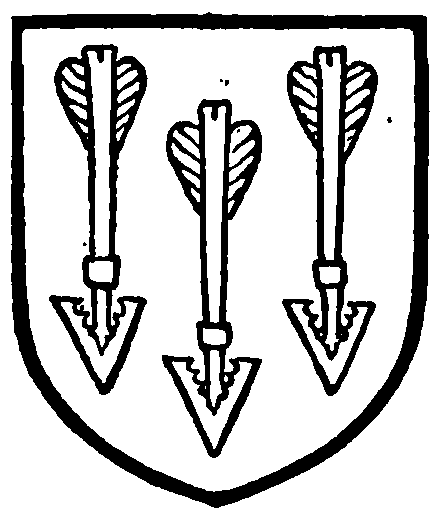
Archer. Azure three arrows or.
The manor of MONKSPATH was given by William, Earl of Warwick, to Roger de Hulehale in the reign of Henry II, (fn. 42) and was sold by Roger's greatgrandson William to John Archer. (fn. 43) In 1315 it was held of Earl Guy as ¼ knight's fee by John 'Larcher' and was said to be ⅓ of Tanworth. (fn. 44) It then descended with Umberslade (fn. 45) (q.v.).
Another manor of MONKSPATH (fn. 46) may have originated with Simon de Mancetter, younger son of Hugh, who, according to Dugdale, 'settled himself within the Lordship of Tanworth, where a certain large moated place (though the buildings be gone) beareth yet the name of his habitation'. (fn. 47) The name has been lost, but the moated site is probably that just south of Monkspath Bridge over the Blythe. Simon's son Sir Simon de Mancetter in 1304 made a feoffment of his manor of Monkspath to John de Dene, Isabel his wife, and John his son. (fn. 48) It may have been this part of the manor of Tanworth that the Earl of Warwick leased in 1348 to Sir Peter de Mountfort (see above), as in 1352 Sir Peter dated a grant to Bordesley Abbey from Monkspath. (fn. 49) His descendant Sir William Mountfort held ¼ fee here of the Earl of Warwick in 1400 (fn. 50) and died seised thereof in 1452, (fn. 51) having in the previous year settled the manor in tail male on his son Robert. (fn. 52) As Robert left only a daughter, the manor passed to his nephew Sir Simon, who bestowed it in 1479 upon his son John and his wife Anne, previously widow of Lord de Say and later wife of Humphrey Seymour. (fn. 53) It descended to Sir Edward Mountfort, who in 1629 conveyed it to James Prescott and George Palmer, (fn. 54) apparently for sale to Thomas Warner, vicar of Tanworth, who died in 1642, and before 1730 it had been acquired by the Archers (fn. 55) and passed with their other estates.
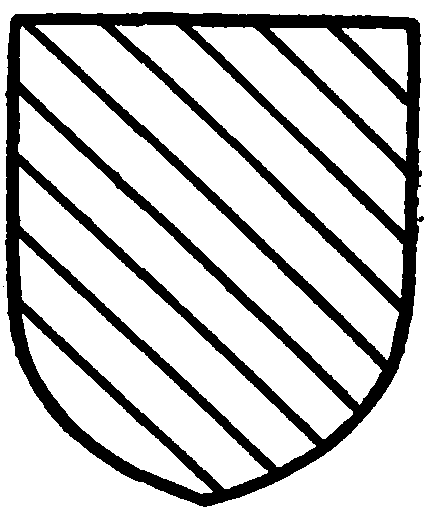
Mountfort. Bendy of ten pieces or and azure.
BEDSWORTH was included in Earl William's grant of Monkspath to Roger de Hulehale; (fn. 56) the ¼ fee held by John Archer in 1315 was in the two places, (fn. 57) and in 1400, when held by Thomas Archer, was described as in Bedsworth. (fn. 58) An estate in Bedsworth, however, was held of the Earl of Warwick in 1235 with others in Cherington and Wiggins Hill in Sutton Coldfield (q.v.) by William Bonchevaler, (fn. 59) and with them passed to Ralph de Wilinton, who granted it to Roger Durevassal. (fn. 60) His grandson Thomas held the manor in 1330, (fn. 61) and when the latter's grandson Nicholas died without issue it passed by the marriage of his widow Rose to Richard de Mountfort and so to the family of Catesby. (fn. 62) Richard Catesby between 1533 and 1543 sold his estates here to Thomas Green, (fn. 63) whose grandson held the property in 1640. By 1730 it was in the hands of 'the Reverend Mr. Banner'. (fn. 64) Later it came to the family of Heynes, and in 1930 the estate was owned by Mr. Hammond. (fn. 65)
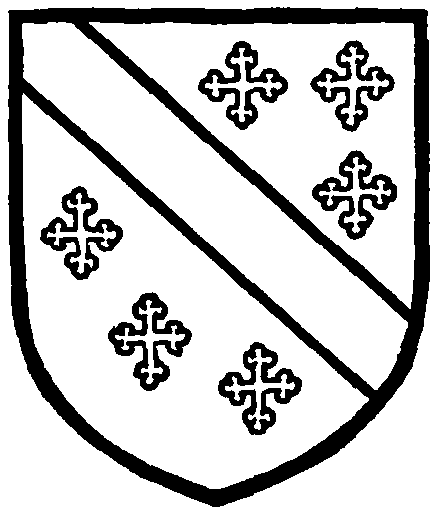
Durevassal. Argent a bend sable between six crosslets gules.
Richard de Mountfort also acquired land in Tanworth from William de Codbarwe, who had inherited it from his brother Nicholas, in 1362. (fn. 66) Richard's son William left two daughters, of whom Helen brought this estate in marriage to Richard Merebroke, (fn. 67) who in 1427 entailed the manor of CODBARROW on his son William or his daughter Alice. She married John Norris, and in 1534 Sir John Norris conveyed it to William Willington of Barcheston. (fn. 68) He died in 1557 seised of the manor, (fn. 69) which he bequeathed to Anne, one of his seven daughters and coheirs, and her husband Francis Mountfort, whose grandson Sir Edward sold it to Sir Simon Archer. (fn. 70)
Land in Tanworth was held by Sir Henry de Lodbroke in 1316. (fn. 71) His son Sir John was at Tanworth at the end of June 1349, when he conveyed his manor of Ladbrooke to William de Catesby and Nicholas le Wodeward. (fn. 72) In August of that year this Nicholas conveyed to William Catesby and others a 'manor of Tanworth'. (fn. 73) Sir John must have died just about this time, not improbably of the Black Death, as in 1350 his widow Hawise (fn. 74) was granted by William son of Nicholas le Wodeward a life interest in the manor of Harbury and an estate in Tanworth, with remainder after her death to William Catesby and then to Thomas son of Sir John de Lodbroke and Alice daughter of the said William Catesby in tail male, with contingent remainders to Thomas's brothers Hugh and John. (fn. 75) Apparently Thomas and Hugh left no male issue, as Sir John de Lodbroke died in 1385 seised of a manor of Tanworth, leaving a daughter Alice, aged 30. (fn. 76) She was then the wife of Lewis Cook, or Cardigan, who disputed the possession of the Lodbroke estates with William Catesby's son John. (fn. 77) Their daughter Catherine had married William Hathewyk and had a son John, (fn. 78) but this estate seems to have been acquired by Thomas Beauchamp, Earl of Warwick, as on his death in 1401 he was holding, jointly with Margaret his wife, the manor of LADBROOKS in Tanworth. (fn. 79) On this occasion, and at the deaths of his widow Margaret in 1407 and his son Earl Richard in 1439, the manor was said to be held of the King as of the Honor of Peveril, (fn. 80) the explanation of which is obscure. It passed with the other Warwick lands (fn. 81) to the Crown and was acquired in 1544 by Sir George Throckmorton, as 'Lodbrokes Park', containing 288 acres, part of the manor of Tanworth, (fn. 82) to which it remained attached. In 1571 the park was said to be 2 miles in circuit, 'replenished with Roes, furnished with a great number of Timber Trees, and hath also two springe woodes or coppices containing by estimacon about 40 acres'. (fn. 83)
The family of Fulwode, who are said to have been a branch of the Offords of Wootton Wawen, (fn. 84) were resident in this parish by the middle of the 14th century. (fn. 85) John Fulwode had a licence for a private oratory in his house here in 1395 and 1403, (fn. 86) and his younger son Robert claimed to have inherited some 50 acres about 1450. (fn. 87) Edmund Fulwood died in 1578 seised of FULWOODS manor, held of Sir Robert Throckmorton in free socage, leaving a son Richard. (fn. 88) He seems to have died shortly after his father and to have been succeeded by his brother Robert, who in 1593 sold the manor to Thomas Greswold, (fn. 89) whose widow Elizabeth (Shuckburgh) in 1602 sold to Thomas Spooner the manor of 'Cleahall or Fulwood Hall'. (fn. 90) The manor of CLAYHALL, the name of the residence of the Fulwodes since the end of the 14th century, was sold by Thomas Spooner's grandson William to Andrew Archer (fn. 91) and descended with the other Archer estates in Tanworth.
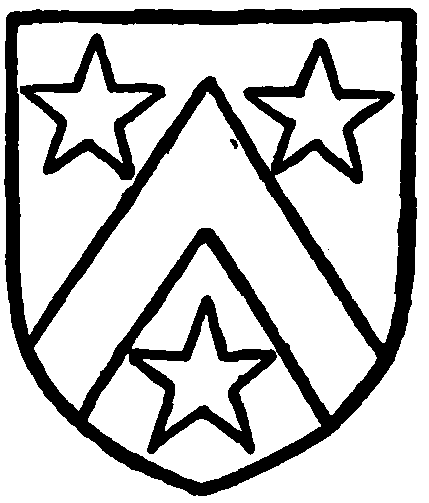
Fulwode. Gules a cheveron between three molets argent.
Another manor, that of SIDENHALE, is said to have come to William Fulwode in 1330 by marriage with Joan, (fn. 92) heiress of the main branch of the family which took its name from this place. (fn. 93) A later Fulwode sold to (? John) Hugford of Henwood, (fn. 94) and in 1544 there is reference to John Hugford's manor of 'Syddenalles Hall'. (fn. 95) One of his descendants in the 17th century sold the manor to Nathaniel Cookes of Ingon, (fn. 96) and he was dealing with it in 1675, (fn. 97) after which date it was probably bought, with the other Cookes property of Pinley in Rowington (q.v.) (fn. 98) by Aaron Rogers, as the manor was held in 1765 by his descendant Bridget Prew. (fn. 99) Her granddaughter Elizabeth Mary Wise held it in 1766 and, with her husband Robert Roe, in 1775, being succeeded in 1780 by her sister Patience, wife of Thomas Benbow. (fn. 100) By 1798 the estate was apparently in the hands of their brother Mathew Wise, (fn. 101) who was lord of the manor in 1803. (fn. 102) His son Mathew probably sold it to James Mann, Earl Cornwallis, whose nephew Philip Wykeham-Martin inherited it. (fn. 103) His son Cornwallis Philip WykehamMartin, who died in 1924, succeeded to the estate, but the manorial rights appear to have lapsed. (fn. 104)
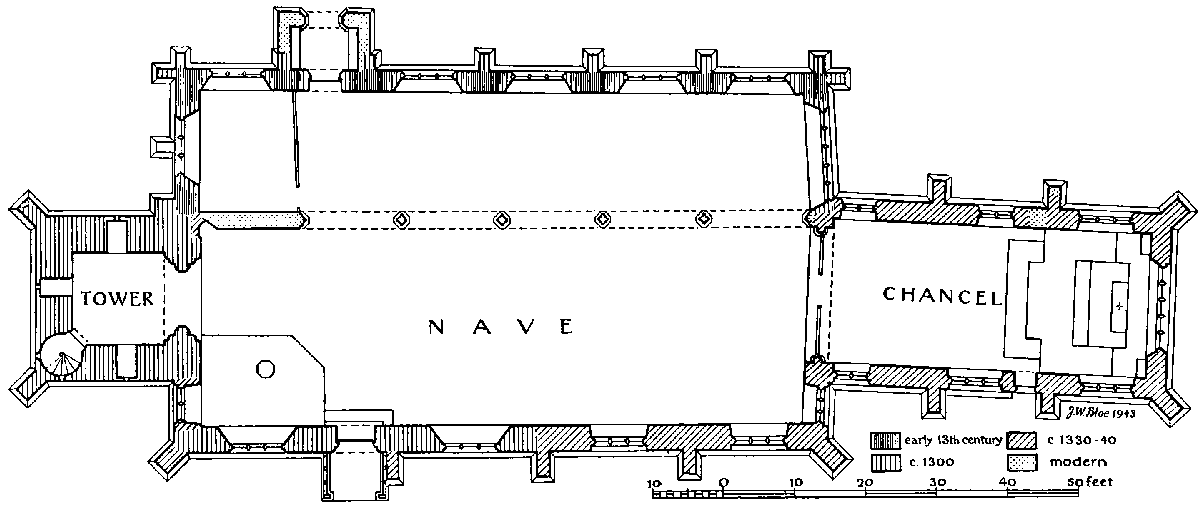
Plan of Tanworth Church
An estate called Crewenhale was held for at least five generations by a family who took their name from it, and passed in the 15th century, by the marriage of the daughter and heir of John de Crewenhale, to William Parker of Chartley. (fn. 105) Its site is uncertain, but it was probably near Light Hall (south of Shirley Heath and west of Monkspath), which was also held by the Parkers. (fn. 106) The last of that family in the male line was John Parker, who died 31 December 1516. (fn. 107) His daughter married Thomas Greswold, in which family the estate descended. (fn. 108)
A quarter-fee in CHESWICK was held of the Earl of Warwick in 1267 by William de Ulnhale. (fn. 109) In 1301 John de Broughton had a grant of free warren here, (fn. 110) and in 1368 Sir Thomas Broughton sold the estate to John Waryng and Richard Gower. The latter's heir in the 17th century sold it to William Bache. (fn. 111) By 1730 it had come into the hands of one Hall, (fn. 112) and in 1737 John and Richard Hall conveyed the so-called 'manor of Chiswicks' to John Dewes, but no more is known of it.
Church
The large parish church of ST. MARY MAGDALENE consists of a chancel, nave, wide north aisle, porches, and west tower with a spire.
A period of about half a century, from the late 13th century to c. 1330–40, covers the whole of the architectural details of the building, apart from the modern work.
Several structural features tend to confuse the history of the development of the plan, the principal being the disproportionately wide east window of the 17-ft. north aisle. This has its south jamb overlapped by a foot or more outside by the north wall of the 14th-century chancel, while the splay inside is a very tight fit with the arcade-wall of the nave, suggesting that the aisle was some 18 in. wider to the south before the arcade was built, if the window was central. Its tracery is not greatly different from the good 14th-century tracery of the east window of the chancel, but it is modern and may not be a true indication of the original design. From the overlap the window seems to be earlier than the chancel, which was built in its present form, c. 1330–40.
The other windows of the church may be roughly classified as of two types, one with deeply set glazing as seen from the outside, and acute internal splays, as in the chancel and the east half of the south wall of the nave, dating probably from the 1330 period, and the other with less deep glazing, generally simpler tracery, and wide internal splays, as in the north aisle and the west half of the south wall of the nave; these may be ascribed to the end of the 13th century. Those in the aisle show signs of having been inserted in an earlier wall, which is of rougher masonry than that of the rest of the church and perhaps of early-13th-century date.
The development appears therefore to have been as follows: an early-13th-century chapel, represented by the wide north aisle, into which new and larger windows were inserted at the end of the century, followed very soon afterwards by the complete enlargement of the church, beginning probably with the lower part of the tower and the west half of the nave, into which two of the widely splayed windows were transferred from the south wall of the chapel; then the east half and the chancel. The nave is 28 ft. wide; whether it had a narrow (6 or 7 ft.) south aisle originally within it is uncertain. There are east and west windows that could have lighted it and the positions of chancel arch and tower arch seem to take cognizance of it, but there are no traces in the walls of the existence of a south arcade.
The walls are unusually thick for the period (3 ft. to 3 ft. 9 in.), excepting that of the north arcade, which is only 2 ft. 4 in. thick and which was set as far north as the splay of the east window of the aisle would allow. It is known that the arcade was abolished in 1790. The old west respond is the only original fragment remaining and is of good early-14th-century type.
The upper half of the tower is later than the lower, but not much.
From the traces of the former nave roof showing on the tower, the roof rose from the present south wall of the nave, ignoring the south arcade, if there was one. Also the lower marks of a low-pitched roof indicate that the 18th-century roof spanned the whole width from north to south, the north arcade being also then nonexistent. A gallery across the west wall was built in 1790, when the north and south porches were demolished and new doorways made, opening into lobbies under the gallery. (fn. 113)
A general restoration was carried out in 1880, when the north arcade was rebuilt, its details obviously based on the old west respond, but one bay shorter, the gallery removed, new high-pitched roofs provided approaching more or less the original forms, and the north porch rebuilt. The south porch was added only recently.
The spire is recorded to have been taken down about 13 ft. in 1720 and rebuilt 6 ft. higher.
The chancel (about 45 ft. by 20½ ft.) is deflected to the south of the axis of the nave. The east window is of five trefoiled ogee-headed lights and foiled tracery, mostly intersecting, in a two-centred head, all of the 14th century except the thin foiling in the top piercing and parts of the mullions. The jambs and head are of two orders, the outer wave-moulded and with the hoodmould cut in one piece with it: it has head-stops, one with a 14th-century cowl; the inner splays are of old ashlar and the rear-arch has a filleted roll-mould. The sill is low as compared with the floor-level, which was raised in 1880 but is to be restored to its original level.
In the north wall are three windows, the eastern of three trefoiled ogee-headed lights and net tracery in a two-centred head, largely restored. The other two are of two lights and tracery of the same style as the east window. The jambs, of two chamfered orders, are deep-set outside and there are no hood-moulds. The acute ashlar splays are old; the rear arches are moulded as the east window, but the west half of the third window, close to the west end, is irregular and has probably been rebuilt. Of the three similar windows in the south wall the two eastern are of three lights and the third of two.
East of the middle window is a priest's doorway with a fairly acute pointed head; the jambs and head are wave-moulded and it has no hood-mould. The reararch is straight cambered and has a hood-mould of the same section as that of the east window, probably re-used.
The irregular spacing of the windows allowed a longer stretch of solid wall for the stalls that probably once existed here. The sill of the easternmost is lifted a little higher than the others for the piscina and former sedilia, of which traces still remain. The piscina has diagonal pilasters and a trefoiled ogee-head with a crocketed hood-mould and foliage finial. The sill projects slightly and has a round basin. There were three sedilia with crocketed ogee-heads, not foiled. One and a half bays are left, the head being all in red sandstone but the pilasters and remainder in white. The west half was hacked away flush with the wall-face in 1790 to make room for the large Archer memorial (now at the west end of the church), but has traces of the pilasters and heads. The modern tiled floor is dropped at the sides to show the correct original level of the sedilia.
The walls are of old grey Umberslade stone ashlar and have a moulded plinth. At the east angles are diagonal buttresses carrying crocketed pinnacles. The east gable-head has an ancient coping and remains of a gable cross. The side walls are divided into three bays by buttresses and have moulded eaves-courses. These buttresses may be later than the walls. In the southeast bay are grooves caused by arrow-sharpening.
The wall faces inside are of white ashlar; there are modern repairs between the two eastern north windows where there was a doorway to the vestry of 1790. Old grey sandstone was used to make good the face outside, and the buttress east of it, now faced with modern red sandstone, probably marked the east wall of the vestry.
The gabled roof is modern, of trussed rafter type forming two-centred arches inside. It is covered with tiles.
The pointed chancel arch is of three orders, of which the innermost is continuous and of a wave-mould section; the others are chamfered and die on the square responds.
The nave (86½ ft. long on the north side and 84 ft. 9 in. on the south by 27 ft. 9 in.) has a modern north arcade of five 14¼-ft. bays; it has slender grouped piers with four engaged shafts and moulded capitals and bases. One bay west of the arcade is solid wall, and the west end of this has been splayed back on the nave side to expose the top 2 ft. of the original 14th-century west respond with its moulded capital, showing that the modern work has followed the original detail fairly closely. The lower part of the respond was hacked off.
In the east wall south of the chancel arch a threelight window has been squeezed in, in the limited space. It is of three trefoiled two-centred lights and a kind of reticulated tracery in a two-centred head. Its north splay is acute and the south reveal flush with the south wall.
In the south wall are four windows; the two eastern are of three trefoiled ogee-headed lights and net tracery of the usual 14th-century type in a two-centred head. They are like those in the chancel with deep jambs and acute splays. The two western windows are of different type and resemble three of the north aisle windows; they are three trefoiled pointed lights with pierced soffit cusps; the middle light is taken up to the apex of the two-centred main head; the others at the springing-level have cinquefoiled piercings above them. The inner order is ovolo-or wave-moulded, the outer chamfered. The jambs are much less deep than those of the others; the internal splays are very obtuse and of the same masonry as the walling, but the courses of the west splay of the west window are smaller than those of most of the others. The segmental-pointed rear-arches are like those in the chancel. Below the sills of these two windows (only) outside are drip-courses. Between them is the south doorway with jambs and two-centred head of two wave-moulded orders.
Under the south-east window is a mutilated piscina with a trefoiled ogee-head which had a hood-mould; the basin is circular. In the face of the jamb stones are small holes, probably for wall plugs for panelling.
In the west wall is a window of two lights like those in the chancel.
The walls are abnormally thick (3 ft. 9 in. or 3 ft. 10 in.) and of grey sandstone ashlar with a plinth of two courses, the upper moulded like that of the chancel but mostly of later red-brown stone, and with a moulded eaves-course. There are old east and west diagonal buttresses and three intermediate, all original but partly restored. On the face of the middle buttress is scratched a sundial and on the main wall-face east of it is another just above the plinth. The head of the east gable is largely restored. The internal faces are also of ashlar.
The gabled roof is modern, of six bays with semicircular trusses above tie-beams.
The south porch is modern. On the wall are traces of an earlier and slightly higher porch-roof.
The north aisle (about 17 ft. wide) has a large east window, 18 in. wider than that of the chancel, of five trefoiled lights and tracery in a two-centred head with an external hood-mould. The middle light and its tracery are at the apex, the others in pairs at the main springing-level. The mullions and tracery are all in modern red-brown stone, but the jambs are ancient and are of the shallower type; the inner order is wavemoulded. The south jamb is overlapped by the north wall of the chancel, which is splayed back to meet the wave-moulded inner order, the rest of the jamb being buried or destroyed. The chancel wall meets the aisle wall below the window with a straight joint. The hood-mould is continued along the wall and part of the north wall as a string-course, and there is another of the same section below the sill outside. The wall is of grey-white ashlar, rather more roughly tooled than that of the chancel, and the moulded plinth, of a larger and somewhat different section, is 3 in. higher; the lower chamfered courses are of equal height.
In the north wall are five windows of three trefoiled lights and differing tracery in two-centred heads, but all of the same character as the east window and with wide splays. Three of the window heads resemble the two western south windows of the nave.
The wall, over 3 ft. thick, is of the roughly tooled ashlar and rather unevenly coursed. The window jambs are of larger courses, and few of them range with the courses of the walling and there are straight joints and vertical seams, suggesting that the windows are insertions. The string-course below the sills and the plinth are continued from the east wall, but the upper string-course after about a foot changes to a plain 18th-century course passing above the window heads. It has a moulded eaves-course. There are pairs of square buttresses at the angles and intermediate buttresses dividing the wall into six bays. These buttresses have the same plinth as the wall, but do not bond in with it, and the lower string-course is cut off where it meets them.
The 14th-century pointed north doorway (fn. 114) has jambs and head of two continuous orders, each of two chamfers; those of the outer are ogee-pointed. This and the south doorway were once altered to windows and still show the scars caused by the mutilation.
In the west wall is a window of three trefoiled lights and tracery. The grey stone jambs and outer order of the head are ancient and much decayed, but the red stone tracery is modern. The wall is of the unevenly coursed rough ashlar and the recent repointing gives it the appearance of being wide-jointed. There is an upper string-course well above the north eaves-level and about 1 ft. 6 in. above the springing-level of the window which interrupts it. Below the sill (only) is another length of the string-course. The gable-head is modern. Below the window is an old low buttress; the southern of the two bays it forms has a later plinth and has been patched with old stones. It was probably the position of the 18th-century doorway before the north doorway was restored and shows a rough straight joint.
The gabled roof is modern, of six bays with collarbeam trusses.
The west tower (about 13 ft. square) is of two stages divided by a string-course, like that of the north aisle, which passes also round the diagonal buttresses at the west angles. The plinth is the same as that of the nave. The walls, 5 ft. 3 in. thick, are of coursed grey ashlar, the lower half in general with smaller courses than the upper and probably earlier. The buttresses also have larger courses above the string-course; below it they are of five stages, the first, second, and fourth being very short; above it they are of two normal stages, all with plain offsets. The parapet is represented by one plain course only and coping, above a moulded stringcourse of later form than the lower string-course.
In the south-west angle is a stair-vice entered by a doorway in the splay, having a segmental-pointed doorway with an ogee point, and lighted by south and west loops. The upper doorways have segmental-pointed heads and the top of the drum has a saucer dome. The lower loop is rectangular and the upper has a trefoiled ogee head.
The archway towards the nave is lancet-pointed and is of three continuous orders of diminishing size from inner to outer and of medium-small voussoirs.
In the north, south, and west walls are 5-in. trefoiled lights in 8-in. monials and with square inner recesses, 2½ ft. or more wide, and with chamfered corbel-courses below the lintels. The lintel over the southern is made up of several stones, including two 13th-century coffin lids, showing the incised lines of long crosses. These recesses are unusually wide for such narrow lights and look as though they were for defensive purposes, rather than for light. Below the northern the walling has been repaired, as though there was once a doorway below it. The lights have been partly repaired outside at different times, but the trefoiled heads of the western and southern are ancient.
The story above has similar narrow lights, but each about 9 in. wide with a trefoiled pointed head cut in a single stone, that on the south side extending to the west of the light. A little higher at the east end of the north side is a segmental-pointed doorway on to the valley between the nave and aisle roofs. The bellchamber has in each wall a window with an obtuse pointed head of two trefoiled pointed lights and a plain spandrel. The jambs are of four chamfered orders.
The faces have dials for the striking clock below these windows. On the east face of the tower are traces of earlier nave roofs. South of the present nave-ridge is the weather-course of a higher steep-pitched roof, and it shows the top corner of a doorway that must have opened into the roof-space. North of the nave roof is a low-pitched gabled chase cut in the wall-face for the late-18th-century roof that extended from the north to the south wall.
The octagonal spire is of later grey ashlar in small courses and has broach base-stops. On the north side is a doorway with a cambered lintel. Higher up in the four cardinal faces are vertical spire-lights, rectangular openings with solid trefoiled heads and crude uncarved finials. The top 6 ft. of the spire is of 1720 repair in red stone and has a finial and weather-cock.
Two of the most interesting fittings in the church are the elaborate image-brackets that stand on the floor at the eastern angles of the chancel, at a level below the window ledges. They are rectangular on top, of nearly the same size but differing in their mouldings and enrichment, the northern being the simpler. This has a battlemented top moulding, below it a tier or frieze of quatrefoil panels, and then four sets of receding mouldings of typical 14th-century form. The southern has a vertical face with two tiers of panels. The upper has cinquefoiled pointed panels alternating with quatrefoiled squares over which are battlement mouldings. The lower has trefoiled ogee-headed panels and foiled spandrels. The lower receding mouldings include two rows of dog-tooth ornament. Both are carried on slender square stems with attached half-round shafts and with moulded bases. They are probably of c. 1330.
The font is modern, but there is a disused late-18th-century font nearby.
Near them, lying upside down, is the 14th-century capital of a pier that was circular, surrounded by four 4- or 5-in. shafts. It is larger and of different section from those of the nave-arcade, the abacus being of octagonal plan, the bell following the form of the pier.
The floor of the altar pace has been raised, but around the pedestal image-brackets it is left at the original lower level and has some paving of 13th- or 14th-century slip tiles of conventional patterns. (fn. 115)
At the west end of the nave is a fine framed chest, 8 ft. 3 in. long by 1 ft. 8 in. wide by 1 ft. 11 in. high, including the lid, which is of one plank hung by six strap-hinges, two of which have remains of fine scroll ornament. It has two hasps for padlocks and three locks. The styles at the ends are carried down as quadrant feet. The front has six straps rising from the base and retaining most of the original scroll-arms. The ends have plain crossed straps. The dexter end of the interior is partitioned off, with a separate lid inside. It is probably of the late 13th century.
Another chest, of the early 17th century, stands in the vestry at the west end of the aisle. It is 4 ft. 9 in. long and the front is carved with a pair of double scrolls terminating with monsters' heads. It has one lock.
There are several brasses: on the west wall south of the tower archway are two small plates with Latin inscriptions to Margaret, wife of Edmund Chambers of Studley, 1666, and John Chambers, 1670. On the north wall is a Latin inscription to Robert Fulwode, 1531, and his wife Margaret, and nearby a group of ten daughters. Another brass plate farther west in a carved oak frame is to Margaret, wife of Andrew Archer and daughter of Simon Raleigh of Farnborough, 1614. It shows her effigy in an embroidered mantle, flat turnover head-dress, ruff, &c., kneeling before a prie-dieu; above is a shield of arms. Another, also in a carved frame, is a Latin inscription to Ann, daughter of Edmund Baylye of Haselor and wife of John Chambers, died 15 February 1650, aged 35. She had three sons who sign the monument: W[illiam] dedit; E[dmund] sculpsit; J[ohn] composuit. It has a shield of arms.
There is also a white stone tablet with the indent of a brass, below which is the inscription 'Supradictus Richardus obijt primo die Octobris anno domini 1593'. It is to Richard Dolphin, and the original inscription was destroyed because it contained a prayer for the dead. (fn. 116)
On the west respond of the nave arcade is a large marble monument to Thomas Archer, died 1685, aged 67; also to Anne, 1685, aged 52, the mother, and Elizabeth, 1703, aged 29, the wife of Andrew Archer, who erected the monument. On the west wall of the nave is a tablet in a Classic order to Thomas Sponar, died 6 September 1593, aged 93. There are later monuments to Andrew, Lord Archer, 1778; to John Hunt, 1763, and others.
Five of the six bells date from 1707, by Richard Sanders, and the tenor from 1733.
The communion plate includes a cup of 1639 with a baluster stem; it is inscribed ec & sr 1664; also a stand-paten of 1703 with a cable rim.
The registers date from 1558.
Advowson
The chapel of Tanworth, dependent on the church of Brailes, was given by Roger, Earl of Warwick, to the canons of Kenilworth Priory early in the 12th century. (fn. 117) It had become an independent parish church by 1202, when the Prior of Kenilworth agreed with Earl Waleran that in future the earl and his successors should nominate the incumbent to the priory, who should present him to the bishop, and that the rector should pay yearly to the priory 2 marks and a stone of wax. (fn. 118) The endowment of the church was increased in the 13th century by a grant of lands from Walter son of Peter de Wolvardington, (fn. 119) and by 1291 the rectory was worth £33 6s. 8d. (fn. 120) In 1340 the Prior and Convent of Kenilworth conveyed the advowson to William de Clinton, Earl of Huntingdon, to whom the Earl of Warwick made over his right of nomination, and royal licence was given for the earl to give the church to his newly founded Priory of Maxstoke. (fn. 121) The church was at once appropriated to Maxstoke and a vicarage ordained. (fn. 122) In 1535 the rectory was farmed at only £3 13s. 4d., and payments were due to the Bishop of Worcester 26s. 8d., the Archdeacon 8s. 5½d., and Kenilworth 30s. 8d. (fn. 123) The vicarage was then valued at £7 13s. 4d. (fn. 124)
At the Dissolution the possessions of Maxstoke were granted to Charles Brandon, Duke of Suffolk, from whom the advowson of the vicarage was acquired by William Stanley, Lord Monteagle, and was by him sold to Ellis Aynesworth of Bolton (Lancs.). (fn. 125) His son sold it in 1584 to John Addenbrooke, (fn. 126) who in the following year conveyed it to Andrew Archer. (fn. 127) Since that time it has descended with Umberslade (see above), but was retained by the descendants of Sarah, eldest daughter of Lord Archer, until 1913, when it was sold to F. E. Muntz with the rectory. (fn. 128)
The rectory was sold by the Duke of Suffolk in 1540 to Robert Trappes, (fn. 129) and was in the hands of his son Nicholas when he died in 1544. (fn. 130) Mary, younger daughter and coheir of Nicholas Trappes, married Giles Poulet, whose son William sold it in 1602 to Andrew Archer. (fn. 131)
Robert Folewode, the first vicar after the appropriation of the church, in 1345 assigned to Ranulph de Folewode, chaplain, lands at Beaumunt and elsewhere in the parish for the maintenance of a chaplain at the altar of the Blessed Virgin in the church of Tanworth. (fn. 132) There is, however, no evidence of any licence in mortmain having been obtained, or of any such chantry having been actually constituted. Later, in 1391, Thomas Colyns assigned lands at La Vale in Tanworth and in Aspley for a chantry of two chaplains, but as he had neglected to obtain the necessary licence the lands were seized into the king's hands and granted in 1398 to Thomas Sydenhale and John Swet. (fn. 133) On the accession of Henry IV, however, Lady Rose Mountfort obtained licence to use these lands for the endowment of the proposed chantry of two chaplains, (fn. 134) and conveyed them to John Blakenhale and Richard Boys, chaplains of her chantry at the altar of the Blessed Mary. (fn. 135) In 1421 Lady Rose granted the advowson of the double chantry to John Catesby, (fn. 136) who had married her granddaughter, and the patronage of one of these chantries remained in that family until chantries were suppressed. (fn. 137) This chantry is called in 1450 'the lesser chantry of St. Mary', (fn. 138) and from 1471 onwards 'the chantry of St. Catherine'. (fn. 139) The other chantry, of the Blessed Virgin Mary, at some date between 1425 and 1431 came into the hands of the Earls of Warwick, who presented to it in 1431, 1450, and 1467, as did the Duke of Clarence in 1471 (fn. 140) and King Henry VII 'in right of the earldom of Warwick' in 1506. (fn. 141) In 1488, however, when William Catesby had been attainted and his possessions seized into the king's hands, the advowsons of both chantries were granted to Sir James Blount. (fn. 142) William's son George Catesby recovered the family estates and died in 1504, (fn. 143) and his feoffees presented to this second chantry in 1510. (fn. 144) In 1535 the double chantry was worth £12 0s. 8d. clear; (fn. 145) and after the suppression of the chantries the two priests were assigned pensions of £6 each, which they were still receiving in 1553. (fn. 146) In 1549 John Nethermille and John Milwarde had a grant of lands belonging to the first and second chantry, including the house, garden, and orchard of the two chaplains, and also lands in Tanworth belonging to the chantry of Lapworth. (fn. 147) Later, in 1553, Kenelm, Clement, and John Throckmorton acquired Beamontes, Vales, and other lands late of 'the first chantry alias the chantry of All Saints' (sic), and of other lands in Tanworth and Aspley late of the chantry of St. Mary. (fn. 148)
Roger Durevassal is said to have obtained licence from Pope Alexander IV in 1256–7 to build a chapel at Bedsworth, from which place access to the parish church was difficult in winter owing to the badness of the roads. The rector of Tanworth gave his assent, provided that Roger and his successors presented a wax candle of half a pound weight to the mother church on the day of St. Mary Magdalene. (fn. 149) No more is known of this chapel, but a chapel is marked at Bedsworth on Cary's maps of 1793 and 1805.
A brick church in honour of St. Patrick was erected at Salter Street in 1840 and the district was formed into an ecclesiastical parish in 1843. A tower containing five bells was added in 1860 by Thomas Burman in memory of his father; (fn. 150) and in 1899 the body of the church was rebuilt at the expense of Miss E. Burman. (fn. 151) The living, now known as Earlswood, is a vicarage in the gift of the vicar of Tanworth.
Charities
The Tanworth United Charities, formerly known as the Combined Charities. (fn. 152) These charities are regulated by a Scheme made under the Endowed Schools Acts on 7 July 1874. Under the provisions of clause 5 of the scheme a yearly sum of £15, part of the endowment of the charities, is applicable for the relief of the poor inhabitants of the parish by means of doles, or for such other purposes within the discretion of the governing body. A sum of £15 (approx.) is applied annually in doles to the poor, and the remainder of the income, amounting to over £400, is applied to educational purposes, as the maintenance of schools in the village of Tanworth, at Salter Street, and at Hockley Heath.
Tanworth Poor Householders' Charity. The share of Wheatley's Charity applicable for the parish of Tanworth consists of various securities producing 35s. (approx.) yearly in dividends, which are distributed to four poor men, householders of the parish.