A History of the County of Warwick: Volume 6, Knightlow Hundred. Originally published by Victoria County History, London, 1951.
This free content was digitised by double rekeying. All rights reserved.
'Parishes: Allesley', in A History of the County of Warwick: Volume 6, Knightlow Hundred, ed. L F Salzman (London, 1951), British History Online https://www.british-history.ac.uk/vch/warks/vol6/pp3-8 [accessed 30 April 2025].
'Parishes: Allesley', in A History of the County of Warwick: Volume 6, Knightlow Hundred. Edited by L F Salzman (London, 1951), British History Online, accessed April 30, 2025, https://www.british-history.ac.uk/vch/warks/vol6/pp3-8.
"Parishes: Allesley". A History of the County of Warwick: Volume 6, Knightlow Hundred. Ed. L F Salzman (London, 1951), British History Online. Web. 30 April 2025. https://www.british-history.ac.uk/vch/warks/vol6/pp3-8.
In this section
ALLESLEY
Acreage: 4,257. (fn. 1)
Population: 1911, 955; 1921, 1,013; 1931, 994.
The old parish of Allesley, to the west of Coventry, forms a roughly rectangular block 3 miles from north to south with an average width of a little over 2 miles. It lies for the most part at elevations between 400 ft. and 500 ft., sloping down at the south-east to 300 ft. The ground is open, with many ponds and small streams. Of the latter the largest are the River Sherbourne, running near the eastern boundary south from the millpond at Hawkes End and then south-east, and the Pickford Brook, which in the north forms part of the western boundary and then turns south-east to join the Sherbourne at the south-eastern angle of the parish. Between them, a little before their junction, the village of Allesley lies on the Coventry-Birmingham road. A short distance south of the village, across the Brook, is Allesley Park, with an early-18th-century mansion and contemporary square dovecote, and the earthwork called 'the Castle'. Of this all that is known is that when Robert Fitch died in 1588 he was seised of 'the site of the late castle of Allesley'; (fn. 2) it may perhaps have been erected by Lord Hastings early in the 14th century at the same time as his fortalice at Fillongley (q.v.). (fn. 3)
Half a mile west of the Castle a road runs westwards through Lower and Upper Eastern Green. This district was constituted an ecclesiastical parish in 1876, the church of St. Andrew, Eastern Green, having been built and endowed by Mrs. Morgan in 1875; it is a building of red brick with Bath Stone dressings, in the style of the 13th century, and has a tower and spire; the living is a vicarage in the gift of the rector of Allesley. (fn. 4) There is a school here and another, founded in 1705 by Martha Flint, in Allesley. (fn. 5)
The parish is dotted with 18th-century and modern farm-houses, except on the east side where the city of Coventry has encroached with housing estates and ribbon development. A by-road runs north-west from the village through this recently developed area and then alongside the River Sherbourne into open country, passing close by a farm-house, called 'Stone House', which stands on the east side of the road with the river between. The main block of this house faces south, with gables to east and west. A back wing runs northward—recessed back from the west gable, but as the east side of this is made up of a more recent addition, it is probable that the original nucleus, built in the 16th century, was in the shape of an inverted T. The stem of the T originally extended to include what is now an isolated block of the same type, and ancient foundations run farther north and then return westwards; these are now incorporated in modern and 17th-century timberframed cow-sheds with brick nogging. An 18th-century barn on the west side encloses the farm-yard. (fn. 6)
The 16th-century portions are of reddish-grey sandstone and are two-storied. There are a number of mullioned windows at both levels, they have straight cyma-moulded hoods and are all of similar type, having a single chamfered order recessed by a small square rebate behind the face of the surround, which, together with the quoin-blocks on the angles, project a similar amount from the wall face. In the case of the rear block the wall surface is smoothly rendered flush with these features by rough-cast, with which the whole may originally have been treated. A slight chamfered ashlar plinth surrounds the ancient portions of the buildings. Above this level the main front has been rebuilt in the mid-17th century of brick with stone quoins, central doorway, and two windows on each side. The latter, together with five others lighting the first floor, are all similar, each having a square mullion and transom (moulded only on the interior face) with moulded and recessed architraves framing them. The doorway is also of stone, except for the brickwork filling the field within the curved pediment, which is supported on a plain pulvinated frieze and a heavy bolection-moulded architrave. A moulded stone string marks the level of the first floor on this façade only, and this is broken by the pediment of the doorway. The roofs are mainly of tile with open eaves. The gables carry parapets with boldly projecting moulded kneelers. The chimneystacks have been rebuilt in brick. The only original doorway pierces the north wall of the main block and is combined with a window light, its one jamb being treated like the window mullions. The other door at the rear, in the north wall of the wing, where a narrower wing once continued northwards to link up with the remaining building, is modern. The east wall of the connecting-link remains, with two ground-floor windows of the same 16th-century type. Close to the southeast angle on the east side there are signs of a square opening with an ancient oak lintel and 17th-century brickwork blocking it beneath; (fn. 7) this now forms a cupboard in a room fitted with large heavy panels and bolection-moulded architraves around the doors and fire-place.
The garden to the south of the house is partly surrounded by walls. A portion of the 16th-century stone wall remains on the east side, covered by two courses of weathered copings. The south wall is of slighter stonework, and to the west and south-west the walling is of brickwork on a stone plinth, which may mark the footings of the ancient wall. There are 18th-century stone ball finials on the brick gate-piers and on a pier where the wall is stepped up in height.
Half a mile northwards similar stonework exists at a cottage standing to the east of the road junction, Hawkes End. This has a large stone chimney-breast, but the remainder of the walls are of 18th-century brick. In the village of Allesley, too, there is 'The Stone House', so named, which stands below the churchyard on the opposite (south) side of the road facing east on to the entrance to a drive leading to Allesley Park. It has two flanking gables, and in the centre a porch carries a first-floor bay-window. The whole stands on a chamfered plinth and consists of two main stories, with attics provided with a two-light window in each gable. All the windows have square heads and carry straight dripmoulds, (fn. 8) and some contain a single transom. Those in the gables have a single-chamfered order, with one three-light window in each at first-floor level and taller transomed three-light windows below them. All the glazing is modern, as are the roof of slate and the brick chimneys. The finials have disappeared from the gables, but there are kneelers supported on square corbels. The gable over the porch is similarly treated but of steeper pitch, and the doorway below is approached by steps from the footpath, which is raised above the roadway. It is an open doorway with a lintelled head shaped into a flat ogee, having a moulded edge which returns a third of the way down the jambs on to moulded stops. Superimposed upon the plain lintel is a small square panel with 'WWO 1608' in raised lettering. The hood-mould repeats the ogee shape of the head with a fleur-de-lis on the apex; the ends have square returns which drop onto diamond-shaped stops. Each flanking wall bordering on the door-jambs carries a light pilaster strip rising from a square plinth block and topped by a fan-shape and a moulded tapering finial. The ground-floor windows are of five lights with transoms. The bay-window over the porch has four front lights, and three lights each side. Two remaining three-light windows light the first floor, with the baywindow between them. Single plain slit-lights pierce the side walls of the porch.
The building now functions as a home for the aged under the Ministry of Health, and the interior has been greatly altered and restored, and only a trace of the original fire-places remains. All the other façades are either of 18th-century brickwork or else modern.
A little to the south-east of Hollyberry Hall (of which some part is of the late 18th century) is a timberframed cottage, built c. 1600 and now (1949) in bad repair. The framing is in square panels with brick nogging, and there are some stop-chamfered beams inside.
The only extensive block of woodland is on the northern boundary of the parish, consisting of Daddley's, Muzzard's, and Hooton's Woods to the north of Hollyfast Farm and Wall Hill, with Hawke's End Wood and Pleek's Wood to the south. In 1325 there were attached to the manor woods called Hasshauwe, Bolewelleschauwe, Estendemor, and Suffage Grove. (fn. 9) At that time there was also a water-mill and a windmill, the latter being presumably at the present Windmill Farm, half a mile north-west from the village.
The inquiry into depopulation in 1517 showed that two of Lord Bergavenny's tenants in Allesley had recently inclosed arable and converted it to pasture. William Pereson of Banbury had inclosed 28 acres, allowing a messuage to decay and a plough to go out of use; and William Smyth 20 acres, entailing the ejectment of six persons. (fn. 10) About 1652 agreements were made between a number of the landowners, Sir John Smith, Thomas Flint, Richard Hopkins of Eastern Green, and others, for inclosing the open cornfields of the parish, which led to disputes but seem to have become effective. (fn. 11)
Manor
ALLESLEY was originally a member of Coventry and by about 1140 was in the hands of the Earl of Chester. (fn. 12) On the extinction of that earldom a hundred years later the overlordship came into the hands of the Crown, (fn. 13) and in 1313 the manor was held of the king as of the Honor of Chester, (fn. 14) as it still was in 1476. (fn. 15) In 1235 a knight's fee in Allesley was among the fees of Hugh d'Aubigny (fn. 16) (son of William d'Aubigny, Earl of Arundel, who married one sister and coheir of Ranulph, Earl of Chester). This fee was probably already held by Henry de Hastings, (fn. 17) who in 1244 held it of Roger de Somery (fn. 18) (husband of Nichole, sister and coheir of Hugh d'Aubigny, Earl of Arundel). When Henry died in 1250 his son Henry was a minor and the manor therefore came into the king's hand and was committed in 1251 to the care of Geoffrey de Lusignan. (fn. 19) The younger Henry de Hastings took the side of Simon de Montfort in 1265 and forfeited the manor of Allesley, valued at £15, (fn. 20) but his wife Joan was given the custody of it. (fn. 21) He died in 1269 and his son John, 1st Lord Hastings, in 1279 held the manor, which then included 6½ yardlands held by 11 freeholders and 20½ yardlands of villeinage, with 30 acres of park, which had been formed by his grandfather out of land in Westwood waste acquired from the abbey of Stoneleigh; (fn. 22) the whole was held of Roger de Somery who held it of the king by yearly render of a palfrey. (fn. 23) Lord Hastings had rights of free warren, gallows, and the assize of bread and ale in the manor. (fn. 24) After the death of his son John the manor, valued at £56 14s. 7¾d., was assigned in 1325 to his widow Julian, who had already married Thomas Blount. (fn. 25) It was similarly assigned to Anne, widow of John de Hastings, Earl of Pembroke, and reverted on her death in 1384 (fn. 26) to her young son John, on whose death in 1389 it passed to his cousin Reynold Grey of Ruthin (fn. 27) and was included in a general settlement of his estates in 1400. (fn. 28) The manor, however, had been so entailed that it should have descended to Sir William Beauchamp, Lord Bergavenny, with whose granddaughter Elizabeth (fn. 29) it passed in marriage to Sir Edward Nevill, who was seised thereof at his death in 1476. (fn. 30) His descendant Henry, Lord Bergavenny, conveyed it in 1639 to Sir Henry Compton, (fn. 31) who apparently held it three years before, (fn. 32) probably on mortgage. Sir Henry sold it to Thomas Flint, serjeant-at-law, who died in 1670, (fn. 33) and his widow Martha (Greswold) in 1692 conveyed it to Henry Neale. (fn. 34) In this family it descended until the death, without issue, of Col. John Neale (fn. 35) in 1793 and of his widow in 1805. The manor then passed to the Rev. Edward Vansittart, rector of Taplow, Bucks., as son of the granddaughter of John, son of the firstmentioned Henry Neale. (fn. 36) He took the name and arms of Neale and held the manor until his death in 1850, (fn. 37) when it passed to his son Edward, the great Socialist and founder of the Co-operative movement, (fn. 38) soon after which it was acquired by George Woodcock of Coventry, who still held it in 1874. (fn. 39) By 1900 it was in the hands of Frederick Twist of Coventry, (fn. 40) and in 1936 Harold Twist was lord of the manor. (fn. 41)
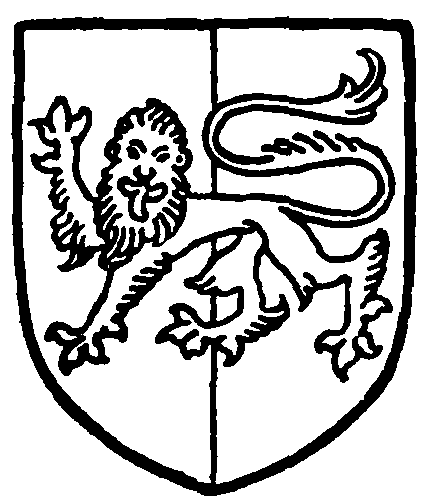
Neale. Party sable and gules a leopard argent.
Church
The church of ALL SAINTS is built on the rising ground to the north-east of the Birmingham road where this enters the village from Coventry. It is approached by steps and a long ramp which ascends the bank by the road, and consists of chancel, with a vestry adjoining, nave, north and south aisles, south porch, and west tower with a spire.
The 12th-century arcade on the south side is all that remains of the church built c. 1130. (fn. 42) The tower and spire were erected or rebuilt in the 13th century (fn. 43) and the north aisle was added in the 14th, when the chancel may also have been rebuilt. The vestry and porch are new, and the chancel and south aisle were completely rebuilt in 1863 when the whole church was restored. Both the new and ancient walls are of red sandstone.
The east wall of the new chancel is flanked by pairs of square buttresses with deep chamfers finishing 5 ft. below the base of the gable, which is surmounted by a stone cross. A small, glazed, trefoiled light pierces the gable above a large five-light east window with geometrical tracery. The plinth consists of two plain chamfers. The south side is divided into two bays by a single buttress of similar type, and each bay contains a two-light window with a trefoiled circle in the head. The eaves are open and carried on a plain chamfered line of corbels. On the north the wall is covered as far as the angle buttresses by the east bay of the north aisle.
The modern south aisle is equal in length to the nave and is similar in treatment to the chancel, with a threelight window in the east gable wall and in each of the two eastern bays of the south wall, with geometrical tracery. A porch divides these windows from a single lancet window on the west side. The buttresses are similar to those of the chancel but are diagonal at the angles. The south porch has a doorway with a twocentred head carried on heavy attached shafts with foliated caps. At the foot of the gable parapet the kneelers are supported by small twin shafts incised into the angles. The west gable of the aisle has a two-light window with trefoiled lights, and, in the gable, a circular window, quatrefoiled with a second circle of tracery within. Set diagonally between this wall and the south wall of the tower is a modern, plain, two-centred doorway to give access to the tower vice, above which it weathers back into the angle, topped by a leafy finial. The left jamb is brought forward 1 ft. from the face of the tower to accommodate a buttress (see below).
The east gable of the north aisle contains an original 14th-century three-light window set immediately above a string-course with a rounded top and underside chamfered, stretching across between the modern square buttress of the chancel to the south and a 14th-century diagonal buttress on the angle. The plinth has two plain chamfers, the upper projecting with a drip, and the gable parapet is covered by a restored plain coping with a gable cross; the kneelers have small gablets. The window is of two chamfered orders; the cusped head of each light is lancet shaped and filled with a minor tracery-bar supported on a cusped ogee minor head growing from the chamfers of the main bars. The north wall of this aisle is divided into four bays by buttresses similar to that on the north-east angle. The eaves are open with rafters carried on a corbelled course of stonework, all renewed during the restoration. The second bay from the east angle is filled between the buttresses by a new vestry, whose north wall is gabled with a central chimney; the east wall has a squareheaded mullioned window, and the west wall a doorway with a two-centred head. The remaining three bays each have a window, the two to the west being two-light with their tracery of new stonework resembling the original window in the east wall, but with a circular centrepiece above with quatrefoil cusping. That to the east bay is three-light and similar to the east window, the spandrels in the head being uncusped, but all the tracery has been renewed. The renewal of stonework in the western bay has been more extensive on account of a doorway beneath the window having been taken out and blocked with masonry; its position is marked by the return ends of the plinth, 4 ft. apart. The north-west angle is similarly treated with a diagonal buttress and the window in the west gable resembles those of two lights in the north wall. The gable is similar to that at the east and lines up with the east wall of the tower.
The tower has two stages divided by a continuous splayed offset. The buttresses are square and massive, two at each angle. Each has a deep top splay reaching to within 2 ft. of the offset and has two further splayed front-face offsets between this and the plinth. The latter is made up of two splays which return round the buttresses. To accommodate the west doorway the upper plinth-splay is cut and the lower is returned into the wall face. The doorway is small and of two orders with a two-centred head upon shafted jambs, and it appears to have been built during the restoration. The inner order is chamfered and continuous with that of the jambs ending on chamfered stops. A mould is cut on the angle of the outer order, which descends on the abacus of the foliated capitals, which, like all the detail of the doorway, are of 13th-century type. There is a hood-mould with a rounded top hollowed underneath which stops on foliage bosses. There is a tall window stretching from a point 2 ft. above the apex of the doorway to a distance of 7 ft. from the offset. It is twocentred and contemporary with the tower, although portions of the head and the single mullion have apparently been renewed. The hollow-moulded hood is carried on two head-stops. There are two chamfered orders carried on a splayed sill. The head is equilateral and contains a circle of tracery with pointed cusps forming a quatrefoil. The head of each light is trefoiled in a similar manner. A little above the offset is the sill of a smaller window which also appears to be of the same period, though the hood-mould and head-stops are new. The single hollow-chamfered mullion divides to meet the head and to form the two lights, each of which has an apex placed between the line of the window jamb and the centre-line of the light. The unevenly balanced head of each light is trefoiled, but the pierced central spandrel above is not cusped. The belfry two-light windows are unglazed and contain boarded louvres on all four faces of the tower. They have two-chamfered orders and possess no hood-mould; they are similar to the lowest window on the west face. Above them is a corbel-table consisting of a large hollow-mould containing a row of nine corbelled heads, animal and human, inclusive of those inclined at the angles, which have lead spouts. Above is a small level parapet topped by a roll surmounting a double splay.
The north face contains two openings only, both above the offset and similar to those on the west. The plinth returns against that of the north aisle, which is 6 in. higher. A block of stone with splayed top projects from the tower wall near the north-east angle, but there is no other trace of a buttress on this angle. On the south face, the plinth stops against the modern walling, forming the door-jamb referred to above, which goes up to support an ancient buttress of the same projection but which overlaps this support by 9 in. on the west side. This extra width is held up on an ancient corbel, two stones deep and built up of two hollows, the edge between them having a rounded fillet. Two plain slitlights piercing the buttress light a part of the vice. The top splay matches those of the other buttresses, but there are no offsets below. Another slit-light occurs immediately to the west of the top offset. On this face is a 19th-century iron clock dial. The two windows above the offset are similar to the others; and a feature in common to all is the curious break in the vertical alignment of these upper windows. On the west face all the openings are apparently on the centre-line except that between offset and belfry, which is placed some 6 in. to the north; on the north face, the same window is drawn 6 in. to the east, and on the south 6 in. to the west, the belfry window above always being central.
The spire is octagonal and there are plain broaches at the four angles. Spire-lights occur at three different levels and upon alternate sides: (a) immediately above the parapet and facing the cardinal points, having two plain chamfered orders rising into lancet-shaped heads, each window containing two lights filled with louvreboards; they are gabled out from the spire slope with slightly projecting verges having a roll apex and drips at the shoulders; (b) on each alternate face mid-way up the spire (similar to a but smaller, having only a single order and without louvres); (c) upper lights, again to the cardinal points, of small size and without mullion or louvres. A foliated stone finial bears a gilded wroughtiron weather-vane at the spire apex.
In the modern chancel the sandstone frames all the openings, but the remainder of the wall is plastered. The trussed rafters forming the roof are exposed. The east window and that immediately to the south have modern stained glass. Oak panelling round the sanctuary embraces an aumbry on the north side which may be part of an original wall. This has two squareheaded openings with a square mullion between them. A projection from the rear of the mullion, which is curved underneath, assists in the support of the stoneworkabove. On the south side there is a piscina (modern) and a window-seat. There is a two-centred arch, having an inner chamfered order resting on heavy foliated corbels, which overlooks the east bay of the south aisle. The chancel arch is similar, but with its inner order supported on half-columns having similar capitals.
The east bay of the north aisle is screened off in the west by a modern oak screen (unpierced) for an organ chamber and choir vestry. The north arcade has three two-centred arches of two chamfered orders supported on two octagonal piers and half-octagonal responds with an outer chamfered order. The east bay has been restored, but those to the west appear to be of the 14th century, and the two original bases are octagonal with roll mouldings. The moulded capitals are all similar and have fluted neckings opening out with a plain face to a fillet with a roll-moulding over, separated from the hollow-moulded abacus by a sunk billet enrichment.
The nave has no clearstory and the roof is modern, being open and of the trussed-rafter type. The walls are treated in the same manner as the chancel except for a patch of exposed masonry above the tower arch. The arcade opening on to the south aisle is also of three bays, but that to the east is modern, being similar to those opposite, except that in place of the free-standing octagonal pier there is a semi-octagonal jamb built on to a larger pier, 2 ft. 6 in. wide, which separates this bay from two 12th-century bays to the west. The latter both carry semicircular arches of two plain square orders, the inner arch-ring being the deeper. The east 12th-century respond has a capital which is square at the top and equal in thickness to the pier it adjoins; there is a plain chamfered abacus above. The lower portion of the capital is scalloped, the grooves between the scallops at the angles are plain, but all the remaining grooves are filled with ridged projections; the necking is a heavy roundel which returns round the angle of the wall and is then cut off. The base-mould of the circular shaft consists of a slightly rounded chamfer carried upon a square base block without spurs. The centre column is similar except that the diameter exceeds that of the responds, being equal to the full thickness of the wall, and the capital has no groove on the angles as there are angle-scallops. The west respond is exactly similar to that on the east. The west tower-arch is lancet shaped and consists of two heavy chamfered orders. The caps are moulded with a rounded necking and a plain field above, swelling into an undercut rounded mould supporting grooved fillets. The abacus above has a rounded edge with a central fillet. The base consists of two roll mouldings divided by a fillet.
In the south-west corner of the nave, piercing the west wall, is the original doorway to the vice; it is twocentred with a single chamfered order and contains the original door with wrought-iron strap-hinges. It is now disused and is covered by the pews.
The south aisle windows are glazed with stained glass in each end gable. When the aisle was rebuilt it was evidently extended by one extra bay eastwards, (fn. 44) and the east wall of this is now faced with an inscribed oak-panelled war memorial.
The inner doors of the south porch and the doorway with its two-centred head are modern, the exterior jambs are shafted, and the two exterior moulded orders of the arch are framed by a hood-mould.
All the roofs and floors are modern.
A modern stone and marble font stands opposite the south door and beside the round 12th-century pier. Modern and 18th-century wall monuments adorn the south aisle. Similar monuments of the 18th century are against the north and south walls of the north aisle; one on the north side, dated 1684, commemorating a servant of the family of John Lacon, is rectangular and surrounded by an architrave which is supported on two consoles. More of the late 18th century are at the west end of the north and south nave walls and under the tower. All the furniture in the chancel is modern.
There are eight bells: 1 and 4 are by Joseph Smith of Edgbaston, 1708; 2 is probably by Thomas Newcombe, c. 1570; 3 was a 15th-century bell but was recast in 1901; 5 is by Robert Newcombe, 1710; and 6 by Taylor, 1901. (fn. 45) Two more have recently been added.
The registers of marriages and burials begin in 1562; those of baptisms in 1569, but the earliest volume is imperfect.
There are many 18th-century tombs in the churchyard and a few elm trees of great age. The Rectory adjoins the churchyard to the west, and its spacious front garden runs parallel with the churchyard and down to the main road where a picturesque 18th-century brick arbour with an oriel window overlooks the steep bank.
Advowson
In about 1130 Bishop Roger of Coventry, at the request of Ranulph, Earl of Chester, allowed a chapel to be built for the poor people of Allesley, reserving the right of sepulture to the mother church of Coventry. (fn. 46) By an arrangement made in 1249 the chapel became independent, the incumbent receiving all tithes and oblations, except the tithes of the park and personal tithes, and paying 6s. 8d. yearly to the church of Coventry in lieu of burial fees. (fn. 47) This may have been the outcome of a dispute between the monks of Coventry and the rector of Allesley, about which they complained in 1236 that the Bishop had ignored their appeal to the Pope. (fn. 48) The benefice was said to be worth £5 in 1256, (fn. 49) but was valued at £8 in 1291 (fn. 50) and at £17 18s. 8d. in 1535, (fn. 51) at which date the cellarer of Coventry Priory provided 2s. 6d. for the support of a lamp in the chapel of Blessed Mary at Allesley. (fn. 52) Meadowland and a grove called Hornechurche were also appropriated to the support of lights in the church. (fn. 53)
The advowson descended with the manor until at least 1739, when John Neale presented, (fn. 54) but by 1748 it was in the hands of Thomas Bree, M.D., and in 1778 Ann Bree, widow, presented. (fn. 55) It has continued in the same family, H. W. Mapleton-Bree being patron at the present time. (fn. 56)
The Rev. William Thomas Bree, rector from 1823 to 1863, acquired a reputation as an authority on botany and entomology. (fn. 57) An earlier rector, William Warde, in 1638 achieved local notoriety as a drunkard who played ninepins with a butcher on Sunday and fought a cobbler in the ale-house yard. (fn. 58)
Charities
Poor's Land. It is recorded on the Table of Benefactions that there was given by unknown benefactors £98, with which were purchased a tenement and certain land in Allesley. Parts of the land have since been sold and the proceeds invested.
Robert Moore by will dated 27 January 1639 gave £4 to the churchwardens and overseers of Allesley, the income thereon to be disposed of to six poor people in six sixpenny loaves on St. Thomas's Day and six sixpenny loaves upon Good Friday yearly for ever. The £4 is supposed to have formed part of the £98 with which the Poor's Lands were purchased, as from the earliest records remaining 6s. has been paid out of the rents towards the bread distribution.
Mary Tallis by will dated 27 June 1637 charged certain land called Berks Land in Allesley with the payment of 5s. to the poor of the town of Allesley to be paid at Easter.
Ann Ebourn by will in 1745 gave £100 to the poor of Allesley, one moiety of the interest to be paid on 19 March equally between four old maids or widows of Allesley, not receiving weekly collection, and the other moiety to four poor girls, inhabitants and settled in Allesley, equally, towards clothing them when going out to service.
Martha Wigley by will in 1773 gave to the minister and churchwardens £100, the interest to be distributed annually on 19 March among four poor widows and four poor children of Allesley equally; the children's shares to go towards clothing them to go to service.
| Elizabeth Tristram, will dated in or about | 1754, | £50 |
| Anne Cole, " " " | 1759, | £20 |
| John Taylor, " " " | 1766, | £20 |
| Richard Bosworth, " " " | 1774, | £20 |
The above four bequests are recorded in the Table of Benefactions as given for the benefit of the poor.
John Barber by will dated 1780 gave to the minister and churchwardens of Allesley £40, the interest to be applied in the purchase of Bibles and Prayer Books, upon which should be put some memorial to his benefaction, and which should be distributed yearly on the anniversary of his death among deserving poor.
Elizabeth Huddesford by codicil dated 9 October 1829 to will dated 21 August 1822 bequeathed to the rector and churchwardens of Allesley £200, the interest to be either distributed amongst poor inhabitants of the parish or otherwise laid out in the purchase of books or otherwise for the use of the Endowed Free School in Allesley.
Catherine Eagle and Elizabeth Morgan in 1847 gave to the rector of Allesley the sum of £200 in 3 per cent. Consols, the interest thereof to be applied in equal moieties to the Girls' School at Allesley and in bread or flannel on St. Thomas's Day to such poor women of Allesley as the rector shall select.
John Francis Greswolde-Williams by will dated 26 May 1891 gave £1,000, the income to be paid to the rector and churchwardens of Allesley, to the intent that the income should on 23 October in each year (or as soon after as could conveniently be done) be distributed among parishioners or other poor persons resident in the parish in orders upon shops for flannel or other things for domestic use or comfort, or in money for paying the rent of their cottages or lodgings.
The above-mentioned charities, with the exception of the share of the charities of Catherine Eagle and Elizabeth Morgan for the Girls' School at Allesley, are now regulated by a scheme of the Charity Commissioners dated 31 August 1920. The scheme appoints a body of trustees to administer the charities and provides that the income of the charity of John Barber shall be applied in the purchase of Bibles, New Testaments, and Prayer Books, the income of the remaining charities shall be applied under various heads for the general benefit of the poor, and further that one-half of the income of the charities of Ann Ebourn and Martha Wigley shall be applied in the supply of clothes or other benefits to poor girls on their going into service or other employment.
The annual income of the charities amounts to £65 approximately.
Elizabeth Morgan by will dated 30 August 1864 gave to the rector of Allesley £2,000, the interest to be expended in coal, food, and clothing at Christmas among poor and aged men and women residing within the parish, a preference being given to those who have been the most industrious, steady, and useful members of society in early life. The annual income of the charity amounts to £57 11s. 8d.
Church Lands. This charity is regulated by a scheme of the Charity Commissioners dated 25 May 1923. The scheme appoints a body of trustees and provides for the income to be applied in payment to the Parochial Church Council of any sums expended on the maintenance of the parish church and steeple of Allesley. The endowment now consists of lands in the parishes of Allesley and Meriden and a sum of £307 12s. 9d. 3½ per cent. War Stock, representing the proceeds of sale of land formerly belonging to the charity.
Parish Room. By an Indenture dated 6 July 1898 a piece of land in Allesley was conveyed to trustees for a parish room to be erected thereon. The deed provides that the room shall be used as a Parish Room for the parish of Allesley and part of the hamlets of Eastern Green and Corley for such social, educational, and parochial purposes as the managing committee of the property shall think proper.