A History of the County of Warwick: Volume 6, Knightlow Hundred. Originally published by Victoria County History, London, 1951.
This free content was digitised by double rekeying. All rights reserved.
'Parishes: Bilton', in A History of the County of Warwick: Volume 6, Knightlow Hundred, ed. L F Salzman (London, 1951), British History Online https://www.british-history.ac.uk/vch/warks/vol6/pp30-35 [accessed 30 April 2025].
'Parishes: Bilton', in A History of the County of Warwick: Volume 6, Knightlow Hundred. Edited by L F Salzman (London, 1951), British History Online, accessed April 30, 2025, https://www.british-history.ac.uk/vch/warks/vol6/pp30-35.
"Parishes: Bilton". A History of the County of Warwick: Volume 6, Knightlow Hundred. Ed. L F Salzman (London, 1951), British History Online. Web. 30 April 2025. https://www.british-history.ac.uk/vch/warks/vol6/pp30-35.
In this section
BILTON
Acreage: 2,306.
Population: (fn. 1) 1911, 5,188; 1921, 6,080.
By the Rugby Urban District (Extension) Order, 1931, the greater part of the ancient parish of Bilton was transferred for civil purposes to Rugby and the remainder to Dunchurch. The old village, a compact settlement typical of the eastern and southern portions of Warwickshire, is about 1½ miles south-west of Rugby on the Leamington road. Other roads lead from the village to Long Lawford, Dunchurch, and the main road from Dunchurch to Northampton, which itself crosses the south-east part of the parish, a bridle road from it leading past Inwood's Farm over Rains Brook into Northamptonshire. The northern part is crossed by the road from Rugby to the Lawfords and contains New Bilton, a separate ecclesiastical parish since 1867 and a suburb of Rugby, also the Rugby Portland Cement Works and several brickworks. The L.M.S. Railway lines from Rugby to Crewe, Birmingham, and Leamington cross the parish, but there is no station. There were about 40 houses in Bilton in 1730. (fn. 2)
The land rises from the River Avon on the north, and Rains Brook on the south-east, where the level is about 270 ft., to 373 ft. in the village and 401 ft. near Bilton Grange on the southern boundary. Bilton Grange is a modern house on the site of a grange of Pipewell Abbey, to whom most of the southern part of the parish, described as 'in breadth from the outmost limits of Dunchurch to the old Morwey by the old road leading from (Hill) Morton towards Warwick, and in length from the end of that road by the same Morwey to a little rill of water, called Reynesbroc', (fn. 3) was granted in the 12th century. The parish was inclosed by private agreement in 1656. (fn. 4)
A fragment of the shaft of a cross stands in the middle of the village, where it was reset in 1897. South of it is a small range of timber-framed building, probably of the early 17th century, to which date also belongs 'The Long Barn', west of the church, now forming two cottages.
South-west of the church is Bilton Hall, a brick building with stone dressings and tiled roofs, generally of two but in part of three stories. The main frontage to the drive faces north-west, that to the garden southeast. It has been divided in recent years into four flats. In the garden are the former entrance gates erected by Joseph Addison and bearing his initials and the monogram of his wife Charlotte, Countess of Warwick. They were moved to their present position in 1825. (fn. 5)
The oldest part of the house is said to have been built by Edward Boughton of Lawford; (fn. 6) its architectural features are consistent with a late-16th- or early17th-century date. It appears originally to have been of H-plan, though successive alterations have made its exact form difficult to determine. It was added to in 1623 and partially rebuilt first in the early 18th century (fn. 7) and again rather more than a century later.
The north-west elevation of the main block consists of a gabled wing of three and a range of two stories; it has a porch and modern additions. The gabled wing, aligned north-west and south-east, shows three mullioned and transomed windows of six lights; each mullion and transom bears a cyma moulding. The top window is shorter than the others and has a label stopped with short returns. (fn. 8) There is a moulded plinth; a stringcourse indicates externally the division between first and second story, and both this and the porch gables are surmounted by tapering pinnacles of square section, placed diagonally. The porch, adjacent to this wing, has a stone doorway with a depressed four-centred head, chamfered continuously with the jambs. Above it is a semicircular-headed panel moulded with a hexagram within a circle. The string-course, which is continuous from the wing around the porch, is here raised to clear the head of the panel. In the second story is another mullioned and transomed window of six lights; in the top story is a mullioned window of three lights having a label stopped with short returns. A stone panel above it bears the date 1623. Both wing and porch have flush ashlar quoins to the first and second stories, but not to the top story. On the southwest side of the porch is a chimney-stack, added in the early 19th century, having three octagonal shafts with moulded cappings. Abutting the stack and alongside the 17th-century range connecting the two wings is a small extension also dating from the early 19th century. (fn. 9) In the remaining original portion of the range is a string-course of a profile similar to that around the porch; there is a casement window in the first and a sash window in the second story. A small gabled porch occupies the angle between this range and the older wing; its brickwork is not bonded with either of the adjacent blocks. It contains in its north-west elevation a doorway with a depressed four-centred head, chamfered continuously with the jambs. Above the door are two three-light mullioned windows; both windows and door have square labels stopped with short returns.
The original building of H-plan has in the recessed portion of its north-west elevation a three-light mullioned window and two blocked windows, one with a segmental head. The gable has a window in each of its two stories and attic, all having been altered from the original Tudor form; above the attic window is a stone shield bearing the arms of Boughton with supporters. The finials of this gable, as also of the porch gables, are of a more elaborate form than those on the 1623 portion of the house. Most of the windows in the north-west elevation of this wing, and the entire southwest elevation of the house, have been greatly altered in the 18th and 19th centuries.
The south end of the garden frontage is built in stretcher bond with quoins and a plat-band. The first story externally is largely modern; of the eight secondstory windows one is now blocked but the others retain their original moulded wooden frames flush with the wall. Of the two dormers in the steep-pitched roof, one retains its heavy segmental head. The garden front of the 1623 wing, now covered in smooth stucco, has two large bay-windows in the first and second stories, of which the upper one is battlemented; both seem to belong to the first quarter of the 19th century. (fn. 10)
The interior of the house nowhere retains its 17thcentury appearance, and much even of the plan has been altered. The hall still has its 18th-century panelling, and the staircase, of the same date, its twisted balusters and fluted angle-posts. At several places throughout the house are wall-cupboards and powder-closets of early-18th-century date. The attics in the oldest part of the house contain a small amount of timber-framed plaster panelling, the roof of the 1623 part has a kingpost, tie-beam, and diagonal braces.
Amongst noteworthy men associated with Bilton are Joseph Addison, who was lord of the manor from 1711 to 1719 (see below), and Henry Holyoake, rector from 1705 to 1731, the first headmaster of Rugby School to raise it above the level of purely local importance. (fn. 11)
Manor
BILTON was held by Ulwin in the time of Edward the Confessor. In 1086 5 hides less 1 virgate were held by a certain William under Roger de Montgomery, Earl of Arundel and Shrewsbury, and 1 virgate by Turchil of Warwick with Gilbert as sub-tenant. (fn. 12) Most of Turchil's lands passed soon afterwards to the Earl of Warwick, but there is no further record of his small estate in Bilton. In the middle of the 12th century Walter son of Hingan, or Ingald, and Mary his wife, gave their lands here to the abbey of Pipewell, Northants., between 1154 and 1163. (fn. 13) This gift was confirmed by Roger (son of Geoffrey) de Craft who had married Walter's daughter Beatrice. (fn. 14) Further gifts of land in Bilton, making up the portion known as Dunchurch Grange and later sometimes described as a separate manor, were made by Roger's son, another Roger, in 1196. (fn. 15) This Roger took part in the rebellion led by Robert Fitzwalter against King John, for which he forfeited his lands, but was restored to them by Henry III. (fn. 16) In 1226 Roger de Craft was involved in a lawsuit with Roger Pantulf over rights of common pasture in Bilton, Newbold-on-Avon, and Little Lawford. (fn. 17) In 1235 Roger de Craft, perhaps his son, held one knight's fee in Bilton of the Earl of Arundel for 2 marks, (fn. 18) and in 1242 the same of Robert de St. John, (fn. 19) the earldom of Arundel being in abeyance at this time. (fn. 20) Part of the Craft estates, including Bilton, descended to the Charneles family by the marriage of Roger's daughter Beatrice with William de Charneles; (fn. 21) his son, Nicholas de Charneles, was implicated in the baronial revolts of the later part of the reign of Henry III but was pardoned in 1268. (fn. 22) He entailed the manor on his son George and his heirs, with remainder to the heirs of his brother William, early in the reign of Edward I. (fn. 23) In 1309 George de Charneles granted the manor to Henry de Stodle, parson of Elmesthorpe (Leics.), for life, with remainder to the heirs of his son Nicholas Charneles and his wife Joan. (fn. 24) George was a knight of the shire for Warwickshire in the parliament of 1312. (fn. 25) In 1319–20 his widow Lucy held the manor in dower. (fn. 26) In 1339 his son Nicholas represented Warwickshire in parliament, (fn. 27) and in 1356 was appointed to put the Statute of Labourers into effect for the county. (fn. 28) His granddaughter Maud married Laurence Trussell of Kibblestone, Staffordshire, to whom the manor ultimately passed after a lawsuit. (fn. 29) John de Charneles of Bedworth had intruded into the manor, obtaining right of free warren for himself and his heirs (fn. 30) and falsely alleging that Edward, Prince of Wales, had died seised of the manor (fn. 31) having been enfeoffed by John de Charneles. Judgement was given in favour of Maud Trussell, (fn. 32) and in 1383 she and her husband entailed the manor on her heirs, with contingent remainder to the heirs of Joan wife of John Pauy. (fn. 33) In 1385 the Trussells leased the manor to Sir Ralph de Ferrers for life. (fn. 34) Laurence Trussell died in 1399 (fn. 35) and Maud must have at once married Robert Litton, as they made a fresh settlement of the manor in 1400. (fn. 36)
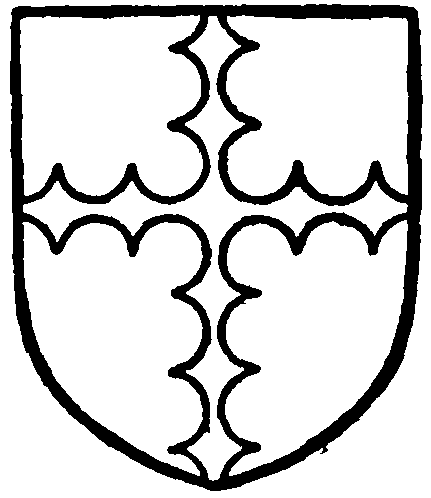
Charneles. Azure a cross engrailed or.
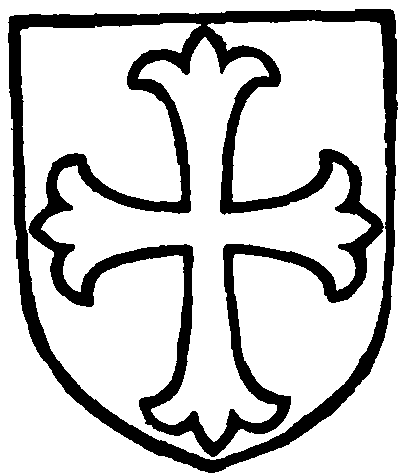
Trussell. Argent a cross paty gules.
In 1481 Sir William Trussell died seised of the manor, which was valued at £14 and was stated to be held of the Prior and Convent of Barnwell, Cambridgeshire. (fn. 37) At this time his son Edward was only 2 years old, and the manor came into the king's hands. (fn. 38) He died in 1499 when his daughter and ultimate heiress Elizabeth was still a minor, and his son John died, holding the manor of the Prior of Barnwell, in 1500. (fn. 39) Elizabeth was granted in wardship to John Vere, afterwards 15th Earl of Oxford, in 1507, (fn. 40) whose second wife she became, and to whose family the manor of Bilton passed for some 70 years. In 1574 Edward, Earl of Oxford, leased it to John, Lord Darcye, (fn. 41) and in 1580 he sold it to John Shuckburgh, (fn. 42) who immediately leased it to Edward Cordell. (fn. 43) John Shuckburgh died in 1599, having by deed of 8 November 1595 settled the manor on his sons Henry and Francis in tail male successively, with a jointure for Christian, the wife of Henry, who in 1599 was 35 years of age. (fn. 44) Henry Shuckburgh in turn sold the manor to Edward Boughton (who already held the portion of Bilton that had belonged to Pipewell Abbey) in 1610. (fn. 45) In 1620 Edward Boughton was granted free warren in Bilton. (fn. 46) In 1623 he, William his son and heir, and Thomas, another son, were dealing with the manor. (fn. 47) William and Thomas Boughton married two sisters, Abigail and Judith Baker of Shoebury, Essex, in 1623, when Edward Boughton settled the manor proper on William and the Pipewell lands on Thomas. (fn. 48) William, who was created a baronet in 1641, (fn. 49) also inherited the family estates at Little Lawford; Thomas, described as 'of Bilton' in the 1682–3 Visitation, presumably took over all the Bilton property on the death of his father in 1640. (fn. 50) In 1711 Edward Boughton, grandson of Thomas, sold the manor to Joseph Addison, the poet and essayist, for £10,000. (fn. 51) Addison married the Countess of Warwick in 1716, (fn. 52) and after his death in 1719 she had the estate and was lady of the manor in 1730. (fn. 53) After her death in the next year her daughter, Charlotte Addison, inherited the estate; she died in 1797. (fn. 54) The manor had been acquired by John Simpson (third son of Henry Bridgeman, Lord Bradford) who had taken his mother's name of Simpson, in or before 1799, when he made a conveyance of it to George Bridgeman and Jonathan Heaton. (fn. 55) The Hon. John Bridgeman Simpson was the owner of Bilton Hall, and Capt. J. H. W. Hibbert of Bilton Grange (the former Pipewell estate) in 1850: (fn. 56) in 1900 Mr. G. H. O. Bridgeman was lord of the manor. (fn. 57) With the urbanization of the parish any surviving manorial rights appear to have lapsed.
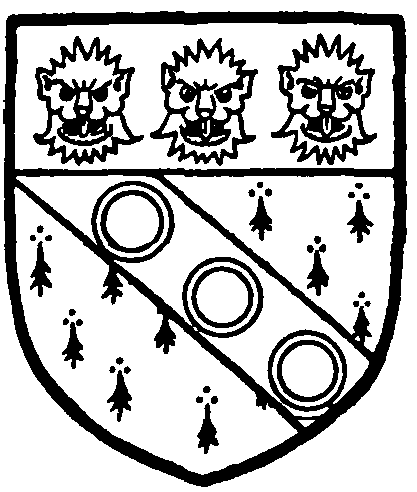
Addison. Ermine a bend gules with three anulets or thereon and on a chief azure three leopard's heads or.
THE GRANGE, the portion of the parish given to Pipewell Abbey, is sometimes described as a separate manor. According to Dugdale it was usually known as Dunchurch Grange although locally situate in Bilton. (fn. 58) This estate had been demised by the abbot of Pipewell to Richard Boughton, William Boughton, and Agnes his wife for their lives and for the term of 99 years, in the reign of Richard III. (fn. 59) In 1542 it was granted, with other Pipewell property in Warwickshire, to Edward Boughton for a rent of £2 8s. 8d., in exchange for the manor house of Kempston Hardwicke and other property in Bedfordshire. (fn. 60) In 1596 it was leased by Edward Boughton to Sir Thomas Conyngsbye and Thomas Morgan, (fn. 61) and from 1610, when the Boughton family gained possession of the manor of Bilton itself, it has descended with that manor.
Church
The parish church of ST. MARK consists of a chancel (40 ft. by 22 ft.), vestry, north chapel (13 ft. 6 in. by 16 ft.), nave (45 ft. 9 in. by 32 ft.), north aisle (46 ft. 6 in. by 15 ft. 6 in.), west tower (14 ft. 6 in. by 11 ft. 6 in.), and north and south porches. All dimensions are internal.
The chancel, nave, and west tower are of the mid14th century; the south porch was added in the early 19th century, possibly in 1821 when the then east window was altered; the north aisle was added at the general restoration in 1873 by G. F. Bodley.
The chancel has a large, pointed east window of six lights inserted, as indicated externally by a stone on its south side, in 1873. On the north side is a similar stone bearing the date 1609. (fn. 62) Internally there is a hood mould with head-stops re-used from the original window. The east wall, (fn. 63) like all the 14th-century work, is of coursed red sandstone ashlar with fairly wide joints. The top part of the wall is of modern masonry and some part of the remainder has been scraped during the 19th-century restoration. Below the window is a string-course, and beneath it under the east window a single course of modern masonry, indicating the position of the east window which was inserted in 1821, (fn. 64) replacing that of 1609, and which in 1873 was removed to the west end of the north aisle. There are square buttresses of two offsets at the angles and a double plinth about 3 ft. high continues around them and on to the north and south walls.
The north wall has a two-centred window of three trefoiled lights with chamfered jambs and mullions. The central light has an ogee head, the others elliptical heads; above them is cusped pear-shaped tracery and a quatrefoil, and there is a hood-mould with weathered head-stops. Internally it has slightly splayed jambs and a hood-mould with a head-stop at the east side only. To the west of the window is visible the profile of a buttress now embodied in the wall of the modern vestry. Like the other ancient intermediate buttresses of both chancel and nave it was of three offsets, the top one being of very slight projection, so imparting to the topmost stage of the buttress the character of a flat pilaster. Inside, beneath the window and to the west of it, is a cinquefoiled ogee-headed tomb recess. Each main foil itself carries a trefoil; the head is of three moulded orders with a hood-mould. It is crocketed, with a finial, some of the crockets on the east side being cut away to allow of the insertion of panelling and others on the west for the organ. Inside the recess is now a stone tablet stating that 'This Vault was made at the charge of William Boughton Esq.'; the date is obscured, but the lettering appears to be of early-18thcentury date. The recess is said by M. H. Bloxam (fn. 65) to have been both a founder's tomb and an Easter Sepulchre. The doorway from the chancel into the modern vestry, originally a priest's door, has moulded jambs and two-centred head, and on the south side a hood-mould with head-stops. The masonry of the reveals is ancient on the east side, modern on the west, where it is plastered. There are no signs on the chancel side of rebates for hinges, and the suggestion (fn. 66) that the door was reversed when the vestry was built is probably correct. West of it is an arch to the north chapel, of two orders, chamfered in the jambs and having a swelled chamfer in the head. It, like the north chapel, was built in 1873.
The south wall of the chancel is divided by buttresses into three bays with a window in each. The easternmost window resembles that in the north wall; it has restored mullions and an ancient external hoodmould with stops, of which the eastern shows the beginnings of carving and the western is an untouched square block. The head of the rear-arch is chamfered and there is an internal hood-mould. Three sedilia extend the full width of the jambs of the rear-arch; their heads rise above the ledge of the window. They are entirely of modern masonry. Slightly to the east is a piscina having a modern cinquefoiled ogee-head with a hood-mould stopped on heads, and an ancient cinquefoiled bowl, part of which is in a projecting stone of tapering semi-octagonal form. The middle bay contains a window of three trefoiled ogee-headed lights with cusped net tracery under a two-centred head. The restored jambs and mullions are chamfered and there is a hood-mould stopped on the east by a badly weathered human mask, on the west by a grotesque mask with large ears. There is also an internal hood-mould with head-stops and the rear-arch has a pointed chamfered head. The ledges of this window and the string-courses which are immediately below them are raised a little higher than those in the adjacent bays in order to clear the head of a doorway. The doorway is moulded with two swelled chamfers in the jambs and two-centred head, and has a rear-arch with a chamfered segmental-pointed head. The jamb mouldings are much worn at the foot, and the head is partly restored. Both inside and outside there are hoodmoulds, the apexes of which join the string-courses. That inside is of pointed segmental form with headstops, on the east a man with protruding tongue, wearing a cowl, on the west a grinning mask. The third bay has a window like that in the first; the tracery is modern, and the lower part is blocked because there are high-backed modern choir-stalls inside. The hood-moulds have head-stops, those outside being grotesques. Below the string-course and beneath the westernmost light of the window is a small blocked square opening. This 'low-side' window is chamfered externally; a hood-mould is formed by two short vertical projections from the string-course. The choirstalls conceal the internal form of the window. The plinth, which on the south chancel wall is broken only by the priest's door, terminates on the south face of the westernmost buttress.
The north wall of the north chapel is continuous with that of the aisle, and like it, is of re-used 14thcentury sandstone ashlar. It has a window like the middle bay of the south chancel wall; the hood-mould and jambs appear to be for the most part ancient masonry re-used. There is a modern parclose screen; but the only architectural division between chapel and aisle is a formerly external buttress, east of which a short piece of the original string-course still remains.
The 14th-century chancel arch is two-centred, of two chamfered orders continuing unbroken into the responds, which have chamfered bases. From a height of 4 ft. above the floor the inner order has a double chamfer. In the arch are several repairs in brown stone indicating the position of beams connected with the screen and rood-loft. A rood-loft altar was discovered during the restoration. (fn. 67)
The nave has a north arcade, built in 1873, of three 11¼-ft. bays and irregular octagonal piers, the cardinal faces being wider than the others. The arches are moulded with two swelled chamfers.
The south wall of the nave has at the east end a trefoiled ogee-headed piscina with a damaged quatrefoil bowl. The eastern window has net tracery, the western pear-shaped tracery; they are in all respects like the windows of those respective forms described above. The plinth and string-course are about 1 ft. higher than on the chancel wall. The third bay has a stuccoed modern porch in front of the south doorway; the latter is probably a poor copy, done in the early 19th century, of the 14th-century original. There is a buttress at the south-east angle.
The original north wall of the nave, of three bays, was re-erected to form the north wall of the aisle. The eastern window has pear-shaped, and the western net tracery in the head; they are like the eastern and middle windows, respectively, in the south wall of the chancel. Only the jambs are ancient; the restored external hoodmoulds are stopped with square blocks. The third bay contains the north doorway, of two orders, each a swelled chamfer, having a hood-mould stopped with uncarved square blocks. In the jambs of the rear-arch are still two large holes for a sliding bar. The brick and timber porch is modern. The west wall of the aisle is entirely modern and contains a window of three lights with net tracery in a two-centred head, removed from the east end of the chancel in 1873. The ancient north-west angle buttress of the nave, partially concealed by the west wall of the north aisle, is visible outside.
All the roofs are modern.
The two-centred tower arch is of three chamfered orders which on the west side die into the walls.
The battlemented west tower (fn. 68) has a moulded plinth, of the same profile as that of the nave but rather higher, and is divided externally into two stages by a moulded string-course. It has angle buttresses and a north-east stair vice which overhangs at the base, where it is carved with a grotesque head. The buttresses, of four offsets, have at the top semicircular hollow niches with much-worn projecting bases which are surmounted by gabled heads; the latter have on the face blind traceried cinquefoils and are crocketed with finials. The copings slope up to the wall behind them. The openings of the north and south walls are similar. At the top of the first stage is a pointed window containing a trefoiled ogee-headed light with a hoodmould stopped on heads; the western head-stop on the north side has disappeared. At the same level in the stair vice is a narrow square-headed window with chamfered jambs and head, and at the top is a similar but smaller window. Above the string-course is a pointed louvred window. The west face of the tower has a window of two cinquefoiled elliptical-headed lights with cusped pear-shaped tracery under a twocentred head which, with the jambs, is chamfered. All the tracery and mullions are modern; the jambs and hood-mould with its uncarved stops are ancient. The rear-arch has a chamfered two-centred head. The windows above are similar to those in the north face. The east face has only the top window. In the northeast, south-west, and south-east angles of the tower are the original vault ribs, chamfered and resting on tapered corbels. Below the external cove at the top of the tower are gargoyles and carvings. On the north face at the west end is a much-weathered quadruped animal. The south face has a shield bearing a cross engrailed with supporters. The east face is carved with two animals, a ? monkey, and a ? frog. There is an octagonal spire with two ranges of lights, each of which has two trefoiled pointed openings with a recessed quatrefoil under a gabled head.
The octagonal font is of the later 14th century; the panels of the bowl alternate in the form of their decoration, one having quatrefoiled roundels, the other two trefoiled ogee-headed panels. The blind tracery is throughout flush with the sides of the bowl, giving it the appearance of being unfinished.
There are in the nave two chandeliers, said to be 17th-century Dutch work and to have come from Bois-le-Duc (S'Hertogenbosch).
The organ case (fn. 69) came from St. John's College, Cambridge, about 1868. It was built by Robert Dallam c. 1635–6 and despite sundry alterations now presents almost its original appearance. It is of oak, with gilt ornaments, among which are the Tudor rose and portcullis, emblems of the founders of the College.
The altar rails are said to have come from Great St. Mary's, Cambridge, (fn. 70) and are of the 17th century.
There are fragments of medieval glass made up with modern glass in the north window of the chancel. The old pews were at the restoration used to form panelling around the church.
The bells, which were re-hung in 1948, are as follows: (fn. 71) (1) Treble Memorial bell, inscribed with the names of the fallen, 1939–45; by John Taylor of Loughborough, 1948; (2) Gift of the Countess of Warwick, 1722, by Richard Sander of Bromsgrove; (3) by John Sturdy or John Kebyle of London, c. 1450; (4) and (5) by John Danyell of London, c. 1460; (6) Tenor, by Henry Bagley of Chacomb, 1682.
The registers begin in 1655.
Advowson
There was a priest at Bilton in 1086, (fn. 72) and late in the 12th century Roger de Craft and Beatrice gave to Pipewell Abbey 2 acres belonging to the church of Bilton adjoining the grange of Dunchurch, to hold by paying the rector 4d. or a pair of cowhide boots. (fn. 73) The advowson was included in the settlement of the manor made in 1310 by George de Charneles, (fn. 74) and similarly the advowson was wrongfully alleged to be held, with the manor, by Edward, Prince of Wales, in 1376. (fn. 75) It so descended from the Charneles to the Trussell family and their successors the Earls of Oxford, or their lessees in the manor, except in the latter part of the 16th and early 17th century, during which period grants of the advowson without the manor were made to Alice Worcester, widow, of Bilton, who presented in 1558 and 1559, (fn. 76) to Francis Bosworth by Henry Shuckburgh and his wife Elizabeth in 1608, (fn. 77) and to William Riplingham or Replingham, who presented in 1621 'by reason of the advowson granted to him'. (fn. 78) Dugdale states that this grant was made by the Earls of Oxford, but the manor and advowson had already passed through the hands of the Shuckburgh family to the Boughtons, the then owners. Edward Boughton died seised of the manor and advowson in 1625. (fn. 79) While the manor went to his younger son Thomas, the advowson seems to have gone to the elder son Sir William. In 1705 Sir John Sandys presented Henry Holyoake, (fn. 80) head master of Rugby School, and in 1731 William Adams made a presentation, (fn. 81) but these were probably under grants of a turn, as in 1745 the patron was said to be Sir William (? Edward) Boughton; (fn. 82) in 1759 Anna Boughton, a minor, (fn. 83) and in 1763 Sir Edward Boughton. (fn. 84) In the first half of the reign of George III the Hume family were in possession, Alexander Hume and his wife and William Caldecott and his wife conveying it in 1768 to Thomas Caldecott and others. (fn. 85) Alexander Hume was patron in 1784, (fn. 86) and Abraham Hume granted it to the Rev. Jonathan Parker in 1795. (fn. 87) Between 1817 (fn. 88) and 1859 (fn. 89) the Rev. J. T. Parker was rector and patron, as was Richard Orme Assheton from 1862 to 1900, and his son the Rev. W. O. Assheton as late as 1940. (fn. 90)
The patronage of St. Oswald's Church, New Bilton, erected in 1867, was in 1915 (fn. 91) in the hands of the Trustees of the late R. H. Wood, and from 1926 of the Bishop of Coventry. (fn. 92)
The rectory was valued in 1291 at £6 (fn. 93) and in 1535 at £16 10s. 6d. (fn. 94)
Charities
Poor's Land. By a decree of the Court of Chancery dated 10 July 1661 an agreement for inclosing the fields, meadow ground, commons, and heath ground in Bilton, then lying open, was confirmed. By the agreement a plot of heath land containing 42 acres adjoining to Causton Lordship was allotted and set out for the use of the poor of the town.
Langton Freeman by will dated in 1783 gave £20, the interest for the use of the poor inhabitants of Bilton.
Charlotte, Countess of Warwick and Holland. It is recorded on a tablet in the church that she left £10 a year out of her estate in Bilton to the churchwardens and overseers for the use of the poor.
William Smith by a codicil to his will dated 23 August 1711, charged certain property at Kites Hardwick and Thurlaston in the parishes of Leamington Hastings and Dunchurch with the yearly sum of 4s. to the poor of each of the parishes of Dunchurch, Bourton, Leamington, Birdingbury, Grandborough, Stretton-upon-Dunsmoor, Stockton, Nether Shuckborough, Bilton, and Long Lawford, to be paid on Easter Day to the churchwardens and overseers of the poor of the several parishes, to be laid out in bread and distributed among the poorest people of the parishes. The rent-charge was redeemed in 1905 in consideration of the sum of £80 Consols, producing an annual income of £2.
William Butlin by will dated 15 August 1832 bequeathed to the churchwardens and overseers of the poor of the parishes of Rugby, Bilton, and Barby, respectively, the sum of £50 for each parish, the interest to be applied as near to Christmas day as conveniently might be, in purchasing and distributing bread amongst the poor of the said parishes.
The above-mentioned charities are regulated by Schemes of the Charity Commissioners dated 8 January 1878 and 10 October 1933 which appoint a body of Trustees to apply the income of the charities, under various heads, for the benefit of the poor of the parish. The annual income of the charities amounts to £180 approximately.
Church Land. The endowment of this charity, the origin of which is unknown, consists of a close of land in this parish containing 2½ acres, the rent of which is applied by the churchwardens for church purposes.