A History of the County of Warwick: Volume 6, Knightlow Hundred. Originally published by Victoria County History, London, 1951.
This free content was digitised by double rekeying. All rights reserved.
'Parishes: Brinklow', in A History of the County of Warwick: Volume 6, Knightlow Hundred, ed. L F Salzman (London, 1951), British History Online https://www.british-history.ac.uk/vch/warks/vol6/pp42-46 [accessed 9 May 2025].
'Parishes: Brinklow', in A History of the County of Warwick: Volume 6, Knightlow Hundred. Edited by L F Salzman (London, 1951), British History Online, accessed May 9, 2025, https://www.british-history.ac.uk/vch/warks/vol6/pp42-46.
"Parishes: Brinklow". A History of the County of Warwick: Volume 6, Knightlow Hundred. Ed. L F Salzman (London, 1951), British History Online. Web. 9 May 2025. https://www.british-history.ac.uk/vch/warks/vol6/pp42-46.
In this section
BRINKLOW
Acreage: 1,487.
Population: 1911, 667; 1921, 681; 1931, 732.
Brinklow is a parish 7 miles east of Coventry on the Lutterworth road, which here takes a right-angled turn and runs more or less north and south, forming the main street of the large and compact village. Its eastward course is continued by Cathiron Lane, leading to the hamlet of that name in Harborough Magna and eventually to Rugby. The Fosse Way crosses the parish from north to south, but its course near the village is obliterated, the main street running parallel about ¼ mile to the west. The land is fairly level, being mostly around the 300-ft. contour. The Smite Brook bounds the parish on the north, and the Oxford Canal has a short branch to a wharf on the main road. Brinklow Station on the former L.M.S. main line to the north is about a mile from the village and locally situated in the parish of Stretton-under-Fosse.
The most prominent topographical feature of Brinklow is the very fine motte-and-bailey castle crowning a slight hill just east of the village. It is a very well preserved example of an early Norman type of stronghold, presumably built of timber, as there is no trace of masonry, but no documentary history seems to have survived. (fn. 1)
Brinklow, which in the early 13th century gave its name to the hundred later known as Knightlow, (fn. 2) has always been a large village. There were about a hundred houses in 1730, (fn. 3) and the density of population, over 300 to the square mile, is high for a rural parish—almost as high as that of the neighbouring parish of Bulkington, formerly an Urban District. A grant of a weekly market was made in 1218; (fn. 4) it is mentioned in manorial documents as late as 1832 (fn. 5) but seems to have died out long before then; it is not mentioned by Dugdale. As with many main road villages where markets were held, Brinklow accumulated a large number of alehouses. In 1646 six of the seven then existing were ordered to be suppressed, as owing to them 'the children and servants of the said [i.e. most substantial] inhabitants are often drawn into many inconveniences and so neglect their callings'. (fn. 6)
Among noteworthy men (fn. 7) associated with Brinklow are David Stokes (1591?–1669), author and divine, rector 1625–42 and 1660–9; William Basset (1644–95), author and divine, who was rector 1671–83; and John Rouse Bloxam (1807–91), historian, son of a rector.
An Inclosure Act relating to 1,700 acres was passed in 1741. (fn. 8)
Manors
BRINKLOW is not mentioned in Domesday Book; according to Dugdale (fn. 9) it was included with Smite, which would account for the high rating of 6 hides, with land for 25 ploughs, and at least 47 families, given for that manor. The overlordship therefore, after a short period in the hands of Earl Aubrey, passed to Robert, Count of Meulan, and so to the earldom of Leicester, and afterwards that of Lancaster. In 1275 the Earl of Leicester held a court twice a year and had assize of bread and ale, (fn. 10) and in 1361 the Earl of Lancaster had twice yearly view of frankpledge. (fn. 11)
The principal tenancy, from early in the 12th century, was in the hands of the Mowbrays, Roger de Mowbray holding Brinklow of the Earls of Leicester by the service of 1 knight's fee. (fn. 12) In 1201 a lawsuit involving Brinklow was brought by William de Stuteville against William de Mowbray. The matter dated back to 1106, when after the battle of Tinchebrai Robert Grondeboeuf, William de Stuteville's greatgrandfather, a partisan of Duke Robert of Normandy, lost his barony to Niel d'Aubigny, great-grandfather of William de Mowbray. Roger de Mowbray had compensated Robert de Stuteville with Kirkby Moorside (Yorks.) for 10 knight's fees, in the reign of Henry II, but William de Stuteville did not recognize this as it had no confirmation in the king's court. As a result of his suit he was granted, in return for relinquishing his claim to his great-grandfather's barony, £12 rent and an additional 9 knight's fees. (fn. 13) Brinklow formed part of this extra compensation, being reckoned as worth £12 yearly, (fn. 14) and in 1218 Nicholas de Stuteville, William's nephew, (fn. 15) was confirmed in possession of the manor (fn. 16) and in the right to hold a weekly market on Mondays and an annual fair on St. Margaret's day, as granted to his father Nicholas by King John. (fn. 17) In 1240 another grant of a weekly market in Brinklow, on Tuesdays, was made to Stephen de Segrave; (fn. 18) this, however, appears to be an error, as no Segrave connexion with Brinklow can be traced; it may have been a blunder for Thurlaston 'in Brinklawe Hundred', which Stephen held in 1227. (fn. 19)
By the marriage of Joan de Stuteville with Hugh Wake of Liddell (fn. 20) the manor descended to her son Baldwin, who was of full age at his mother's death in 1276. (fn. 21) In 1298 John Wake held 1 knight's fee in Brinklow of the Earl of Lancaster by homage and scutage, his tenants coming to view of frankpledge. (fn. 22) In the late 13th and early 14th centuries the principal of these tenants was the Whittlebury family. Aubrey de Wytlebiri was enfeoffed by Joan de Stuteville in an estate in Brinklow, to hold by yearly render of a sparrowhawk, (fn. 23) and Gilbert de Witteleburi in 1282 was holding the manor at a rent of a sore sparrowhawk or 2s. yearly, as a knight's fee pertaining to the manor of Kirkby Moorside. (fn. 24) In 1316 John de Whittlebury was in possession; (fn. 25) he gave it to (? his son) Aubrey and his first wife Alice in tail; later John made a fresh grant of it to Aubrey and his second wife Joan, (fn. 26) and in 1341 Aubrey de Whittlebury held the manor. (fn. 27) Three years later William, son of Sir Robert de Thorp, probably a kinsman, (fn. 28) received licence to alienate the manor of Brinklow in mortmain to the Abbot and convent of Combe, the yearly value being stated as 66s. 8d., (fn. 29) less a water-mill and pond in the tenancy of Sir John Ryvel, Elizabeth his wife, and John his son, of which the remainder was to the abbey on Sir John's death. (fn. 30) At the inquisition preceding this grant William de Thorp was stated to hold the manor of Thomas Wake of Liddell, who held of John de Mowbray, who held of the Earl of Lancaster. (fn. 31) Further alienations of land in this parish to Combe Abbey were made in 1347 (fn. 32) and 1350, (fn. 33) and in the latter year the abbot's holding, of Thomas Wake of Liddell, was reckoned as 1 knight's fee. (fn. 34) As late as 1495 Robert Wittelbery, a descendant of Aubrey, (fn. 35) made a quitclaim of the manor to the abbey. (fn. 36)
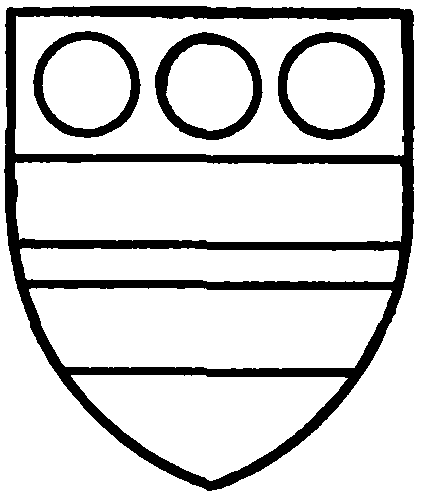
Wake. Or two bars and in chief three roundels gules.
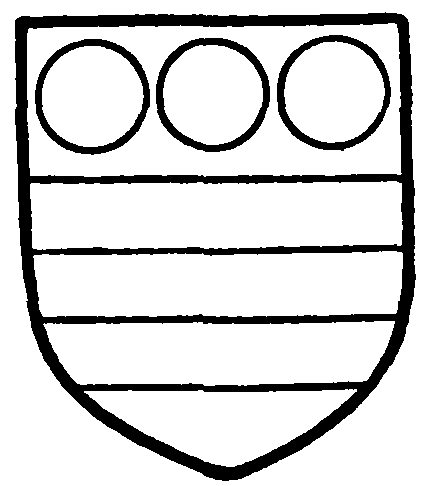
Whittlebury. Barry of four azure and argent on a chief argent three roundels azure.
The intermediate overlordships of the Combe holding were changed by marriages during the 14th century. By the marriage, about 1325, (fn. 37) of Margaret, daughter and heiress of Thomas Wake to Edmund, Earl of Kent, the immediate lordship came to this earldom. Brinklow was one of the manors assigned in dower to Elizabeth, widow of John, 3rd Earl, in 1353; (fn. 38) it was still in her possession when she died in 1411, when it was stated to have been granted by Edward III to Edmund, Earl of Kent, her father-in-law. (fn. 39) The marriage, about 1349, of John, 5th Lord Mowbray, with Elizabeth Segrave, daughter and heiress of the Duchess of Norfolk, (fn. 40) brought a similar change in the next higher tenancy. In 1399–1400 Thomas, 1st Duke of Norfolk, held 2¼ knight's fees in Warwickshire, (fn. 41) and in 1461–2 John, 3rd Duke, held one and one-tenth and onequarter fees in Brinklow. (fn. 42)
In 1539 the 'manor' of Brinklow, namely the undertenancy granted by William de Thorp in 1344 to the Abbot of Combe, was granted for life to Mary, Duchess of Richmond and Somerset. (fn. 43) She died in 1557, and the following year the manor was granted to Robert Lane of Horton (Northants.) and Anthony Throckmorton of Chastleton (Oxon.). It was then valued at £11 8s. 10½d. and held with Great Addington in Northants., of which the value was £15 10s., as onefortieth of a knight's fee. (fn. 44) In the same year Lane and Throckmorton obtained licence to grant the manor to William Dawes, his heirs and assigns, to be held in chief. (fn. 45) In 1628 William Dawes, probably his grandson, died in possession of the manor, William his son and heir being 30 at the time of the inquisition. (fn. 46)
Part of the parish, including the site of the castle, was in 1626 in the hands of Arthur Gregory of Stivichall. (fn. 47) His son John appears subsequently to have obtained possession of the whole of what was called 'the manor', with which he was dealing in 1654. (fn. 48)
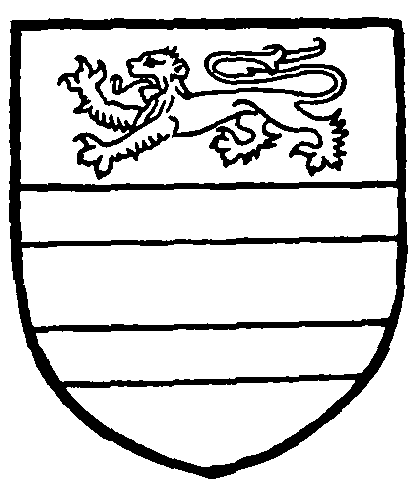
Gregory. Argent two bars and in chief a lion passant azure.
It was perhaps through Sir Simon Clarke, who in 1636 with John Clarke granted view of frankpledge in Brinklow to John Williams the younger, Simon Edolphe, and John Vaughan, (fn. 49) that another manor of Brinklow came, before 1728, (fn. 50) to the Skipwith family, Sir Fulwar Skipwith, 1st baronet, who died in 1678, marrying Dorothy Parker the niece of Dorothy Hobson (daughter of Thomas Hobson of Cambridge), Sir Simon Clarke's second wife. (fn. 51) The court leet and view of frankpledge was leased to Sir Fulwar Skipwith, 2nd baronet, in 1685, and confirmed in 1707 and 1731. (fn. 52) The Skipwith baronetcy became extinct in 1790, (fn. 53) but Thomas George Skipwith, a distant cousin, (fn. 54) was vouchee in a recovery of the manor in 1832, (fn. 55) and in 1850 the joint lords were Sir Grey Skipworth and A. F. Gregory, (fn. 56) the latter being directly descended from the John Gregory who was lord of the manor in 1654. (fn. 57) The lordship remains with the Gregory (now GregoryHood) family. (fn. 58)
In 1201 when William de Mowbray conveyed Brinklow to William de Stuteville he reserved the services of Samson de Cornubia, who held by knight service. (fn. 59) This may represent the knight's fee held in Brinklow of John Mowbray the elder of Axholme by the Prior of Monk's Kirby in 1361. (fn. 60) This alien priory was absorbed in 1415 by the Carthusian priory of Axholme (Lincs.), (fn. 61) and in 1539 its lands in Brinklow were assigned for life to Thomas Mannyng, formerly Prior of Butley (Suffolk) and then Bishop of Ipswich, with remainder to Charles Brandon, Duke of Suffolk. (fn. 62)
One-tenth of a knight's fee was held in Brinklow in 1298 by Thomas de Bray, of the lands of John son of Benedict. (fn. 63) In 1361 a similar fraction was held by Thomas de Grey; (fn. 64) in both cases the Mowbrays were the immediate overlords, and this is no doubt identical with the tenth of a fee in the hands of John, 3rd Duke of Norfolk, in 1461–2. (fn. 65)
A messuage in Brinklow, with lands in other parishes, was devised by will dated 19 April 1625 by Thomas Wale, citizen and mercer of London, to provide a schoolmaster and usher in the school at Monk's Kirby, this school to be free to the children of Monk's Kirby, Stretton, and Brinklow. (fn. 66)
Church
The parish church of ST. JOHN THE BAPTIST, on the west side of the main street, stands in a small churchyard on the slope of a hill, the ground falling from east to west, its eastern boundary being the outer ditch of the castle. It consists of a chancel, nave, north and south aisles, west tower, and north and south porches; the south porch has been converted into a vestry. It was rebuilt about the end of the 15th century and all that remains of the earlier church is the chancel, parts of the north aisle walls and possibly the staircase to the roodloft.
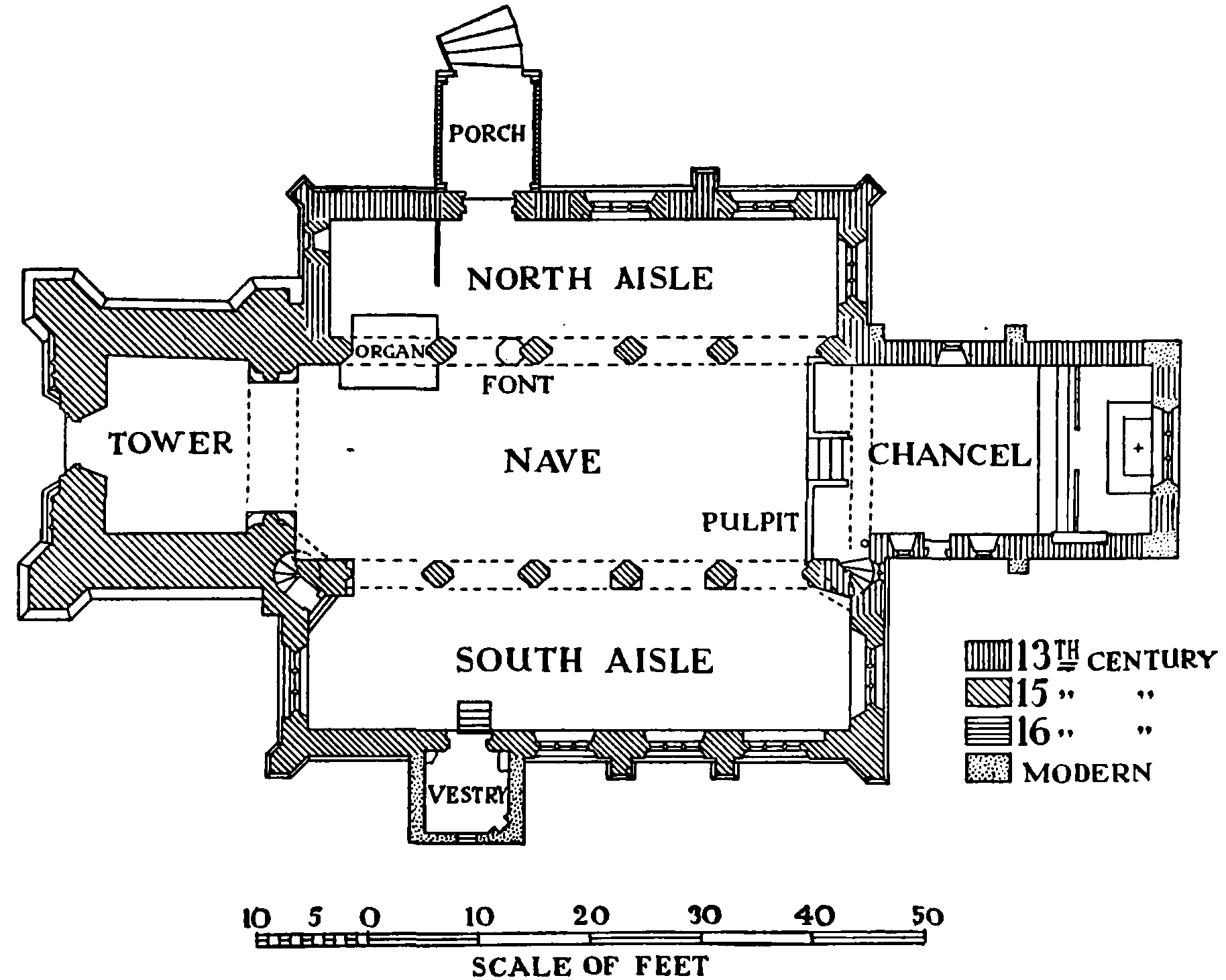
Plan of Brinklow Church
The chancel is built of a mixture of limestone and sandstone rubble patched with bricks and tiles and has a modern steep-pitched tiled roof, modern coping and cross finial, and rebuilt buttresses. It is lighted on the east by a modern window of three pointed lights with a hood-mould and head-stops. The south side has a central buttress, and west of it are two restored lancet windows with a narrow doorway between them. The lancet to the west is divided by a transom to form a low side window. The doorway has a restored pointed arch, the splay carried down the jambs. The north side has a central buttress and another butting against the aisle wall, with a restored lancet window between them. The south aisle is built of red sandstone ashlar with a plinth of one splay, stepped down to conform with the slope of the ground. The wall is diminished in thickness by a weathered offset at sill level. It has a low-pitched lead-covered roof with a plain low parapet, with a moulded coping projected on a moulded stringcourse. The east gable is lighted by a partly restored traceried window of three cinquefoil lights under a hollow-moulded four-centred head. The south wall has buttresses at the angles, two intermediately, and a porch towards the western end. It is lighted between the buttresses by three windows similar to the one in the east wall. The porch has been rebuilt in brick and stone with a tiled roof and the entrance blocked to form a vestry. The south door, which has a four-centred arch under a square head, has been mutilated. The west end is similar to the east, but the coping is carried up as a lean-to instead of a gable. The buttress at the angle is diagonal, splayed to a point. The north aisle is built of rubble similar to the chancel and has a lean-to roof covered with lead, a battlemented parapet with trefoil panelled pinnacles at each end and crocketed finials. Originally there were two intermediate pinnacles, of which only the bases remain. The north side has diagonal buttresses at the angles, one intermediate and, towards the west, a porch. It is lighted by two three-light traceried windows with splayed fourcentred heads, the centre light trefoiled, the two outer cinquefoil; by a similar window on the east; and on the west by a trefoiled single light with a square head. The porch is timber-framed with a tiled roof, and the entrance has been fitted with a pair of modern doors. On both sides the timbering has been concealed, externally with roughcast and internally with plaster. The front retains its timbering, the entrance having a heavy moulded frame and four-centred head, carved spandrels and lintel, and a timber-framed gable plastered between the timbers. The door has a moulded four-centred head, square hood-mould, carved spandrels, and trefoil-panelled soffit and reveals which have been badly mutilated. In the centre of the hood-mould there is a shield with three swords (for Clarke).
The tower is built of light-coloured sandstone ashlar with a moulded plinth and battlemented parapet on a coved string-course; at each angle there are bases for pinnacles. It rises in four stages, diminished at each stage by weathered offsets on the north and south, and on the east and west at the first and half-way up the third only. At the angles there are diagonal buttresses rising in five stages and splayed off to a sharp edge, except at the third stages on the west side which have gabled trefoiled niches. The west doorway, in a deep wave-moulded splay, is constructed of red sandstone and has a moulded four-centred arch under a square head, with carved spandrels. It is flanked by wall aracading in two tiers of trefoil-headed roll-moulded panels. Above the doorway is a tall pointed traceried window of three cinquefoil lights with a hood-mould, the tracery and mullions being modern, and in the second stage a clock dial. The tower staircase is in the south-west angle, with a loop-light to each stage and a square-headed doorway opening on to the aisle roof. The belfry is lighted on each face by pointed traceried windows of two trefoil lights, and the ringing chamber by similar windows on the north and south.
Internally the floor of modern tiles has been laid to a continuous fall from east to west, probably taking the place of a series of steps, as the bases of the arcade pillars and windows are stepped down following the slope. The walls, except the arcades and tower, are plastered, the plaster being finished round all the aisle windows with scalloped edges.
The chancel (28 ft. 4 in. by 15 ft. 6 in.) has four steps from the nave and three to the altar in addition to the slope of the floor. The east wall has a dado of modern coloured embossed tiles, and the window a segmental pointed rear-arch. At the east end of the south wall there is a shallow recess with a segmental pointed stop-chamfered head, probably a blocked piscina. The lancet windows have splayed recesses with square heads, and the doorway a segmental pointed rear-arch. The roof is a modern hammer-beam, its trusses supported on carved stone corbels. It is continued under the chancel arch with twin trusses, panelled between with pierced panels and supported on slender stone shafts with carved capitals and moulded bases resting on moulded corbels.
The nave (48 ft. 3 in. by 17 ft. 7 in.) has a modern open roof with curved trusses resting on moulded timber corbels. Both arcades consist of five bays of pointed arches, of two splayed orders, supported on lozenge-shaped roll-moulded pillars, the arch splays dying out on the mouldings, which terminate in splayed stops on plain lozenge-shaped pedestals. At the junction of the south arcade with the chancel there is a circular stair up to a square-headed doorway which gave access to a rood, and half-way up there is a pointed opening to the aisle. It is lighted from the east by a small square-headed two-light window. The chancel arch is a modern pointed one, of two splayed orders, dying out on the north wall and on the south resting on a floriated corbel. The tower has a pointed arch of two splays to the tower and three to the nave, the inner order supported on three-quarter-round responds with moulded capitals and bases. The arch is of red sandstone with capitals of a light-coloured stone, and on the tower side in the apex there is a carving of an angel. The south-west angle is corbelled out in three steps for the tower staircase, the upper step being trefoiled, and below it there is a square-headed doorway. The pulpit and reading desk, of stone, are modern.
The south aisle (49 ft. by 12 ft. 9 in.) has a lowpitched open roof of five bays with moulded members and carved bosses in the centres of the tie-beams. It probably dates from the early 16th century; the boarding and some rafters are modern. The trusses rest on stone corbels on the south wall, and on the north the outer roll mouldings of the arcade pillars are carried up with capitals in place of corbels. At the east end, the north-east angle is splayed to accommodate the staircase to the rood. The windows have hollowmoulded reveals with four-centred rear-arches, the window to the east having its arch extended eastwards and carried down to form a recess. The east wall has an offset at sill level with a chamfered stone capping, and the window reveals are carried down as a recess. In the east window there are some fragments of early coloured glass consisting of two chalices and parts of a canopy.
The north aisle (45 ft. 7 in. by 9 ft. 11 in.) has a lean-to roof of five bays, of which two retain some of their original moulded members, probably early-16thcentury. The trusses are supported on stone corbels on the north wall and on square blocks of stone as capitals to the outer roll moulding of the arcade pillars. Over the door there is a painted coat of arms of George IV. The font, with a lead-lined basin, is built into the west side of the north arcade pillar opposite the door. It is of stone, with an octagonal moulded basin with paterae, and octagonal stem and base which has been rendered in cement. It has been re-dressed but is probably contemporary with the arcade. Near the door there is a small 17th-century oak chest with three hasps and fitted with lifting rings at each end. In the centre and east windows there are a few fragments of early glass, including a peacock and portions of a castle.
The tower (15 ft. 10 in. by 13 ft.) has a window with widely splayed reveals, and a rear-arch of two splayed orders; the recess is carried down to include the doorway.
In the chancel and aisles there are a number of 18thand 19th-century wall memorials.
There are five bells, all of 1705, by Joseph Smith of Edgbaston. (fn. 67)
The registers begin in 1558.
Advowson
Brinklow was originally a chapelry of Smite, and was granted with the parent church, in the reign of Henry I, by Samson de Albenei with the consent of Roger de Mowbray to the priory of Kenilworth. (fn. 68) The patronage continued with that house till just before the Dissolution, when it was granted by the convent to Richard Haw, who presented in 1541. (fn. 69) After the Dissolution the Crown retained the advowson in its own hands; the Lord Chancellor is the present patron. (fn. 70)
The value of the rectory was £4 in 1291, (fn. 71) and £17 10s. in 1535. (fn. 72)
Charities
William Edwards by will dated 9 June 1789 gave to the minister, churchwardens, and overseers of Brinklow £300, the yearly interest to be distributed in bread to the amount of 5s. 6d. every Sunday at church to the most deserving and necessitous poor of the parish. Any sum remaining to be given in bread on Christmas Day.
Mary Barker by will dated 9 December 1721 gave £20 to the minister and churchwardens of Brinklow, to be laid out in bread especially on the Sunday after Christmas Day and on Whitsunday and given to poor persons regularly attending the church service: £10 of this sum was lost by the insolvency of the person in whose hands it had been placed. The annual income of this charity and that of William Edwards amounts to £7 11s. 4d.
Ann Brierly, by will dated 16 July 1863 gave £25 to the rector and churchwardens of Brinklow, the income to purchase coal to be distributed on 21 December to necessitous widows residing in the parish. The annual income of the charity amounts to 12s. 4d.
Mary Ferguson, who died in 1862, bequeathed to the rector and churchwardens of Brinklow £100, the interest, amounting to £2 12s., to be given at Christmas among deserving widows of the parish.
Elizabeth Frances Lyne Hill by will dated 29 July 1925 gave to the rector and churchwardens of St. John's, Brinklow, £500, the income to be distributed to deserving poor residents in the parish. The annual income of the charity amounts to £14 6s. 4d.
The Rev. Thomas Muston by will dated 30 September 1729 charged certain property in Foleshill with the annual payment of 20s. to the minister of Brinklow for the use of the poor of the parish, special regard being had to those who frequent the service and sacraments of the church. The rent-charge was redeemed in 1926 in consideration of the sum of £40 2½ per cent. Consols, producing an annual income of 20s.
James Hancox by will dated 30 September 1752 devised land called Potters Close in Brinklow to trustees to dispose of the rents and profits among poor persons of the parish. The land was sold in 1947 and the proceeds of sale invested. Trustees of the charity are appointed by Order of the Charity Commissioners and by the parish council. The annual income amounts to £12 16s. 8d.
Alice Ansley by indenture dated 11 January 1635 charged certain property at Brinklow with the payment of the yearly sum of 10s. to the rector of Brinklow on Good Friday towards the repair of the parish church.
Thomas Wale by a codicil to his will dated 19 April 1625 ordained that the Mayor and Aldermen of the City of Coventry should yearly bestow out of the rents and profits of certain property devised to them the sum of 40s. to the churchwardens and overseers of the poor of Brinklow to be distributed for the relief of the poor of the parish.