A History of the County of Warwick: Volume 6, Knightlow Hundred. Originally published by Victoria County History, London, 1951.
This free content was digitised by double rekeying. All rights reserved.
'Parishes: Bulkington', in A History of the County of Warwick: Volume 6, Knightlow Hundred, ed. L F Salzman (London, 1951), British History Online https://www.british-history.ac.uk/vch/warks/vol6/pp48-57 [accessed 9 May 2025].
'Parishes: Bulkington', in A History of the County of Warwick: Volume 6, Knightlow Hundred. Edited by L F Salzman (London, 1951), British History Online, accessed May 9, 2025, https://www.british-history.ac.uk/vch/warks/vol6/pp48-57.
"Parishes: Bulkington". A History of the County of Warwick: Volume 6, Knightlow Hundred. Ed. L F Salzman (London, 1951), British History Online. Web. 9 May 2025. https://www.british-history.ac.uk/vch/warks/vol6/pp48-57.
In this section
BULKINGTON
Acreage: 4,892.
Population: 1911, 1,837; 1921, 2,216; 1931, 2,747.
The parish forms a large roughly square block, 3½ miles across, to the south of Nuneaton. Its boundaries are for the most part formed by small streams, that on the east being the upper reaches of the River Anker. The village is situated centrally, on a slight rise, most of the houses being built on four roads which form a square inclosure south of the church. A road leads due west to Bedworth, passing Bulkington station on the Trent Valley branch of the L.M.S. Railway, which crosses the parish from south-east to north-west. Just to the east of the village is the road to Nuneaton, on the east side of which is the hamlet of Ryton. Half a mile north-west of the church is Weston-in-Arden, a hamlet which contains Weston Hall, the Roman Catholic church, and a few farms. A mile farther to the north-west is Marston Jabet, through which passes the Ashby-de-la-Zouch Canal, which runs for over a mile along the northern boundary of the parish. In this district are a number of old quarries, and Marston Lane, leading to Bedworth, was described in 1654 as 'the common way to the coalpits and stonepits'. (fn. 1) From Ryton a road runs east, and slightly north, to Wolvey, crossing the Anker by the 'stone horse bridge called Goose Bridge' in 1659. (fn. 2) North of this road, on the left bank of the Anker, is the hamlet of Bramcote, including Wolvershill, access to which is now diverted owing to the siting of a naval aerodrome.
Under the provisions of the Public Health Act of 1848 a Local Board was formed in July 1850. This was converted into an Urban District Council in 1894, but Bulkington lost its urban status by the Warwickshire Review Order, 1932.
To the south of Bulkington village lies Barnacle, connected with it by a field path, no doubt the 'ancient paved causey' mentioned in 1659. (fn. 3) Just to the west of the hamlet is the moated site of Barnacle Park. (fn. 4) This was a freehold of the manor of Barnacle Hall and at the time of the Civil War was in the tenure of William Hickman, who was a captain in the army of King Charles, for which offence the Parliamentary forces plundered and burnt his house. (fn. 5) It was still in the hands of the Hickmans about 1725. (fn. 6)
The village street is lined by late-18th-century houses and cottages, some of which are constructed with three stories, the uppermost being lofty and lit by broad windows, the result of a small offshoot of the silk-weaving industry from the main centres of Coventry and Bedworth. (fn. 7) One or two of the cottages are timberframed of the 16th century.
Weston-in-Arden is hardly separated from the village, and the nucleus of the hamlet is Weston Hall, an ancient manor-house, close to a sharp bend in the by-road, with the modern Roman Catholic church standing on the opposite side of a lane branching from the angle. The present Hall is of the mid-16th century and was substantially extended about 1892. (fn. 8) It is built of grey and cream-coloured ashlar sandstone with roofs of modern tile, and the old main block appears from the road as a symmetrical three-gabled front facing south. The east side has two gables and is less in width. The three southern gables intersect with the long roof whose ridges stop on the east wall. The new wing, which includes the kitchens and the main entrance porch, continues westwards. The original south front projects beyond the porch of the new wing, which is recessed in the re-entrant angle; there are three stories and the two chimneys have been rebuilt. (fn. 9) All the windows are mullioned, with a single transom and a square head, head and jambs being of two chamfered orders. In each of the outer gables the windows are four lights wide, except for those on the second floor, whose width is three lights. Above the doorway, which is central, there is a window of three lights at each of the two stories over, and within the centre gable also are two two-light windows at each side, at ground- and first-floor levels only. The two lower windows in the eastern gable and the doorway, with its moulded jambs and square head of two orders together with the two sunk panels above, are of modern stonework. The plinth is moulded and is returned on either side of the doorway. Projecting string-courses, weathered with a hollow under, are continuous across the facade immediately above both ground-and first-floor windows. The second-floor windows carry straight hood-moulds of their own width. The gables are continuous with the short lengths of moulded parapet at their feet.
The two gables of the east facade are similar, except that the second-floor windows (one in each gable) are less in height and without transoms, and the northern window to the ground floor has been replaced by a modern stone bow window of six lights. The whole of the north facade has been rebuilt (fn. 10) except for the bay at the east end, which is two stories in height, each lighted by the same type of window of three lights with a transom. The upper one of these is blocked inside the glazing, which is divided into small panes and is either original or of the 17th century: all the other glazing is modern. Neither string-courses nor the plinth return beyond the north-east corner of the building.
The central entrance door of the original block leads into a vestibule, which, together with most of the interior, was modernized during the restoration of 1893. Here, two open arches with modern panelled elliptical heads open onto an oak-panelled lounge hall beyond. Some of the panelling in the vestibule and most of that in the hall is original; the panels are small and surrounded by a small bead within an ovolo and may be ascribed to the late 16th century; they rise to a height of 7 ft., where they are topped by a modern cornice. The hall fireplace, on a splay wall opposite the entrance, has a modern oak surround, but the overmantel is inset by an original late-16th-century centrepiece 1 ft. 7 in. high of two panels, each being framed by two crude Ionic pilasters supporting a semicircular head enriched with egg-and-dart and interlaced ribands. Each frame contains an urn sprouting flowing vine foliage and thistle heads. Dividing the panels and at each end are grotesque figures used as pilasters, each carrying a rosette. There is a band of enrichment spanning the whole length of the original portion (4 ft. 2 in.), and there are vertical lengths of the same moulding as that of the wall panelling.
There is a staircase hall immediately to the east of the vestibule. This rises up through two stories, and the staircase, giving access to the first floor only, winds round in short straight flights of six or seven steps; (fn. 11) it appears to be of the late 17th century, although the panelling re-used for lining the soffit is of the early 16th century. The balusters are turned and moulded and the strings are treated in the form of an entablature with a plain pulvinated frieze.
The panelling which lines many of the internal doorway openings matches that of the lounge hall, but all the doors are modern, except for those to the panelled bedroom described below.
Entered from the staircase hall and situated in the south-east corner is a square library fitted with 18thcentury bookcases; 16th-century carved oak panels incorporated in the modern panelling of the window jambs bear decorative motifs such as leaf forms and rosettes. The timber surround to the fireplace is apparently French and of the 18th century; it has a crested overmantel of the same period.
The room in the south-west angle of the front has a modern projecting bay on the west side with a door providing access to the modern wing.
The first-floor bedroom over the library is completely panelled up to the ceiling with early-16th-century panels like those beneath the staircase. The doors are similarly treated and set flush, with H-pattern hinges on the reverse side. The fireplace is modern and the overmantel is probably of early-17th-century work, consisting of four panels with another above. The bedroom to the north communicates both with this one and the staircase landing, and the doorway between them is treated with an oak surround on the north side. This is of the late 16th century and consists of two Ionic pilasters rising from the skirting and fluted above a height of 2 ft. The entablature above has a moulded cornice supported on small brackets; the triglyphs of the Doric order are crudely represented by a series of slightly bevelled panels planted on at intervals. The narrow architrave has a fine upper mould with a row of guttae beneath each triglyph panel. The walls of this room are plastered and there is a late-17th-century stone architrave surrounding the fireplace.
The other first-floor rooms to north and west are completely modernized, the second floor has been similarly treated with recent plasterwork concealing all roof timbers, and it is entered only from the modern wing.
The original entrance now opens onto a square formal garden, which is surrounded on three sides by walls about 8 ft. in height. The latter are of doubtful age. (fn. 12) The opposite wall to the doorway is pierced in the centre by a narrow gateway flanked by piers executed in the early-17th-century manner. These are approximately 12 ft. high; they are square with sunk panels, and the moulded cornices carry ball finials; the lower halves of the finials are fluted. On the south and west sides the walling is carried on a chamfered plinth. The wrought-iron gates are modern. The west and east walls are pierced close to the house by openings with similar piers to those on the south side. Beyond the latter there is a short avenue of beech-trees reaching to the road.
Park Farm at Barnacle is a 17th-century farmhouse built of brick and tile. The windows are wood-framed with mullions and transoms; the brick chimney-stacks are treated with sunk panels, and at the base of the walls there is a plain stone plinth which may have been the foundations of an older building. The internal oak staircase is contemporary and is treated with turned and moulded balusters between square newel posts in short flights. The buildings are partly surrounded by a deep ditch and there are other traces which suggest that there was originally a moat. There are ancient yew-trees at back and front. A few cottages form a group close to the track leading to Park Farm and there are 16th-century timber-framed buildings among them.
Marston Hall, at Marston Jabet, is a late-18thcentury residence built with buff-coloured bricks; and Bramcote House is an 18th-century farmhouse now (1948) standing derelict and in a ruinous condition, the aerodrome being close at hand.
At the time of the Domesday Survey woodland 4 furlongs in length by 3 furlongs in breadth belonged to Barnacle. (fn. 13) Now the parish is almost destitute of woodland, though the grounds of Weston Hall may be the last remnants of the park for the enlargement of which Sir William la Zouche had permission in 1372 to close a path leading westwards from the manor. (fn. 14) The open country is, however, well watered, being not only bounded but intersected by small streams, which accounts for the large amount of 100 acres of meadows attributed to Bulkington in 1086. (fn. 15)
At Bramcote, where the site of a water-mill can still be traced, a mill was given to the Abbey of Leicester by Geoffrey l'Abbe about 1143. (fn. 16) This gift was confirmed in 1240 by Ernald de Bois, including meadow and the pond of Cressewelle; (fn. 17) and at the Dissolution the mill of Bramcote was leased for £3 6s. 8d. (fn. 18) A windmill appurtenant to the manor of Weston is mentioned in 1277, (fn. 19) and in 1710; (fn. 20) and another at Marston Jabet in 1590. (fn. 21)
Under an Act of 1766 (fn. 22) some 700 acres of common fields at Ryton were inclosed, and four years later inclosure was applied to the remainder of Bulkington, affecting some 1,600 acres. (fn. 23)
Manors
It would seem that the parish of Bulkington had originally constituted two 5-hide vills, the southern consisting of Bulkington (4 hides 1 virgate) and Barnacle (3 virgates), and the northern containing Marston (1 hide), Weston (2 hides), and Bramcote (2 hides). At the time of the Domesday Survey the first four of these divisions were among the estates of the Count of Meulan. (fn. 24) In BULKINGTON his sub-tenant was Salo, presumably identical with the man of that name who had held in Bramcote in the time of Edward the Confessor, (fn. 25) though here the pre-Conquest tenants were Aliet and Alsi. The overlordship of the count's estates here passed to his descendants the earls of Leicester, and after the division of that honour between coheirs in 1204 (fn. 26) came to Roger de Quincy, Earl of Winchester, and his heirs, (fn. 27) being held in 1299 by John Comyn, Earl of Buchan, (fn. 28) and in 1352 by (Henry) heir of John de Beaumont, then a minor and ward of the Crown. (fn. 29) This Henry's grandson, Sir Henry, Lord Beaumont, still held the overlordship at his death in 1413. (fn. 30)
At the time of the foundation of the Abbey of St. Mary of Leicester, in 1143, the manor of Bulkington was evidently held by Roger de Watevile, or Watervile, as he gave the church and its chapels and 2 virgates of land to that abbey, (fn. 31) his brother Robert giving other property in the parish. The Watevile estates passed to Ernald de Bois, nephew of Roger, and he, his son, grandson, and great-grandson, each called Ernald, confirmed the gifts made to the abbey. (fn. 32) The fourth Ernald de Bois died in 1277, leaving a son John, aged 24. (fn. 33) By this time the centre of the manor had shifted to WESTON-IN-ARDEN—where in 1086 Fulk had held 2 hides which before the Conquest were held by Sexi (fn. 34) —and Bulkington had become a member thereof. John de Bois in 1285 successfully claimed view of frankpledge and other franchises, and free warren in his manor of Weston with its members Bulkington, Bramcote, Barnacle, Ryton, Clifton, and Wibtoft, (fn. 35) except in the estates of the Abbot of Leicester, who held similar franchises. (fn. 36) He died early in 1290, when his brother Master William de Bois had livery of his estates, saving dower to John's widow Joan. (fn. 37) In 1296 Master William had licence to enfeof Milicent de Monhaut (wife first of Eudo la Zouche and afterwards of John de Monhaut) (fn. 38) in a moiety of the manor of Weston and for her to regrant it to him for life with remainder to William la Zouche (her son) and Maud his wife (daughter of Master William's sister Isabel) (fn. 39) and her heirs. (fn. 40) Milicent died seised of the manor in 1299 (fn. 41) and Master William de Bois died early in 1313, (fn. 42) in which year William la Zouche and Maud had a grant of free warren for their lands in Weston, Bulkington, Ryton, Bramcote, Wolvershill, and Foleshill. (fn. 43) The manor then descended in the family of Zouche of Haringworth (fn. 44) until the attainder of John, Lord Zouche, in 1485, when it was forfeited and in 1488 was granted by Henry VII to Sir James Blount in tail male. (fn. 45) On the reversal of the attainder in 1495 (fn. 46) the manor was restored to Lord Zouche and continued in the family until 1580 when Edward, Lord Zouche, sold it to Humphrey Davenport and Richard Bucknam. (fn. 47) In 1589 Davenport conveyed the reversion of the manor (or more correctly a moiety thereof) to Sir Christopher Yelverton, retaining an interest in it for the lives of himself and his wife Joan. Humphrey died before Joan, who was still living at Weston when Sir Christopher died in 1612. (fn. 48) His son Sir Henry Yelverton died on 24 January 1630 and bequeathed the manor of Weston-in-Arden to his younger son Robert in tail, (fn. 49) who died on 10 December 1610, when the manor passed to his elder brother Sir Christopher. (fn. 50) In 1655 Sir Henry Yelverton, bart., and others conveyed the manor to Sir Richard Samwell, of Upton (Northants.), and his son Richard, (fn. 51) and the latter's grandson Sir Thomas Samwell, bart., apparently sold it to John Hayward about 1710, (fn. 52) in whose family it was in 1730. (fn. 53) One-half of the joint lordship of the manor was held in 1735 by Mary Hayward and in 1744, 1748, and 1769 by Richard Hayward. (fn. 54)
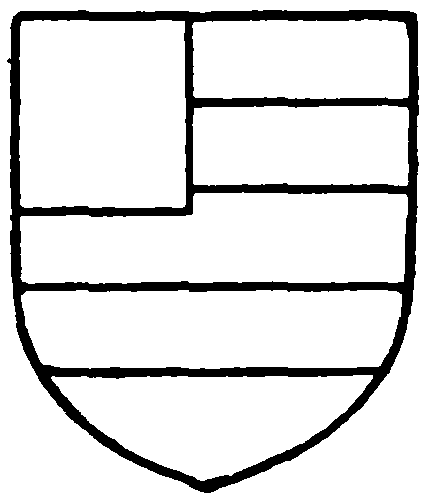
De Bois. Argent two bars and a canton gules.
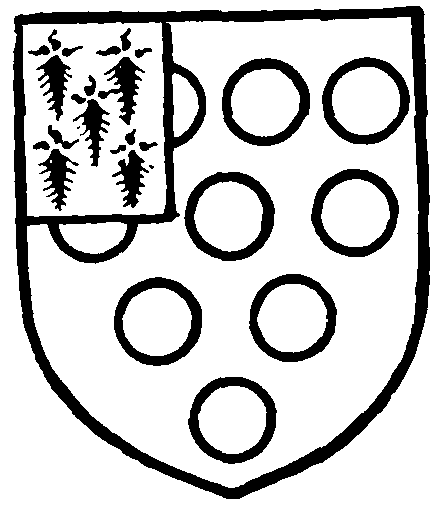
Zouche of Harringworth. Gules ten bezants and a canton ermine.
The second moiety of the manor had been sold by Humphrey Davenport to George Purefoy, (fn. 55) whose son Gamaliel succeeded to it in 1615. (fn. 56) He sold it to Anthony Stoughton, who was dealing with the moiety of the manor in 1652. (fn. 57) From 1726 to 1761 George Stoughton occurs as one of the lords of the manor. (fn. 58) By 1769 his place is taken by James Money, who had married his daughter and eventual heiress Eugenia, and he was succeeded by William Money in 1785. (fn. 59) At the opening of the 19th century the joint lords were the Rev. Peter Debary and Ann his wife (fn. 60) and Thomas Woods Weston. (fn. 61) The latter and Richard Brome Debary are named as lords in 1850, (fn. 62) and Richard Lerins Debary as sole lord in 1874, (fn. 63) but the estate and lordship were subsequently bought by F. A. Newdigate, who was lord of the manor in 1900, (fn. 64) and were acquired in 1920 by Lt.-Col. F. B. Leyland. (fn. 65)
In 1086 an estate of 3 virgates in BARNACLE was held of the Count of Meulan by Hereward, who had held it of King Edward the Confessor. (fn. 66) Roger de Watervile gave land and tithes here to Leicester Abbey, (fn. 67) and he was succeeded by the family de Bois, of whom Ernald IV in 1240 confirmed to the abbey a carucate of land here which Henry (Jabet) of Marston had held of his grandfather. (fn. 68) The family of Dyve (fn. 69) held a mesne lordship, in right of which Henry de Dyve of Ducklington (Oxon.) had custody of the manor during a minority in 1316. (fn. 70) At some date before 1373 Margaret widow of Richard Hastang and kinswoman and heir of Thomas Dyve conveyed this mesne lordship to William Catesby; (fn. 71) but in 1389, when his son John Catesby claimed custody of the manor on the attainder of Sir John Beauchamp, it was alleged that Barnacle was formerly held of John Dyve as of his manor of Deddington (Oxon.) which was forfeited for felony and given by Edward III to the Collegiate Church of Windsor, so that Barnacle was then held in chief of the king. (fn. 72) Catesby, however, established his claim (fn. 73) and in 1420 the manor was said to be held of 'the heir of Henry de Dyve' as half a fee. (fn. 74)
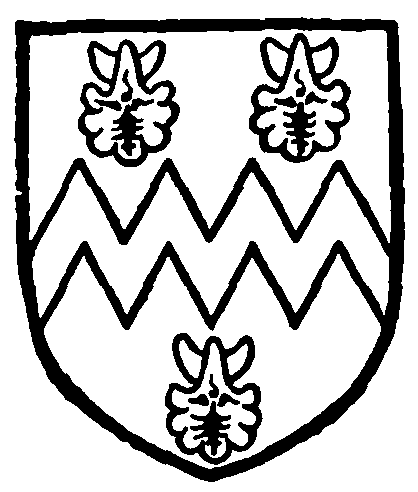
Dyve. Gules a fesse dancetty or between three scallops ermine.
Guy (FitzWyth) was tenant in fee of the manor about the end of the 13th century, when the canons of Leicester Abbey gave him leave to have an oratory in his house at Barnacle, saving the rights of the mother church of Bulkington. (fn. 75) Guy was lord of the manor in 1314, (fn. 76) but was dead before Christmas 1316, when his widow Joan had dower and his heir Elizabeth was in ward to Henry Dyve. (fn. 77) Elizabeth married Thomas de Lucy and in 1351 they granted the manor to (her cousin) Robert FitzWyth, (fn. 78) who agreed to pay 12 marks yearly during the life of Elizabeth. (fn. 79) Next year he granted it to his nephew Robert and his wife Agnes in tail. (fn. 80) The manor then descended with Bubbenhall (q.v.) in the families of Beauchamp of Holt and Croft and was sold by John Croft to Sir Edward Grevill in 1515. (fn. 81) His grandson and namesake dissipated his fortune and had to sell his estates. (fn. 82)
The Knights Hospitallers (fn. 83) held an estate in Barnacle of which the early history has not been ascertained, though a casual reference to lands of the Master of the Hospital in Barnacle occurs in 1262. (fn. 84) This was granted, by the name of Ferme Place, to Sir Ralph Sadler in 1550 (fn. 85) and sold by him to John Wade. (fn. 86) He with Richard Perkins and Isabel his wife in 1573 conveyed the 'manor' of Barnacle to Edward Aglionby and Katherine. (fn. 87) Aglionby in 1590 granted the reversion of it to Michael Feilding, on whose death it passed to his brother Basil, who settled it on his younger son Sir Roger, on whose death it went to his nephew William. (fn. 88) This estate, part of which lay in Shilton, formed the reputed manor of BARNACLE HALL (fn. 89) and continued in the family of Feilding until at least 1733. (fn. 90) In 1769 it was conveyed by George Byrd and Ann his wife to Samuel Thomas. (fn. 91) Holled Smith of Normanton Turville (Leics.) was lord in 1785, (fn. 92) and in 1808 his daughters (fn. 93) and their husbands, Richard Coxe and Susan, Thomas Noel and Catherine, George Smith and Frances, Isaac William Webb Horlock and Ann, Thomas Althorpe and Mary, conveyed it to William Tomlinson, (fn. 94) after which date it has not been traced.
As in the case of Barnacle, Hereward the preConquest tenant of MARSTON retained his estate of 1 hide in 1086, but as undertenant of the Count of Meulan. (fn. 95) The overlordship came to the earls of Warwick, and from early in the 13th century a mesne lordship was held by the family of Estley, or Astley. (fn. 96) In 1242 Henry Jabet held of Thomas de Estley, who held of the earl, a half-fee in MARSTON JABET. (fn. 97) This Henry, (fn. 98) who gave his name to the manor, was the son of Fulk de Merston and gave to Leicester Abbey tithes and 4 virgates here which had been settled on his wife Alice in dower; for which gift he and his wife were received into the fraternity of the canons. (fn. 99) He and his sons John, William, and Robert gave lands here to Combe Abbey, (fn. 100) the grants being confirmed by Thomas son of Walter de Estley in 1241. (fn. 101) Land near 'le Churchweie' was given by Henry to the office of the porter of the abbey to provide shoes for the poor. (fn. 102) In 1285 this was one of the places in which the abbot successfully claimed view of frankpledge (fn. 103) and other franchises. (fn. 104) The abbey was deriving a revenue of 106s. from its lands in Marston Jabet in 1535, (fn. 105) and these were given with the other Combe Abbey lands to Mary, Duchess of Richmond and Somerset, for life in 1539. (fn. 106) In 1544 the manor of Marston Jabet was sold to Thomas Broke, merchant tailor of London, (fn. 107) who sold it to Henry Waver, or Over. (fn. 108) He conveyed the manor in December 1549 to John Perkins, (fn. 109) who died in 1557, bequeathing the manor to his wife Emmote for life with remainder to his son William, (fn. 110) with whose descendants it remained until the execution of Sir William Perkins for high treason on 3 April 1696, (fn. 111) when it was forfeited but later restored to his widow, whose eldest son Blackwell Perkins sold it to Mr. Robert Surman, Deputy Cashier of the South Sea Company. On the catastrophic collapse of that company it was taken into the hands of the Commissioners of the forfeited estates of the Directors. (fn. 112)
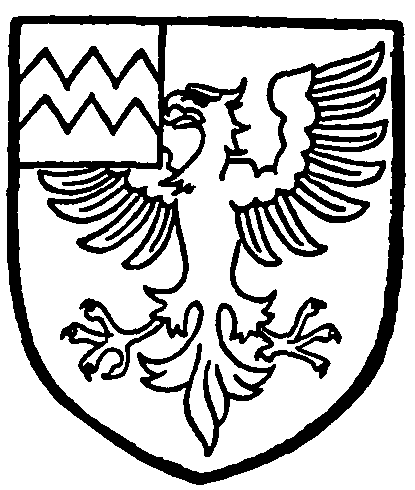
Perkins. Sable an eagle argent and a canton argent charged with a fesse dancetty sable.
At the time of the Domesday Survey BRAMCOTE was held in two portions: 1½ hides, held before the Conquest by Salo, had been given to Earl Aubrey (de Couci) (fn. 113) but, owing to his having left England, were in 1086 in the King's hands; (fn. 114) another ½ hide, formerly held by Sexi, was among the lands of Richard the Forester, or Hunter. (fn. 115) The larger part seems to have been attached to Bulkington and it is possible that the Hunter's estate may have been added to Weston-inArden, as that manor was held in 1277 by the sporting tenure of the yearly render of a brach hound. (fn. 116) Roger de Watervile is said to have given to Geoffrey l'Abbe 3 hides 'in the soke of Weston' as ¼ knight's fee; (fn. 117) and these were presumably in, or included, Bramcote, where Geoffrey gave a mill and 6 virgates to the Abbey of Leicester; which gift, with another 2 virgates from one Ranulf, was confirmed by Roger and, in 1240, by Ernald (IV) de Bois. (fn. 118) Thomas, Earl of Lancaster, also confirmed these grants in 1318, (fn. 119) and in 1346 the Abbot of Leicester held ⅓ fee of the Earl of Lancaster. (fn. 120) When the abbey was dissolved its property in Bramcote and Barnacle, apart from the mill, was producing about £8 10s. yearly, (fn. 121) and in July 1546 these lands and rents were granted to Edward Watson and Henry Herdson, (fn. 122) who in November sold them to Henry Waver, or Over, of Coventry, grocer. (fn. 123) He conveyed them in 1552 to John Masterson, (fn. 124) who died in 1565 seised of 'the manor of Bramcoyt alias Barwangle'. (fn. 125) His heirs were his sisters, Alice wife of Thomas Lisley, and Mary wife of Richard Turner. In 1575 Alice, then a widow, and her son John Lisley sold a moiety of the manor to George Purefoy, (fn. 126) whose son Gamaliel bought the other moiety from Mary's son William Turner in 1639. (fn. 127) The manor was not sold to Anthony Stoughton with the Purefoy moiety of the manor of Weston (see above), but remained with the Purefoys until at least 1730. (fn. 128) It was held by Thomas Puffen in 1756 and 1764, (fn. 129) and he was succeeded by George and William Russell, who sold it to John Finch in 1784. (fn. 130) Jane Simpson, who held the manor in 1792, (fn. 131) was sister and heiress of John Finch; (fn. 132) it was held by John Finch Simpson of Launde Abbey in 1811, (fn. 133) and by his four coheiresses, Mary, Louisa, Harriet, and Elizabeth Finch Simpson (of whom the two eldest married respectively Edward and Henry Dawson), in 1827 and 1831. (fn. 134) Later the estate was probably divided and the manorial rights extinguished.
When John de Hastings died in 1312 his knights' fees included ⅓ fee in Bramcote held by the heirs of Henry de Hastings. (fn. 135) This third descended to John de Hastings, Earl of Pembroke, (fn. 136) and so to Joan, widow of William de Beauchamp of Bergavenny, (fn. 137) and to Edward Neville, Lord Bergavenny. (fn. 138) Its earlier and later history remains obscure.
Ryton was one of the members of Bulkington, with which it is mentioned in many documents, but had no separate manorial existence. Tithes and rents to the value of 46s. 8d. in the vill were given to Leicester Abbey by Roger de Waterville. (fn. 139)
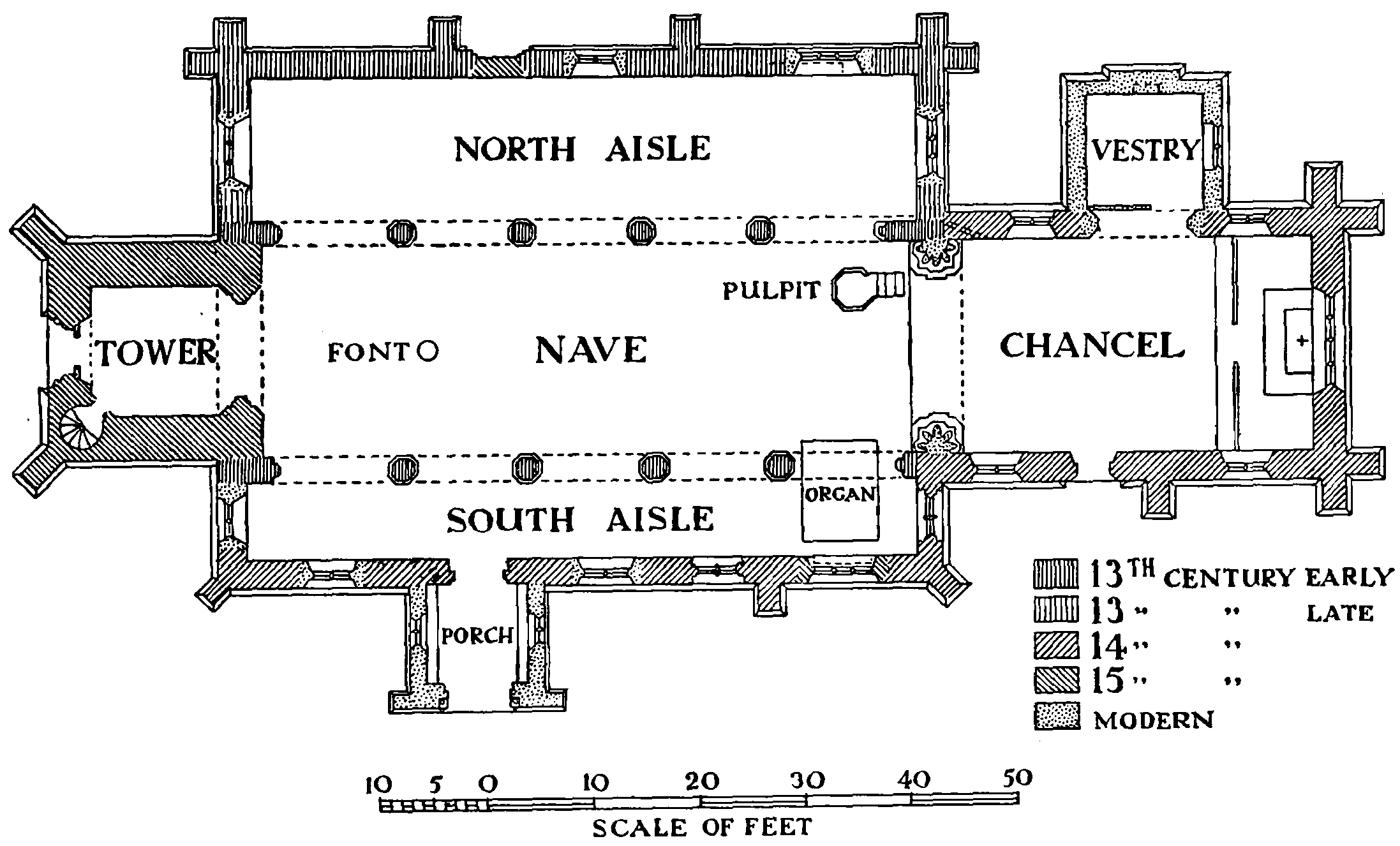
Plan of Bulkington Church
WOLVERSHILL, another member of the chief manor, was occasionally called a manor (fn. 140) and in 1580 was so described when it was sold by Edward, Lord Zouche, to Humphrey Davenport and Richard Bucknam. (fn. 141) They sold it to George Purefoy, (fn. 142) whose son Gamaliel inherited it in 1616, (fn. 143) after which it descended with the manor of Bramcote alias Barewangle (see above), being held early in the 19th century by the Finch Simpson coheiresses.
Church
The parish church of ST. JAMES is situated on level ground on the north side of the village. It is approached by two side streets which join the main street at different points where it meanders towards the north. To the north of an extensive churchyard are open fields and the Vicarage.
It consists of a chancel with a vestry on the north; a nave, with a clearstory to the south only; north and south aisles; south porch; and a western tower. The chancel is three bays in length (fn. 144) and the nave five.
Of the church as it existed early in the 13th century only the nave arcades remain, the north aisle having been rebuilt late in the same century. The south aisle was rebuilt and the present chancel added in the latter half of the 14th century. In the mid 15th century the west tower was built. The present south clearstory appears to have been either added or rebuilt in the late 15th or early 16th century, when the eastern window of the long wall of the south aisle was rebuilt in conjunction with an arched recess beneath the sill. An extensive restoration took place in the last century when the chancel vestry was added, the chancel arch rebuilt, and all the roofing reconstructed. The existing porch was built in 1907, when the tower was also restored, as was the south wall in 1928. (fn. 145)
The east wall of the chancel contains a transomed four-light 14th-century window with a hood-mould and with a two-centred head of two moulded orders, the outer being a casement with an ovolo and the inner being hollow-chamfered, like the mullions, with a rounded fillet. Each light has a four-centred cinquefoiled head, which is repeated below the transom, where the spandrels are hollowed. In the traceried head is a trefoil above the centre mullion, which divides to form two side lancets, each with a similar but smaller trefoil. The gable, with sloping parapets, carries a modern cross finial above an apex stone with a cusped head. The kneelers are moulded and occur 18 in. above the top offsets of the paired buttresses at each angle, which have three weathered offsets. The plinth has two offsets, one moulded with a drip and a plain chamfer below; it returns round the buttresses and stops against the end walls of the aisles.
Like the remainder of the church, including recent additions, but excluding the tower, the chancel has walls of cream-coloured sandstone, the roof is tiled with modern bluish tiles which slope down to a chamfered course of corbels to north and south supporting open eaves. The south buttress is similar to those on the angles; to the east of it there is a single window and to the west a door with a window beyond. That to the east is a two-light window with a hood-mould and with a two-centred head and two small chamfered orders; each light is cinquefoiled and the tracery, which has been renewed, forms three cusped compartments. The window to the west is similar except for the lower portion, which has a sill at a lower level, having a transom at the sill level of the other window, thus providing two additional plain square lights. The priest's door, immediately to the west of the buttress, has a single hollow-chamfered order; the ogee head continues the line of the jambs without imposts; the bases to the jambs are much decayed. The door itself is modern.
On the north side the modern vestry has a projecting gable with a chimney (fn. 146) rising past the apex. The roof is tiled like the chancel and intersects with the chancel wall a short distance below the eaves. (fn. 147) The plinth matches that of the chancel and there is a two-light square-headed window on the east side. There is a window each side in the chancel wall similar to the eastern one opposite, but more of the original tracery remains.
The east gable of the nave has been rebuilt. It is equal in width to the chancel but rises 2 ft. higher, with a roof of modern tile, on the north side of which is a long valley between it and the north aisle roof. On the south side the lower lean-to roof of the south aisle is surmounted by the clearstory of five bays, of which the windows have square heads and are of three lights with four-centred heads over the inner chamfered order, the outer order forming a rectangular splayed frame. The spacing of the mullions is varied in the different windows, being slightly narrower in the centre one and those at either end.
The north aisle is built of a similar stone to that of the chancel, but is not of the same ashlar finish, and would appear to date from the 13th century. It is divided into three wide bays by buttresses which are similar to the pairs set square at the angles. They have two deep weathered offsets, and the plinth with two chamfered offsets returns round their bases. At the level of the window sills there is a string-course, consisting of a roll moulding with a fillet, which returns round the buttresses also. The buttress to the east of the centre bay has been utilized as a flue to the outside heating chamber, being rebuilt for this purpose above the lower offset. The eaves and gables have recently been rebuilt to match those of the chancel, (fn. 148) and the gable at the west intersects with the north wall of the tower just to the west of its diagonal buttress. Both gables contain modern three-light windows with reticulated tracery and hood-moulds with head-stops. The east bay is pierced by a modern three-light window with a square head and hood-mould. The centre bay contains a similar modern window on the east side, and on the west there is an ancient doorway, blocked with masonry, having a lancet head of two chamfered orders; the string-course rises at springing height to form a hood-mould; on the east side of the doorway the plinth is cut off. (fn. 149) The west bay has no openings.
The south aisle is narrower than that on the north and carries a low-pitched lean-to roof which is surrounded by a continuous moulded parapet. On the south-east angle there is a diagonal buttress, capped by a single deep chamfered offset reaching the level of the heads of the windows; the base-stone of the offset is gabled and cusped. Midway up its height there is a small chamfered offset returning round the buttress and stopping against the aisle walls; the plinth is similar. Unlike the north aisle the length is divided into five window bays in conformity with the nave divisions, but only one buttress occurs between the angles, on the west side of the eastern bay, and this is similar to the one described except that the top offset is not gabled. The remaining buttress (on the south-west angle) also has no gable, the chamfered plinth is deeper, and there is a short horizontal string-course round the buttress at the base of the top offset. The wall plinth consists of two chamfered offsets.
Only two of the original 14th-century windows remain, that in the second bay from the east and that in the east gable. They are two-light with two-centred equilateral heads of two moulded orders, the outer being practically square with a continuous roll fillet on the outer edge rising from a moulded base. The mullions and inner orders also have a roll fillet with a similar base. Each light has a cinquefoiled head, above which the mullion divides to form a cusped centrepiece. In each case the tracery has been replaced and in the end window the inner order of the jambs and head has been renewed also; they both have a hoodmould, which in the case of the latter dies into the return wall of the chancel. The second bay from the west is occupied by the south doorway, which is lancetshaped and of two continuous orders, the outer hollowchamfered. In front of it is a modern projecting porch which has a gable to the south and small windows to west and east; the roof is of red tiles whose ridge runs back at a height a little above that of the aisle parapet, which is gabled up at this point to accommodate it. The windows in the two bays adjacent are two-light, modern, and small in scale, and there is a third window identical with these in the west wall of the aisle. The window occupying the east bay is different from both the original and modern types. It is of three fourcentred lights with a square head and reaches to within 2 ft. of the upper edge of the parapet and was perhaps built to fit this layout as a small chantry in the late 15th century. The sill has a single splay, and the jambs are of two orders; the outer consists of a wide casement between two narrow chamfered fillets returning to form the square head. The two chamfered mullions are modern replacements. To the west of the window head a string-course, with underside chamfered, runs westwards, just clearing the buttresses and windows. There is a large yew tree to the south of this aisle.
The 15th-century tower is built of dark grey sandstone. It is divided by a weathered offset into two stages. The buttresses are diagonal and have five main offsets, the third level with the division between the two main stages; each is splayed, except that at the top which terminates each buttress where the string-course occurs below the parapet and supports a stone gargoyle in the form of a winged monster projecting diagonally beyond the buttress. The highest splayed offset marks the point where the buttress changes from being square below to being set diamondwise above, making the outer faces square with the walls of the tower. Half way up the belfry, on each projecting buttress face, occurs the sill of a small sunk panel with a crocketed hood.
The parapet is embattled, with three embrasures on each side, and at each angle carries a square finial with sunk trefoiled panels which supports a small hood with stops and finial; the main finial tapers above with crockets at the angles and a top finial. The low-pitched pyramidal roof of the tower is lead-covered and supports a flagstaff with gilded weathercock. A plinth surrounds the tower and its buttresses, stopping against the west walls of the aisles; it consists of an upper moulded splay, a wave-moulding with drip, and below there is a hollowed splay offset.
The belfry windows are two-light with a fourcentred head. They have two chamfered orders and there is a transom half-way up each mullion. Each light is trefoiled, and above is a single quatrefoil. There is a hood-mould, crocketed, with carved monsters as stops, and a short finial almost reaching the parapet string.
The tower vice, which winds within the south-west angle, is lighted by five slit windows evenly spaced in vertical alignment; each has a two-centred trefoiled head and a hood carrying two large crockets, a finial, and stops carved in the form of winged griffins. (fn. 150) Also on the south face only, beneath the belfry windowsill, is a semi-octagonal niche. It has finely moulded jambs supporting a projecting ogee arched hood and canopy; the finial to the canopy is missing but must have stood above the sill level. On each side of the hood is small-scale shafting dropping down to half the height of the niche below. Below the niche a modern gilded dial clock covers the upper portion of the small central slit light, now blocked. On the other faces this central slit light is exposed, and is seen to be similar to those lighting the vice.
The only external openings in the lower stage are in the west—a doorway and a three-light mullioned and transomed window over. The window has a fourcentred head of two chamfered orders, both hollowed, and a sill with a double splay. The tracery and inner order below transom level have been renewed; these lights have four-centred cinquefoiled heads; the upper heads are ogee-shaped, cinquefoiled also, and carry minor mullions, with the main mullions rising straight to the main arch; each minor mullion terminates in a small diamond quatrefoil. The west doorway is contained within the returned ends of the tower plinth. It carries a single arch-ring with a four-centred head similar to those of the belfry windows, and the moulded single order is divided into three hollows separated by two roll fillets which spring from moulded bases; there is no impost. Both doorway and window carry hood-moulds with short wide finials, large crockets, and winged monsters as stops. The west door may have been reconstructed from the ancient oak of the original, the hinges being of recent date.
The whole of the interior walls have been plastered, except for the reveals of the exterior openings and such features as arcading and stone projections. In the chancel there is a modern stone cornice supporting the modern pointed barrel roof, which is boarded. The furniture of the sanctuary is all modern. On the south side there is an oak coat of arms dated 1629 at its base, and on the top cresting there are the initials P. O. A. In the north wall, close by the chancel arch, there is the open end of a squint. In the centre is a modern stone arch, opening into the priest's vestry, with a modern oak screen across it. There are some early-19thcentury wall monuments, and beneath the sill of the north-east window, within the sanctuary, is an aumbry of stone. The square recess is of dressed stone with a rebate for the door, which is modern. The hoodmould is a depressed ogee in shape, and is decorated by five maple leaves linked together by a flowing stem, the two lowest forming bosses. The chancel arch is modern with a two-centred arch revealing the full height of the chancel roof; the mouldings are Early English in type but heavily executed with Corinthiantype capitals.
The nave roof is modern, with braced principals supporting a collar-beam with a short king-post over, supported on modern foliated stone corbels. Both arcades consist of five arches of two chamfered orders on octagonal piers with semi-octagonal responds; the pier bases are mainly square, but are damaged and partly concealed beneath the timber flooring. They are early-13th-century. The arches to the south have on the nave side chamfered hoods, and all the headstops are modern. The outer chamfered order is splayed out to the full width of the voussoirs immediately above each abacus; the capitals vary—both responds and the western pier have bell capitals, the remaining piers have foliated capitals with plain flat leaf forms terminating in a boss at each angle. (fn. 151) The abaci combine the varied use of small roll mouldings beneath projecting chamfers. The south side of this arcade carries no hood. The opposite arcade carries a hood-mould on the south side; the only original headstop is at the western end and is somewhat crude. The capitals to the responds provide support for the inner order of the arch only, the outer order being without impost. Over the four piers the stops to the inner order vary from those opposite, being pyramidal instead of splayed. All are bell capitals with varying abaci. The north side of this arcade has a hood-mould with mitred intersections and ancient head-stops at each end, that to the west being small and contemporary with the arcade, and that to the east being large and probably the work of the following century; below this head the respond is cut back and coved forward above the springing, probably to give access to the north-west end of the squint, which is now blocked and plastered over. The clearstory windows have an outer order which provides a rectangular splayed frame to the three lights of the inner order. On the west wall of the nave there is a chase cut in the stonework indicating a former nave roof of slight pitch and at a lower level.
The open roof of the south aisle, with braced rafters, is modern. The east bay is occupied by a small modern organ, at the back of which is the late-15th-century window, which has a flat internal sill beneath which is a recess with chamfered jambs, and a four-centred arch with a hollow within a wave-moulding, the former running into the arch and the latter forming a rectangular frame. Plain shields are superimposed at the outer ends of each spandrel and the remainder enriched with flowing foliage; the recess is 16 in. deep. The two 14th-century windows have small bases to the roll mouldings inside as well as externally. The bay at the west end forms a choir vestry, with modern screens.
In the north aisle the west window has a hood with original round carved heads as stops, but the hoodmould of the east window has modern head-stops. The bay at this end contains a recess in the north wall, built about 1300; its two orders of mouldings forming a two-centred head are much defaced. The outer order is stilted above the springing and consists of an enriched hollow mould; the inner mould includes a hollow and a roll with fillet which is supported on half-shafts with central fillets carried up into the bell capitals. This recess is also 16 in. in depth. There are 18th-century wall slabs on the north wall, and supporting a modern roof with braced principals are a series of modern stone corbels.
The tower arch is of two orders without imposts; the inner is a large roll with central fillet and the outer is a sunk chamfer; the base consists of a hollowed splay which follows round the general contour of the jambs. The space beneath the tower has a bellringers' loft with a modern timber floor above it, a step-ladder giving access on the south side. The doorway to the stone vice pierces a splayed wall in the south-west corner; it has a four-centred head and consists of a single hollow-chamfered order. There are 18th-century wall slabs on the north side.
The box pews were fitted in 1821, and the aisles between them are paved with slate and stone slabs. There is a remarkable marble font. Its base consists of a single drum from an antique column with low relief convex flutes between fillets; a shape like an inverted bell cut out of the solid upper end supports a white marble bowl surrounded by figures carved to depict the Baptism of Christ and supported on four feet enriched with panels containing dolphins. A flat elliptical panel is sunk into the fluted side of the column which is inscribed thus: 'This fragment of antiant Numidian marble was imported from Rome by Richard Hayward and given to this church mdcclxxxix.' The carvings were executed by Hayward, who lived at Weston Hall, and he also carved the marble monument to his parents in the church.
None of the ancient glass referred to by Dugdale remains. A few of the windows are filled with modern stained glass and the remainder have plain glazing with bands of pale green glass (also modern).
Within the south porch, and bonded into the stonework of the north wall, is a single voussoir from a 12th-century arch bearing zigzag enrichment, and in the south-west re-entrant angle is a late-12th-century bell capital.
There are six bells, of which the tenor is of the 16th century, probably by Thomas Newcombe; others are of 1605 by Newcombe, 1614 by John Greene of Worcester, 1676 by Henry Bagley, (fn. 152) and two recently added.
The registers begin for baptisms and burials in 1606 and for marriages in 1683.
Advowson
Roger de Watervile gave to the Abbey of Leicester at, or shortly after, its foundation in 1143 the church of Bulkington with its chapels of Barnacle, Weston, Ryton, Marston, Bramcote, Shilton, and Ansty, (fn. 153) of which the two last were subsequently transferred to Coventry Priory and became independent parishes. (fn. 154) The church was appropriated to the abbey before 1291, when it was rated at £17 6s. 8d., (fn. 155) and in 1535 the rectory was farmed at £17 (fn. 156) and the vicarage was worth £6 10s. 6d. (fn. 157) After the Dissolution the advowson was retained in the king's hands until 1554, when it was granted to Thomas Reve and Giles Isham, (fn. 158) who sold it to Henry Waver, alias Over. He died in 1567, leaving a son Richard, (fn. 159) who presented to the church in 1595. (fn. 160) In 1633 George Belgrave is said to have presented, (fn. 161) but by 1662 the advowson was in the hands of the Crown (fn. 162) and it has so remained, the Lord Chancellor being now patron.
The rectory of Bulkington was acquired in 1587 by Robert Johnson, Archdeacon of Leicester, as part of the endowment of the grammar schools which he founded at Oakham and Uppingham. (fn. 163)
Robert Fitz Wyth, lord of Barnacle in 1337, owned land in that vill which was assigned to the maintenance of a lamp in the church of Bulkington. (fn. 164) A decayed chapel, possibly identical with the 'oratory' in the manor-house mentioned above, was included in a grant to George Page and others in 1606. (fn. 165) Another at Marston Jabet is mentioned in 1570 (fn. 166) and was still included among the appurtenances of the manor as held by Thomas Perkins in 1633. (fn. 167)
In 1345 William la Zouche was licensed to assign 8 messuages, 9½ virgates of land, and 30s. rent for the support of a chantry of two priests in the chapel of the Blessed Mary in Weston, which he had rebuilt, to celebrate for the souls of his ancestors, himself, William de Bois, William Danet, and Richard Dobyn. (fn. 168) But in 1347 he altered this foundation to one priest and an assistant. (fn. 169) The last presentation to this chantry seems to have been made in 1500 by John, Lord Zouche. (fn. 170)
John Coke in 1390 gave rents in Bramcote to provide lights for the high altar in the church of Bulkington. (fn. 171)
Charities
Bishop Hickman and others. It is recorded that Bishop Hickman gave £100 to this parish and William Incely gave £20 and other benefactors gave other sums. It is supposed that these sums were laid out in the purchase of lands in Bulkington and Ryton. Out of the rents received 10s. is given by the churchwardens at Easter to ten poor widows and the remainder is distributed on St. Thomas's day amongst the poor settled parishioners of the parish.
William Lagoe by will dated 16 December 1735 charged certain property in Coventry with the payment of the yearly sum of 55s. to the minister and churchwardens of Bulkington to be applied by them in two sixpenny loaves to be distributed every Sunday morning in the church amongst the poor of the township of Bulkington and Ryton. He directed that the balance of 3s. should be paid on Christmas day to the minister and churchwardens equally as a small acknowledgement for their care in seeing to the distribution. The rent charge was redeemed in 1941 in consideration of the sum of £110 Consols producing an annual income of 55s.
Poor's Piece. By an Inclosure Award dated 26 February 1771, 3a. 3r. 12p. of land was allotted to the churchwardens and overseers of the poor of Bulkington for the benefit of the poor inhabitants of the township.
William Croft by will dated 8 August 1919 bequeathed to the trustees of the Bulkington Congregational Church £300, the interest to form an addition to the stipend of the minister of the churchThe annual income of the charity amounts to £7 11s. 2d.
Charity for benefit of Minister of Congregational Church. By a Declaration of Trust dated 31 December 1855 a sum of £200 was settled upon trust, the income to be applied to the use of the legally officiating minister or pastor of the Chapel or Meeting House. The annual income of the charity amounts to £14 4s.