
A History of the County of Warwick: Volume 6, Knightlow Hundred. Originally published by Victoria County History, London, 1951.
This free content was digitised by double rekeying. All rights reserved.
'Parishes: Churchover', in A History of the County of Warwick: Volume 6, Knightlow Hundred, (London, 1951) pp. 62-64. British History Online https://www.british-history.ac.uk/vch/warks/vol6/pp62-64 [accessed 26 April 2024]
In this section
CHURCHOVER
Acreage: 1,641. (fn. 1)
Population: 1911, 323; 1921, 274; 1931, 324.
The parish is bounded on the east by the straight line of the Roman Watling Street, which here forms the county boundary with Leicestershire. At the southeast angle of the parish, where Watling Street crosses a small stream at Holywell and Caves Inn Farm, are traces of earthworks, possibly marking the site of the Roman station of Tripontium. (fn. 2) It was probably here that in Dugdale's time 'a great Tumulus' caused travellers to turn out of their way; (fn. 3) and it was certainly round here that highway robbers lurked some three centuries earlier. (fn. 4) At the northern tip of the parish Watling Street passes over Bransford Bridge across the River Swift, whose sinuous course marks the western boundary of the parish. From Gibbet Hill, in the middle of this stretch of Watling Street, a road leads south-west and then west to the village of Churchover, close to the river. About ¾ mile south of the village is Coton House, a large building of early 19th-century date, standing in extensive grounds (fn. 5) which contain traces of an earlier moated site. Nearly ½ mile farther south is a moated circular mound, which seems to be the site of an early castle. (fn. 6)
South-east of the church on the opposite side of the road is a house of L-shaped plan which shows in the end gable timber-framing of late-16th-century date. On the north side of the main street in the village is a row of four cottages built in brick with stone dressings. They have stone lintels of seven blocks with emphasized keystone and a moulded stone eaves-cornice; they date probably from the third quarter of the 18th century.
The mill, worth 2s., mentioned in the Domesday Survey (fn. 7) was no doubt on the Swift. In 1223 Cecily, formerly wife of William Shirewode, sued the Abbot of Combe for one-third of a mill in Coton, as dower, her husband having become a monk at Combe. (fn. 8) The abbey's mill was valued at £1 in 1291. (fn. 9) A mill was attached to the manor of Churchover in 1600 (fn. 10) but does not appear to be mentioned later.
Manors
The chief holding in 'Wavre' recorded in the Domesday Survey was 7 hides, which had been held before the Conquest by Waga (who gave his name to Wootton Wawen) and in 1086 were in the hands of Robert de Stafford. (fn. 11) The overlordship continued with the Staffords, twothirds of a knight's fee being held in 1166 by Robert de Wavra as part of the 4 fees which Robert fitz Otes held of Robert de Stafford; (fn. 12) and in 1242 the fees of Robert de Stafford included half a fee in 'Roger's Waver', held by Ralph de Mora, (fn. 13) who was grandson of Robert fitz Otes. (fn. 14) The Roger whose name is used on this one occasion to distinguish this Waver was apparently Roger de Waver, who in the time of Henry II confirmed to Combe Abbey the gift of 96 acres here made by his father, Robert, son of Seward de Waver. (fn. 15) The vill had, however, by this time acquired its distinctive name of CHURCH WAVER. (fn. 16)
The early history of the manor is obscure. It seems to have been divided between two coheiresses before 1280, when Elizabeth, wife of John Beneyt, and Joan, wife of Thomas de Dadelinton, shared the advowson of the church. (fn. 17) Elizabeth, as a widow, conveyed her share to John, son of Simon de Shirford. (fn. 18) In 1292 Richard de Stapelford and Joan his wife held a moiety of the manor in her right. (fn. 19) John de Shirford and Ralph de Morton were lords of Churchover in 1316. (fn. 20) The advowson, and presumably the manor, in 1323 was held by Thomas Ireys and Alice Shirford. (fn. 21) One moiety was soon after this held jointly by Thomas Ireys and Agnes his wife and Philip Ireys and Alice his wife for the lives of the said wives, with reversion to John de Hampton, who in 1330 granted the reversion to Thomas, son of Geoffrey Ireys of Ansty. (fn. 22) Thomas and Philip Ireys and their wives Agnes and Alice in 1332 conveyed their moiety of the manor to Master Robert de Stratford (fn. 23) (later Bishop of Chichester and Chancellor). In 1337 John de Shirford conveyed one moiety of the manor to his brother Simon de Shirford, vicar of Nuneaton, and they jointly assigned it to William Purefey and to Philip his son. (fn. 24) John had three sisters, Eleanor, Margaret, and Katherine, (fn. 25) of whom Katherine married Walter de Knyghtcote of Leicester and in 1343 made over her rights in this moiety to Philip Purefey of Minsterton and Margaret his wife (fn. 26) (her sister). (fn. 27) Their descendant, Philip Purefey, died in 1468 seised of the moiety of the manor, which he left to his wife Isabel for life, with remainder to his son John (then aged 10) in tail. (fn. 28) The Purefeys had held land in the parish since at least as early as 1277, (fn. 29) William Purefey being the largest tax-payer here in 1332, (fn. 30) and they continued to hold the manor until 1566, when John Purefey sold it to Sir Thomas Leigh. (fn. 31) In 1602 Sir William Leigh sold to William Bond, (fn. 32) who in turn sold it in 1605 to William Dixwell, (fn. 33) after which it descended with the manor of Coton (see below).
It seems probable that when Master Robert de Stratford acquired the Ireys moiety of the manor and advowson it was with the object of conveying it to Kenilworth Priory, as in 1333 licence was granted for the alienation of it in mortmain by the rectors of Landford and Lillington, no doubt Stratford's agents, to the priory. (fn. 34) From this time onwards till the Dissolution Kenilworth and the Purefeys presented to the living alternately. (fn. 35) After the Dissolution the Kenilworth lands in Churchover (fn. 36) produced £4 12s. 8d. in rents from customary tenants, (fn. 37) and it seems probable that they constituted the so-called manor of Churchover, which was sold by Humphrey Burnaby and Cecily his wife to William Dixwell (his mother's nephew) (fn. 38) in 1619. (fn. 39)
As already mentioned, 96 acres in Churchover were given by Robert, son of Seward de Wavre, to Combe Abbey. Other gifts were made to the abbey, the most important being one of 6 messuages and 16 virgates of land from Alice, daughter of William Daus, in 1288. (fn. 40) By 1291 their lands here and at Newton (in Clifton) were producing £3 1s. in rents, with another 20s. for the mill, and 6s. from pleas of courts, &c., and a large farm was in operation, producing £5 from stock. (fn. 41) By the time of Richard II the monks are said to have had 6 messuages and 155½ acres of land here. (fn. 42) After the Dissolution, in 1539, the estates of Combe were granted for life to Mary, Duchess of Richmond, (fn. 43) and in 1545 she and Thomas Broke, merchant tailor of London, to whom the reversion had been granted, were licensed to alienate the manor of Churchover to William Dixwell, who was already tenant of part of the land. (fn. 44) He died in 1581, having settled the manor, in 1557, on his son Humphrey at his marriage with Helen Lowe, (fn. 45) and the manor descended in the family for 200 years with Coton.
The manor of COTON alias COTES may perhaps have had its origin in the 2½ hides in 'Wavre' which had been held before the Conquest by Alric, had subsequently been granted to Earl Aubrey (de Couci), and in 1086 were in the king's hands. (fn. 46) But if so this estate must have been joined to the main Stafford manor and been held with it by Robert fitz Otes, for in 1242 a half-fee in Cotes was held by the Abbot of Combe of William Trussell (one coheir of Robert), who held of Ralph de Mora (the senior coheir), who held of Robert de Stafford. (fn. 47) The abbey had acquired lands here by grants from Hugh and Simon Bagot. (fn. 48) Hugh Bagot had bought the half-fee from Ralph de Duverne, and gave it to his brother Ingeram. (fn. 49) Their brother Robert's son Roger died without issue, his eventual heirs being his sisters' children, Amice de Halesford and Peter de Cumbiton, who in 1246 sued the Abbot of Combe for half a knight's fee in Cotes and Newton. (fn. 50) The abbot evidently retained possession, as in 1285 he proved his right to court leet, &c., here, (fn. 51) and in 1290 had a grant of free warren. (fn. 52) Next year the abbey's grange of Cotes was said to contain 6 ploughlands, worth 20s. each. (fn. 53) This half-fee in 'Cotton on the Wolds' continued to be held of the earls of Stafford by the Abbot of Combe, (fn. 54) whose estate in 'Cotton Laywold' in 1535 was producing £15 6s. 8d. (fn. 55) After the Dissolution the manor was granted to the Duchess of Richmond for life, (fn. 56) and in reversion on 16 November 1551 to Edward Fynes, Lord Clinton and Say, (fn. 57) who next day had licence to alienate it to Thomas Marrowe, (fn. 58) who on 24 November granted it to William and Elizabeth Dixwell. (fn. 59) It then descended in this family, (fn. 60) coming in 1640 to William Dixwell who for the past 5 years had been out of his mind. (fn. 61) William, son of Brent, Dixwell was created a baronet in 1716 but died without issue in 1757, when the title became extinct. (fn. 62) The manor then passed to his nephew, William Dixwell Grimes, who made a settlement of the manor in 1774. (fn. 63) He was succeeded about 1787 (fn. 64) by Abraham Grimes, who built Coton House, and his son Henry Grimes was lord of the manor and patron in 1850 (fn. 65) and 1859. (fn. 66) About 1870 the manorial rights and patronage came into the hands of Francis Arkwright. After his death in 1915 the advowson passed to his nephew Bertram Arkwright, (fn. 67) but Mrs. Arthur James, J.P., is said to have been lady of the manor in 1936. (fn. 68)
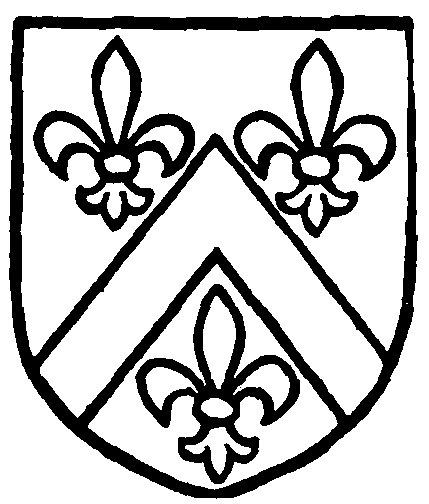
Dixwell. Argent a cheveron gules between three fleurs de lis sable.
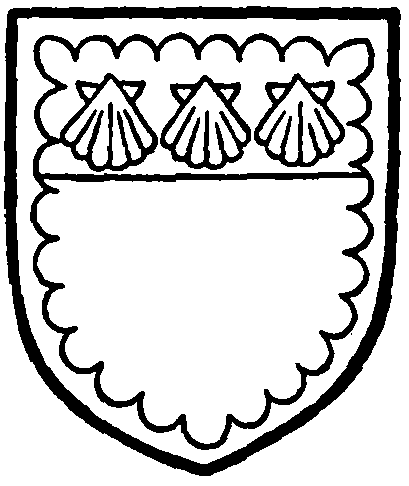
Grimes. Or a border engrailed azure on a chief sable three scallops argent.
Church
The church of THE HOLY TRINITY consists of a chancel with vestry and organchamber on the south side, nave, north and south aisles, south porch, west tower, and spire.
The south arcade, south door, and west tower are the only medieval portions of the present building; the remainder dates from 1896 when the church was rebuilt, mainly in 14th-century style, by an architect named Bassett Smith. Before this restoration it consisted of chancel with apsidal termination, nave, galleried south aisle, south porch, and west tower. There was no chancel arch, the walls of the chancel and nave being continuous; they were probably of the late 13th century. The apse and south porch were modern additions. (fn. 69)
The south arcade is of three bays, of an average width of 7 ft. 7 in. between bases. The late-13th-century octagonal pillars were originally built of a pale grey stone, but show considerable modern repairs, as do the moulded capitals and bases. The two-centred arches, of two chamfered orders, do not fit the capitals, the outer order projecting considerably to north and south of the abacus. The east and west imposts therefore take only the inner order, the outer being continuous with the respond. On each side of the arcade is a hood-mould, which above each capital is stopped on heads, those above the responds being at a slightly lower level than those above the pillars.
The doorway in the south aisle is 13th-century. It has a moulded two-centred head and in the jambs two narrow attached shafts with poorly moulded conjoined capitals; there is a hood-mould with defaced headstops. The rear-arch is modern.
The 15th-century west tower (about 10 ft. 6 in. square) is built of small coursed lias limestone rubble; at the angles are narrow diagonal buttresses of four offsets, and at the south-east angle a projecting stair-vice. Both tower and buttresses are built upon a heavy base of ashlar which has a moulded plinth. Externally there is no architectural indication of the internal divisions of the tower. The segmental-pointed tower arch is of three chamfered orders dying into the responds. The west window is of three pointed lights with chamfered jambs and mullions and pierced spandrels under a fourcentred head; the middle light is cinquefoiled; those flanking it trefoiled. The original head and tracery were of red sandstone and now show considerable modern repairs in cement. The round-headed reararch has splayed jambs in which a few pieces of masonry appear to show axe-dressing. In the second stage the north, south, and west faces of the tower have each a small square-headed window. In the third stage, the bell-chamber, there is in each of the four faces of the tower a square-headed window of two pointed trefoiled lights with blind-traceried heads. (fn. 70) The parapet is recessed slightly, but has its angles emphasized by their being flush with the wall surface; the base of the parapet is indicated by a string-course, and the top carries a simple moulding. The octagonal stone spire is devoid of architectural ornament; it has two sets of four plain rectangular lights. Both tower and steeple were restored in 1911.
On the west wall of the north aisle, but formerly on the south wall of the chancel, is a monument, (fn. 71) erected in 1641 to Charles Dixwell of Coton and Abigail his wife. Two flat panelled marble pilasters with Corinthian capitals support an architrave frieze with strapwork ornament, and a moulded cornice. Beneath this entablature the kneeling figures of Charles and Abigail Dixwell face each other with a prie-dieu between them. Below are busts of four sons and one daughter. On the west wall of the south aisle is a monument (fn. 72) to Humphrey and Ann Dixwell, their daughter Mary, and her husband Robert Price. An entablature consisting of architrave, decorated frieze, and cornice is carried on three fluted Corinthian columns and linked by emphasized keystones to two shallow semicircular-headed recesses in which are two pairs of kneeling figures, each pair face to face with a prie-dieu between them.
Below this monument and near the respond of the arcade is a much-worn slab, mutilated, but showing an incised foliated cross. Above it is a small ancient capital or corbel.
The 12th-century font (fn. 73) is a truncated inverted cone with a roll-moulding on the bottom edge, and cable ornament between two roll-mouldings on the upper edge. The base is modern, and the bowl itself shows slight modern repairs. The tall octagonal wooden font-cover is dated 1673; each panel has a formalized foliage design.
There are four bells, (fn. 74) two of 1622 by Watts, one of 1803, and one which is probably of the late 16th century.
There is a silver paten dated 1690 on the foot and an 18th-century chalice with cover.
The registers begin in 1658, but those between 1670 and 1721 are missing.
Advowson
The advowson and rectory of Churchover remained attached to the manor, as already related. The church was rated at £5 in 1291 (fn. 75) and at £15 in 1535. (fn. 76)
At Holywell the Abbey of Rocester (Staffs.) had from an early date a chapel served by one of their canons as a chantry for the souls of Robert de Cotes, Richard Fyton, and other benefactors. (fn. 77) In 1320 the sheriff seized the chapel into the king's hands because the abbot had for two months failed to have service performed there. It was, however, shown that this was only because his canon, Godfrey Spigurnel, had been robbed there; (fn. 78) and in 1325 the abbot was licensed to transfer the chantry to his conventual church, on the ground that it was situated in a solitary dangerous spot on the highway of Watling Street, frequented by robbers. (fn. 79) The endowment of the chantry included 2½ virgates in Holywell, Churchover, and Clifton, held of the heirs of Robert de Cotes; (fn. 80) but the monks seem to have parted with the land before the Dissolution.
Charities
Abigail Harcourt. By an indenture dated 3 September 1627 certain arable lands, meadows, and pasture containing ½ yard-land in the common fields of Churchover were settled upon trust that the rent should yearly at Michaelmas and Lady Day in the parish church of Churchover be bestowed to the poorest people of the parish as should seem to have most need.
The Poor's Estate. The endowment of this charity, the origin of which is unknown, consists of a piece of garden ground known as the Poor's Yard in Churchover, together with the five cottages erected thereon.
The above-mentioned charities are now regulated by a Scheme of the Charity Commissioners dated 16 August 1935, which appoints a body of trustees and directs that the yearly income shall be applied in providing coals and clothing or other necessaries to be sold at reduced prices, or distributed gratuitously, to industrious poor parishioners who are incapacitated by age or other infirmity from supporting themselves by their own labour. The annual income of the charities amounts to £59.
The Rev. William Heygate Benn by will dated 10 August 1892 bequeathed to the rector and churchwardens of Churchover £500, the interest to be laid out in the purchase of flannel blankets, coal, or bread, to be distributed annually on or near to Christmas Day among the deserving poor inhabitants of the parish. The annual income of the charity amounts to £12 10s.