
A History of the County of Warwick: Volume 6, Knightlow Hundred. Originally published by Victoria County History, London, 1951.
This free content was digitised by double rekeying. All rights reserved.
'Parishes: Dunchurch and Thurlaston', in A History of the County of Warwick: Volume 6, Knightlow Hundred, (London, 1951) pp. 78-86. British History Online https://www.british-history.ac.uk/vch/warks/vol6/pp78-86 [accessed 25 April 2024]
In this section
DUNCHURCH AND THURLASTON
Acreage: Dunchurch, 3,137 (3,641 since 1931). Thurlaston, 1,823; Total, 4,960 (now 5,464).
Population: Dunchurch, 1911, 935; 1921, 963; 1931, 1,255 (1,355 on present area). Thurlaston, 1911, 313; 1921, 285; 1931, 245. Totals: 1911, 1,248; 1921, 1,248; 1931, 1,500 (1,600 on present area).
Dunchurch, with its hamlets of Thurlaston (a separate civil parish), Cawston, and Toft, is a large village situated on the main road from London to Coventry and Birmingham, where it is crossed by that from Southam to Rugby, 3 miles south-west of the last-named town. In 1931 a portion of Dunchurch parish was transferred to Rugby, and that part of Bilton not included in Rugby merged in Dunchurch. (fn. 1)
The village is grouped round the junction of the Coventry, Daventry, and Rugby roads. Most of the houses are built of red brick with tiled roofs, dating from the 18th century, but a short distance along the Rugby road there is a small group of timber-framed houses with thatched roofs, and one of puddled clay, now plastered over. These clay-built houses have very thick walls and small windows set in deep splays. Close to the church there is a two-story timber-framed house with a projecting upper story, formerly the Lion Inn dated 1665, which has been plastered over; a row of almshouses with an inscription dated 1695, entirely rebuilt in 1818 in brick, and a red-brick building with stone dressings, now divided into two residences, formerly a Church School built in 1707. At the road junction there is a cross with a square tapered shaft with an inscription stating that it was erected in 1813 as a milestone; the steps probably belong to an earlier cross.
Dunchurch lay upon an important high road, though in 1675 the portion of this road east of the village was notoriously bad, (fn. 2) while two centuries earlier the western portion, over Dunsmore, was dangerous for other reasons. John Rous, inveighing against inclosure by greedy landlords, particularly instances Cawston, the portion of this parish north of the road—'Cawston on Dunsmore was formerly a township (villa) but now (c. 1490) is only a grange of the Abbot of Pipewell, by grant of the Earl of Warwick, and it is now a den of thieves and murderers. The monks rejoice in the profit from inclosure, but those impoverished by robbery committed by means of that inclosure grieve. The voice of the blood of men killed and mutilated cries to God. The road is perilous, and it is the high and public road between the city of London and the city of Coventry.' (fn. 3)
Licence was given in 1607–8 for a market, (fn. 4) and with its favourable position as a road centre Dunchurch might have developed into an important town; to this day milestones on the main roads give distances to Dunchurch. Rugby, however, in the Avon valley, became the centre in the railway age, and even earlier with its school and better established market had outpaced Dunchurch, though it is worth noting that Dunchurch was only about a third smaller than Rugby in 1801, and also in 1730 if the numbers of houses given in Thomas's edition of Dugdale are correct. (fn. 5) In 1332 there were in Rugby only 16 tax-payers against 35 in Dunchurch and Thurlaston. (fn. 6)
The ground slopes from 400 ft. at the church to just under 300 ft. in the valley of the small stream which forms the north-west boundary, flowing northwards round Cawston to the Avon, and 260 ft. by the Rains Brook, the south-eastern boundary.
Minor roads lead from the village northwards to Bilton and north-west to Cawston, from Bilton through Cawston to join the main Coventry road at Blue Boar Farm at the western extremity of the parish, and from the latter road Northampton Lane branches northwards near Dunchurch Station (2 miles from the village), forming a direct route from Northampton to the west, avoiding both Dunchurch and Rugby. The road from Dunchurch to Northampton was noted as being in a very bad state in 1754. (fn. 7)
Thurlaston hamlet is on a by-road a little south of the main Coventry road, which on its way across Dunsmore Heath is lined with trees, forming an avenue nearly 5 miles long.
In 1605 Sir Everard Digby called a meeting of disaffected gentry of Warwickshire at Dunchurch for 5 November, ostensibly for a hunting expedition on Dunsmore, but in reality to receive news of the success or failure of the Gunpowder Plot. (fn. 8)
Famous natives of Dunchurch include Thomas Newcombe (1627–81), king's printer to Charles II; his son (died 1691) left money to build almshouses in the village. (fn. 9) Also, probably, William Tans'ur or Tanzer (1699?–1783), psalmodist, some of whose hymn tunes are still sung; his parents were Dunchurch people, and he was baptized here (aged 6), but he may have been born at Barnes (Surrey). (fn. 10)
White mentions a farmer named Thomas Maycock who, though accidentally blinded by Rugby schoolboys, 'is extremely ingenious; has, since he lost his sight, erected several buildings, invented and made improvements in agricultural implements . . . is said to be one of the best judges of corn and cattle; and has taught reading, writing and music'. (fn. 11)
There seems to be no surviving Inclosure Award or Act, but between 1699 and 1730 the parish was inclosed 'to its great improvement'. (fn. 12) In 1266 there were at Cawston two common ovens baking for Pipewell Abbey tenants in Dunchurch, Rugby, Lawford, and Newbold, and in Ashby St. Legers, Winwick, and Elkington (Northants.), one oven baking 16 quarters weekly and the other 6, the fuel being obtained on the heath. (fn. 13) Seven parishes meet on Dunsmore Heath, which land or freeboard was common to all these parishes, (fn. 14) but was given to Thurlaston on its inclosure in 1728. (fn. 15) In 1712 there were 31 'home closes' in Thurlaston, containing 23 a. 2 r. 31 p. (fn. 16) A kiln existed on the Montagu estates in Thurlaston in 1710.
Roger Pantolf gave to Pipewell Abbey the dam of his mill-stream outside their inclosure at Potford. (fn. 17) This may have been one of the two mills held by the abbey at Cawston in 1291, (fn. 18) and in 1546 the pond called Potford Dam was among the Pipewell property granted to Thomas Boughton. (fn. 19) A windmill in Dunchurch 'on the West heathe' is mentioned in 1547, as well as a rabbit-warren and a turbary. (fn. 20)
Manors
DUNCHURCH, assessed at 5 hides in Domesday Book, had been held by Ulmar in the time of Edward the Confessor, and in 1086 was held by William from Osbern son of Richard. (fn. 21) The manor, assessed at half a knight's fee, continued to form part of the honor of Richard's Castle in the Welsh Marches, being held of William de Stuteville of that honor in 1235–6 (fn. 22) and 1242–3, when John de Dunheved was tenant. (fn. 23) In 1287 another John de Dunheved held the manor of Dunchurch of Robert de Mortimer of Richard's Castle for 1 knight's fee. (fn. 24) Eustachia, John's widow, held a messuage and 2 carucates of land of Hugh de Mortimer in 1308, (fn. 25) and in the following year the overlordship of this holding, assessed at half a knight's fee, was ordered to be delivered to Thomas de Bykenore and his wife Joan, who was Hugh de Mortimer's eldest daughter and coheiress. (fn. 26) Soon afterwards Richard's Castle passed to a branch of the Talbot family through the marriage of Richard Talbot with Joan de Mortimer as her second husband. (fn. 27) Richard's grandson John died in 1375 holding a knight's fee in Dunchurch. (fn. 28) His second son, another John, was the last male Talbot of this line, and died in possession of Dunchurch, then held by Sir Kynard de la Bere and Katherine his wife, in 1388. (fn. 29) His estates devolved on three coheiresses, and Dunchurch is not mentioned further in this connexion.
By a charter of between 1154 and 1161, confirmed in 1235, (fn. 30) Ingelram Clement granted a grange in the territorium of Bilton, now partly in Dunchurch, with other lands in the latter parish, to Pipewell Abbey (Northants.); and this monastery also obtained from Ralph son of Wigan 7½ of the 8 virgates of land in Dunchurch with which his father had been enfeoffed by Henry I, the remaining half-virgate being given to the church of Dunchurch. (fn. 31) The Abbot and Convent of Pipewell were granted free warren in their demesne lands in Dunchurch and elsewhere in 1283. (fn. 32) Their property in Dunchurch and Toft in 1291 comprised 6 carucates valued at 15s. each, rents of £2 annually, livestock worth £2, and 2s. in perquisites of court. (fn. 33) In 1316 the abbot was stated to be lord of Dunchurch and its members. (fn. 34) The possessions of this monastery in Dunchurch, including Bilton Grange and Toft, were valued in 1535 at £16 16s., plus £16 10s. for the rectory. (fn. 35) In 1557 they were reckoned as a manor and assessed at one-fortieth of a knight's fee, and were granted in chief to Sir Rowland Hill and Thomas Leigh, citizens and aldermen of London, (fn. 36) after which date they descended with the rest of Dunchurch (see below).
The part of Dunchurch not granted to Pipewell passed to Ingelram's son William Clement. He left two daughters of whom the elder, Christiane, married Avenel the Butler. They sent the younger daughter Alice to the nunnery of Ankerwick when she was 5 years old, and three years later persuaded her to say that she wished to be a nun. (fn. 37) When she came to years of discretion she repudiated her vows and left the nunnery; for which she and her supporter William de Bidun were excommunicated. (fn. 38) But a later inquiry into her case caused Pope Innocent III to annul the sentence and to approve her marriage to Alan de Wodecot. (fn. 39) In 1208 Hamo de Bidun granted her land in Warwickshire for her life; (fn. 40) and in the same year when the Abbot of Pipewell sued Hamo for the advowson of Dunchurch he called Alice to warrant it. (fn. 41) Christiane had died before this, and her son Jordan the Butler was ill in 1220 (fn. 42) and died before 1223, in which year William de Stuteville and Margaret his wife, of Richard's Castle, claimed the custody of Jordan's daughter and heir Christiane. (fn. 43) Alice having, presumably, left no surviving issue (fn. 44) the manor was held entirely by Christiane, who married John de Dunheved, (fn. 45) and, after his death, Thomas Trymenel, with whom in 1260 she granted the manor and the wardship and marriage of her son John de Dunheved to Henry de Montford for 5 years. (fn. 46) In 1300 John de Dunheved and Eustachia his wife settled two parts of the manor on themselves for their lives with contingent remainders to their sons and daughter Stephen, John, Thomas, Oliver, and Roese. (fn. 47) Stephen leased the manor to John de Somery for life and then fled the realm for a felony. (fn. 48) John the second son apparently mortgaged the manor to Sir John Pecche, whose rentcollector he murdered in 1325, (fn. 49) and granted it to Sir John and Eleanor his wife and to their heirs in 1330, to hold of the chief lords. (fn. 50) Sir John Pecche died seised of the manor, held of John Talbot of Richard's Castle, in 1386, leaving two infant daughters as coheiresses, (fn. 51) and two years later it was in the hands of Sir Kynard de la Bere, who had married Katherine, Sir John's widow. (fn. 52) Margaret Pecche, who was one day old at her father's death, married Sir William Montfort of Coleshill, to whose family the manor passed. In 1410 she, with her husband and her mother, made a settlement of the manors of Dunchurch and Toft on themselves and her heirs. (fn. 53) The manors passed to the Crown on the attainder and execution of Sir Simon Montfort for his support of Perkin Warbeck in 1495. (fn. 54) The following year the manor of Dunchurch was granted to Gerald, Earl of Kildare, and Elizabeth (St. John) his wife, (fn. 55) this grant being renewed in 1503, when free warren was granted, and Toft is also mentioned. (fn. 56) After the earl's death in 1513 his widow granted a term of years in the manors to the Prior of the Order of St. John of Jerusalem in England; she died in 1516. (fn. 57) In 1529 Sir Thomas Fitzgerald, her grandson, had licence to alienate the manors. (fn. 58) He, as 10th Earl of Kildare, and his brother James, who was concerned with Thomas Howth in a recovery of the two manors in 1532, (fn. 59) were executed for rebellion in 1537, so that the manors again fell to the Crown, Dunchurch being granted in 1541 to Sir John Williams. (fn. 60) He must have re-granted it almost immediately to Anthony Stringer of London who, in 1543, exchanged it, with lands in Bucks. and Northants., for Marlborough Priory and other monastic estates. (fn. 61) It then remained with the Crown till 1555, when it was granted to Christopher Smythe and Thomas Warton, to be held in chief as one-fortieth of a knight's fee with three other manors. (fn. 62) In the same year Smythe and Warton received licence to alienate the manor to Sir Rowland Hill and Thomas Leigh, (fn. 63) which was accomplished in 1556. (fn. 64) By a private agreement between Hill and Leigh Dunchurch was reserved to the latter and his descendants. (fn. 65) In 1575 Alice Leigh, widow of Thomas, who had been knighted and was Lord Mayor of London in 1558–9, (fn. 66) was dealing with Dunchurch, Thurlaston, and Long Lawford manors. (fn. 67) Her younger son Sir William and his wife Frances (Harington) and son Francis conveyed the two first-named manors, and that of Toft, to Sir Thomas Egerton, Lord Keeper of the Great Seal and Francis's father-in-law, and Edward Mountague, in 1597, (fn. 68) probably for a settlement on Francis's marriage. Further transfers by fine occurred between these families in 1601, (fn. 69) 1605, (fn. 70) and 1609. (fn. 71) In 1620–1 Sir Francis Leigh obtained the right to hold a yearly court leet. (fn. 72) Sir Francis Leigh's son Francis was created Baron Dunsmore in 1628 (fn. 73) and was lord of the manor when Dugdale wrote (1640), but died without male issue in 1653. His daughter Elizabeth married Thomas Wriothesley, Earl of Southampton, (fn. 74) and their daughter, another Elizabeth, inherited the manors of Dunchurch, Thurlaston, and Toft, and married Jocelin, Lord Percy, who became Earl of Northumberland in 1668. (fn. 75) After his death without issue in 1670 she married Ralph, 1st Duke of Montagu, with whom she was dealing with the manors in 1673. (fn. 76) The lordship continued with the Dukes of Montagu till the extinction of the dukedom in 1790, when it passed by marriage to the Dukes of Buccleuch and Queensberry. Charles William, 4th duke, was vouchee in a recovery of 1811, (fn. 77) and in 1850 Lord John Scott, probably the second son of the 5th duke, was lord of the manor, (fn. 78) which still belongs to the Duke of Buccleuch.
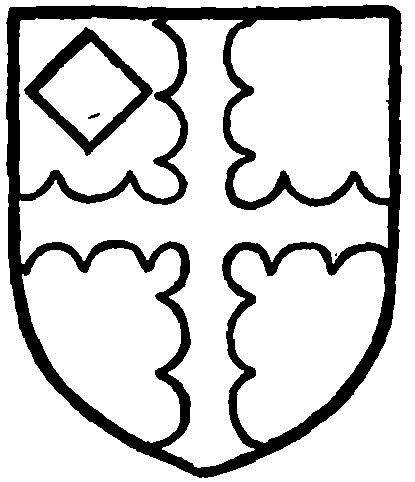
Leigh. Gules a cross engrailed and in the first quarter a lozenge argent.
In 1701 a survey of Dunchurch made for the duke showed his estate as 21 yardlands, or 1,560 acres, of which the church lands accounted for 2 acres and glebe for 26 more. The duke as lord of the manor held 743 of the 1,252 acres in the common fields at that date, and 19 of the 21 cottages which had rights of common. Nine years later he was holding courts leet and baron in both Dunchurch and Thurlaston and had right of free fishery in the latter manor; his rents at this date amounted to £573 16s. 4d. from Dunchurch, £327 17s. 11d. (including £70 for the tithes) from Thurlaston, and £265 5s. 6d. from Toft. The rentals from the two latter manors remained roughly constant during the 18th century, but by 1779 the value of Dunchurch, where there were then 80 tenancies, had risen to £790 16s. including £3 1s. 6d. from the herbage of the great roads within the manor of Dunchurch. In 1771 the three manors, with the duke's other Warwickshire estates, were mortgaged to Morris Robinson for £23,164. (fn. 79)
The hamlet of TOFT contained two estates which in the 15th century were reckoned as manors. One, first mentioned in 1410, (fn. 80) descended with the main manor of Dunchurch, and is not always separately referred to. The other was conveyed in 1464 by John Burghton of Burghton (Staffs.) to Humphrey Swinnarton and John Horeway, priest. (fn. 81) In 1472 these two settled it on Swinnarton's son-in-law and daughter, Humphrey and Elizabeth Hill of Blore (Staffs.), and their heirs. (fn. 82) Humphrey Hill of Buntingsdale (Salop), probably their grandson, conveyed it in 1527 to John 'Letteley' of Dunchurch, (fn. 83) who was apparently already tenant in 1519. (fn. 84) John 'Litley' and Elizabeth his wife in 1564 granted it to John Fawkes. (fn. 85) Another John Fawkes, probably his grandson, was dealing with it in 1657, (fn. 86) as were Marmaduke and William Fawkes in 1674. (fn. 87) William Fawkes, grandson of the mid-17th-century John Fawkes, was lord in 1730, (fn. 88) after which date this manor is not separately mentioned.
CAWSTON, which had been held by Edwin in the time of Edward the Confessor, was in 1086 in possession of Turchil of Warwick, of whom Almar held 1½ hides and Ulf 1 hide. (fn. 89) In the next century the overlordship was with the Earl of Warwick, who with Henry de Ardern, Turchil's grandson, confirmed the gift of Ingelram Clement and William his son of all the land they held in Cawston to the abbey of Pipewell, as stated in a charter of Henry II, confirmed in 1235. (fn. 90) In 1201 Margaret de Hondesacr' granted half a knight's fee here to Pipewell. (fn. 91) In 1266 the men of Thurlaston tried to obtain common pasture on Cawston Heath by force, but Gerard the abbot 'stood against the whole town of Thurlaston like a wall', and obtained a verdict favourable to Pipewell in an assize of novel disseisin. (fn. 92) In the reign of Edward I there were disputes between Monks Kirby Priory and Pipewell as to the ownership of the grange or manor of Cawston, the former obtaining it 'by fraudulent claims', but after a suit before the king the monks of Pipewell recovered it on payment of 200 marks to Monks Kirby, the agreement being embodied in a fine of 1278. (fn. 93) In 1291 the Abbot of Pipewell held 6 carucates worth 15s. each, 2 mills together worth 13s. 4d. and stock valued at £2 10s. (fn. 94) Cawston continued in monastic ownership up to the Reformation, the Pipewell property here being valued at £36 6s. 8d. in 1535, (fn. 95) and was granted in 1546 to Thomas Boughton for £678 and an undertaking to pay for the woodlands as they should be appraised on survey. (fn. 96) At this time there were six tenants on the estate. Boughton died in possession in 1558, (fn. 97) and his eldest son, another Thomas, two years later, when his brother Edward was still a minor. (fn. 98) This latter married Susanna, daughter of Sir John Brocket, (fn. 99) and according to Dugdale enjoyed the favour of the Earl of Leicester. With materials from the church of the White Friars in Coventry he 'raised here (at Cawston) the most beautifull Fabrick that then was in all these parts'. (fn. 100) He died in 1589; (fn. 101) his widow, on whom the manor was settled for life, married George Darrell and survived till 1626, (fn. 102) outliving her son Henry. Henry's son Edward was vouchee in a recovery of 1638, (fn. 103) and his younger son William had the manor by 1655, when he owed several years' rates but was 'a man so desperate and ill-conditioned that no one dares distrain him'; (fn. 104) he continued to ignore or threaten the collectors (fn. 105) until he died without issue in 1663. His nephew Francis (died 1707) founded and endowed a school in Dunchurch, and devised the manor to his kinsman Edward Boughton, a younger member of the Lawford branch of the family, who was high sheriff in 1712 and lord of the manor in 1730. (fn. 106) His son Francis apparently died without issue, the manor being split into five parts among his sisters as coheiresses, John, Duke of Montagu, in 1744 obtaining a fifth share from Thomas Harris and his wife. (fn. 107) After this date the manor is not separately mentioned and probably descended with Dunchurch.
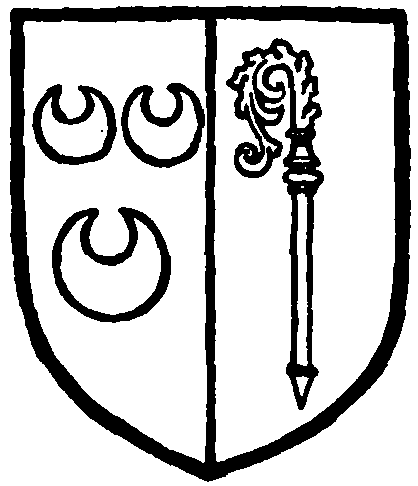
Pipewell Abbey. Party argent three crescents gules and azure a crozier erect or.
THURLASTON, which had been a 5-hide vill, was in 1086 divided into two parts, 2½ hides (held freely before 1066 by Wlgar) being then held by the Count of Meulan, (fn. 108) and 2½ (formerly held by Baldeuin) were held by Hubert of Hugh de Grantemesnil. (fn. 109) The Count of Meulan's Warwickshire estates mostly passed to the Earls of Warwick, of whom one fee was held in Thurlaston in 1235–6 and 1242–3, (fn. 110) and again in 1316. (fn. 111) The Earl of Warwick was stated to be lord in 1372, (fn. 112) and again of a knight's fee in 1401. (fn. 113)
The subtenant in 1235–6 was William le Franseiz, (fn. 114) and in 1242–3 John de Thurlaweston, who held of Roese de Verdon. (fn. 115) Theobald de Verdon was in possession in 1316, (fn. 116) his subtenants in the following year being Simon son of Margery and John de Derset. (fn. 117) In 1337 the fee was held by Hugh Daunsere of Theobald de Verdon the younger. (fn. 118) Theobald's widow held it in dower in 1360, when there were several tenants and the reversion was to Thomas de Furnivall, (fn. 119) whose mother was daughter and coheiress of Theobald by his former wife. (fn. 120) At the death of William de Furnivall in 1383 the fee was stated to have been formerly held by John Derset, (fn. 121) but though the Talbot Earls of Shrewsbury came into possession of the Furnivall estates through female lines they do not appear to have maintained this mesne lordship in Thurlaston. (fn. 122) The Dersets (later Dorsets) continued to hold the manor; William Derset of Thurlaston was a justice of the peace in 1434, (fn. 123) and in 1528 William Dorset made a conveyance of the manor. (fn. 124) In 1533 he and his wife Margaret settled it on trustees, (fn. 125) including Edward Cave of Winwick (Northants.), whose daughter and coheiress Mary married Thomas Boughton, (fn. 126) lord of Cawston. Their son Edward Boughton ran into debt over his great house at Cawston (q.v.), and on his death in 1589 his Thurlaston estate was sold to meet his creditors. (fn. 127) It was probably bought by the Leighs of Dunchurch, and descended with that manor, the Duke of Montagu being lord of both in 1730, (fn. 128) about which time he owned 1,307 acres in Thurlaston, with 20 tenants. (fn. 129)
The estates of Hugh de Grantemesnil passed to the Earls of Leicester, (fn. 130) but as there is no record of this earldom in connexion with Thurlaston Dugdale is probably right in identifying the Grantemesnil portion with that of which Wigan the Marshal was enfeoffed by Henry I, and of which a quarter of a knight's fee was held of Ralph, Wigan's son, by Roger de Torlavestone de novo feffamento in 1166. (fn. 131) Ralph son of Wigan held I ploughland (waignagium i caruce) in Thurlaston in 1198, (fn. 132) and Stephen de Segrave 10 virgates in 1226–8, (fn. 133) of William de Cantilupe, who had been enfeoffed of the Marshal property by William, Ralph's son. (fn. 134) In 1232 Stephen was stated to hold these 10 virgates by serjeanty of the king, of the fee of Willoughby, (fn. 135) having been granted them by William son of William de Cantilupe in 1228. (fn. 136) This manor continued with the Segrave family for over a century, (fn. 137) and at the death of John, the last male Segrave, in 1353 (fn. 138) passed, through his daughter Elizabeth, to her second husband Sir Walter Mauny, who held it of the Earl of Warwick at his death in 1372. (fn. 139) His daughter Anne, Countess of Pembroke, was his heir, but the manor was held to pass to Thomas Mowbray, 1st Duke of Norfolk, Elizabeth Segrave's son by her first husband. (fn. 140) He was banished and died in exile in 1399, when his son Thomas was a minor. (fn. 141) Thomas Derby (fn. 142) and Thomas de Rempston (fn. 143) were successively appointed stewards and receivers of the ducal manors in the hands of the Crown. Thomas, 1st Duke, granted an annuity to his esquire John Wilcotes, including £5 from the issues of the manor of Thurlaston. (fn. 144) After the death of the last Mowbray Duke of Norfolk in 1477, (fn. 145) it passed to the Lords Berkeley, who were descended through Isabel, daughter of the 1st Duke, who married James, Lord Berkeley (1424). (fn. 146) Sir Maurice Berkeley, grandson of James, had licence of entry to his estates without proof of age in 1507, (fn. 147) and by his will dated 1 May 1520 left a life interest in Thurlaston, held of 'the heir of Cantelow', to his widow Katherine, with remainder to his brother Sir Thomas Berkeley; he died in 1523. (fn. 148) Sir Thomas's son, another Thomas, died in 1534; (fn. 149) his posthumous son Henry and his wife Katherine granted the manor, with view of frankpledge in Dunchurch, to Alice widow of Sir Thomas Leigh, lord of Dunchurch manor, in 1572, (fn. 150) from which date this manor has descended with Dunchurch.
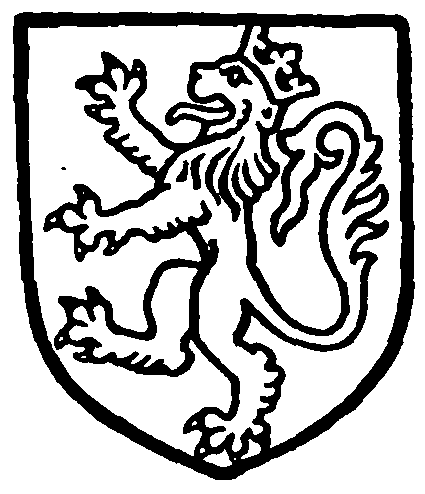
Segrave. Sable a lion argent crowned or.
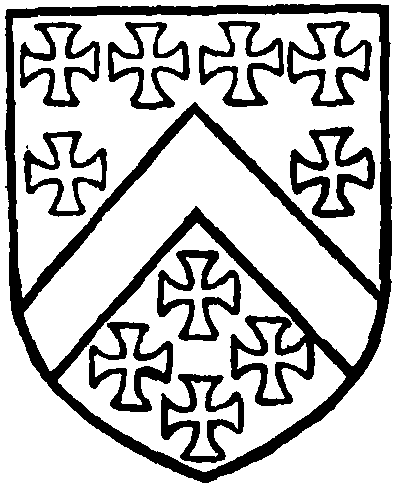
Berkeley. Gules a cheveron and ten crosslets formy argent.
Much property in Thurlaston, of which the total value in 1535 was £5 14s. 1d., (fn. 151) was at various times granted to Pipewell Abbey. Ellen, widow of Richard de Turlaveston, conveyed her dower of 1 virgate and a third part of 16 acres in 1199, (fn. 152) and at the same time William son of Stephen conveyed the 'common of pasture of Thurlaston where the granges of the abbot are set'. (fn. 153) Nine further grants, including one from Ralph son of Wigan and totalling about 8 virgates, were confirmed in 1235. (fn. 154) The monastic estate in 1291 was reckoned at 4 carucates in demesne worth 12s. each, and rents of £1 10s. (fn. 155)
Immediately after the Dissolution Christopher Seyntgerman, cousin of William Boughton of Lawford (whose son Thomas was to receive the Cawston portion of the Pipewell estates) wrote (July 1539) to Cromwell suggesting that William Boughton's wife should have 'the £3 15s. land in Thurluston' for life, with remainder to her son, (fn. 156) but this recommendation seems not to have been carried out and the Thurlaston property of the abbey stayed in Crown hands till 1557, when it was granted to Sir Rowland Hill and Thomas Leigh, (fn. 157) subsequently following Dunchurch.
Lands in Thurlaston Fields, formerly belonging to Coventry Priory and in 1570 in the occupation of William Olney, were in that year granted to Nicholas Yetsweirt and Bartholomew Brokesby. (fn. 158)
The division of Thurlaston between the abbots of Pipewell and lay lords is reflected in the following note on an early-18th-century survey: 'The meadows are divided into pieces called Hides, each [of] 20 equal parts called Poles, the Hides are called Abbot's Hide and Lord's Hide, which fall interchangeably throughout the Meadows, but the Inequality of the lengths of the Hides has occasioned the Changeing of them, one year begining with Abbot's Hide and the next with Lord's Hide, and each Proprietor keeps the same number of Poles in the same Hides, which varies the Contents.' (fn. 159)
Church
The church of ST. PETER is situated on the north side of the Coventry—Daventry road, in the centre of the village, and stands in a large churchyard. It consists of a chancel, nave, north and south aisles, north chancel aisle, west tower, and vestry. It was almost entirely rebuilt late in the 14th century and the tower added probably early in the 15th century. Little is left of the earlier church other than the south wall of the chancel, the bases of the arcade pillars and the piscinas, all of 13th-century date, together with the north door, of the early 14th century, all re-used in the rebuilding. A modern aisle has been added on the north side of the chancel and the south porch destroyed and replaced by a modern vestry. In addition there is the damaged basin of a 12th-century font lying in the nave, and four carved-oak traceried panels in the modern priests' stalls, one bearing the arms of the Isle of Man, (fn. 160) probably early-15th-century. The whole church was extensively restored in 1908. The earlier south wall of the chancel is built of roughly coursed limestone rubble with red sandstone dressings, all the later work being carried out with red sandstone ashlar. The roofs are all modern, of steep pitch covered with tiles, separate roofs replacing one of a lower pitch which roofed the nave and aisles in one span.
The east wall of the chancel has been refaced with red sandstone ashlar, the gable and diagonal buttresses rebuilt. It is lighted by a modern pointed traceried window of three trefoil lights with a moulded panel below each light and a hood-mould having head-stops. On the south there is a 13th-century buttress in the centre, with a rectangular low-side window of one splay, and, to the east, a pointed late-14th-century much restored window of two trefoil lights with hoodmould. The chancel walls were raised and finished with a moulded eaves-course during the 14th-century rebuilding to correspond with the newly built aisles.
The south aisle, which has a plinth of two splays and a string-course at sill level, is divided into three bays by buttresses which terminate at the moulded eaves-course. The two bays to the east have pointed traceried windows of three trefoil lights with hoodmoulds, the tracery and mullions cemented over, and a similar window in the east wall. In the west bay a modern vestry of red sandstone ashlar has been built, with a pointed doorway on the west, and lighted on the south by a pointed traceried window of two trefoil lights. The west side is lighted by a small circular quatrefoil light placed high up in the wall. The north aisle is also divided into three bays; the two eastern have pointed traceried windows of two splays, each with two trefoil lights, hood-moulds, and a stringcourse at sill level, the tracery cemented over. In the west bay there is a doorway with a moulded pointed arch of three wave-moulded orders carried down the jambs without capitals. The west side has a modern pointed traceried window of two trefoil lights with a hood-mould.
In building the modern aisle to the chancel some of the old work taken from the chancel and the east end of the aisle was re-used, e.g. the window and diagonal buttress from the east wall of the aisle in a similar position in the new aisle, the north door, a two-light traceried window, buttress, low-side window, and moulded eaves-course, but not all in their corresponding positions; the low-side window has been put towards the eastern end instead of the west and at a higher level. The early-14th-century door, rebuilt in its normal position, has a moulded segmental-pointed arch with the mouldings continued down the jambs to splayed stops.
The stonework of the tower is badly decayed and much of the detail has been lost. The tower, which is divided into three stages by string-courses, has diagonal buttresses in six stages at each of its angles, those on the west with carved grotesque beasts projecting from the upper stage. It has a moulded plinth and is finished with a battlemented parapet resting on a hollowmoulded string-course with carved grotesque animals at intervals and at each corner. Immediately below the string is a band of square quatrefoil and traceried panels carried right round the tower. On the west side there is a doorway with a moulded pointed arch of three orders, the centre one has five moulded foils on each side with a trefoil at the apex. All details of the jambs have been lost but it is probable that the cusped order was supported on capitals and shafts. There is an outer band to the arch of trefoiled panels with square quatrefoil panels between, and a hood-mould with traces of stops. Above is a restored window of three cinquefoil lights with tracery; the pointed arch has an outer band of panels similar to those round the door, the reveals and the soffit of the arch panelled with trefoil-headed panels, and a hood-mould formed by the string-course; the window-sill is splayed; at the apex of the arch are the remains of a canopy, its niche filled in. In the second stage there are windows of two trefoil lights with square heads and hood-moulds. The belfry windows are arranged in pairs on the west and south faces, and single on the north and east. They are deeply recessed, with pointed arches, of two trefoil lights and quatrefoil piercings, panelled below the sills, on the west side with square quatrefoil panels over trefoiled panels, on the three remaining sides the quatrefoils are omitted, the sills resting on the trefoiled panels; they all have hood-moulds with traces of stops, and on the north and east carved heads in the centre of the jambs. On the south side there is a stair-turret in the junction of the tower with its eastern diagonal buttress, and it is carried up to form a battlemented turret. It has two loop-lights in the lower stage and two in the second, and string-courses, one in the first stage and two in the second. Over the north light of the belfry window, on the west side, there is a quatrefoil opening in the band of quatrefoil panels with a trefoil canopy and the base of a pinnacle. The upper stage has been patched with light-coloured stone and the parapet is a modern restoration.
The chancel (31 ft. 4 in. by 16 ft. 11 in.) has a wood-block floor to the altar with three steps, the rest paved with light and dark lozenge-shaped stone paving. On the south towards the east there is a double piscina, with cross divisions to the basins, in a modern trefoilheaded recess, with a hood-mould. The traceried window has a pointed rear-arch with hood-mould and wide splayed jambs; the low-side window has a moulded segmental-pointed rear-arch, the mouldings dying out on splayed jambs. On the north side close to the east wall there is a small modern recess with a moulded wood frame and label moulding. The modern arcade has two bays of moulded pointed arches of two orders, decorated with paterae, supported on a pier of six half-shafts, with moulded capitals and bases, the responds being formed of half-piers.
The nave (45 ft. 2 in. by 16 ft. 8 in.) has plastered walls and an open queen-post roof with curved struts on moulded corbels. The south arcade consists of three bays of pointed arches of two splayed orders, resting on rather slender octagonal pillars with moulded capitals, the top member battlemented and, to the east pillar only, ball-flowers in the hollow moulding. Their bases rest without mouldings on square 13th-century bases with stopped splayed corners for pillars of a larger diameter. At the east end the arch splays are continued as a respond without capitals and finish on a mutilated 13th-century base; the western arch is supported on a mutilated carved corbel. The north arcade is similar, except that the battlements and ball-flowers have been omitted from the capitals and the pillars made 2 ft. shorter. The chancel arch is pointed, of two splayed orders, the inner supported on carved corbels formed by cutting away the responds and carving the stone below the capitals. At the junction of the arcade with the chancel there are carved heads on either side, probably the stops of a destroyed hood-mould to the arcade arches. The pointed tower arch is very lofty, of two splays to the nave and four to the tower, supported on half-octagon responds with moulded capitals, the responds decorated on the nave side with a series of trefoil-headed panels, all made out with cement, but probably roughly following the original. On the south side of the arch there is a narrow doorway with a moulded pointed arch to the tower staircase.
The pulpit is a modern one of stone, octagonal, trefoiled panels on each face, on an octagonal stem.
The south aisle (40 ft. 4 in. by 14 ft. 8 in.) has a flat ceiling of wood panels under a steep-pitched roof. The windows have stop-chamfered pointed reararches to splayed recesses. A string-course at the level of the window-sills has been cut away except to the sills. At the east end of the south wall there is a muchmutilated piscina with a fluted basin, with a trefoil ogee head and traces of a hood-mould. This end of the arcade is now used as a chapel. The doorway to the vestry is modern with a segmental head.
The north aisle (40 ft. 6 in. by 11 ft. 10 in.) has a ceiling similar to the south aisle. The windows have segmental-pointed rear-arches with wide splayed reveals, hood-moulds with defaced stops, and a stringcourse at sill level. The doorway has a modern reararch similar to the vestry. At the eastern end of the south wall there are two square aumbries, which once had doors with locks. Against the east respond of the arcade is a mutilated piscina with a trefoiled head and an hexagonal basin, probably left in its original position when the church was rebuilt. The east wall of the aisle has been removed for a modern arch giving access to the modern chancel aisle. Parts of the reveals and rear-arches to the windows and door are originals re-used. The eastern end is occupied by the organ, obscuring the east window. It has an open steeppitched roof and a wood-block floor. Under the arch from the aisle there is an early-17th-century carved oak chest with a panelled lid. Over the north door there is a marble wall-memorial to Thomas Newcomb, 'servant of his Late Majesty King Charles II in the Printing Office', who died 1681.
The tower (11 ft. 10 in. by 11 ft. 6 in.) is paved with light and dark stone paving, the walls are rendered with cement with scratched masonry joints. The angles of the west wall have been splayed and panelled in cement to match the tower arch, the window and door recesses and the soffits of the arches are also panelled in cement, probably roughly following the original work. The ceiling is a modern plaster vaulting springing from moulded plaster corbels. The font, which stands in the centre of the tower, is an octagonal stone one dated 1848, with trefoiled panels on each face. On the north wall there is a V-shaped framed wooden panel with the following painted inscription:
Here lyeth ye body of Margarit Hixon, Daughter to Thomas Manley, of Manley in ye County of Chester Esq. & wife to Thomas Hixon of Greenwch in ye County of Kent Esq. who lyeth there intomed wth the inscription of these titles on his Monument Mr of Arts Oxon. souldier under Henry ye 4th, King of France, Gentleman of the Bedchamber to Queen Elizabeth, Yeoman of ye removing Wardrop, keeper of the Standing Wardrop & privy Lodgings at Greenwch to Queen Elizabeth and King James, by which husband, Thomas Hixon shee had 5 sonnes, viz. Robert, Humphrey, Thomas, John & William: also 3 Daughters, viz. Elizabeth, Margarit & Katherine. Shee departed ys life 21 April an[n]o 1632.
At the top of this inscription there is a coat of arms with crests on either side, left Hixon, right Manley.
The plate consists of a silver flagon, two silver chalices, and two silver patens.
There are five bells by Joseph Smith, 1724, and one by John Briant, 1792. (fn. 161)
The registers begin 1538. The earlier entries were transcribed in 1662 by Simon Hawkhurst, B.D. (fn. 162)
Advowson
There was a priest at Dunchurch in 1086. (fn. 163) The church was appropriated to Pipewell Abbey by Bishop Richard Peche in the reign of Henry II, (fn. 164) and the vicarage endowed by Bishop Stavensby in 1229, when £10 yearly was reserved to be paid to the Cathedral of Lichfield. (fn. 165) In 1247 the advowson was granted by John de Dunheved and Christian his wife to the Abbot of Pipewell, the concord being made in the presence of Roger (Weseham), Bishop of Chester, and the dean and chapter of Lichfield, who acknowledged that they had no right to the advowson. (fn. 166) Presentations were, however, made by the Bishops of Chester, Coventry, and Lichfield from 1329 onwards, (fn. 167) and the advowson has ever since remained in the hands of the diocesan bishop.
The value of the church in 1291 was £10, plus the £10 payable to the dean and chapter of Lichfield (see above); (fn. 168) in 1535 the vicarage was worth £14 1s. 10d., plus 8s. for procurations and synodals, (fn. 169) and the rectory was farmed at £16 10s., (fn. 170) out of which the £10 was still payable to Lichfield. (fn. 171)
In 1360 Bishop Stretton of Lichfield granted licence for 2 years to the inhabitants of Thurlaston, at the instance of William de Petton, that divine service should be celebrated in the chapel there. (fn. 172) This chapel is not mentioned in the Taxatio or the Valor, but according to Dugdale it existed till about 1562, when it was pulled down by Lord Berkeley's officers. (fn. 173)
Charities
Thomas Newcombe, by will dated 2 March 1690, gave to trustees £600 upon trust to purchase some ground as near to the church and to the open street of Dunchurch as they could, and thereupon to build six almshouses for as many poor men or widows being born in and inhabitants of the parish; and he desired that the rest of the money after finishing the almshouses should be laid out in the purchase of land, and the rents and profits thereof be yearly divided among the said almspeople equally.
John Spier, by will dated 30 March 1618, gave to his executors £100 to be set forth upon good security to the use of the poor of the parishes of Dunchurch and Newbold.
The above-mentioned charities are regulated by schemes of the Charity Commissioners dated 8 September 1911 and 9 March 1934. The annual income amounts to £64 9s. 4d.
Church Land. By the award under the Dunchurch Inclosure Act, 1709, 2½ acres of land were awarded to the churchwardens, and the income used to be carried to the general account of the church rates. The land was sold in 1930 and the proceeds of sale invested. The annual income of the charity amounts to £17 11s. 4d.
Poor's Land. By the same award 20 acres of land were awarded to this parish.
The charity is regulated by schemes of the Charity Commissioners dated 22 November 1861 and 31 July 1934. The scheme of 1861 appoints trustees to administer the charity and directs that the yearly income of the charity, which amounts to £190 approximately, shall be applied either in gifts of coal or in the purchase of coals to be re-sold by the trustees at a reduced price to deserving poor persons resident in the parish.
William Smith. This parish participates in the charity of William Smith and receives 4s. per annum which, in accordance with the terms of the bequest, is required to be distributed in bread to the poorest people of the parish. For particulars of the charity see under parish of Bilton.
William Fawkes. It is stated in an old will-book that William Fawkes gave 40s. to be distributed on St. Thomas's day to such poor men and women of this parish as the minister and churchwardens should think fit; and a note adds that the payment was charged on lands in Grandborough.
Church Land (Thurlaston). By an award dated 20 April 1728 it was determined that a plot of land containing 8 a. o r. 24 p. laid out in lieu of the Church Land and the tithes yearly issuing thereupon and the rents and profits should be employed for the same purposes as the Church Land was theretofore used. The land was sold in 1891 and the proceeds of sale invested. The income thereon, amounting to £15 12s. 4d., is remitted to the vicar and churchwardens of Dunchurch, the trustees of the charity, for the purposes of the trusts.
Poor's Land. By the same award it was determined that a plot of land containing 43 acres and all tithes issuing thereupon and the rents and profits thereof should be employed as the churchwardens and overseers of the poor should think proper, for providing fuel in winter for the poor of the town of Thurlaston; and the said poor inhabitants were to have free liberty to cut bushes from the land as often as they should have occasion for the same.
The charity is now regulated by a scheme of the Charity Commissioners dated 13 January 1865. The annual income of the charity amounts to £65 approximately.
Dunchurch and Thurlaston Branch of the National Federation of Women's Institutes. By an indenture dated 29 July 1925 the Rt. Hon. Samuel James, Baron Waring, conveyed to trustees the village hall and two cottages and other property in Dunchurch upon trust for the purposes of an institution to be so known.