
A History of the County of Warwick: Volume 6, Knightlow Hundred. Originally published by Victoria County History, London, 1951.
This free content was digitised by double rekeying. All rights reserved.
'Parishes: Ladbroke', in A History of the County of Warwick: Volume 6, Knightlow Hundred, (London, 1951) pp. 143-147. British History Online https://www.british-history.ac.uk/vch/warks/vol6/pp143-147 [accessed 20 April 2024]
In this section
LADBROKE (fn. 1)
Acreage: 1,975.
Population: 1911, 162; 1921, 169; 1931, 164.
The western boundary of the parish is formed by the River Itchen, and the northern, for a short distance, by a small stream that joins that river after flowing through the grounds of Ladbroke Hall and then for a little over a mile in a north-westerly direction. Ladbroke Hall, with its well-timbered park and two large ponds, lies to the south of the village, which is mostly grouped round a road running north from Banbury to Southam and a smaller road leading westwards to Harbury, crossing the Itchen by Deppers (formerly Defford, or 'deep ford') bridge. The village spreads along both sides of the main road with a group of houses at the western end, of the 17th and 18th centuries, built both of stone and half-timber, mostly with thatched roofs. One on the west side of the road is part of a 16th-century building, with alternate courses of limestone and sandstone similar to the masonry employed in the construction of the church tower A few timberframed cottages remain among the 18th-and 19th-century houses built of red brick with tiled roofs which make up the bulk of the village buildings. From the village, which lies at a height of 300 ft., the ground rises gently to the south and rather more rapidly to the east, where heights of over 400 ft. are reached at Lady Hill and Windmill Hill. Early in the 13th century Henry son of William Boscher gave to the monks of Combe Abbey land on Heidune for building a new mill, and a little later John de Lodbroke gave 3 acres 'below the mill', this being evidently a windmill. (fn. 2) Although a water-mill worth 3s. existed on Hugh de Grentemaisnil's estate in 1086, (fn. 3) the only later references to such a mill seem to be in about 1263 (fn. 4) and in 1316, when William le Vynter of Coventry and Joan his wife conveyed a mill and 2 carucates of land in Ladbroke to John and Alice de Langeleye. (fn. 5)
Most of the parish appears to have been inclosed and divided up by the end of the 16th century, as shown by a detailed agreement about rights of pasture made in 1603 between Sir Robert Dudley, who had just bought the manor, and his freeholders. (fn. 6) The demesnes at this time amounted to 33 yardlands, or rather over 1,000 acres, while the 18 freeholders had 13 yardlands, of which Thomas Thornton had 5 (containing 200 acres) and a messuage, which was probably the nucleus of the present Ladbroke Hall. Some 30 years later Sir Robert Dudley was said to have put 16 houses and 500 acres of arable in Ladbroke out of use, William Burton another 60 acres, and Ralph Garrett 16 acres. (fn. 7)
In the south-east corner of the parish is a small earthwork, of which the age and purpose are unknown, though the most likely explanation is that it is a ditch or moat surrounding a medieval dwelling. (fn. 8)
Manors
In 998 King Ethelred gave to the ealdorman Leofwine (father of the famous Leofric of Mercia) lands in Southam, Ladbroke, and Radbourn. (fn. 9) By 1086 Ladbroke had been split up into a number of estates. Of these the Count of Meulan held 2 hides, which William held of him; (fn. 10) Hugh de Grentemaisnil held 3 virgates; (fn. 11) and Turchil had four estates, the largest of which, 2 hides, 1 virgate, was held of him by William; another 3 virgates, of which the pre-conquest tenant was Hereward, were held of Turchil by Gilbert, 1 virgate by a priest, and 1½ hides in Ladbroke and Radbourn by Almar. (fn. 12) The count's estate descended to the Earls of Leicester, of whom Robert II married Pernell, heiress of Grentemaisnil. One of their two daughters and eventual co-heirs married Saier de Quincy, Earl of Winchester, whose son Roger died in 1264 seised of the manor of LADBROKE. (fn. 13) On the division of the Winchester fees this passed to Earl Roger's daughter Margaret, who had married William de Ferrers, Earl of Derby, and the overlordship descended in the line of Ferrers of Groby, (fn. 14) ranking as a quarter-fee in 1344 and as a half-fee at the death of Edward Grey, Lord Ferrers in right of his wife, in 1456, (fn. 15) the last occasion on which the overlordship is mentioned.
The overlordship of Turchil's estates came to the Earls of Warwick. In 1207 Alice, widow of Earl Waleran, recovered from his son Henry dower which included the service of 1 knight's fee in Ladbroke held by John de Lodbroke. (fn. 16) When John du Plessis, who was Earl of Warwick in right of his wife, died in 1263 his son by a previous wife, Hugh, tried to occupy the manor but was promptly ejected by the new earl, William Mauduit, (fn. 17) who died seised of the fee in 1268. (fn. 18) The Lodbrokes therefore held of two overlords, and in a list of knight's fees of Thomas, Earl of Warwick, drawn up about 1320 it is noted that 'John de Lodbroke holds 1 fee; but he holds his chief messuage and all his land of the fee of Winchester, and all his tenants hold of the fee of Warwick.' (fn. 19)
The suggestion made by Dugdale (fn. 20) that the Domesday tenant William may have been the ancestor of the eponymous family (fn. 21) who held the manor for some two centuries is not correct. In the course of a dispute between the earls of Winchester and Warwick in 1262 over the guardianship of John son and heir of Henry de Lodbroke the jury stated that Robert le Bossu, Earl of Leicester (died 1168), gave the half-fee to Henry's ancestor Mauger, 'before he had any other land in England'. (fn. 22) Mauger seems to have been succeeded by his brother (fn. 23) William de Lodbroke, who was holding a knight's fee of the Earl of Warwick in 1166, (fn. 24) as did his grandson John in 1207 (fn. 25) and in 1235. (fn. 26) By 1242 John had been succeeded by his son Henry, who died between 1254 (fn. 27) and 1257, in which year his widow is mentioned. (fn. 28) His son John was under age (fn. 29) and between 1260 and 1262 the custody of his person and of the messuage land and mill which he held in Ladbroke was disputed, as already mentioned, between the two earls who were his overlords. (fn. 30) Sir John de Lodbroke seems to have lived until about 1310, (fn. 31) being followed by his son Sir Henry, who held the manor in 1316 (fn. 32) and 1329. (fn. 33) His son Sir John de Lodbroke held the quarter-fee of Henry, Lord Ferrers, in 1344 (fn. 34) and released his rights in the manor of Ladbroke to William Catesby in 1349. (fn. 35) The exact significance of this is not clear, as in 1371 Thomas de Lodbroke, Sir John's eldest son, was holding of Sir William Ferrers certain tenements here and the advowson of the church. (fn. 36) It seems probable that Sir John had made a settlement of the manor in tail male on his son Thomas, with contingent remainder to Sir William Catesby, whose daughter Alice Thomas married. (fn. 37) When Sir John died, a very old man, in 1385 his heir was his daughter (by a second wife) Alice, then aged 30 and wife of Lewis Cardigan alias Cook, (fn. 38) and she and her husband disputed the manor with John son and heir of William Catesby. It was ultimately awarded to the latter, who was tenant of the Ferrers fee in 1387 and 1393. (fn. 39) His son William did homage for the manor to the Earl of Warwick in 1404–5 and died about three years later, being succeeded by his brother John. (fn. 40) He in conjunction with his mother Emma had a grant of free warren at Ladbroke in 1412. (fn. 41) His grandson William was a strong supporter of Richard III and was executed and attainted in 1485, and the manor of Ladbroke was seized into the king's hands and granted in 1488 to Sir John Risley in tail male. (fn. 42) In 1495, however, the attainder was reversed and on the death of Sir John Risley without male issue in 1512 the manor, with its court leet, was restored to Catesby's grandson William, (fn. 43) who died seised thereof in 1517, his heir being his brother Richard, then aged 11. (fn. 44) It descended to Robert Catesby, afterwards one of the conspirators in the Gunpowder Plot, and he sold it in 1597 to Sir Robert Dudley, (fn. 45) who also bought a considerable estate in Ladbroke from Sir John Spencer of Althorp. (fn. 46) Dudley, angered at his failure to establish his legitimacy and right to his father's title of Earl of Leicester, left England in 1605 and refused to return. His estates were taken into the hands of the Crown and administered for his wife and children, whom he had abandoned. In 1633 Lady Alice Dudley and her four daughters sold Ladbroke to William Palmer of London. (fn. 47) He died in 1636 and his son William in 1642 exchanged Ladbroke with his cousin Sir William Palmer for the latter's estate of Hill in Old Warden, Beds. (fn. 48) The latter Sir William died in 1682 and his eldest surviving son William settled at Ladbroke, where he died in 1720. (fn. 49) His great-grandson William in 1825 inherited the Alfreton estate of his aunt Ellen Morewood and took the name of PalmerMorewood. (fn. 50) On the death of his grandson Charles in 1910 the estate passed to his son Rowland Charles Arthur Palmer-Morewood. (fn. 51)
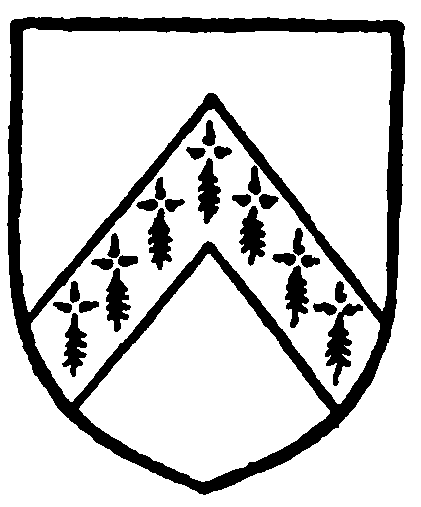
Lodbroke. Azure a cheveron ermine.
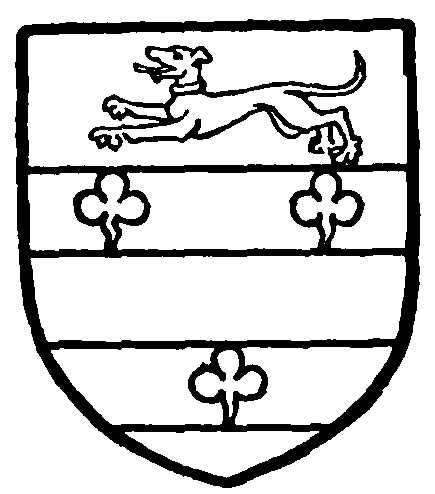
Palmer. Argent two bars sable with three trefoils argent thereon and in chief a running greyhound sable collared or.
In addition to the knight's fee held of the Earls of Warwick by the Lodbrokes there was a fraction of a fee held of them in Ladbroke. This may be the 3 virgates held of Turchil by Gilbert in 1086, as it first appears as 3 virgates in Ladbroke held in 1226–8 by Henry Boscher by serjeanty of keeping one of the king's brachet hounds, and was then worth 15s. yearly. (fn. 52) In 1235 Henry Boscher was holding one-fifth fee of the Earl of Warwick. (fn. 53) He must have died not long after this date as his heirs are entered as holding a half-fee in 1242, (fn. 54) one of those heirs being possibly Roger de Sutham who held one-fifth fee here in 1268. (fn. 55) Henry Boscher's daughter Maud, however, gave her share of her father's lands in Ladbroke to the Hospital of St. John outside the East Gate of Oxford, (fn. 56) to whom one Warin de Greneburgh also gave land with a house and croft here. (fn. 57) In a list of fees of the earl c. 1320 the master of the hospital is said to hold a quarter fee of the fee which Thomas de Arderne once held of the earl 'and it is called Boscref'. (fn. 58) In 1350 Adam de Lodbroke, master of the hospital of St. John, leased the lands in this parish to William de Catesby at 40s. (fn. 59) —apparently much more than they were worth. (fn. 60) The hospital and its possessions were subsequently absorbed by Magdalen College.
The Cistercian abbey of Combe received a number of small grants of land in Ladbroke, many of them from Henry (son of William) Boscher. (fn. 61)
A manor of Ladbroke was granted, with that of Fenny Compton (q.v.), by John son and heir of Ralph Aylesbury to Alan Percy, clerk, in 1523. (fn. 62) But this manor or grange had apparently already been given to the Abbey of Combe by Margaret widow of Sir Robert Bellingham (fn. 63) and daughter and heir of John Beaufitz, who had bequeathed to her in 1489 his 'manor of Ladbroke called Wynteners'. (fn. 64) In return for the gift the monks were to receive her into the fraternity of the Cistercian Order and to maintain one of their number at the University of Oxford. Alan Percy, who was chaplain to Cardinal Wolsey, brought a number of suits in Chancery against Margery and Oliver and Robert, successive Abbots of Combe, (fn. 65) but these do not throw much light on the history of the manor and did not enable him to get possession of it. In 1535 the abbey's property in this parish was producing £4, (fn. 66) and early in 1538 the abbot and convent let the grange of Ladbroke with its demesnes to William Alybonde, Alice his wife, and John his son for 60 years at a rent of £4. (fn. 67) Shortly afterwards the abbey was suppressed and in 1539 its estates were conveyed to the Duchess of Richmond for her life. After her death the manor or grange of Ladbroke was among the estates acquired by Anthony Throckmorton in 1558, (fn. 68) and this was sold by his son John to Sir Robert Dudley in 1598, (fn. 69) after which it descended with the main manor.
Church
The church of ALL SAINTS stands on the west side of the Coventry-Banbury road, in the centre of a small churchyard with three large yew trees on the south side and entered by a lych-gate erected in 1884. The 13th-century church, which probably consisted of a chancel and nave, was entirely rebuilt in the 14th-century with north and south aisles and west tower. All that remains of the earlier church is the lower portion of the chancel. Late in the 15th century the nave and chancel were raised and clearstory windows inserted. It was restored and reroofed in 1876 by Sir Gilbert Scott.
The east wall of the chancel is built of small limestone rubble, with brown sandstone dressings, and has a plinth of two splays and low angle buttresses with gabled heads. Above the sill level the wall has been rendered with cement and the gable rebuilt with red bricks faced with cement; a projecting splay shows the line of the 16th-century roof. The window has three pointed lights under a pointed arch of two splayed orders dying out on splayed jambs, and a hoodmoulding with head stops. The south side has a central buttress, probably added when the clearstory was built. There are three windows to the clearstory, each of three pointed cinquefoil lights, set in deep splays with flat heads. Below there is a similar window to the east, and to the west a modern window of three trefoil lights with a label. On the west side of the buttress there is a narrow doorway with an ogee head under a stopchamfered segmental arch. The wall west of the buttress has been refaced, omitting the plinth. The north side has three clearstory windows corresponding with those on the south, with an offset at sill level formed by the original wall-head. The wall between these windows has been rendered with cement. Below, on either side of the buttress, there are twin lancet windows of one splay and a rectangular low-side window underneath the most westerly light.
The south aisle has been extensively refaced with a mixture of roughly coursed limestone interspersed with squared blocks of brown sandstone and has a plinth of two splays and a buttress at each end. The south wall is lighted by a window of three ogee-headed trefoil lights of two splayed orders, with cusped spandrels, a flat head and label-moulding to the east, and by a similar one of two lights, to the west. Between these windows is the porch, which has been almost entirely rebuilt, the front of ashlar, the sides of coursed rubble, with modern stone seats on either side. The entrance has a pointed arch with continuous mouldings and a hood-mould with return ends. In the apex of the gable there is an incised stone sundial dated 1611, with a carved head corbel built in immediately below, and inside the porch large 14th-century carved head corbels have been built into the wall, two on each side. (fn. 70) The doorway, which is modern except for the two lower courses of the jambs, has a pointed arch of one continuous splay. The east wall has been partly refaced and the plinth omitted; it has a modern two-light window with a flat head and a label with return ends. The west side has a window of three trefoil lights with a hollow-splayed four-centred arch. The lean-to roof is covered with lead and the clearstory has three windows of two trefoil lights set in deep splays with flat heads. The north aisle and clearstory are similar, but without a porch and the doorway is blocked. The west wall has been refaced and the plinth omitted. On the east wall there are traces of the line of the original steep-pitched chancel roof.
The tower is built of alternate bands of white limestone and brown sandstone with a plinth of three splays; it is not divided by string-courses, but has a weathered offset at the sill level of the belfry window. There are buttresses to the angles, those on the west being diagonal. They rise in five weathered stages, the lower stages having trefoiled gablets with grotesque head-stops, and terminate in pinnacles at each corner of an embattled parapet. The tower is crowned with a tall, slender, octagonal spire having a floriated finial and weather-cock. At the base and midway there are canopied spire lights of two trefoil lights with pointed arches, quatrefoil piercings, crockets to the gables, with head-stops, and terminating in poppy heads. On the west side, in the lower stage, is a window of two trefoil lights and tracery with a pointed arch of two orders, the inner a splay and the outer a shallow wavemoulding, and finished with a hood-mould and headstops. The belfry windows are of a similar type. In the string-course at the base of the parapet there are two gargoyles on each face. On the south side there are two loop-lights to the tower staircase, and a rectangular light to the ringing-chamber, with a clock dial above.
The chancel (32 ft. 3 in. by 18 ft.) has a modern tiled floor with two steps to the altar, plastered walls, and a modern low-pitched roof with moulded tiebeams, purlins, and wall-plates of early-16th-century date. The east window has splayed reveals with a segmental-pointed rear-arch. On the south the clearstory windows have splayed reveals with flat heads, and, below, the eastern window is similar. The modern window to the west is inserted in an earlier recess with a stop-chamfered segmental arch. Between these windows the narrow doorway has a plain ogee head. At the east end there are sedilia with three seats, having moulded cinquefoil ogee heads with crockets, poppy-head finials and head-stops over the moulded mullions dividing the seats; it is entirely a modern restoration except for the two mullions. In the centre there is a wall monument of white marble with coloured marble pilasters supporting an interrupted pediment, with a coat of arms to William Palmer, lord of the manor, died 1720, and his wife Mary, died 1729. In the east clearstory window there are three panels of late-15th-century stained glass representing St. Cuthbert with the head of St. Oswald, St. Chad, and St. Giles with his hind. All the remaining glass is modern. On the north the clearstory corresponds with the south. The window to the east has wide-splayed jambs with a segmental-pointed arch embracing the two lancet windows, below is a badly mutilated recess 3 ft. wide with a moulded pointed arch and traces of a carved gable flanked by pinnacles, which may be an Easter Sepulchre. The window to the west is similar to the one to the east, but the recess is carried down to include the low-side window. The organ is placed between these two windows.
The nave (46 ft. 4 in. by 15 ft. 2 in.) has a modern tiled floor and open trussed rafter roof, and the walls are plastered. The clearstory windows on the south have splayed jambs with modern flat-shouldered rear-arches, and on the north splayed jambs with square heads. Both arcades are of three bays with pointed arches of two splayed orders supported on octagonal pillars with moulded capitals and bases of one splay. The responds repeat the orders of the arches with similar moulded capitals. The chancel arch follows the arcade in detail, but the springing is at a slightly higher level. The tower arch has widely splayed jambs with a pointed arch of four splayed orders on the nave side, the inner going down to the floor and the remainder dying out on the splayed jambs; the tower side has three splayed orders dying out on the tower walls. Above this arch is the line of the earlier roof. The pulpit, placed on the north side of the chancel arch, is a modern octagonal one with traceried panels on a stone base. Opposite the south door there is an early-17th-century wooden chest, bound with iron straps with two locks, a centre hasp, and two additional hasps fitted later.
The south aisle (43 ft. 7 in. by 9 ft. 2 in.) has a tiled floor, plastered walls, and a modern lean-to roof. The 15th-century windows are inserted in 14th-century recesses with widely splayed jambs and chamfered segmental rear-arches. The west window, which is a late-15th-century insertion, has a four-centred reararch. In the south wall there is a modern tomb recess with a chamfered segmental arch, built to accommodate an effigy of a priest in vestments, with his hands clasped in prayer, which was found under the floor of the chancel during the 1876 restoration; it is reputed to be John de Pavely, rector of Ladbroke (1298–1303) but is probably later. The font, placed near the south door, is modern.
The north aisle has similar window recesses, floors, and roof as the south aisle. The blocked north door has a chamfered segmental rear-arch.
The tower (11 ft. 6 in. by 8 ft. 11 in.) is paved with memorial slabs, one a large slate slab to Edward Rayney, with a coat of arms, who died 1699. In the north wall there is an aumbry with an ogee head and two 18th-century mural tablets. The window has a deep, square recess with a head consisting of a series of four plain pointed arches. The south-west angle is splayed for the circular tower staircase and has a narrow door with an ogee head. A modern traceried screen has been placed across the tower arch to form a vestry.
The five bells were recast by J. Taylor & Co. 1873. (fn. 71)
The registers begin in 1559.
Advowson
In 1086 there was 'a priest' among the tenants on Hugh de Grentemaisnil's estate, (fn. 72) and 'a priest', possibly identical, held 1 virgate under Turchil. (fn. 73) The advowson of the rectory, which was valued at £10 in 1291 (fn. 74) and at £13 10s. in 1535, (fn. 75) remained attached to the manor until about 1925, when Capt. A. H. Wheeler was patron, but shortly after this date the advowson was conveyed to the Bishop of Coventry. (fn. 76)
Charity
The Town Lands Charity was founded by deed of feoffment dated 5 August 18 Elizabeth and is now regulated by a scheme of the Charity Commissioners dated 3 September 1901. The scheme provides that the income of the charity shall be divided into the Ecclesiastical Branch and the Non-ecclesiastical Branch, under the administration of two separate bodies of trustees. The scheme appoints the rector and churchwardens for the time being of the parish of Ladbroke to be the trustees of the Ecclesiastical Branch, and provides that the trustees of the Non-ecclesiastical Branch shall, when complete, consist of three representative trustees and one co-optative trustee. The scheme further provides that the two bodies of trustees acting together shall be the Estate Trustees for the management of the estates and property of the charity, and that subject to certain payments the yearly income of the charity shall be divided equally between the two branches by the Estates Trustees. The endowment of the charity consists of 16 a. 11 r. of land at Ladbroke, producing an annual income of £24.